1979 CM400A Winter Rebuild [COMPLETE]

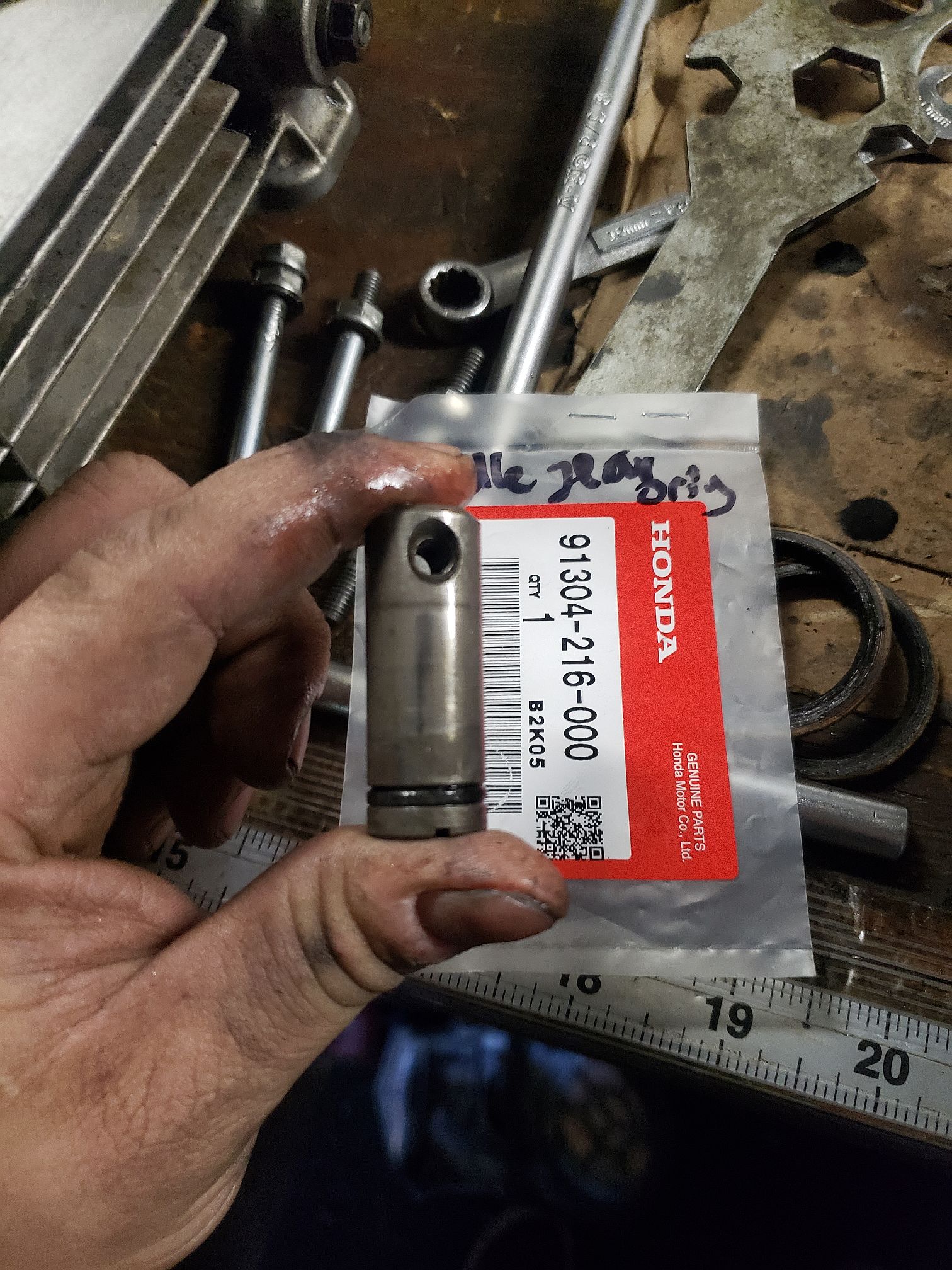
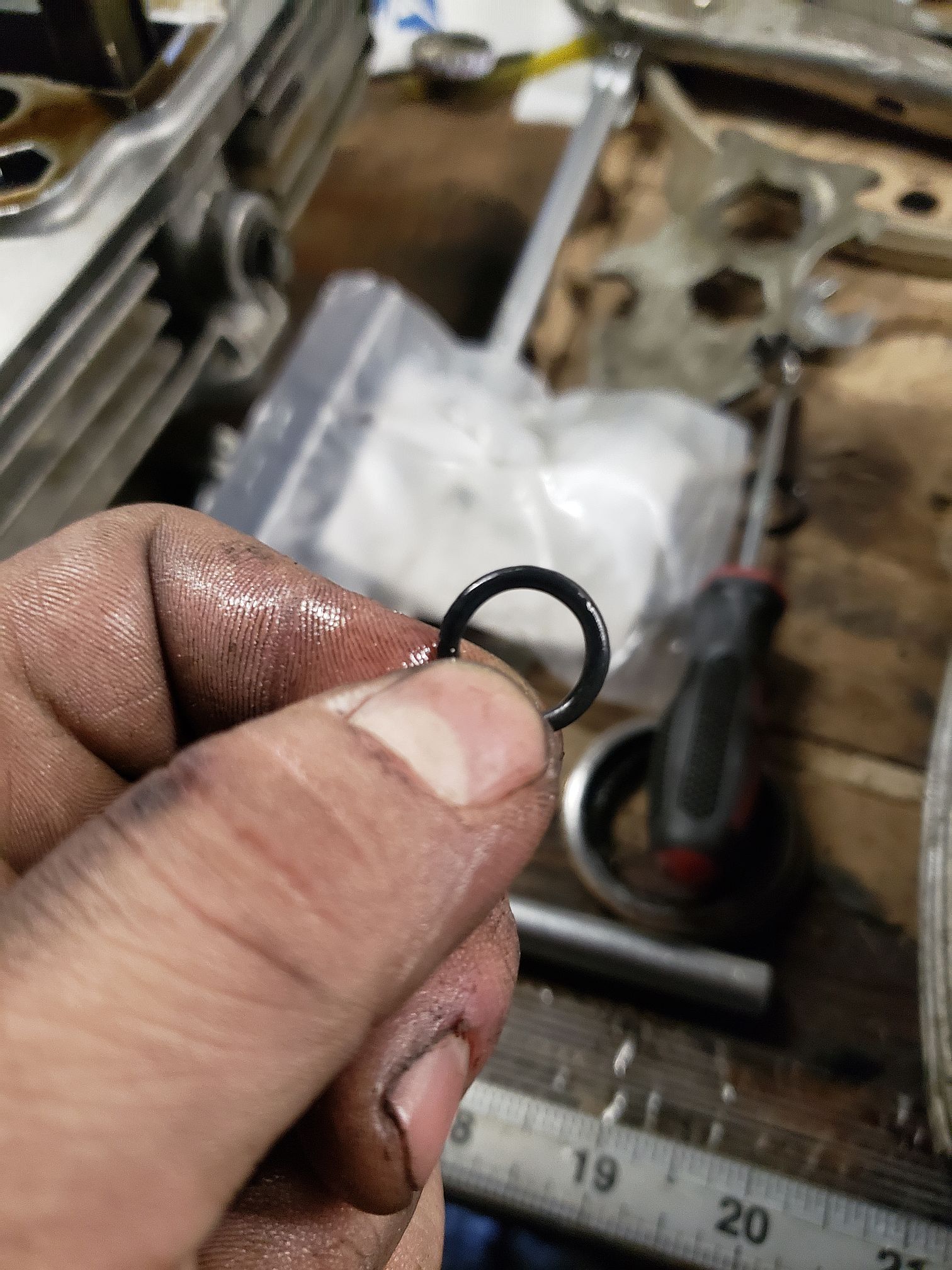
Upon checking my spreadsheet I did not order those o-rings. Funny, the parts fiche only shows one, but there's two and they're the same size. It's NLA, but can be found. Says it's a 60 x 1.4. I'll see what MCM has. It's just to keep water and oil out, so being 1.5 isn't going to hurt it.
Look back at my post just above. There is a link in there now that will get to the thread I did about the O-ring. I fat fingered the typing on my tablet and posted before I had the link inserted, so I just now edited. I believe the part number and source is near the beginning.
 
I saw DSS has them, but ironically it's cheaper to get those MCM replacements. However, I didn't look at your thread yet. I will after this post.

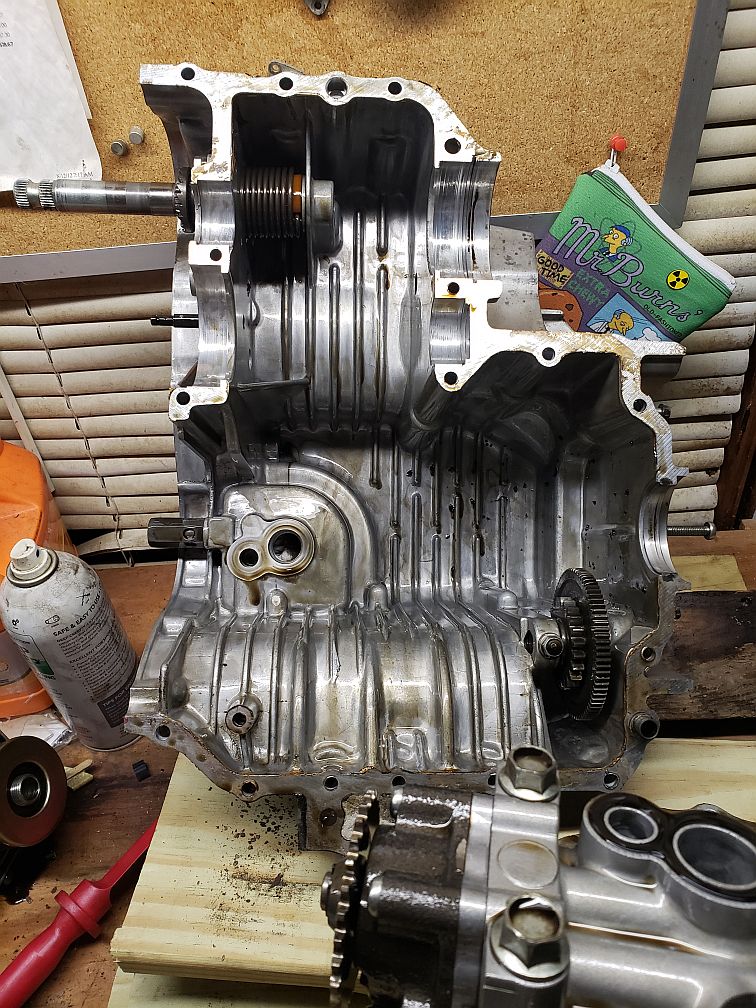
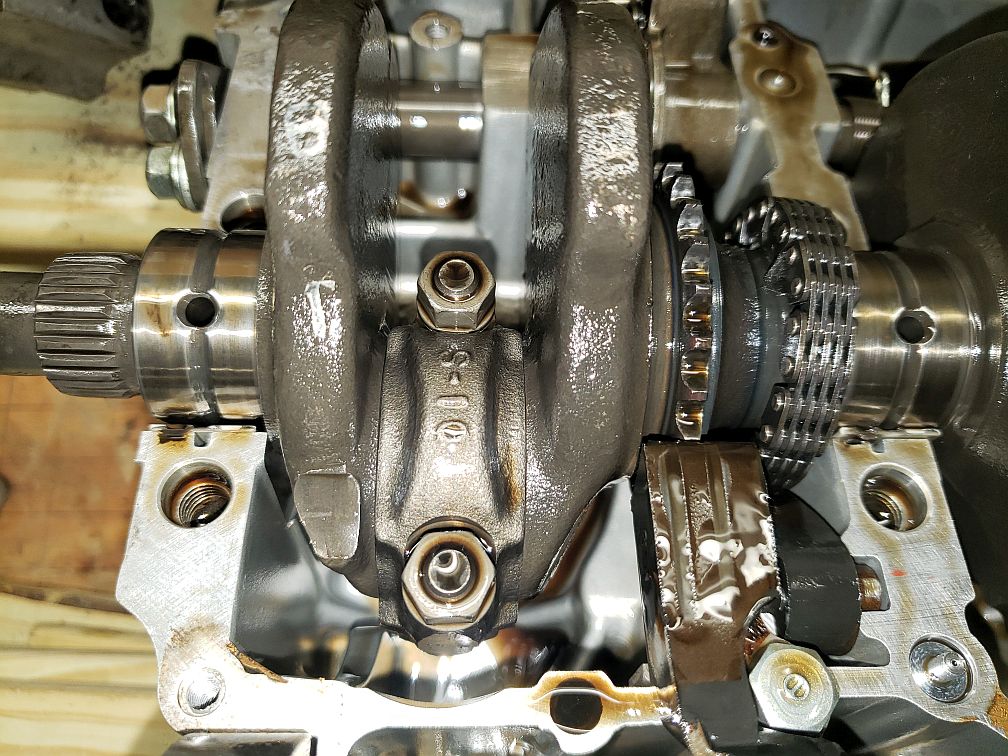
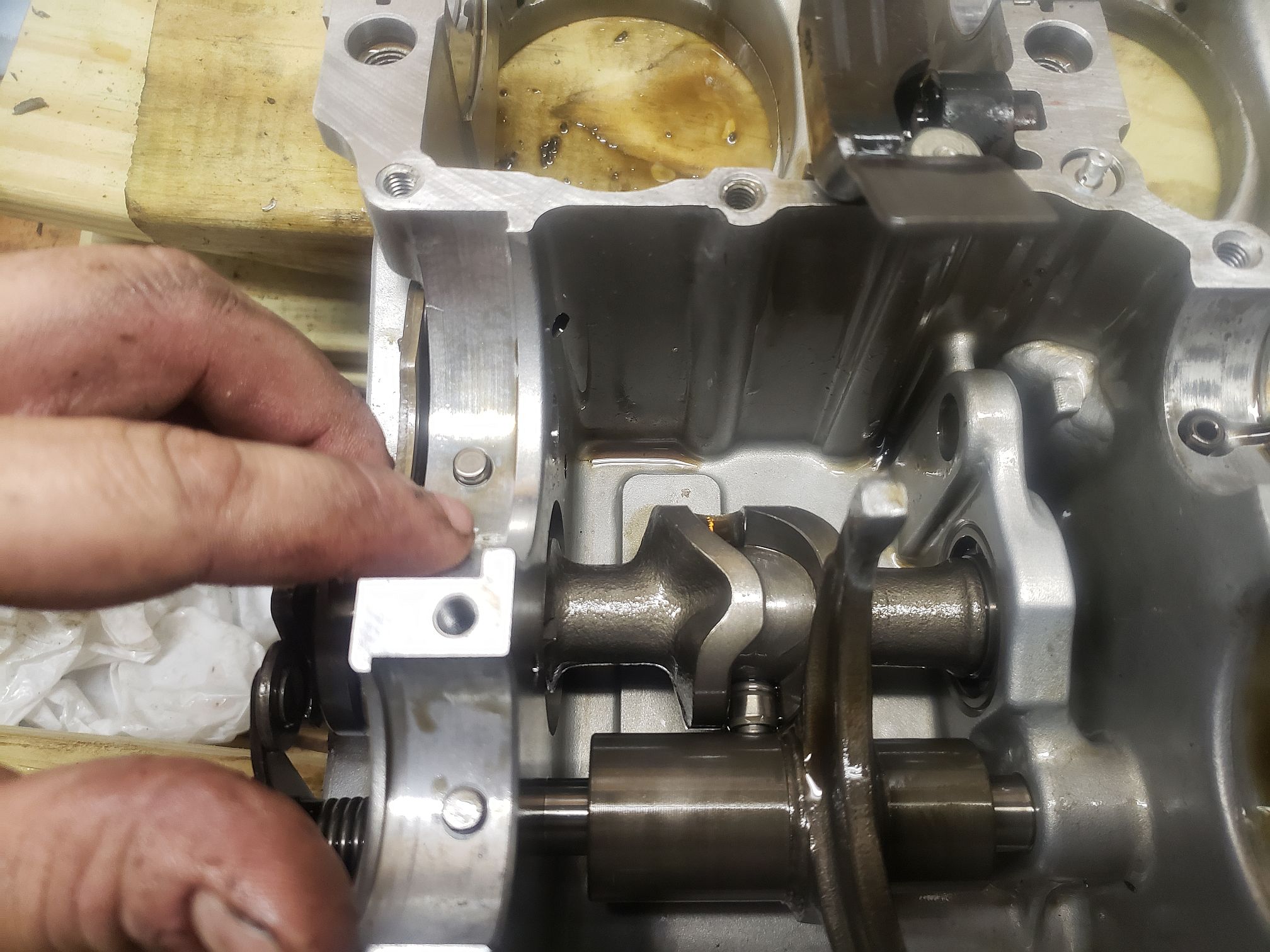
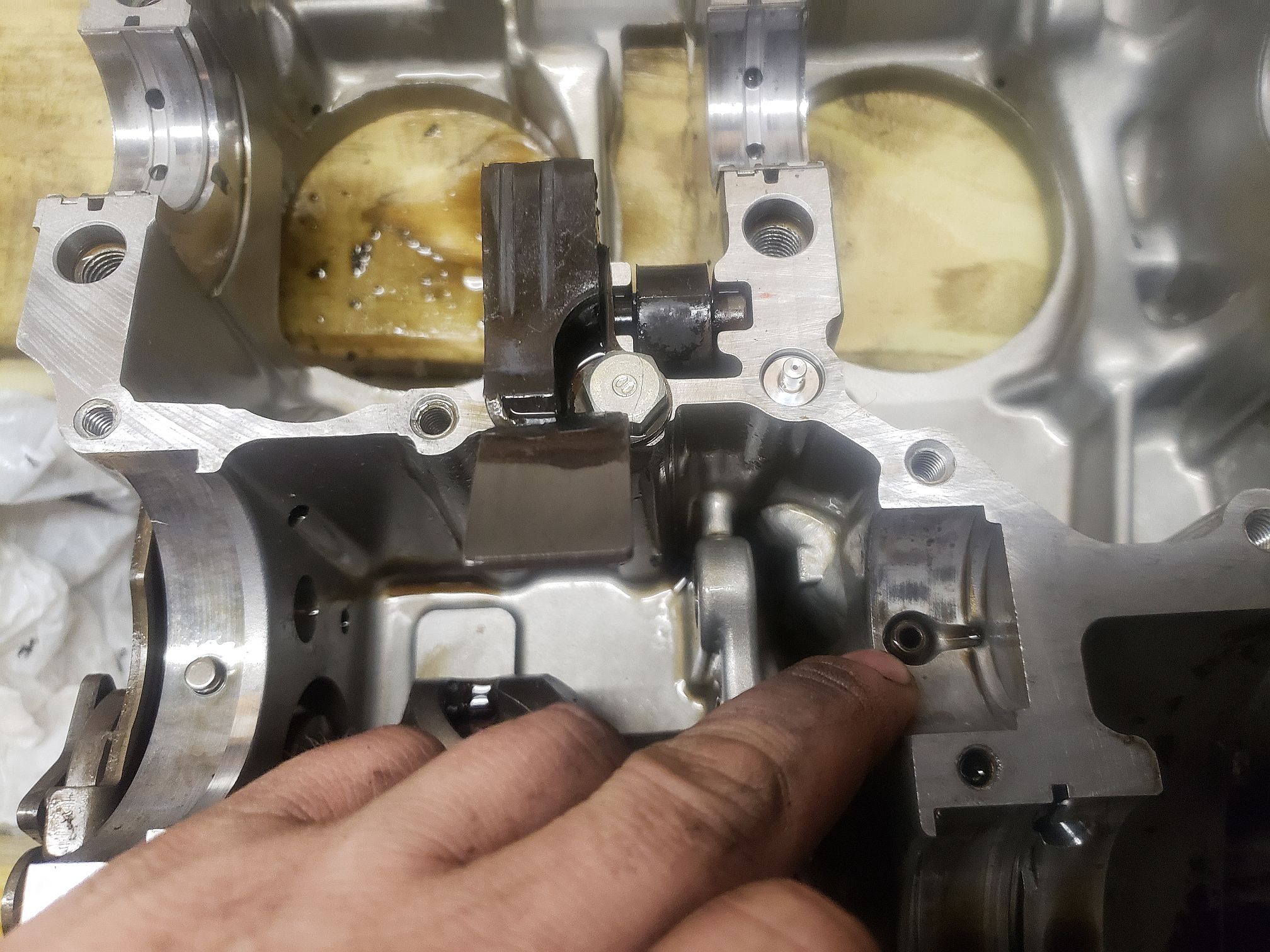
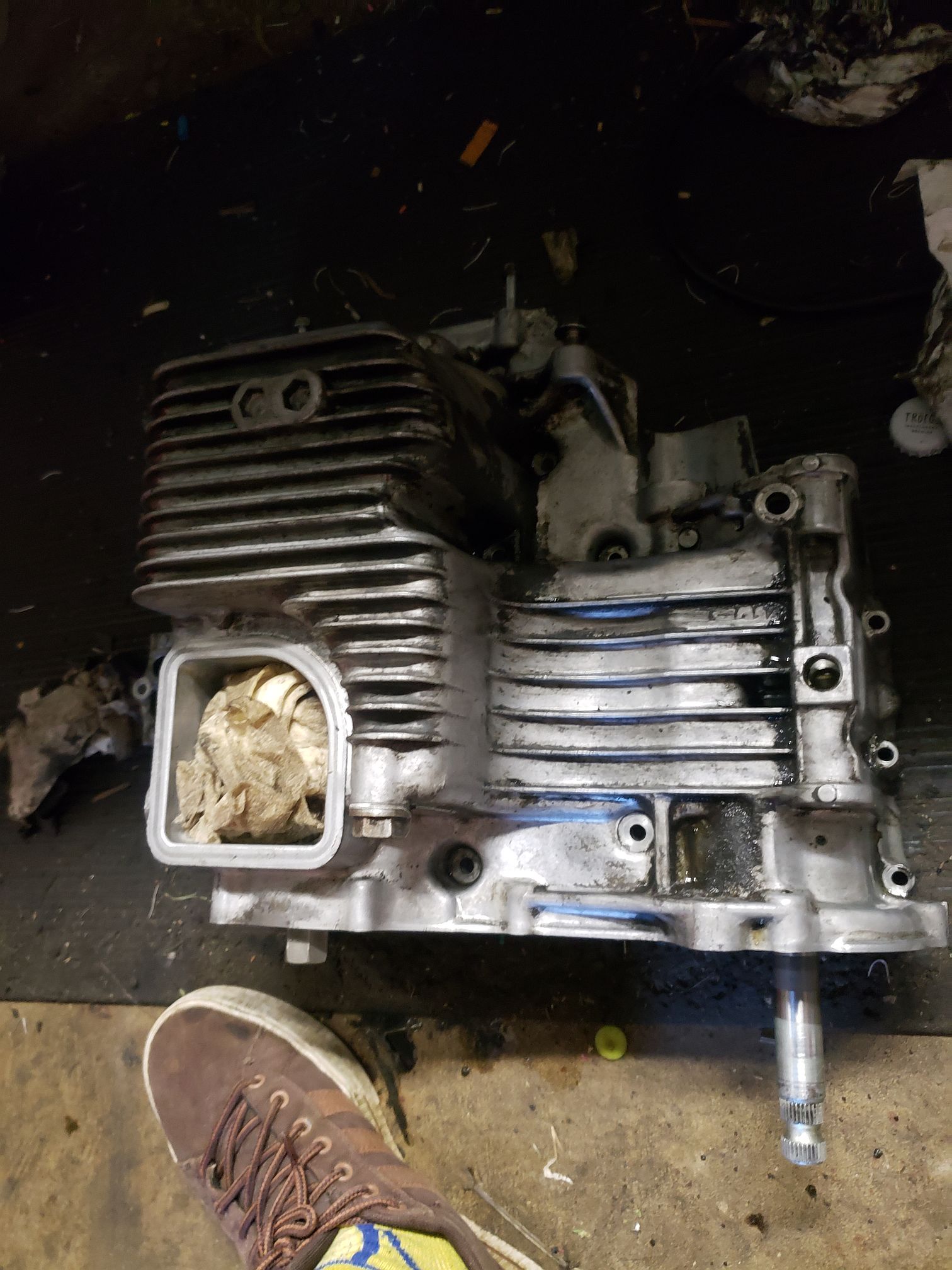
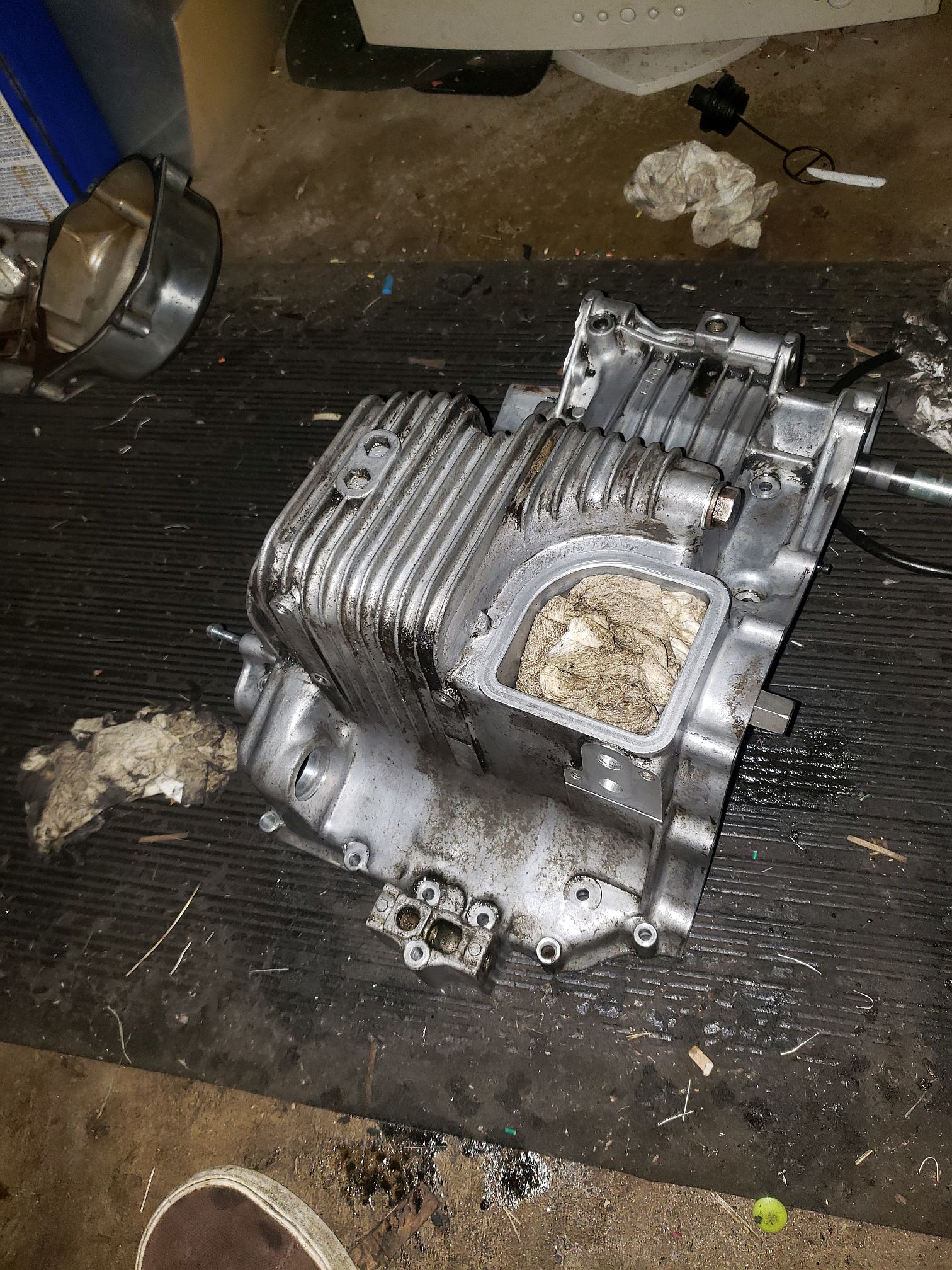
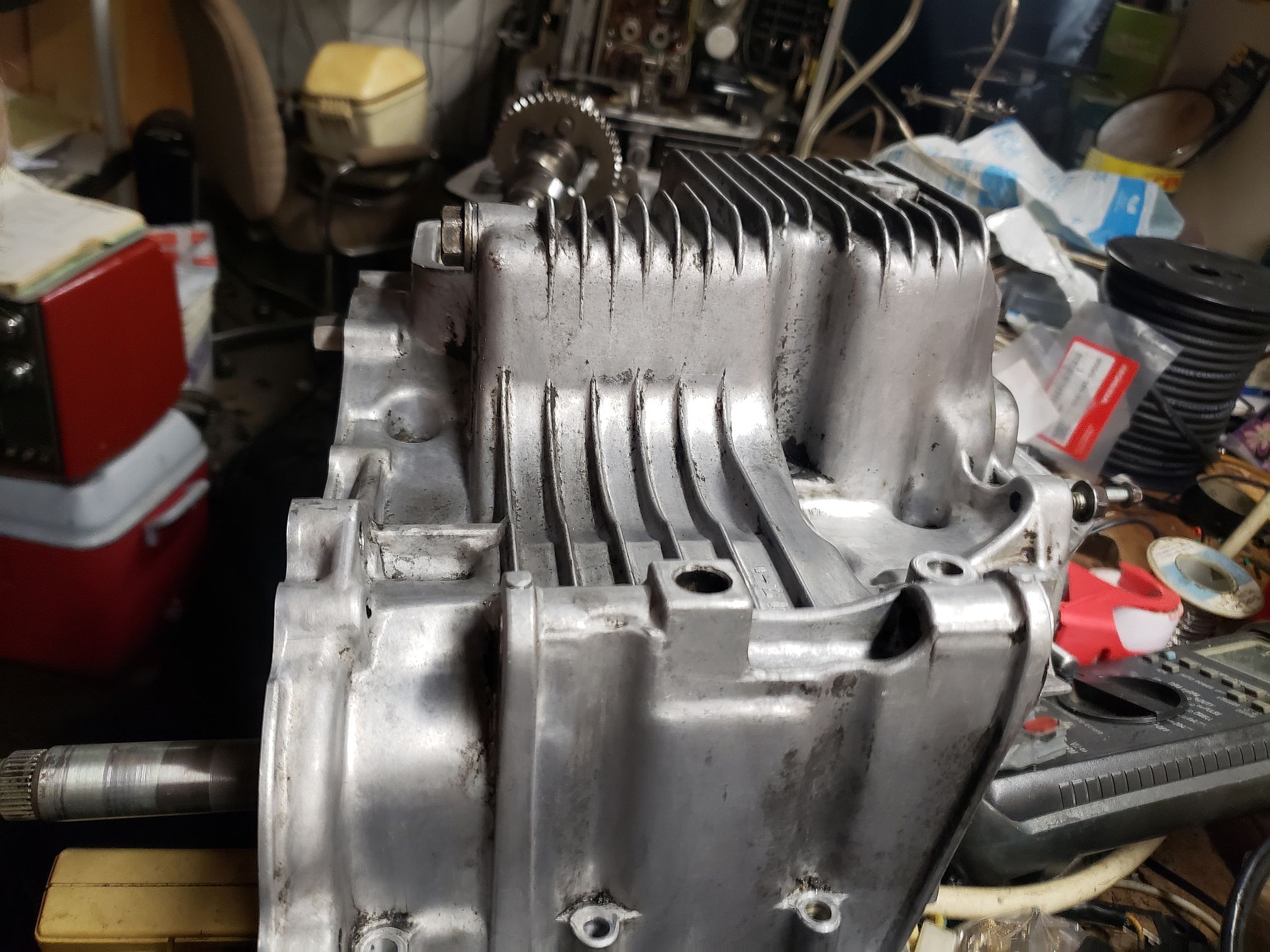
Finally got the crankcase split. It was annoying and tought. I reached out to Mike on some tips. He suggested using the transmission or rotor shaft as a pry point for leverage with a pry bar. What I did was put an old sprocket on the trans shaft, wrapped the pry bar with a bunch of towels and it popped right off. Nice trick.

Upon initial inspection some rubber bits, from the rubber balancers and possibly the cam chain guide no doubt. Both are already in my bucket of parts to be replaced.

20231014_092418.jpg


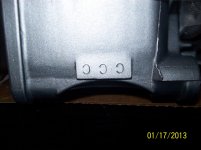
B1 on the left (upside down)
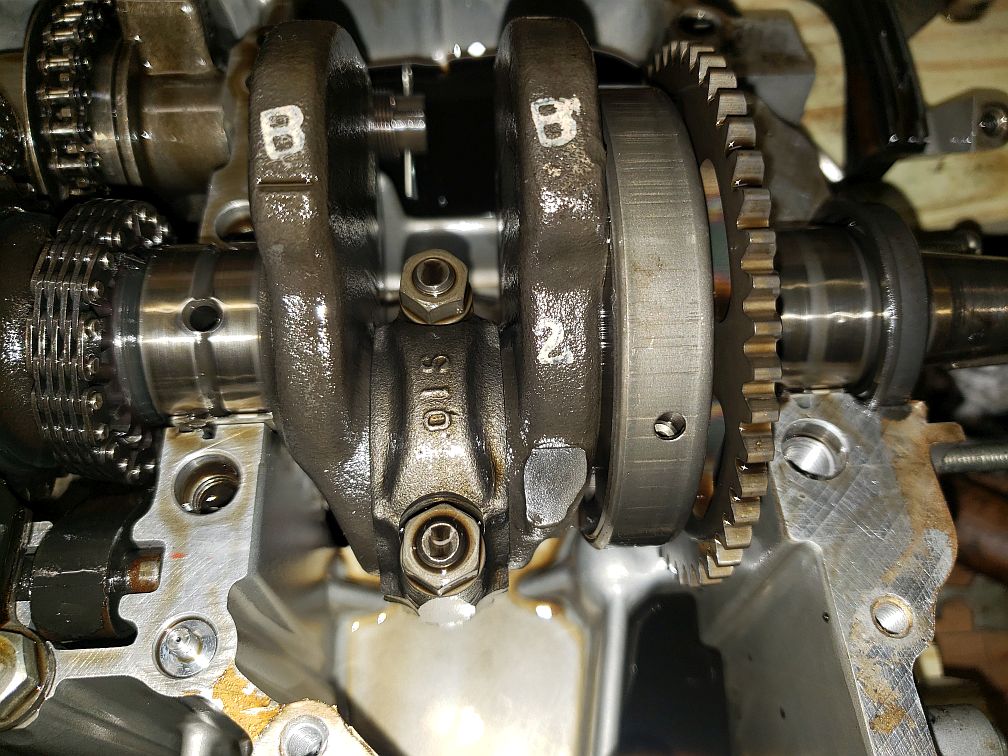
20231014_092900.jpg


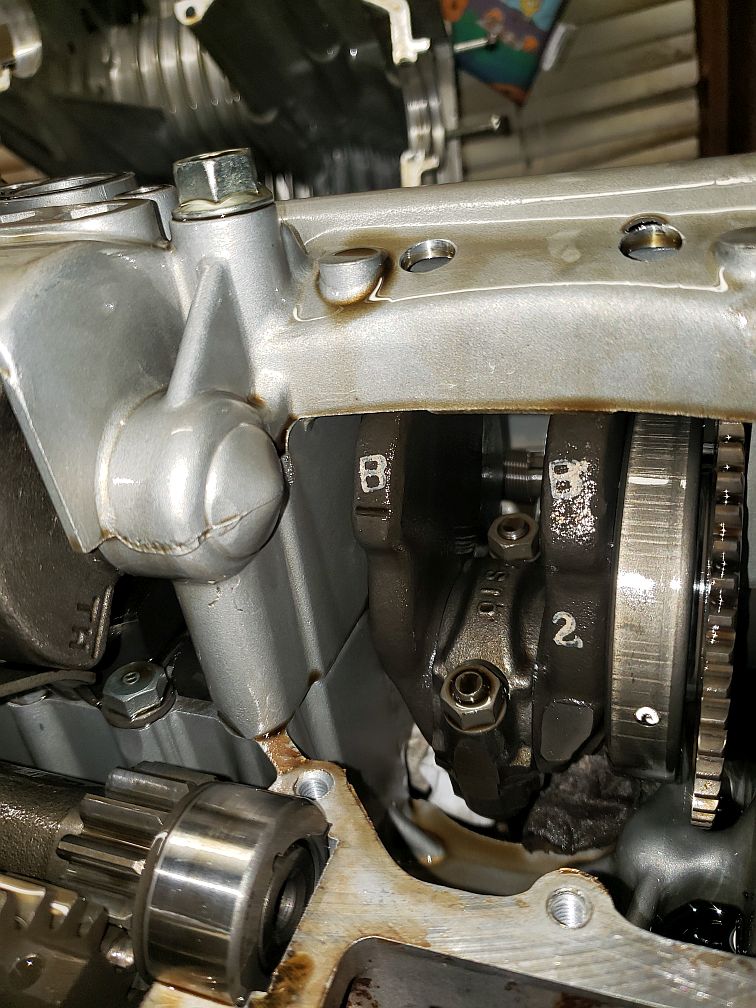
B2 on the right (again upside down)
20231014_092904.jpg


And I believe Bill H mentioned it but the back of the case will also show this. All said "BBB".

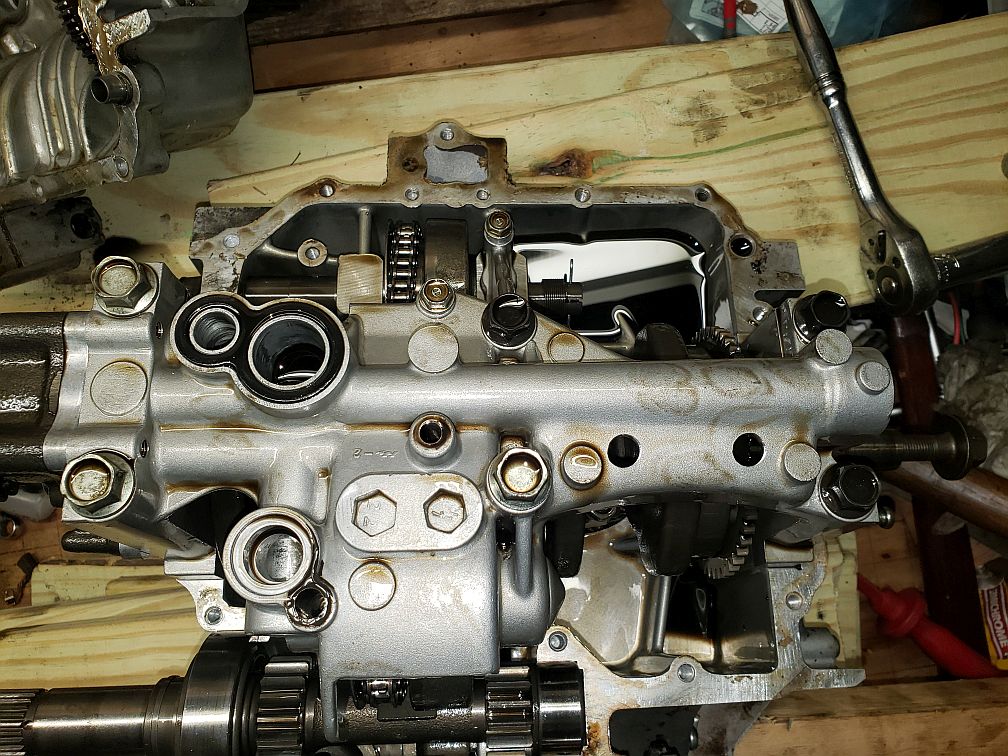
Anyways, remove the oil strainer, two 10mm head bolts, then there's six 14mm head bolts, two 10mm head bolts, and a flat head shaft on the left side for the front balancer that have to be removed. Do it an X pattern. The 14s will require the use of a cheater bar.
20231014_093105.jpg


Loosened and showing location of the balancer shaft. Notice the groove, this is where that one 10mm goes from the top from the oil strainer.
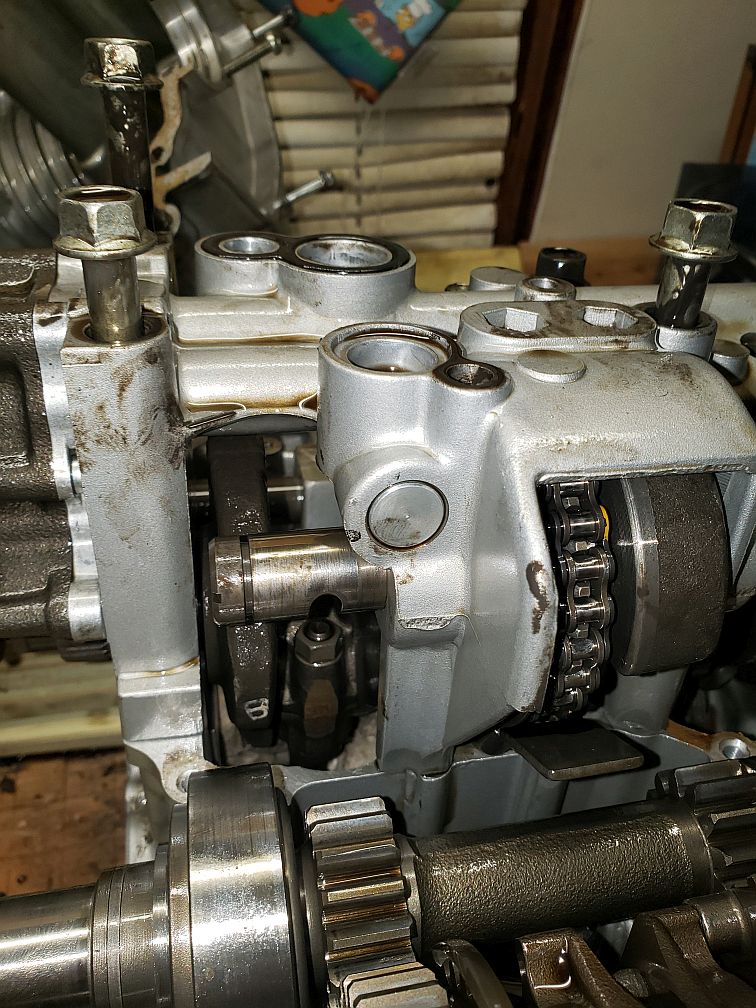
20231014_093645.jpg


Lift carefully and move the front balancer forward out of the way. Wear looks OK.
20231014_093905.jpg

20231014_093908.jpg


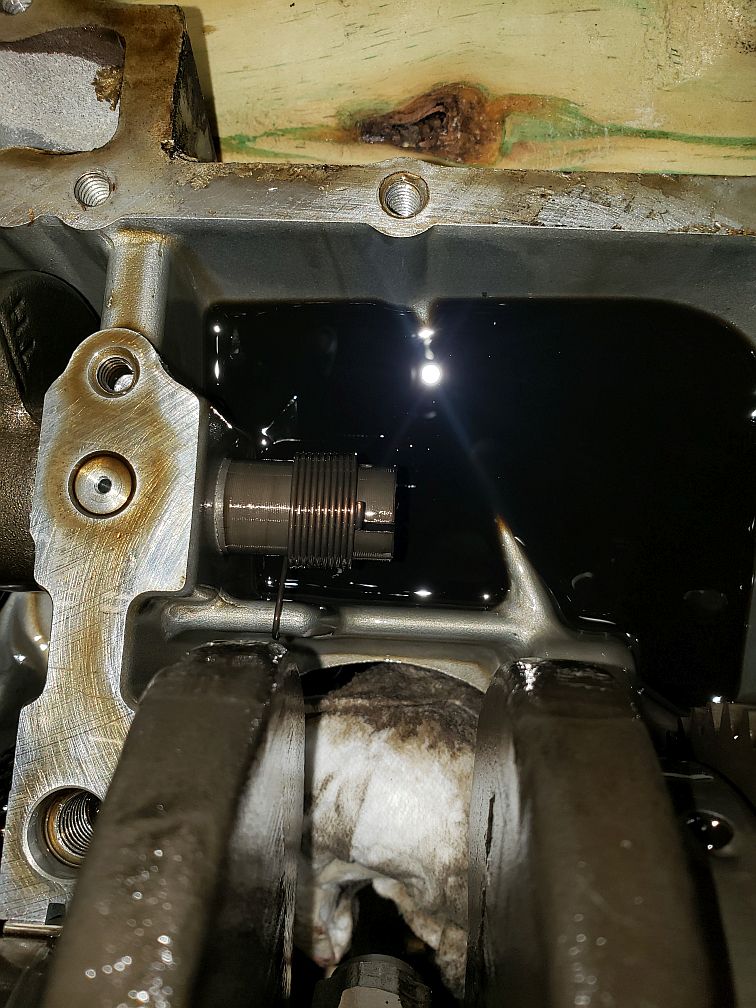
To get the rest of the balancer assembly out remove the 10mm on the left for the "auto adjuster" part of the balancer adjustment. Remove the circlip, and the spring. Picture of the orientation of the spring.
20231014_094019.jpg


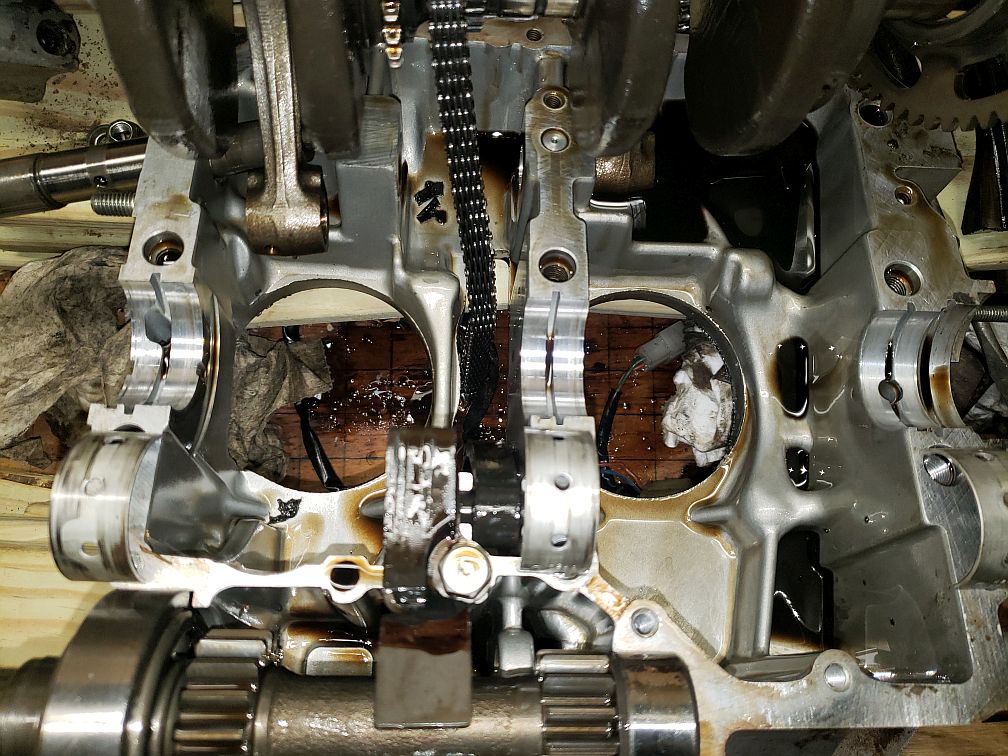
Opposing side the crankshaft, still looks good to me.
20231014_094356.jpg


The bearings are all brown. Do not be alarmed by the look of the bearings. Most of it is oil stains that wipe off. No scoring and I don't feel anything with my fingernail so I'm going to leave it be. And of course, the brown ones are the only ones that are NLA. Makes me wonder if that was the most common size at the time.
20231014_094618.jpg
 
Last edited:
I'm sure you know this and I'm not trying to nit-pick, but the 10mm and 14mm bolts you mention are actually 10mm and 14mm-headed bolts (6mm and likely 10mm threads). Can be confusing for future readers.
 
That makes me appreciate the simplicity of a CB/CL/SL 350.
I was thinking the same thing while looking at all the stuff packed into that bottom end. Nothing to do with the choice of plain bearings, but the whole balancer thing has never appealed to me. Based on the fact that the 360° crankshaft 175s regularly turn 10,000 rpm and when built can turn 12,000 rpm reliably (I know from personal experience), I guess the 360° crank in the SOHC 400/450s wasn't an issue for longevity considering the miles that Frank's 400A and Jim's 400T have on them.
 
I'm sure you know this and I'm not trying to nit-pick, but the 10mm and 14mm bolts you mention are actually 10mm and 14mm-headed bolts (6mm and likely 10mm threads). Can be confusing for future readers.
Ah ok. I'll revise the post. Thanks for pointing this out.

I was thinking the same thing while looking at all the stuff packed into that bottom end. Nothing to do with the choice of plain bearings, but the whole balancer thing has never appealed to me. Based on the fact that the 360° crankshaft 175s regularly turn 10,000 rpm and when built can turn 12,000 rpm reliably (I know from personal experience), I guess the 360° crank in the SOHC 400/450s wasn't an issue for longevity considering the miles that Frank's 400A and Jim's 400T have on them.
I guess not. I'm quite amazed I got as far as I have. Cam chain would have had to been done regardless. Those link-plate/hy-vo chains are really only good for around 20K-40K from what I hear. Opinions vary, and might also be determined on how often you're actually tightening the chain. I also need to do something about the starter clutch and starter gear. This brings me to some new pictures.

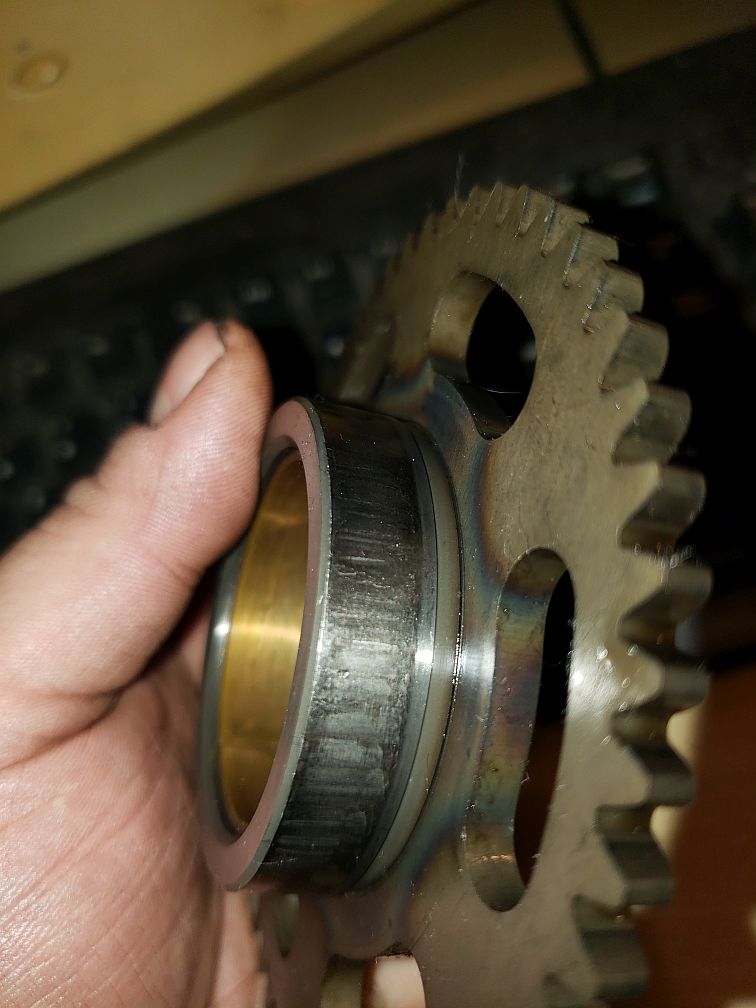
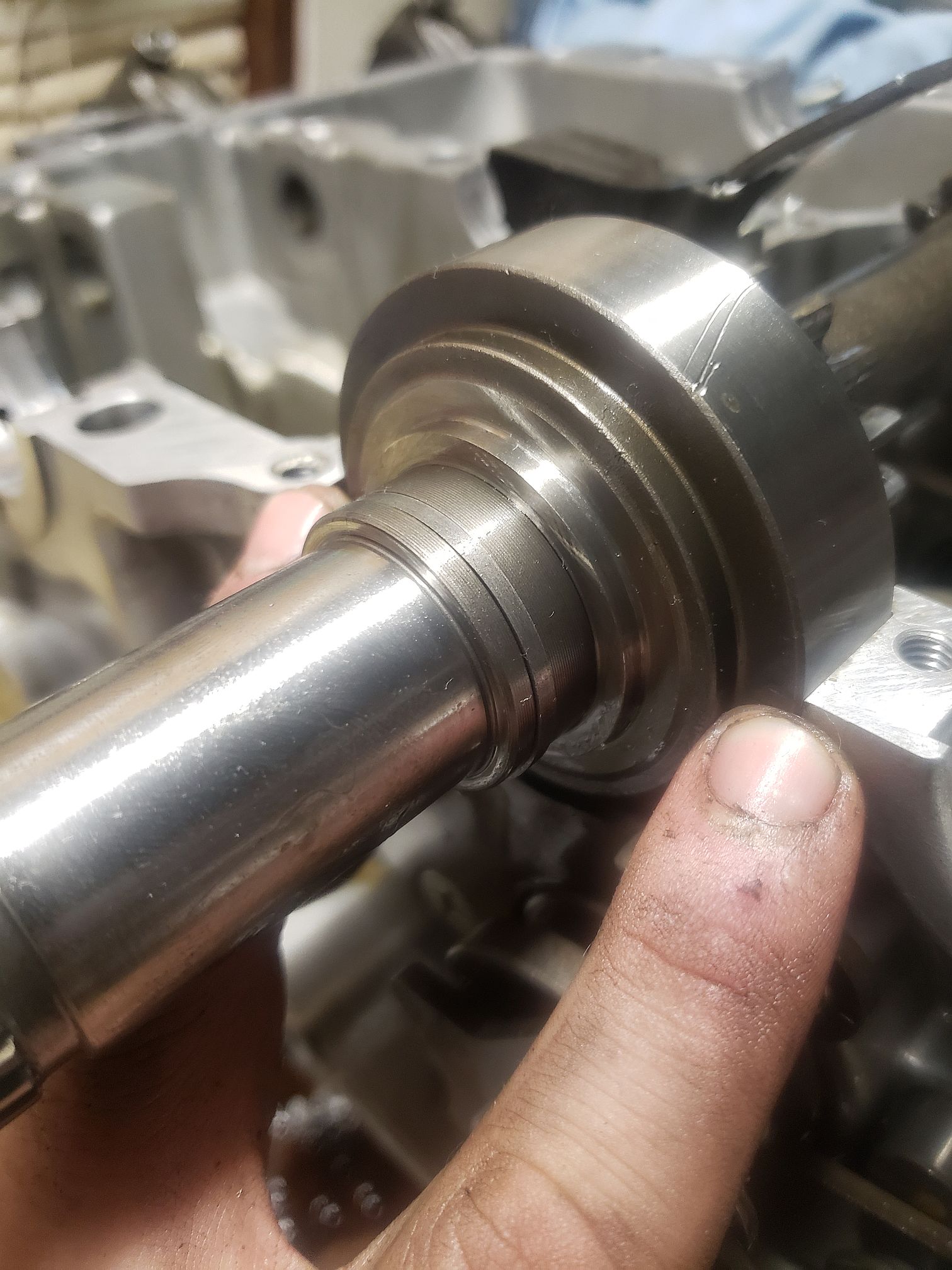
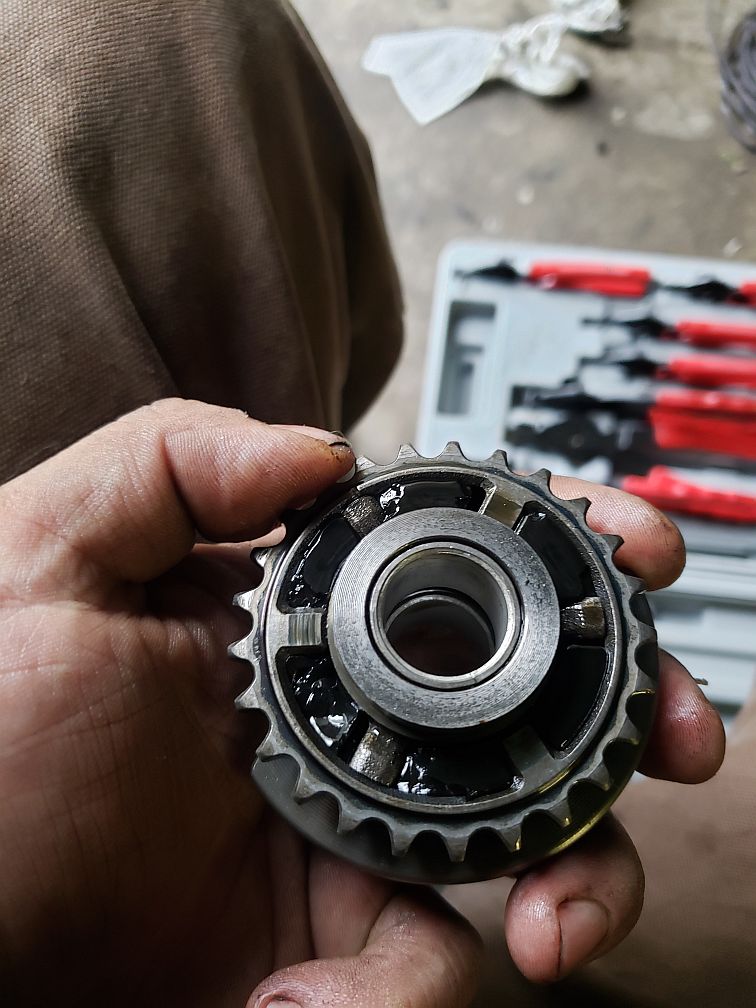
The starter gear itself is junk. There are skips on the outer bushing and I can feel scoring with my finger nail on the inner bushing. Jim mentioned he used a 450 gear. This is fine, because the part number for the 450 gear is actually a superseded part for the 400s. The difference he mentioned was that the older style gear is lightened. Maybe they found this was a bad idea and causing early wear. Who knows?
20231014_103240.jpg

20231014_103248.jpg


Notice that waviness on the outer. I just got done talking with Mike through email and he mentioned this is the issue. That the surface the rollers ride on (the outer) get wavy from wear and from here it starts oscillation in the rollers and escalates. He also mentioned that the scoring on the inside is unimportant.

With that said, I found an eBay one that appears to be in good shape from a 450. Ordered it. We'll see how it is.

In the mean time, I don't know how Jim did this, but the starter clutch itself is held in place with T30 Torx with thread locker. I'm concerned that I won't be able to get them out except with a T-Handle or a cheater bar. If this happens to me, how do I keep the crank steady to even do this? Maybe a vice, but I don't like that idea. The other question is which type of thread locker? The FSM makes zero mention of strength. I assume "blue" or low. Or should I go with medium (forget which colour this is, green?). I think the high strength is probably ridiculous and overkill and will make me mad at myself if I ever have to disassemble it again.
 
Last edited:
Those link-plate/hy-vo chains are really only good for around 20K-40K from what I hear.
Considering older straight 6 and V-8 engines used hy-vo timing chains and they often lasted well over 100,000 miles, I'd say they'd last a long time in a constant oil bath because the car versions ran inside a mostly dry cover getting a little splash now and then.

In the mean time, I don't know how Jim did this, but the starter clutch itself is held in place with hex bolts with thread locker. I'm concerned that I won't be able to get them out except with a T-Handle or a cheater bar. If this happens to me, how do I keep the crank steady to even do this? Maybe a vice, but I don't like that idea. The other question is which type of thread locker? The FSM makes zero mention of strength. I assume "blue" or low. Or should I go with medium (forget which colour this is, green?). I think the high strength is probably ridiculous and overkill and will make me mad at myself if I ever have to disassemble it again.
Jim's been sick the last day or so, he'll have to answer that one since I'm seeing all of this for the first time myself.
 
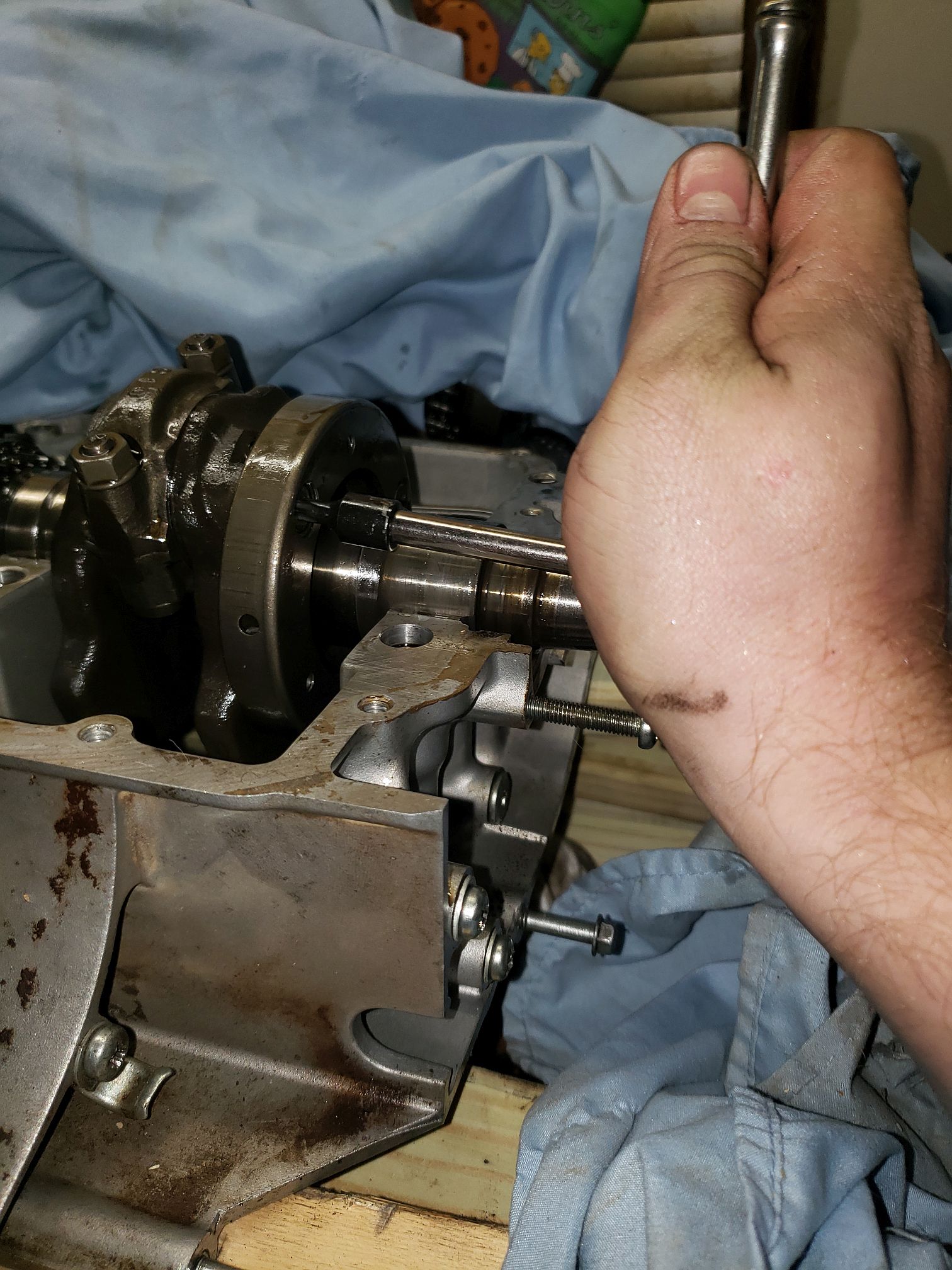
I figured it out. I'm dumb (well not really). To hold the crank in place is easy. Just leave the crank in the top case! From here I was able to get them free. It's a T30 torx (will update previous posts). I had impact grade ones, but it's 1/4" for that size. Would have been nice to have 3/8" in that size. Anyways, they did come loose. What I did was tighten them first until I heard a click, then removed them. Only one was kind of a booger.

20231014_105432.jpg


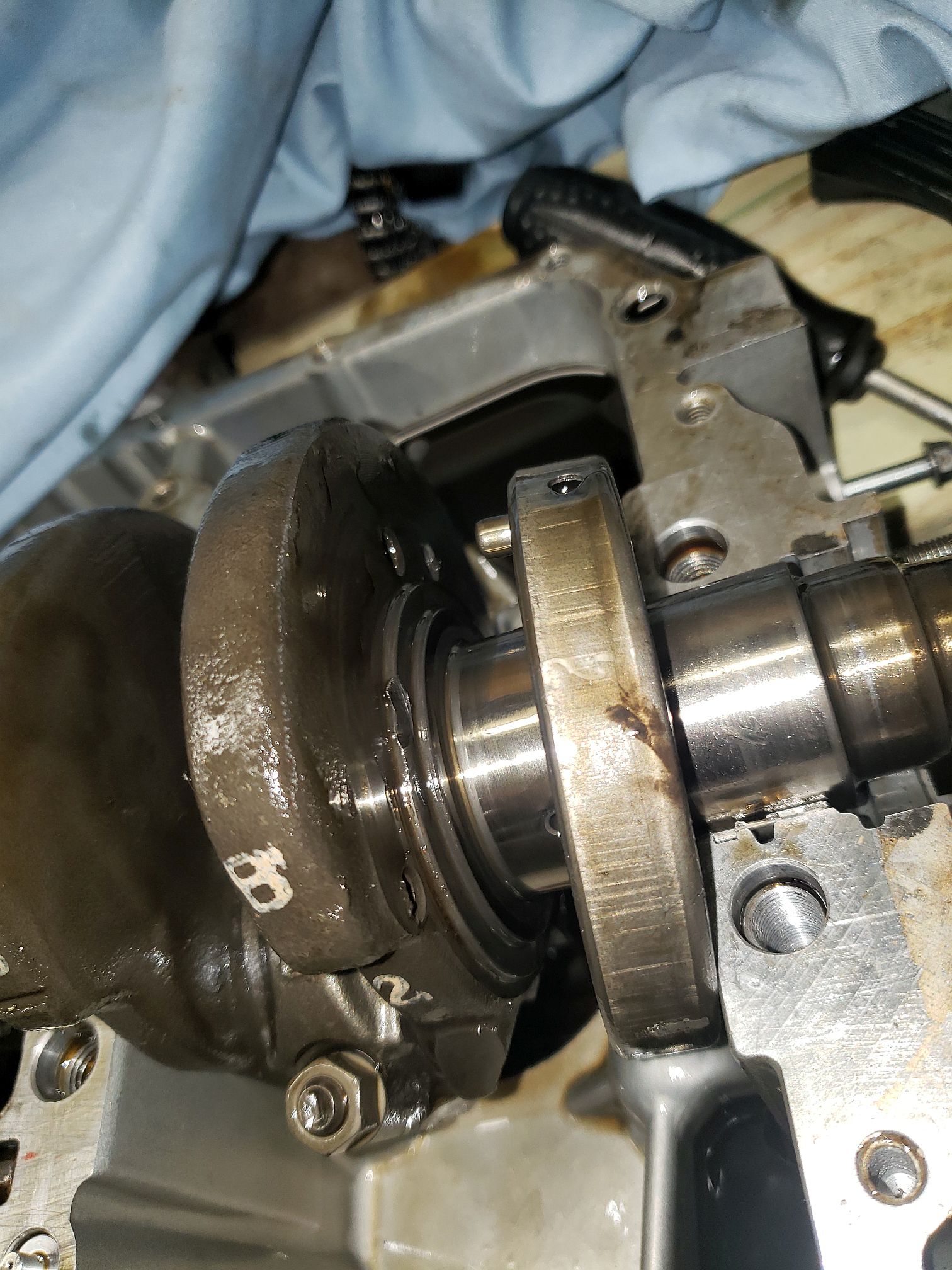
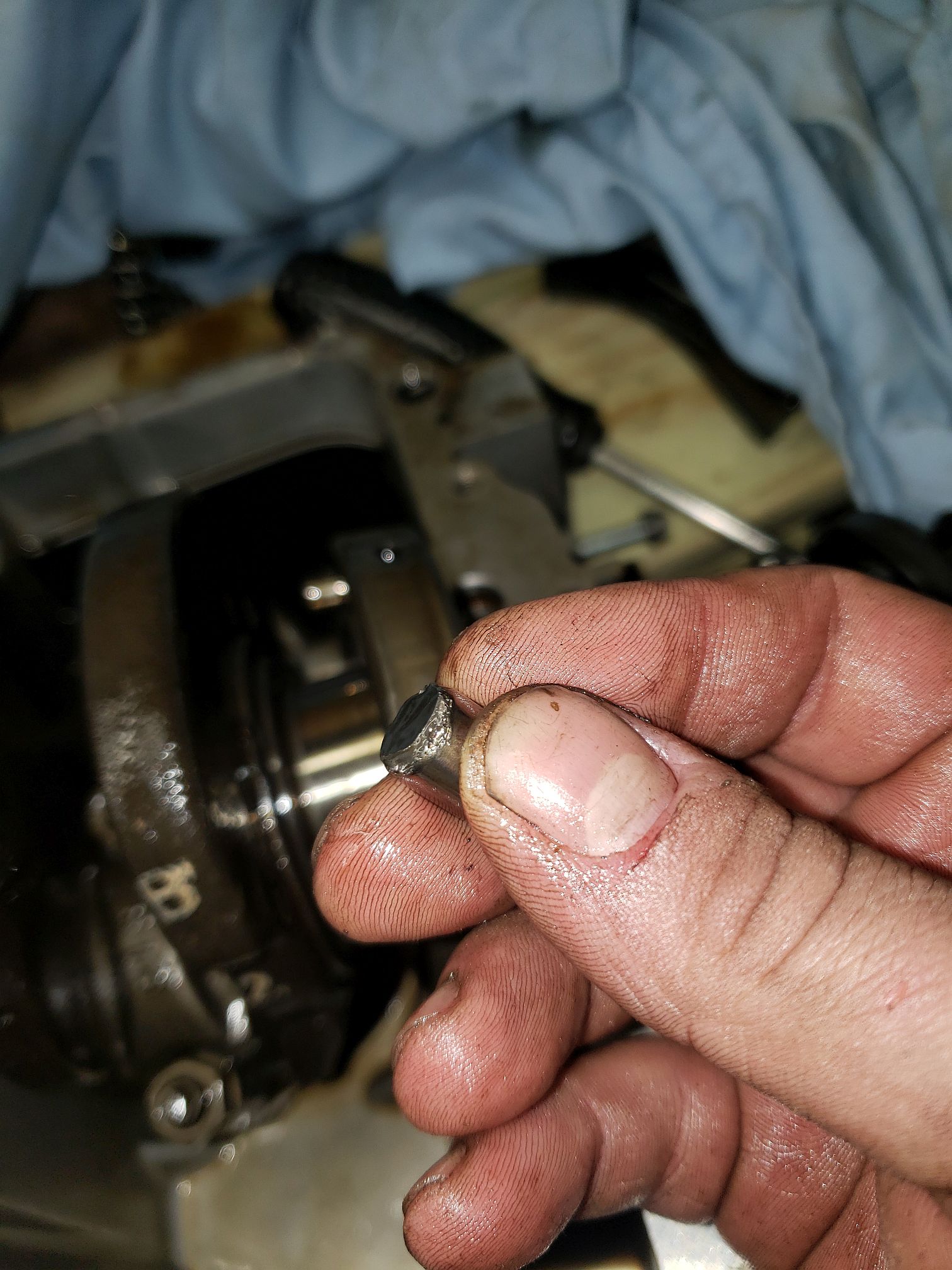
There's a dowel pin in there. Don't lose it.
20231014_110023.jpg


The problem is obvious, just look at that one roller!
20231014_110029.jpg
 
Last edited:
Look back at my post just above. There is a link in there now that will get to the thread I did about the O-ring. I fat fingered the typing on my tablet and posted before I had the link inserted, so I just now edited. I believe the part number and source is near the beginning.
Funny your link. This is was the exact set of o-rings from MCM I was going to order! :ROFLMAO:
 
Did it ever actually slip? The outer surface of the drive area on the gear had lots of chatter marks on it, maybe the most I've ever seen.
 
Did it ever actually slip? The outer surface of the drive area on the gear had lots of chatter marks on it, maybe the most I've ever seen.
Yes, pretty bad. I could get about 2 or 3 seconds out of it before you'd hear the starter free wheel. Sometimes you could hear a bit of clunking. Probably accelerated wear from 13 years ago with the bad CDI and the constant cranking and swearing before I got another one. I pretty much stopped using the starter about a year or two ago. I would kick it over about 4 times OFF with gas on and then turn it ON and it would start fine. I found if the bike was warm, because the oil is thinner after it's at operating temperature, then the starter would work. Or mostly work. This coincides with what Mike said in an article about using 10W30 instead of 10W40 if your clutch is junk and you're not opening the case yet.
 
So while removing the collars I found one is completely stuck. Even with a flathead. Probably explains the problem.

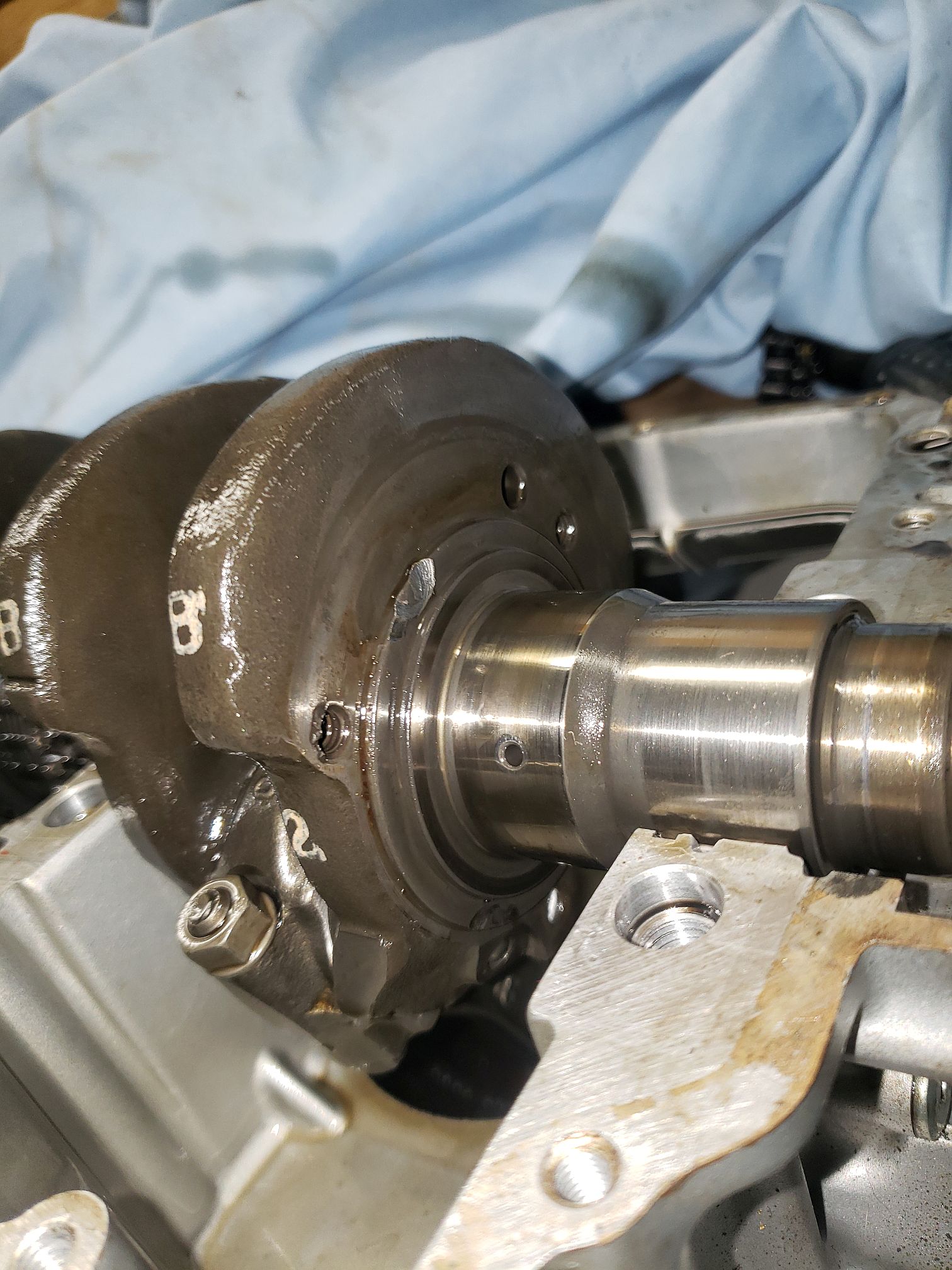
Another thing I noticed is digging on the crank from that nasty roller. Not sure if this is fatal. If it is, it's not an end of the world scenario as there are amazingly cranks available and not $1200 (thank you very much CMSNL).

20231014_111556.jpg

20231014_112115.jpg
 
Last edited:
So while removing the collars I found one is completely stuck. Even with a flathead. Probably explains the problem.

Another thing I noticed is digging on the crank from that nasty roller. Not sure if this is fatal. If it is, it's not an end of the world scenario as there are amazingly cranks available and not $1200 (thank you very much CMSNL).

View attachment 25556
Is there a small hole in the metal cover on the outside directly behind the stuck cap? If so you can push it through. I've seen many stuck caps on starter clutches over the years, most of the time you just extract them, deburr the opening if it even got damaged at all (caps are softer) and put new caps, springs and rollers in it. Make sure they move freely all the way in and out before assembling.
 
No small holes for access to that. I saw holes and was hoping it led to the springs back there. They don't. I'll have to spray penetration fluid, wait an hour, then try. If still nothing then I'll take a butane torch to it and see. I actually had to do that in order to get the long screws off for the starter. If all that fails I'll just get another used unit.

In regards to the crank. I think what I'll end up doing is deburr that and just see what happens. If it's back to the same old tricks shortly after the rebuild I'll just live with it for now and continue to kickstart it. I think it might work OK, but can't excessively spin it over. Which you shouldn't do anyways or you overheat the starter.
 
I got it out. Required penetrating fluid, heat gun, and an angled pick. Had to push real hard then finally it freed up.

Jim mentioned in his rebuild about tapping the threads because of the thread locker. I checked the bolt. It's an M6 x 1.0 tap that you need. Will order. I think that's enough for me today. Will work on getting the heads boxed up.

I may get bored later today or tomorrow and work on cleaning the cases/surface prep. I'll have to wait on the cam chain and balancer chain because it's depending on the tap and starter gear. No sense in doing that painstaking alignment of the balancer shaft when I'm going to have to lift the whole assembly up again to put the clutch and gear back in.
 
In regards to the tap. You have many options, considering it's a one time use kind of deal for me a cheaper one is fine. And I have tapped things before. Using of cutting fluid is what you want to do and go in a bit, then back out to catch those chips.

With that in mind I think this tap will be appropriate for my needs on this project. What do you think?

 
Considering older straight 6 and V-8 engines used hy-vo timing chains and they often lasted well over 100,000 miles, I'd say they'd last a long time in a constant oil bath because the car versions ran inside a mostly dry cover getting a little splash now and then.


Jim's been sick the last day or so, he'll have to answer that one since I'm seeing all of this for the first time myself.
Forgot about what you said about the cam chain. Mike, and others I've spoken to, think these don't last as long. One of the reasons suggested by Mike is because the chains are 't subjected to contorting around a bunch of guides in awkward positions. He also thinks they are not more durable than the regular chains the replaced in these bikes. He was saying that the reason for the change wasn't durability, but rather to reduce noise.

Per his camshaft facts article:

Something not many are aware of is that the cam chain is the highest wearing part in the bottom end of the engine. Yes, more than the clutch in fact.Cam chains
Hy-Vo type cam chains replaced roller cam chains on Honda's bikes in the late 70s. Hy-Vo, for "high velocity", is a trademarked name; the generic term is link-plate chain, gear chain or silent chain, the last rather ironic inasmuch as in motorcycles they can be noisier than roller chain when out of adjustment. And adjustment is problematic. The increased mass of the Hy-vo chain over its roller counterpart, and its unfortunate application outside its original design parameters (wherein, in cars, they were centrifugally self-tensioned), makes for very creative approaches for pursuading it into tension in motorcycles. It also wears surprisingly quickly, the chain's mass and tortuous encasement doubtless adding to this, resulting in a chain that needs replacement by 30,000 miles, and whose cam's timing is consequently markedly retarded (delayed), softening engine performance. Worse, many of the Hy-Vo cam chains originating in older Hondas are now discontinued as replacement parts. Worse still, Honda is being unconscionably deceptive about this and is putting inferior third-party (aftermarket) cam chains in wrappers with their names on them, just as they are also with ignition points and other vintage parts. I laud them for addressing vintage. I am scandalized that they are doing so in such a disengenuous, lowest-common-denominator fashion.

You and others may disagree on this with Mike. Again, I'm totally ignorant to any of it and since I'm cracking the bottom end open anyways makes sense to just do it. Another thing I dislike with the Hy-Vo chains is that they are endless. The chains you're dealing with you can break the old one and fish it up through and rivet. Hy-Vo doesn't seem to offer that options as far as I know.

I really have no idea as I have zero experience in it and he's rebuilt so many engines so I'd say it's likely true. Either way, I got a new cam chain, tensioner/slipper and guides.
 
Last edited:
Forgot about what you said about the cam chain. Mike, and others I've spoken to, think these don't last as long. One of the reasons suggested by Mike is because the chains aren't subjected to contorting around a bunch of guides in awkward positions. He also thinks they are not more durable than the regular chains the replaced in these bikes. He was saying that the reason for the change wasn't durability, but rather to reduce noise.

Per his camshaft facts article:


You and Mike, and others may disagree on this. Again, I'm totally ignorant to any of it and since I'm cracking the bottom end open anyways makes sense to just do it. Another thing I dislike with the Hy-Vo chains is that they are endless. The chains you're dealing with you can break the old one and fish it up through and rivet. Hy-Vo doesn't seem to offer that options as far as I know.

I really have no idea as I have zero experience in it and he's rebuilt so many engines so I'd say it's likely true. Either way, I got a new cam chain, tensioner/slipper and guides.
Oh I would have replaced it too since the engine is completely apart, of course. I read what Mike had to say about them and can't disagree, he has a lot more experience with them than I do. I was just pointing out their durability in the automotive applications and the fact that if these engines really had problems with them, I'd imagine there would be a lot more on the internet about it. I can't ever recall anyone saying theirs broke, and there are plenty of stories about roller cam chains breaking. As far as contorting around a bunch of guides, doesn't seem like much contorting happens in this engine. I could more easily understand it when talking about some of the modern OHC V-6 and V-8 engines where the chain makes a lot more turns and switchbacks.
 
I think they get so noisy and run so awful with Hy-Vo chains on the bikes before it would get to a point that it would break when being incredibly loose. Esh's bike was a good example of that. Just enough to throw the valve timing off when it got good and hot because the chain was that loose. Though, you couldn't hear any noise.

I've seen one example of cam chain breakage on a 400 twin. There was someone on marketplace whose father died and they had 3 spare engines and his dad noted the problems with each one. Apparently one had a broken chain around 30K. But who knows the maintenance history on that one? For all we know some clown rode it around for 20K+ miles and never adjusted it. We have a joke in the automotive world, "if you turn up the radio does the noise go away?".
 
And beyond me, Jim and Bill, I really don't know of anyone who has seriously pulled these apart and talked about it online. Because they're considered "starter" bikes I think most people just ran them until they got bored and upgraded. A shame because they are nice bikes. It's no balls of fire like the 550, but pleasant to ride back roads on, errands, cruising around town. Does pretty good at typical highway speeds of 65-70. Past that it gets a bit wonky if you don't have a windshield. I used to have one many years ago, but it broke.
 
⚠⚠NOTE NOTE NOTE TO THOSE WHO USE THIS AS A GUIDE IN THE FUTURE. YOU? YES YOU!⚠⚠

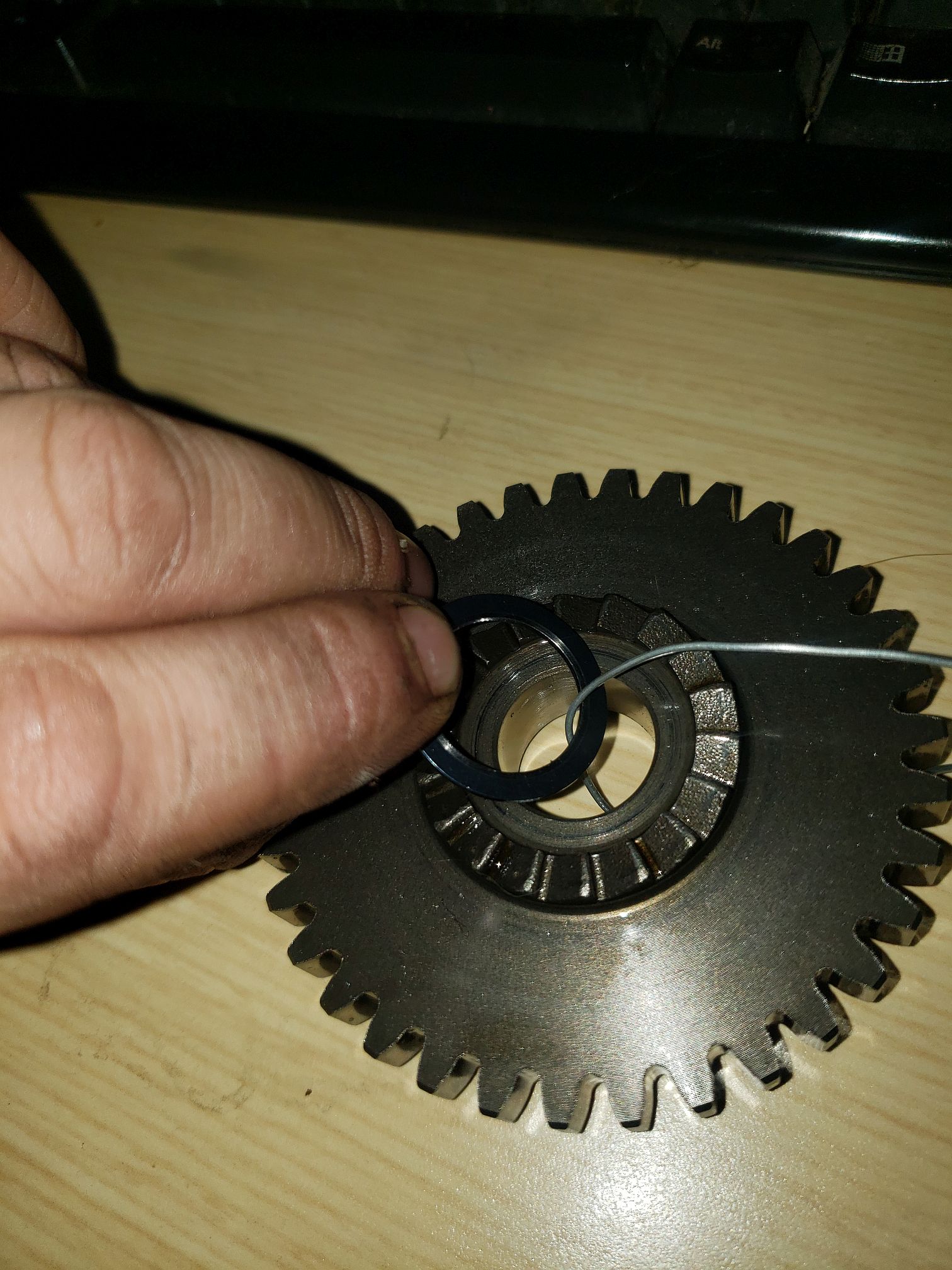
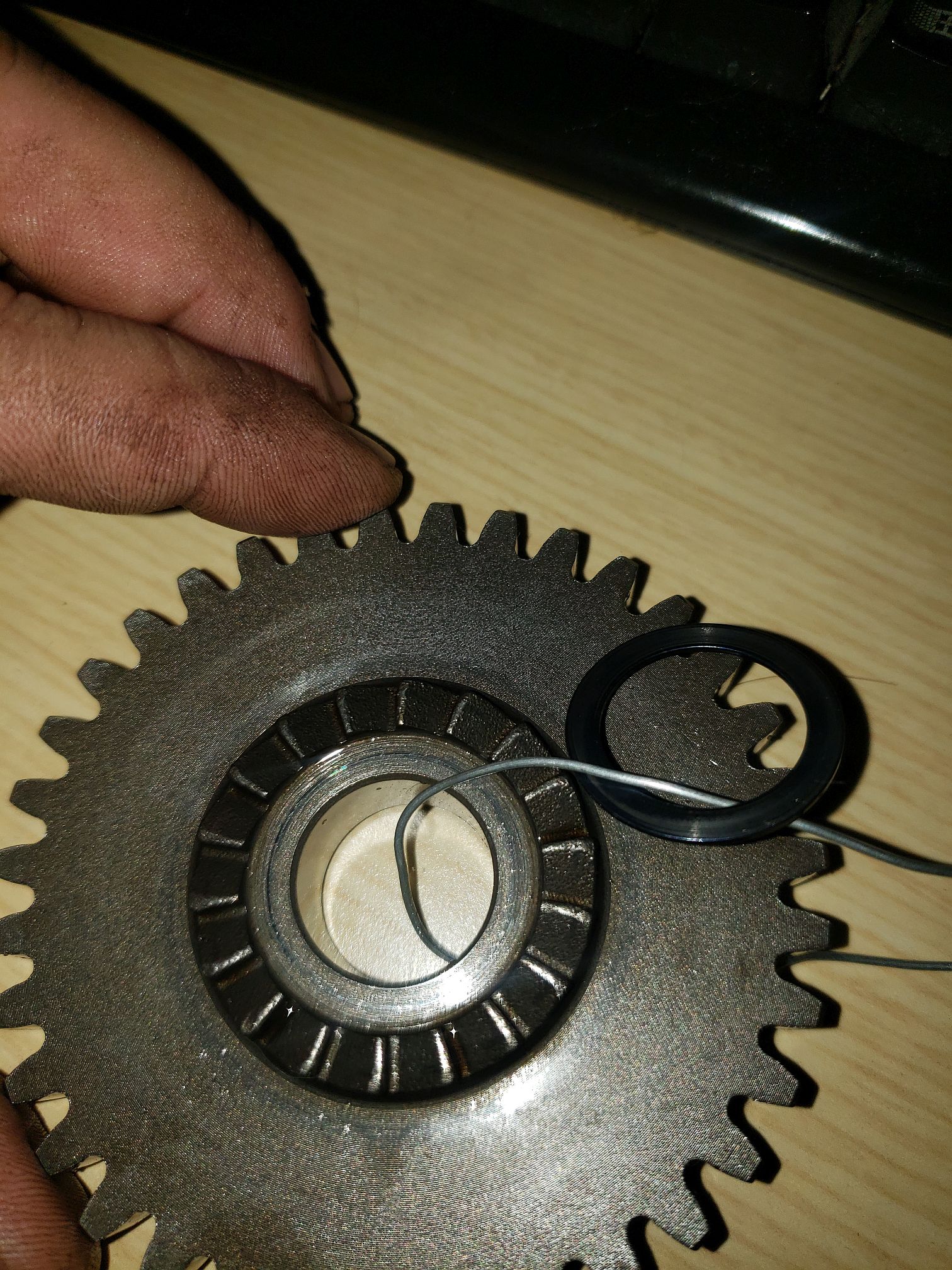
Jesus was looking over me, because right where I had a few parts sitting on my creeper chair I see this blue thrust washer. I'm looking all over to what it could be. Measure it, go inside and look at the fiche and what do you know... it was on the kick starter pinion and must have stayed stuck to it and eventually fell off when I picked up the pinion. Whew! I looked at like every shaft on that side trying to see what it was to and I was pretty sure it was kickstarter related.

So look at that pinion gear when you take it off. It slides right off, so this is easy to lose and I am incredibly lucky to have seen it and that it was attached to at it one point from the oil. Double lucky that it didn't just fall off when working on the crankcase.

I've updated that particular post.

20231014_151518.jpg

20231014_151523.jpg
 
Last edited:
Now I have nothing to do except surface prep/cleaning. As I look at the book addendum for Hondamatic in the FSM it shows a gasket on the oil pump. Funny, because the fiche for 400A and 450A do not show this and it's not in either of the "Gasket Kit B" sets for these bikes. It may be a mistake. However, I'm not removing the oil pump. I see no reason to. So if you decide to do that, let us know. If it does have a gasket I suppose you will have to make one.

Capture.PNG
Capture.PNG
 
This is not a mistake. But rather the 1978 year up to serial #2004610 (according to CMSNL) has a different part number that is not superseded. This one has the gasket. I have to check the book, but I don't believe the 1979 addendum mentions this change. So for those with a 78 CB400A look out for this. It does appear that the 4into1 gasket kit has this piece. I have found one place you can grab it. Might be worth sending out to get a few made.
 
OK. I checked the 79 addendum, it mentions nothing. So this means 78 CB400A users with early serial numbers beware. You can probably switch to the newer pump, but I have no idea.
 
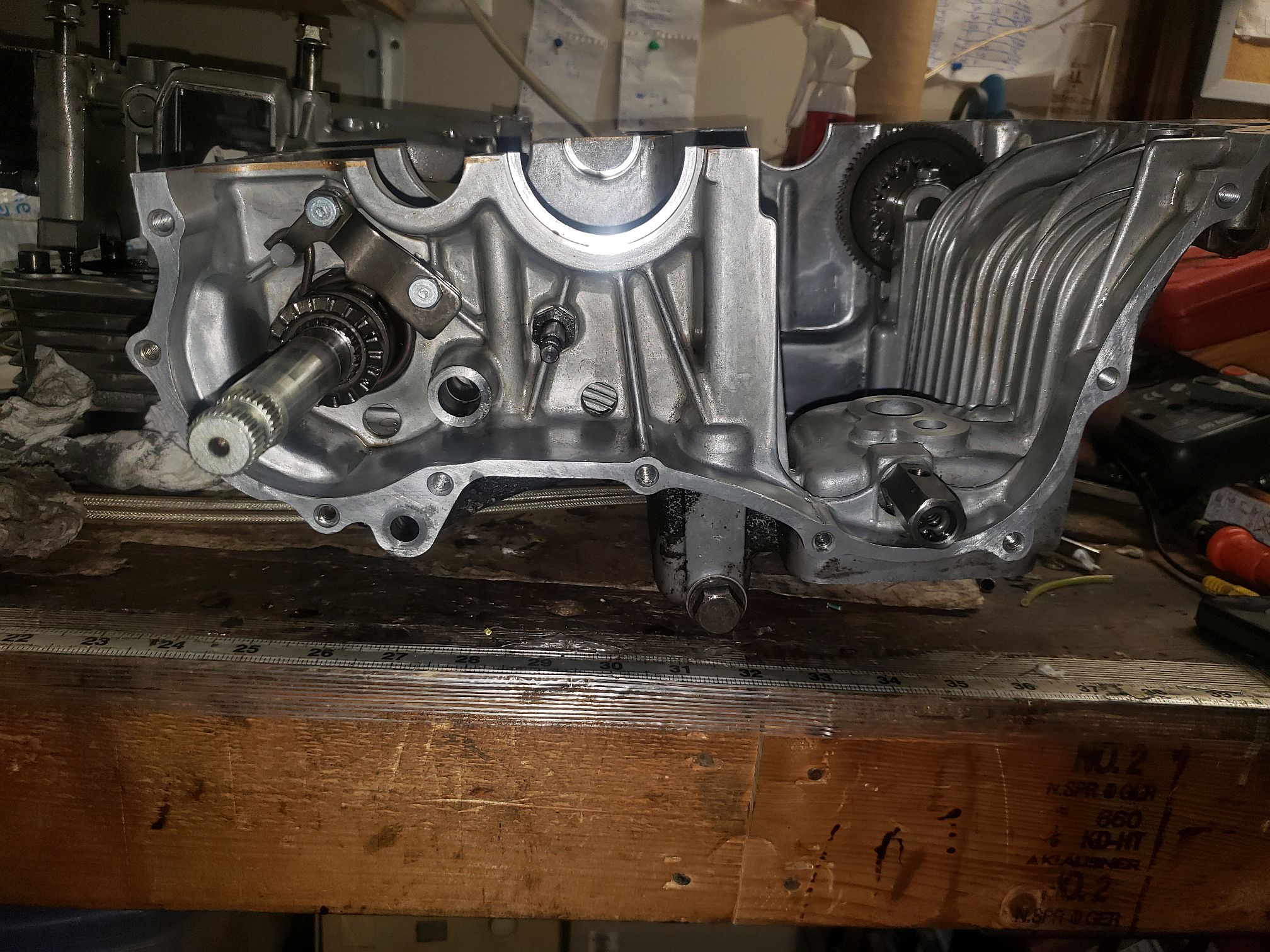
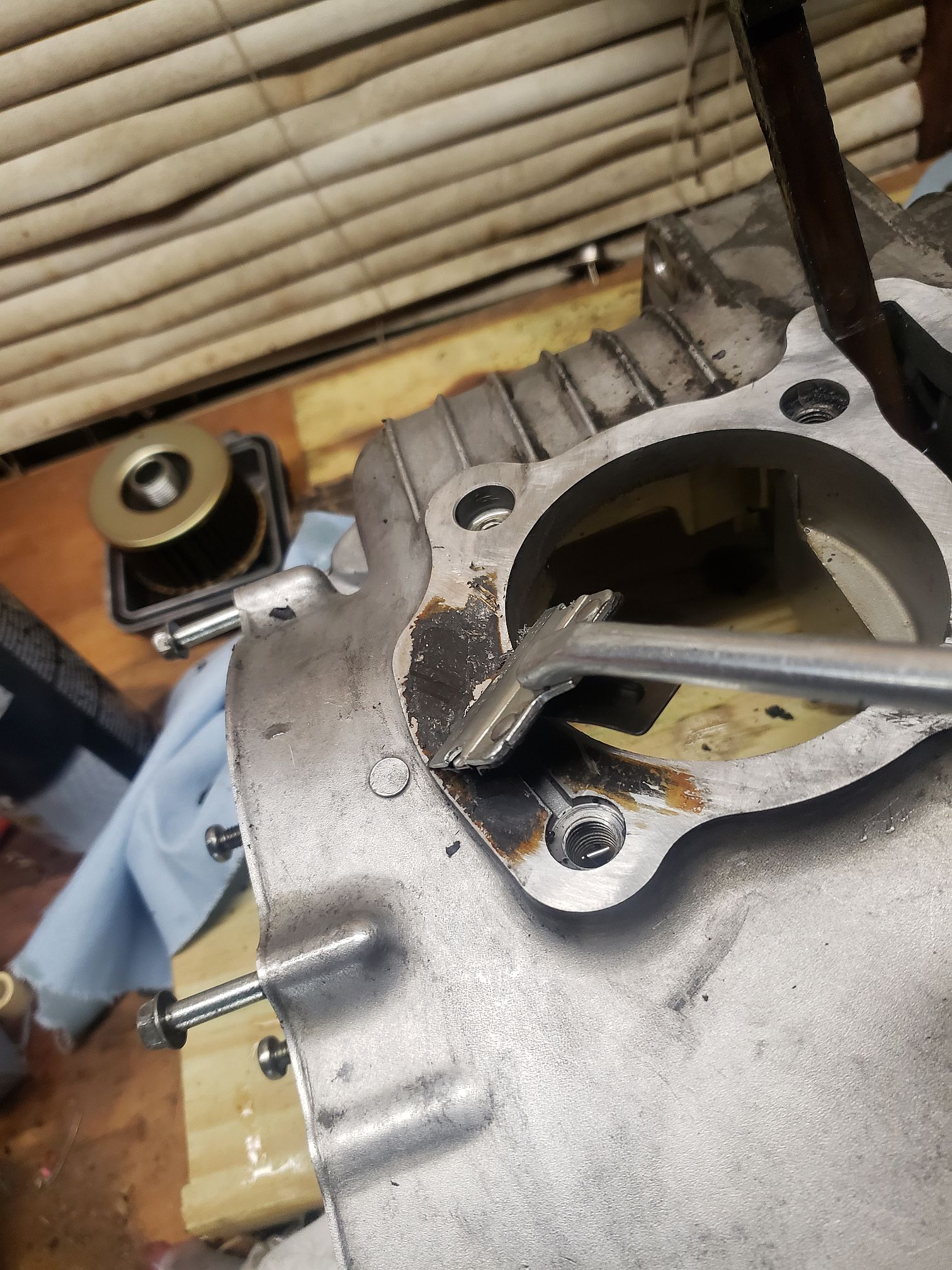
Cleaned up the bottom case. Most of the old Hondabond was already disintegrated. Went over it all with acetone a few times, including the seal areas (don't forget the seal areas!) then oil stoned with some honing oil lightly. Didn't take much.
20231014_193944.jpg


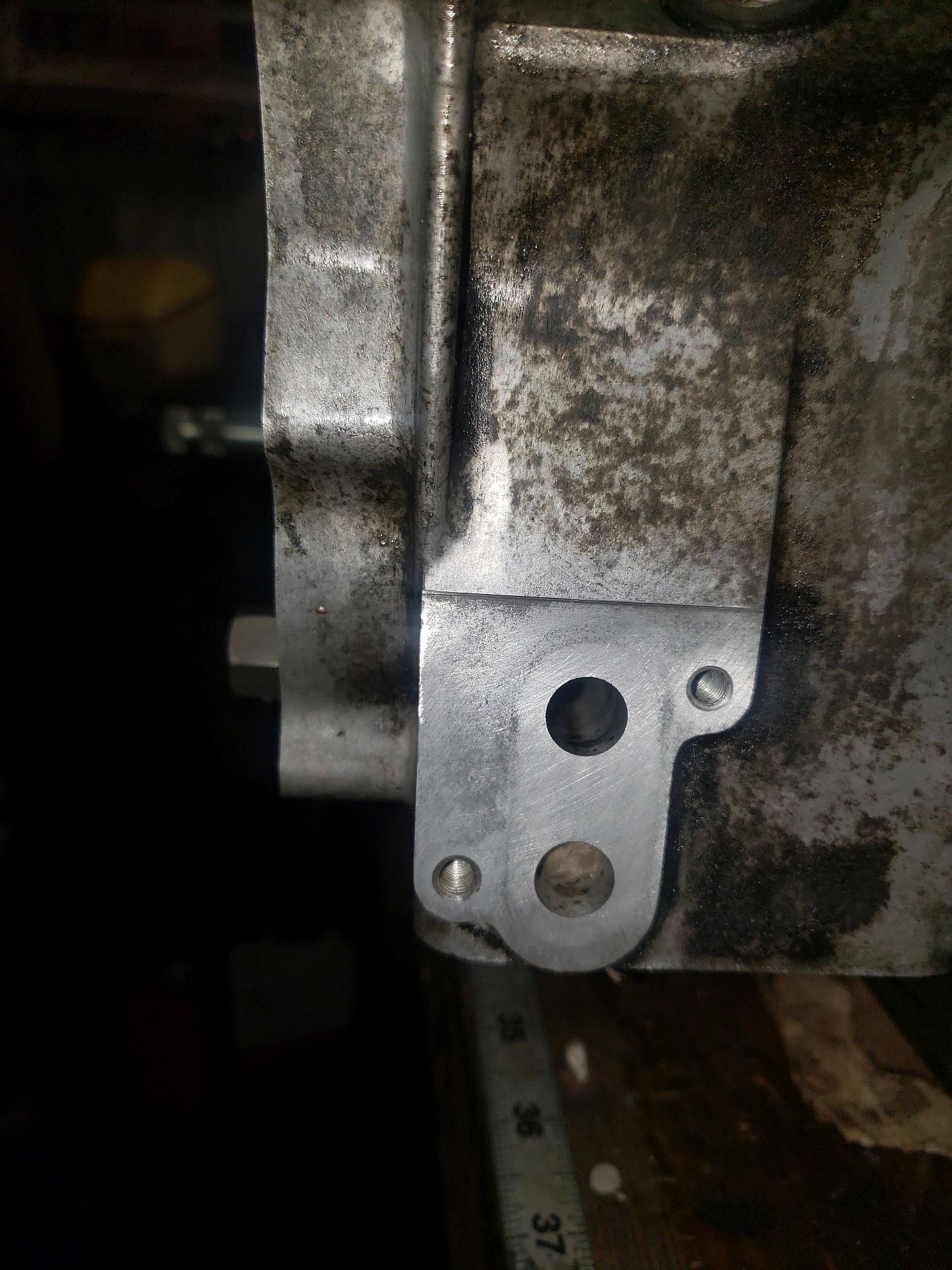
Oil cooler gasket area too.
20231014_193949.jpg


Bottom half of torque converter side.
20231014_194606.jpg


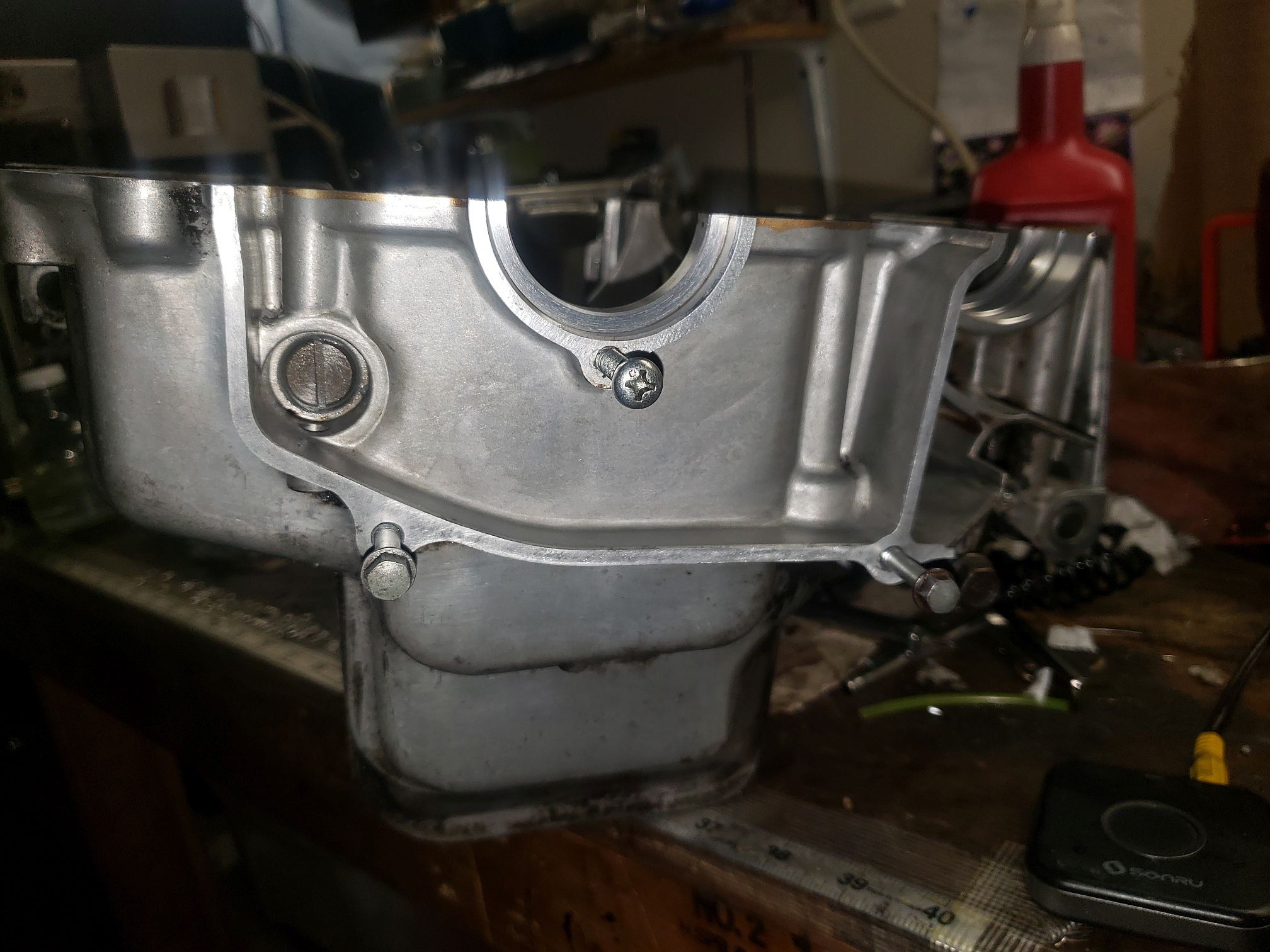
Bottom half of stator side.
20231014_194554.jpg


Tomorrow I'll pull the starter idler gear and replace that o-ring. Jim mentioned they leak, and I already have all this so now is the time. I'll also blow the case out with compressed air to make sure there's no stray rubber bits left.
 
Last edited:
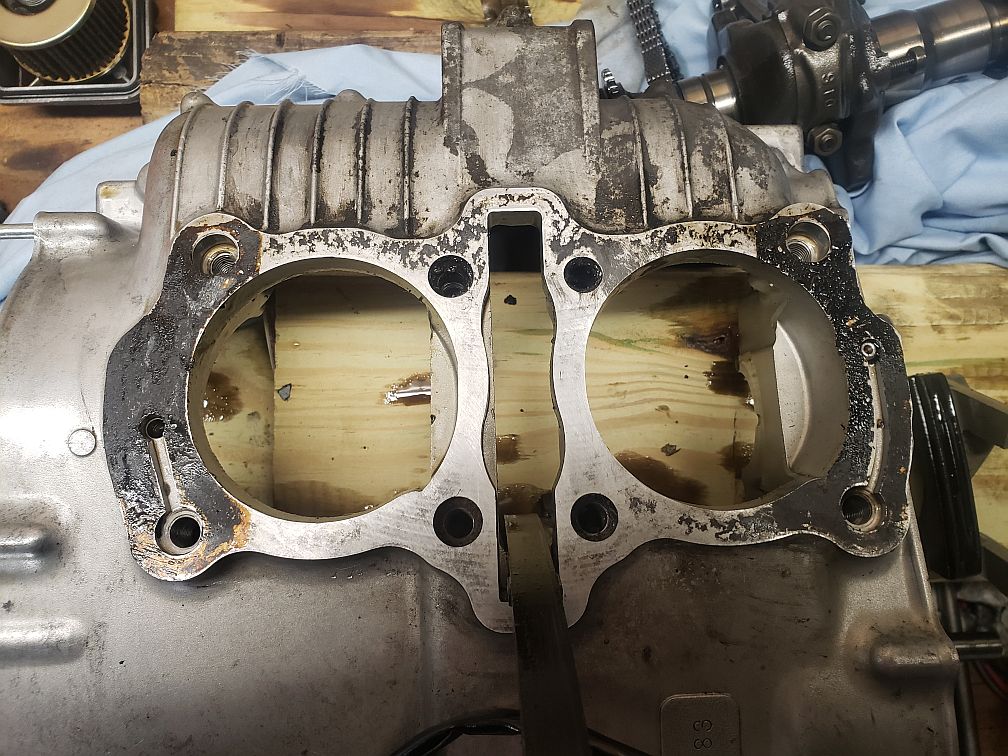
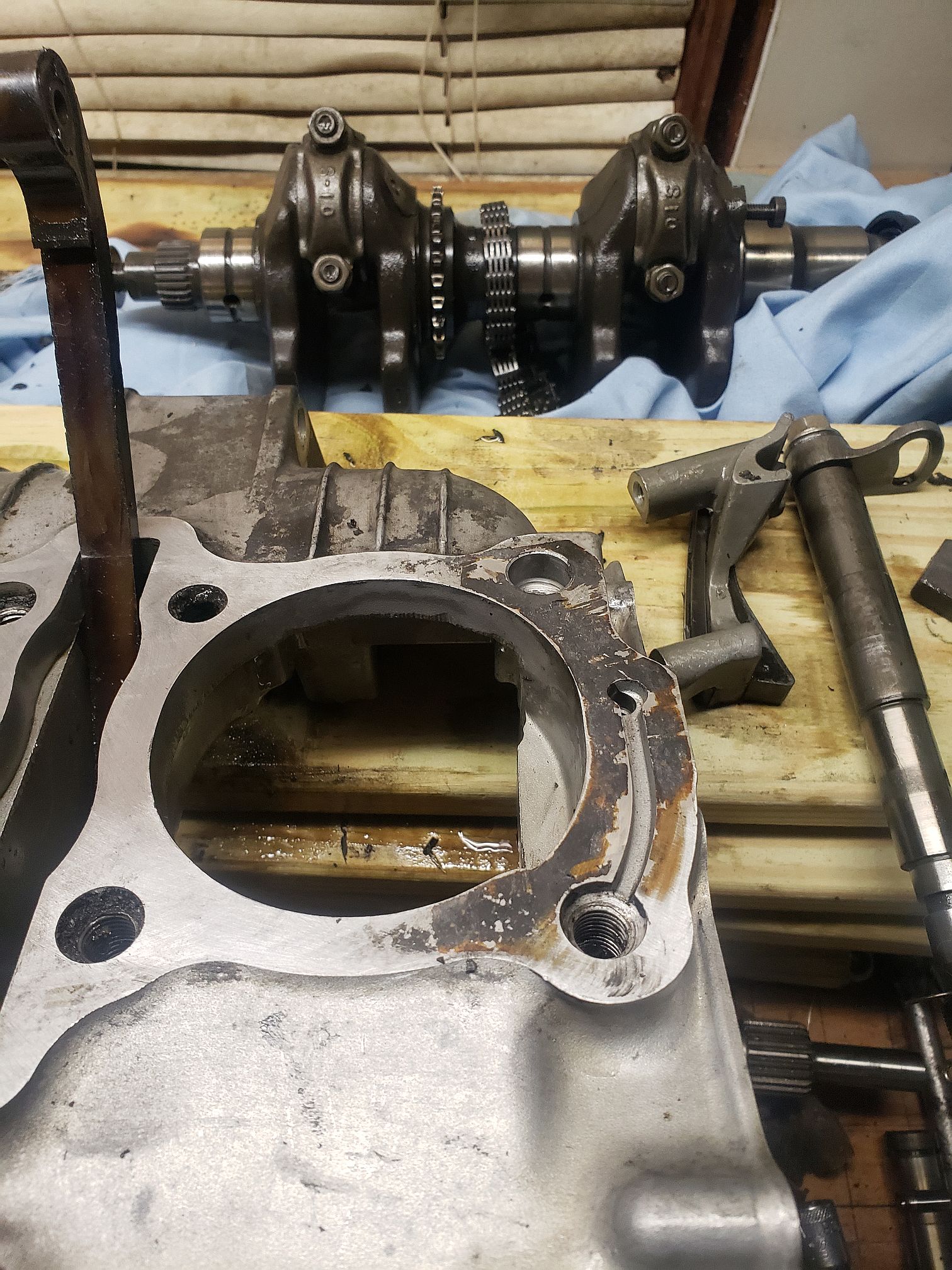
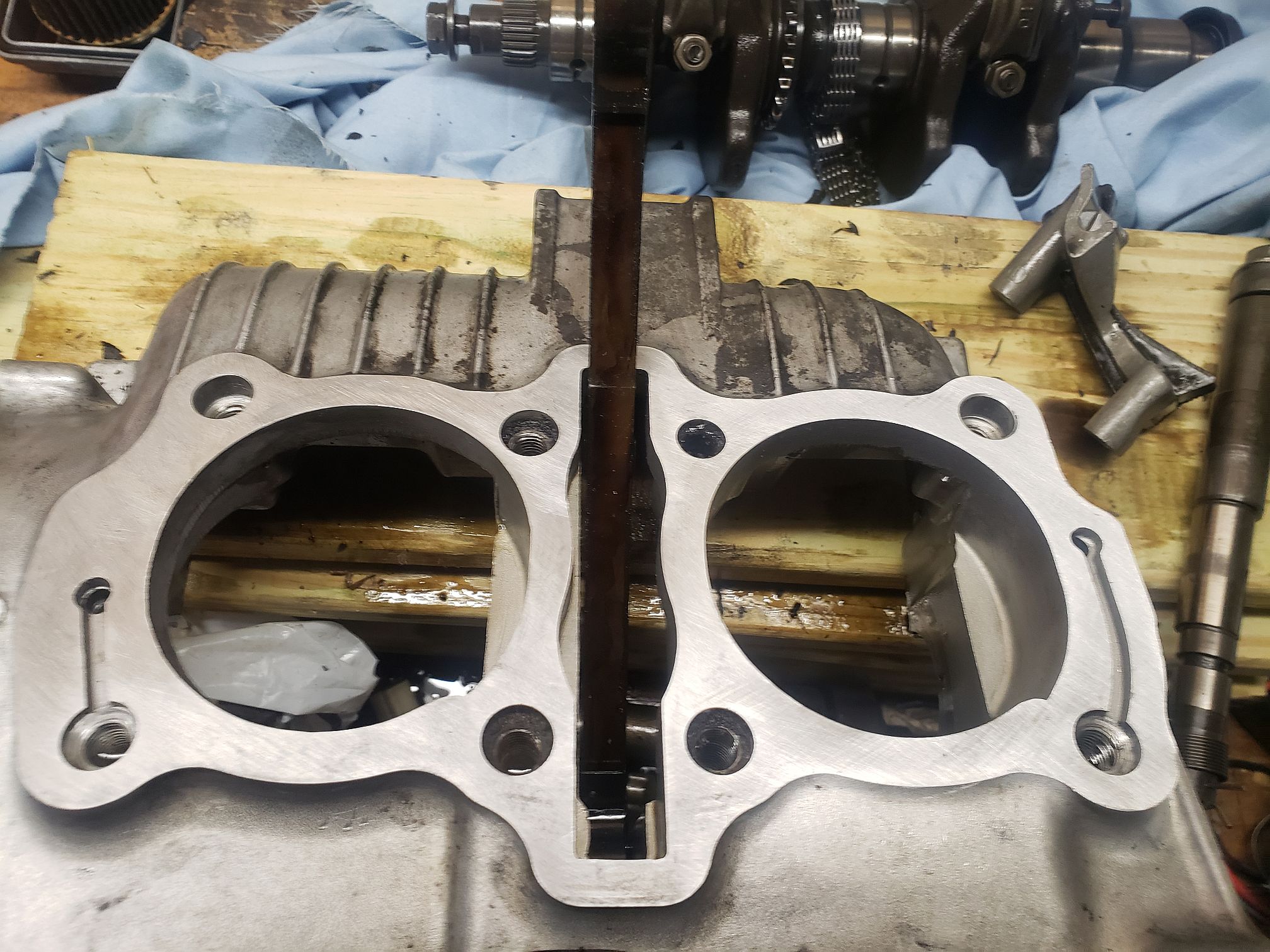
Let's get into the part almost everyone hates... cleaning gasket surfaces. The base gasket surface will likely be annoying. So start off by removing the crank holder, crank, and balancer chain assembly. Since I did this early there are no pictures of this. Be mindful of dowel pins as well.

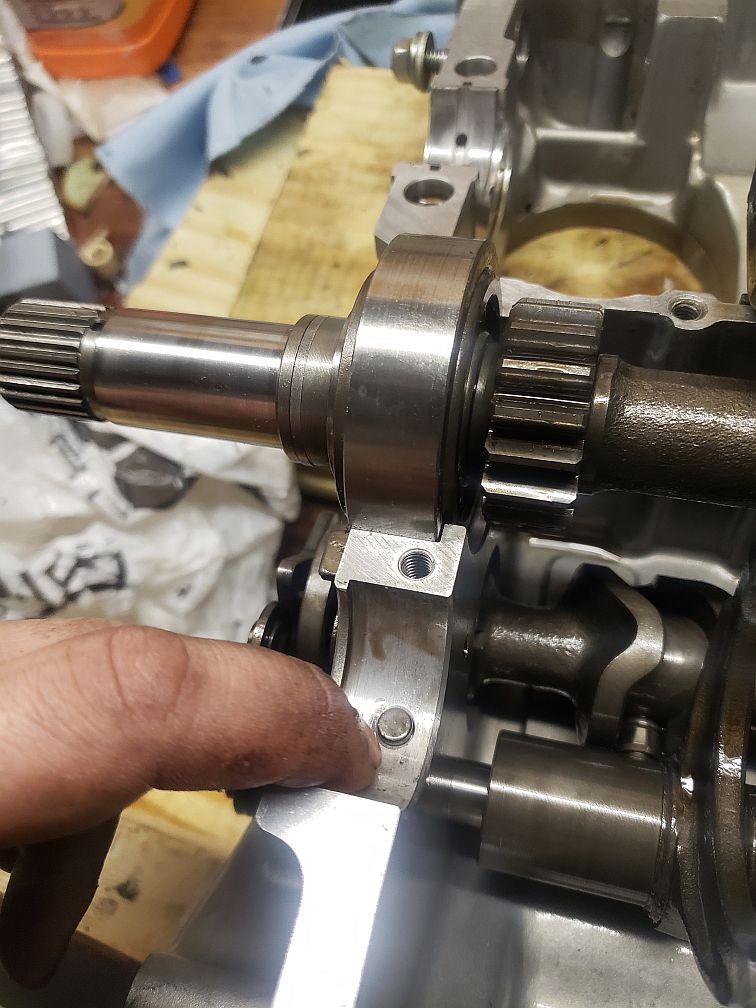
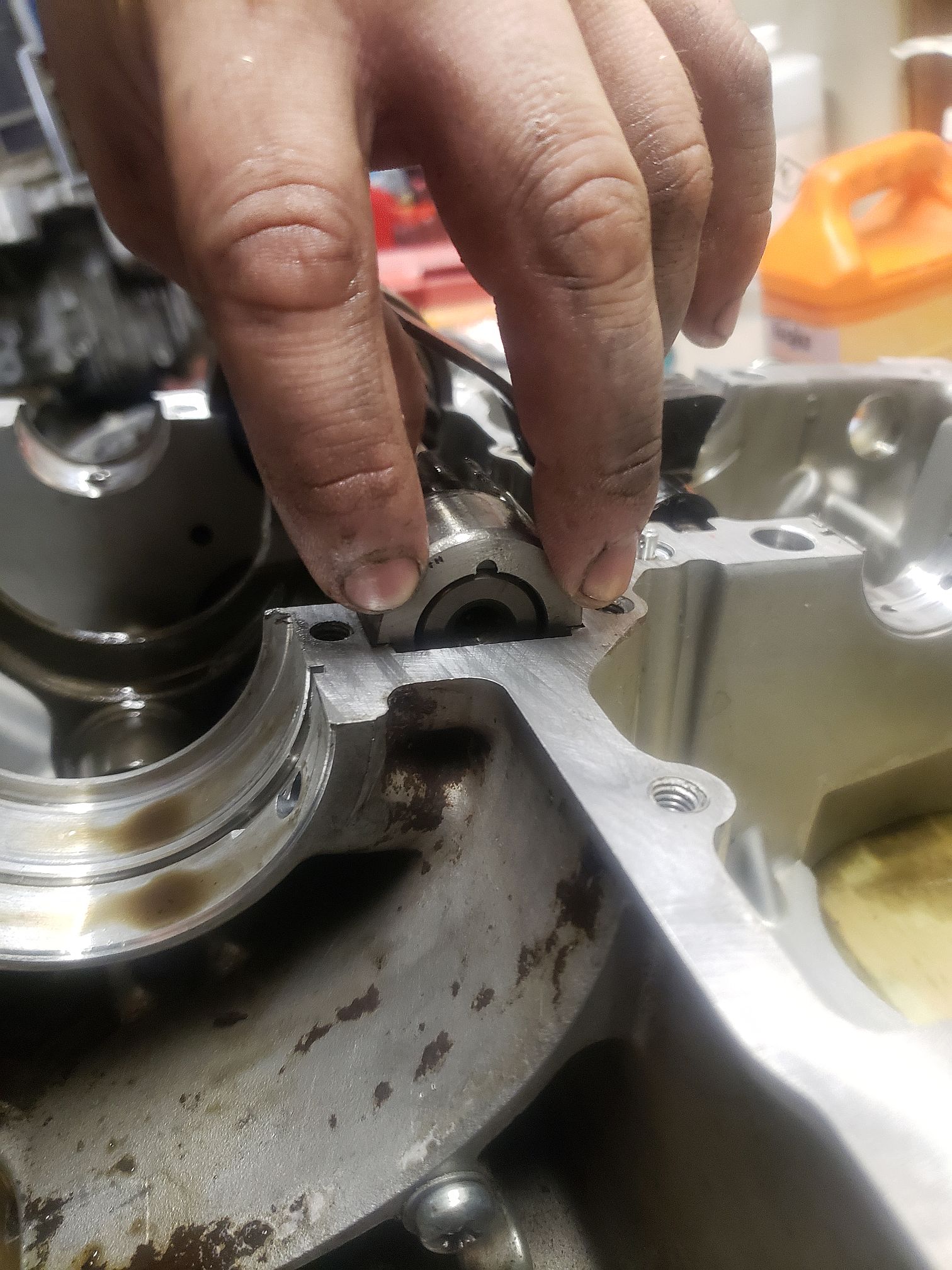
Now you have to remove the transmission. This is very easy. Start by removing the actual gear assembly. Located in the rear, the same shaft that holds the sprocket. The the other shaft for the torque convert. Be careful, there are 2 dowel pins and an bearing oil hole pin. Honda calls the dowel pins, "Gearshift fork guide pin" and the oil hole pin "Bearing setting pin".

There is one dowel pin, on the torque converter cover side for the transmission shaft.
20231015_120958.jpg


There's a second dowel pin, for the torque converter shaft, also located on the torque converter cover side.
20231015_121009.jpg


The bearing oil hole pin is for the torque converter shaft and is located on the inside of the crank case.
20231015_121013.jpg


Now on to the actual prep, flip the case upside down and remove the oil jets. What I did was spray carb cleaner in that area then used Jim's method of two small flatheads. They lifted up pretty easy. You'll only be able to get it so far then you have to use your fingers while still applying pressure on one side of the oil jet with the screwdriver to get it out. No pictures of this, I only have two hands. 😂

The case as-is.
20231015_110016.jpg


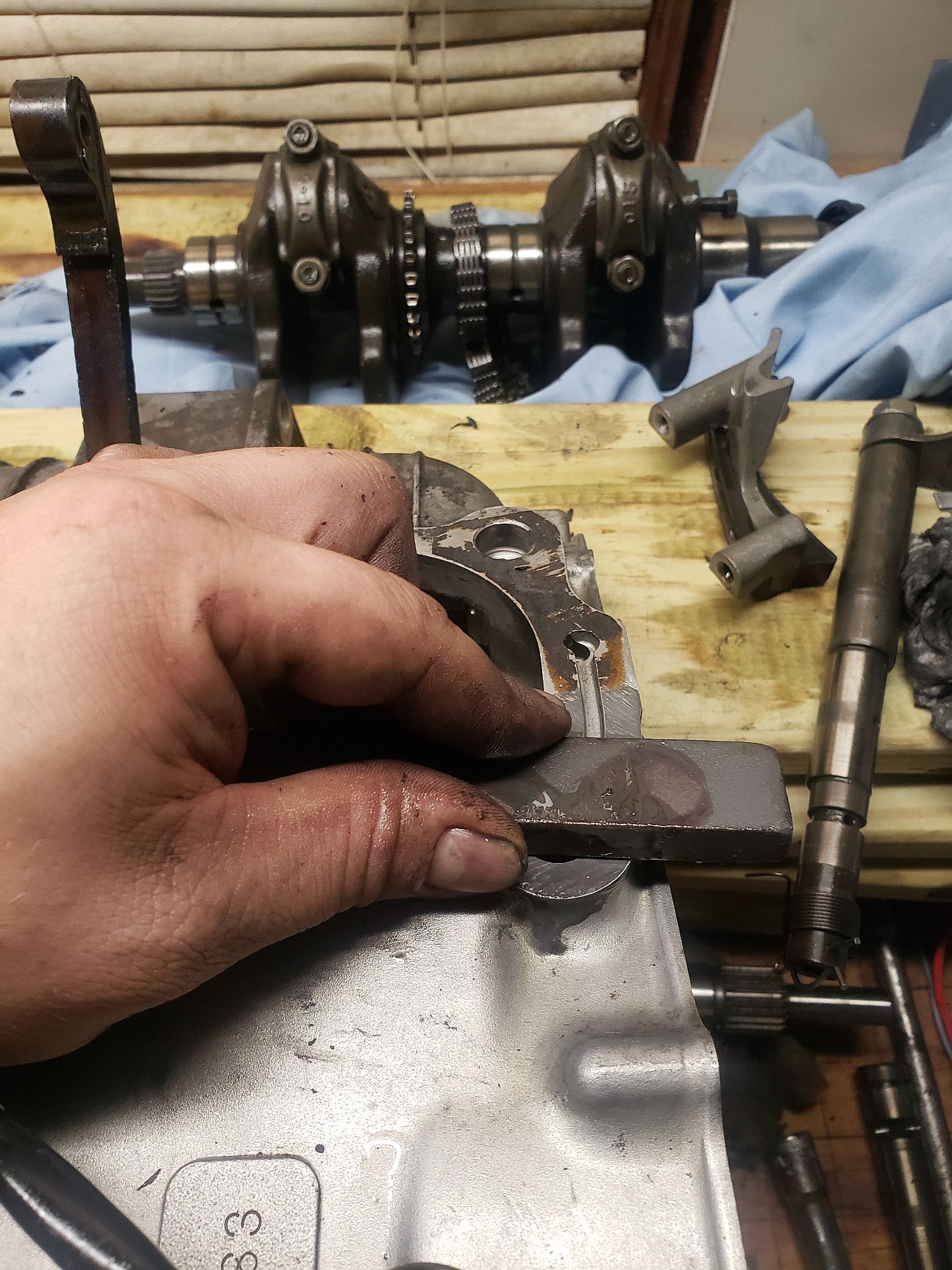
I spray carb cleaner on the gasket, then use a razor blade to get as much off as possible. You won't get it all. Then per Jim's and Mike's advice I use a red oil stone (equivalent to 320 grit) with some honing oil. I ran out part way and used 3-in-1/SAE20 oil and it worked fine. I'll bet you could use two-stroke oil too if that's all you have.
20231015_111120.jpg


20231015_112004.jpg

When using the stone make sure to you're not getting a lot of debris in the oil passageways. After you use the stone for about 15-30 seconds it will start smearing, indicated you need to wipe everything off with a towel, oil the stone and go again. When you do this wipe any crud that gets in that passageway. I use some carb cleaner in that area as well and also on the old gasket where the razor blade isn't helping. The carb cleaner does dissolve some of it. Also spray in the passage way to verify flow every so often. It will come out where the plain bearing is located underneath it.
20231015_114708.jpg


One side done, took about 15-20 minutes.
20231015_113521.jpg


Other side, man this is boring! 😂
20231015_114400.jpg


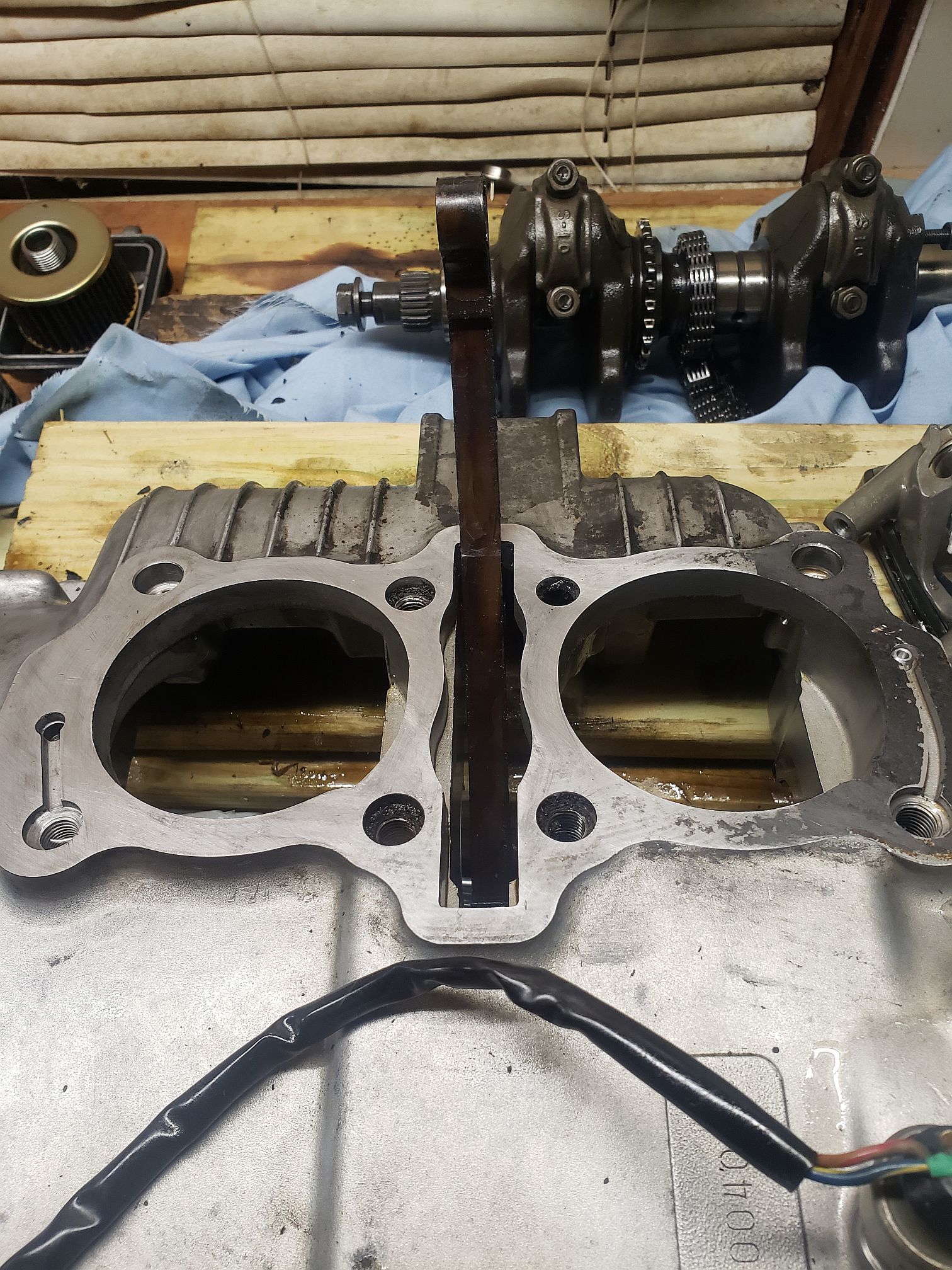
All done, cleaned off with carb cleaner and oil flow verified with the carb cleaner.
20231015_115349.jpg


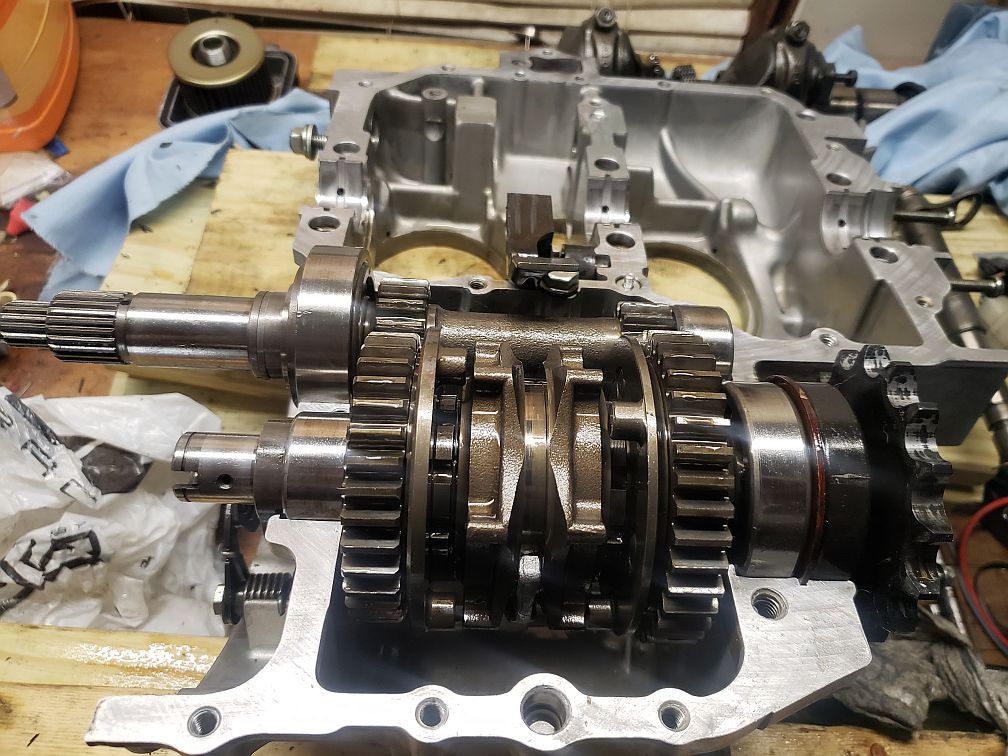
Reinstalling the transmission is easy, reverse of assembly of course. Don't forget the two pins on the outside and the bearing oil pin on the inside. Make sure the shaft, bearings, and gears are clean of any old debris. I used a small amount of assembly lube on the bearings and gears. To help you find the alignment holes there are marks on the shafts.
20231015_121136.jpg

20231015_121146.jpg


Put the torque converter shaft in first, then the transmission gear shaft in. Line it all up and then spin the sprocket a few rotations. Make sure it's spinning the torque converter shaft. If it spins so far then stops check for debris on the gears. It should spin freely and easily forwards and backwards.
20231015_121301.jpg
 
Last edited:
Simplest transmission and shift fork setup ever, aside from the added complexity of the torque converter. One shift fork. Unusual dog arrangement on the gears, this is interesting to see since I've never been in one.

Yes, gasket surface cleaning is boring as hell, but be thankful (at least to some extent because there's also the downside of the cylinder bolts) that you don't have cylinder studs to clean around, and typically 8 of them for most of us. That would be the easiest base gasket cleaning to work on ever.
 
Yes, the bolts can be real tough. I think part of it comes from using a ft lbs torque wrench instead of an inch pounds on reassembly. But I've found that bikes that have sat outside for a long time in poor conditions make it much more likely for them to break. And of course when it breaks it's right at the base of the case so you're kind of screwed. However, I wonder if you could use some sulfuric acid to dissolve it. This would work on the outers and two in the front. The inners on the rear of the case have those steel inserts so you'd have to put new ones in.

If you did the acid you'd have to make doubly sure you close it off to wherever it leads with putty or something. Just FYI, I'm not advocating these methods, but if it's a junk engine and you're desperate it might work in a pinch instead of broken taps or having someone vaporize it.

The torque converter itself isn't too hard. The biggest pain on reassembly is aligning it to the primary/oil pump gear, then the torque converter "smaller" gear and finally the kickstarter gear. That's covered in the balancer chain adjustment guide I did, but I'll show it again when I get to that point.
 
Got everything apart and bagged for the cylinder heads, camshaft, rockers, etc. to be sent out. Still need to pack it.

Besides that, I'm at the mercy of that tap and the starter gear before I can assemble the bottom end. In the mean time let's do the o-rings and seals that are easy to get to.

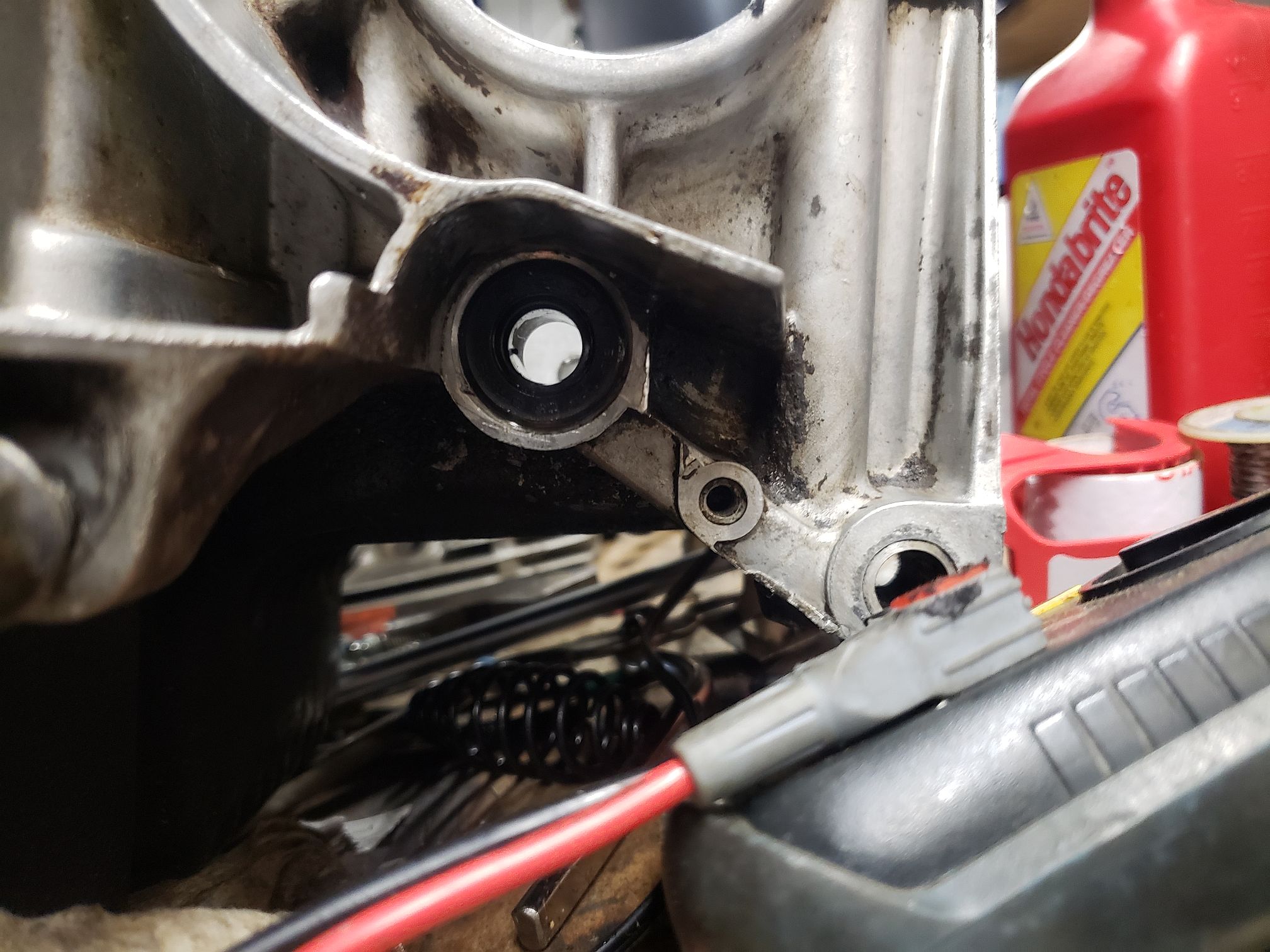
The idler gear on the bottom case is simply a 10mm bolt head. Remove it.
20231015_142236.jpg


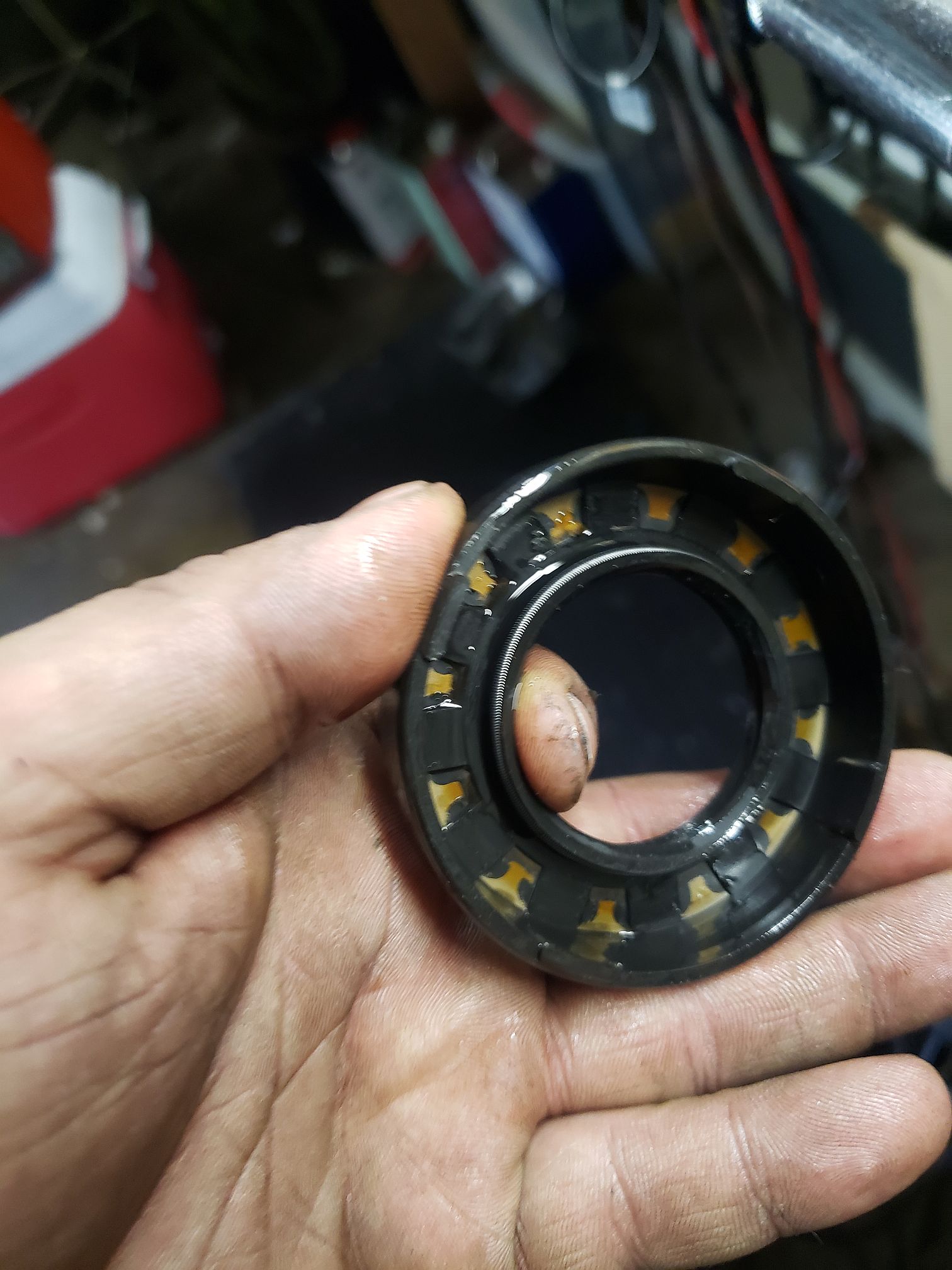
Push the shaft off. You might need a tiny socket or something similar to push it out. Just like doing an axle. The old o-ring is totally solid.
20231015_142438.jpg


Remove it, then get your new o-ring and put a skim coat of fresh oil on it. Doesn't matter what oil, most just use motor oil.
20231015_142603.jpg


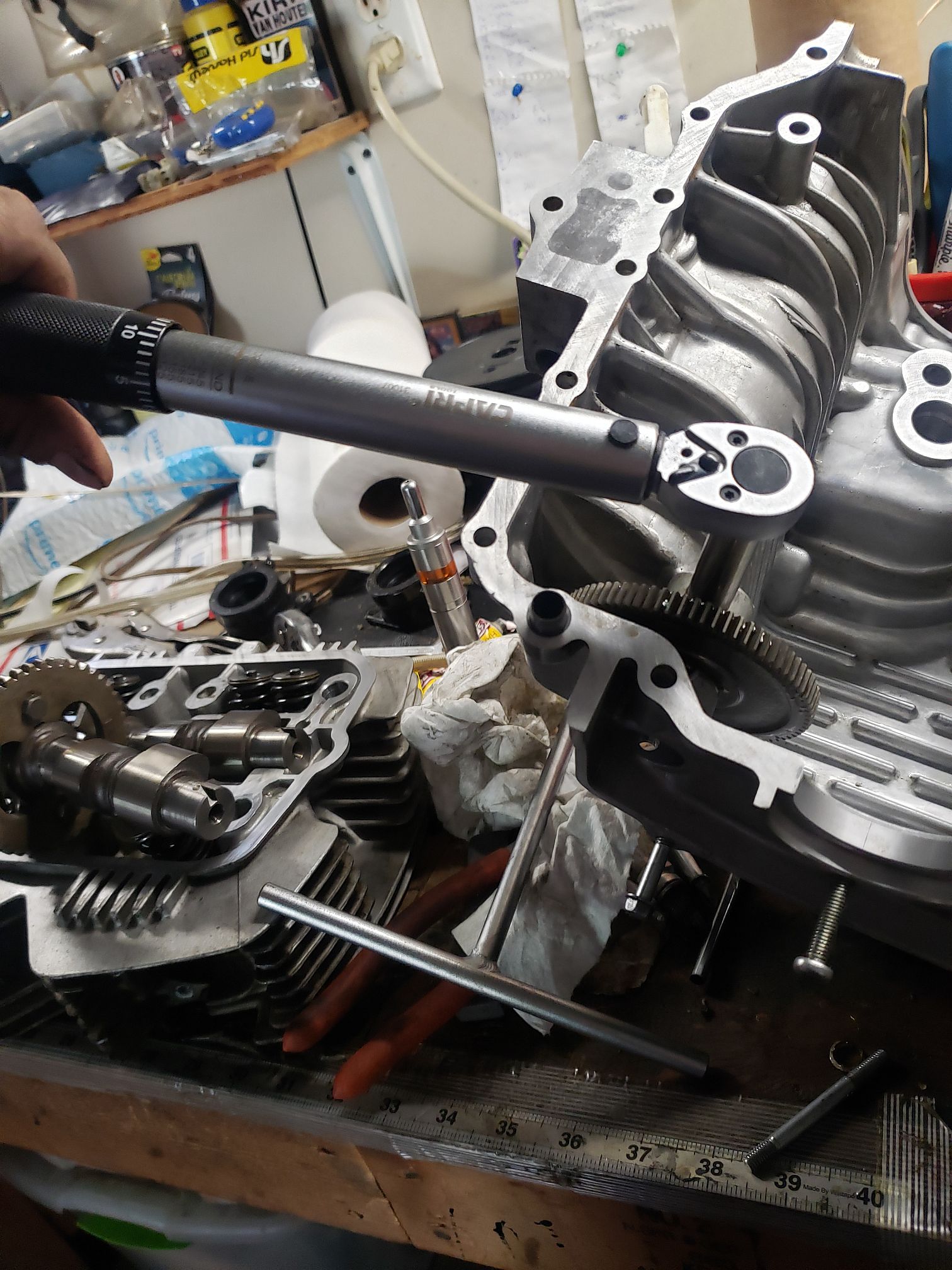
Clean the shaft then put a skim coat of oil on it. Slide it all back in. For me it was a bit tight going back in. I pushed it back in with a socket and it seated. Now the books will fool you here if you don't understand. The torque value is not listed specifically for the exploded diagram in the FSM. What you do is go to chapter 1 in the book and there is a table of typical torque values. Now, DON'T GO BY THE SIZE AS THE HEAD BOLT SIZE. IT'S THE ACTUAL BOLT SIZE. That means, NOT the 10mm torque value here, but the 6mm torque value! The range is 6.0-9.0 ft/lbs. A 3/8" torque wrench is NOT going to be accurate that low of range. Use a 1/4" inch pounds wrench instead. I set it to 90 inch pounds.
Here's another tip, if you get confused... is this 6mm according to the book or 8mm or what? One thing you can do is look at the parts fiche online. For instance, this bolt is listed as 6x20.
20231015_143534.jpg


Ok, now with that out of the way let's do the transmission seal.
20231015_143707.jpg


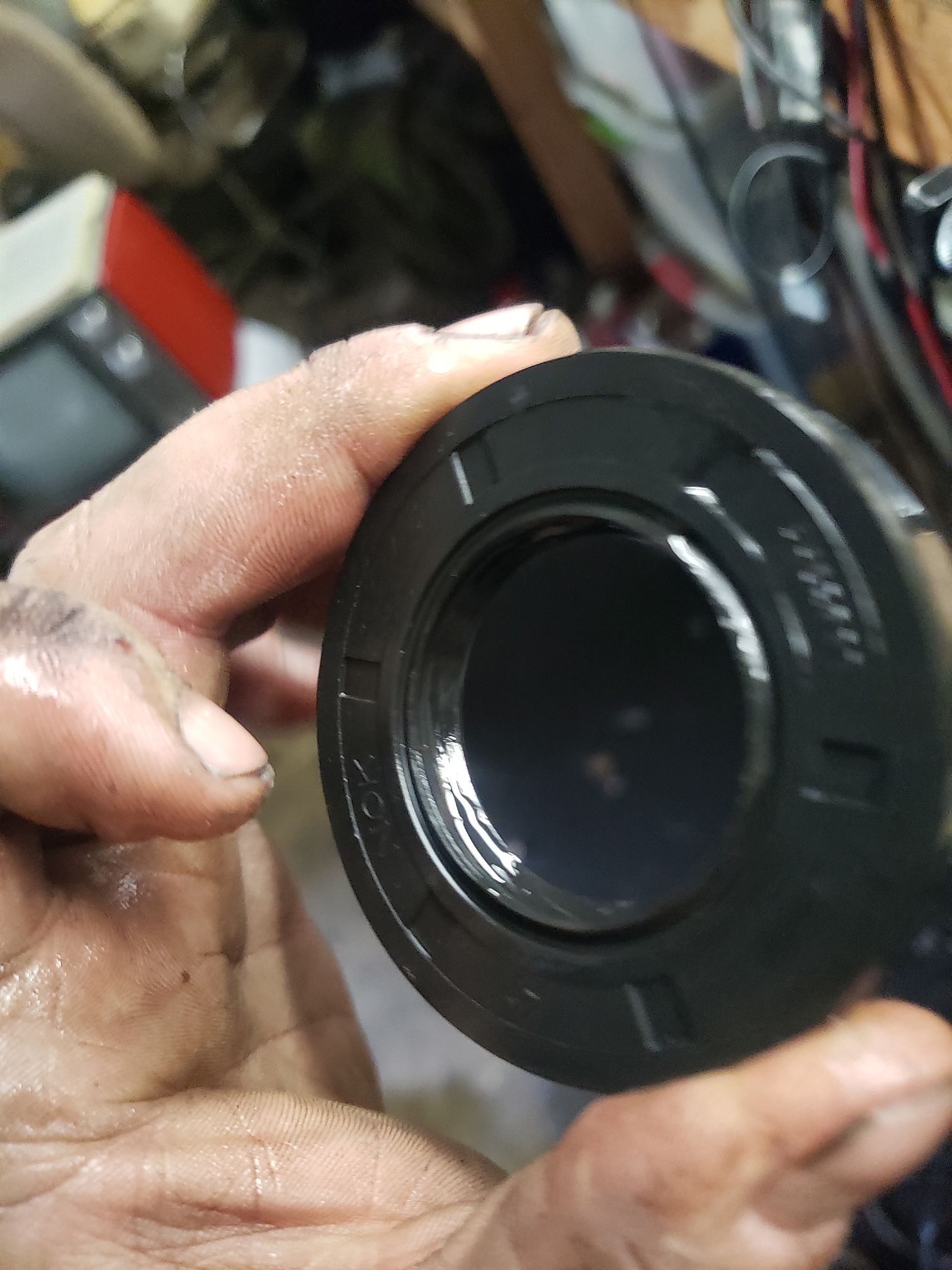
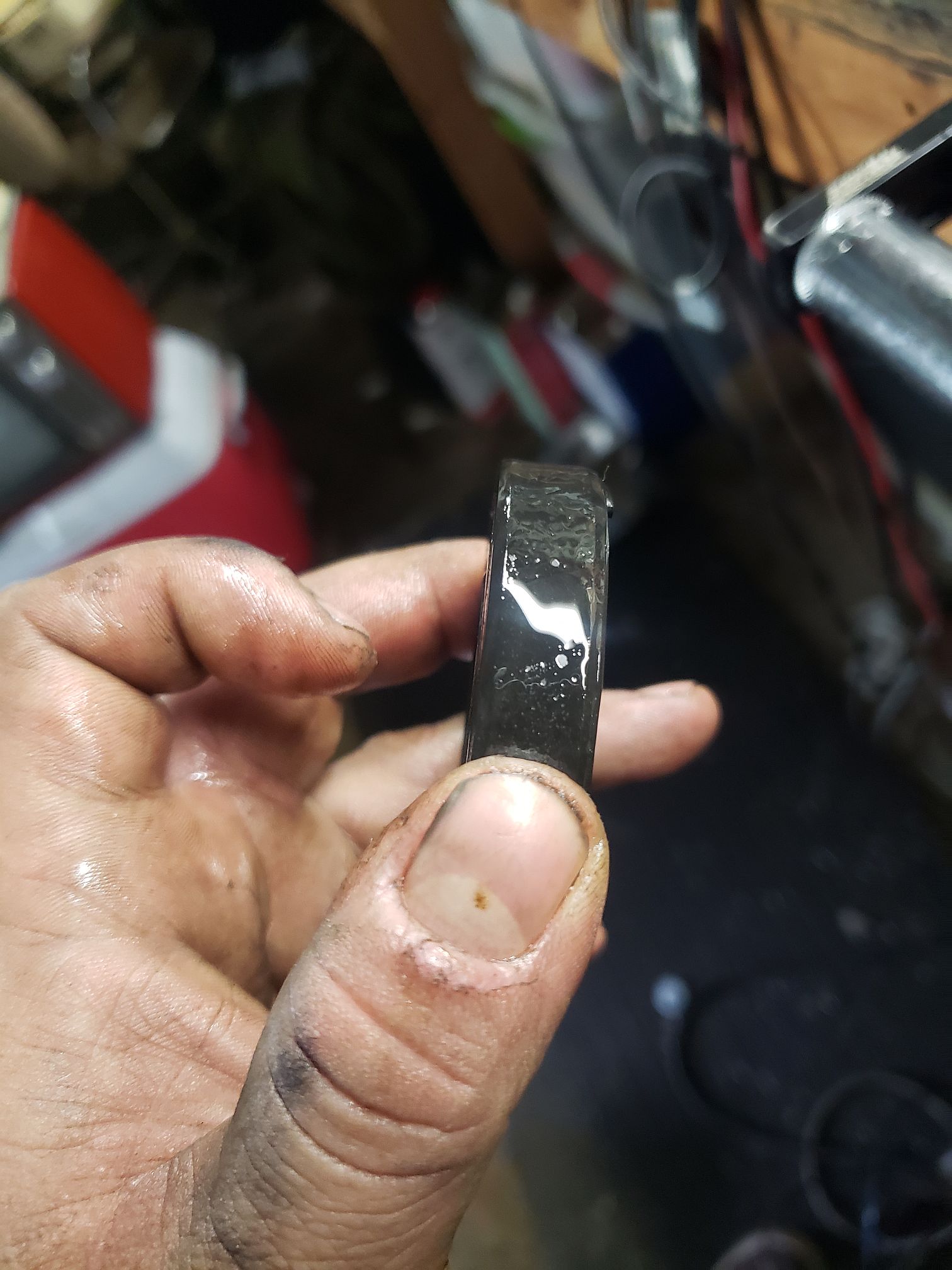
Skim coat of oil on the outside, inside lip and around the spring seal area.
20231015_143923.jpg

20231015_143926.jpg

20231015_143928.jpg


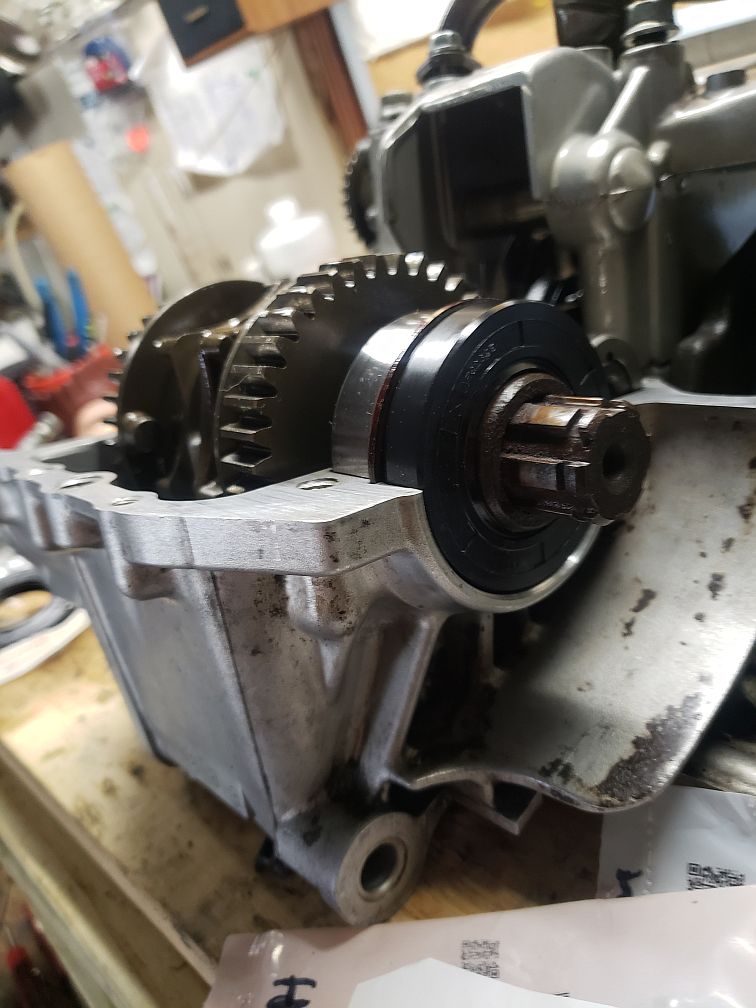
Simply lift the shaft up, make sure it's clean and slide it on.
20231015_144117.jpg


There is still the gear shifter oil seal and that goofy JIS screw "8mm bolt sealing" that has an o-ring behind it (look at "Crankcase Set #10 and #8 on the fiche) that I can do in the mean time. Officially at a stand still until parts arrive and me shipping things out.
 
Last edited:
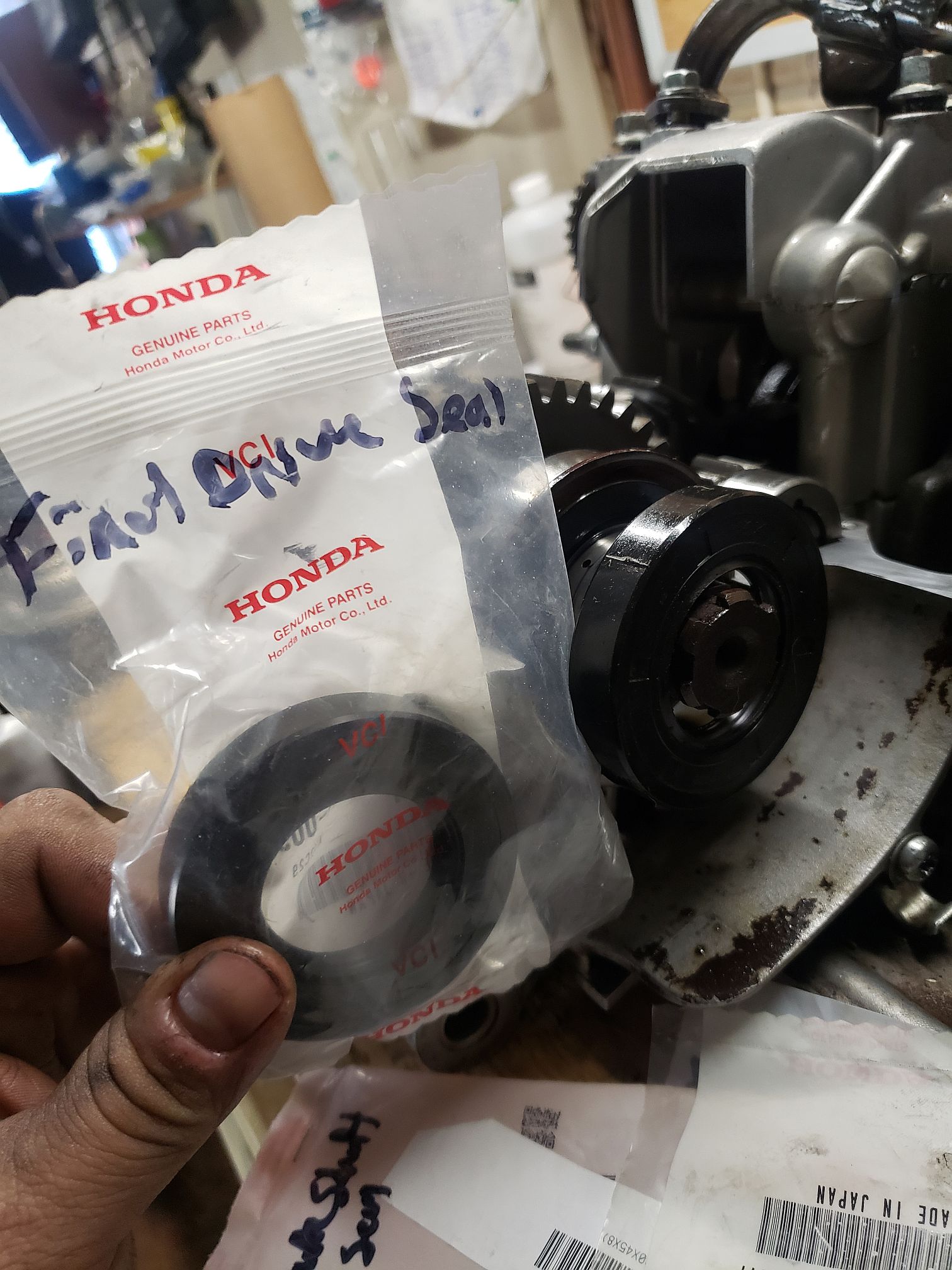
We like fun, right? Replaced gear shift seal. An easy one, but also easy to miss. It's also one of the most common leaks on this bike next to the kickstarter seal. Those marr marks are from a long time ago, when I was young and dumb didn't pry nicely. Never gave a leak, however I did take a points file and filed the burrs down.
20231015_175359.jpg


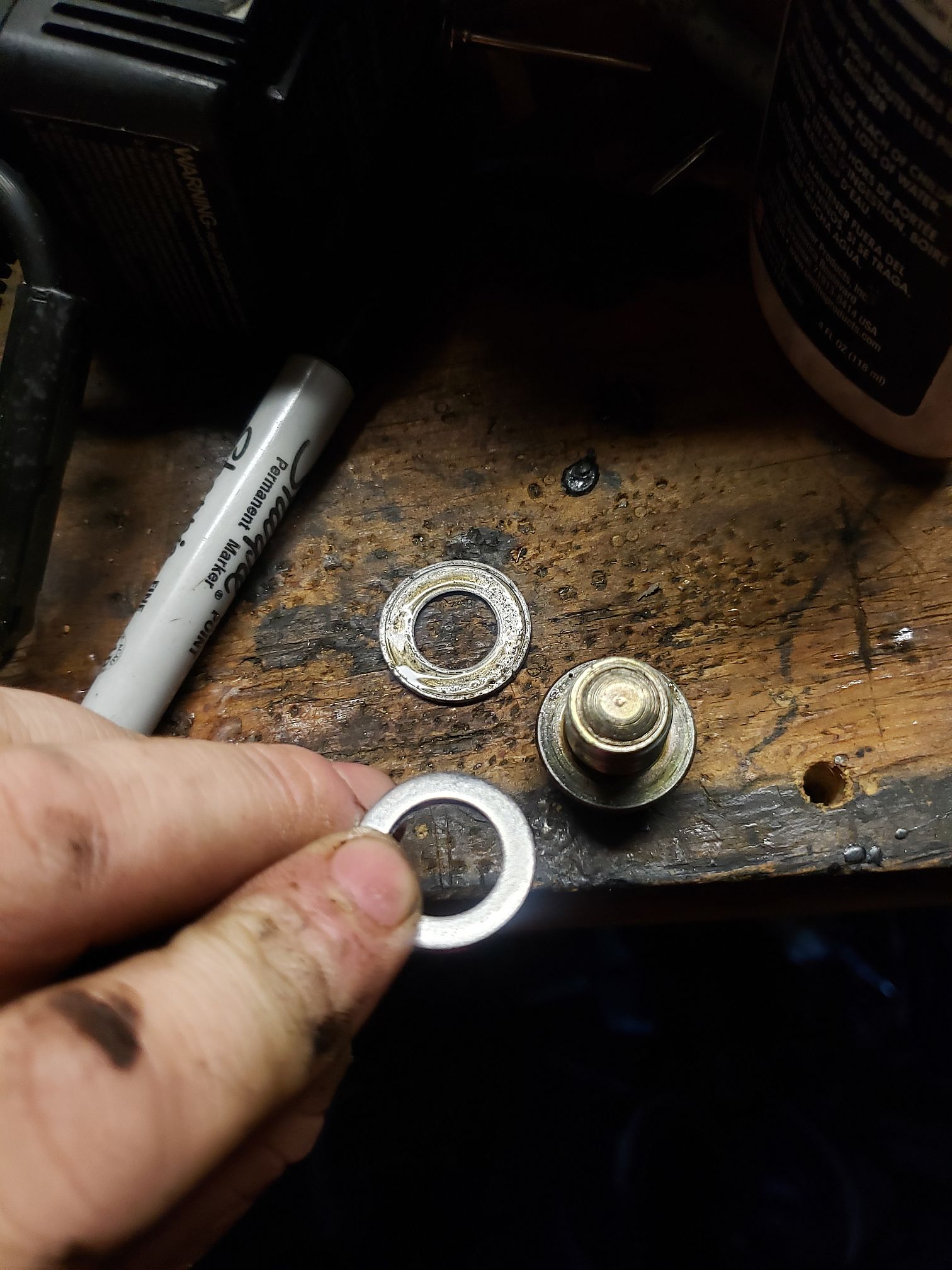
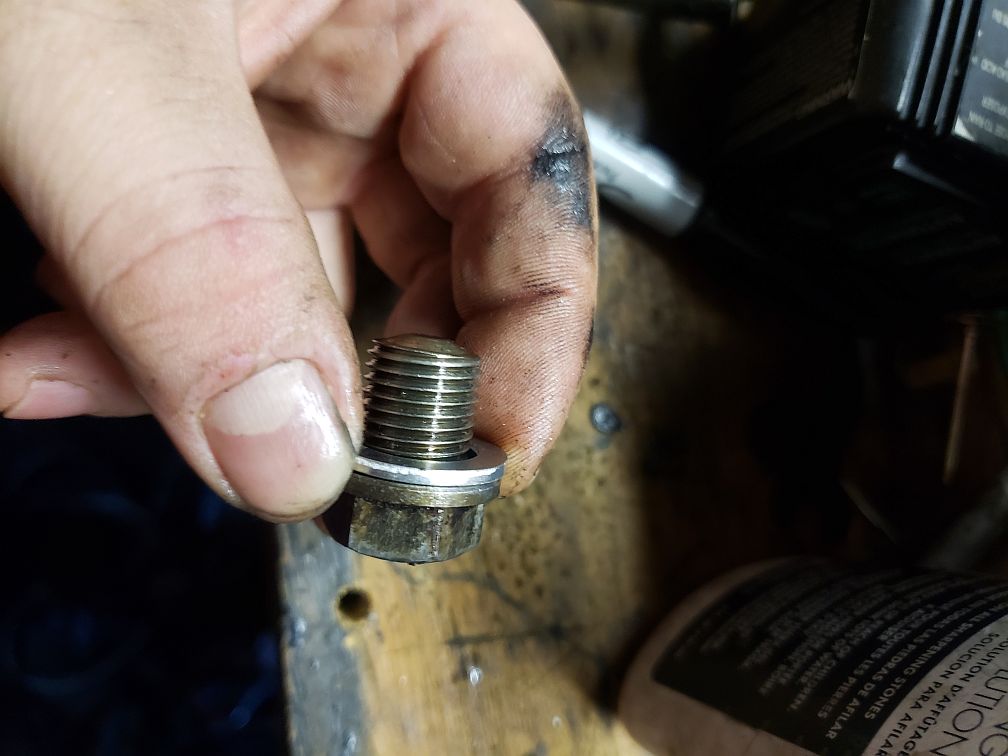
One thing that I think everyone misses, including me, is new crush washers on the drain plug. I've since bought a large bag of them.
20231015_175404.jpg


Rounded part goes towards the bolt, the rough spot goes towards the case. I only got this about finger tight. No point in getting it setup now. Just wanted to get that washer swapped out before I forget.
20231015_175411.jpg


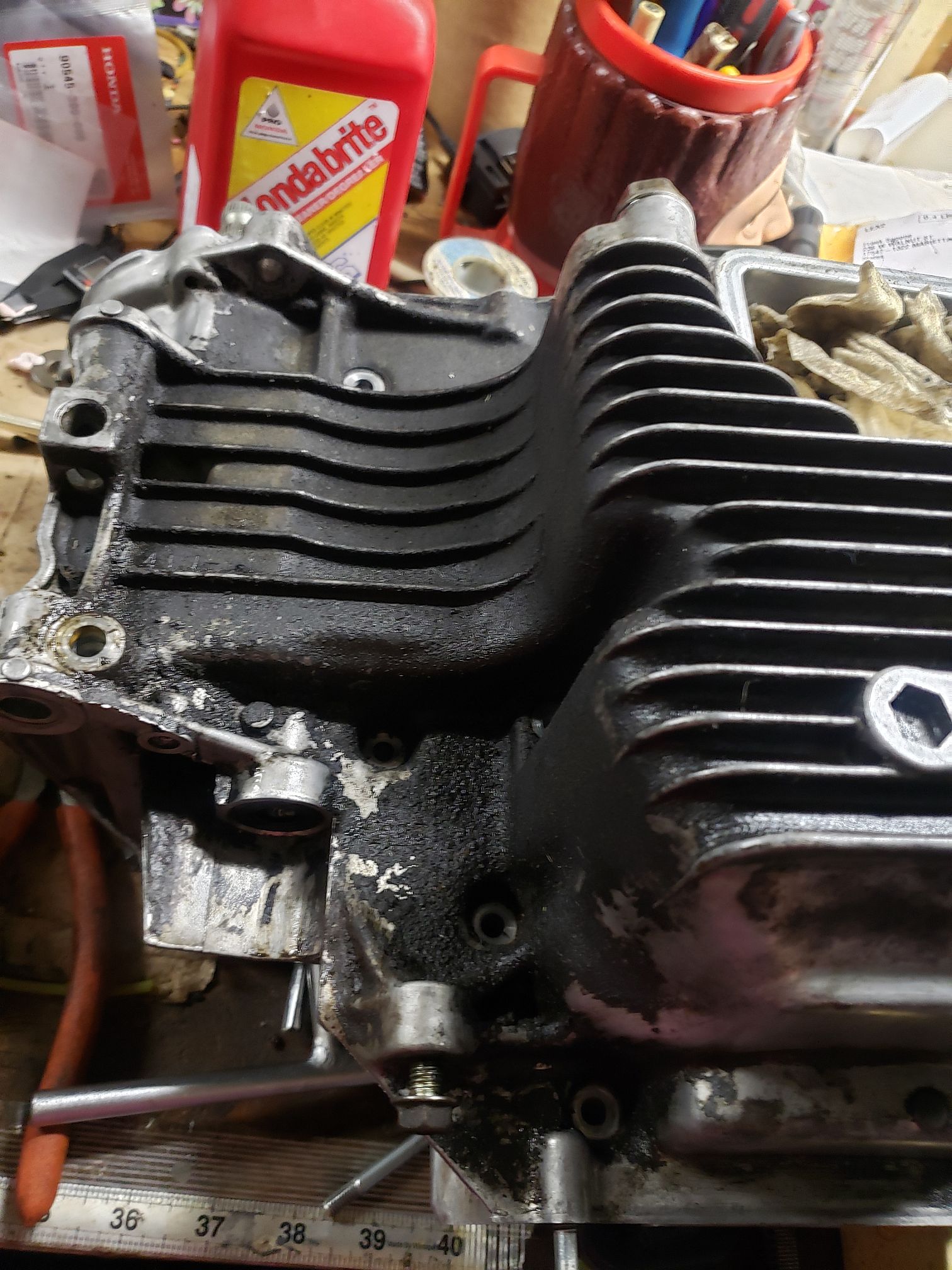
Let's take a look into the filth on the bottom of this case.
20231015_175439.jpg


I'll be using that Hondabrite, spray it on and let it soak for about 2-5 minutes then use an old toothbrush and wipe it off with new paper towels. Here's the results after about 5-10 minutes.
20231015_180529.jpg

More time and more spray. Notice the corrosion on the side of the cases from years of stuck dirt and that oil cooler. That's there to stay, and I could probably media blast or sand it out, but the oil cooler covers most of it and this isn't a 100 point restoration. I'll live.
20231015_181502.jpg


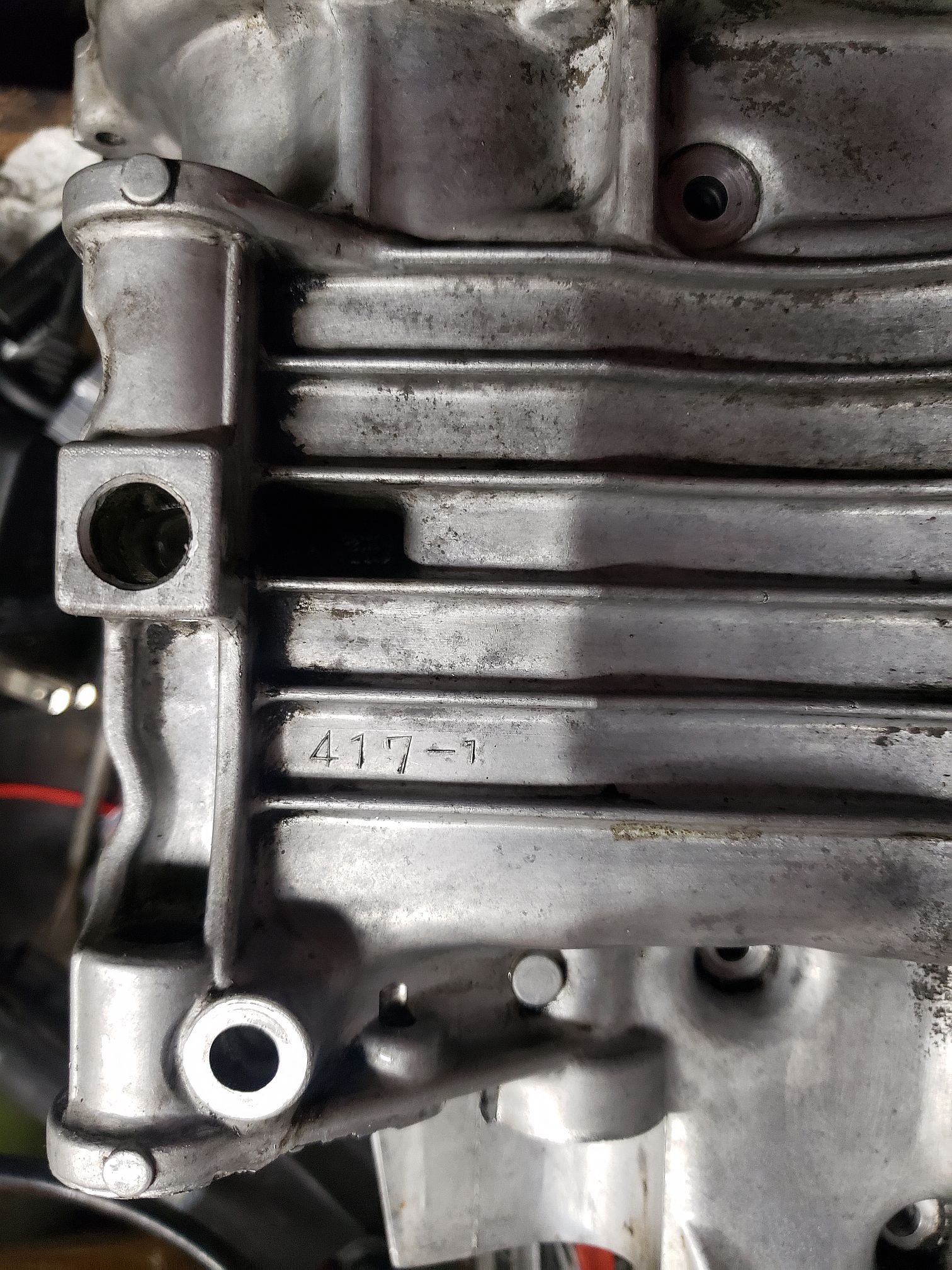
417, the middle number, indicating the series/model of the bike. Hondamatic specific part numbers have a middle suffix of 417.
20231015_183904.jpg


Final results. Not perfect, but way better than where I started. I'm satisfied, and nobody is going to see most of this anyways.
20231015_183908.jpg

20231015_183911.jpg

20231015_183914.jpg


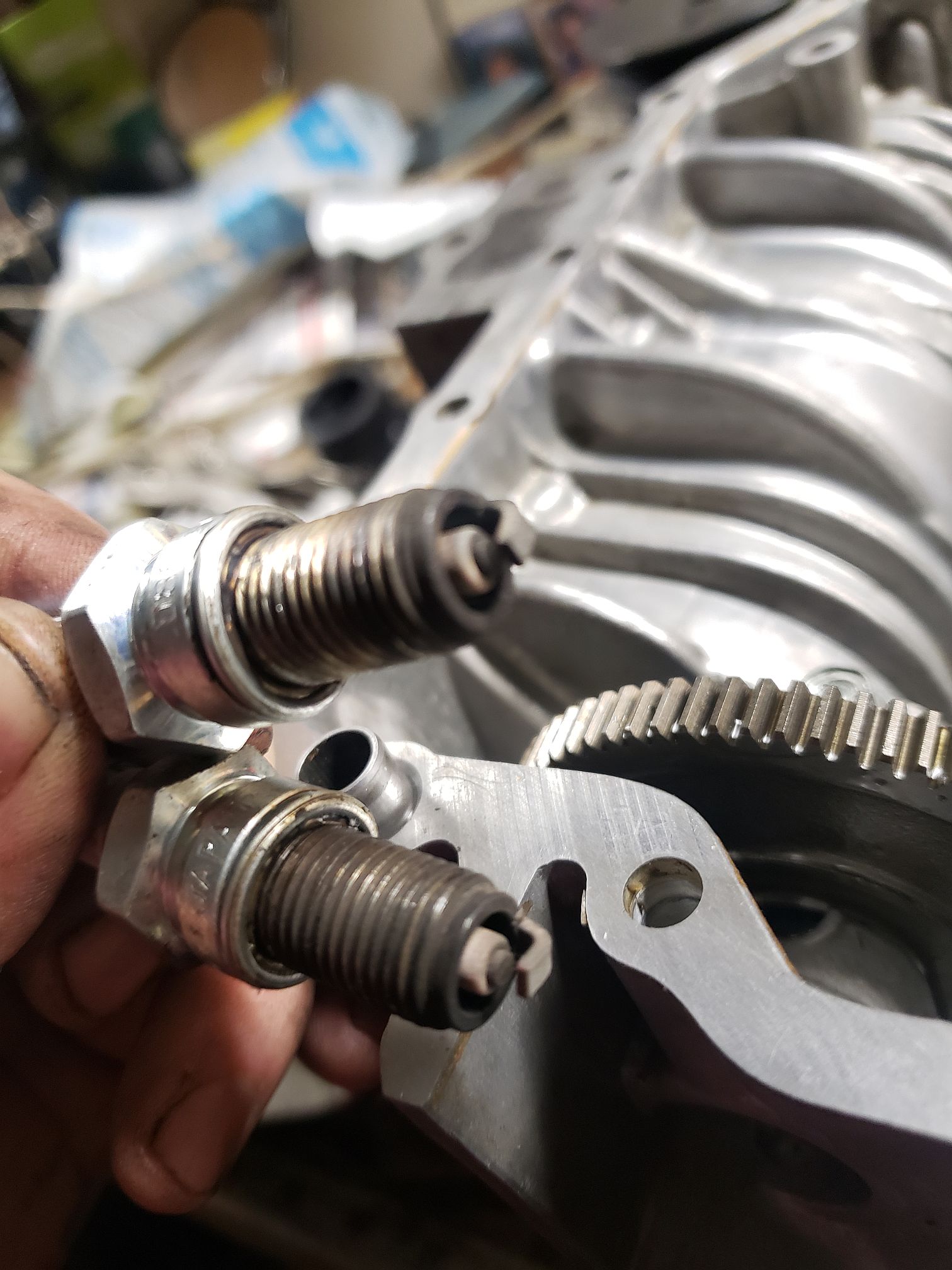
I forgot to post it earlier, but condition of the plugs over 1500 miles. Looks pretty good to me.
20231015_184020.jpg
 
Last edited:
Since my exhaust collector totally fell apart upon removal I went ahead and ordered that David Silver Spare repro. We'll see if it's any good and if it's the same inside (I will be taking a borescope to it). This also means new muffler gaskets and the rubber spacers for the chrome pieces on the side.
 
Since my exhaust collector totally fell apart upon removal I went ahead and ordered that David Silver Spare repro. We'll see if it's any good and if it's the same inside (I will be taking a borescope to it). This also means new muffler gaskets and the rubber spacers for the chrome pieces on the side.
Though I don't ever expect to be involved in any of this model, I'll be curious to know about the quality of the repop power chamber too.
 
Though I don't ever expect to be involved in any of this model, I'll be curious to know about the quality of the repop power chamber too.
Same. Jim hasn't tried it and when I asked here nobody else replied so I'd say the answer is nobody really knows for sure. But I see them go in and out of stock, so someone is buying them. I guess put it this way, I have not heard a complaint about it.

They also have the headers, mine are rusty looking in various spots but still in one piece. I'll hold off on those for another time. Also curious to see if those fit correctly.

I will be comparing dimensions and provide details when it arrives.
 
I think they get so noisy and run so awful with Hy-Vo chains on the bikes before it would get to a point that it would break when being incredibly loose. Esh's bike was a good example of that. Just enough to throw the valve timing off when it got good and hot because the chain was that loose. Though, you couldn't hear any noise.

I've seen one example of cam chain breakage on a 400 twin. There was someone on marketplace whose father died and they had 3 spare engines and his dad noted the problems with each one. Apparently one had a broken chain around 30K. But who knows the maintenance history on that one? For all we know some clown rode it around for 20K+ miles and never adjusted it. We have a joke in the automotive world, "if you turn up the radio does the noise go away?".
As you're aware I've been sick for a few days and working my way thru all the posts. There's so much to unwrap with your's I'm going to do it in pieces.
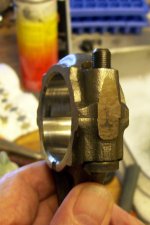
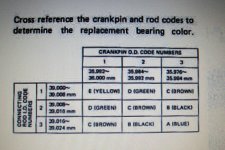
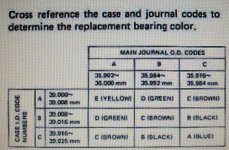
Crankshaft markings: those are for the bearing selection. They are painted on the crankshaft and easily removed with any cleaning fluids like carb spray, etc. So be careful. The B is for the crank main journal and the # is the rod journal. The corresponding case letters are stamped on the rear of the case, you mentioned they are all B's. The corresponding rod number is lightly printed on the side of the rod. You match the letters and numbers up in the FSM charts to find which bearings to use.
201_4378.JPG


201_4379.JPG

201_4414.JPG

201_4409.JPG


201_4410-001.JPG

Starter clutch: The burnishing you see on the crankshaft bushing run area isn't a problem. It's heat related to excessive starter use because of the clutch failing. The clutch failure is due to those little spring caps binding up in the housing which then allows the rollers to bounce in and out of contact. I'll suggest getting a replacement outer housing rather than reusing the old one. Reasoning is that the stuck cap has created a wear pattern and a replacement cap is likely to do the same thing at some point, time frame unknown. Obviously you want new springs, caps and rollers. The gear can be saved by turning the contact ring down but no more that .010". Use Blue loctite on the Torx screws, Not Red and definitely not Green. For replacement I don't think it'll matter on early or late gears.
 
Hey Jim,

I was waiting for you to recover so you could have a look at this thread! Yes, I spoke with Mike and some of my own judgement and I will be leaving the crank bearings alone. Plain bearings are in good shape. He said if they look good, they likely are as the cranks don't really go bad that often. So I'm not concerned.

I don't have someone, except maybe esh, that can turn the gear down properly. I already have one coming from a 450 it's in the mail. Already have new caps, rollers and springs as I was anticipating swapping them out anyways since the starter has been on the fritz for a couple of years (one of the reasons to tear the bottom end open).

The outer housing looks pressed on, and so does the inner. I think I will roll the dice on it and see. Conditions of others will be unknown. Unless you have a known good one that can be rebuilt. If it stops working again shortly thereafter I'll just go back to the kickstarter and deal with it some other time. Now that I know the insides of the engine, it's really not as scary as I thought. Especially with the auto trans.

Pretty much at this point, beyond what is posted and to recap... today I spent a good hour or two with the Hondabrite on underside of the frame where the swingarm area is and where the engine mounts. It's all stuff that I just cannot get to unless the engine and exhaust was out so now is the time to do it. I know I sound like an advertisement, but I am very impressed with that bottle of Hondabrite. I still have more than 3/4 of it left and have used it extensively with good results. Not bad for ~$9. Besides that, all surfaces are prepped, cleaned, new seals installed minus the kickstarter and crankshaft seal. Will do the crankshaft seal when doing the balancer chain and cam chain. Kickstarter seal when it's time to put the covers back on. Did not get time to run up to USPS today due to a small family emergency (everything is fine), but will do so tomorrow and finally get the heads shipped out. Starter sprocket arriving any day now.
 
I think they get so noisy and run so awful with Hy-Vo chains on the bikes before it would get to a point that it would break when being incredibly loose. Esh's bike was a good example of that. Just enough to throw the valve timing off when it got good and hot because the chain was that loose. Though, you couldn't hear any noise.

I've seen one example of cam chain breakage on a 400 twin. There was someone on marketplace whose father died and they had 3 spare engines and his dad noted the problems with each one. Apparently one had a broken chain around 30K. But who knows the maintenance history on that one? For all we know some clown rode it around for 20K+ miles and never adjusted it. We have a joke in the automotive world, "if you turn up the radio does the noise go away?".
Hy-Vo timing chain: I think lack of maintenance is the cause of all the issues with these chains. I have heard of the chain breaking before but at higher than 30K. I've heard of a lot more single roller chains breaking like the 350's. Personally I think it's a superior chain drive compared with the single roller and quite possibly to a double roller. There's a phenomenon I've called "chain whip" but actually known as "chordal motion" that's pretty well eliminated with the Hy-Vo chain. Here's an article https://www.cycleworld.com/driving-camshafts-roller-chain-silent-chain-morse-hy-vo-chain/
I think a primary reason for Honda to use the more expensive Hy-Vo chain was related to noise pollution laws.
 
I'll have to compare to the new one when I put it on, but I can "stretch" the current one if I pull on it from each end. Not sure if this is normal. Either way, like Tom and I were talking about if I'm ripping the bottom end open might as well do it. So I will.
 
OK. I checked the 79 addendum, it mentions nothing. So this means 78 CB400A users with early serial numbers beware. You can probably switch to the newer pump, but I have no idea.
The first production SOHC 400 engines all need the later pump, A models included. There is no gasket used on the pater pumps. The width of the tricodial rotors was increased for higher volume.
I would look for the lastest 450A pump if there's one for a reasonable price. It may measure out to be identical but it may also be an improvement.
In any case it does deserve to be disassembled for damage inspection.
 
Everything looks like it's going according to plan. I didn't see where you blew out the case oil passageways for the trans to be sure they're clear.
Did you remove the small trans roller bearings and check the shafts for damage? Did you check the large trans bearings for flat spots by applying pressure while turning them?
WHAT? a new drain plug washer? Don't need that, you just tighten it more and more and more. :ROFLMAO: :ROFLMAO: :ROFLMAO:
 
Everything looks like it's going according to plan. I didn't see where you blew out the case oil passageways for the trans to be sure they're clear.
Did you remove the small trans roller bearings and check the shafts for damage? Did you check the large trans bearings for flat spots by applying pressure while turning them?
WHAT? a new drain plug washer? Don't need that, you just tighten it more and more and more. :ROFLMAO: :ROFLMAO: :ROFLMAO:
If you're referring to the oil hole on the right where the trans aligns to, yes that one was checked. I really do not want to remove bearings from the trans and completely disassemble that. I believe it is all press fit, yes? If yes, I am not really equipped to do that and don't want to cool the shaft and heat bearings. Trans has been working with no issues for a long time. The large bearings are fine and move smoothly.

If I had a spare trans to practice on completely tearing it apart I'd feel more confident, but I don't and I feel like it's probably OK. Bike wasn't ran low on oil like that and I never abused it.

Yeah the drain plug washer is one of those things everyone is supposed to do, but nobody really does.

If I'm ever able to come across a junk 400A engine for cheap then I will look into ripping a trans apart. With regards to the oil pump, I can check it but it's going to have to wait until the engine is back in the frame because those screws tend to be on there incredibly tight and trying to do it on the bench isn't going to go over very well. If it's truly bad I can source a new one at a reasonable price. FYI, the 450A pump is the same superseded part number as the 400A. Not sure if there's a flow rate difference, but CMSNL lists that it fits 400A bikes as well.
 
OK, I was being dumb. Caged bearings are the larger, typical style when I think of bearings. I've always referred to the roller bearings as needle bearings. Those look like they can come off easy for inspection. Really all I need to worry about it is flat spots and crunchiness/binding on these correct? I have plenty of time now. It's going to be a week before that gear shows up.

Some other news and even some information I was unaware of:

  • Got a deal on the official piston base tools. I know you could do Jim's method with cardboard or make something out of a piece of wood. Or if you're @esh21167 you could machine it yourself. I don't want to goof around with any of that, so I bought the real tool. Will come in handy next year when I tackle the CB550.
  • David Silver Spares actually has a new cylinder in stock and at what I could consider a price for the people. Not necessary for me, work is now done. But the interesting thing is that it mentions it's the later model that requires the use of the two left inner bolts with the rubbers. This got me thinking, my bike itself has no rubbers. Indicating it's an early version of the cylinder. When I got the spare cylinder I did ask him to include the bolts. That one DOES have the rubbers. So I will need to make sure to use the correct ones. I was unaware of this, but Jim probably knew about this quirk.
  • Got quotes from shipping USPS double boxed. Significantly cheaper than the rip off UPS gave me previously. Now because of the strike the prices are completely insane. I shipped that cylinder it cost about $120. To ship the smaller box, double boxed, with the piston, rings and valves was like $117. I nearly fell over, thought it was a joke. I was expecting about $60 for the cylinder and like $30 or so for the smaller box. USPS first class, double boxed, with the fee for using a larger box to double box it is like $60. Way more reasonable. Probably about $70 with the insurance.
 
Ooops(UPS) settled that strike with drivers now getting $53/hr including benefits. Haven't used them for years and groan when I'm getting something shipped thru them. Post Office(USPS) or FedEx are my choices for shipping. Surprisingly FedEx is typically a few dollars cheaper.
It's a bit odd about the cylinders. The CB400 versions in '78/79 didn't have the rubber head bolts, those were found on the '79 CM400 engines. Partzilla is showing the cylinder available again for $388.
 
There are other sources, substantially cheap than PZ. Maybe Honda switched in the middle of 79. They don't really make that information public sometimes. As far as I know everything is original and has never been opened up before. No signs of such things either.

There is one documented change that I'm aware of. At some point in between 78-79 they changed the rockers to eliminate the springs and used a wave washer in it's place.

I did get those o-rings from MCM for the starter. They work fine. So thanks @fxray . I checked the needle bearings on the trans, they are good. I will pull it out further later and verify the oil passageways again.

I can try to stop at FedEx later and see. It's kind of out of my way, so I don't like to use them.
 
There are other sources, substantially cheap than PZ. Maybe Honda switched in the middle of 79. They don't really make that information public sometimes.
But, if there's a part number change related to engine numbers, that verifies a change of some sort whether Honda mentions it or not.
 
But, if there's a part number change related to engine numbers, that verifies a change of some sort whether Honda mentions it or not.
Yeah, but the thing is the book doesn't mention it, not even in the addendums. So it seems to be a sneaky change at some point.
 
Yeah, but the thing is the book doesn't mention it, not even in the addendums. So it seems to be a sneaky change at some point.
I know, and honestly many of the minor changes were never documented in the FSMs, Honda fixed stuff wen it needed to be fixed instead of waiting for the model year end like so many others. So checking part numbers, when changes are associated with a section of engine numbers, is one way to know. Service bulletins are another if any change was announced, but typically the public can't access that info. And most of our service bulletins are of the older models prior to the SOHC twin series.
 
Yeah. Just the nature of the beast sometimes.

I got bored and decided to spray bomb the battery box. It has some rust on the bottom left, typical from running an acid battery without a hose or a pinched/incorrectly routed hose.


Nobody is going to really see it, but gave me something to do. So therefore it's not going to be an all-out thing. I simply scuffed it all red scotch brite, used a brass wire wheel to clean up some surface rust and a bit of 320 to feather it out.
20231017_155500.jpg


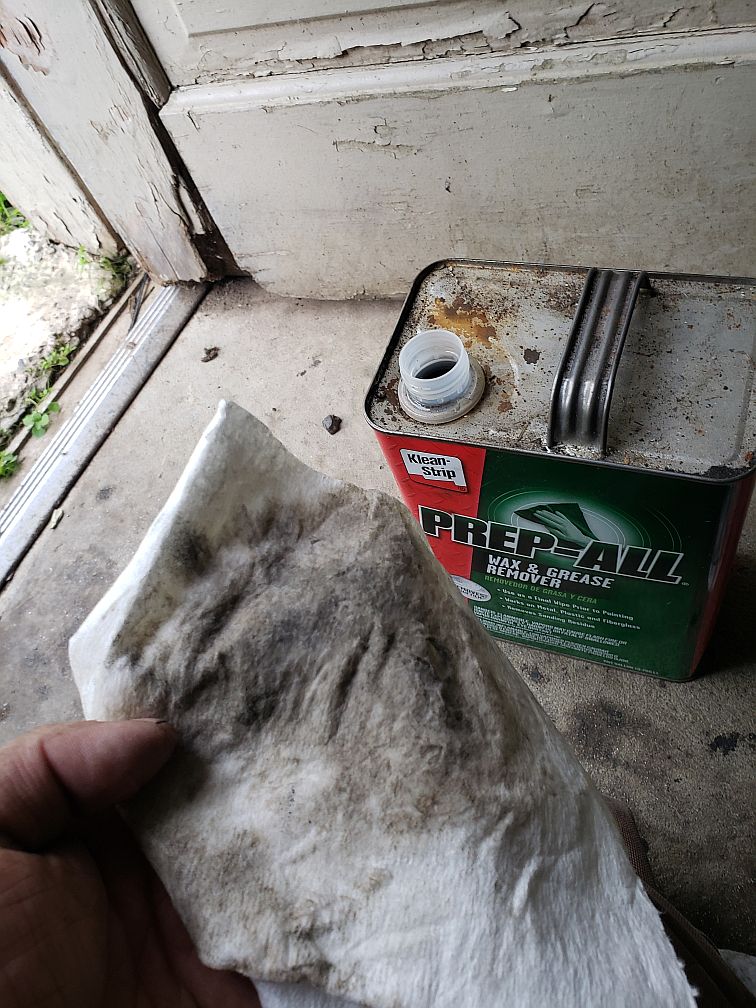
Wipe the surface off with wax and grease remover or acetone. This step is important. The following picture is the result of wiping.

20231017_155633.jpg


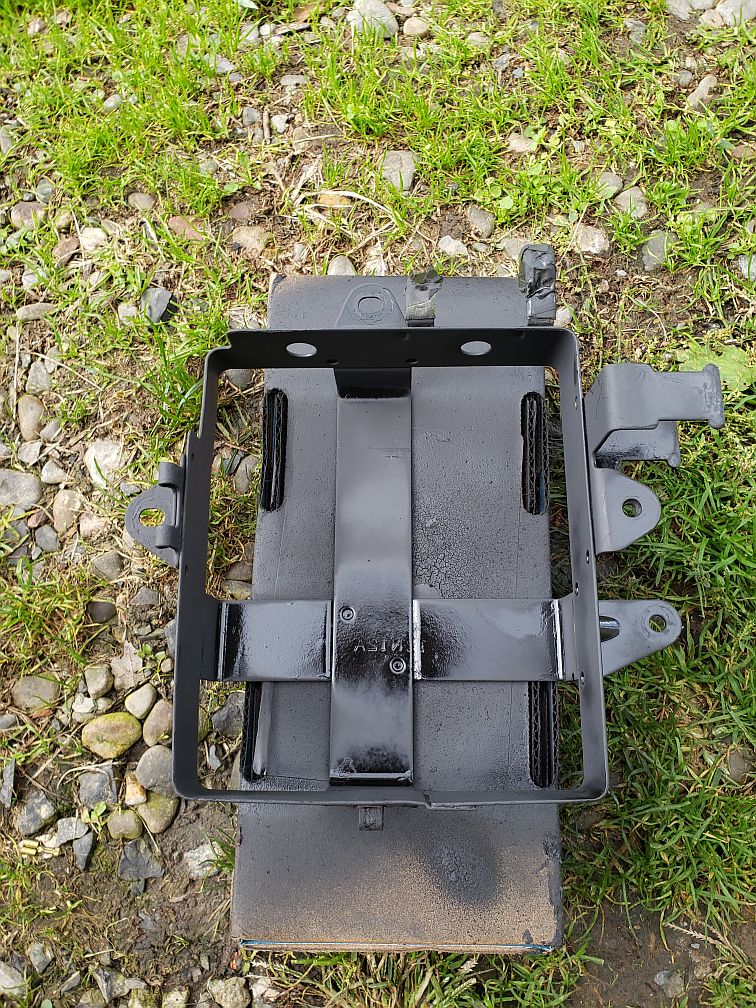
First coat with some rustoleum.
20231017_155835.jpg


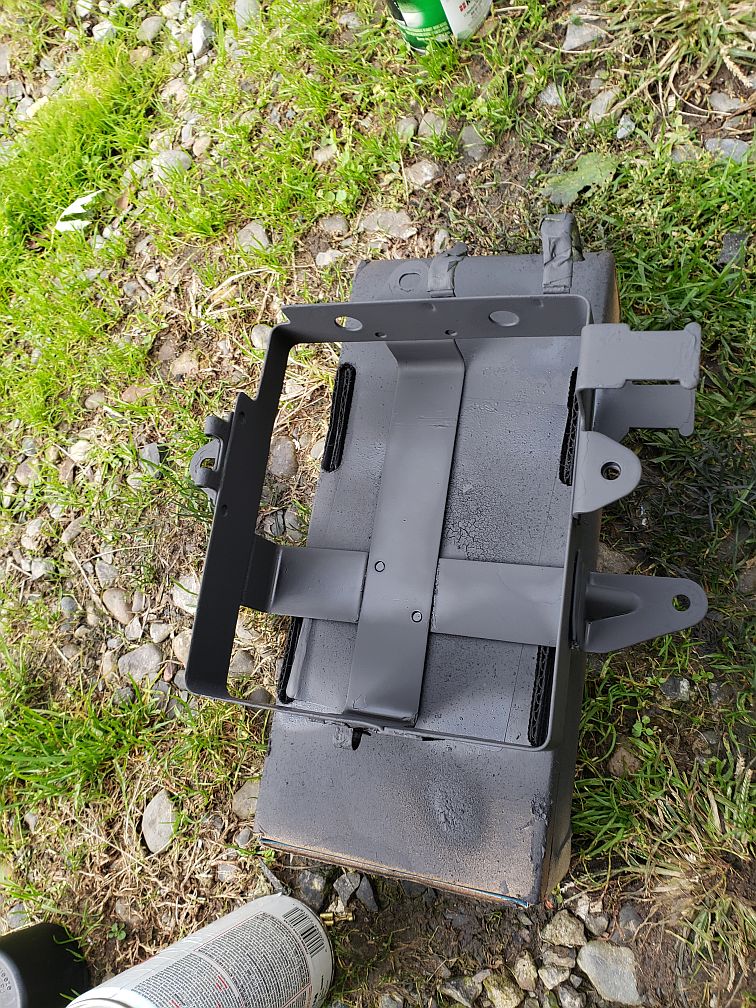
Second coat.
20231017_160208.jpg


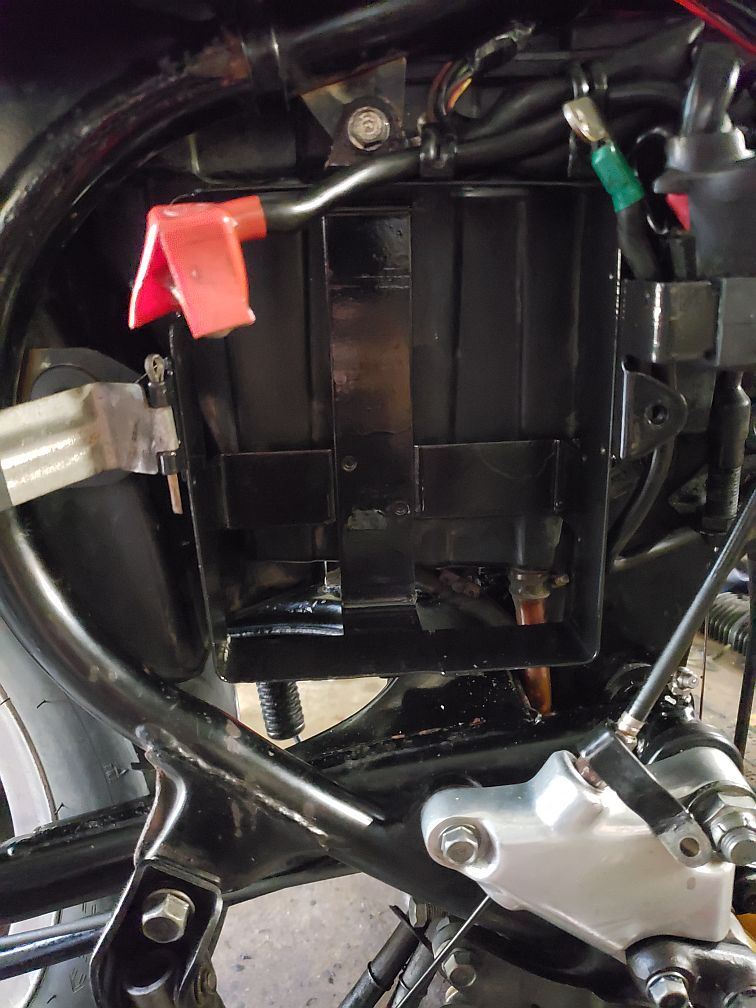
Sprayed two coats of spray bomb clear and back on the bike. A bit shinier than original, but nobody is really going to notice. Makes me feel better.
20231017_163118.jpg


An easy way to tell if your balancers are junk before you even open them is just hold one side and put pressure on the gear. If it moves back and forth, any play, the rubbers are junk. So I decided to open them up to show you.
20231017_165902.jpg

20231017_170554.jpg


I'm sure the 450 ones Jim recommended will be a welcome upgrade. Maybe smooth things out a little bit.
 
Last edited:
Back
Top Bottom