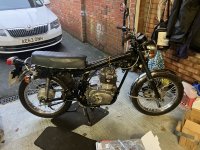
1977 CB200

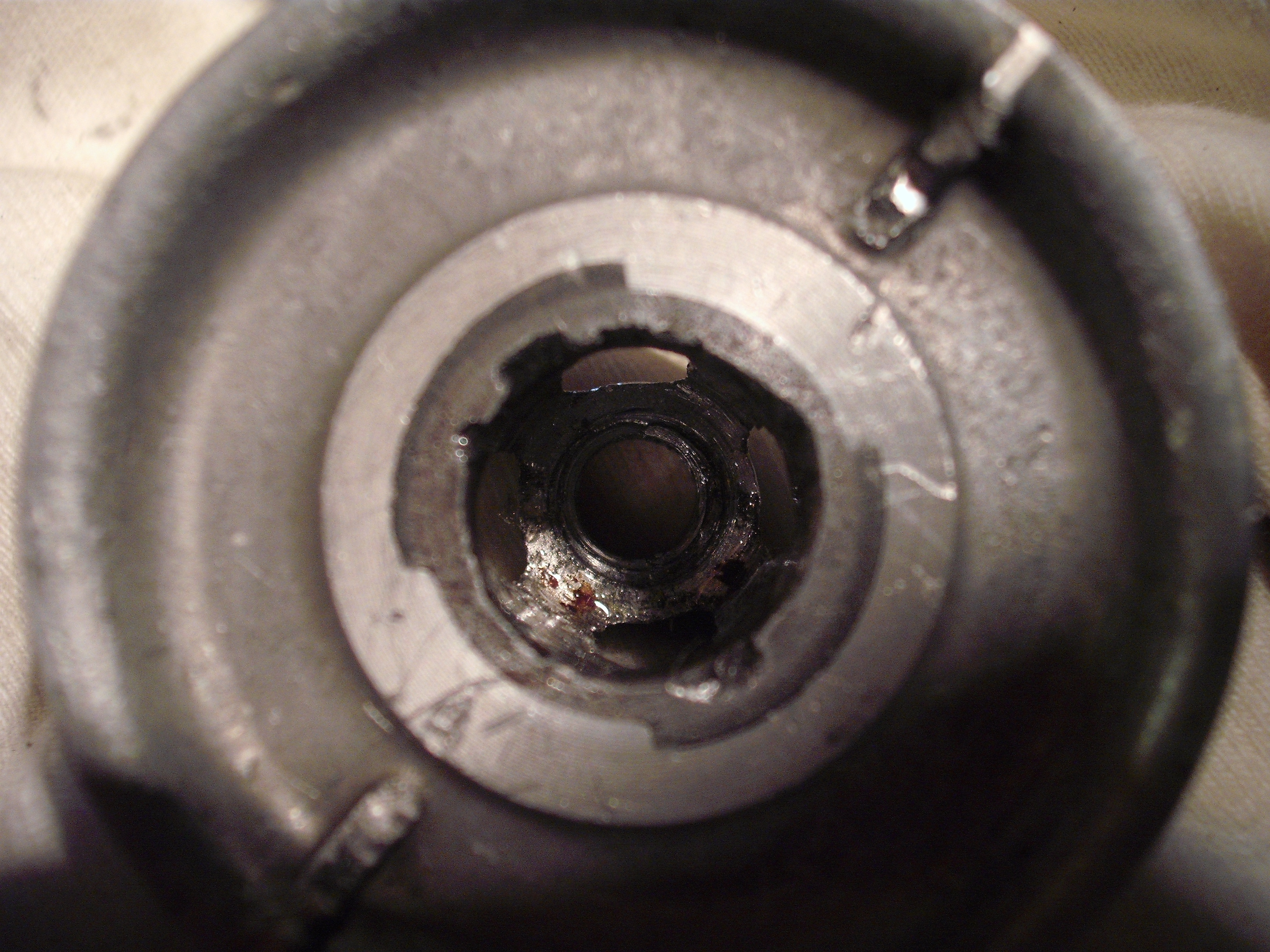
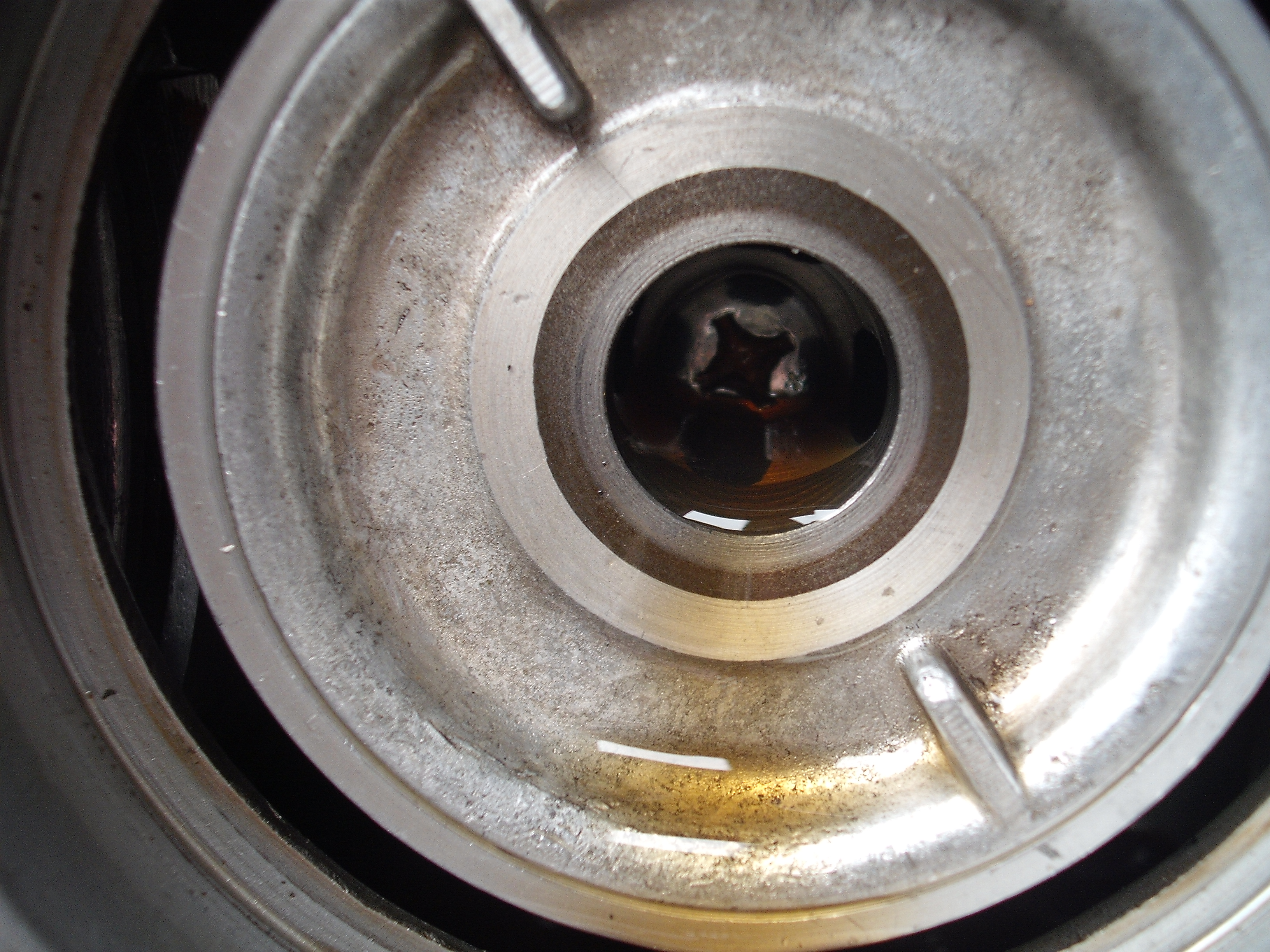
As above, one of the handlebar mounting bolts is ideal for use as a puller. But worse news, based on that photo the filter cap is scrap, the area around the central hole is a bearing surface, forming a seal against the spring loaded valve in the outer cover. Any damage here results in a loss of oil pressure. As it happens, the CB200 motor that I mentioned had exactly this problem.

My duff one

Df9jTvl.jpg


and its replacement

OPlpQPm.jpg
Thank you, I’ll have a look at that.
Alan
 
This is the manual I have:

… it looks the same style as the one I have for my Goldwing, so I’m assuming it is the correct one? It would be very kind of you to send a link so I could download a library copy so I could check it is the same.

Alan
It looks to be the correct one, but I'll send you a link for the one we have in our library in case.
 
I'd intended to make a good start on the rebuild today, but other things kept getting in my way (trivia like buying a house and so on). Once I did find time to get out to the garage this afternoon the usual 50 year old motorcycle issues prevented me from making much progress.

The oil filters are now cleaned, which is good news, but as I was putting the right side engine covers back on I noticed that two of the M6 threads had stripped - indeed it looked like the mechanic that fitted the new clutch for the PO had used a little bit of glue (or similar) to hold them in. That won't do... so it then took me a while to find a M6 helicoil kit - by which time it was getting a bit cold and dark, Those two little repairs will have to wait until tomorrow. I only have the morning free tomorrow (Thursday), and I think no spare time on Friday, so I won't get the motorcycle back together by the end of this week as I'd intended.

Ho hum :cautious:
 
Was I mistaken about the condition of the oil filter cap ?
I've given it a polish up - it isn't perfect, and of course I can't see how well the case seats on it, but the sealing surface is flat and smooth now. I'm going to take a chance as I can't find Honda part 15441354000 in stock anywhere in the UK.

It is hard to know when to stop with reconditioning older machines, in a perfect world I'd blueprint the motor and gearbox, but that might take a year looking for obsolescent parts.

Alan
 
I've given it a polish up - it isn't perfect, and of course I can't see how well the case seats on it, but the sealing surface is flat and smooth now. I'm going to take a chance as I can't find Honda part 15441354000 in stock anywhere in the UK.

It is hard to know when to stop with reconditioning older machines, in a perfect world I'd blueprint the motor and gearbox, but that might take a year looking for obsolescent parts.

Alan
At a minimum I would check the strength of the spring which keeps those two mating surfaces together. The spring being in the outer cover pushing on the oil guide.
 
At a minimum I would check the strength of the spring which keeps those two mating surfaces together. The spring being in the outer cover pushing on the oil guide.
Was I mistaken about the condition of the oil filter cap ?
Thank you chaps,

I will re-visit this today. I have to take the cover off again anyway (to fix the two stripped engine case threads with helicoils). Thank you for the prompt.

Alan
 
If you are talking about the surface which the rim of the cap meets, there is supposed to be an o ring there, should be replaced. Also looks like replacement cap may be available on cmsnl.
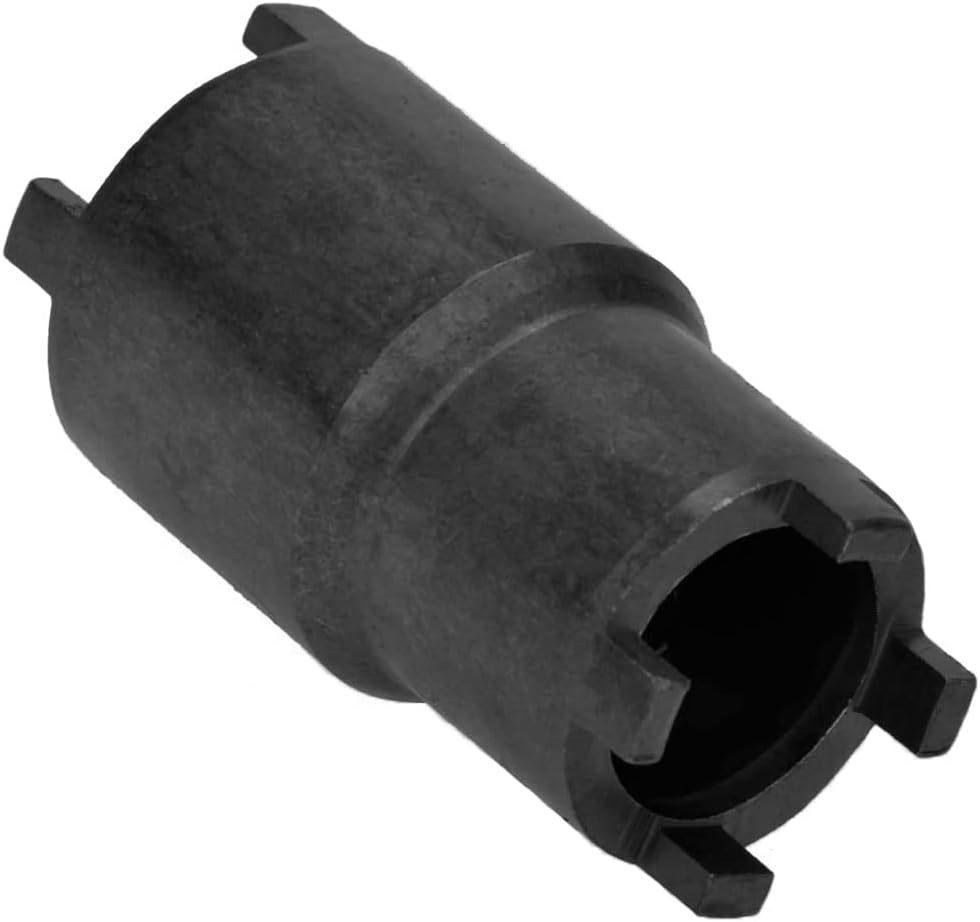
And for planning ahead, may want to acquire this tool.
51owGxjjHEL._AC_SL1500_.jpg
Fortunately that O ring is the same size as fits the water pump on my Goldwing GL1200 - so I had a spare to hand.

The tool is for...?

Alan
 
Fortunately that O ring is the same size as fits the water pump on my Goldwing GL1200 - so I had a spare to hand.

The tool is for...?

Alan
The special locking nut holding the oil filter. Don't forget to straighten the tab of it's special locking washer first.
 
The special locking nut holding the oil filter. Don't forget to straighten the tab of it's special locking washer first.
Ah, for removing the whole centrifugal oil filter assembly - tool # 07916-2830000 - thank you, I may look out for one of those in the longer term but I won't need it for servicing today.

I'm pretty confident (as much as one can be) that the oil feed is making good contact with the centrifugal filter now - I dropped my endoscope down through the oil filler hole and could see the metal surfaces touching.

Whilst I had the endoscope out I had a good look into the cam chain and the two crankcase cavities. I know it isn't as conclusive as a full strip down of the motor, but it does show there are no birds‘ nests or other things that shouldn't be there. Everything looks pretty sound so I think that concludes my pre-reassembly checks.

I had a stroke of good fortune with the two bolt holes I was going to fit helicoils into this morning. When I checked I could see that the issue wasn't about the threads being stripped in the aluminium, it was that a PO had replaced the engine bolts (with smart Allen head ones) that were too short. Two of the bolts only protruded into the threads by one or two turns. The answer was simple: to fit some longer case bolts. Fortunately I had plenty of spares and soon found a pair (with Allen heads so they look the same) that could be trimmed to fit perfectly. It is always best to measure several times before cutting metal :cool:.

So, I'm ready to start putting everything together now, but I don't have enough time to finish this morning, so that will be a job for tomorrow. Hopefully I won't find any more gremlins as I put my 47 year old engine back together :unsure:.
 
Last edited:
When it's all back together and filled with oil, before initial startup you can check that oil is reaching the top end by spinning the motor over ( I use a cordless drill on the alternator rotor bolt, rather than straining the electric start ) and checking for oil at the slacked off right rear outer head nut. Honda suggest doing this with the engine running, but if there is a problem that might be a bit late ..
 
When it's all back together and filled with oil, before initial startup you can check that oil is reaching the top end by spinning the motor over ( I use a cordless drill on the alternator rotor bolt, rather than straining the electric start ) and checking for oil at the slacked off right rear outer head nut. Honda suggest doing this with the engine running, but if there is a problem that might be a bit late ..
Thank you for that; so one of the 8 domed nuts?

Alan
 
Thank you for that; so one of the 8 domed nuts?

Alan
Yes, though I've never been a fan of un-torquing one of the 8 cylinder stud nuts after a proper torquing sequence, it is the recommended method on many twins. Have your torque wrench handy and reset it to whatever value you torqued them to originally.
 
To expound on the thought above, it's the right rear outer stud/cap nut as mentioned by Richard above. That particular rear stud is the path to the top end for oil flow from the centrifugal filter.
 
To expound on the thought above, it's the right rear outer stud/cap nut as mentioned by Richard above. That particular rear stud is the path to the top end for oil flow from the centrifugal filter.
So the oil pathway is up the right rear cylinder/head stud, and then on to the camshaft?

IMG_2072.jpeg

… I’m guessing the rear stud should not have the spacer that is fitted to the front stud (also the front left hand stud) so as not to impede the oil flow?

Alan
 
Correct. The parts fiche shows a total of 6 required (#51), 4 of which are used with the head gasket. Despite the base gasket seemingly showing the cutouts for the oil flow areas on the forward holes in the gasket... :rolleyes:

honda-cb200-england-cylinder-cylinder-head_big00025862e01_4b67.gif
 
Correct. The parts fiche shows a total of 6 required (#51), 4 of which are used with the head gasket. Despite the base gasket seemingly showing the cutouts for the oil flow areas on the forward holes in the gasket... :rolleyes:

honda-cb200-england-cylinder-cylinder-head_big00025862e01_4b67.gif
Thank you, that is really helpful.
I think you are right - the base gasket is shown back to front.
Alan
 
When it's all back together and filled with oil, before initial startup you can check that oil is reaching the top end by spinning the motor over ( I use a cordless drill on the alternator rotor bolt, rather than straining the electric start ) and checking for oil at the slacked off right rear outer head nut. Honda suggest doing this with the engine running, but if there is a problem that might be a bit late ..
Just a thought about using the alternator rotor bolt. Wouldn't the oil drain out via the removed generator case?
Alan
 
Just remove the inspection cover, three JIS screws. Might need a block of wood under that side of the centre stand to incline the bike slightly to stop oil coming over. Same thing as when checking the ignition timing, setting valve clearances etc.
 
You would be turning the rotor bolt counter clockwise with your drill which could break the bolt free. Make sure the spark plugs are out to minimize the effort required.
 
You would be turning the rotor bolt counter clockwise with your drill which could break the bolt free. Make sure the spark plugs are out to minimize the effort required.
... I'd assumed Richard meant clockwise - so as not to loosen the bolt? :unsure:
 
... I'd assumed Richard meant clockwise - so as not to loosen the bolt? :unsure:
While the oil pump would probably work backwards, it's best to check the engine turning in its normal direction. If the alternator rotor bolt is properly tight, it shouldn't loosen by turning the engine with the spark plugs removed.
 
As Tom says, you won't undo a correctly tightened alternator bolt by using it to rotate the engine, and of course it should be rotated anti clockwise, following the direction arrow on the rotor.
 
While the oil pump would probably work backwards, it's best to check the engine turning in its normal direction. If the alternator rotor bolt is properly tight, it shouldn't loosen by turning the engine with the spark plugs removed.
Okay. I could think of no reason why the oil pump wouldn't work just as well backwards as forwards - hence jumping to the conclusion I should spin the generator (and hence the motor) backwards. If this was a crank bolt on a car engine (and I know - it isn't) I would never spin it backwards unless I was removing it. This isn't quite the same though, it is a generator bolt and a motorcycle engine (particularly with the plugs removed) will have little inertia compared with a car. I suppose I could re-torque the generator bolt once I have the drive chain back on?

I'm wondering whether 10 or 15 sharp kicks on the lever might achieve the same - I only need to see some evidence of oil appearing at the cylinder head?

Alan :unsure:
 
As Tom says, you won't undo a correctly tightened alternator bolt by using it to rotate the engine, and of course it should be rotated anti clockwise, following the direction arrow on the rotor.
Thank you. I think our comments passed in the ether.

I see your point, and as I said above, I could always re-torque the generator bolt once I've refitted the drive chain.

Alan :cool:
 
It might take more than 10 to 15 kicks but yes, you would eventually get oil to the top end by kickstarter.

I rotated Honda engines backwards long before the internet existed and never had any troubles as a result. I would say that an engine with a very loose cam chain, or damaged tensioner components, might jump a tooth or two in cam timing if turned backwards, but with an engine in proper working condition and adjustment it isn't going to happen. It's basically another wive's tale gotten larger than life with internet repetitions.
 
It been covered it seems and you have your answer on the rotation of the rotor and motor.
 
Agreed. I thought that the main point of only turning the engine anti clockwise was to do with setting the ignition timing, and secondly the valve clearances, to ensure cam chain was pulled tight in the forward direction, so cam was in right position with regard to crankshaft position.
 
It might take more than 10 to 15 kicks but yes, you would eventually get oil to the top end by kickstarter.

I rotated Honda engines backwards long before the internet existed and never had any troubles as a result. I would say that an engine with a very loose cam chain, or damaged tensioner components, might jump a tooth or two in cam timing if turned backwards, but with an engine in proper working condition and adjustment it isn't going to happen. It's basically another wive's tale gotten larger than life with internet repetitions.
Yes, I'd thought about the issue of the slack in the cam chain being at the front rather than the back of the motor if it were to be rotated backwards, but discounted it because at that stage I'd have checked it was properly tensioned immediately prior. I think both methods would work perfectly well, but I'm happy to go with the flow and rotate the motor forwards (anticlockwise).

I may start off using the kick starter, it wouldn't be a bad idea to get a bit of oil flowing round the rebuilt top end slowly. If my right leg gets too tired before any sign of oil appears at the head I can then resort to the electric drill method (anticlockwise of course :cautious:.

Many thanks for your help and advice on this issue chaps.

Alan
 
Last edited:
I'm just lazy, kick start method took far too long for my liking, and the leccy drill method is easiest method when engine is out of the bike, on the bench.
 
I'm just lazy, kick start method took far too long for my liking, and the leccy drill method is easiest method when engine is out of the bike, on the bench.
Ah! I hadn't really considered filling the motor with oil before fitting it in the frame :sneaky:.
 
Yes, I'd thought about the issue of the slack in the cam chain being at the front rather than the back of the motor if it were to be rotated backwards, but discounted it because at that stage I'd have checked it was properly tensioned immediately prior. I think both methods would work perfectly well, but I'm happy to go with the flow and rotate the motor forwards (anticlockwise).

I may start off using the kick starter, it wouldn't be a bad idea to get a bit of oil flowing round the rebuilt top end slowly. If my right leg gets too tired before any sign of oil appears at the head I can then resort to the electric drill method (anticlockwise of course :cautious:.

Many thanks for your help and advice on this issue chaps.

Alan
Pretty much a non-issue, you can't turn it clockwise with the electric starter in place.
 
An engine reassembly question if I may. The manual talks of inserting the 4 knock pins and 2 O rings at the same time as the head gasket. The knock pins are obvious (part #51 in this diagram) but it isn't obvious where the two O rings (part #38) go (I didn't retrieve any from the previous installation, which may mean they have wasted away over decades, or the previous assembler may have left them out?).

Now, it looks like the two O rings go on the rear outer head studs. Do they fit in the hole that goes through the cylinder head prior to tapping in the knock pins or round the knock pins and into the larger hole in the cylinder head gasket?

1705754941609.png


Alan :unsure:
 
around them. See the second photo in your post #54
Fabulous! You have far better attention to detail than do I :cautious:.

Many thanks.

Addendum: that explains it I think. That block was from a stock photo I found online. It would seem most likely that the previous installer had omitted them. I’d better find some new ones :cool:
 
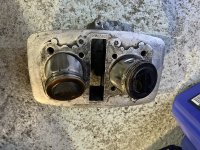
I had half a day free yesterday, so I started the rebuild. Everything has gone pretty smoothly so far: replacement pistons and barrels on, head replaced (including those two little O rings the previous assembler had omitted), new cam and chain installed, journals push fitted.

I had the valve timing spot on (so I thought) until I released the chain tensioner bolt - which has moved it backwards a little. By then it was getting dark, cold and I was a bit tired, so I'll check that today and see it it has moved it a whole tooth on the sprocket. If it has I'll have to re-position the chain by one link and set it up again, if it is half a tooth or less it will be fine and I'll get the rest back together.

Baring calamities I should have the motor back together and in the frame by the end of today.

Alan :cool:
 
The valve timing turned out to be a good compromise, a whole tooth moved would have been futher the other side of the mark. Everything is going together well, but I’ve ended up correcting lots of things along the way. I’ve concluded that the previous assembler just put the motor together badly (probably for the big bore conversion), that was rather confirmed when I tried to check the oil circulation using the method Richard suggested: spinning the motor up from the generator bolt. Unfortunately the bolt started coming undone fairly soon. That probably shouldn’t have happened if the bolt had been torqued up properly, so I rather assume it wasn’t done up properly. No matter, I tightened up the bolt with a cordless impact driver, and I‘ll torque it up properly when I’ve got the drive chain back on.

The motor is back together and in the frame, which is where I’d hoped to get to today:

IMG_2835.jpeg

I‘ll get the cycle back together in the next day or two, I’m taking a chance on there being nothing else wrong, but I’m an optimist so it should be running and riding in a jiffy.

Anyone fancy a big bore kit for a CB200:

IMG_2836.jpeg

:cool:
 
Last edited:
It runs (after a fashion)!

So the CB200 is more or less back together. There is some good news, and some not so good:

First of all, it started up on the key pretty easily, and it runs:

The CB200 runs (after a fashion)…

It needs quite a bit of fettling and some faults sorting out, but it is nearly there. One piece of really good news is that the oil supply to the cylinder head is very healthy. I used Richard’s suggested method of slackening the rear right cylinder head nut a few turns when I first ran the engine and was rewarded with a copious supply of oil. I have tightened the bolt, but must remember to re-torque it tomorrow.

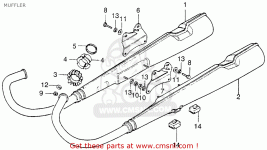
Some not so good things: the silencers (mufflers) are rubbish, I have a new set of replicas that I’ll fit and should both quieten the engine and allow the kickstart to be used. An exhaust question if I may, the gasket kit came with these copper crush washers (presumably for the exhaust ports):

IMG_2841.jpeg

There were none fitted previously and they don’t seem to be mentioned in the manual, so I didn’t fit them today. Should I have fitted them?

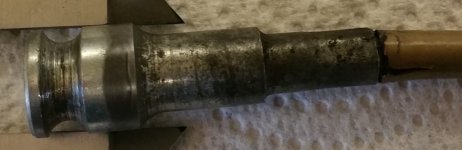
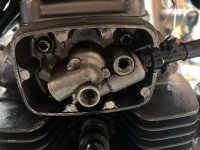
Next the tachometer cable doesn’t fit into the drive properly (although the worm drive does work). It looks like it was held in with a lump of glue or sealant previously. I can’t find a good diagram in the manual, is there something missing or do I have the wrong cable?
IMG_2837.jpeg

The motor needs quite a bit of fettling: checking the tappet clearances and ignition timing (I did them both on the bench but things have probably moved around a bit since then), the correct exhausts fitting and the carburettors need to be tuned and balanced. I can’t find much information regarding carburettor tuning in the manual - can anyone recommend good start positions for the main and slow running screws?

The wiring is a bit messy in places (lots of domestic connectors and so on); I’ll go through that in slow time and get everything back to standard. There are some faults also: the horn button doesn’t work and the rear lamp stays on all the time (may be the brake light switch, I have not investigated yet).

There will probably be lots of other flaws… inevitably with a nearly 50 year old machine that hasn’t been used for about 20 years, but I’m fairly pleased that I’ve got it back together, it runs (more or less) and the lubrication system seems to be very healthy.

I‘ve left the battery charging overnight; now I’ve got to this stage (where I’d hoped to be 2 weeks ago when I bought the motorcycle) I can tinker with it until I get it sorted.

:cool:
 
Last edited:
There were none fitted previously and they don’t seem to be mentioned in the manual, so I didn’t fit them today. Should I have fitted them?
I realize you had the engine apart, but did you look really closely at the exhaust ports to be completely sure there were no old exhaust gaskets well-crushed and blackened by exhaust yet still in there? It has happened many times over the years and I seriously doubt the pipes would come close to properly sealing against the bare head aluminum in the port without them.
Next the tachometer cable doesn’t fit into the drive properly (although the worm drive does work). It looks like it was held in with a lump of glue or sealant previously. I can’t find a good diagram in the manual, is there something missing or do I have the wrong cable?
Can't be sure of the cable, but if it won't go into the drive on the end of the cam any further than that, I'd look for a broken portion of plastic, or possibly a second oil seal, stuck in the drive. The countersunk screw hole middle right near the end of the drive is what holds the cable in place when the screw is present.
I‘ve left the battery charging overnight; now I’ve got to this stage (where I’d hoped to be 2 weeks ago when I bought the motorcycle) I can tinker with it until I get it sorted.

I hope the charger wasn't a higher amp output than 0.5 to 1 amp, or the battery will be ruined after that long.
 
The business end of the OEM tacho cable looks like this, with a forked internal end that engages with the tacho drive. The countersunk screw that Tom mentions above engages with the waisted portion of the cable outer.

TACH.jpg
 
I realize you had the engine apart, but did you look really closely at the exhaust ports to be completely sure there were no old exhaust gaskets well-crushed and blackened by exhaust yet still in there? It has happened many times over the years and I seriously doubt the pipes would come close to properly sealing against the bare head aluminum in the port without them.

Can't be sure of the cable, but if it won't go into the drive on the end of the cam any further than that, I'd look for a broken portion of plastic, or possibly a second oil seal, stuck in the drive. The countersunk screw hole middle right near the end of the drive is what holds the cable in place when the screw is present.

I hope the charger wasn't a higher amp output than 0.5 to 1 amp, or the battery will be ruined after that long.
Thanks Tom, that is really helpful.

I'll go looking for some old exhaust washers in the ports - I didn't particularly look when I took it apart.

Ah! A countersunk screw - that will be the answer. I'll check in the bottom of the parts box tomorrow.

The charger is a motorcycle specific CTEC with a battery tender function (that I use to maintain my Goldwing). It will take all night and charge very slowly. I've fitted a spare CTEC fly lead to the battery so I can top it up from time to time without opening the seat.

Alan
 
I've got a CTEC bike specific battery charger, I used to use it the 'float' mode, but after a couple of Motobatt batteries expired sooner than expected I just use it charge batteries until all the lights on the charger come on, then disconnect it, move onto the next battery, five in a row at present in the shed. Then charge them every couple of months or so.
 
Back
Top Bottom