1971 CB350 . . . 40 year hibernation

I haven't had much garage time since school started in late August as it's been and continues to be a busy semester, but I'll give one small update to indicate just how slow things are moving with my projects.

The inspection back on 21 August was a success, so I mailed the appropriate paperwork to the State office by the end of August. I received a new title around the end of September. The year of manufacture has been corrected from 1967 to 1971, but the status of the title was still Salvage and not Prior Salvage as I had indicated on the forms. It took two attempts to reach someone on the phone, but they were then able to confirm the mistake and still had digital copies of the previous forms and supporting material. I was told to apply for a corrected title, surrendering the one I had just received to get the Salvage status corrected to Prior Salvage. It's been a month since I sent it all back in, so I called at the end of last week to check on it. All I learned was that it is still being processed, but the person I spoke with was going to put in a ticket to see what was going on. They also said to call back in another three weeks if I don't hear anything in the meantime. Fingers crossed.
 
I haven't had much garage time since school started in late August as it's been and continues to be a busy semester, but I'll give one small update to indicate just how slow things are moving with my projects.

The inspection back on 21 August was a success, so I mailed the appropriate paperwork to the State office by the end of August. I received a new title around the end of September. The year of manufacture has been corrected from 1967 to 1971, but the status of the title was still Salvage and not Prior Salvage as I had indicated on the forms. It took two attempts to reach someone on the phone, but they were then able to confirm the mistake and still had digital copies of the previous forms and supporting material. I was told to apply for a corrected title, surrendering the one I had just received to get the Salvage status corrected to Prior Salvage. It's been a month since I sent it all back in, so I called at the end of last week to check on it. All I learned was that it is still being processed, but the person I spoke with was going to put in a ticket to see what was going on. They also said to call back in another three weeks if I don't hear anything in the meantime. Fingers crossed.
I hope for the best with your State office workers ;)
 
I haven't had much garage time since school started in late August as it's been and continues to be a busy semester, but I'll give one small update to indicate just how slow things are moving with my projects.

The inspection back on 21 August was a success, so I mailed the appropriate paperwork to the State office by the end of August. I received a new title around the end of September. The year of manufacture has been corrected from 1967 to 1971, but the status of the title was still Salvage and not Prior Salvage as I had indicated on the forms. It took two attempts to reach someone on the phone, but they were then able to confirm the mistake and still had digital copies of the previous forms and supporting material. I was told to apply for a corrected title, surrendering the one I had just received to get the Salvage status corrected to Prior Salvage. It's been a month since I sent it all back in, so I called at the end of last week to check on it. All I learned was that it is still being processed, but the person I spoke with was going to put in a ticket to see what was going on. They also said to call back in another three weeks if I don't hear anything in the meantime. Fingers crossed.
Ah, bureaucracy... such fun. Hope it gets resolved for you soon.

Good to see you back for a few minutes, there's been a lot going on around here. We passed 150,000 posts so fast the other day I wasn't able to get a screenshot of it. Plenty of new members with more interesting bikes, and the usual high-jinks too.
 
We passed 150,000 posts so fast the other day I wasn't able to get a screenshot of it.
I had a similar experience recently when I eclipsed 10,000 miles on my CB360. I didn't want to pull over to get a picture and it was already over when I had a chance to grab a picture at a red light.

I'll try to resurface a little more frequently, but I'm already looking forward to the summer when I can be more active here and in the garage.

Hope all is good with you.
 
I'm overdue in reporting back on the title, but about a month ago I did finally receive the corrected prior salvage title for this 1971 CB350. The prior salvage status allows the bike to be registered and sold in the state of Missouri.

In the spring, I'll need to redo the top end to correct a fairly substantial oil leak around the base gasket, but it is a relief to have the title sorted out. Thanks to everyone for the support on this thread, which has been slow going at times.
 
I'm overdue in reporting back on the title, but about a month ago I did finally receive the corrected prior salvage title for this 1971 CB350. The prior salvage status allows the bike to be registered and sold in the state of Missouri.

In the spring, I'll need to redo the top end to correct a fairly substantial oil leak around the base gasket, but it is a relief to have the title sorted out. Thanks to everyone for the support on this thread, which has been slow going at times.
Glad it's sorted now, and good to see you back for a minute. Looking forward to your yearly return to our little spot of insanity.
 
Will you get it registered soon ?
Probably not until spring. My current insurance policy allows four bikes and I hope to take one off (selling my CB750F) before adding this one. It'll take a little time to make that happen and make sure this bike is really ready for daily use.
 
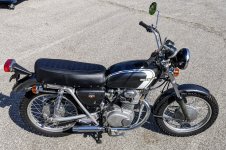
This weekend I installed the front fender, front wheel, swingarm, shocks, and rear wheel. It's now a roller and I took the opportunity to get a couple decent pictures of the progress to this point.

View attachment 24870

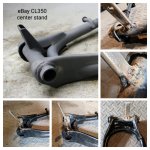
This allowed me to check the design of the center stand stop that I added to accommodate the scrambler exhaust. I was concerned that the center stand might sit too low, but it's actually a bit high. As shown I think it would interfere with the chain, but I included a stop bolt that will allow me to correct the height.

View attachment 24872

I did a test fit of the step bar and I noticed that there is not much clearance on either side of the motor — does this look normal? This is my first CB350, so correct me if I'm wrong here, but it seems that the sprocket cover would be really difficult to install without removing the step bar. I am able to remove that cover on my CB360 and CB450 without removing the pegs, although it definitely takes some fiddling around.

View attachment 24873

I was planning to install the rear fender and freshly powder coated handlebar, but ran into issues. The handlebar came from a CL350 CL450 and it includes a larger diameter section between the clamps that is too wide for the clamps on my CB360 top bridge. This is a complete oversight on my part and I plan to look for a CL360 handlebar as a replacement. The rear fender had mismatched bolts when I disassembled the bike and I failed to pick up on that clue. One of the threaded holes in the fender is completely stripped, so I'm going to have to repair it. Currently, I'm thinking about using the welder to fill the hole and then retapping the hole.

CL350 CL450 handlebar

View attachment 24874
I’m having an issue with the center stand going up too high. Where did you add the stop bolt?
 
I’m having an issue with the center stand going up too high. Where did you add the stop bolt?
I'm sorry for the late response. The simplest method is to acquire a CL350 center stand, which has a tab already on it for this purpose. Otherwise, you can weld a tab onto a CB350 center stand. See below.

20230723_172328-COLLAGE.jpg

I think I had to reweld this one because it didn't hold up to use. I'm a novice welder at best, but this is an easy task for a real welder.
 
You could probably go 20, I've gone over the factory torque spec on my 450 by at least 5 lbs safely.
I'll move back to my thread to avoid a Mousetown sidetrack rabbit hole.

Thanks, Tom. I think I'll split the difference and go to 19 ft-lbs. I have a click style wrench from HF and a beam type wrench from a box auto parts store, maybe NAPA. I thought the click style would be an upgrade, but after using it I'm not sure that's the case.
  • With the beam style, I like that I can see the deflection.
  • With the click style, I guess the idea is that the click happens while the wrench is moving so you know exactly when the proper torque is reached.
The second options helps avoid confusion with the torque needed to overcome static friction, but the first allows one to check that the nut won't move at a given deflection/torque. Do you have any advice here?
 
I'll move back to my thread to avoid a Mousetown sidetrack rabbit hole.
(y)
Thanks, Tom. I think I'll split the difference and go to 19 ft-lbs. I have a click style wrench from HF and a beam type wrench from a box auto parts store, maybe NAPA. I thought the click style would be an upgrade, but after using it I'm not sure that's the case.
  • With the beam style, I like that I can see the deflection.
  • With the click style, I guess the idea is that the click happens while the wrench is moving so you know exactly when the proper torque is reached.
The second options helps avoid confusion with the torque needed to overcome static friction, but the first allows one to check that the nut won't move at a given deflection/torque. Do you have any advice here?
PJ commented on over-torquing too and said he's gone higher with the stock studs. I like both styles of torque wrench for the reasons you've mentioned. My old beam-type, which had probably long since gotten inaccurate anyway, disappeared like the proverbial 10mm socket long ago, and I bought an Ikon click style in the last 6 months or so but haven't used it yet. The static friction can be overcome with lube, though I've never done them that way and for whatever reason was never advised to do so as an option while learning the trade when I was young.
 
I think I'll use the click style again this time and go up in increments, like 10 ft-lbs, then 15, and finally 19 or 20. I may check them with the beam style afterwards to see if any can still be tightened at a lower value.
 
I'm sorry for the late response. The simplest method is to acquire a CL350 center stand, which has a tab already on it for this purpose. Otherwise, you can weld a tab onto a CB350 center stand. See below.

View attachment 47880

I think I had to reweld this one because it didn't hold up to use. I'm a novice welder at best, but this is an easy task for a real welder.
It may bend just above your weld because it is only flat. A short piece from above the weld halfway to the hole then angling back to the tube will form a structurally superior triangle. mimicking the channel shaped steel of an OEM.
 
I made a quick road trip out to Sacramento and back in the last week, returning on Sunday. This morning, I finished reassembling the bike after replacing the top end gaskets. The cam chain tensioner always tricks me on this motor and I had to remove and reinstall it for the same reason as with the initial build (see post #930).

While changing the gaskets, I also replaced a broken front brake switch and swapped out the erratic silver painted gauges with used ones (black) from eBay. I think it is possible to have too much of a good thing, so decided against painting these gauges to match the frame.

I recently got a set of CB headers and decided to use them for the time being in case I need to remove the carbs while tuning the bike. I have 12" shorties on it currently, but could probably use one of the aftermarket exhausts I purchased for my 360. The bike started up pretty easily and then I discovered that the clutch plates were stuck, but after freeing them I was able to make a short test ride. These gauges seem much better than the ones I inherited with the project.


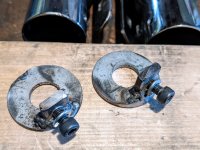
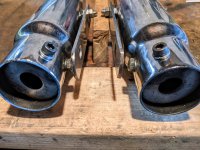
I was thinking about making something like a snuff-or-not for these mufflers. I've only seen pictures of them online, so I wonder how well they actually work. I would make something non-adjustable, but removable either by drilling a new hole or removing the baffle and using that bolt to secure the snuffer.

PXL_20250812_145213911.jpg
 
Cool silver frame. Cheap short extensions packed with stainless potscrubbers might also be an option, or DIY snuffers too. Now you're a welder, so ....?

Thanks, Tom! I gave it a shot this afternoon and I don't think the DIY snuffers do a whole lot, except maybe make the exhaust a little more snarly. That's not an entirely bad thing. I may try the pot scrubbers. I know the packing material I bought in the past does not last long in the baffles.

PXL_20250812_200115497.NIGHT.jpg

PXL_20250812_200428156.NIGHT.jpg

Video without snuffers:

Video with snuffers:
 
They'll hold in the potscrubbers. My old school buddy Mark always harps that Hondas run better with some backpressure. It sure worked on my 160 with open megaphones, which screeched like a banshee before and had no midrange.
 
Video without snuffers:


Video with snuffers:
I'm just impressed that you have a Radio Shack dB meter and it still works! I have an old Realistic multimeter that I still have the original box for, my father had it and it must not have worked. I took it apart but can't see anything obvious wrong, another project for another day.
 
I'm just impressed that you have a Radio Shack dB meter and it still works!
Thanks, Tom! My dad is a retired mechanical engineer and he used it at work to check sound levels from A/C compressors. He gave it to me when I was studying acoustics and, every once in a while, I come up with a reason to dig it out. We used to have a lot of Realistic stuff and I definitely miss the Radio Shack stores.
 
Last summer, I bought a new set of CB350 headers (made in Thailand) on eBay. I ran into a problem when I received them because the lip is thinner than the OEM parts and the joint collars were too short to clamp them down.

I noticed in an eBay listing that the 350F headers seem to have a thinner lip than the 350T and then found that the joint collars are longer. So, I'm thinking out loud here, but I wonder if the 350F collars will solve the fitment problem for the aftermarket headers. Unfortunately, I don't know if the headers have the same external diameter between the 350F and 350T, but an initial search suggests 1.5" for both.

350T collar:
Screenshot_20250813-192526.png

350F collar:
Screenshot_20250813-192446.png
 
I can't remember if the 305 collars are longer or shorter, but same diameter. I should double check.
Nope, won't work. Same pipe diameter but no flared out edge, just straight and a little less tall. Could work the other way if cut down; 350 collars on 305.

I did measure the thick ends of some 350 headers and got between 18.8-19.1mm. If that helps.
 
I still have an oil leak after replacing the top end gaskets, so it looks like I'll have to that again. The first time I didn't do anything special for sealing and used the upper factory torque spec of 14.5 ft-lbs, but this time I used copper gasket spray on the head gasket and a bit of Hondabond on the outer parts of the base gasket. Torqued to 22 ft-lbs.

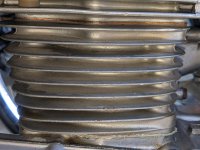
The leak appears to be in the front. I don't see a clear trail from the head gasket, but there is oil above the level of the base gasket and parts of the head gasket that are visible in the front are shiny.

This amount of oil accumulated in about 60 seconds after running the bike up and back three residential blocks.

PXL_20250818_161325649.NIGHT.jpg

PXL_20250818_161250224.NIGHT.jpg

Head Gasket (from left)
PXL_20250818_161450366.jpg

Head Gasket (from right)
PXL_20250818_161522347.jpg

Head Gasket (partial view from front)
PXL_20250818_161608910.jpg

View from front
PXL_20250818_161653559.jpg

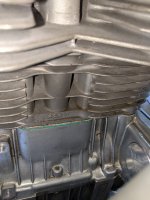
I can't decide whether it's the base gasket or head gasket that is the problem. The oil above the base gasket could have been pushed up there as the bike was moving and there isn't much oil visible higher on the cylinders.
 
Since this is a 350 and not a 360, are you sure it isn't a pinhole in the cam chain tunnel from excess wear due to lack of cam chain adjustment? Head gaskets don't usually leak a quantity like that, more like seepage over time.
 
Since this is a 350 and not a 360, are you sure it isn't a pinhole in the cam chain tunnel from excess wear due to lack of cam chain adjustment? Head gaskets don't usually leak a quantity like that, more like seepage over time.
Thanks, Tom. Interesting – I was wondering if there would be a possibility way for oil to come out of there, but thought I was becoming paranoid and dismissed it.

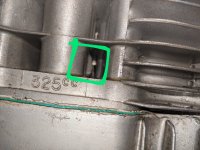
PXL_20250818_161653559~2.jpg

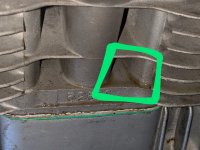
So it may be possible for oil to come out of that green boxed area (or the other similar areas) and specifically from a pinhole on the outside of the tunnel wall? That would explain a lot. I guess I can have a look with my cheap boroscope after things cool down.

I didn't notice any unusual wear at any earlier point in the process, but I could have missed it since this is my first experience with the 350 motor.
 
So it may be possible for oil to come out of that green boxed area (or the other similar areas) and specifically from a pinhole on the outside of the tunnel wall? That would explain a lot. I guess I can have a look with my cheap boroscope after things cool down.
I didn't see that specific spot when I looked earlier but yes, absolutely it can. And now that I take a closer look, that sure looks like it. Note that the tunnel has air passage space around it, so the pinhole would be back in between the cylinder area and the side of the tunnel.
I didn't notice any unusual wear at any earlier point in the process, but I could have missed it since this is my first experience with the 350 motor.
I'm guessing it just didn't look as extreme as some we've seen so it didn't occur to you it would be possible. I haven't looked yet, did you previously post that rebuild with pictures?
 
I'm guessing it just didn't look as extreme as some we've seen so it didn't occur to you it would be possible. I haven't looked yet, did you previously post that rebuild with pictures?
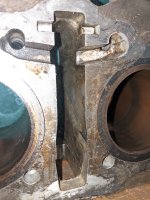
Here are two pictures of the cylinder. Unfortunately, the angles don't show a whole lot.

PXL_20230722_154941012.NIGHT.jpg

PXL_20230722_155303347.NIGHT.jpg

I see some weird shadows inside the tunnel, but can't figure out what they are.
 
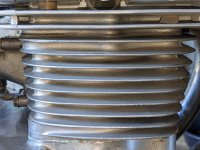
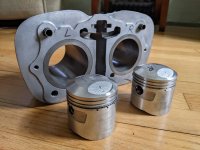
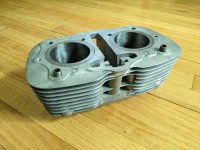
Here are pictures of my spare cylinder, that I just took. Do they show any unusual wear? I assuming some of the odd looking areas are from the casting, but can't be certain.

PXL_20250818_175344788.jpg

PXL_20250818_175356044.jpg
 
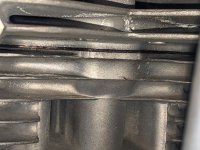
This spot looks like it could be, and the same area on the opposite side - but it's not as much as you'd typically see for the kind of wear that results in a pinhole.

1755540415784.png
 
Much appreciated, Tom.

I guess if it is a leak of that type, I ought to be able to see oil bubbling out once the motor has run a bit. I'll try to get my borescope in there to have a look when I get the chance.
 
Last edited:
Here are two pictures of the cylinder. Unfortunately, the angles don't show a whole lot.
I see some weird shadows inside the tunnel, but can't figure out what they are.
But....
did you previously post that rebuild with pictures?
I guess by now I could have looked it up myself, but I was busy approving a new member.
 
Yes, those pictures appeared in post #530, but I didn't take or post any other pictures specifically showing the tunnel.
Yeah, I went back and looked at those and there isn't a good enough view. But, I'll say from what you can see that it doesn't look worn enough to cause a thin spot or pinhole. Which makes this all the more curious, because generally we see some serious carving away of the sides near the cam chain run if left unmaintained for a long time. Hopefully the borescope and some bright light will reveal the spot, but either way the top end has to come apart again...
 
Hopefully the borescope and some bright light will reveal the spot, but either way the top end has to come apart again...
I hope so, too. It will feel a lot better pulling it apart if the source of the leak is conclusively identified.

Are pinholes of this sort considered repairable, say, with epoxy?
 
Since this is the front of the engine and the leak is significant how about cleaning it all off. Add baby powder to that area and run the engine for a few minutes. That should get a closer definition.
If the borescope is inconclusive, I will certainly do so. I had already acquired said powder, but the engine is pretty clean at the moment, so it's not too hard to spot the oil with the naked eye.

Are these tunnel leaks somewhat common on these motors?
 
I bet that oil is only left over and migrated from last clean up. I have to blast with mucho water on a hot motor to get it clean enough to further inspect for leaks.
 
Wouldn't have figured this out so quickly without your help, Tom. Should've documented the leak better the first time to get better feedback – I was just disappointed in myself thinking I had botched the torque process or something.

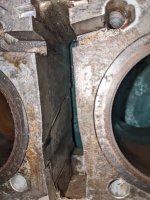
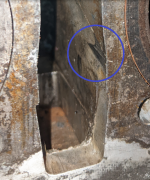
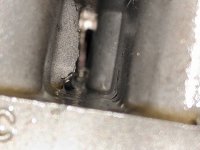
Too bad the borescope didn't capture sound. I revved the motor to sling more oil and that causes the little shots of oil to spit out of the tunnel wall. The camera is pointed in that lower channel on the left side (from the front) that appears wet in the previous photos.


This looks like the culprit, right?
 
Last edited:
The spurting seemed to be more like a source from the oil circulation system, rather than just the relatively unpressurized internal cavity gravity return areas. I see on the diagram of the oil lubrication system, at the front and center, close oil gallery or column upwards delivery members, near your leak. Oil pump strokes occur less than crank revolutions via primary reduction.
If you could isolate and pressurize each column (with aluminum HVAC tape?) and find and fix a leak, it would be great, since you spent $ to re-bore.
I've seen variations in the castings and drillings on the external air passages on 160, 305 and 350 cylinders, having cleaned and cleared mud plugs and wasp nests with old spokes and drill bits. I bet the mold makers, in the foundry, had their secrets too.
 
Back
Top Bottom