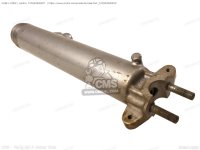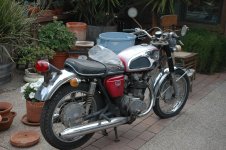
The build of The Three Twins (CB450's, maybe 4), an inquiry into Differences and Similarities

In the thread "https://vintagehondatwins.com/forum...enths-and-other-differences-k0-vs-k1-5.13454/" I promised to check and measure valves differences between a K0 and a K1-K5's.

Ok, first let's identify the types of valves for the 450's

CB450 K0 Japanese internal market :

From engine number 1500010 to 1501436:

- intake valve 14711-283-000
- exhaust valve 14721-283-000

From engine number 1501437 to 1502043

- intake valve 14711-283-010
- exhaust valve 14721-283-010

From engine number 1502044 until end of production:

- intake valve 14711-283-010
- exhaust valve 14721-283-020

CB450 K0 US / Europe export market :

From engine number 100046 to 1001764:

- intake valve 14711-283-000
- exhaust valve 14721-283-000

From engine number 1001765 to 1011935:

- intake valve 14711-283-000
- exhaust valve 14721-283-010

From engine number 1011936 to until end of production:

- intake valve 14711-283-010
- exhaust valve 14721-283-020

Pictures from valves (engine number 10249xx):

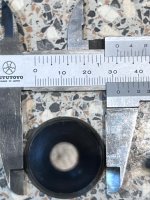
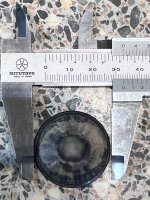
Intake valve disk diameter 36 mm
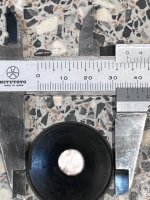
IMG-20250601-WA0006.jpg

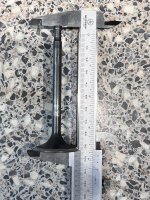
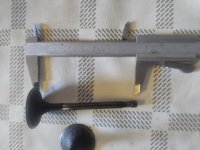
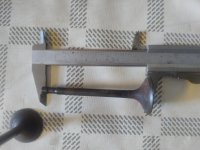
Intake valve length 98 mm:

IMG-20250601-WA0010.jpg

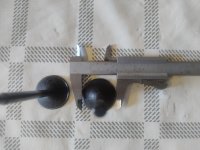
Exhaust valve disk diameter 32 mm:

IMG-20250601-WA0007.jpg

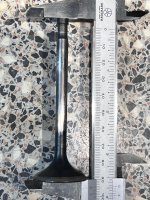
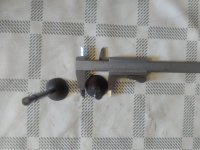
Exhaust valve length 94 mm:

IMG-20250601-WA0011.jpg


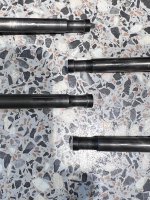
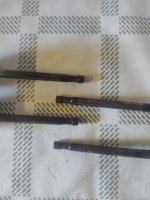
Detail picture of valve top:

IMG-20250601-WA0008.jpg

I will cross-reference with another engine within this serial number range (sometimes valves are shortened after a seat job), but not today.

CB450 K1-K7 & CB500T US / Europe export market:

From engine number 3000010 to 3000448:

- intake valve 14711-292-000
- exhaust valve 14721-292-000

From engine number 3000449 until end of production:

- intake valve 14711-292-000
- exhaust valve 14721-292-010

Pictures from valves (engine number 30046xx):


Intake valve disk diameter 38 mm:
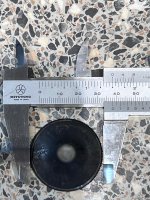
IMG-20250601-WA0004.jpg

Exhaust valve disk diameter 33 mm:

IMG-20250601-WA0005.jpg

I'm sure about the K1intake valve, but not sure about the exhaust valve disk diameter, will check tomorrow with multiple exhaust valves.

I'm pretty sure that I have all the valve's in my stash, NOS or Used, and will add pictures, starting with the late K0 and the late K1-K7 & CB500T.
 
Last edited:
I took the same dimensions from the valves of these two engines:
K1 3001384
K2 3028943 (frame number, the engine housing is cracked, just 302... is readable)

Intake
Diameter 38mm
Length 100mm
1000084772.jpg
1000084774.jpg

Exhaust
Diameter 33mm
Length 96,5mm
1000084775.jpg
1000084776.jpg

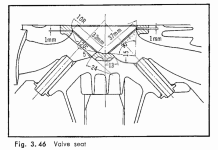
As you compare the dimensions of the valve seats in the head, I saw, that they are 32 and 37mm or slightly above at the K1 and K2 head, like given in the FSM,
1000084824.png
and on my valveless head of the K0 engine 1025820 they were 32 and 35mm.
This would hint to 33 and 36mm valves, or the exhaust is worn to 32. Your picture shows a 32mm exhaust valve, which wouldn't fit to a 32mm seat. Or,as I said, it is worn on my K0 head
I cannot find the dimensions, how the seat have to be on the K0,like shown above for the K-later.

So the question remains, which valve dimensions do I need?

Would you think someone shortened the K0 Valves on the pictures above? The seem like, compared to the other pictures.
1000084780.jpg

Unfortunately I sent my camshafts to someone who tries to modify them to needle bearing, because they were very rusty.
I did send them long time ago.
Without them I can't try the K-later valves in the K0 head.
 
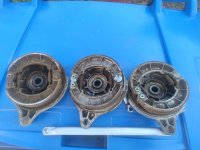
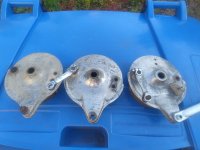
And a second thing are the anchor plates of the rear brakes.
I have a K0 wheel, a K2 wheel and an anchor plate of the brake of a K5.
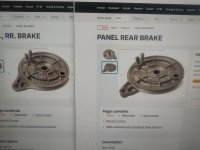
According to the parts list, there is K0 and K-later plate. On the pictures on cmsnl, the differ in the rear side, on the right (K-later) you see two domes, which are missing at the K0 plate1000084743.jpg

But none of my plates have these domes. Are there other marks to identify them?
1000084770.jpg
1000084771.jpg

From.the left: K0-K5-K2.
Please don't mind the modification of the K2, someone switched it to a cable pull.
That's why I purchased the K5 plate.

Edit: As I put the pictures here I noticed another difference around the anchor lash.
According this, the right plate is K0 and the other both are K-later, but without the domes.


Beat regards,
TeaLow
 
Last edited:
I will come back to you about the brake hubs, since the stash of brake hubs is not located at my house.

In the meantime, I cleaned a couple of CB450 rotors, "measured" the magnetic strength (see method in another thread), and made them ready for repairs. Most rotors you see in the picture are missing 1 or more tabs that hold the starter clutch centered, some threads are destroyed as well. I take these to my work for the repair so that these rotors can be used again. Repairing the threads seemed more difficult for me, but I asked a senior machinist if he was able to fix it, and he looked at me with disbelief....

Afbeelding van WhatsApp op 2025-06-15 om 14.14.00_345bf8ed.jpg
 
Hahaha, I get those same looks from my machinist! Those guys are amazing and can literally do anything, and everything.
 
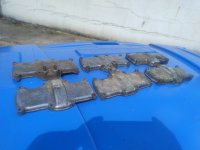
Today I had a look on my cam shaft covers.
I have three sets, all with different air outlets and different lengths of the holes, where the bolts go through (named "thick" in the following)

Let us find out, which is which, please

I am pretty sure, that the set on the left with the two outlets is for K0 and that the on with the outlets belong to the exhaust side.
Closed one is 10mm thick and the opened is 15mm.

The set in the middle has the same direction of the air tube, but only one. Bothe parts are the same, only one has the bore.
Both are 15mm thick.

And the set on the right has the air tube on the top, also both parts are the same, but only one with bore.
They are 18mm thick.

According the parts list, all bolts are the same from K1-K5, but the right set is 3mm thicker than the other.

Do all covers get the metal sheet beneath or only the ones with the opening?

1000086182.jpg
 
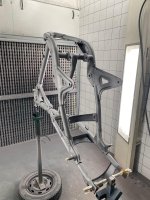
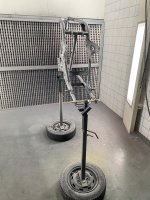
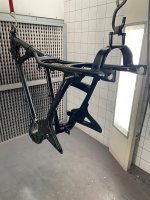
The painter called, one to pick up


Afbeelding van WhatsApp op 2025-11-10 om 08.31.09_2e6dd344.jpg

Afbeelding van WhatsApp op 2025-11-10 om 08.31.09_910a3830.jpg

Afbeelding van WhatsApp op 2025-11-10 om 08.31.09_77a568c5.jpg

Afbeelding van WhatsApp op 2025-11-10 om 08.31.10_3124b6da.jpg

Industrial paint, direct on metal, I'm happy how the CB72 frame came out, so asked the painter to proceed with the CB450 K1 frame in the same way. The surface roughness is still visible, especially when rust did it's work, but this CB450 K1 frame was not rusted. The CB72 frame was rusted around the battery area, and that is still visible trough the paint.

The other black parts of the CB450 K1's will be painted together with the C77 frame and parts, using a base layer and glossy paint. The industrial paint is a 3/4 gloss, kind a semi gloss, very close to the Honda paints in the past (and Honda used also paint to metal without a base layer in the past).
 
Last edited:
Sometimes, you think you have seen it all, and that you know everything about the CB450K0's, but just when you reached that point, the reality takes over and you are thrown back into a desert of ignorance. While I was sorting all parts for my CB450 K0 build, and looking for a set of CB450 K0 front forks (as you might know I was sorting front forks for the blue CB72'61/62), I run into a box of what appeared CB450 K0 front forks as well.

I found out that there are two types of CB450 K0 front forks, an early type, and a late type, but looking at my own parts manuals, en CMSNL online, I see that Honda used just one part number for both types. After some serious research I found out that the early type was used until mid 1966, and that the later forks were used in the production rum until 1967.

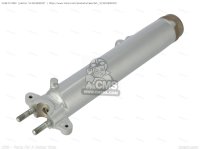
The differences between the forks are obvious, and hard to mis, once you see them, it cannot be unseen. The top is all the same, same threaded chrome seal connection, same pants for the mudguard, but around the fork bottom, there are differences in the moulding. There are ribs around the axle connection in the later type, the early type is smoother.

Early type :

case-r-fork_big51420283000T-01_726a.jpg

Later type:

case-l-fork_big51520283000T-01_8334.jpg

The differences are made to make the front fork more stiff, and less prone to microcracks. The inner diameter is also 0,01 mm smaller, (?) and the quality of the aluminium is higher. like I said, the numbers are the same, also for the other parts like the chrome bushings.

Further research, and looking at many pictures online, I found out that the very first CB450 K1's shared this front fork with the CB450 K0's, and that all replacement forks ordered after 1966 where the later type. It made me curious if I would have the same front fork in my very really K1, so I checked, and it was the this later CB450 K0 style front fork. There is not one parts manual I looked at that points out this significant difference.

You learn every day, and thinking that you know everything about these bikes is a big mistake to make, so I returned being humble, and asure myself, that I just know enough to remain amazed, confronted that I know nothing.

The strangest thing is that I only have one set of early type front forks, the rest is a later type. I would expect that it should be the other way round, since I have a mid 1966 bike (my rider) with the early style forks, and a few early bikes in parts. First I was thinking that these forks didn't't belong to the CB450 K0, but maybe from a CL350 K0, or an SL350 (Google AI pointed me in that direction), but that wasn't the case. These forks are genuine CB450 K0 forks, used in the latest production run, maybe never delivers as part of a complete bike, and only made as a replacement part, who knows. I checked all my pictures of CB450 K0's, also from bikes I know here in the Netherlands, but not one has the later style forks delivered on the bike from factory.

I'm in a luxury position, that I can make a choice which front fork type I'm gonna use on the CB450 K0, but I deftly will use one for my very really CB450 K1.

CB450 K1 1967.jpg

It's this bike, a very early CB450 K1, US style, imported from the US, that has this type of front fork The chrome busing is threaded, and it has inner leg springs instead of outer leg springs.
 
Last edited:
Back
Top Bottom