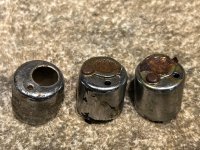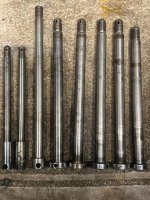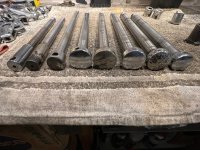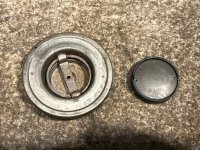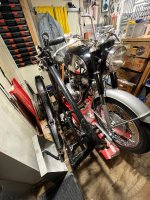
The build of The Three Twins (CB450's, maybe 4), an inquiry into Differences and Similarities

Next pile of parts to categorize : Mufflers

Over the years I acquired an amount of (250 / 305 / 450) mufflers, in all kind of shapes, meaning used & rusted, used & broken, used & good to go, used & nice and everything in the mix. I greased them up years ago, and put them on a pile, now is the time to file them, and decide which will be for what bike and what should be repaired.

Tonight I started with the 450's, K0's and K1's. Some mufflers have the brackets on, some don't, some are one piece, some are two-piece systems, and some have the header pipes still on them. So time to take those apart first.

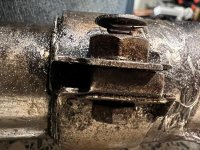
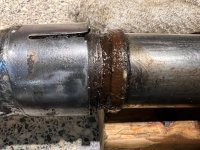
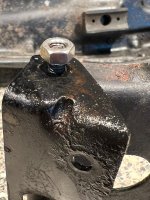
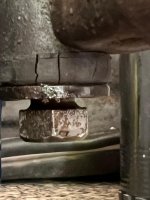
The first one was already very difficult to take apart, and for some reason the PO welded a washer on the back of the bolt that clamps the header. In the past I would ask myself WHY ?, but I learned that answers are hard to get, so I gave up on that. Below, a picture of the bolt and clamp. Don't mind the dirt, that's a job for later.

CB450 K1 muffler_1.jpg

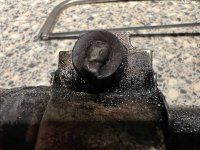
Clearly to see that it is welded, so there is only one solution: trying to saw through the bolt and hopefully the welded part is not too hard for my saw. I don't like grinding, but if the saw doesn't work, I have to.

Why_1.jpg

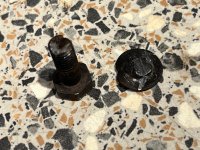
After 10 minutes of sawing, swearing and sweating, the bolt was finally cut, so I could proceed to take off the clamp.

bolt.jpg

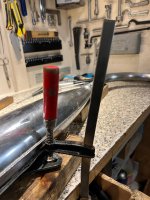
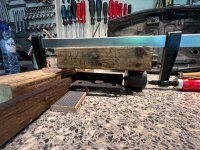
But, there is always a problem behind a problem, the header was stuck, it didn't move at all. First, I heated the area up with a torch, to burn away the dirt, but that didn't work. Finally, I did put a bracket on, to hold the muffler down, so i could try to rotate the header. That worked, and once it turns, it will give up, and it did.

taking apart.jpg

What was planned as an evening to finish the 450 mufflers, I started with one, taking the whole evening to take it apart. But it was worth to save this one, rusty at the back, but no dents or scratches. Chrome is decent, thus this muffler will be classified as useful.

finally.jpg
 
I find working on the mufflers to be an extreme challenge. Removing stuck end baffle tubes has humbled me before. I once had to resort to cutting some slits in an "H" pattern on the backside of a pretty nice CA77 muffler after I had lost patience and thought hammering in a bit on the end of a baffle would perhaps loosen it. Well, the rusted tube of the baffle collapsed inside jamming it in an interior partition wall and partially occluding the end of the muffler, necessitating the afore mentioned surgery to remove it. To make things worse, it was my friends bike and I insisted on buying a replacement (which was not quite as nice) but he forgave me anyway and I still have that muffler waiting for a careful welding repair.
Because baffles have many perforations in them, they are inherently delicate and means that they should be periodically removed and cleaned of carbon and rust before they become stuck fast and risk being destroyed in removal, or worse, destroying the muffler too.
Now I have two Benly (CA95) mufflers with stuck baffles which I've been soaking with everything I can think of, including just soaking in a bucket of used motor oil for a few months (about a cubit deep). A perfectly sized internal bearing puller fitting and gentle use of a slide hammer is my current strategy, along with procrastination.
An inspired double meaning name for that particular part; a baffling baffle for sure.
 
Parts categorization is mostly finished? How are the twin triplets/quadruplets?

Especially for @stl360+450 an occasional add / update to this thread ;)

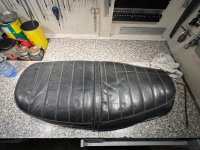
CB450 K1/K2 seat dissemble, starting with the mechanical parts for re-plating.
CB450 seat_1.jpg

After a few days, adding penetrating oil to the (rusted) bolts / nuts, the rear hanger came off.

CB450 seat_2.jpg
 
I find working on the mufflers to be an extreme challenge. Removing stuck end baffle tubes has humbled me before. I once had to resort to cutting some slits in an "H" pattern on the backside of a pretty nice CA77 muffler after I had lost patience and thought hammering in a bit on the end of a baffle would perhaps loosen it. Well, the rusted tube of the baffle collapsed inside jamming it in an interior partition wall and partially occluding the end of the muffler, necessitating the afore mentioned surgery to remove it. To make things worse, it was my friends bike and I insisted on buying a replacement (which was not quite as nice) but he forgave me anyway and I still have that muffler waiting for a careful welding repair.
Because baffles have many perforations in them, they are inherently delicate and means that they should be periodically removed and cleaned of carbon and rust before they become stuck fast and risk being destroyed in removal, or worse, destroying the muffler too.
Now I have two Benly (CA95) mufflers with stuck baffles which I've been soaking with everything I can think of, including just soaking in a bucket of used motor oil for a few months (about a cubit deep). A perfectly sized internal bearing puller fitting and gentle use of a slide hammer is my current strategy, along with procrastination.
An inspired double meaning name for that particular part; a baffling baffle for sure.

I experimented with a high pressure steam cleaner, that worked partly, patience and like you mentioned, a bearing puller will do the rest.
 
Especially for @stl360+450 an occasional add / update to this thread
Much obliged (thank you). That pan appears to be in very good shape. With your bike/part purchases for these builds did you encounter any unusable pans?

I guess anything can rust away when left in a bad environment, but the seat pans on the CB350 twins seem predisposed to cracking across the width, maybe due to a combination of fatigue (?) and some design flaw.
 
Much obliged (thank you). That pan appears to be in very good shape. With your bike/part purchases for these builds did you encounter any unusable pans?

I guess anything can rust away when left in a bad environment, but the seat pans on the CB350 twins seem predisposed to cracking across the width, maybe due to a combination of fatigue (?) and some design flaw.
Jensen's seat has it's midship support rubbers looking very good. The pans are not very strong by themselves and if the support rubbers have gone missing then a cracked pan is inevitable.
 
Jensen's seat has it's midship support rubbers looking very good
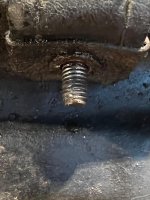
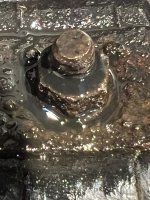
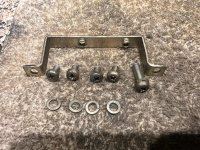
Yes, and pliable too. And the rubber at the end is also there, lucky me ! Bought this seat at "marktplaats", 35 euro, years ago. It will be the seat for the K2 "candy blue-green", my future rider. The seatpan looks fine indeed, but the bolts for the strap are damaged and rusted.

bolt strap.jpg

The other one is even worse, so lots of penetrating oil added, hoping to get it off tomorrow.

bolt strap _2.jpg

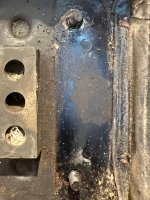
The hinge area looks fine, bolts are in good shape. Also, the third rubber is visible now.

good bolts.jpg

The hinge bolt itself, however, stuck ! I think the tube and bolt are so rusted that it's need some help. Penetrating oil added, patience added. The only thing that should be added is some force.

hinge bolt.jpg

So I use a "poor man's press" to convince the bolt that it has to come out eventually.

hinge bolt _2.jpg
 
Last edited:
Amazing how something that should not be a tight fit can rust so solidly. If the tube has an open seam that can be gently expanded with a screwdriver flat blade to open it a bit perhaps.
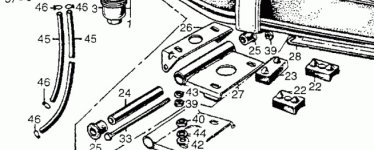
 
If the tube has an open seam that can be gently expanded with a screwdriver flat blade to open it a bit perhaps.

Not possible, there are two rubber pieces, one at each side, so there is no way to reach the tube. The bolts go through a tube, and that tube is fit in rubbers. The tube is just a spacer to avoid over tightening the bolt.
seat - kopie.jpg
 
I like your 'press' method.

The strap bolts are bad but only supply shearing force for the strap so strong threads aren't needed. The older seats had tiny holes drilled through the bolt for a 'keeper' cotter pin.
 
Not possible, there are two rubber pieces, one at each side, so there is no way to reach the tube. The bolts go through a tube, and that tube is fit in rubbers. The tube is just a spacer to avoid over tightening the bolt.
The rubbers and the spacer make it more challenging. :ROFLMAO:

Even if 24 and 33 are frozen but 24 and 27 are not, using a very thin cut off wheel or hack saw will still destroy the rubbers. You may have to sacrifice them in order to be the first to ever take it apart.:cry:
 
An adjustable torque drill/driver set very low will send shock waves through without much twisting stress and help break up the rust bonds.
 
It's moving ! (2 mm, but it's a start). I used penetrating oil and last night I added phosphoric acid.
Once it moved, I would probably make the bad choice to apply more force to keep it moving, destroying threads in the process. You never seem to be tempted in that regard. 👍

Now, if only you had added the penetrating oil right after bringing it home from the marktplaats years ago! Or maybe you did?!?
 
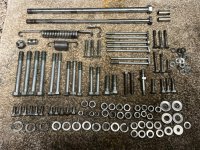
Opened another box, in search for hardware to plating, and found the parts of the K2.

IMG-20240929-WA0008.jpg

Also, a few parts for yellow plating:

IMG-20240929-WA0007.jpg

I sincerely hope that these are the last parts, because I'm fed up with cleaning, cutting and polishing
 
The goodies came in today :

Afbeelding van WhatsApp op 2024-09-29 om 22.45.13_cc57ae18.jpg

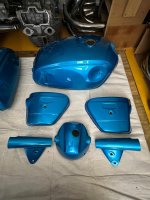
Candy sapphire blue for the (early) K1, the last set that is painted. Next to this set, I have a candy red set (K1) and a candy green blue (K2), so, after the plating of the last parts, everything is more or less ready for "build of the three twins". It will be a long winter, a C77, a CB72, two CB450 K1's and a CB450 K2. Goal is to finish the C77 and the CB450 K2 for next spring, the rest of progress would be nice.
 
They look very nice. You must have a great painter.
The only thing I don't like is they make me nervous that I will scratch them.
 
Like mentioned in the CB400F thread, de-chroming of parts is the next step.

IMG-20241005-WA0026.jpg

Some are nice and going to be re-used, some are pitted, and some need re-chroming or nickle plating (I'll try this because this is something that can be done at home).

IMG-20241005-WA0025.jpg

All pitted, just going one step further to de-rust chemically and go from there.

IMG-20241005-WA0027.jpg

Need re-chroming, way to rusted

IMG-20241005-WA0028.jpg

Shafts, also from the C71 and the C77 / CB72

IMG-20241005-WA0029.jpg

Many are butchered with a hammer, going to de-chrome, and grinding to make them ready for re-chroming.

IMG-20241005-WA0032.jpg

Fuel cap after chemically and mechanically de-rusting, ready for using.

IMG-20241005-WA0033.jpg

The inside of another one, the cap was rusted, but the inner parts were in good shape.

IMG-20241005-WA0035.jpg

The plastic chamber and the metal part are fine, however, the metal part will be zinc-plated, just like the rest of the inner parts of the fuel cap's.
 
As I was cleaning the shafts, I saw that the shaft of the C71 is made different from the later shafts. I have the feeling that the later shafts are made out of one piece, but the early shaft seems to be a two piece assembly, both welded (?) together. Anyway, after grinding this shaft I have to weld or hard soldering the holes before chroming.

IMG-20241005-WA0031.jpg
 
Like mentioned in the CB400F thread, de-chroming of parts is the next step.

View attachment 37824

Some are nice and going to be re-used, some are pitted, and some need re-chroming or nickle plating (I'll try this because this is something that can be done at home).

View attachment 37825

All pitted, just going one step further to de-rust chemically and go from there.

View attachment 37826

Need re-chroming, way to rusted

View attachment 37827

Shafts, also from the C71 and the C77 / CB72

View attachment 37828

Many are butchered with a hammer, going to de-chrome, and grinding to make them ready for re-chroming.

View attachment 37829

Fuel cap after chemically and mechanically de-rusting, ready for using.

View attachment 37830

The inside of another one, the cap was rusted, but the inner parts were in good shape.

View attachment 37831

The plastic chamber and the metal part are fine, however, the metal part will be zinc-plated, just like the rest of the inner parts of the fuel cap's.
You are doing good restoration work on these parts;I have never done this,although I wanted to.
 
The only thing I don't like is they make me nervous that I will scratch them.

Neither do I, but they will be scratched while using the bikes where they made for.
You are doing good restoration work on these parts;I have never done this,although I wanted to
I'm trying to save some money here, re-chroming is expensive here in Europe due to environmental issue's and inflation. I can get myself some pure nickel, and plate those parts to see if that's an option.
 
btw, this is how another fuel cap looked like:

Afbeelding van WhatsApp op 2024-10-05 om 21.18.40_7583ca4a.jpg

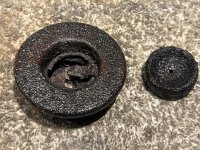
Completely rusted out, spring broken, plastic part cracked, and the metal part inside the plastic part, completely rusted, adding some extra holes. The chrome cap that came with it is rusted as well, however, only at the outside (top) instead of the inside (what I was expecting).
 
As I was cleaning the shafts, I saw that the shaft of the C71 is made different from the later shafts. I have the feeling that the later shafts are made out of one piece, but the early shaft seems to be a two piece assembly, both welded (?) together. Anyway, after grinding this shaft I have to weld or hard soldering the holes before chroming.

View attachment 37840
The splined foot peg bracket on the Dreams were made like that, built up from several components. Kind of surprised to see an axle made like that though.
 
IMG-20241007-WA0005.jpg

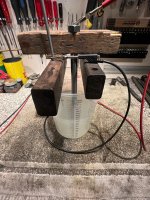
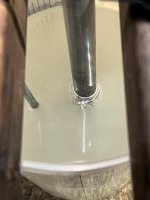
De-chroming process with electrolyze


IMG-20241007-WA0006.jpg

1 hours is enough, all the chrome has disappeared, what stays is nickel and copper.

IMG-20241007-WA0004.jpg

The nickel and copper layer can be removed with HCL (hydrochloric acid) 20-30%.

Next step is to grind the surface, and nickel plating as finish
 
Since the CB400F is ready for the new season, and the CB72 and C77 frames are at the paint shop, I located the frames for the K1 and K2. The K1 frame is already painted, the K2 frame not. The CB450 K0 will be the next on the motorcycle stand for maintenance, and in the meantime I will prepare the parts for the K1 and K2 and assemble a K1 engine, a K2 engine and a K0 engine at the same time.

Afbeelding van WhatsApp op 2025-02-16 om 22.22.15_9067c1b4.jpg
 
That is good to have a pick up and drop off for every trip to the paint shop. This winter's shop schedule for you seems very full.
 
Rotors (magneto's)

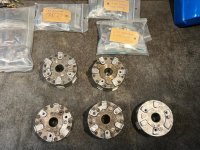
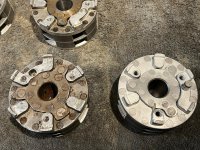
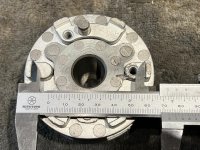
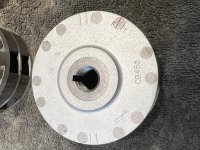
I don't know if this is known to all CB450 K0 owners at this forum, but there are two types of rotors, an early (p/n 31101283003) and a late one (p/n 31101283013). Since I have both, I made some pictures to show the differences.


Afbeelding van WhatsApp op 2025-03-26 om 22.05.27_72b200c7.jpg

Afbeelding van WhatsApp op 2025-03-26 om 22.05.27_24cb1bb9.jpg

Left is the late one (a heavy damaged one), the right one in the picture is the early one. It's clear to see the differences,

Afbeelding van WhatsApp op 2025-03-26 om 22.05.27_1014493b.jpg

Afbeelding van WhatsApp op 2025-03-26 om 22.05.27_1528dc6f.jpg

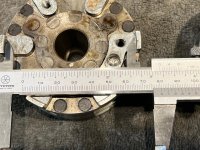
Not only the diameter for the starter clutch is different, but the late one is also slightly higher. The diameter of the rotor itself is the same.


Afbeelding van WhatsApp op 2025-03-26 om 22.05.27_5c491b3b.jpg
 
Tonight I measured the magnetic strength of all the CB450 K rotors, and found a lot of differences between the rotors.

meeting.jpg

Afbeelding van WhatsApp op 2025-03-31 om 22.55.13_950b375e.jpgAfbeelding van WhatsApp op 2025-03-31 om 22.55.13_17a1d086.jpg


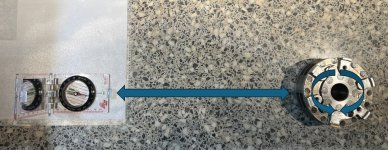
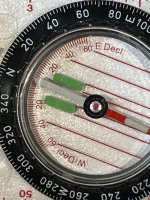
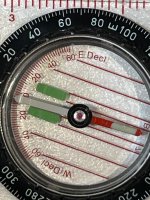
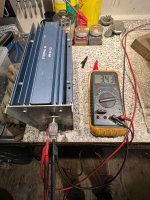
I used the set-up above, on the left I have a compass, and at the right the rotor to test. I try to make the distance between rotor and compass as large as possible while I rotate the rotor by hand. If the needle of the compass doesn't wiggle anymore, the rotor magnetic field is not able to influence the compass needle. I measured the distance between the center of the compass and rotor, and did this for all the rotors.

The distances differed from 41cm (16 inch) to 57 cm (22,5 inch), which, in terms of magnetic strength is a huge difference (not a linear correlation but an inverse square law correlation). The whole set-up is a relative measurement method, not absolute, it only works in comparison with other rotors.
 
CB450 K0 frame is back from the powder coater and ready for assembly (which I started by mounting the rear fork and steering stem) I used needle bearings for the rear fork pivot and tapered bearings for the steering stem. Since this is my 3th BB, I went for powder coating, don't know yet what I have to think of it. The rest of the parts will be painted. My all original CB450 K0 (except the rear shocks) is still on the lift, waiting for it's upholstered flat (early) seat to be finished by me. The frame next to the CB450 K0 frame is a dream, also ready for painting. Unfortunately, the dream frame is too big for our blasting cabinet, but the rest of the parts are blasted and ready for painting.

Afbeelding van WhatsApp op 2025-04-06 om 22.10.44_cb8c5e9d.jpg
 
Last edited:
and tapered bearings for the steering stem
I think I read somewhere that you use a tapered bearing in the bottom of the stem and an original style ball bearing in the top. Are you going to tapered in both top and bottom this time? I need to replace mine...
 
I think I read somewhere that you use a tapered bearing in the bottom of the stem and an original style ball bearing in the top. Are you going to tapered in both top and bottom this time? I need to replace mine...

I did it in the same way as I learned from my nr1, tapered below, standard on the top. The forces work in the lower part, the top is only for guidance and end-play adjustments. Tapered bearings on both side has some disadvantages, like height issue's and heavy steering.
 
Tapered bearings on both side has some disadvantages, like height issue's and heavy steering.
I find that interesting, because I never rode a bike with tapered steering head bearings (aside from my CBXs) until I put them in my 450 and I haven't experienced any of those things. My bike rides and steers like any other medium sized Honda with loose balls and races in good condition.
 
The first disadvantage is described in detail in the thread that KHSE mentioned, the second disadvantage is more a theoretical nature, tapered bearings have more friction then ball bearings of the same diameter. The pre-load of tapered bearings is also higher, therefore the tapered bearings tend to have more friction in the same application. The tapered bearing can handle much higher loads, and in case of the application in our motorbikes, the shock load resistance is much better. However, steering is a little heavier.
 
You must have better sensitivity to the subtle difference then, I certainly don't feel any difference even on my lighter than stock 450.

Or in the Netherlands we have more fast corners on highways, and sharp corners as in roundabouts ;) . It's the same as taking the top engine mounts off for less vibration, like I got my CB450 without them. After adding a set the, the bike's behavior in short cornering was way better. Most people don't feel the differences if these are mounted or not, only in difference of vibrations.

What I try to say is that the difference can be felt under (heavy load, not stationary. For the same reason I mount needle bearings for my rear forks, no bushings.
 
Last edited:
Back
Top Bottom