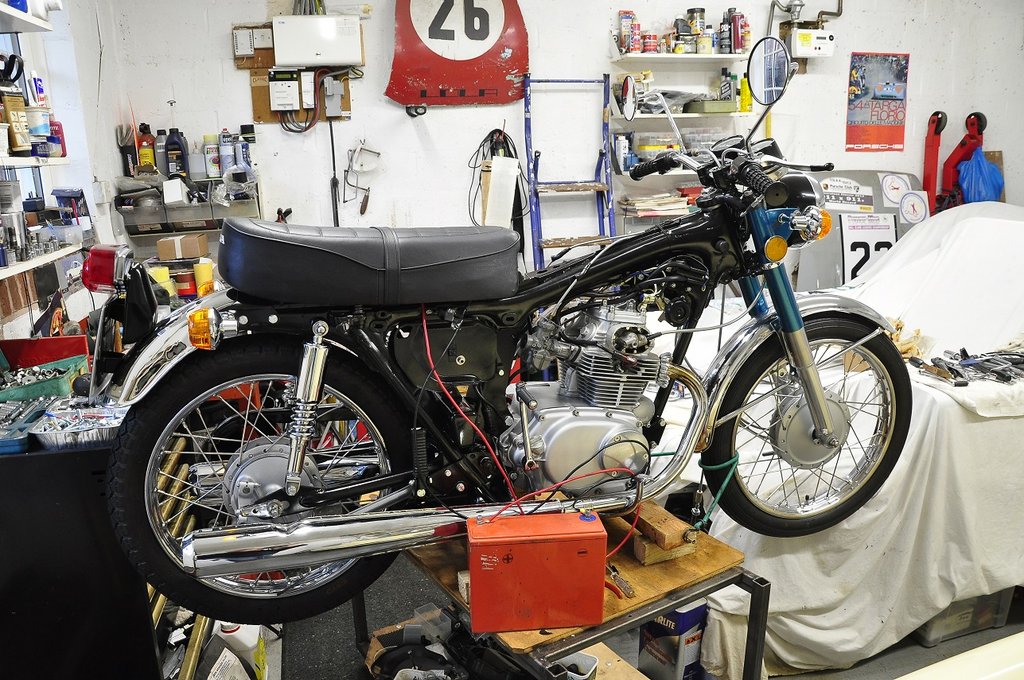
Rebuild of my English CB175K6, 1972

Thanks Sprint, that is how I've been doing it from the start, 12 thou is loose, 15 thou is far too tight so = 13/14 thou!

You have not made a comment about the other details in my 'methods' so presume there is nothing wrong there...
 
People talk about the bike static timed to the LHS on the compression/firing stroke, but I thought this bike released spark on the compression to one cylinder and a 'wasted' spark to the other so it does not matter if the timing is set on LHS compression as you also check the timing on the other side 360 deg later or is this the step I've missed?

thus:
Set crank at T and the cam timed with the peg for the advance device at 6 o'clock. The 'O' on the cam sprocket is at 12 noon.
Adjust tappets on the LHS to 2 thou, 360 later, set the RHS to 2 though, rotate 360 to get back to starting point, advance pin at 6 o'clock.

Set points to 14 thou. using either of the 2 cams lobes on the end of the cam shaft/advance unit. I turn the engine so the points heel is between the lob starting and dropping.

Set crank to T with LHS on compression cycle, both valves closed, checked by the tappets being clear by 2 thou. (RHS tappets lifting valves, so tight), so crank at TDC.
Set points plate about where i think is right for static timing.

With the buzzer set on my meter, one lead to ground on the engine, check it buzzes. Disconnect condenser wire.

Place other lead on the points screw head that fastens the points spring and condenser wire.

Turn the engine 360 and see, when the buzzing stops, where the F line is to the generator reference line.
Adjust the plate position a million times to get the buzzer to stop as close to the alignment of the F line/generator line as possible. Recently I manage the position about 1mm or 0.5mm either side of the generator line of the F line.

I check it all after fully tightening up the clamp screws on the plate.

I now consider the engine electrically timed.

Now, is any of the above wrong?

What can possibly go wrong?

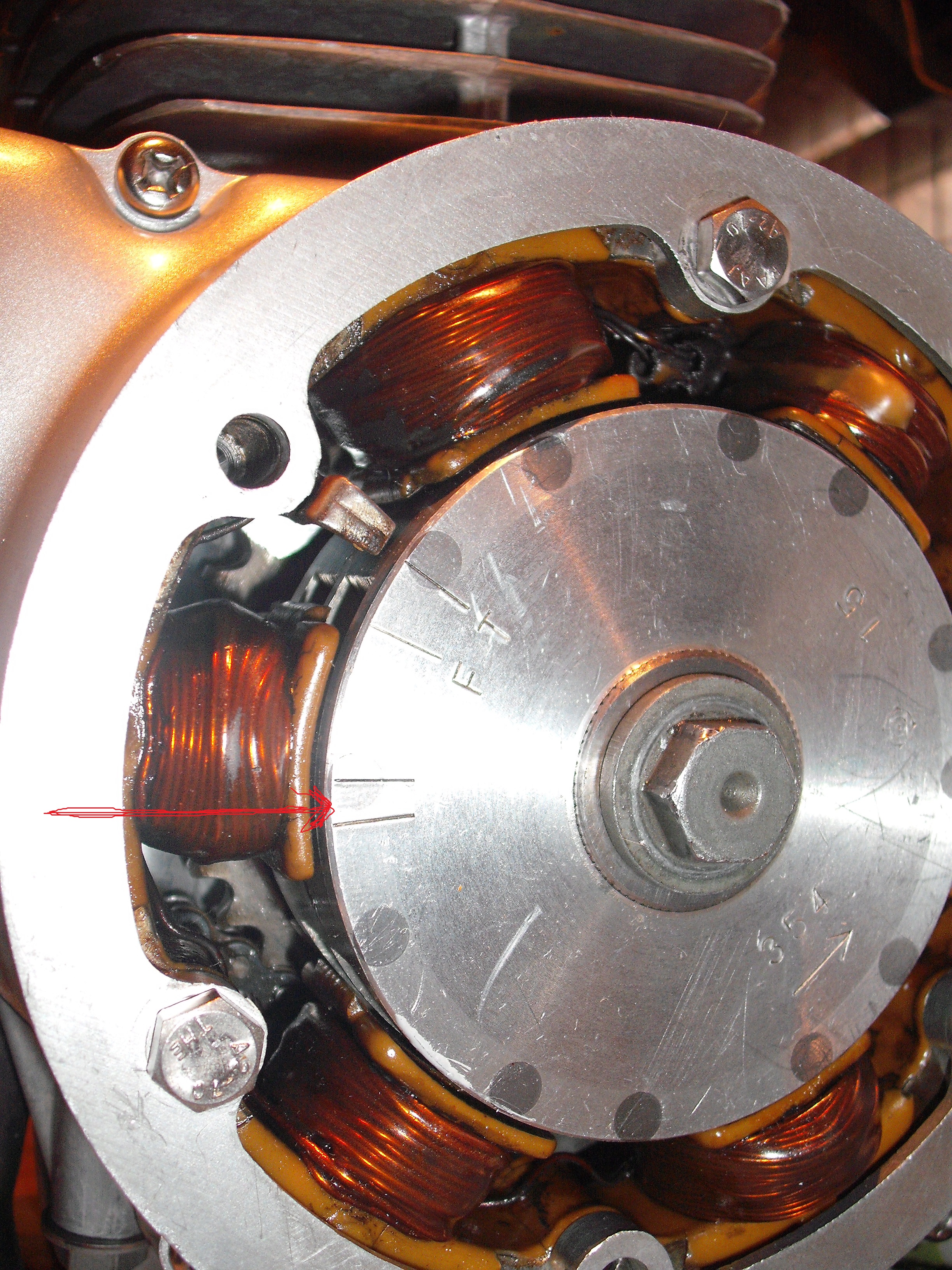
The F line (Not the F itself) MUST EXACTLY align with the index line on the stator....... A mm off is wrong......
Does your cam follower touch the breaker cam through all of its revolution except when the points are closed?
 
Last edited by a moderator:
Don't know, but will check tomorrow morning.

The buzzer on the meter 'buzzes' on the lead-up to the cam so I assume it is then that the contacts are together and when the buzzer stops is when the points 'just' open.

To get it 'bang-on' the F line will be really tricky as the very small (almost cannot see the movement) seems to make a large difference, ie 3 mm off the mark.
Screw tightness to lock the plate makes a difference to final position too, most marked on the points fastening screws too.
However, I will persevere tomorrow to get the timing set as you say and try yet again.

I've had the static timing at this position before tearing the engine down again when the RHS ran alone with no carb on the LHS and only the LHS plug in the head to allow grounding.

Everything that is shared on the engine (coil etc) will not even give one firing on the LHS with the RHS carb fitted.
So I have everything that works on the RHS now devoted to the LHS and nothing works at all.
 
Are both plug wires attached to plugs in the engine?......Coil secondary can only fire if its circuit can complete.....
I ASSUME you plugged the points wire back into the condenser....
 
Getting the timing spot on is important for optimum performance, but these engines will start and run with the timing / points gap way out of spec.
 
I agree Richard, and after 2 hours this morning I would say it is impossible to time this engine 'spot-on'.

This freezing morning:
Removed the points to check the contacts, as good as new. (they were new during the engine initial re-build).
Replaced them, adjusted to 13 thou on the apex of the breaker lobe, rotate 360 and check the points gap on the other breaker lobe, 13 thou (!); set the cam with the 0 at the noon position, checked by getting the advance drive pin at 6 o'clock. (advance unit removed to do this).
So, I am now @ TDC, LHside cam at 0 @ noon. Set the valve tappets to 2 thou. Rotate 360 and set the RHS tappets. Go back and check LHS and RHS tappets. all @ TDC of course.

Replace the advance, set the static timing with the LHS first, cam at noon etc. got it to coincide with the F mark 3 times out of 5. There is poor repeatability in this engine.
Rotate 360 to the RHS breaker lobe and the timing is WAY off, ie after TDC.

There is no way this method is repeatable, the accuracy of the breaker lobe forms are not the same on the advance unit. I put the original advance unit on and it was worse. I simply cannot get both sides to time to the F mark.

Thus, following the Haynes book, I accept, as they do, that you cannot get precise timing with this design and HAVE to split the difference. This mean the points open about 1mm either side of the F mark and that is where it is now.

So, wired it all up and checked for 12v at the points with a piece of paper in the contacts, ign ON and 12v all there. Removed the paper!
Fuel to the carb (only one fitted remember) and the RHS plug tested for spark. Weak to say the least, but there if you stare hard. Checked the LHS plug for spark, nice and fat!

Mmmm...duff plug on the RHS? Both new a few runs ago....

Petrol tuned on... NOTHING.
Put carb onto the RHS and nothing, engine just will not fire.

I simply must have the ignition done, though the weak spark is a worry. New coil remember. As Richard says, the timing does not need to be race-engine-perfect to at least splutter let alone run. My Porsche 3.2 litre 6 cyclinder engine runs 6 cylinders on a distributor, a condense and points....

Fuel, doubt this carb is duff, it was working before I did the rebore....

Therefore, following you need 3 things to run, sparks, fuel and compression, it leaves me with the heart sinking thought I have no compression to generate a fire of some sort.
I find this hard to accept after all I have done to the cylinders.

Tomorrow, compression test and a leak down test to see if I have profound hissing from the engine (rings), the carbs, (inlet valve) or silencers (ex valves).

I really cannot face another engine strip and 1mm over rebore and all that goes with it.

Really no fun at all now.
 
Getting the timing spot on is important for optimum performance, but these engines will start and run with the timing / points gap way out of spec.
True, if that's the only error, although it depends on direction of (advance or retard) and how great the error is as to how finicky/difficult it will be to start....
Of the three requirements for an engine to run (suitable fuel/air mixture to compress into an explosive mixture,...That (and enough) compression to occur,....A correctly timed spark to ignite it and cause that explosion to occur...), two have to be eliminated (as verified correct) before the problem can be determined to be the remaining one......There is always the possibility that the compounded effect of more than one (or all) of the three being slightly off is preventing starting and running until two are absolutely correct.......A contributing factor to the problem can only be eliminated after and IF it is corrected.......But you know this.....
 
Replace the advance, set the static timing with the LHS first, cam at noon etc. got it to coincide with the F mark 3 times out of 5. There is poor repeatability in this engine.
Rotate 360 to the RHS breaker lobe and the timing is WAY off, ie after TDC.

There is no way this method is repeatable, the accuracy of the breaker lobe forms are not the same on the advance unit. I put the original advance unit on and it was worse. I simply cannot get both sides to time to the F mark.

Thus, following the Haynes book, I accept, as they do, that you cannot get precise timing with this design and HAVE to split the difference. This mean the points open about 1mm either side of the F mark and that is where it is now.
This is often a sign of damaged or missing thrust washers under the breaker cam, or a bad advance unit....

When I have to "average" it is usually no more than the lines width (maybe 0.2mm) to one side or the other of centered on the line......
 
Last edited:
Just reading that:

I have 2 advance units, original and second hand. The springs on the original were 'stretched' so the weights were not firmly coming it to the breaker lobe sleeve, so i got another and those springs are good and 'firm'. All my saga episodes are with this replacement.

The advance unit slips onto the cam shaft journal and locates on the small drive pin in the cam. It can go on in 2 positions, there is no off-set to the drive, so I presume it can go on in either position. If position was critiacl it would be noted in the manual or engineered to only fit in one way.
The unit is fastened to the cam by one central screw. When tight, the cam lobe sleeve can move axially about 0.5mm so it is free to rotate when the engine revs increase.
All this seems sound to me.

As to position, there is absolutely no way I can get the opening points to +/- 0.2mm, far more +/- 1mm.
The transition of the surface of the cam sleeve for the points going from the points closed to the points 'just' opening is not a clean step, it is of course a smooth transition thus cannot be defined.

Can it be my trigger in my meter is too insensitive for this? However, the position of opening is not repeatable, I can get the one lobe to open bang on F +/- zero (to my eye) and the next 720 degrees round it will be 2mm off F! With
that un-repeatability I have no chance.

however... I could set the timing to F +/- nothing on the LHS and ignore the RHS. (so still working on the one side of this engine). This would mean the timing is right. Assuming I have a spark, then one of the 3 needs is ticked-off.
To fuel, well the bowl is full and this carb has always worked, so I hope that ticks that one off too.

So, this leaves the elephant in the room, compression.

After a rebore, fresh rings and pistons and a 1 thou radial clearance and 6 thou ring gaps what compression pressure can I expect assuming the head/gasket is sealed tight?
My last comp test gave a miserable and unexpected 80 psi, almost in the RED zone, I expected more like 120 psi. It was 110 before the rebore!!!

Am I the only one to go through this torture?
 
One thing I forgot to add in all that drivvel above:

Setting the LHS tappet clearances, TDC, cam 0 at 12 noon, I set the tappets to 2 thou.
Turn 360 degrees and repeat for the RHS.

NOW, before hand when I did this the LHS tappets would be tight, ie the valves partly open, both of them.
This time the LHS clearances were really large, maybe 2mm, yes, 2 mm.

Rotate another 360 and check the clearances, 2 thou, RHS massive clearances, again.
What on earth is gong on or have I lost my marbles?
 
Tappet clearances MUST be set on the compression stroke, not just any TDC......

The TDC that occurs next after the intake valve for that cylinder closes is correct assuming anti-clockwise crank rotation...

Am beginning to wonder if cam journal to points housing bearing surface is correct.......
 
Ok, crank at tdc, ie Pistons right up the bores. Cam at 0 @ noon, tappets wound right off. All set on the lhs of the engine.
I think the heels of the lobs are uppermost so the tappers will rest on the heels and get a 2 thou gap.
This must be the firing position, tdc and valves closed?

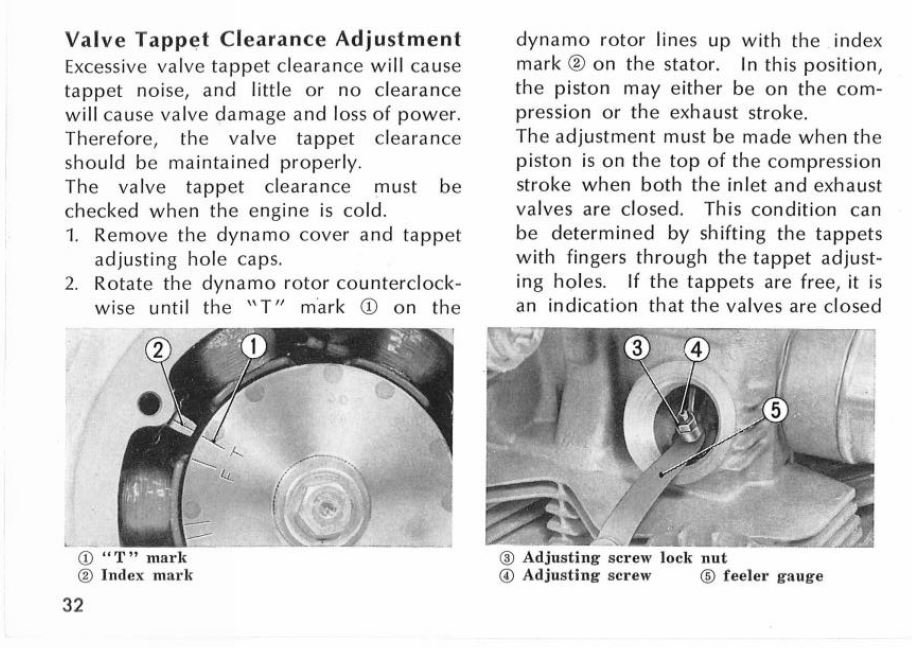
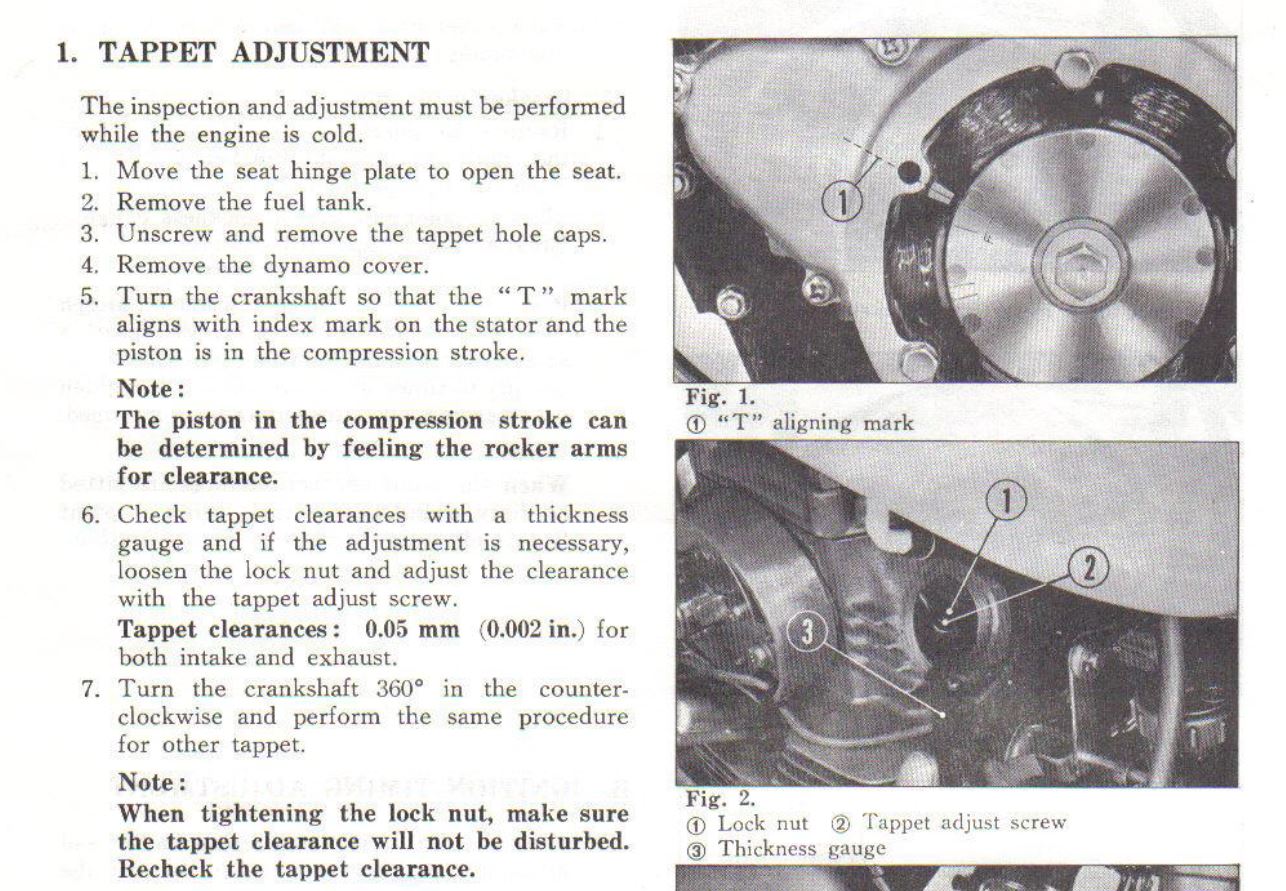
The manual shows just a simple alignment and the job is done.
 
The manual shows just a simple alignment and the job is done.

But which manual? You have mentioned the Haynes manual many times, I hope you also have the FSM from our library. And BTW, my method is not to look at cam timing marks but rather watch the intake valve close, then the next TDC is correct for that cylinder
 
Thank you for all the replies.
I refer to the Haynes manual.
I have looked at the library and the cb175 works manual and cannot find anything to the above procedure, but will follow the link above and pray it guides me correctly, i.e. I understand it!

I followed the Haynes book on the first bike and had carb tuning troubles, but none of what I'm going through.

Hoping for a good day tomorrow.
Please!
 
1ftNNRx.jpg

From the owners handbook, the one that fits under the seat.
 
Thank you Richard, saves me a search tomorrow morning.
The above is for routine maintenance, not for engine assembly though. It assumes the engine is correctly built.

I had the tappets slack/ roughly set when I assembled the head, cam with 0 at noon so the valves are closed, the cam can be radially moved slightly , as in very slightly.
I placed the head on the block and set the tappet clearances as the Honda Book.
I presume in this state the LHS cylinder is not on the firing stroke?

Sorry to be so thick here, but I've been round so many times over this.

Will this work:-
LHS at tdc, cam at 0 at noon. No idea if this is firing stroke, but as the engine does not work, it must not be on the fire stroke. This places the peak of the cam lobes at about 4 and 8 o'clock viewed from the LHS end of the cam.
Rotate crank 360 and set LHS tappets to 2 thou. In this position, the lobes are at 10 and 2 o'clock and the tappets will be clearance set on the other side of the lobes. the 0 mark will be at 6 o'clock.
Rotate crank 360 and set RHS tappets. Check again to see that tappets are all clear.

Engine cam and tappets all done. (?)

The above is different to what I have done during the 2nd rebuild.
I think this way above will give clearance on the side at firing stroke and the other cylinder will have tight tappets.

Or, can anyone point me to engine assembly details or please, even list out the correct procedure assuming an engine build, not maintenance..

Bet I dream about this tonight!

I so hope my next post will be to say it runs.

Is there a reference in the manual section of this forum for rebuilding the engine from scratch as I've failed to find anything so far, hence always referring to the Haynes book.

The forum manual I've looked at is in the Library, up to 200cc and is the purple coloured one.
 
With the cam in the timing location, mark at 12 o'clock, the engine is at the top of the exhaust stroke, both valves slightly off their seats.
 
With the cam in the timing location, mark at 12 o'clock, the engine is at the top of the exhaust stroke, both valves slightly off their seats.

As Mike just emphasized, you are on the wrong stroke and need to be TDC on the compression stroke to set either tappets or point timing......

Cam to crank timing is generally set on the left cylinders' "off" stroke @ TDC on these twins......

From the left side of bike, WATCH the left intake valve until it closes and then proceed CCW to the "T" ...Set Left Tappet clearances....
Rotate Crank 360 and set right tappets....
 
Last edited:
Thank you both.
Yes, I realised last night I was on the 'wrong side' but could not see how to get it right.

Will give this a go this morning as Sprint describes. This is nothing like the Haynes manual!

Sorry to hog this section of the forum, I've never had such a frustrating time with a 4 stroke engine.
 
This is all just a test of my patience and tenacity, possibly many others too.

This is what I have just done, hoping I have followed instructions.

So:
Set the engine back to LHS @ tdc, cam at 0 12 noon ie at the non firing position. Essentially this is the Haynes manual assembly AND many others on YouTube who have done these engines and they run, just like that.

However:
opened all 4 tappet ports. turned the crank and watched the inlet open and close and carried on a little to align the T to the generator mark. The cam is now 0 @ 6 o'clock.
Set the tappets on the LHS and 360 deg later, the RHS tappets.

Rotated the engine a few times (at least the oil pump works with all the oil coming out...) all feels nice and smooth. (plugs out)

Covers back on and fire the starter.

The good carb is now on the RHS where it worked before the rebore work. Fuel on etc and the engine fired for about 5 cycles and stopped, 2 seconds max (choke on).

It will not fire now at all. Found my EasiStart can and shot a bit at the carb but nothing happens.

Checked the tappets again.
With the LHS @ 2 thou the RHS are tight on the lobes. Rotate 360 and the RHS are 2 thou, LHS tight on the lobes, at least I think that is right and totally different to yesterday prior to following Sprint's method this morning.

I will now check for compression etc and report back.

Feeling utterly dejected right now.

On my mind is why the Haynes book and other people simply set the engine/cam/tappets and the bike works. This is what I did with my previous cb (I'm using the same manual) and it ran, albeit cold on one side.
Prior to the rebore, this engine would reliably run hot on the left, cool on the right and once actually ran evenly on both carbs but with the left slide screw wound in as tight as possible and the rhs car quite the opposite.

Just so very perplexing.

This has got worse with every action I have taken, yet those actions should improve things, ie the rebore etc.

On that, I read the tolerances Honda give for cylinder/piston clearance as 0.5 thou to 2 thou, ie 0.25 thou around the piston to 1 thou around the piston.

I have this rebore to 2 thou, ie 1 thou around the piston. With the new rings fitted the ring gaps were 6 thou, so I should expect good compression...

The compressions are 80 psi.
The leak downs were @ 30 psi into the cylinders individually @ tdc

RHS: exhaust silent, inlet silent engine (via the top breather hose) a low hiss, hard to describe, but you have to listen quite hard.
LHS: exhaust silent, inlet very very low hiss, engine hiss as above.

The engine hiss' are the same, expected when the compressions are the same.

I shot some engine oil into the LHS bore with the piston at tdc and the compression went to 95 psi and the hissing all but silent.

These compressions are very low about 40% of a good engine, must be why it wont start?

Not sure where all this leaves me, but in a boat without a paddle comes to mind.

And so the beat goes on..

Put some neat petrol down the plug hole on RHS with the Chinese carb on.

After some struggle it actually ran for about 5 seconds, down pipe got hot. Will not repeat itself.
Just tried it many other times and the carb will occasionally back fire, ie a flame out of the carb, sometimes a small flame in the slide area. Not sustained, just as if the ignition of the fuel come out tof the inlet rather than out the exhaust. This is not a regular occurrence.

The Chinese carb is new and although wrong jets etc I would expect some action with it.

So, for a very brief moment I have all the conditions to run, then nothing.
The starter is not helping.
It will sometimes not turn the engine over for more than 1 or 2 revs before the clutch loosens (one behind the generator), and it very rarely hold and turns the engine as soon as you open the twist grip!

The more I try the more I despair.

Maybe time to leave it alone for a month and come back to it. This project was to be a good bit of fun during lockdown, really the opposite.
 
Thank you both.
Yes, I realised last night I was on the 'wrong side' but could not see how to get it right.

Will give this a go this morning as Sprint describes. This is nothing like the Haynes manual!

Sorry to hog this section of the forum, I've never had such a frustrating time with a 4 stroke engine.
For what it's worth to you, I'm doing a rebuild of a '72 CL175 right now so all of your troubles are very insightful for me! [emoji28]

Sent from my SM-N960U using Tapatalk
 
Gavin, I have the only rubbish cb engine, so you will be fine!
Richard, many thanks, encouraging compression readings, I thought yours would be 130 psi.
The lines on the generator are like mine with the LHS @ tdc and the 0 at noon, the 'strobe' lines are exactly where mine are.

For the life of me I cannot see where I've gone wrong, or what is wrong, but it is far worse than when I first re-built it.
 
Obtain a medicine dropper/eyedropper and remove carbs and manifold tubes from engine......Three drops petrol in intake port and NEARLY seal with two fingers across port (thin gap between fingers acting as "choked"/restricted air inlet)......Try to start, cranking engine at least 10 to 15 seconds.....Repeat on other side.....I expect each side will momentarily fire/rev/sputter.......Report results
 
80 psi is a bit low, even with unseated rings, almost like the valve timing is still suspect. Maybe you should remove a spark plug, stick a straw in the hole and verify tdc position coincides with the pointer on the "T" mark.
 
The generator magnetised hub has one key slot machined in its bore and one pin in the crank, so the crank-to-hub registration is just one position, so TDC has to be right, ie the pistons are at TDC when the T mark aligns to the generator marker, BUT, I have taken this for granted, so will check tomorrow, easy to do.
Thanks for the suggestion.

80 is to me very low, but as Richard's fresh engine shows, his rebuilt and hot engine is not much better, but works.
 
The generator magnetised hub has one key slot machined in its bore and one pin in the crank, so the crank-to-hub registration is just one position, so TDC has to be right, ie the pistons are at TDC when the T mark aligns to the generator marker, BUT, I have taken this for granted, so will check tomorrow, easy to do.
Thanks for the suggestion.

80 is to me very low, but as Richard's fresh engine shows, his rebuilt and hot engine is not much better, but works.

In those pictures I'm showing around 140 psi on each side, on a gauge intended for larger capacity engines.

FSM states 170 psi, presumably on a bedded in engine at operating temp, using correct pressure guage
 
Embarrassed now...:whistle:

I have the same gauge as Richard and use it on my 3.2 litre Porsche engines, BUT I have read 8 BAR as 80 psi! What a prat I am, this confirms all you think of this 'master mechanic'! (although I am certified by YouTube..)

So I have 120 psi cold fresh engine, assembly oil in the rings. Suddenly feel better.
Off to drip petrol into this engine.


Oh well, made you smile!

So, the petrol-drop test failed, but not as you would expect...

The starter will not 'grip' the engine crank now. I might get on revolution and it disengages with a nasty gear clatter as the starter runs down to a stop.
Had this from the start months ago, new chain, new rollers all the usual stuff, so the engine never gets spun enough.
Yesterday I could get some kind of multiple cranking, but not today.

It is as if the electrical supply is immediately cut after the first stab though the starter solenoid clicks etc. to commence the start.

Sigh..just what else can happen?
 
Charge battery, do one cylinder at a time (other plug out but grounded to engine).......
Or, get a helper to be the "chokes" and kick it over.........
 
And for what it's worth, I want to echo what gavinbpughsaid. I know when I finally get back to my tear down, and hopefully rebuild, I am sure this thread will be revisited often. I really appreciate all of the detail your are putting in here hillclimber and of course all of the detailed responses.
 
Oh, how I wish I had little to discuss!

Sprint, tried kicking it over by hand, the bike is on a table, too high to kick, and the kick start lever is still only giving 1/4 turn despite pulling the bottom case off to check it was all in correctly!
Thus, the very limited stroke I have on the kick does very little to turn the engine, just so typical of my luck.

I took the generator side of the engine off this afternoon, 8th time in 2 weeks.

With the magnetic hub of I drove the starter up to see what is chattering and making the clutch rollers come free of the sprag gear and stop turning the crank.
It all speeds up perfectly.

So, fitted the hub.
The hub has 3 new rollers and springs and the sprag gear diameter to which the rollers lock is shiny smooth across 2/3rds of the width of the land.
Turned the motor on via the button and the problem is clear. The clutch roller grip initially then come free of the gear/hub and freely spin leaving the crack stationary. This is accompanied by a real rattle/chatter that sounds terminal if you could not actually see it.
My conclusion is the sprag gear roller surface in no good and a new assembly is needed, so i have to find one.

These are no longer available, the Chinese ones are no good, dimensionally miles off. I bought one and when I asked why the cb175 one does not fit my cb175, the man said the part numbers were the same, so it must fit. Utter waste of time and money.
He was upset when I gave him a negative ebay rating.

I think I have to risk all and buy a used gear/clutch/generator hub and fit it as a whole and keep my fingers crossed.

OK, BUT I will say I dropped about 1/2 a cc of petrol in each intake as Sprint suggested and I feel it would fire. If I could have gotten multiple cranking then I feel sure it would have run briefly.
Have to wait another week now for a 'new' starter, £70.
 
Thank you for searching those out.
I have ordered a good looking unit from a very popular breakers here in the middle of England (Two Wheel spares) and managed to get the hub, gear and roller cage for £64 delivered in 2 days, so should be with me on thursday.
The shipping costs from the USA are crippling!

I hope this will fix things on the starter, and with this done I can get a good churning of the engine every time and get rid of the terrible noise.

I've seen a video today of a guy in the USA with the same issue on his 350 twin, but new rollers fixed it, but the malfunction was the same. New rollers/springs/followers have not fixed mine of course...

With this fixed I can get on with the fuel experiment and hopefully progress!

I'm still smarting over mixing up Bar pressure with psi readings, what a schoolboy error.
Wonder what else I've cocked-up?

https://www.ebay.co.uk/itm/Honda-CB...e=STRK:MEBIDX:IT&_trksid=p2057872.m2749.l2649
 
Wednesday, and a pass-out to the garage for the day.

Starter hub/gear/rollers arrived early today, so that went on and really works well! Never had a starter on this bike that locks on and just keeps on cranking round. Fabulous!
Tried the idea from Sprint to put a few drops of fuel into the intakes but nothing. Put some fuel directly into the plug holes, but nothing.

Decided to fit one Chinese carb on the RHS. It spluttered into life! but really not happy, but it fired.

Getting excited, put the stock carb on the RHS (nothing on the left). A few seconds on the starter on choke it ran, and ran really sweetly. Exhausrt got hot really quickly too, took me by surprise as I grabbed the silencer to 'test' it...ouch.
Getting more excited I put the stock LHS carb on but only fuel to it, the RHS would be left to run dry. This was to be sure the LHS was working in it's own right, not assisted by the RHS.

IT RAN!

Once I had sworn at it I left it to run (2K on the tacho). RHS hot, LHS about 2/3rds as hot. Real progress.

Did a rough carb balance so the slide screws were at the same spot and eased the engine speed down 1/4 turn at a time on the RHS carb and the heat came into the LHS AND equalized to the RHS (careful touch of hand through gloves).

Throttle response is immediate and no bogging-down when you snatch the twist grip wide open, very keen to rev, and dies to the fast tick over quite quickly, about as fast as a normal car engine does.

First time it has behaved in this manner, ever.

It then petered out, ran out of fuel!

Decided to leave it there for the day, tidy all the odds n sods on the wires etc.

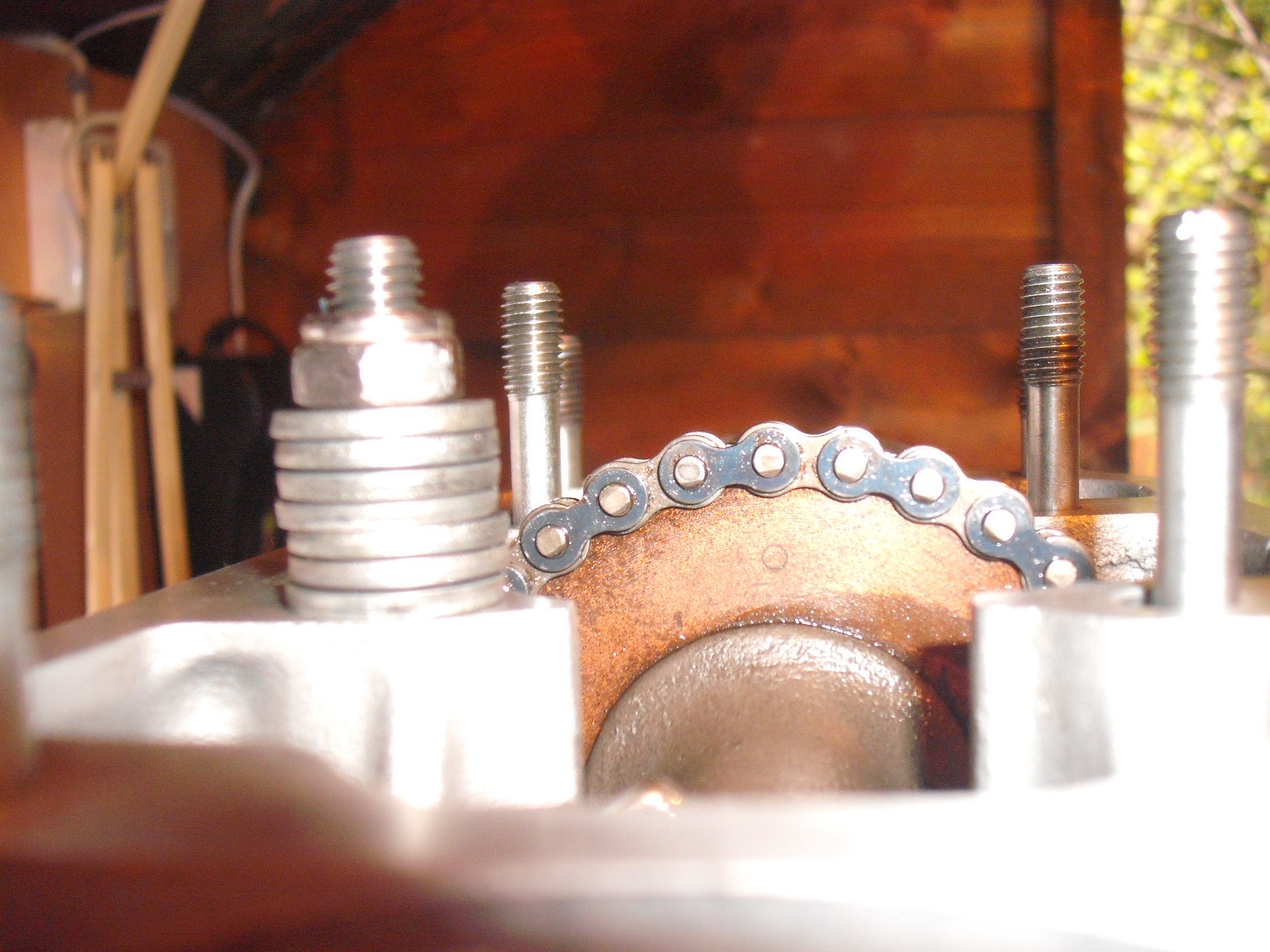
So, tomorrow I hope for more time to tweek the engine with the filters on and try to fix the oil leak on the cylinder head stud where the hot oil is getting past the washer and the domed nut and running down to the top front engine mount point. I hope a good clean and some HondaBond will seal it.
Can't have a Honda with a leak.

WHAT A DAY, 10 STEPS FORWARD IT FEELS LIKE, SPANNERS CROSSED FOR MORE FINE PROGRESS TOMORROW.

WILL I GET TO 1400 RPM? I DON'T TRUST THE TACHO, SO WILL EASE IT DOWN TO AS LOW AS I CAN GO RELIABLY.
 
Back
Top Bottom