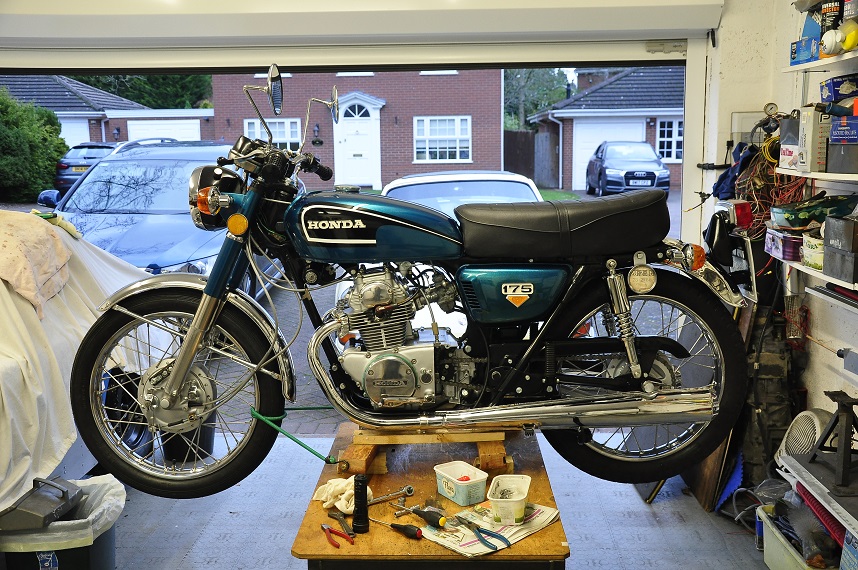
Rebuild of my English CB175K6, 1972

Think I've got it today.
Stripped the carbs for the 8th time, cleaned and cleaned again, poked all the holes etc and re-assembled.

It started just like that, instant on the electric starter and I warmed it up.
Had the usual hot side/cold side and it almost switch over sides during some tweaking, BUT I seem to have found a sweet spot.

The tick over is close to a Harley though the tacho says 1800 sounds more like 3 rpm to me.
The pilot screw seems close to redundant but has with some combination of throttle slide adjustment seem to have bought the engine to balance, the silencer temps are really close.

Boyed by that, the next step is to fit the air filters and see if things are all ok after and re-tweak. These little bike can be sensitive I've read to the choking effect of the cleaners, but I hope my custom foam ones will win through.

Following a post on a UK classic bike forum, I still have a nagging doubt about the drillings by the air ratio screw.
There is a short drilling with ball bearing seals and you cant get a wire to it, so going to strip the carbs again, and take the bodies to Villiers Services, close to me, who do old bike stuff and get them to US clean in thier heavy duty tank. Might then leave them in cellulose thinners for a few days soak and see if the screws have more effect on the engine.
Worth a try providing they are open due to bloody Covid 19!
 
CB200 manifold has tappings for vacuum gauges. How would we use these in the procedure described above ? Use the throttle stops to get the vacuum equal on both sides at 1200rpm ?

Both the throttle stops and the mixture screws I'd assume, just as you would if you didn't have gauges on it. The mixture screws improve the idle as well, which will affect the vacuum during synchronizing.
 
The carbs could not be cleaner!
Brake cleaner shoots through all the passages and jets, and to top it off they spent time in the US cleaner at Villiers Services this morning.

Bike running on equal heat both sides and a low tickover. I don't trust the tacho's accuracy.
Good response to the twist grip so leaving it all at that.

The air screws STILL do nothing around the 0.5 turn to 2.5 turns to the tick over.

The starter chain/sprags etc make an awful din now but sometime hook up and spin the engine well to start, so taken the generator cover.case off.

The chain is very slack, but i doubt it would go on if I took a link out.
Are they supposed to look 'too slack'?
The lower half is nearly touching the engine case.

I have new sprags etc coming, but maybe I should bite the bullet and fit a new chain while in there.

Oil came out black, so discarded.

Last snag to fix is the leaking lh side fork.
Fork oil keeps on coming out albeit very slowly. Seems to be coming from where the front mudguard mounts. Maybe the fastener hole has broke into the lower fork casting?

Anyhow, still progressing. :)
 
IME, the starter chains often look quite slack but it has never caused an issue that I've seen. I'm sure you could find some equivalent industrial chain the same size to work, as the load on it and quantity of usage times wouldn't require anything exceptionally tough. Actually, I think it's the same size as most cam chains so a link would be easy to find. Hard to say what is behind the fork leak, but that isn't far below where the seal might seep out on the inside of the fork area and could be fooling you.
 
Agree about the starter chain, quite slack as standard.

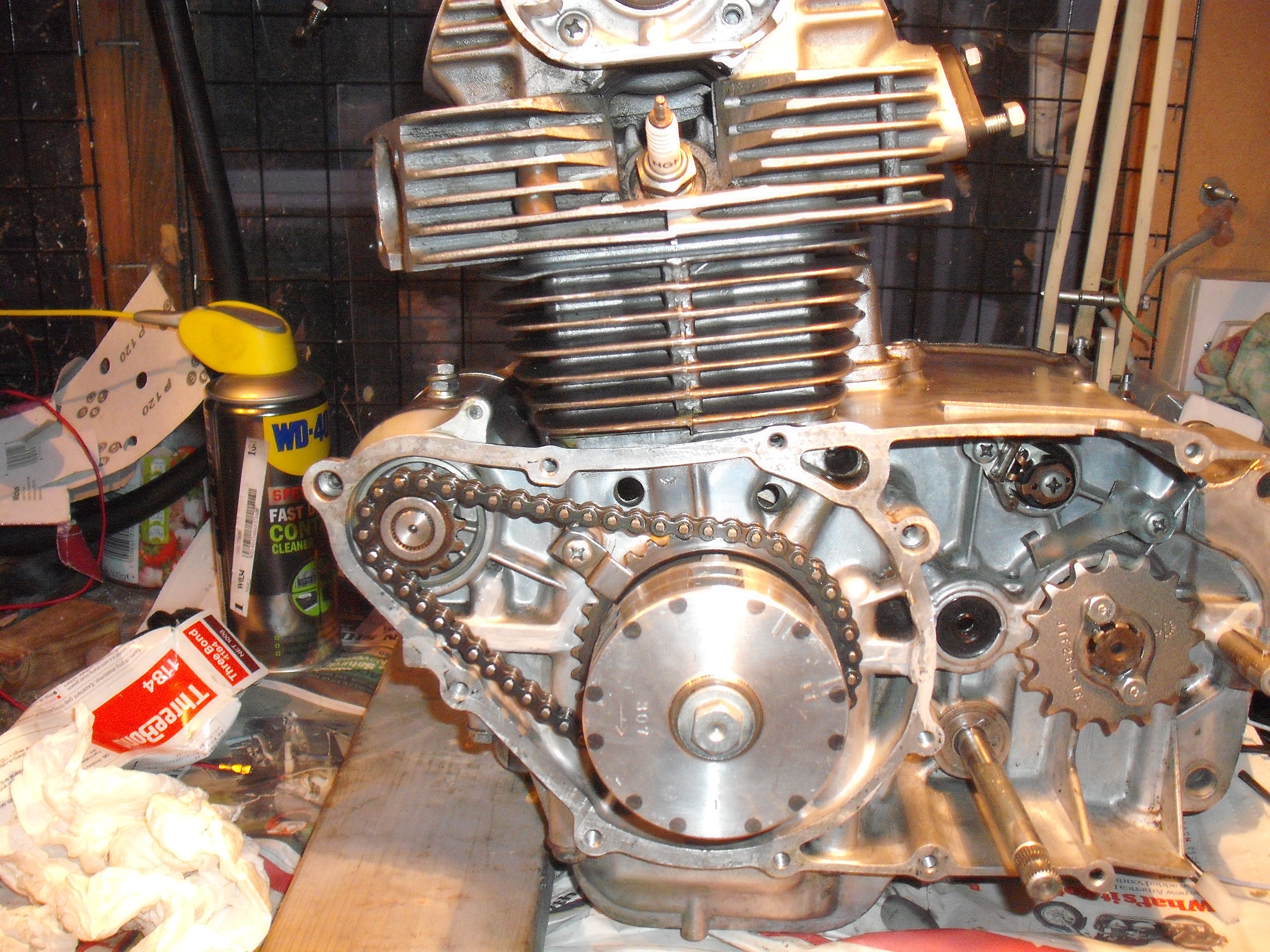
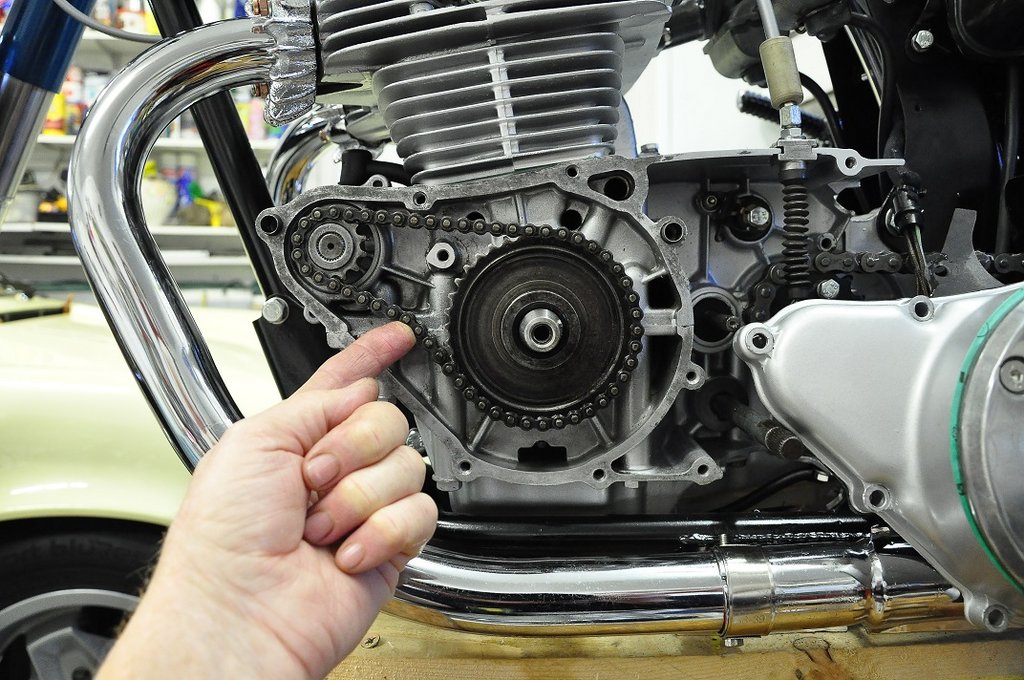
Here's the only photo I could find, from my first 175 engine rebuild. Chain is virtually dragging on the lower crankcase and on the chain retaining thingy on the top chain run.

k5e9gG9.jpg
 
Just been looking at that picture Richard.
pic below is mine, still looks a lot.
The sprags work well now I've bought new parts (typical) but will fit them when they arrive anyway.

The splined pinion out of the starter seems to have too much play to me, it spins well, and quite quiet too, but the clatter from the starting action 'down there' is really not good.

Will remove the starter and look at the gears and the pinion bush. i think i have a spare which might be better.

 
A few steps back and a few smaller steps forwards today. Funny how some days you get in the mood to get the jobs done.

Still waiting for parts from D Silver for the starter clutch, but found my spare starter motor which has a pinion spline shaft that is not wobbling all over the place, so a silver paint job, back on tomorrow.
Kept on seeing the oil weep from the engine top 'rocker cover', been weeping since I started the engine, one of the green gaskets that seem poor at their prime task, but found a new black one so the top mounting came off and the gasket replaced.
Moved the conderser from the one cylinder head domed nut to the mounting bolt so getting a good torque-down of the head to 14 lbft, nice solid click on all 8 and a guess on the m6 bolt.

Lack of parts stopped play, so did some gardening to impress the Wife.
 
It seems that is one of the more guaranteed avenues of success in that area, as experienced by more than a few here. (y)

Indeed, after morning dog walking duties, a brief spell of carb twiddling in the garage, yesterday afternoon spent acting as labourer to the head gardener.

Essential trip to garden centre today, before lockdown closes everything down.
 
Richard is not the only one 'suffering' Honda Twin carbs...
The starter sounded terrible (electric) so replaced the motor, replaced the rollers/caps and springs, didn't replace the chain (mistake I think) and it sounds as awful now as it did before.
Parts were delayed as the 'in-stock' cover gasket was in fact in stock in the USA, but parts arrived today.

Putting that snag to one side, started the engine.
Would not start, churned over and over and then realised I had left the plug caps off....day not going well.

Running now but really not well. LH side hot, smoking rich and rusty water droplets profusely coming out the back, RH side cold. Here we go again!

Cold rh side carb then really flooded!.
Removed that carb and checked the float level, 21mm with the float just touching the sprung tip.
Decided to check the needle to the brass seat and that seals, so did a radical thing and set the float to 21 with the car upside down, ie the needle seated by the weight of the float.

Put it all back together and no flooding, however stone cold when running (LH side hot and smoking rich) and the speed adj screw does nothing, understandable as no combustion on the RH side...

It's 4.00 o'clock in the afternoon, just had a cup of tea and put the bike into the garage and tomorrow is another day.
Will this bike ever come into tune?
 
Banging my head against a granite wall here.

I have tried to set the float level on the carbs.
The book says 21mm, there are a 1,000,000 ways to do it according to Google experts.

Thus I ask on here exactly how do you set the 21mm?

I have fuel running out of the carbs via the overflow tubes and the engine runs super rich and uneven temperature on both side exhausts.
I am sure all the drillings and jets are clean as they left the factory.

The method I have used is to hang the carb such that the float hangs down like a pendulum and 'just' touches the sprung end of the needle valve.
I place the end of my rule on the lip of the carb casting (not on the gasket rib and not in the notch)

I then invert the carb so the float compresses the needle valve under gravity and blow gently down the petrol feed tube (from the petcock), the valve is shut firmly.

So, if my method is correct the bowl should fill and shut off before the level reaches the overflow pipe tip.
As it does overflow, the float presumably does not close the valve before the petrol reaches the overflow level.
This would say the float needs to be (far) more than 21mm, maybe the valve should be shut closed when the float is at 21mm?

Can anyone please give me the definitive method to use?
 
I'm assuming you are aware of the possibility and you've already done this, but did you check the overflow pipes for cracks? For whatever reason, the brass pipes do get tiny cracks in them leading to leaks from the overflow despite a proper float setting. If that is the case in your situation, they can usually be soldered
 
Thank you, was not aware of that, will check.
Just seen a convincing video of the carb upside down so the weight of the float is on the needle spring and the float set to 21mm from the gasket face in the cast body of the carb.
This is very different to my method, but also saw a tech drawing section of the carb off Honda Twins showing the same !
Back to the garage now...
 
Overflow brass tubes are good.
Tried a trick just, took a carb off and held it horizontal in the vise, not at engine angle, so the bowl gasket is level all round.
Took the drain screw out and made an adaptor that screwed in as a tube and pushed a length of clear pvc tube to that and ran it vertically.

Filled the carb with fuel, fed under gravity, until the bowl was full, ie it would not take any more fuel.
Noted the level showing in the clear tube, it is 2 to3mm below the gasket interface.
This places the fuel level some 5mm below the overflow brass tube in the bowl.

So, how is this carb getting to overflow (and the other one)?
It tends to overflow when the engine runs at a about 2000 rpm, which may be a red-herring...

I have now also lowered the small petrol vessel I am using so that the fuel shut-off tap is at the same level as the petcock on the fuel tank so I have a head of fuel which is roughly 50mm dia and 125mm high above the shut-off tap, it has been higher before by 100mm.

Hope to try a few more things tomorrow.

Is it only me and Richard who have these problems?
 
No, I think a few others have had issues with the 175 carbs too, can't recall any names at the moment but I do recall others asking about aftermarket carbs as a solution. It is odd that these carbs seem to be such a problem
 
I've had all sorts of problems with the float valves themselves, either sticking shut or refusing to close properly.

Here's some historical ramblings:

My CL/CB 175 rebuild thread

Ignore the bit about painting a fuel tank, more stuff about float valves after that.
 
Last edited by a moderator:
Interesting read, thanks.
I was thinking of getting even more parts from DS tomorrow, namely the new seats and needles they sell for the floats, but they are quoted as aftermarket.
They look a bit rough in their pictures, do you know any better?

I had the very same issues on these carbs/running on my gold bike and that partly led to me selling it.

One of the Chinese AJS 125's looks great, but 1/2 the power of the cb175!
 
I’ve found that there is a very fine line on these carbs between correct float level, too high, and too low. Float bowl gaskets are finicky as well. If they aren’t seated just right, they can leak, and/or stop float movement.
 
But...
when these bikes were in volume production the factory or dealers would not be messing about like this?
They would need to slap them together and sell them.
 
But THEN they had factory spec parts and gaskets, not aftermarket versions.......

Modern fuels MAY have differing specific gravity/density than fuel available back then.....So different float level specs might apply.....
 
From the tests I made today, the fuel level is 5mm below the bowl overflow tube tip with the carb horizontal.
I tipped the carb while looking at the fuel level in the clear tube, and tipped the carb to 45 degrees and not a drop came out.

Not sure how the fuel can be raised to above the overflow and then run out like a syphon effect had been established.
To sustain the flow the fuel has to be supplied and that has to be by the needle passing the fuel, ie the float had dropped and even stuck down, ie not rising as fuel is filling.

I can only think this is what is happening, the needle is jamming in the seat, jamming open that is so the fuel simply flows in, floods the bowl and exits.
Tempted to move the float level to 24mm and see what happens.
As long as the jets are immersed all is well, and as long as they stay immersed during riding dynamics too.

Can't believe this is so hard!
 
But...
when these bikes were in volume production the factory or dealers would not be messing about like this?
They would need to slap them together and sell them.

I don't believe that Honda ever 'slapped something together' !

None of the following is through rose tinted specs, I also had some truly horrible bikes in my youth.

As I've droned on about many times, I did 22k miles in 18 months on my new (in '73) CB175, and had no carburettor, or any other, for that matter, problems whatsoever. Very reliable idle - my friend also had one, and for some reason we left our bikes idling on their side stands on a hot day while we were messing around, waiting for some others to turn up. One of them was an experienced biker, unlike us, and he was horrified that we'd left two air cooled engines idling for 15 minutes or more on a hot summers day.

Even then, I don't remember that adjustments to the mixture screws made much difference, we just left them at the handbook setting. Similarly, fitting larger main jets after bashing through the baffles in the original silencers didn't make a difference that I could notice back then. As did removing the airfilters and running bell mouths (aka velocity stacks, in modern parlance.) I washed the airfilters in detergent and left them in the airing cupboard for a week or so, ran just as well when refitted.

I also once ran it on few laps of a club race track (Gaydon) on open pipes, ran perfectly well and sounded amazing. Same experienced mechanic said that I was bound to damage my exhaust valves, but it was fine.

EDIT And it would rev well into the red sector on the tacho (11k+ rpm ??) in the gears, unlike my present two, which don't like going much past 9K.
 
I can only think this is what is happening, the needle is jamming in the seat, jamming open that is so the fuel simply flows in, floods the bowl and exits

That was certainly a problem that I've had in the past, only really solved by trial and error. Even those genuine Keihin 1.5 float valves that I got the other week, one of those played up, problem went away when I refitted the original 1.7 seat.
 
Ok, bad turn of phrase, but the factory would not spend ages tweeking when new. As some others on another UK forum say, these Hondas were good to 10K miles then people threw them away, their sentiments, not mine, one was a Honda dealer down south.

Made some good progress over the last 2 days.

Cured the carb flooding issue. The carb float brass tang in the centre which bears down on the needle valve: I found the tang angle was at 45 deg and not square to the needle valve causing a side load on the needle and jamming open, hence the flood of fuel. I reset the float to 24mm.
Tick off the List.
Got the engine running better, far better with oh-so-small incremental movements of the tick over screw and the pilot air/fuel ratio screw, talk about a tight rope tuning.
Tick off the List.
Fixed the loose headlamp mountings by re-assembling the top fork handle bar yoke and all snugged-down nice and tight. No headlanp shakes now.
Tick off the List.
Trial and fitted the mega expensive side panels except they didn't fit at first. Numpty here had placed the tool box in the wrong pair of mounting holes in the chassis frame, what a faff to move and re-fit! All on now.
Tick off the List.
Fuel tank back on and fully coupled up. Pesky balance tube connecting the left and right sides of the tank fought me all the way, but lost.
Tick off the List.
Fitted the new seat from Taiwan, what a bargain for £100 delivered, resplendent with the 'HONDA' script of course. Perfect fit, fabulous.
Tick off the List.
Fitted the aluminium number plate at long last, really looks the Classic it is.

Nearly completed now, waiting for a new expensive starter chain to arrive and the bike can come down off the stand although it is very convenient on the stand while I prepare for some work on the Lola and the 911.
Just need to get the bike down so I can fit the front pegs and the side stand and it is all done.
3 weeks late on the project!

 
Numpty here had placed the tool box in the wrong pair of mounting holes in the chassis frame, what a faff to move and re-fit!

"Numpty" does fine work. As for the aspect of being "3 weeks late on the project"... Mom used to say "haste makes waste". Your results are certainly worth the wait, faffing and all.
 
Looks good. How are going to get it down ?

As some others on another UK forum say, these Hondas were good to 10K miles then people threw them away, their sentiments, not mine, one was a Honda dealer down south.

Which forum is that ? I'd love to go there and tell them that they are badly informed, to put it politely. Compared with the rubbish produced by the contemporary British factories, surviving examples of which are now regarded as 'investment grade classics', I despair ..
 
I use my car engine hoist.
just sling it round the rear seat bracket and the top fork triangle, takes about 30 mins, no straining or high pitch voice after!
I am in deep trouble with the participants on the other site, mostly after doing my troublesome Terrot MT1 2 stroke which became a real nightmare, but now in a gite in southern France.
Best you don't get me shot!
 
These carbs are bugging me, hate things to run 'nearly good enough' so just thinking out aloud on the subject of REPLACING these originals.

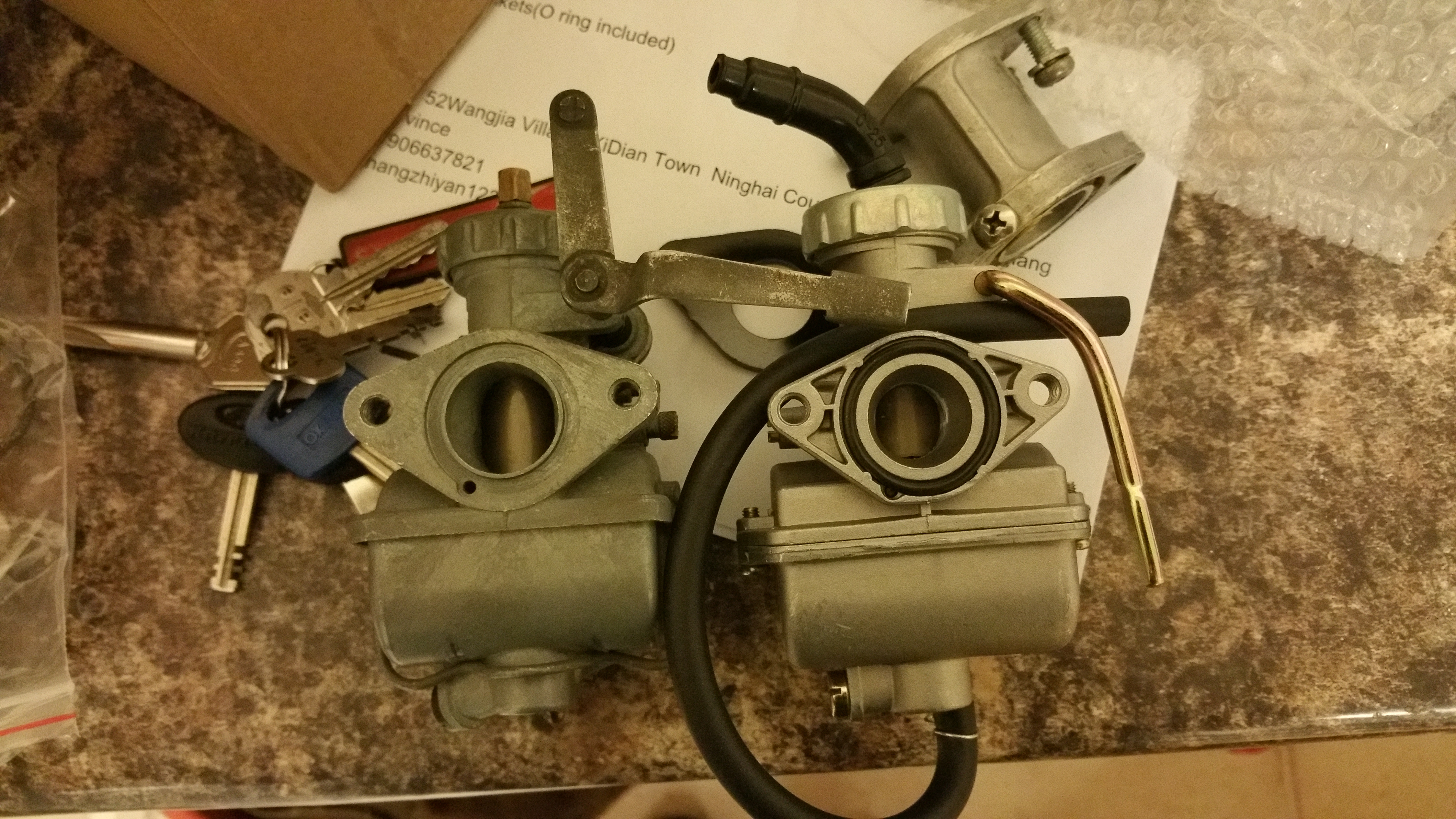
From a previous bike project I have a Chinese Dellorto knock-off, cost all of £11/13$ and is nicely made.

They are only available in one hand which might be a pain on set up, but the mounting flange is the same as the Keihin but the piston is 17mm dia not 18mm.

The double oval throat is 19mm x 16mm overall, inlet is 28.5mm (from the air filter, and the outlet to the engine is 19.35.
I have a range of main jets with numbers strikingly the same as the original jets, the pilots look the same too...

You can see where this is going.

For the minimal cost, I can get 2 new carbs and jets to tinker with, but they are smaller than the originals, but other sizes are available too which I need to search for on ebay.

https://www.ebay.co.uk/itm/Carb-Car...rentrq:c25c64281750a4cec45fb90bfffc8846|iid:1

Now, do the ones Who Know think this is a silly idea?

New starter chain came today, all changed over in 15 mins! Sure is tight compared to the original, really little slack in the free run of chain, sounds nice and quiet now.
 
Well, I'm not one of those "who know", but I will say the last Dellorto carb I saw looked nothing like what your link shows (of course, it also had a tickler instead of a choke too). Who knows how it would go, but at that price it wouldn't set you back too much to find out.
 
Thanks, the one I have looks just like the ebay advert, so have one to actually compare.
For about £50$ I could have a pair on the bench with a range of jets, so if it is a wild goose chase, not a real problem, could also work!
I'll see if any others have a strong opinion, but I'll give it a go, what could possibly go wrong....
 
It's a pity those OEM STD carbs are not available locally over here, it would cost the purchase price again in import costs and duties.

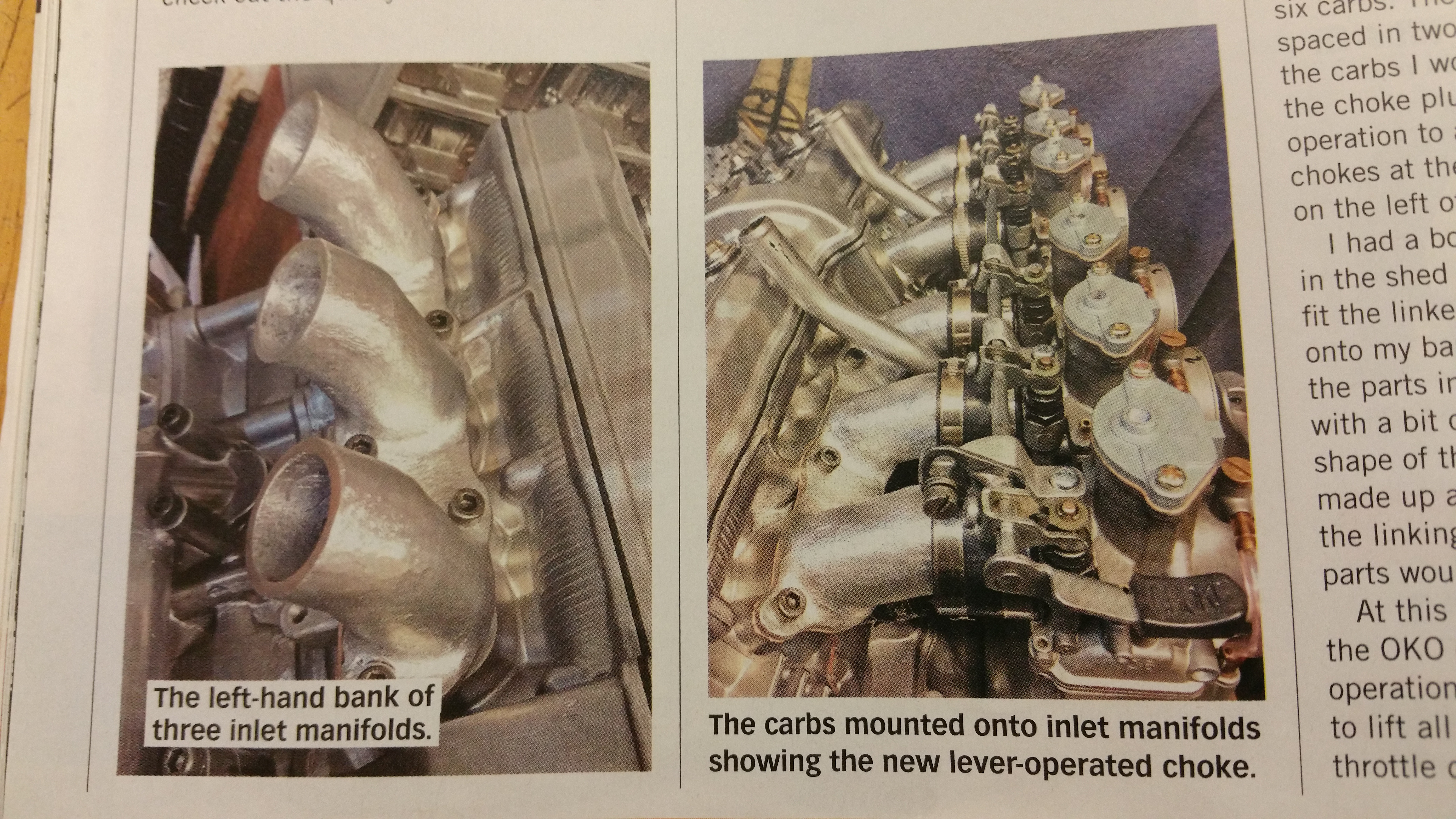
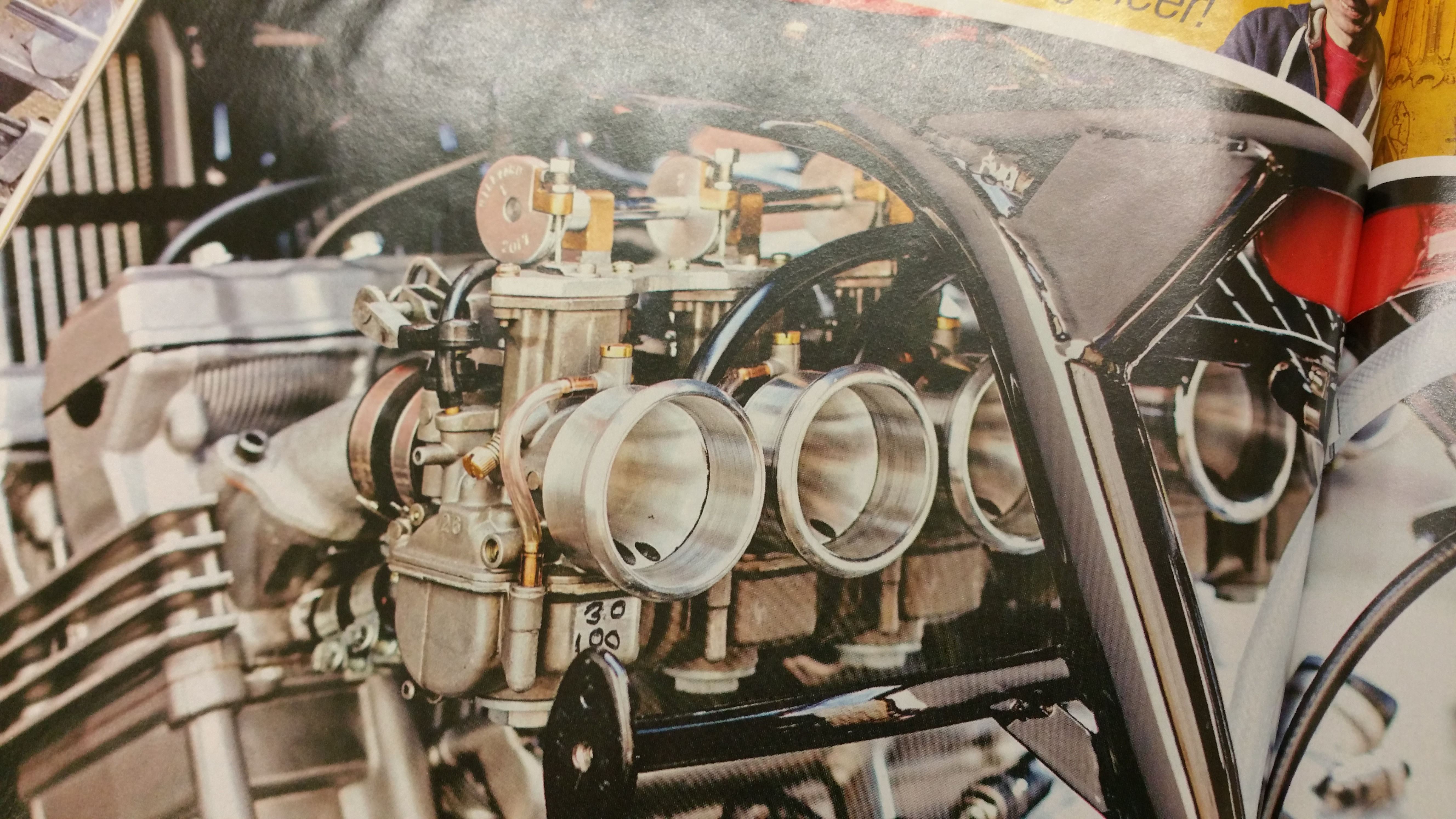
I'd suggest that Graham gives those pit bike carbs a go. Allen Millyard built a home made version of a Honda 250/6 last year, and he used 6 pit bike carbs, in a magazine article he said how good they were at the price.

Not clear from the photos on Ebay if the carb choke lines up correctly with the Honda inlet manifold ?
 
The holes are offset just. Like the originals Richard.
If Millyard thinks they are ok, then good enough for anyone ( a ledgend in the UK).
Tomorrow I'll remove one of the cb's carbs and do a check on jets etc.
my jets are good, maybe the drillings are still partially blocked.
For the low cost, well worth the experiment.

The replacements available in the USA will be about £120 landed, but I've read they are murder to balance?
 
2 new Chinese/Dellorto/Keihin carbs on order, £21.
The stock jets etc all fit this copy carb, and even the choke actuation mechanism swops over.

They are only available to one hand, so will need a long thin screwdriver to tweak the adjustors.
There will be several compromises here, but having the stock jets in place could mean I can get away with it.

The air screws are solid, no drillings (ref Sprint's post on Richard's thread about early carbs using undrilled screws) but the stock ones fit!
This should give me some variables to try.
I have a set of fine drills, 0.3mm to 1.5mm, all new, and I've compared the copy jets to the stock jet drillings and they all match, exactly the same sizes, BUT the stock jets have more cross drillings than the copy ones have.
I'll try the stock jets in the copy bodies first running the copy slides but if I can, the stock needles.

Looking forward to this experiment.(y)
 
Yes, I shall be fascinated to see how you get on, tempted to have a go myself.

I took the liberty of copying the relevant bits from the Millyard build.

upF1gOs.jpg


6WTi1ca.jpg


First set of carbs, with his home built choke and throttle linkages

rqcYglJ.jpg


Second set, also modified.

VAV2VG6.jpg
 
2 new Chinese/Dellorto/Keihin carbs on order, £21.
The stock jets etc all fit this copy carb, and even the choke actuation mechanism swops over.

They are only available to one hand, so will need a long thin screwdriver to tweak the adjustors.
There will be several compromises here, but having the stock jets in place could mean I can get away with it.

The air screws are solid, no drillings (ref Sprint's post on Richard's thread about early carbs using undrilled screws) but the stock ones fit!
This should give me some variables to try.
I have a set of fine drills, 0.3mm to 1.5mm, all new, and I've compared the copy jets to the stock jet drillings and they all match, exactly the same sizes, BUT the stock jets have more cross drillings than the copy ones have.
I'll try the stock jets in the copy bodies first running the copy slides but if I can, the stock needles.

Looking forward to this experiment.(y)

Needles and needle jets should be considered as a unit, and since the old carbs problems could be related to the interfacing of those parts, you may just be transferring the problem.....
 
Yes, take your point.
The mains that come in the copy carb are dimensionally the same, but missing the number of fine cross drillings along the emulsion tube the needle moves in, but I can drill those.
I think this is worth a try.
The air screws do nothing on my stock carbs and the tick over cannot be dropped below 1800 rpm (assuming the tacho reads correctly).

Once here, should not take long to fit them and see where that leads me.
If a dead-end, I can re-enstate the stock carbs and try to refine them.

I have had carb cleaner coming out of the full drillings in the stock carbs, so sure they are clear, but are they clear 'as good as new'?
 
Try the carbs as received...The number, size, and height of the emulsification ports in the needle jet holder are part of a theoretically balanced system.....
Changing any aspect changes the results throughout the system...... You are already revving too high at tick-over....Why add proportionally more air to the mixture at that stage?

BABY STEPS.......
 
Yes, change one thing at a time.
I wanted to be reasonably sure that the stock parts could transfer to the copy body.
The carb is sold as a general replacement for many bikes and ATV's of a wide capacity , from 50cc to 90cc, so a twin set could run maybe 180cc so this experiment will be working at the upper reaches of the copy design which may be good.

A previous I rebuilt bike ran one instead of the crude original that seemed so tired, I had to make a new slide for it in brass to original had been filed oval for some reason... Bike ran just like that, but eventually got the original to work hence me having this 'spare' to check out.
Should have them end of the week, lockdown has not affected UK postal deliveries much.
 
I think the carby’s you have are the Chinese copy of the OKO copy of the Keihin PWK28 D slide carby’s - only OKO tooled up for a broader size range. Whew!

as to a matched set, I agree with baby steps, or more importantly having a baseline to start. FWIW, I’ve found the main and slow jet sizes from the OEM Honda carbys are a good place to start to speed the jetting process. Further, if you can measure the OEM carb needles, starting with diameter at L1, etc., you can select an equivalent needle from a Keihin or Mikuni chart as that’s how they also do it. Grossly generalized but is how I’d approach making them work.

pm me if you want help, I just went through this same exercise on my 450 using Chinese PWK33’s. I like them lots!
 
Thank you Jays, that is good to read.
I already have one of these copy carbs and I've prepared it for this bike inasmuch that I've modified the choke actuation lever and have measured the honda jet sizes (hole diameters) and they are amazingly close or even idenical to the honda sizes. I have a new set of unused fine drills from 0.3mm to 1.5mm dia which are perfect to get the hole diameters.

The main get I can drill in my small lathe, the pilot seems right BUT has less holes cross drilled.

As to the needle, I have the stock and copy here, but will use the new ones when they arrive.
I notice that the stock needles are on the top groove, ie the weakest mixture position, the deepest the needles can be into the jet tube. Maybe someone has been in here before me....

As Sprint says, small steps first.
The copy carbs are exactly the same installation dimensions, even the air filter rubber connectors tubes fit. I have my carb resting on the cylinder head checking these fitments.
also have made a nice thin long screwdriver to reach the screws as the carbs are not handed.
I have a good feeling about this lot, the carbs are literally on their way, hope to have them on the bike by the weekend.
Will post pics etc of the 'conversion'.
 
Are the new needles comparable L1 diameter and taper? If so, you may get lucky and everything works as to runability. As you’ve no doubt found, synchronizing the two is also critical.

by feel, i check the slide cutaways at full throttle position (to the top of the bore) and adjust the idle speed screws to maintain simultaneous movement at the proper rpm. Crude, but very effective.
 
I can check the needle tapers tomorrow with a vernier, and that's how I set up my stock carbs recently!
I now fully understand just how sensitive the sync is between the slides...
 
Why do these things never go to plan?

Carbs arrived, choke levers modified to resemble the stock carbs, both main jets are the same (and smaller in dia to stock carbs for now.)

Fuel in, switch on...
And the flippin' starter seems all screwed again.

As the electric motor spins, the (new ) rollers engage via the (new) chain and the engine is turned over (throttle closed).
Open the twist grip any amount and the starter stops and there is a nasty racket as the rollers slowly and erratically disengage to a stop,

Does this every time.
If i leave the twist closed the starter will spin and turn the engine endlessly while the button is pressed, touch (rotate) the twist and it all grinds/rattles to a halt.

The twist grip must be interfering with the starter button?

Long hard day working on the house today, will get on it tomorrow. New carbs look great on the engine!
 
I was inquisitive about these carbs, and ordered a pair via the Ebay link that Graham posted. At around 20 quid posted, less than a pair of float valves. They arrived late this afternoon.

I've not had time to strip them down yet, but I noticed straight away that the ventur1 is much smaller than the original Keihins, and the slide is a smaller diameter. External dimensions appear very similar, air filter matches nicely. The manifold fits, but there is large step, manifold internal diameter bigger than the carb choke.

I expect they will run fine at idle and low rpms, but strangle top end performance. Might work well on my SL 175 alike.
 
Just like mine Richard.
They are dimensionally smaller in the air passage as I detailed, but they are fresh, clear passages through the drillings etc, so might, in my case, be a better carb than my stock carbs.
hope to have the bike running tomorrow, but the starter needs sorting first...
Will not know about the top end until on the road which might be 2021.
 
Back
Top Bottom