Rebuild of my English CB175K6, 1972

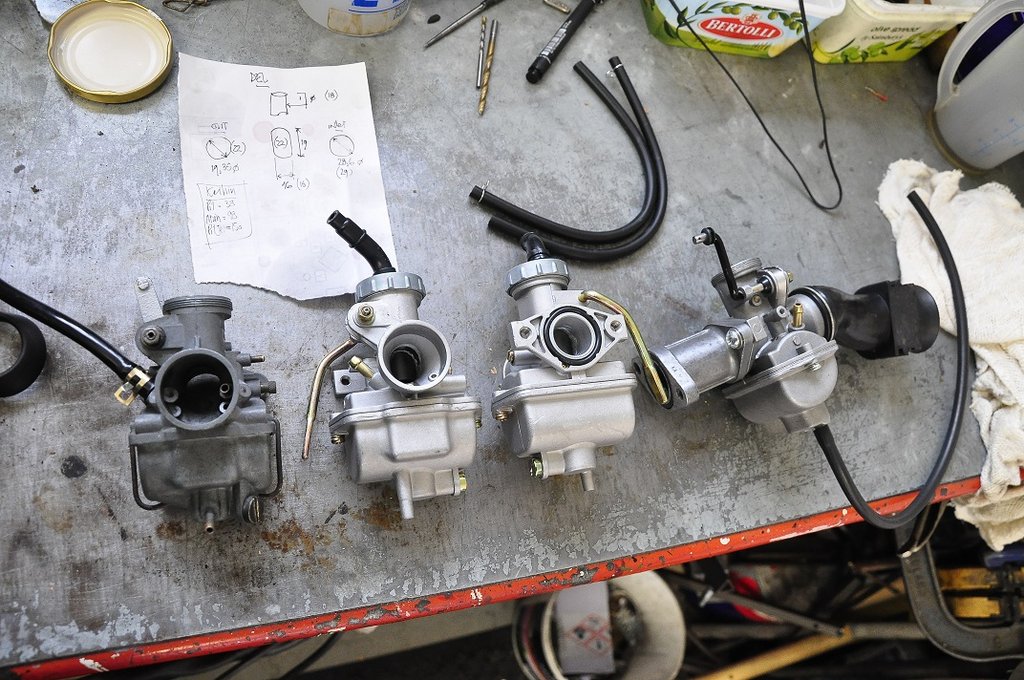
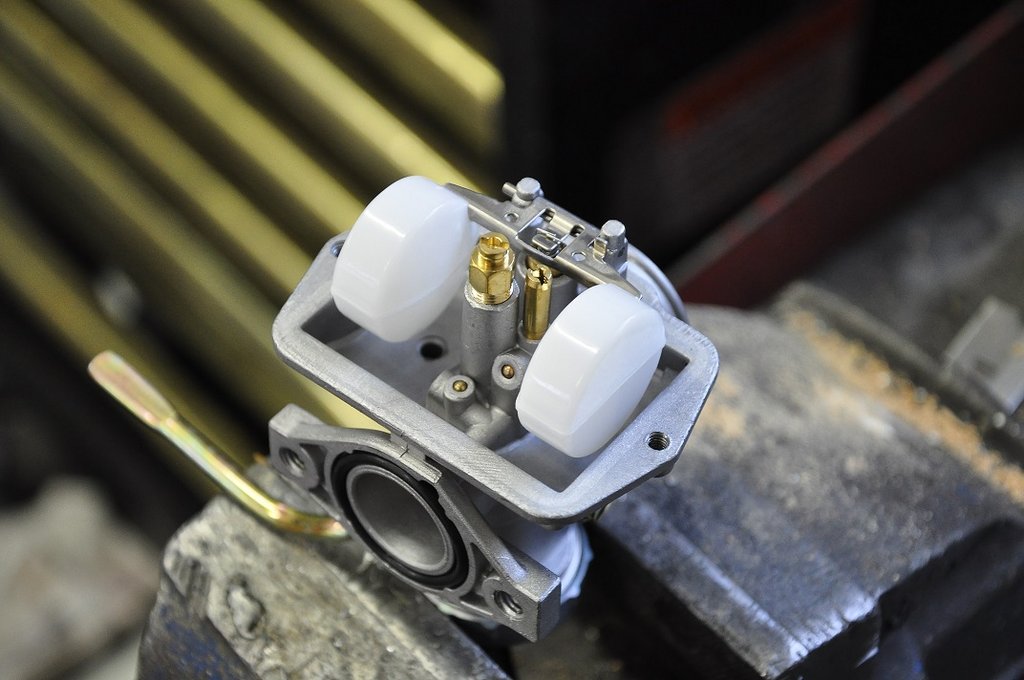
The float chamber and float valve assembly certainly appears superior to the Keihin setup. Incredible that they can build them like this at the price. I'm wondering if I could transfer the plastic floats across to my original carbs, would more than pay for these.

Carb tops appear to be straight swaps, need to do this to fit with existing throttle cables.
 
Indeed, really good part for the £, £22 ish delivered, the pair.

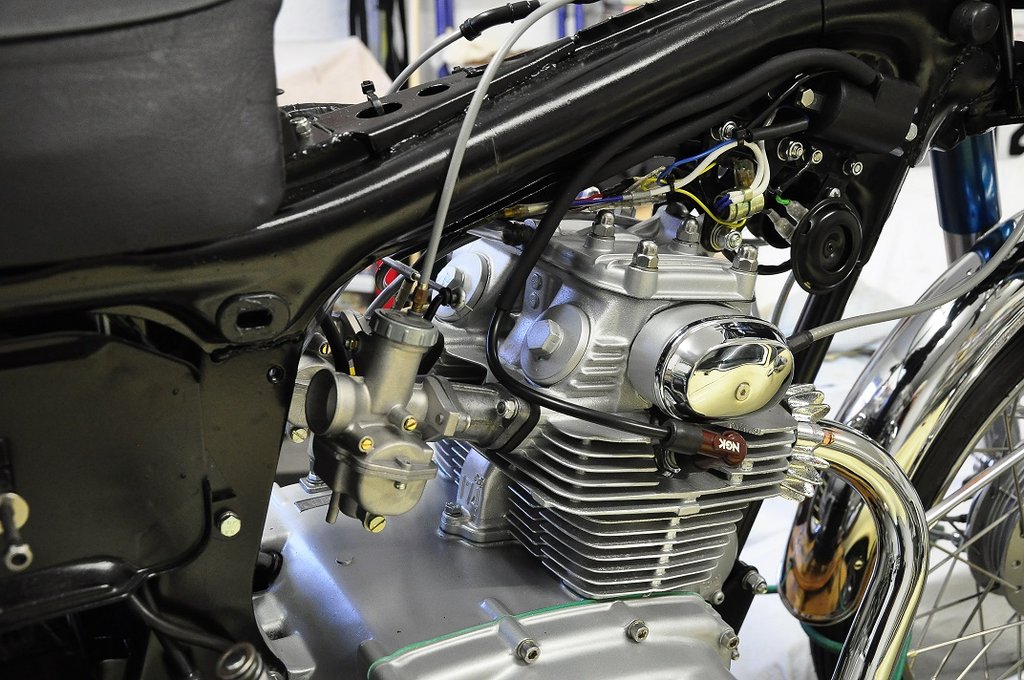
Here are some pics of when I was checking the fit/interchangeability of the stock to copy parts:

I used the stock top hat for the better and straight cable adjuster, it fits with the gasket straight on. Twist is nice and smooth and repeatable.
Converting the carbs to the stock choke lever system was a pain, but a bit of welding fixed that. I used the stock adjustable cross link.

Just got to fix the starter switch issue and can try again to get it going.


Still have the strange starter situation, the engine turns over well and fast until you open the throttle with the twist grip and then the starter stops working! WHY?

Anyway, got it started (by luck) on these new copy carbs.
Got the tick over to a rather lumpy 1800 and screwed the pilot screw in until the revs maxed, which it actually did, and appreciably too, so adjusted the engine down to 1800 again on the one carb.
Repeated with the other, the pilot screw had NO EFFECT.
Messed about for 15 mins tweaking the screws up and down, in and out until I have an engine equally hot on each side and both exhausts slightly smokey.

Cant seem to get it all better.

There is considerable lag if you snap open the twist grip to max open, which I think indicates too rich as the revs when up drop quickly to the twist grip position.

could do with some learned input please.

Too late in the afternoon to be blipping motorcycle throttles, so decided to resume battle tomorrow,
At least it runs!
 
The starter clutch slipping when you open the throttle is likely the product of more load on the starter due to allowing more air/fuel mix into the engine. You must have a worn gripping surface of the large sprocket where the rollers ride, or possibly the outer housing shell is cracked under the metal skin on it which allows the housing to expand in diameter when under load.
 
Thank you for the thought!
It cuts only if you open the throttle the smallest degree, and I mean 1 deg or less will cut it.
rediculous situation.
so far, I think the stock carbs are ok, but will have another good go tomorrow.
 
On my 68 450, I was able to rework the starter clutch so it worked properly.

Ancientdad was correct that the ramps on the sprag can/do have grooves worn into the ramps that must be removed. I reworked mine by using a rotary file and 1/4” carbide bit (abrasive would work fine too) and just deepened the ramp toll the groove disappeared. The rollers engage slightly farther down the ramp but no matter, so long as it all stays assembled.

the ramps and rollers are both through hardened so no worries on rework going through any case, or surface hardening.

when I get home, I’ll do a How-to on a recalcitrant clutch.
 
recalcitrant

There's a word you don't see every day... engineers. Pffft.

LOL :) I'm reconstituted myself.

Here's the part I'm concerned about you possibly finding a crack in, if the clutch is used for a while with worn parts sometimes the constant slamming of engagement when it does work causes this housing to get a crack in it but the outer sheet metal cover hides them. (it's the same part with the ramps Jay the engineer mentioned)

starter clutch housing.jpg
 
Thank you, I was not sure what you were detailing.
I changed the rollers/springs/cups without fighting the staked csk head screws, so have not seen that surface.
I'll take it apart again and open it up.
I do know the surfaces of the large gear and the crank are good, no chatter marking etc, so you may have identified it!
 
Got the tick over to a rather lumpy 1800 and screwed the pilot screw in until the revs maxed, which it actually did, and appreciably too, so adjusted the engine down to 1800 again on the one carb.
Repeated with the other, the pilot screw had NO EFFECT

Not sure if it's relevant, but I took out the air screw on one of these new carbs, and found some metal filings, looked like the sharp edges knocked off the thread in the casting. Might be worth taking the brass ware in and out a few times, then blowing through the passages.
 
If idle speed won't sustain @ 1250/1300, you are running on one cylinder most of the time......

At 1800, you are at least partially on the main jet circuit, Not just the idle circuit, and starting to advance the timing......
 
Thanks to all for the comments.
Richard: will remove them and check.
Sprint: Yes, this engine is still not even at tick over, and right side hotter than the left, possibly a 10/20 deg heat difference.
Have running 'just' at 1500, will not run slower. pilot screws seem insensitive.

Still light smoke from both pipes, equal amount, and a lot of 'water' spat out of the pipes on both sides.

As to the noisey started system; cover off again and stripped. No cracks but the clearance in the grooved bush in the large sprocket is too large imho and allows quite a lot of rock on the shaft.

I think this is my problem.
The chatter sounds like the noise you get when a saucer is dropped on a table and it rattles to a halt in a spinning motion. The previous owner did not replace the large gear guide plate so I had to make one (found that cmsl sell them...) but I see from the cmsl diagram the plate has two fingers, each to one side of the gears.

I think this all allows the gear to chatter and the rollers to chatter too.
The bush is not available, so will machine one to close the tolerance and get or make a new plate.
Found a UK source ( in Stourbridge Richard)) that make Honda replacement gaskets so no need to wait 10 days for one from DS in the USA.

All a bit tedious, but will get there eventually.
 
After the world's longest wait for a simple bearing to arrive, it did and with some lathe work all back together. Bloody thing still rattles, so ordered a new Chinese replacement for £23 delivered, a last gasp to fix the starter.

Bike fired up awkwardly and ran very rich.

Back to basics tomorrow, valve clearances, ign timing and start again. If this fails, swopping the jets from the original carbs to the copies, and try, try, try , again.
 
Today spent some time on it.

Checked the points gap, 0.35mm with the heel on one of the 2 lobes, other lobe also gave 0.35mm. This engine is a parallel twin, ie two single together, so both pistons come to tdc together.
Checked the timing which was odd.
The timing check I use is a separate battery, lead with a bulb in line from +'ve to the screw that holds the points together. The screw insulation is good and new. Condenser lead off the screw disconnected.
Earth wire from the points back plate to the battery -'ve.
Rotate the engine anticlockwise and noted the bright bulb dulled noticeably when the contacts just broke open at the right 'F' timing mark on the alternator magnet on the crankshaft.
The bulb did not go out even when the points were wide open, some current flow somehow.?

Rotate the crank a further 360 and the same happens, this partial dimming of the bulb is repeatable.

The timing was out a little, so adjusted the plate by around 1mm on the 60mm dia plate and the dimming is now on F for both cylinders.
The F mark is the static advance and is 4mm before tdc on the 60mm dia alternator.

Decided to put the stock carbs back on, did that and had had enough in the damp cold.

Here is a picture of the set-up on my old 'Gold' cb175 I did 5 years ago which gave me very similar problems.

 
The bulb did not go out even when the points were wide open, some current flow somehow.?

Rotate the crank a further 360 and the same happens, this partial dimming of the bulb is repeatable.

So, Basically you are telling us an OPEN switch is still conducting power through it........ Something is wrong.......
 
Last edited by a moderator:
That is true. Took the points off the bike to the bench and there is no path in the assembly, the points bell through when touching, nothing with a piece of paper between them.
The screw which holds the assembly together is insulated and the spring is thus isolated.
The head of the 'spring side points pad' rivit is well away from grounding to the cam. With the bulb dim, if you pry the plastic heel wide open the rivet eventually contacts the cam and the bulb instantly glows '12volt bright', returning to dim when released but with a gap in the points.
I have the points I removed from the bike so will swap them over and see if anything changes.

On the bike and I get this low voltage path, the bulb looks like it is getting about 3 to 4 volts max.
Something must be touching or the insulation broken somewhere surely.

It can only happen to me!
 
I decided to simply start the engine first and see what I have.

It started, now with the original carbs on, and ran. The LH carb side ran rich, smokey fume exhaust, the RH side ran 'clean', and cooler to the touch (about 600mm downstream of the head)
This is with the air mix screw at the lowest tick-over I could get (about 1900).

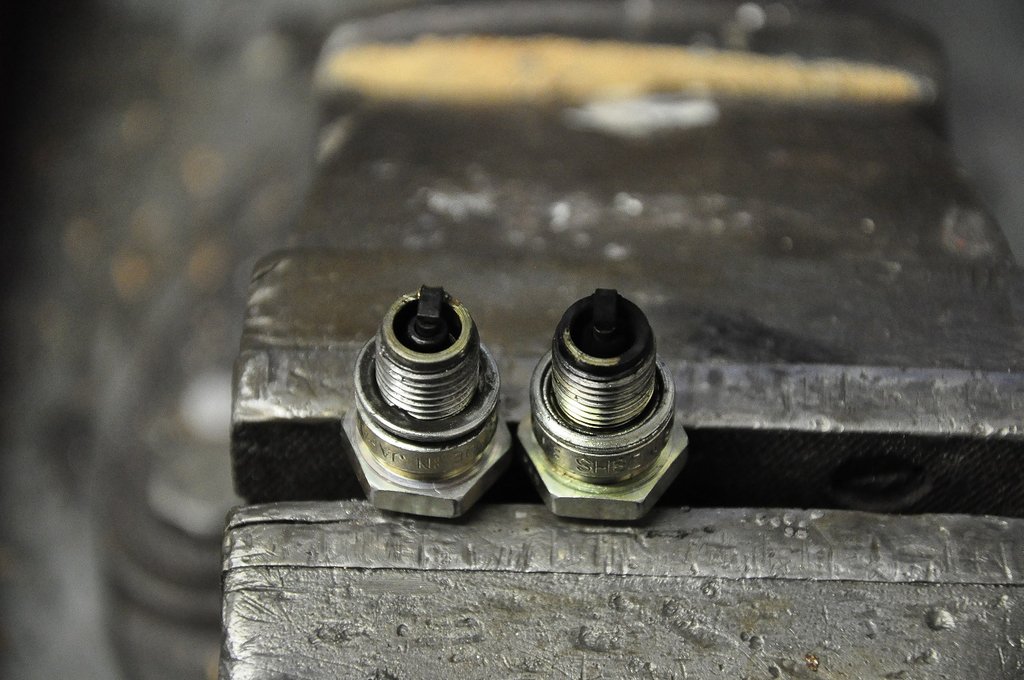
No amount of tweeking to the LH side would delete or even change the richness, so after about 30 mins, engine hot and having run at tick over most of that time, killed the engine and removed the plugs, see picture.
The sooty one is the LH 'rich' side.

So, the bike restarts from cold well, re starts from stinking hot with one quick press of the starter and I have one side very rich and can do nothing externally to change it.

The RH engine side looks ok to me considering lots of time at tick-over.

The LH carb is now off, totally stripped in sitting in clean cellulose thinners for the night.
Will go though the carb passages and jets yet again tomorrow once I've bought and planted a Maple leaf tree!

 
"TICK-OVER" is an engine speed BELOW 1400 RPM......1900 is NOT an idle speed !!!!!!!
IF you are anywhere above 1400, you are running on the principle jetting, so the mixture screw is being bypassed and is out of the equation........
 
Thanks for your reply:
I cannot get it to run anywhere near 1400, it just stops if I unscrew slide screws out, thus I can never get to the air mix screws for idle.

Maybe the best thing is to simple set the engine to run at 1900 and ignore idle speed, maybe the problem will go away and both side will run at the same temp and no smoke from one side, or both.

So bloody irritating, my last cb was the same.

I'm thinking of running the engine on just one carb, sparking on both cylinders. Tune that carb and remove it.
Fit the other carb and repeat, fit the first and see what I have.
 
Bad day at the Office on this bike.

Got it started on one carb fitted but refuses to go to 1400 or less.
Thought I would check the electrics again, and the advance bob weights.
Everything free to move on the weights, set the points to 0.35mm and then set the static timing using my multimeter, when the buzzing stops the F should line up on the alternator. Set the timing on both side so the break is 1mm one side, 1mm the other accounting for cam wear/tolerances, thus 'averaged-out' the timing.

Thought I would check the tappet clearances, and now I need you to check what i have.

With the crank at TDC T mark aligned one side of the head has tight tappets and the other a large clearance, maybe 2mm.
I reset the tappets from slack to 0.002" inlet/ex on that one side. I have assumed the cylinder is at TDC, valves closed and ready to fire.

Turned the engine 360 deg and adjusted the tappets the same, 0.002" on the other cylinder.

Is it correct that when one cylinder is at tdc (and clearance is 0.002") the other cylinder's tappets are tight?

The carb I took off last night and soaked is all clean and the brake cleaner sprays through all the drillings.

Please can someone confirm if i have the tappets right?
 
Yes, since the crankshaft is a 360° version, every TDC is compression/firing stroke on one cylinder (valves to be adjusted) and overlap on the other cylinder (exhaust valve closing after exhaust stroke and intake valve opening for next intake stroke) so assuming you've done it as described, you should be good.
 
Thank you.
Loosing my self confidence tbh, this all should be a non-event yet is now a real issue. Starting to question everything I've done on this engine.

Another few hours on it tomorrow.
Thank you again.
Graham.
 
Set the timing on both side so the break is 1mm one side, 1mm the other accounting for cam wear/tolerances, thus 'averaged-out' the timing.

IF you can get no closer than that 2mm advanced/retarded range, either the points are defective, or the breaker cam/advance unit needs replaced......I SUSPECT the former....
I have had examples where the cam was worn, but was still able to achieve an advance/retard situation where one firing was before, but still "touching" the line, and the next firing was after but still touching.... A full millimeter off the line in either direction is too great an error........
 
Thank you for the thought.
poiints are new and look good on the surfaces.
looking at the advance bob weights there is a lot of free play before the springs come into tension, but nothing looks worn.
 
What 3 digit number is on the advance unit?

There should be virtually NO flyweight free swing before the springs are in tension.....
 
Last edited:
Just checked, number is 306
the weights can freely move about 3mm out before the springs are in tension.
looks like a new assembly is needed...
 
I have a 306 advance in my hands, and can only rotate the breaker cam about 5 degrees (if that much) before the springs exert.......
 
Nearly midnight here, so will check tomorrow, but I think mine move far more than that. It leaves a large angle for the cam to 'float' between the proper mechanical dead stop position and to where the springs start to take tension.
 
^^^and engines that get advanced too early like to stay advanced, so this could well be a factor in your idle issues
 
Just for fun (and because it's not working properly now) On ONE spring, clip the hook and carefully bend up the next 1/2 loop into a new hook , and see how that works.......(two pairs of needle-nose pliers)......
IF you then can achieve a lower idle, at least you will have verified the assumption....Best case, it will again function correctly......

May require work on both springs, BUT try only one at first.......
 
Last edited:
You could always lock the advance mechanism in the idle position by adding another washer under the retaining bolt, as a quick and non destructive means of testing this theory.
 
Yes, going to lock them 1 or both this afternoon.
Spent some time this morning:
The advance 'free-play ' before the springs come in tension is about 5 degrees, I thought it was more, but about 5 degs. The mechanism does seem to be loose, nothing very precise anywhere mind.
Have ordered a secondhand set this morning from a supplier Richard and I know well in Stoke so will have something soon to prove or whatever this advance unit.

Put the original back in, re-set the points, they had close to about 11 thou from 14 though and then spent ages re-timing using my buzzer on my multimeter, Doubt I could get both sides closer to F if I tried harder.

Checked and re-set the tappets and checked them again, added my super clean LH carb, fuel and ignition.
Started up instantly on full choke and came off choke quickly, idle @ 2500 deliberately.

Hot, the tick over came down to a wobbly 2000, air screws @ 1.25 turns out.
LH exhaust smokey as before, RH smoke-free.

Squeeeeezed the tick over to a dodgy 1800, the engine if left at this speed would ie after about a minute.
Screwed in the air needles, nothing changed messed with the tick overs, nothing, then the smoke started to come from the RH carb, and the LH side seemed to stop firing, smoke free and loosing pipe heat, the now smokey RH side was good and hot.

Messed about with the speed and air needles to try to 'move' the smoke from the RHS to the LHS to little avail, managed to get the LHS to smoke a little, RHS a bit less, but not the same.

Engine now though responds to snap open throttle and comes down to 2 or 3K rpm a bit slowly.

The smokey RHS sound a bit 'chugging' compared to the barely firing LHS, engine eventually dies. On trying to re-start, got several blow-backs from the RH carb.

Stopped messing about.
Removed the plugs, both look almost the same, LHS a bit wet but soot cover the same and light.

Lunch time now, resume this afternoon as it's raining so no Garden Labourer Duty.

WHY does this engine swop firing left to right, smoke then not, and smoke on different sides??
 
Locked the one bob weight to secure the advance. Did all the timing again etc and ran the engine. Not much different, engine will not hold less than 1500 rpm, which is the lowest I've seen ever on this engine.

Had the usual hot one side, cool the other, smoke on one side then the other etc.

On the LHS that went 'out' it had a good spark, so assumed no compression, (ie tappets too tight holding a valve open when hot). Did a compression test which was not that good, 100 psi with throttle wide open, hot and cranked for 5 secs. Other side was 120psi. Just about in the green sector.

So, why was the LHS not working. Found out.
Embarrassingly, the fuel container I am using instead of the tank had slipped down the pole it is mounted on and the petcock was below the LHS carb's inlet, so the bowl was empty....
Now you have all stopped laughing.

That fixed, ran the engine again and had even exhaust temperatures BUT the RHS exhaust smoke has an even 'pulse' in it, the LHS does not, it is the RHS that had a chuffing tone to it, so I suspect the tappet(s) are too tight and a valve is held open.
2 thou is a very tight clearance cold, so might go to 3 for now to see if things change.

Not sure if I've stepped Advanced, Stayed Static, or Retarded today for all my hours of toil.

Anyway, one thing to rejoice, the UK has an approved vaccine for Covid, Father Xmas has indeed come early.
 
^^^No laughing here, you're a brave man to admit it and we've all done something like it (mucked up oil filter relief valve :sorry:) at one time or another.
 
Anyway, one thing to rejoice, the UK has an approved vaccine for Covid, Father Xmas has indeed come early.

Good news indeed !

We've just had our winter flu jabs, and our GP practice rang this afternoon to check that we had indeed had this done. Wife took the call, and was told that we'd probably get our Covid jab in January, once all the real geriatrics had been seen to. Still seems a bit optimistic to me.

I'm hoping that the Oxford vaccine is approved soon, but I'm happy to take whatever is offered, can't understand the vaccine denial lunatics.
 
Decided to go right back on the engine.
Did a leak-down test, 20psi of air from a spare wheel, TDC (firing stroke) and listened. No hissing at all! Checked there was air pressure in the cylinder by moving just off TDC when the piston positivly 'fired' down stroke. Hissing when the crank was 360 deg round on overlap. Did both cylinder, both the same result. Thus, no inlet valve leak, no ring leak and no ex valve leak. Good going.


The second hand mech advance unit came and is much tighter than the original one, the 2 bob weights are tight to the centre shaft. Good going.


Pondered if all this cr"p is due to the cam being timed wrong, so removed the cam cover, set TDC and the faint mark should be at 12.00 noon at TDC. It is. Good going.


Put it all back together, torqued the head etc etc etc, did all the timing checked all the tappets, and started it.


Horrid, started on both cylinders, and after a few mins dropped onto one. Messed about, but really did not want to run. The full choke nearly strangles the engine to death in a few seconds so a fast re-set to 1/2 choke and it just about kept going.


Whilst it was running and looking down the RHside carb the bloody thing spat back with a short flame in the carb and I decided to switch off.


Battery now almost flat, so, swore copiously at it in fluent Brummie, attached the charger, and pushed it into it's dark corner.


I really do not know what to do now except put the copy carbs on and try them.


What a depressing position.

Does anyone have any ideas please?
 
Battery voltage drop could be a problem. In order to maintain a good spark the battery/voltage needs to be 11 volts or higher, preferably well over 12. It almost sounds like you're losing voltage while running so I would take a hard look at the charging system to be sure it's keeping up.
 
Thank you for that, the battery is new and does well to sustain the repeated starts I've put it through.
It is fully charged tonight, will put the meter on the terminals during tomorrow's 'adventures'...
 
Engine coming out today.
Have engine oil coming out of the exhaust pipe/head on the LHS.
Suspect the exhaust valve guide or seals (if there is one on the exhaust)
Going to pull the head off when out and go through the valves again. Might fit all new valves etc etc.

Keep me busy as winter sets in.
 
Confused as ever.

Head off, and removed the LHS ex valve, all seals correct and look good. Port saturated in oil. That must mean the valve seals are not working, but they were new when i rebuilt it and feel good on the valve stem.
Lapped the valve in again with fine and have a text-book light grey finish on the seat and valve rim. All back together.
Did the same with the seal-less inlet, again all clean and looks good, so fine paste and back together.
With plug back in, filled the chamber with cellulose thinner and it stayed there, no leaks past valves or plug.

So, where was all the oil getting in from? I can only suspect the rings, so will go though that lot (esp ring gaps) tomorrow when I re-lap the RHS valves.

Both piston tops are different colour, the LHS with oil is far lighter a straw colour than the RHS piston top.

Thinking of a re-bore.
 
Oil on the back side of the valves can only come from the guides/seals. New seals on worn guides will slow it down but it's still going to occur. I'll say it's time to check the guides and valve stems for wear.
 
Indeed, but no side play even in the exhaust side.
The back of the ex valve was not oil wet either, but the port out was hence oil dripping out of the down pipe/head junction past the copper crush seating. This leak was only on the LHS, RHS ok which is why I dived into the RHS chamber.

The firing on that side was very rough before tearing the thing out, a roughness that has progressively got worse as I've tried to settle the carbs.

I will check the ring gaps tomorrow and try to see if the bores are oval, but if I have the oversize pistons I'll get it bored out to suit.

From what i can find out, ring gaps are 6 to 14 thou and piston to bore clearance is 3 thou.for a good engine.
 
Clearance is dependent on cast or forged pistons and with stock (or oversize stock) cast pistons clearance to the cylinder wall is .0004" to a max of .002" radially at the skirt......

Forged pistons require more clearance.... Follow manufacturer's specs......
 
Thank you for those details, will measure best I can.
any idea of the dia of a new exhaust valve stem please?

Just on the ex valve seals:
On my head, the steel hat is a good fit to the guide on it's dia, and the green viton seal has the black rubber seal under it and the whole lot when assembled leaves a gap of around 0.5/1.0mm which is 'crushed' by the compression of the inner spring on assembly.
Thus, the viton and back-up seal get deformed to a tight seal to the inner top of the cap and the valve stem itself giving (to my mind) a very effective seal to oil passage down the stem.
Seems strange why the same was not used on the inlet where a lot of oil could pass into the cylinder reducing the petrol octane rating and inducing a lot of smoke and poor running.

The exhaust would then be sooty and oiled wet which are all the things I thought I had going on in the LHS cylinder...

Surely without a seal on the inlet guide, oil is 'designed' to enter the chamber?? Being the hotter side, the exhaust would benefit from a drop of oil but is sealed, and the cooler inlet is allowed to be oiled!

Odd.
Or am I missing something here?
 
Still mystified, but cleared a few other things:
All valves re-lapped, seals all good on the exhausts and all stem diameters to spec.
Engine already overbored to +0.75mm so reluctant to go the full hog and go 1mm over from stock, so have ordered genuine +0.75 over rings from David Silver and 2 new plugs. £63!

Took all the existing rings off:
Using the cylinder block and the matching sides, all ring gaps are 10 thou to 15 thou so on the large side, the second rings being a tightest at 10 thou. so decided to re-ring.

Have to wait now and hope these parts are in the UK and not in the USA.

For a change, I will be quiet for a while...
 
Thank you for those details, will measure best I can.
any idea of the dia of a new exhaust valve stem please?

Just on the ex valve seals:
On my head, the steel hat is a good fit to the guide on it's dia, and the green viton seal has the black rubber seal under it and the whole lot when assembled leaves a gap of around 0.5/1.0mm which is 'crushed' by the compression of the inner spring on assembly.
Thus, the viton and back-up seal get deformed to a tight seal to the inner top of the cap and the valve stem itself giving (to my mind) a very effective seal to oil passage down the stem.
Seems strange why the same was not used on the inlet where a lot of oil could pass into the cylinder reducing the petrol octane rating and inducing a lot of smoke and poor running.

The exhaust would then be sooty and oiled wet which are all the things I thought I had going on in the LHS cylinder...

Surely without a seal on the inlet guide, oil is 'designed' to enter the chamber?? Being the hotter side, the exhaust would benefit from a drop of oil but is sealed, and the cooler inlet is allowed to be oiled!

Odd.
Or am I missing something here?

I could never understand this either. In my youth, I was quite familiar with the BL 'A' series engine. That had seals on the inlet valves, for the reasons you state above, inlet vaccum drawing oil down the guides and into the combustion chamber. None on the exhaust valves, where any oil would go straight down the exhaust pipe.

Smoking exhaust on a Mini, inlet seals were the usual suspects.

Interesting that the later CB200 engine has top hat seals on inlet and exhaust valve guides.
 
Indeed, my early days were on Triumph engines, even they were sealed correctly.
Typically for David Silver nowadays, my ring sets are in the USA, so maybe with me end of next week....
After all this it will run a dream, right?
 
Back
Top Bottom