Blue Dream CA78

1. Next step is to measure stator outputs, I guess. I've just never done it. Do I leave everything connected and measure voltage from the three stator wires to ground?
2. I've already done the resistance checks before I installed the stator and attempted to gauge the magnetic strength of the rotor in a way prior post.
3. If the stator output shows low, then my options are to get a better stator or rotor (from Rick's?) or both?

1. You disconnect the yellow, pink, and brown so you can measure AC voltage directly across any pair of those three. You want to check all the combinations, just like the resistances. The bike will be running on battery only for this test.

2. I'll go back and have a look at those posts. I'm curious if the observed resistances obey the parallel law I mentioned. I'm also curious about the magnetism of the rotor. I searched your thread for 'charging' and must have missed those posts.

3. I tried checking Rick's for your bike and wasn't seeing much, but I don't know those older models well enough to know what works across the different models. I also read this morning in an old post (2012?) on the 305 forum that Rick's was no longer working on CA77 stators. Things change, so it would still be worth reaching out to them. I believe there are various companies that could rewind the stator if that turns out to be the issue.

I don't know about the 350 mod and, like you, I've only heard about remagnetizing rotors - never had it done.
 
Your measurements were:

brown-yellow 3.9 ohm 3.3 ohm
yellow-pink 4.4 ohm 4.1 ohm
brown-pink 2.7 ohm 2.0 ohm

It would make sense that brown-pink is the parallel combination of brown-yellow and yellow-pink. Those two are about 4 Ohms and (1/4 + 1/4) = 1/2, meaning brown-pink should be about 2 Ohms.

If the stator windings are undamaged, I think the AC voltage check is really a check of the rotor. Greater magnetism should produce higher voltages at the same rotation speed.
 
1. You disconnect the yellow, pink, and brown so you can measure AC voltage directly across any pair of those three. You want to check all the combinations, just like the resistances. The bike will be running on battery only for this test.

2. I'll go back and have a look at those posts. I'm curious if the observed resistances obey the parallel law I mentioned. I'm also curious about the magnetism of the rotor. I searched your thread for 'charging' and must have missed those posts.

3. I tried checking Rick's for your bike and wasn't seeing much, but I don't know those older models well enough to know what works across the different models. I also read this morning in an old post (2012?) on the 305 forum that Rick's was no longer working on CA77 stators. Things change, so it would still be worth reaching out to them. I believe there are various companies that could rewind the stator if that turns out to be the issue.

I don't know about the 350 mod and, like you, I've only heard about remagnetizing rotors - never had it done.


Thanks so much. I will do the test with bike running and wires disconnected.

Sorry about the broken up posts (#417 and #504). In general, are lower resistance numbers better?
 
The rotor comparisons are on page 13 , #504.

I am currently running the heavier rotor and the stator that came with it (black label, K (Kokusan?))
 
low resistance, low amount of windings, thicker wire means higher currents, on the other hand, higher resistance, larger amount of windings and thin wire means higher voltage.
 
Currently using this stator. Not sure of the maker.

T6DMt6k.jpg
 
low resistance, low amount of windings, thicker wire means higher currents, on the other hand, higher resistance, larger amount of windings and thin wire means higher voltage.

It is hard to see much difference between the two that I have, Even the interconnecting single wires are hard to see any difference in wire gauge.

Which one would I want? Higher current or higher voltage? I will test my current in the one on the bike and report back.
 
It is hard to see much difference between the two that I have, Even the interconnecting single wires are hard to see any difference in wire gauge.

Which one would I want? Higher current or higher voltage? I will test my current in the one on the bike and report back.

My thinking may be naive, but power is basically the product of current and voltage averaged over time, so I think there is a trade-off there and I doubt that the two stators you have would be substantially different, except maybe if one is defective and the other is not. The AC voltage test will hopefully paint a picture. Note the voltages across each pair at idle and then at, say, 3-4k RPM.
 
mis-spell
My thinking may be naive, but power is basically the product of current and voltage averaged over time, so I think there is a trade-off there and I doubt that the two stators you have would be substantially different, except maybe if one is defective and the other is not. The AC voltage test will hopefully paint a picture. Note the voltages across each pair at idle and then at, say, 3-4k RPM.

Leave the naive to me. :lol:.

Not even sure I did this right. Batt fully charged. Harness connector to rectifier un plugged and probes in the harness end. Harbour Freight meter set at ACV 200 (lowest).

Brown- yellow 15 idle 80 full rev

Brown- pink 0.2 idle 0.8 full rev

yellow-pink 0.1 idle 1.5 full rev


Mechatronic is not going on my resume :lol:
 
Last edited:
I've really only done this on my CB450, with the stock stator and rotor, and I had two measurements that were "larger" and only one that was "smaller". This makes me suspicious of the stator, but I don't know if that pattern would also be true for your bike.

Maybe Steve or Jensen can weigh in about those numbers before you go to the trouble of swapping the stator out for round two.

Edit #1: I might even suggest trying brown-pink one more time with this stator.

Edit #2: The low readings seem a lot lower by comparison to the one low reading I had with my 450. The one high reading seems good.
 
I've really only done this on my CB450, with the stock stator and rotor, and I had two measurements that were "larger" and only one that was "smaller". This makes me suspicious of the stator, but I don't know if that pattern would also be true for your bike.

Maybe Steve or Jensen can weigh in about those numbers before you go to the trouble of swapping the stator out for round two.

Edit #1: I might even suggest trying brown-pink one more time with this stator.

Edit #2: The low readings seem a lot lower by comparison to the one low reading I had with my 450. The one high reading seems good.


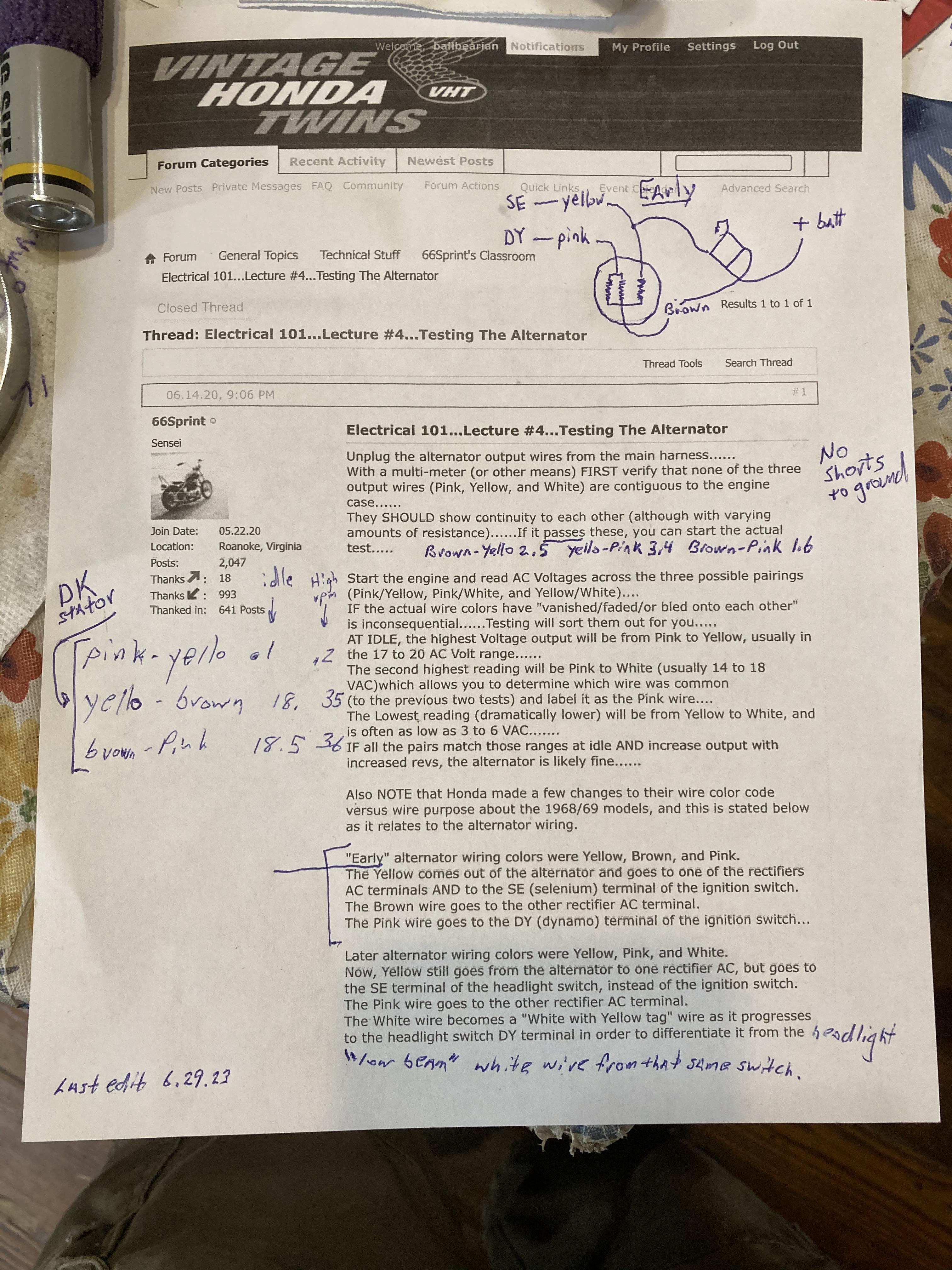
I think I should repeat with Steve's "66 Classroom - testing the alternator " instructions

Electrical 101...Lecture #4...Testing The Alternator (vintagehondatwins.com)
 
For sure. Notice how the ratio of high to low voltages differs from what you found. But he seems to be considering the later stators, at least from the color coding.

The test I did was wrong because the pink (red) does not come from the stator, it just goes to batt+. I missed the real pink from stator because it goes to key switch and then is linked to yellow when the lights are on.

I need to test the actual stator wires.
 
Not all the coils in ONE stator have the same wire gauge and the same amount of windings. The wire gauge differs in pairs. Different wire gauges and amount of windings determine the resistance, the way they are connected too. A long time ago I wrote something about it on the other forum, here you go:

NOS CB450 K1 Alternator resistance measurements
 
Last edited by a moderator:
The test I did was wrong because the pink (red) does not come from the stator, it just goes to batt+. I missed the real pink from stator because it goes to key switch and then is linked to yellow when the lights are on.

I need to test the actual stator wires.

Oh! I didn't realize. On the 450, the wires from the stator go directly to a 4-pin connector along with the neutral switch green w/red so you get access to everything you need by disconnecting that one connector. I take it this is not true for yours?
 
Not all the coils in ONE stator have the same wire gauge and the same amount of windings. The wire gauge differs in pairs. Different wire gauges and amount of windings determine the resistance, the way they are connected too. A long time ago I wrote something about it on the other forum, here you go:

NOS CB450 K1 Alternator resistance measurements

Jensen, when quoting anything from HT please do not use the raw link, rather use the thread title with the link embedded. Linking to yours or anyone's content that they now own is a violation of their TOU, so we try to fly under the radar by doing it that way. And yes, when VS bought HT their revised TOU claims ownership of any legacy content posted there.
 
AD, sorry, my mistake. I wrote a lot in-depth information on that other forum, I wish that all the info could be easily transferred to VHT.
 
AD, sorry, my mistake. I wrote a lot in-depth information on that other forum, I wish that all the info could be easily transferred to VHT.

Yes you did, and it can be referenced here as long as we do it the right way to avoid legal issues. Though they have modified every TOU at each site they've bought over the years, I think it would be hard to enforce their ownership of something someone else wrote - but it's still better to use the thread title and embed the link in it to avoid any potential conflict.
 
Not all the coils in ONE stator have the same wire gauge and the same amount of windings. The wire gauge differs in pairs. Different wire gauges and amount of windings determine the resistance, the way they are connected too. A long time ago I wrote something about it on the other forum, here you go:

NOS CB450 K1 Alternator resistance measurements

Thank you Jensen. That was quite the mechatronic feast. I would love to someday learn to be able to perform the work you have done, but for now, I need to find a plan to resolve this issue.

I will perform the test, as per 66Sprints instructions and report back.
 
I will perform the test, as per 66Sprints instructions and report back.

I'm anxious to learn of the results. Apologies if I missed this tidbit in the thread, but when you checked the stator resistances earlier did you also verify that none of the leads showed continuity to ground? If not, you could check this while measuring the stator output.
 
I'm anxious to learn of the results. Apologies if I missed this tidbit in the thread, but when you checked the stator resistances earlier did you also verify that none of the leads showed continuity to ground? If not, you could check this while measuring the stator output.


Yes, way back in Feb. page 13, post #507, I checked for coil shorts to ground. I will recheck when I do Steve's test.

I rode it for 30 mins. today and tried to see if there was any difference using the two light switches in various positions. Not much, maybe a tenth of a volt.

The first switch is the key switch that unites the two stator outputs together for lighting.
The second switch is the left control switch for High and Low, also has a middle detent position for no headlamp. A middle "off" is not in the owner's manual but I know this because I rebuilt them, a middle detent is there.

Voltage drop from 30 minutes riding, went from 13.3 to 13.0 volts.
 
Yes, way back in Feb. page 13, post #507, I checked for coil shorts to ground. I will recheck when I do Steve's test.

I rode it for 30 mins. today and tried to see if there was any difference using the two light switches in various positions. Not much, maybe a tenth of a volt.

The first switch is the key switch that unites the two stator outputs together for lighting.
The second switch is the left control switch for High and Low, also has a middle detent position for no headlamp. A middle "off" is not in the owner's manual but I know this because I rebuilt them, a middle detent is there.

Voltage drop from 30 minutes riding, went from 13.3 to 13.0 volts.

The "middle" position SHOULD be "both filaments on", not "off" as otherwise you would momentarily be riding in the dark as you switch from low to high beam (or high to low)......


Also, I have added some color code difference information to the alternator test topic in my classroom.......
 
That's actually okay, still well above typical resting voltage of 12.6 but will it continue after more riding and with no supplemental charge in between? Hope so.

No, it'll keep dropping. About 3-4 hours and it needs a recharge. 12.4 or below, I'm headed back to the garage.
 
Do you have a sense of the idle and high rpm values? You're basically getting double the voltage, but was it double the speed or more than that? I don't have a record of the high rpm voltages with my 450 because the idle values were low enough (highest were 12-14) that I needed to do something about it (new rotor, as I mentioned previously).

I'd like to know what Steve has to say about the one low one falling outside the prescribed range.
 
Do you have a sense of the idle and high rpm values? You're basically getting double the voltage, but was it double the speed or more than that? I don't have a record of the high rpm voltages with my 450 because the idle values were low enough (highest were 12-14) that I needed to do something about it (new rotor, as I mentioned previously).

I'd like to know what Steve has to say about the one low one falling outside the prescribed range.


I apologize for my hard to read notes on the left side showing the AC voltage of the pairs. One column is at idle and another at higher rpm. I don't have a tach on the Dream so it's best guess at 3000 + rpms and a low idle.

The pink- yellow pairing isn't putting out much of anything, either at idle or revved up. Those two are united in the ignition switch when lights are selected. Since both yellow and pink wires work when paired with brown, it makes me wonder if a problem is a coil, or coils, or if a wire problem in the branch leg of the yellow to the switch, the switch itself or....?
 
I apologize for my hard to read notes on the left side showing the AC voltage of the pairs. One column is at idle and another at higher rpm. I don't have a tach on the Dream so it's best guess at 3000 + rpms and a low idle.

The pink- yellow pairing isn't putting out much of anything, either at idle or revved up. Those two are united in the ignition switch when lights are selected. Since both yellow and pink wires work when paired with brown, it makes me wonder if a problem is a coil, or coils, or if a wire problem in the branch leg of the yellow to the switch, the switch itself or....?

Don't worry whatever the differences from typical ( NOT prescribed) voltages in the pink to yellow on your bike (white to yellow on later bikes) are.....
That is only the voltage output DIFFERENCE between the 4-coil winding set, and the 2-coil winding set.....
Remember, at any given moment, one set is being magnetically influenced by the opposite polarity and thus subtracted from the total output when read through both sets...
When a set is read directionally from the common connection (brown on early, pink on late model), both sets are performing with typical outputs......
Your alternator tests as fine......

My suspect is the battery itself, even NEW does NOT mean good......It may be taking/accepting a charge but incapable of holding it......
Test by charging while disconnected and out of the bike, and see how long it holds the full charge and if it will stay above 12.6 after resting overnight......
 
Last edited:
Don't worry whatever the differences from typical ( NOT prescribed) voltages in the pink to yellow on your bike (white to yellow on later bikes) are.....
That is only the output DIFFERENCE between the 4-coil winding set, and the 2-coil winding set.....
Remember, at any given moment, one set is being magnetically influenced by the opposite polarity and thus subtracted from the total output when read through both sets...
When a set is read directionally from the common connection (brown on early, pink on late model), both sets are performing with typical outputs......
Your alternator tests as fine......

My suspect is the battery itself, even new does NOT mean good......

That is a huge difference between 0.1-0.2 and either the 18 or 35 volt. I hope you read my chicken scratches right.

The battery is a 10AH, 125CCA. Maybe try a 50amp load tester I have?
 
Don't worry whatever the differences from typical ( NOT prescribed) voltages in the pink to yellow on your bike (white to yellow on later bikes) are.....
That is only the voltage output DIFFERENCE between the 4-coil winding set, and the 2-coil winding set.....
Remember, at any given moment, one set is being magnetically influenced by the opposite polarity and thus subtracted from the total output when read through both sets...
When a set is read directionally from the common connection (brown on early, pink on late model), both sets are performing with typical outputs......
Your alternator tests as fine......

My suspect is the battery itself, even NEW does NOT mean good......It may be taking/accepting a charge but incapable of holding it......
Test by charging while disconnected and out of the bike, and see how long it holds the full charge and if it will stay above 12.6 after resting overnight......

It held 13- 13.3 for two nights.
 
I read them correctly....Alternator itself is fine....Corrosion on connections or even the phone adapter (5V draw) may be a factor in this.....

RESULTS:
Rectifier seems to be problem as battery is OK.....
 
Last edited:
I apologize for my hard to read notes on the left side showing the AC voltage of the pairs. One column is at idle and another at higher rpm. I don't have a tach on the Dream so it's best guess at 3000 + rpms and a low idle.

Your writing was fine. I forgot about the lack of a tach. My bad.

Don't worry whatever the differences from typical ( NOT prescribed) voltages in the pink to yellow on your bike (white to yellow on later bikes) are.....
That is only the voltage output DIFFERENCE between the 4-coil winding set, and the 2-coil winding set.....
Remember, at any given moment, one set is being magnetically influenced by the opposite polarity and thus subtracted from the total output when read through both sets...
When a set is read directionally from the common connection (brown on early, pink on late model), both sets are performing with typical outputs......
Your alternator tests as fine......

My suspect is the battery itself, even NEW does NOT mean good......It may be taking/accepting a charge but incapable of holding it......
Test by charging while disconnected and out of the bike, and see how long it holds the full charge and if it will stay above 12.6 after resting overnight......

Thanks for checking in on this and explaining the differential voltages between the winding sets. Much appreciated.
 
Steve is a great explainer. He also said it might be something stupid so I set about checking continuity and resistance of the wires running from the stator up through the harness and through the key switch then back to the rectifier. I probably should have done this before, after all it is a 60 year old harness but it was all good, 0.6-0.7 ohms on all. His hunch that it might be the rectifier was pretty good.

Here is the Kohler type rectifier. It has a strange blister or swelling on it's backside.

dLrMQmC.jpg


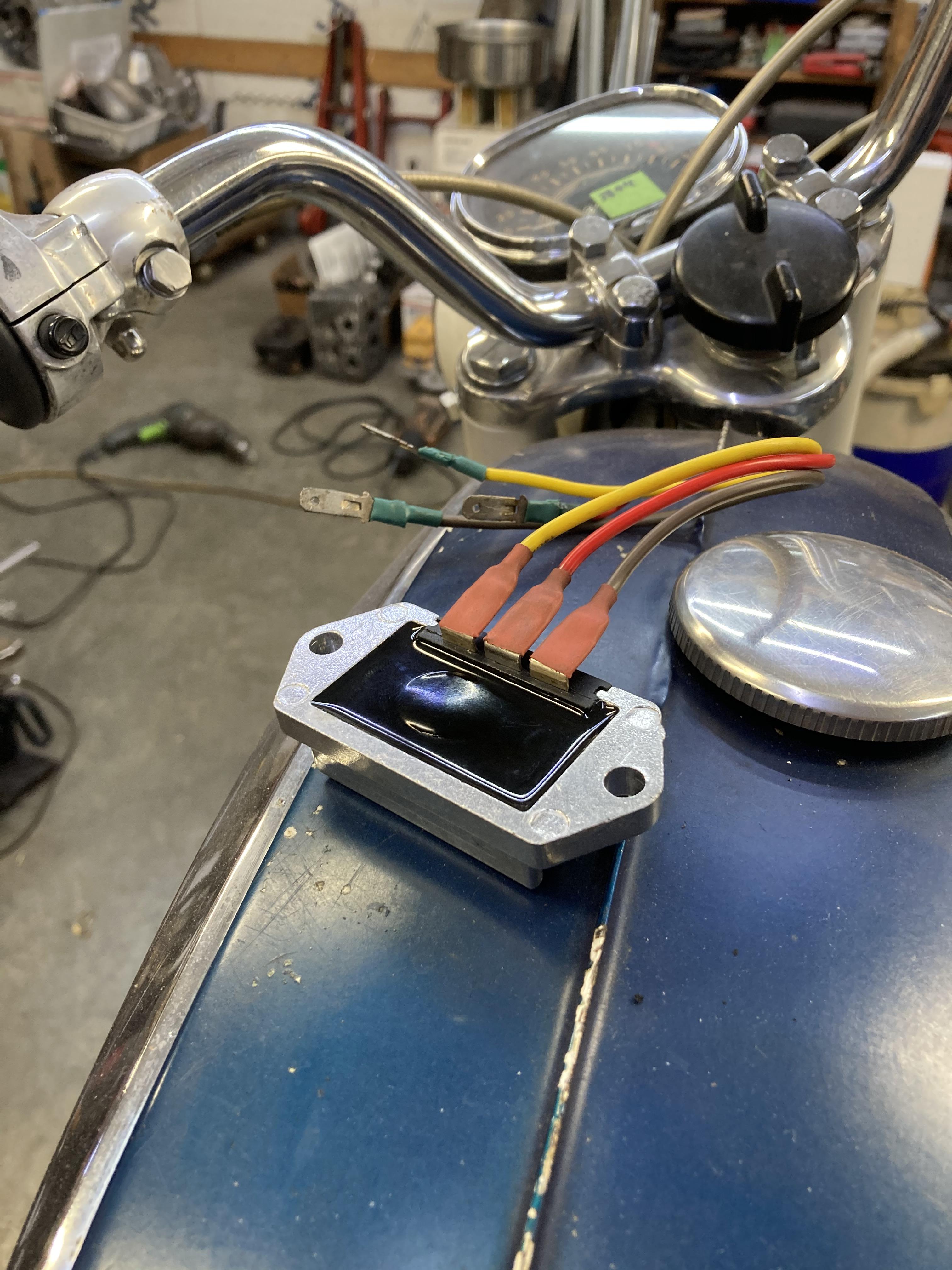
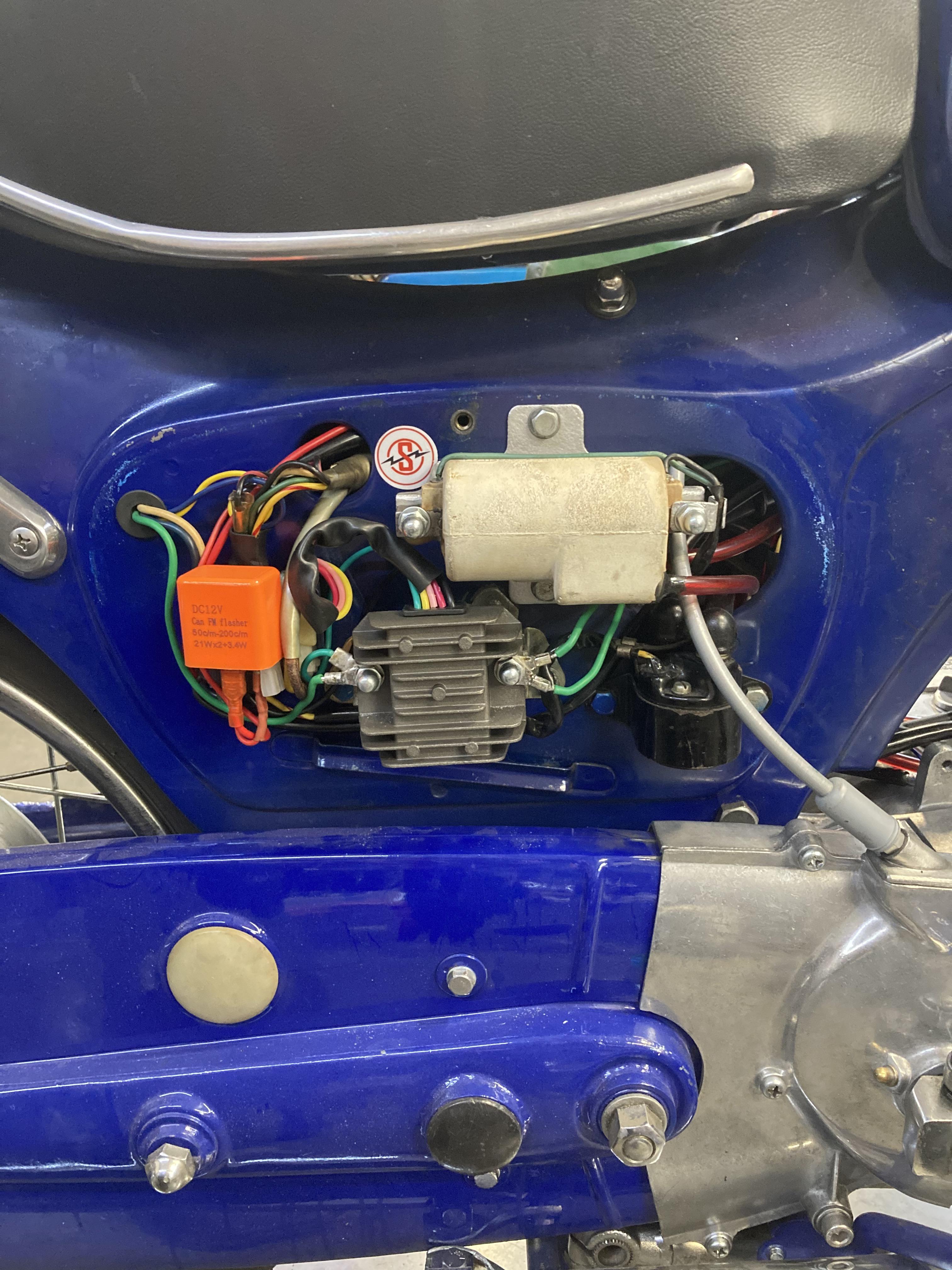
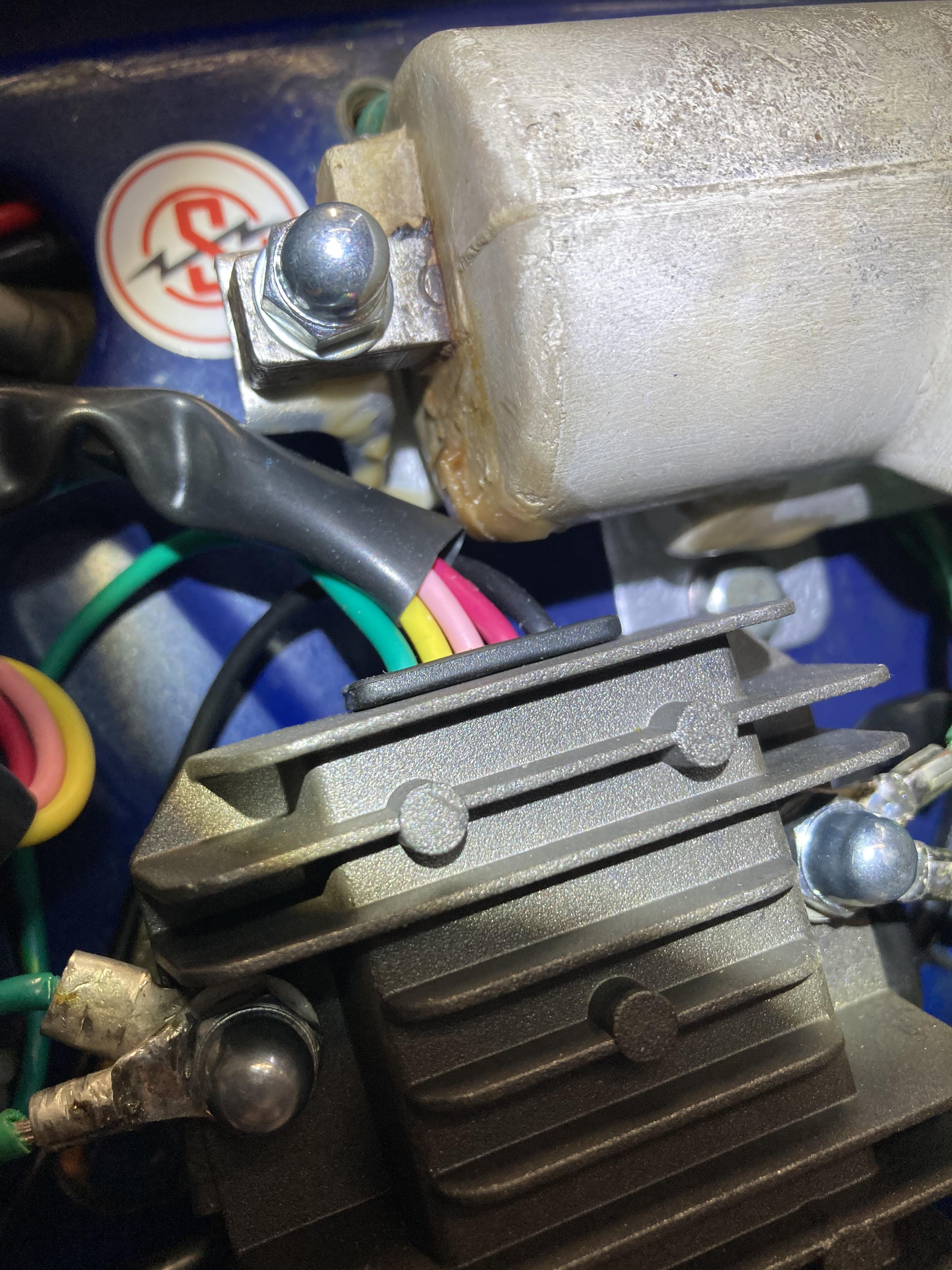
I took the new Sparcx moto single phase rect/reg unit and changed the connector from 4 female spades to 3 males and an eyelet for the green ground and mounted it up.

h6yGGPI.jpg


Test and ride tomorrow.
 
Steve is a great explainer. He also said it might be something stupid so I set about checking continuity and resistance of the wires running from the stator up through the harness and through the key switch then back to the rectifier. I probably should have done this before, after all it is a 60 year old harness but it was all good, 0.6-0.7 ohms on all. His hunch that it might be the rectifier was pretty good.

Here is the Kohler type rectifier. It has a strange blister or swelling on it's backside.

I took the new Sparcx moto single phase rect/reg unit and changed the connector from 4 female spades to 3 males and an eyelet for the green ground and mounted it up.

Test and ride tomorrow.

The bike is looking good Tom.
 
Last edited by a moderator:
Steve is a great explainer. He also said it might be something stupid so I set about checking continuity and resistance of the wires running from the stator up through the harness and through the key switch then back to the rectifier. I probably should have done this before, after all it is a 60 year old harness but it was all good, 0.6-0.7 ohms on all. His hunch that it might be the rectifier was pretty good.

Here is the Kohler type rectifier. It has a strange blister or swelling on it's backside.

Test and ride tomorrow.

This seems like a promising development and could further support Steve's mantra that "New does not mean good!", which has led to the solution of quite a few problems over the years. Not a bad motto for a whole community of folks who prefer to check all the connections on their 50+ year old bikes over riding something built in the last 20 years...

Maybe your charging system was too much for that Kohler unit to handle.
 
This seems like a promising development and could further support Steve's mantra that "New does not mean good!", which has led to the solution of quite a few problems over the years. Not a bad motto for a whole community of folks who prefer to check all the connections on their 50+ year old bikes over riding something built in the last 20 years...

Maybe your charging system was too much for that Kohler unit to handle.

I've got another good one, "everything is good, until it's not".

That blister couldn't be the way it was. Something is cooked in there.

Charles' bike came for a visit and seat swap. While it is here, I checked his charging voltage at 13.3+ volts at higher rpm's, so that is a sign that there is hope as I do pretty much all work on that one. It only gets what it needs, no extra indulgence. I'm ashamed of the turn signal wiring that I cobbled together 3 years ago but it just keeps working. It's rectifier got replaced over a year ago with a cheapy, again, no mercy.

Go figure :rolleyes:.
 
That was it!!!

She's puttin out 13.1- 13.8 idling, revving, lights on or off, in the garage. No long ride yet.

Thanks Steve, 66Sprint.
 
Excellent! This has to be one of the more desirable outcomes, too, since the rec/reg is easily replaced and all of your hard-to-replace components are working as designed.
 
60 mile ride showed charging average 13.9 volts and over 14 at times (14.4). Battery showing 13.0 after a short rest. It seems a bit high to me. Maybe an anomaly with my phone charger/volt meter. Should I relocate my black voltage sensing wire from the Sparcx moto rect/reg from the coil input to the battery+ ?

Also test rode both refurbished seats on both Dreams. Interesting and nice combo on Charles bike with the pretty stiff aftermarket Rebel rear shocks and the soft spring seat. Of course, my original shocks are soft with little damping left. A Dream shock rebuild party is in my future someday.

A hasty stop and chit-chat for a half hour, in town, near home, with an open exhaust afficionado friend, resulted in my bike having it's key left in the 'On, no lights' position. It is easy to do as Dreams and Benlys have a 5 position switch.
1. Starter only, no ignition. For cold start priming (and compression tests)
2. Off. key can be removed
3. On. no lights, brake light functions
4. On with lighting.
5. Parking, tailight on. Key can be removed

8l5Zuu7.jpg


The coil got so hot, I could not keep my hand on it. I could feel the heat through the metal side cover when I threw my leg over it. It wouldn't start. Our new friend came back to see if we were stuck and I wanted to see if it would work if we let it cool a few minutes. At least no smoke (this time) and no burnt wires visible. It was sweating a few drops of it's wax from the ends of the core that stick out.


4Ce3c71.jpg


When it cooled enough to keep touching it. It started. I rode home with the side cover in my jacket to continue cooling it. The fireworks were just starting and I was glad my bike wasn't part of the display.
 
It's too bad that 'Off' isn't one of the extreme positions on that switch, but I'm glad the coil behaved well after cooling. Aside from the coil scare it sounds like a fun ride.
 
If you have a spare coil from your parts, it maybe good to replace that unit. Age of that coil and your key on may not bode well for the longevity of that unit.

Interesting development on the Kohler regulator bubble, as that was a breakdown internally of something. I used the same unit style on my CL77 build and it is something to be aware of that it may not be compatible with these charging systems.
 
14.4v is the cut off voltage of the regulator, won't go to 14.5v. Might try the Black wire connection to the headlight and see if it makes a difference. The regulator is monitoring the battery voltage and at times will go to a full voltage charge condition depending on what it's getting from the battery state.
 
It's too bad that 'Off' isn't one of the extreme positions on that switch, but I'm glad the coil behaved well after cooling. Aside from the coil scare it sounds like a fun ride.

This is what happens when you stop, fiddle to find neutral, stall the bike and only turn the key one notch because you forgot that you were using your lights (two notches).

I always pull the key out then reinsert, when leaving the key in, because that is the only way to know for sure it is in "OFF" position.
 
If you have a spare coil from your parts, it maybe good to replace that unit. Age of that coil and your key on may not bode well for the longevity of that unit.

Interesting development on the Kohler regulator bubble, as that was a breakdown internally of something. I used the same unit style on my CL77 build and it is something to be aware of that it may not be compatible with these charging systems.

I do have another vintage coil that I had tested via 66Sprints methods and will prepare it for future use. It will be interesting to see how really rugged these old coils are.

I will never use a rectifier that does not have a voltage sensing separate wire, regardless of vendors claims.
 
14.4v is the cut off voltage of the regulator, won't go to 14.5v. Might try the Black wire connection to the headlight and see if it makes a difference. The regulator is monitoring the battery voltage and at times will go to a full voltage charge condition depending on what it's getting from the battery state.

Thank you Jim, that was the next question that I was going to ask. Knowing that you are one or more steps ahead of me is a real comfort.

I think I just might run an additional wire up to the key switch headlamp output (green) for that black sensor wire. I would like to keep my LED converted headlamp for huge lumens gain but may switch back to an incandescent for tail/brake light.
 
Back
Top Bottom