71ish CB450 build

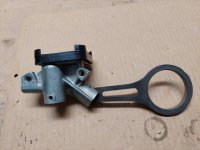
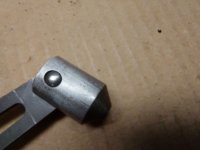
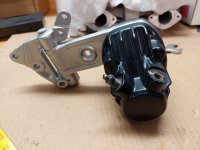
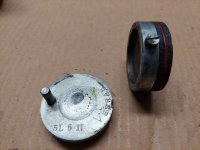
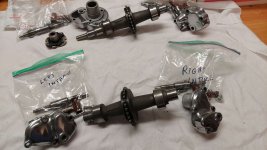
Still a bit on the cool side for painting the cases so decided to look at some of the engine components. The oil pump has some light scratches but more wear from the pin that holds the plunger on the connecting rod. I can feel a slight catch with my finger nail. Since the pin floats in the plunger, is this wear normal from the connecting pin?
It is, and I've seen some that weren't pretty but still apparently pumped fine. Getting a good used one would be a crapshoot and they're NLA new. You do have the option of Jay's pump but not sure you want to spend that much money.
 
It is, and I've seen some that weren't pretty but still apparently pumped fine. Getting a good used one would be a crapshoot and they're NLA new. You do have the option of Jay's pump but not sure you want to spend that much money.
I located a used pump from Canada at $35 plus $35 for shipping and went ahead an ordered it. Description said slight scratches and I didn't see any wear from the pin, so hopefully this one is in a bit better shape.

I would love to have one of Jay's pumps but with the exchange rate it's outside of my budget right now.
 
I located a used pump from Canada at $35 plus $35 for shipping and went ahead an ordered it. Description said slight scratches and I didn't see any wear from the pin, so hopefully this one is in a bit better shape.
I was going to offer you the old one that came out of the engine in my red bike, I bought a NOS pump body from DSS back when they still had them. I haven't looked at it in a long time but I don't recall it being too bad, plus I do have at least one more used one from one of my two spare 5 speed bottom ends. Let me know if the one you bought doesn't look good.
 
I was going to offer you the old one that came out of the engine in my red bike, I bought a NOS pump body from DSS back when they still had them. I haven't looked at it in a long time but I don't recall it being too bad, plus I do have at least one more used one from one of my two spare 5 speed bottom ends. Let me know if the one you bought doesn't look good.
Thanks for the offer. I should receive the pump in about a week so I will let you know if I will be taking you up on your offer.
 
Thanks for the offer. I should receive the pump in about a week so I will let you know if I will be taking you up on your offer.
I'll go look at the one that's already out of an engine just to see how it looks. The other is loose but buried in a right crankcase cover under the removed clutch, etc if needed.
 
The first one is pretty average overall, same marks you have plus a few minor scratches. I can clean it up and take a few pics of it if you need it.
 
So new pump arrived about 2 weeks ago but forgot to post here. It's in better shape than mine so I will go with it. Came with piston, pin, filter and a bent connecting rod (likely due to the "no time to waste" disassembly method).
Pump1.jpg Pump2.jpg Pump3.jpg
 
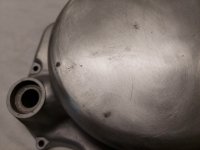
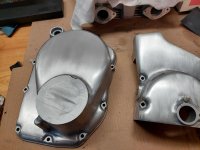
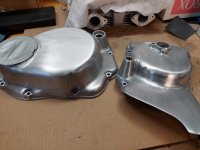
Managed to sand down the covers a bit more to get rid of the larger pits. Since I intend to paint the covers I stopped here and filled any big ones with TechSteel.
Case1.jpg

case00.jpg

case0.jpg

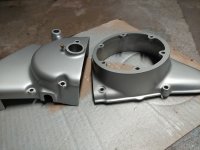
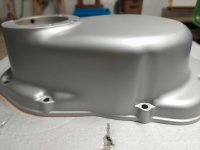
Last week it was warm enough to paint so I gave 2 light coats and 1 medium coat of VHT caliper paint. I waited a day for it to dry thoroughly (and also for the wife to go shopping) then baked in the oven at 200F for 1 hour.

cover1.jpg
cover2.jpg

Still a few blemishes but pretty good for a 52 year old!
Edit: still need to clear coat with SprayMax 2K which I will tackle next week.
 
Looks really good. I wish I'd realized to tell you, the Japanese grease fitting will pull completely out of the cover so you can paint without having to tape it off. I pulled the one on mine and then just pressed it back in afterward.
 
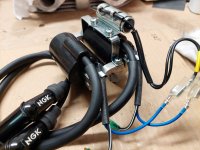
Had some parts come in last week so tackled those little jobs. Got new coils and condensers from 4into1 so installed those on the cleaned up coil bracket. I also had all the screws and condenser bracket zinc plated over the winter. New caps also installed.
coil.jpg
 
Looks really good. I wish I'd realized to tell you, the Japanese grease fitting will pull completely out of the cover so you can paint without having to tape it off. I pulled the one on mine and then just pressed it back in afterward.
Thanks for the tip. I wasn't sure if it would pull out without getting crushed in the process, so I used a rubber cap to protect it from paint.
 
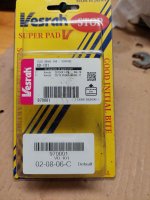
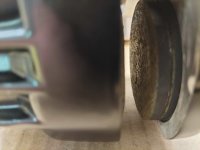
I rebuilt the front caliper over the winter and planned on keeping the brake pads since they looked in good shape. After reading about delamination horror stories I ordered Versah brake pads from 4into1 along with the coils. Oddly, the old pads are also Versah but are at least 45 years old.
caliper0.jpg

Old pads

PadsOld.jpg

New pads installed
Pads.jpg

caliper1.jpg
 
Had some parts come in last week so tackled those little jobs. Got new coils and condensers from 4into1 so installed those on the cleaned up coil bracket. I also had all the screws and condenser bracket zinc plated over the winter. New caps also installed.
Do you have B8ES plugs to go with those resistor caps? If not, you'll want to modify the new caps to non-resistor. I've been meaning to put together a few pics of what to do and I keep forgetting. I know I took some pics previously, I just can't find them now. Back to the garage...
 
DOH. I couldn't find the pics because I deleted them after using them in a thread here. Finally found it.

 
Do you have B8ES plugs to go with those resistor caps?
I bought 4 sets of plugs about 3 years ago when they were still being stocked here in Canada. They are no longer available here as elsewhere. Once they run out it will be on to the resistor plugs and non-resistor caps. These new caps I bought don't seem to be able to come apart. I tried pulling on the screw but it would not budge and I did not want to break them.
 
These new caps I bought don't seem to be able to come apart. I tried pulling on the screw but it would not budge and I did not want to break them.
And they may not, but if they're the same NGKs shown in my pictures then they should. I wondered about it myself in the beginning, but I had this spare pair of new ones and decided to just pull harder and it came right out with enough force.
 
And they may not, but if they're the same NGKs shown in my pictures then they should. I wondered about it myself in the beginning, but I had this spare pair of new ones and decided to just pull harder and it came right out with enough force.
Once I run out of B8ES plugs I will definitely give this a try as my caps look exactly like the ones in your pics.
 
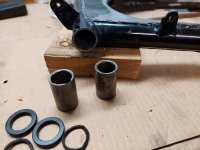
Yesterday I was working on the swing arm bushings and got everything apart with some heat, a hammer and a large drift pin to push out the old bushings.
Bush0.jpg

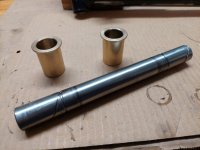
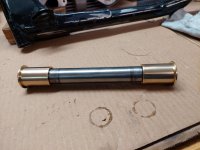
I cleaned up the inner center piece but the new bushings from CBX would not go all the way onto the center pipe. I wrapped some wet & dry around a dowel and with some WD40 slowly opened up the bushings to where they now fit snugly on the pipe. I know, I should have got a reamer but it was so close that I figured a light sanding would do.
Bush1.jpg
BushNew.jpg

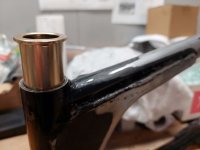
Now for the fit into the swing arm. It took a lot of pounding to get the old bushings out and I don't really want wail on the bronze bushings as they will be ruined. Right now, this is as far as the bushings will go in.
BushInsert.jpg

I have several questions at this point.
1. Is this normal that the bushings only go in this much?
2. Will heat and gentle tapping allow them to go in?
3. Should I remove a bit of material from the swing arm?
4. I plan to powder coat so do I install the bushings now while I can still heat the swing arm or do I wait until after powder coating and use gentle heat?
 
I'm surprised they fit that tight. I had my swingarm powdercoated first and put the bronze bushings in afterward, but mine did not go in nearly that tightly. There are no burrs inside the bushing area from driving the old ones out that might be causing the tight fit?
 
I recently installed these bushings on my 450k7 and I feel I should have been more careful during installation. (thread) I had to freeze the bushings to get them in and then freeze the fork center collar to get it in. I ordered a reamer, but installed the collar before I received it. My impression is that everything is too tight now and the rear is extra stiff as a result, so I will need to remedy this at some point. My only advice is to be more cautious than I was.

Edit: There seem to be part number changes in the bushings and swingarm that could possibly explain my situation with the k7.
 
Last edited:
I'm surprised they fit that tight. I had my swingarm powdercoated first and put the bronze bushings in afterward, but mine did not go in nearly that tightly. There are no burrs inside the bushing area from driving the old ones out that might be causing the tight fit?
I will double check for burrs and clean up anything I find. So I will make sure I am close to getting the bushings to fit and stop there. After powder coating hopefully a little heat on the swing arm and freezing of the bushings will get the bushings to seat.
 
I recently installed these bushings on my 450k7 and I feel I should have been more careful during installation. (thread) I had to freeze the bushings to get them in and then freeze the fork center collar to get it in. I ordered a reamer, but installed the collar before I received it. My impression is that everything is too tight now and the rear is extra stiff as a result, so I will need to remedy this at some point. My only advice is to be more cautious than I was.
Thanks for the info and the tip on freezing the bushings. I will make sure after assembly that everything pivots smoothly and there are no tight spots.
 
Heat up the rear fork, and put the bushings in a freezer. If you need to powder coat the rear fork after assembly of the bushings, you can heat up things really hot. Make sure the area is clean before you start. I use a press to push them in, but if you don't have one, use a poor men's press (glue clamp). Use a piece of hard wood taped to both side of the glue clamp and you'll be fine. If the fitting between bush, and shaft, once pressed in, is too tight, buy a cheap reamer.
 
I just installed the brass bushing on the CB360 swing arm I’m installing on my 450. I used a sand paper bit in a drill to clean up the inside of the “pipe”, froze the bushing, and added alittle lube to the bushing. I then put the swing arm in a clamp, used a piece to wood to protect the bushings and tapped them in with a hammer.

The rod that goes through the bushings did seem to fit tight on one side. So maybe I’ll take alittle material off that particular bushing and freeze that rod as well.

Hope my experience helps you out. This site continues to be very helpful.
 
If you need to powder coat the rear fork after assembly of the bushings, you can heat up things really hot.
I'm not sure I understand, are you saying that the if I insert the bushings after the swing arm is powder coated that the powder coat can take a lot of heat? Thanks for the tip about pressing the bushings in. I have the poor man's press I can use :ROFLMAO:
 
O, sorry, if I read it back I understand why you're asking. :ROFLMAO: No, I meant that you can heat it up before painting / coating.
Thanks. Makes more sense that a lot of heat can be applied before powder coating since I'm not worried about the finish.
 
I had the bushings in the freezer overnight and then checked for burrs inside the swing arm pivot point. I heated up the swing arm and then inserted the busshings and used a "poor man's" press to push them all the way in.
bushpress.jpg


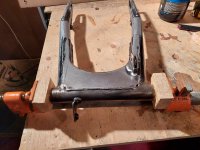
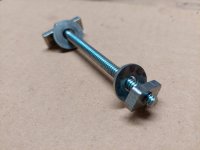
The rear shock mount bushings were more difficult. I tried using a large socket on one side and a bolt and washer on the other side to try and pull the bushings through. Even with heat it was a no go. I then decided to heat the center of the bushing which in effect melted the rubber and the center fell out. I then used the torch to burn the rest of the rubber. Once the rubber was removed I used a grinding stone to wear down the outer metal of the bushing to where it is paper thin ( see yellow line). I figure I won't have to clean this area after powder coating and should just be able to pry up the old metal and pull the rest of the bushing out.
ShockMount.jpg
 
I tried using a large socket on one side and a bolt and washer on the other side to try and pull the bushings through. Even with heat it was a no go.
Those bushings haven't been fun for me, either, but the socket trick worked for me. What were you using to drive the bolt and washer?
 
Those bushings haven't been fun for me, either, but the socket trick worked for me. What were you using to drive the bolt and washer?
I had a piece of threaded plate that I ground down to match the size of the bushing. Maybe I needed a larger bolt.
shock.jpg
 
I wonder if it would help if the rectangular plate were replaced with a socket that matches the outer diameter of the bushing, so as to apply pressure more uniformly.

I used a cordless impact to drive my contraption, not sure if I could have done it by hand.
 
I used a 10mm (14mm head) bolt and car shock absorber washers when I squeezed the new bushings into my lower shock mounts (for some reason my father had a lot of shock washers in his nut and bolt bin, and they're pretty stout).
 
I used a 10mm (14mm head) bolt and car shock absorber washers when I squeezed the new bushings into my lower shock mounts (for some reason my father had a lot of shock washers in his nut and bolt bin, and they're pretty stout).
I think I have a set car shock washers somewhere, and yes, as I remember they were very thick.
 
Place a large socket than the diameter of the bushing on one side, a smaller bushing on the other side and press it out with the "poor man's"press.
 
Place a large socket than the diameter of the bushing on one side, a smaller bushing on the other side and press it out with the "poor man's"press.
Thanks, I will make use of my "poor man's " press for the installation as well. ;)
 
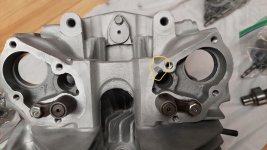
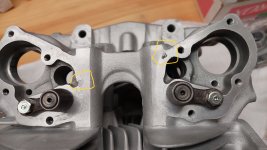
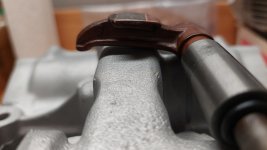
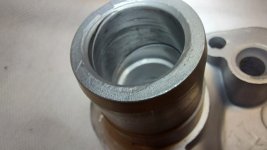
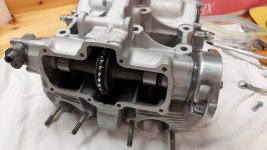
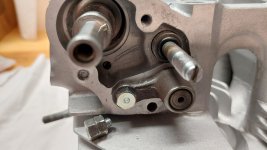
While the frame and other parts are out for powder coating, I decided to start on the cylinder head. I replaced the valve stem seals and lightly lapped the valves then installed all 4 valves. I poured acetone into the intake ports and left for ten minutes - no leaks. Did the same with the exhaust ports and no leaks. When installing the torsion bars I noticed what I thought was a casting flaw but then saw 2 more on the other cam bearing surfaces. Then it dawned on me that the PO must have used the those guys in Houston method of removing the cam bearings. I will put a little dab of honda bond on those blemishes.
Head1.jpg

Head1b.jpg

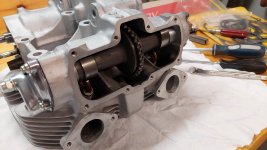
I polished the cam bearings a bit and got every sorted and inspected. I then laid out all the parts for the head to make sure it was all there.
Head00.jpg

The cam chain dampers seemed to be a bit pliable but decided to remove them anyway.
Head0a.jpg
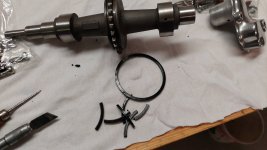
Good thing I removed them, the exhaust ones were breaking apart as I was removing them.
Head01.jpg
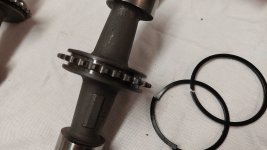
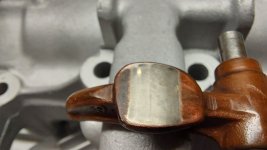
Cam surfaces were good with no scoring. All four cam followers were the same with no perceptible dishing, however, each follower had a slight line across the face.
Head2.jpg
Head3.jpg
Head4.jpg
20240521_155026Lin.jpg
 
I saw in an earlier post that you bead blasted some parts (e.g., cases). Is that how you cleaned up the head components, too? Everything looks super clean.
 
Ouch! those screwdriver pry marks hurt the soul... particularly the first photo and the one on the left in the second. for something that only take 9 ft/lb of torque to bolt up, those should have tapped off pretty easily.

If you do go the hondabond route to try and seal that up, you might want to use the old Pontiac service method. you put your think coat on there and let it set up overnight, then carefully trim it back from the inside a hair so it doesn't squeeze out into the end of that cam and get bouncing around in there.
 
I saw in an earlier post that you bead blasted some parts (e.g., cases). Is that how you cleaned up the head components, too? Everything looks super clean.
Yes I bead blasted the head, cylinder and cases. I taped of the combustion area, put an old set of plugs in and screwed on the cam bearings. All this in an effort to limit the amount of media entering the head. I then washed everything twice in the parts washer and blew out everything with compressed air.
 
Then it dawned on me that the PO must have used the those guys in Houston method of removing the cam bearings.
That's a sad testament to the power of the internet, yeah sure everything you see is true. And those marks look worse than a putty knife would make. Ugh.

At least it looks like you can compensate for it.

Everything else looks great, good used followers are in short supply so it's really good that yours are fine.
 
Ouch! those screwdriver pry marks hurt the soul... particularly the first photo and the one on the left in the second. for something that only take 9 ft/lb of torque to bolt up, those should have tapped off pretty easily.

If you do go the hondabond route to try and seal that up, you might want to use the old Pontiac service method. you put your think coat on there and let it set up overnight, then carefully trim it back from the inside a hair so it doesn't squeeze out into the end of that cam and get bouncing around in there.
When I took the head apart, all I did was tap the cam sprocket with a plastic hammer on the thickest part and the cam bearing separated from the head. No need for any screwdrivers.
I think the picture makes the flaw seem worse than it is, it's not all that deep, maybe 8 thou.
 
Brad, they clearly did what they did because of the chickenspit method originally endorsed by those guys in Houston (forget cutting the chain and removing the head, then rotating the cams until no bearing covers had any stress on them), so they forced them off.
 
Cam bearings were in good shape, slight scoring on the surface but usable. Started on the intake side and used the timing marks to determine which end of the cam went to the right side.
20240521_155848.jpg
Head4a.jpg
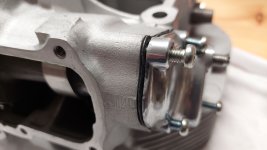
Installed the o-rings that came with the gasket set onto the cam follower shafts and installed the gaskets on the cam bearings. When I installed the cam ends I left a little gap so I could move the gasket and ensure the screws and gasket holes lined up. I put a little assembly lube inside the cam bearings.

Head7.jpg
Intake side done.
Head8.jpg
Followed the same procedure for the exhaust side.
Head9.jpg

Tightening the last screw on the points side and disaster struck. The screw would not tighten up and there was still a gap between the cam bearing and the screw. I pulled out the screw thinking it was maybe too long so grabbed an after market screw that I had purchased that looked to be a few mm shorter. I started to tighten it down again when I felt too much resistance. I tried to take the screw out and it would not budge. I applied so much force trying to remove the screw that the head was ruined. No option but to drill the head off. Once the head was off the screw I removed the cam bearing which exposed enough of the screw that I was able to put 2 nuts on and lock them in place. I then used a 10mm socket to try and unscrew the remains. Well that was a no go as the screw broke just below the surface. I'll have to drill that out and hopefully won't damage things too much.
Well that's enough fun for one night.
Head10.jpg
 
Oh that beyond sucks! I just finished putting the head for my 450 together and if that had happened to mine at that point I am not sure I could have handled it as gracefully as you have seemed to.
 
You deserved better. Really nice work rewarded in an unfitting manner.
It's part of the process. I think we have all hit a brick wall at some point in our restorations. I was thinking about why the screw was so tight to come out and then it came to me. I probably forgot to run the 6mm tap through that one hole. I did all of the others and had some blast media come out on a few. I suspect because this hole didn't get the tap clean out that some media got between the threads and jammed the screw. A self inflicted wound, haha
 
Back
Top Bottom