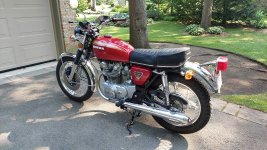
71ish CB450 build

They're actually correctly on the right side of the engine now where they belong (as it sits in the bike, as you are sitting on the bike). Surprised you didn't use the originals
That was my problem, when assembling the engine, I was facing the front of the engine when I installed the copper washers and put them on the right side as viewed from the front. When I got the bike there were not copper washers on the oil passage ways, only the steel ones.
Check the advancer return springs for the hanging idle
I disassembled the advancer and cleaned and greased it. It seemed to spring back ok but I will check again if there is any slack and maybe snip off a half turn of the spring to get more tension.
 
Been busy with the honey-do list so haven't progressed very much. Rain today and the forecast is for more rain for most of the week which means no painting for a while.

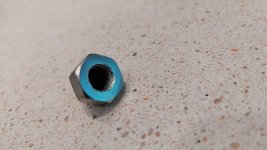
I think the reason for the oil weep under the acorn nuts is that the nuts were a bit pitted so I smoothed out the surface with file, then used some 320 grit wet and dry on a piece of plate glass. I annealed the copper washers and re-torqued the head. Hopefully this fixes that issue.
20250510_124333.jpg

The neutral light stopped working so I checked the bulb and it was fine so moved on to the neutral switch. I found that the wire on the switch had broken at the solder joint. A new piece of wire and a bullet connector restored the neutral light.

I rechecked the advancer and it snaps back so I don't think this is the cause of the hanging idle. I set the static timing and then checked for full advance with the timing light and it was dead on. I noticed that there was quite a bit of arcing at the points, so I threw on the old condenser but nothing changed. The points assembly I have is after market, so maybe the points themselves are not the best.

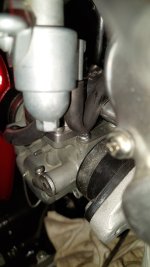
It seems not to idle as well as before and I get the occasional popping in the right carb, so I'm thinking maybe the carbs need to be looked at. I checked the plugs and they were pretty sooty so it has been running rich. I will check the float level and the slow speed jet.
 
I rechecked the advancer and it snaps back so I don't think this is the cause of the hanging idle.


If all the throttle cables act correctly and snap back sharply your adjusted correctly there. If the slides are the metal aluminum style in a CV carb design have you checked for smooth slide operation? They can get a little grungy with oil mist if your PVC hose feeds directly into the carbs throats. Do your carbs have the white plastic caps in the top centre of the carb top caps?
If so give them a vacuum check, as they are known to deteriorate the plastic cap seal with age and leak. This leak if happening there may cause issues with the slides hanging at lower RPM.
 
Good point about the white caps and the slide action. When I rebuilt the carbs the slides moved freely. Things might have changed since then.
 
It's been a while and the honey-do list was long but finally got a bit of time to work on the bike.

I was having a bit of a hanging idle issue (documented in another thread that I will update soon), so I removed the carbs to see if anything was clogged. In the float bowls I found some rusty sediment that was so fine it got past the filter in the petcock. To remove the rust in the tank I initially used vinegar which worked not too bad but even though I coated lightly with Marvel Mystery oil, there was still some flash rust at the bottom of the tank. I then used the Detox C which did a nice job. I did not fully fill the tank with gas as I was still needing to paint it, so flash rust has returned is some areas.

I decided to pull out the POR 15 kit that I bought several years ago but never used. I followed the directions and used the Marine Clean to get out any sludge (there was none but followed the directions to the letter). Rinsed the tank and then used the heat gun to remove any excess water. Next step was the Prep and Ready which removes any rust. Rinsed the tank 3 times with hot water then used the heat gun to get the tank absolutely dry inside. As the tank dried there was a lot of flash rust that developed but the instructions say this is normal and actually lets the sealer bind better to the metal.

Next step was the sealer and I was a little worried since the kit was about 7 years old but the tin was never opened and the contents were still very liquid. After several minutes of mixing I poured the contents of the sealer into the tank and rolled the tank for a good 10 to 15 minutes to ensure all surfaces were coated. I drained the excess sealer into an old paint roller tin in order to verify after a few days that the sealer would harden correctly.
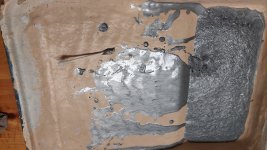
20250620_135604.jpg
I tilted the tank on end to ensure no sealer would not pool around the cross over tubes or petcock spigot. I came back next morning to find that the cross over tubes were blocked. The sealer is very liquid and I think the sealer from the base of the tank probably slid down and covered the cross overs. I used a piece of bicycle brake cable in a drill with the end splayed to kind of drill out any sealer - it worked like a charm.
20250620_135536a.jpg

After 3 days the sealer in the paint tray hardened up beautifully and the tanks is now sealed.
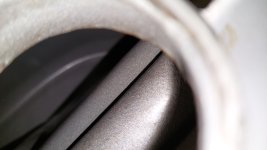
20250617_140757.jpg

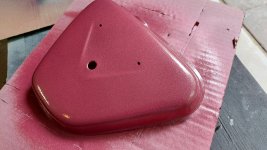
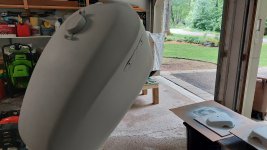
Now that the tank is sealed and the heat/humidity has dropped, I decided to start painting the tank and side covers. I wiped everything down with laquer thinner, got out my respirator and applied several light coats of Spray Max 2K primer. I will let this sit for a few days and then lightly sand before applying the 3 step candy apple red.
20250620_132726.jpg
 
We had a bit of a heat wave at the beginning of the week were it was 38C (100F) and very humid so I couldn't do any painting. Yesterday was closer to 21C (70F) so I decided to apply the 2 stage candy red. I wet sanded the primer to knock off any bumps then applied the base coat which came out a little purple looking.
20250626_155129.jpg


I waited about 20~30 minutes as per the instructions, then applied the clear red coat.
20250626_155343.jpg
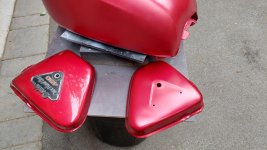
It didn't look quite right but at this point I couldn't do much else except wait for it to dry and see what happens. This morning I took the tank and side cover outside to compare with an original paint side cover that I have. It doesn't have a clear coat yet but I think it came out pretty close.
20250627_152503.jpg


I will let this harden for a few days then put on the decals and clear coat with SprayMax 2K.
 
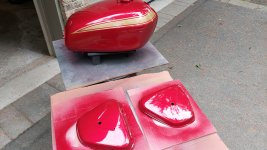
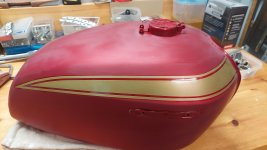
I put on a coat of clear a few days ago and let that harden. This morning I wet sanded with 1200 paper to remove some of the orange peel. I thoroughly dried the tank and side covers and then rubbed down with laquer thinner. I sprayed a bit of soapy water on the tank to allow repositioning of the decals. I applied the tank decals which went on fairly easily except for one little wrinkle. I decided to leave well enough alone before I made things worse. Here is the tank before the final coat of clear.
20250705_150950.jpg


I then used a hair drier on the decals and the rest of the tank to make there was no more soapy water anywhere and did another pass with the laquer thinner. I applied the clear which came out well on the side covers but the tank has some "pitting" in the clear. It's almost like there was still some contaminant on the surface even though I wiped it down with the laquer thinner.
20250705_164532.jpg

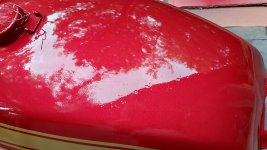
Here is a close up of the "pitting"
20250705_164552.jpg

I will wait a couple of days and sand those pits out and re-apply some clear...:mad:
 
Shame too, you were on your way - stripes went on nicely, sidecovers look great. I don't have a 100th of my father's painting knowledge, but I hope you can get that out without sanding too deeply.
 
I put one coat of clear on before the decals, so I'm fairly confident I wont sand the color out when I remove the "fish eyes". Might start with 800 wet & dry then finish with 1200.
 
Did you by chance use silicone spray in the garage or vicinity since you started working on the tank?
No sprays of any kind were used except for the soapy water to apply the decals. That was wiped off and then a hair drier was used, followed by the laquer thinner.
 
Was the original coat of clear on the paint at least 72 hrs old before you sanded and wiped with lacquer thinner. The area that did that breakout may have reacted to the new fresh clear coat when it was applied, if the old clear on there was less than 72 hrs dry. The lacquer thinner wiping application may have caused a chemical reaction to that area when it was sprayed again with the new clear coat.
 
Was the original coat of clear on the paint at least 72 hrs old before you sanded and wiped with lacquer thinner. The area that did that breakout may have reacted to the new fresh clear coat when it was applied, if the old clear on there was less than 72 hrs dry. The lacquer thinner wiping application may have caused a chemical reaction to that area when it was sprayed again with the new clear coat.
The original clear coat was on for about 36hrs when I re-coated. The spec sheet said it was "ready for assembly" after 24hrs. With a pot life of 48 hrs I wanted to get a second coat on within the 48 hrs. I will wait the 72hrs before sanding and re-coating since I will have to get another can of Spray Max anyway.
 
I had the same thing happen with VHT caliper paint a few days ago. Outdoor sprayed. I wondered if something was in the air, chemtrails maybe.
 
Spent about 3 hours carefully wet sanding the tank to remove the "fish eyes". I was apprehensive about the sanding as I did not want to cut through the clear and sand off any of the candy red. I would sand a bit and then wipe the water up with a paper towel to make sure there was no red color coming off. Ran out and bought another can of clear 2K paint as I didn't want to take a chance on my existing can which has been activated now for 4 days.
Still a few minor remnants of the fish eyes but I think these will blend in no problem. Looks dull now, but when I wet the tank the candy red comes through.
20250708_134159.jpg
 
The weather here has not been favourable for painting - 33~35C (90~95F) and humid. A week ago the temp dropped to about 22C (72F) so I activated the 2K clear and prepared to clear coat the tank. I set up in the entrance to the garage so the fumes could dissipate more quickly when I opened the back door to the garage. I started spraying and then moved to the other side of the tank when a gust of wing blew some small bits of crap into the newly sprayed clear. :mad:

I stopped clear coating and waited for about 30 hours then wet sanded the clear once again. The temps went back up into the 30's C and very humid with some thunderstorms forecast in the evening so I had to wait for cooler temps. The clock was ticking on the 2K and I didn't want to lose a nearly full can because it hardened up. After 4 days of 2K being activated I couldn't wait any longer so last Sunday I sprayed the tank in the evening when it was a few degrees cooler but it was still humid. When I finished I could see the clear starting to cloud over a bit. I waited about 20 minutes so I could handle the tank and brought it inside to finish curing. Next morning there was no more clouding. There are a couple of "flaws" in the paint but I think I can live with them.

Yesterday I put the gas cap and emblems on and today I installed the petcock. Poured in some gas and turned it on only to have gas dripping out of the petcock. On closer inspection it was coming from fuel strainer - when I cleaned the petcock I forgot to tighten the bowl, it was only finger tight :eek:

It took a few cranks to get it going but finally started and idled at around 1000 rpm. Time to put some miles on it!

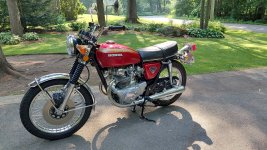
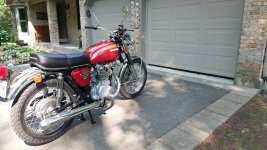
Here are some pics of the finished product
20250715_162138.jpg
20250715_162215.jpg
20250715_162252.jpg
 
A big thank you to all who helped along the way and those that provided some much needed parts (EZPete and one who shall remain anonymous). The project is pretty much done but VHT is part of my daily routine so I will be still hangin around :cool:
 
Brad,

The truth is we're our own worst critics, as we all know the minimal flaws in our build. The reality is no one ever sees those in any detail like what we see/know. ;)

It looks amazing and you have done an excellent job. Great attention to detail while navigating all those little trials and challenges of the build.

David
 
Small update. Been busy the last little while and did not get a chance to do much tinkering with the bike. I was away for two weeks but got back into the bike early this week. I decided yesterday to go for a little ride around the neighbourhood to see how things would go.

I started the bike after a little coaxing with the choke and throttle and let it idle for a couple of minutes. I take off but I have to keep the revs up to get going. I go about a block when the bike just dies. No electrics, no starter, zip. Tried the ignition switch in the park position but nothing. I decided to check the fuse - who knew a 50 year old fuse wasn't going to last! Luckily I had a spare in the toolkit and replaced it. I went back home as something was still not right when driving. Every time I needed to slow I had to keep the revs up to keep it going. I could move the throttle lever on the right carb and the revs would increase but if I did the same on the left cylinder the revs wouldn't increase and the cylinder would just sputter.

This afternoon I dove back into the problem. I decided to check the amount of fuel in the left carb bowl. I removed the spring expecting a bunch of gas the pour out but the bowl was bone dry. I inspected the float valve and all seemed to be working. I checked the level in the tank and it did not need to be on reserve yet but I tried it anyway. No gas coming through. I backtracked to the petcock and guess what I found...
20250807_171043.jpg

The fuel line was about 3/8" too long and had a bend in it that was restricting the fuel flow. There was no bend when I had the tank just resting on the top of the rubber hold down, it was only when I secured the tank to the the rubber that it got kinked. I trimmed the fuel line and now the bike starts much easier and idles well. I took it for a 10 mile ride and all was well except for a little stutter at around 8K rpm - something for another day while I break in the rings.

On my ride I also noticed a little hard shifting at times - I think my repair to the the gear shift drum star is not working out. I will be on the look out for a replacement star I think.
 
I had a fuse go once on my 450 while making a right turn at a four-way stop. (blinker on) Never figured out what caused it other than it being a ten year old fuse and I now carry spares in the tool box that I haven't needed to use.

It's nice when you can figure out something like that fuel starvation quickly and resolve it simply. As I was reading, I was worried about a blocked petcock, but a kink in the fuel line is much easier to deal with.

As others have said above, the bike looks great.
 
Today's fuels make rubber softer, softer then it supposed to be, and sometimes this can result in a bent that cut's the fuel. I know in this case there was another reason, but using ethanol resistant fuel lines is a must.
 
I believe I got the 5.5mm fuel line from 4into1 and hopefully they supply ethanol resistant line. This fuel line was a bit thicker than the original lines.
The 5.5 line 4into1 sells lasts a long time. After about 4 or 5 years of exposure to both ethanol and non-ethanol fuel it finally gets a little bit hard, but the fit is perfect and you can use the original-style Honda wire 'clamps' because it really doesn't need any.
 
Last edited:
Back
Top Bottom