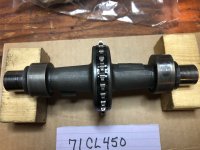
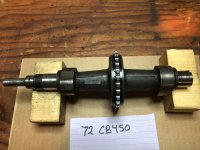
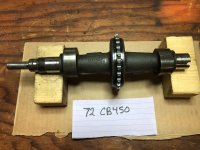
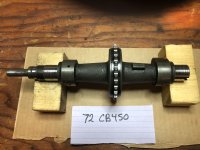
1972 CB450 K5 Hot Mess

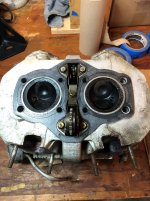
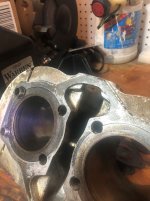
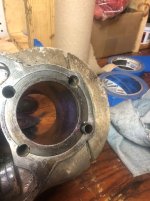
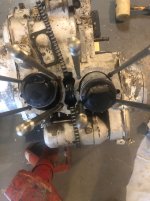
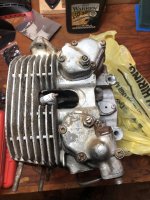
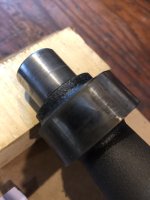
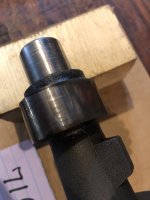
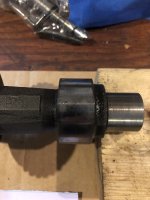
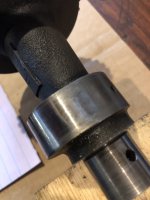
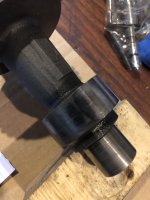
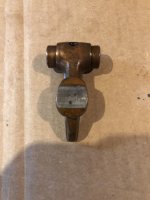
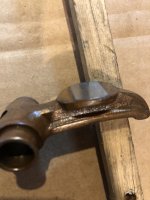
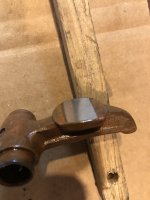
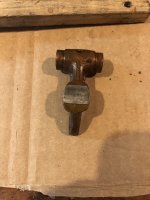
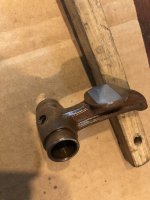
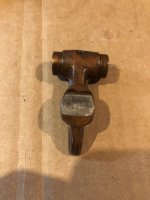
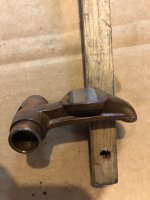
Pulled the head and cylinders on the K5 engine I am planning on restoring and this afternoon was pleased overall although when I pulled the cam chain tensioner, which had the incorrect fasteners as @ancientdad pointed out, at least one had been repaired with a helicoil which came out when I removed the screw. Anyway pulled the head and everything looked really good with just a touch of rust on one of the intake valves. At least I know which valve was being held open for 40 years. :) Pulled the jugs and the the pistons and cylinders look very good but I will need to measure everything to be sure. I think that whoever rode the bike last had recently done a top end ob on it as the I can still see the hone pattern and there is no ridge ring I can feel. Another problem I am seeing though is the center cam chain guide, which looks worn to me with a couple chips on one edge. Wondering if the cam chain was over tightened. Sharing a few pics so if some one sees anything I may miss appreciate letting me know.IMG_4123-1.jpgIMG_4128-1.jpgIMG_4129-1.jpgIMG_4130-1.jpg
 
Yes the brake panel is busted up pretty bad but I think the one that is on the bike I bought is in good shape but I appreciate the offer. Yep the wiring harness is a find just for the reason you mention. Also while I can read a wiring diagram pretty well it is really helpful to have an extra one to be able to physically work with. I was really happy to see the extra carb and at least from the exterior it looks in really good shape.
So. I just got done completely rebuilding the harness from scratch for mine - I would have loved a reference object in lieu of the diagram. If you’re planning on upgrading the rectifier/regulator to a combo unit, you can drop some of the wiring to these units. You can also just tie off the yellow and white together and bypass the whole “night mode” and just have both poles running all the time.

If you’re bumping to LED’s all around, you can drop to 18-22ga silicone insulated wire for a lot of the circuits and have a much lighter and more flexible harness. I also added two ground busses (front and rear) that are tied together to provide some redundancy and made it way easier to streamline the “main” backbone of the harness.

If you want to get really frisky, you can also delete the “park” mode, the keyed ignition switch, and the solenoid actuator button. Just install an RFID push to start button. $30ish drop in part. Quite a bit of checking circuits with the V/OM until you get the right wire combo. Run your headlight to always on, with high beam as a selection option fed by same hot/ground combo and drop in a simple NO/NC/NO selector switch for hi/low beam.

All of the above and you no longer have to deal with keys, the clunky RH stock controls (mount a separate kill switch, just wire a momentary switch to the coil). You also drop about 15-20 feet of wire and save a couple of color combos.

Sorry. I suck at restoring stuff - everything turns into a restomod.
 
So. I just got done completely rebuilding the harness from scratch for mine - I would have loved a reference object in lieu of the diagram. If you’re planning on upgrading the rectifier/regulator to a combo unit, you can drop some of the wiring to these units. You can also just tie off the yellow and white together and bypass the whole “night mode” and just have both poles running all the time.

If you’re bumping to LED’s all around, you can drop to 18-22ga silicone insulated wire for a lot of the circuits and have a much lighter and more flexible harness. I also added two ground busses (front and rear) that are tied together to provide some redundancy and made it way easier to streamline the “main” backbone of the harness.

If you want to get really frisky, you can also delete the “park” mode, the keyed ignition switch, and the solenoid actuator button. Just install an RFID push to start button. $30ish drop in part. Quite a bit of checking circuits with the V/OM until you get the right wire combo. Run your headlight to always on, with high beam as a selection option fed by same hot/ground combo and drop in a simple NO/NC/NO selector switch for hi/low beam.

All of the above and you no longer have to deal with keys, the clunky RH stock controls (mount a separate kill switch, just wire a momentary switch to the coil). You also drop about 15-20 feet of wire and save a couple of color combos.

Sorry. I suck at restoring stuff - everything turns into a restomod.
Wow thanks for a lot of good info there. I will definitively have to pick your brain on the electrical. I am pretty good at troubleshooting electrical problems due more to stubbornness then any master skills. :)
 
Yes I would be interested in finding a key that would fit the ignition switch and seat lock on on my restoration bike or at least the spare one so would appreciate if you have a key that you think would work. I can PM you so we can discuss if that works.
Chris will need the T-number off the ignition switch, seat lock or fork lock cylinder. Back then it should be right out in the open on your ignition switch (before they started putting the numbers on the back or elsewhere due to thieves just buying keys) so hopefully you have the easy search. If not, look on the end of the cylinder in the seat
Tom is correct, I just need the code from the face of your switch, etc. Shoot me a PM and we will discuss the details from there.
 
Another problem I am seeing though is the center cam chain guide, which looks worn to me with a couple chips on one edge. Wondering if the cam chain was over tightened.
Unless someone actually pushed on the tensioner shaft inside the tensioner body, the cam chain would not have been overtightened. The rollers get hard and start to fall apart, more often from a loose chain slapping on them than an overtightened chain. A good quality replacement center guide roller is still available from 4into1 - https://4into1.com/cam-chain-roller-b-14630-292-000-honda-cb-cl450k-cb500t/
Sharing a few pics so if some one sees anything I may miss appreciate letting me know.
Unfortunately the pics do not enlarge much at all, so getting a good look at the cylinders and head would require more close-ups. I'm assuming you're aware of proper head disassembly on this engine.
 
Unless someone actually pushed on the tensioner shaft inside the tensioner body, the cam chain would not have been overtightened. The rollers get hard and start to fall apart, more often from a loose chain slapping on them than an overtightened chain. A good quality replacement center guide roller is still available from 4into1 - https://4into1.com/cam-chain-roller-b-14630-292-000-honda-cb-cl450k-cb500t/

Unfortunately the pics do not enlarge much at all, so getting a good look at the cylinders and head would require more close-ups. I'm assuming you're aware of proper head disassembly on this engine.

Thanks for the heads up and I will check the numbers tomorrow. I am hoping they are all a set although I will not bet any money on it.

Tom is correct, I just need the code from the face of your switch, etc. Shoot me a PM and we will discuss the details from there.
I have been busy with some other issues the last couple of days. PMing you now.
 
Unless someone actually pushed on the tensioner shaft inside the tensioner body, the cam chain would not have been overtightened. The rollers get hard and start to fall apart, more often from a loose chain slapping on them than an overtightened chain. A good quality replacement center guide roller is still available from 4into1 - https://4into1.com/cam-chain-roller-b-14630-292-000-honda-cb-cl450k-cb500t/

Unfortunately the pics do not enlarge much at all, so getting a good look at the cylinders and head would require more close-ups. I'm assuming you're aware of proper head disassembly on this engine.
I have been resizing the pics which is a habit I had from my last job where data storage was an issue. I will start posting full size images going forward so people are better able to see potential problems. I see what you are saying about the roller damage and that makes sense although I have found from working on cars, bikes and airplanes that where there is a will to do something incorrectly then there is someone who will find a way. BTW I did repair/disassemble a CB450 once upon a time but that was in the late 70's probably using a Clymer manual. Really can't remember to many details except one of the lower crankcase bolts broke off where it threads into the upper case and I foolishly I took it to the local Honda dealer to have the part stuck in the upper case removed. Went back a few days later and found they had totally boogered it up. I then did what I should have done and took it to a friend who worked in the machine shop on base where I was stationed and he drilled out the old screw, retreaded it, (SAE cause that is what he had) and I used a length of all thread and a nut and washer. The other issue is one I don't like to remember. When I had the head apart and put it back together and I realized later, after a catastrophic failure, I had neglected to install the camshaft spacer and that allowed too much movement in the spark advance assembly and it shredded while I was heading out on I-10 around Palm Springs I think. Anyway it was about a 10 mile hike back to gas station to call for a friend to come rescue me. Found the spacer in my tool box after I got the bike back to the base and started tearing it back apart. Yep I felt really dumb.

I am using a copy of the 1968-75 CB/CL450 service manual I downloaded and I also have a copy of the parts catalog CB450 K1-K5 I downloaded from 4into1. I have noticed there are some pages missing in it so would really like to find a complete copy if anyone know where one is available for download. I think the main resource I have is everyone on this forum. I really appreciate how friendly and informative everyone has been. That is priceless!
 
I have been resizing the pics which is a habit I had from my last job where data storage was an issue. I will start posting full size images going forward so people are better able to see potential problems. I see what you are saying about the roller damage and that makes sense although I have found from working on cars, bikes and airplanes that where there is a will to do something incorrectly then there is someone who will find a way.
Unless a PO realized that the back end of the tensioner body is open so you could actually push on the shaft (which, for the average less mechanically-inclined PO would be unlikely), then the tension of the cam chain over the long haul would probably have been looser vs too tight. We see them all the time with cam chain wear on the sides of the tunnel, front and back inner surfaces of the head and cylinders and sometimes even the upper case, so neglect leading to sloppy chains is more typical.
 
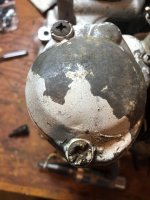
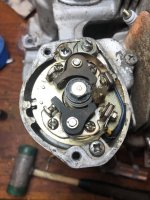
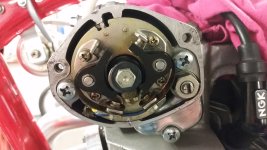
I wanted to send a shout out to @12ozPBR for the keys I got from him for 2 ignition switches and they worked perfectly so that is one check box taken care of. Been busy doing chores around the house but finally had a chance to make a little progress this afternoon. Started tearing the head apart taking pics and bagging the parts pleased to see that upon initial evaluation the cam lobes and bearing surfaces all look good. I did not find any spacers on the cams so I am going to have to make a note to check for end play. If anyone has suggestions on a poor man jig for that I would be happy to hear that advice. Fasteners were another story with a lot of use out of the impact driver although they reall were not that tight. Some of the screw heads had been modified for a flat tip screwdriver and one was obviously not the right screw being about 1/4 inch to short. I am happy they all came out though and I have went ahead and ordered all new OEM screws and bolts that I could for the engine covers and such. I also invested a small set of JIS bits and a T handle per @ancientdad's suggestion. I am also happy to see the points plate and advance looked to be in good shape although I could not find the correct size wrench/socket for the screw and nut where the wires attach to the points. A 5MM was too small and a 5.5MM was too big. Ended us using a 7/32 inch ignition wrench which fit well enough. Got to take the torsion bars apart and remove the valves so I can get a good look at the valve faces and the seats. I also took another look at the cam tensioner bolt holes and what I though was a helicoil coming out must have been JB Weld or something similar. All four holes are stripped out so I will have to see about installing some helicoils. That brings us up to date but I am tempted to veer off to see if I can get the dent out of the fuel tank this weekend. I picked up the Harbor Freight Crossbar Dent Repair Kit and wanted to give it a try. I will take pics and document the results. Have a great weekend everyone.IMG_4153.JPGIMG_4154.JPGIMG_4155.JPG
 
Judging by the condition of the screw heads, it's likely the tiny screws and nuts on the points are SAE and not metric at all. That engine looks like someone took it apart years ago, with whatever tools were lying around, and got stuck at some point and walked away, then put it together (sort of) when they were going to try and sell it. If you are lucky they didn't get too far into it, because they left a trail of destruction behind.
 
Judging by the condition of the screw heads, it's likely the tiny screws and nuts on the points are SAE and not metric at all.
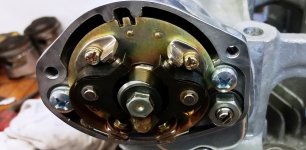
I can't disagree with your assessment of potential internal destruction surprises that may await, but those points plate screws look original to me. In one of the few instances I've seen, Honda chose to use combo cross-point (JIS) and straight screwdriver heads on points screws, possibly because they knew we would be using a flat (straight) screwdriver to make the tiny adjustments at the same time during points and timing settings. My NOS plate came with just what you see in that plate above.

NOS points plate.jpg
 
I can't disagree with your assessment of potential internal destruction surprises that may await, but those points plate screws look original to me. In one of the few instances I've seen, Honda chose to use combo cross-point (JIS) and straight screwdriver heads on points screws, possibly because they knew we would be using a flat (straight) screwdriver to make the tiny adjustments at the same time during points and timing settings. My NOS plate came with just what you see in that plate above.

View attachment 29915

Could you take a photo of the bolts that connect the wires to the points? Did they come assembled with the nut toward the outside or toward the inside? I've always been worried by how close they come to the inside of the cover and routinely put a piece of plastic electricians tape on the inside of the cover just to avoid any contact. It's likely a waste of time.
 
Could you take a photo of the bolts that connect the wires to the points? Did they come assembled with the nut toward the outside or toward the inside? I've always been worried by how close they come to the inside of the cover and routinely put a piece of plastic electricians tape on the inside of the cover just to avoid any contact. It's likely a waste of time.
20210915_141820.jpg

The assembled plate came with the nuts on the outside. With the points wire bolts and wire terminals arranged as they are in this picture, I've never had to insulate the cover against contact before. If anything, the springs are closer to those big-headed JIS screws I got from Motion Pro than anything else in terms of short risk.
 
Could you take a photo of the bolts that connect the wires to the points? Did they come assembled with the nut toward the outside or toward the inside? I've always been worried by how close they come to the inside of the cover and routinely put a piece of plastic electricians tape on the inside of the cover just to avoid any contact. It's likely a waste of time.
Thanks for the discussion and I will take it under advisement about the possibility that they used SAE screws. Thankfully they are good enough to use going forward and they felt fine when I un-tightened them. You can see the imperfections better in the photo where I noticed the corrosion on the point contacts for instance in the photo rather than naked eye (even with reading glasses). I ordered a number of different fasteners from Honda Parts Now which included new point screws, flat and lock washers, as well as all the other pan head screws for the cases and such. I also ordered the upper and lower case bolts that were available but most showed discontinued. Prices were reasonable and shipping actually went down as I ordered more items. Payed by Paypal just in case but looked like legit company.
 
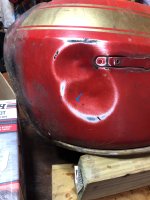
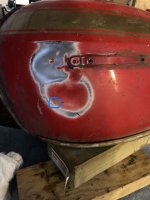
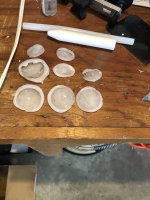
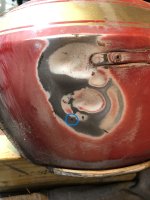
Finished tearing the head down and overall pleased with what I found with one exception. When removing the left exhaust valve after about a1/3 inch or so it stuck and had to be tapped out. Didn't take a lot of force but did not loosen up after working it back and forth a few times using WD40 to see if was carbon build up. I then tried the right exhaust valve as a comparison and it went in and out no problem so appears to be a bent valve stem to me but open to other ideas. At any rate with that exception it is ready to be cleaned up and determine if I need to have a valve job done. If anyone know a good machine shop they can recommend that handles vintage bikes in the Greensboro, Raleigh/Durham area of NC I would appreciate. I also need to take the cylinders and have them miked out for a 2nd opinion. Using my inexpensive mike and telescoping T handle set (not cheap) I was getting a reading of 2.765 thousandths on the left and 2.766 thousandths on the right. The book says bore when over 2.760. To mix things up a bit I did try to see if I could remove the dent in the gas tank using the glue kit from Harbor Freight. If someone has a shallow dent with no creases then the kit may work very well especially on newer machines with thinner metal. Also the glue that comes with the kit didn't stick that great, not sure if it was the old paint or what. I finally got some adhesion after cleaning with 90% rubbing alcohol and in combination with pushing from the inside using a long 3/8 extension I got it to pop the lower dent out a bit. Some reviews mentioned getting different glue sticks so I have ordered some and will see how that goes when they come in. I sanded around the dent so it would show up better to see if I was making any progress. Attaching some pics. The last image show the number of attempts before I got some success. :)

IMG_4162-1.jpgIMG_4161.JPGIMG_4169.JPGIMG_4167.JPG
 
Made some progress on pulling the dents but not as much as I hoped but certainly better. I will probably call it good and resort to body filler after cleaning varnish and rust out of the tank. Getting back to the engine now. IMG_4174-1.JPG
 
Engine update is that I took the cylinder and pistons from the engine from the bike to a local machinist who confirmed that both the cylinders and pistons are very worn requiring a bore and new pistons which is no surprise. I was gratified that he confirmed that the measurements I took of the cylinders were within a thousandth of his. From looking at his shop and some of his work I am impressed with both and will update when I have him do some work for me. His shop is Doug Duffy Motorsports in Gibsonville NC if anyone is looking. The wrist pins were both very worn as well with a noticeable edge when running a fingernail across them

My next step is to tear down the top end on the donor engine and see what shape that it is in. I know I will at least need to cannibalize one exhaust valve but depending on what I find I may use the whole top end or somewhere in between.. I am hoping to use the original crankcase so that the original engine number stays with the bike. Cheers.
 
Started to pull the head on the donor engine today and only got as far as pulling the valve covers and locating the master link on the cam chain on the intake side. I also pulled the cam chain tensioner and while looking it over wondered if there is a replacement for just the roller or is replacing the whole tensioner the only option if a replacement is needed. I also wanted to ask about the kick start and if there is a difference between the CB450 and the CL450 which is what the donor engine is. The CB kick start engages at about 10:00 o:clock and the CL engages at about 9:00 o:clock which seems pretty low to me. If it is not correct what could be the problem? Thanks.
 
...wondered if there is a replacement for just the roller or is replacing the whole tensioner the only option if a replacement is needed.
If you can't find a good used complete assembly there is an aftermarket replacement sprocket-style roller available from Cappellini. If your rubber roller is hard and/or starting to show cracks it needs to be replaced.
I also wanted to ask about the kick start and if there is a difference between the CB450 and the CL450 which is what the donor engine is. The CB kick start engages at about 10:00 o:clock and the CL engages at about 9:00 o:clock which seems pretty low to me. If it is not correct what could be the problem? Thanks.
Unless vastly different year engines, they should both be the same parts. If the kickstart lever position on the shaft is set a notch or two off it could start to engage at a lower angle.
 
If you can't find a good used complete assembly there is an aftermarket replacement sprocket-style roller available from Cappellini. If your rubber roller is hard and/or starting to show cracks it needs to be replaced.

Unless vastly different year engines, they should both be the same parts. If the kickstart lever position on the shaft is set a notch or two off it could start to engage at a lower angle.
Thanks for the info on the roller and I will compare the two tensioners I have and look them over. I will also have to compare the kick start levers on both bikes and see if the CL is set on the shaft lower or not.
 
There is a gear on the kickstart shaft, inside the crankcase, that engages with a gear in the transmission to turn the crankshaft. I had a CL175 that wouldn't engage until the lever was at 9 o'clock, and when I took the crankcase apart I saw that there were a couple of teeth missing on the gear on the kickstart shaft. Since that gear never turns more than half a turn I took everything apart, rotated the gear half a turn and put the kickstart shaft back together. Bingo! It worked fine. That might be your problem. Maybe. If I'm just plain wrong someone will point that out.
 
There is a gear on the kickstart shaft, inside the crankcase, that engages with a gear in the transmission to turn the crankshaft. I had a CL175 that wouldn't engage until the lever was at 9 o'clock, and when I took the crankcase apart I saw that there were a couple of teeth missing on the gear on the kickstart shaft. Since that gear never turns more than half a turn I took everything apart, rotated the gear half a turn and put the kick start shaft back together. Bingo! It worked fine. That might be your problem. Maybe. If I'm just plain wrong someone will point that out.
Thanks I love simple and inexpensive solutions to problems when possible. As this is the donor engine I am hoping it is not an issue I will need to deal with on the current build but anytime I see something like that it will start bugging me until I find a solution. Most of the bikes I rode back in the day that had kick starts were British, my BSA and a couple of friends with a Triumph and a Norton and the kick arms would engage at around 10:00 o:clock as I remember. I will need to disassemble that side to get the gear shift shaft assembly out at some point and I will investigate at that time.
 
Thanks I love simple and inexpensive solutions to problems when possible. As this is the donor engine I am hoping it is not an issue I will need to deal with on the current build but anytime I see something like that it will start bugging me until I find a solution. Most of the bikes I rode back in the day that had kick starts were British, my BSA and a couple of friends with a Triumph and a Norton and the kick arms would engage at around 10:00 o:clock as I remember. I will need to disassemble that side to get the gear shift shaft assembly out at some point and I will investigate at that time.
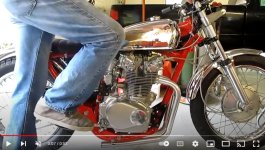
I remembered this morning that the question had come up before and I had taken a screenshot of where mine engages from one of my videos. Kickstart shaft removal requires a full bottom end disassembly.

450 kickstart position.jpg
 
I remembered this morning that the question had come up before and I had taken a screenshot of where mine engages from one of my videos. Kickstart shaft removal requires a full bottom end disassembly.

View attachment 30158
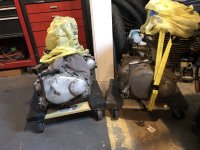
Went out to the garage and compared the two kick arms to each other when at rest and they are mounted on the shaft slightly different with the CB on the left's arm mounted slightly more forward. After looking at it I can see it would actually rub on the case where the CL is set a little further back and clears the case and it looks like it engages about where where it does in your picture. Critical observation is the key. Thanks once again for sharing.IMG_4180.JPG
 
Finally got some time to put in to the obsession I mean project and wanted to share some updates.

I received the the fasteners I ordered for the engine and darn it that pesky Shrinkflation has even hit Honda Parts Division! Haven't gone through everything yet but the acorn nuts for the head jumped out at me. It is a big difference going from a 17mm to a 14 mm head size although the new nut does thread on to the studs I would not feel comfortable using them. Ordered 94021-10000 but got 94021-10000-OS and looks like all that is available except NOS on Ebay. Appreciate any thoughts from anyone who has used them.
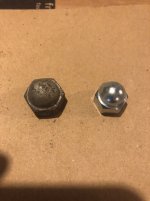
IMG_4182-1.jpg

Started by measuring the cam journals and caps from the engine I pulled out of the bike and have found the exhaust cam within specs and cam lobes look good. The intake cam right journal and cam lobes are are good as well but the left journal is worn pretty bad with the journal measuring 0.860 and the cap bearing ID at 0.868 and didn't get better no many how many times I measured darn it. I already need an exhaust valve (slightly bent stem) and now a intake cam and cap.

BTW I have a question about the cam chain damper O rings that goes on the cams. I have seen some chatter in the forum that they are bad to harden and break up. I can press an indent in the rubber and it will very slowly spring back. Are they just a noise reduction feature and if removed how much more noisy is it or do they limit wear on the cams? New ones are a bit pricey from $8 to $12 each dollars but I will get new ones if needed.

So it is time to get the head off the donor engine so I can see if I can get a good exhaust valve and intake cam. I was told this engine was was running when it was pulled but thankfully I take such things with a grain of salt. I had previously pulled the cam covers but had not really taken a good look as I was asked by the management i.e my wife to help with something else that day. Anyway i pulled the head and once I got it on the bench noted a couple of issues. Apparently the cam follower shafts had been pulled and then just stuck back in without the cam follower being installed on the intake cam as well as the tach drive side of the exhaust. The only reason the exhaust timing side was not pulled is the advance mechanism is frozen up and can't be removed. I have been using a heat gun and soaking in PB Blaster now to see if I can get it loose. Finally got the cam lobe and weights to start moving so I went ahead and removed so I can apply heat directly to the backing plate shaft.
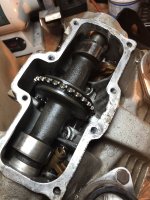
IMG_4185.JPG

On to measuring the intake cam from the donor engine and the journals are within spec although ones of the cam lobes has a small imperfection but I believe it is serviceable. I also was able to remove one of the exhaust valves and it seems to be in good shape I think I would have every thing I need except valve stem seals to start clean up of the head I intend to use and reassemble it.

There was also another small issue with the donor engine, take a look at the intake valve in the pic below, notice anything?
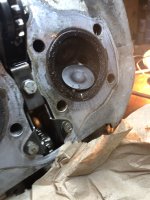
IMG_4186.JPG
This is what I got out. Not sure where the rest of the screw went but doesn't appear to be embedded in the top of the piston but I haven't cleaned the carbon up yet. Doesn't really matter as I am planning to have the original cylinders bored with new pistons.
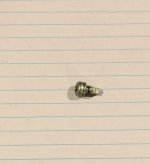
IMG_4188.JPG


BTW for everybody in the USA happy daylight savings. I do like having the extra daylight in the evening. Cheers.
 
Ordered 94021-10000 but got 94021-10000-OS and looks like all that is available except NOS on Ebay.
Had the same thing happen to me as described here. I ended up re-using the original 17mm cap nuts but had them re-plated with a bunch of other parts that I sent to the zinc plater
 
Had the same thing happen to me as described here. I ended up re-using the original 17mm cap nuts but had them re-plated with a bunch of other parts that I sent to the zinc plater
Agree, I wouldn't use the smaller replacements either considering the cylinder head torque involved and the large outer diameter washers used for the head. Getting the originals replated is the best way.
 
BTW I have a question about the cam chain damper O rings that goes on the cams. I have seen some chatter in the forum that they are bad to harden and break up. I can press an indent in the rubber and it will very slowly spring back. Are they just a noise reduction feature and if removed how much more noisy is it or do they limit wear on the cams? New ones are a bit pricey from $8 to $12 each dollars but I will get new ones if needed.
Totally not necessary, they were there to reduce noise and nothing more. If you replace them, eventually they will harden and crack, then come apart and end up in the bottom end. They never cause harm, but why spend the money. They're not in my 450 engine.
...although ones of the cam lobes has a small imperfection but I believe it is serviceable.
You should post pics of all cam lobes and followers from multiple angles so we can get a good look.
That does not look like a choke plate screw... wow, no wonder it was not running, intake valve stuck open and very possibly bent.
BTW for everybody in the USA happy daylight savings. I do like having the extra daylight in the evening. Cheers.

I'm a fan of DST, but not all are. Once our hot summers get here in Florida it stays light until almost 9 pm, lots more daylight to get stuff done when needed even though you sweat your ass off doing it. Or at least I do.
 
Totally not necessary, they were there to reduce noise and nothing more. If you replace them, eventually they will harden and crack, then come apart and end up in the bottom end. They never cause harm, but why spend the money. They're not in my 450 engine.

You should post pics of all cam lobes and followers from multiple angles so we can get a good look.

That does not look like a choke plate screw... wow, no wonder it was not running, intake valve stuck open and very possibly bent.

I'm a fan of DST, but not all are. Once our hot summers get here in Florida it stays light until almost 9 pm, lots more daylight to get stuff done when needed even though you sweat your ass off doing it. Or at least I do.
Thanks for the feedback and I will take pics of the cam lobes and post.
 
Thanks for the feedback and I will take pics of the cam lobes and post.
AND the followers. The exhaust followers typically have some 'dished' wear unless the PO was smart enough to properly warm up the engine to get oil flow to the top end before riding away.
 
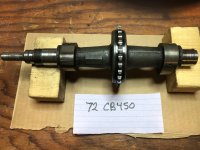
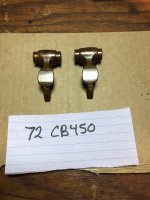
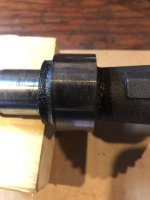
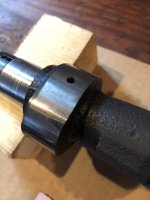
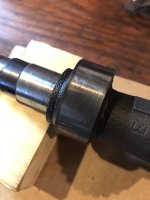
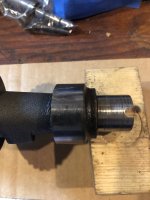
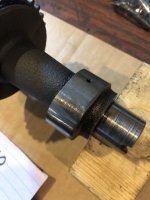
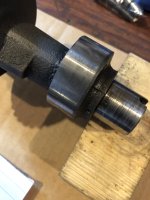
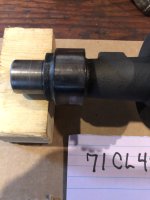
Posting some pics of the cams and followers. I am planning on using the intake cam from the donor CL450 and the exhaust from the CB450 that came in the bike. The intake cam from the CB450 has a journal worn outside the limits in the repair manual and I have not been able to pull the exhaust cam from the donor head as the advance backing plate refuses to come off the shaft on the end of the cam. They say don't ask a question if you can't stand the answer but I do appreciate your feedback.

Here are some shots of the intake cam from the donor and the followers from both the CL and the CB.


IMG_4222.JPGIMG_4216.JPGfrom the donor.


IMG_4212.JPGIMG_4213.JPGIMG_4214.JPGIMG_4215.JPG


Here some shots of the exhaust cam and followers from the CB450.

IMG_4223.JPGIMG_4224.JPGIMG_4225.JPGIMG_4226.JPGIMG_4227.JPG


After looking at the images I see that there is a lot of glare on the faces and I will take better images of them later. Thanks for looking and let me know what you think.
 
Last edited:
As you mentioned, not enough clarity due to glare and angle as well. For the followers, we need close-ups of top view at a slight angle and side views as well, can't see a dished pad surface from above. For the cam lobes basically the same, top view of the lobe from a slight angle so we can see actual lobe condition and close-ups of the lobe faces to see any wear or galling. However, overall so far the cams look pretty good. You'll need to use some heat on the exhaust cam that has the stuck advancer, and soak some penetrant down into the shaft to help it come loose. Use an allen wrench to get behind it for some leverage. Be careful with it so you can ultimately try to save it, these parts are harder to find than ever and a good advancer for a backup is valuable because even if you go to an electronic ignition, the simple EIs available currently still use the advancer..
 
As you mentioned, not enough clarity due to glare and angle as well. For the followers, we need close-ups of top view at a slight angle and side views as well, can't see a dished pad surface from above. For the cam lobes basically the same, top view of the lobe from a slight angle so we can see actual lobe condition and close-ups of the lobe faces to see any wear or galling. However, overall so far the cams look pretty good. You'll need to use some heat on the exhaust cam that has the stuck advancer, and soak some penetrant down into the shaft to help it come loose. Use an allen wrench to get behind it for some leverage. Be careful with it so you can ultimately try to save it, these parts are harder to find than ever and a good advancer for a backup is valuable because even if you go to an electronic ignition, the simple EIs available currently still use the advancer..
Thank you for taking a look and I will take some more pictures for better views of both the cams and followers. I am trying to keep the parts together i.e. left intake follower with the left intake cam lobe it came from but I assume mix and match if needed. I have been using PB Blaster and a heat gun on the advance shaft and prying with an allen wrench and an offset screwdriver and tapping with a plastic mallet all gently for about 3 days with no luck so far. I am thinking of using a propane torch but don't want to ruin the temper if that would be an issue. I am also considering ordering some Mouse Milk as others in the forum seem to think highly of it.
 
Thank you for taking a look and I will take some more pictures for better views of both the cams and followers. I am trying to keep the parts together i.e. left intake follower with the left intake cam lobe it came from but I assume mix and match if needed.
You can mix and match, the followers are all the same and the wear 'pattern' between lobe and follower isn't important.
I have been using PB Blaster and a heat gun on the advance shaft and prying with an allen wrench and an offset screwdriver and tapping with a plastic mallet all gently for about 3 days with no luck so far. I am thinking of using a propane torch but don't want to ruin the temper if that would be an issue. I am also considering ordering some Mouse Milk as others in the forum seem to think highly of it.
Many here use Kroil to help loosen stubborn stuff. There's no temper to be concerned about with propane torch-level heat, the worst that could happen is the advancer springs lose their tension and the seal behind the advancer gets melted, both of which can be replaced though the OEM advancer springs were never available separately. Many have bought and used XS650 advancer springs when necessary though I do not know how closely they compare to stock spring tension, but they do seem to work for those who've used them..
 
You can mix and match, the followers are all the same and the wear 'pattern' between lobe and follower isn't important.

Many here use Kroil to help loosen stubborn stuff. There's no temper to be concerned about with propane torch-level heat, the worst that could happen is the advancer springs lose their tension and the seal behind the advancer gets melted, both of which can be replaced though the OEM advancer springs were never available separately. Many have bought and used XS650 advancer springs when necessary though I do not know how closely they compare to stock spring tension, but they do seem to work for those who've used them..
I have disassembled the the advance unit to the backing plate so no heat on the springs and the mechanism need a good cleaning with scotch-brite anyways. I will try the torch later today.
 
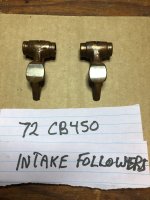
I took some more pictures of the cams and followers for your viewing pleasure. Posting images of the cams first. Hopefully they provide a little better definition.

IMG_4235.JPG


IMG_4236.JPGIMG_4237.JPGIMG_4238.JPGIMG_4239.JPGIMG_4240.JPGIMG_4245.JPGIMG_4246.JPGIMG_4247.JPGIMG_4248.JPGIMG_4249.JPGIMG_4250.JPG
 
Much better though some are still a bit out of focus. Overall everything looks pretty good, and if there is any noticeable wear it would seem to be in picture 1 and 6 of the followers but the other views of those two don't seem to show what it looks like from above. If there is any change is pad height, as in any 'dishing' wear at all, it will affect valve adjustment and will always make more tappet noise than it should. The cam lobes and follower pads can be cleaned up with a whetstone and light oil, but carefully as they lose material easily if you get aggressive. Most owners run them in worse shape and never realize it because they don't go into the top end of the engine and the wear areas of the follower pads are not visible when assembled. Since this is the only time you plan to go into the top end of the engine, getting things in the best shape they can be and strictly following the proper warmup procedure will make them last as long as possible.
 
Much better though some are still a bit out of focus. Overall everything looks pretty good, and if there is any noticeable wear it would seem to be in picture 1 and 6 of the followers but the other views of those two don't seem to show what it looks like from above. If there is any change is pad height, as in any 'dishing' wear at all, it will affect valve adjustment and will always make more tappet noise than it should. The cam lobes and follower pads can be cleaned up with a whetstone and light oil, but carefully as they lose material easily if you get aggressive. Most owners run them in worse shape and never realize it because they don't go into the top end of the engine and the wear areas of the follower pads are not visible when assembled. Since this is the only time you plan to go into the top end of the engine, getting things in the best shape they can be and strictly following the proper warmup procedure will make them last as long as possible.
Thanks for the feedback and I will take a close look at the followers as I have 4 extra although I think these are the best of the lot.
 
I have another question on the head and that is the advisability of having valves and seats ground. I have seen some chatter that this might not be advisable. Is there any reason to avoid have a good machinist do a valve job or is it better just lightly lap the valves?
 
I have another question on the head and that is the advisability of having valves and seats ground. I have seen some chatter that this might not be advisable. Is there any reason to avoid have a good machinist do a valve job or is it better just lightly lap the valves?
The valves have a thin stellite coating for hardness and you do not want to get them "ground". Having a good machinist who is familiar with motorcycle heads cut the seats is fine as long as they know the limits and don't cut the seats heavily and/or too deeply, I'm in the unenviable position of having a 450 head with valves seats cut too deep and fortunately it isn't planned for use on an engine I'll expect a lot of miles from. With a good job on the seats from a professional machinist and with new valves afterward, you wouldn't need to lap the valves. If you use your old valves they need to be in good condition, as in the seating surface not dished or pitted.
 
The valves have a thin stellite coating for hardness and you do not want to get them "ground". Having a good machinist who is familiar with motorcycle heads cut the seats is fine as long as they know the limits and don't cut the seats heavily and/or too deeply, I'm in the unenviable position of having a 450 head with valves seats cut too deep and fortunately it isn't planned for use on an engine I'll expect a lot of miles from. With a good job on the seats from a professional machinist and with new valves afterward, you wouldn't need to lap the valves. If you use your old valves they need to be in good condition, as in the seating surface not dished or pitted.
Thank you! That cleared up some mysteries for me. My main experience with valve jobs was in High school in auto shop doing 60's and older Chevy's Ford' and such.
 
Are the exhaust valves on the 450 K engines made of titanium? I noticed that the exhaust valves from both my 72 CB450 and the donor 71 CL450 are not magnetic although the intake valves are. I assume they are but wanted to get confirmation to satisfy my curiosity. Thanks.
 
I can't say they're titanium and really, I wouldn't have thought that Honda would put that level of additional expense in them back then, but I can also say I've never thought to try a magnet on any of the valves.
 
Are the exhaust valves on the 450 K engines made of titanium? I noticed that the exhaust valves from both my 72 CB450 and the donor 71 CL450 are not magnetic although the intake valves are. I assume they are but wanted to get confirmation to satisfy my curiosity. Thanks.
More likely a non-magnetic stainless steel. Titanium is extremely expensive in comparison
 
Thanks for your feedback on this. I think I picked up the magnet thing from my auto shop teacher in high school who used a magnet to lift the valve out of the seat without reaching and pushing from the other side of the head. Not a big deal on a motorcycle head but on some old straight 6 or V-8 heads it can save some extra steps. Anyway more of Huh moment when the magnet didn't stick for me. After a quick read about titanium valves being lighter I think @LongDistanceRider is probably is correct that they are a non-magnetic stainless as they seem to be about the same weight as the intake valves using my calibrated elbow scale. Not being metallurgist I resorted to Google and to quote the top result "Exhaust valves are commonly an austenitic stainless steel, called “Sil1,” which is non -magnetic" so it appears to be pretty common and I had just never run into it before. Thanks again.
 
Back
Top Bottom