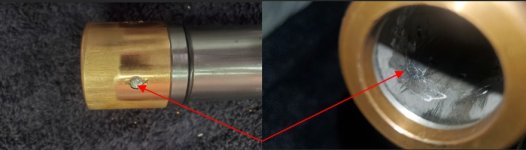
1961 CB72 The Long and Winding Road

Pridanc

Well-known Member
Joined
Dec 4, 2020
Total Posts
88
Total likes
33
Location
LIBERTY HILL, TX, USA
# 0 (long before the real storm)

I've been promising Ancient Dad that I'd start a thread describing my Long and Winding Road trip from beginning to end of restoring a 1961 CB72 (ty Beatles)

Having never touched one, it has been a blast and no doubt will be until the last bolt is tightened and the first ride taken under its own power.

Before I get too far I must thank everyone I've encountered along the way. To a person you've been a great help as clearly without your input I'd be stuck (even if I did take a trip to the Barber museum for a few million pictures of a CB77 as a start). The Vintage Honda Twins forum has been a remarkable place to spend educating oneself not to mention the help I've received from William Silver and another gent who I happily call a friend, Tim Miller.

Some background on this project: A buddy asked me to breath life into his "special" CB72 and since I already do this for myself with other bikes, bikes I'd had growing up days and others that I wanted back then but had missed, I said sure. I was truly delighted to accept his request with one caveat. At no time could he ever talk about how long it is taking. To me, it is yet another lovely project amongst many with each getting some love and attention as each project starts and stops for all the reasons they do. You know, like parts arriving, parts being restored so on and so forth. Oh, and it was to be what I call a "drive by" resto which to me is a mechanically perfect machine but not so pretty. Patina still there etc. Part way into the deal the owner changed his mind and wanted the full Monty.

When I received the bike, I was told it was special but as the ignorant fool I am, I thought "yea sure", this bike is just a modified CB that some enthusiastic young person made to be his own. Well that was the case until I started digging into it!

I found that in the era this bike was made in a man going by the name of Pops Yoshimura, who was racing Hondas at the time, actually had parts made for this bike. From what I've learned, or have been told, you could get a bike converted fully to his spec called a CYB72 (the Y is for Yoshimura) or you could rock up to your Honda dealer and buy the kit or any part there of to convert your own bike.

Long story short, this bike has some bits and reflections of Pops with some even more interesting items inside the engine. I've no idea if the engine bits were from Pops or that he did or did not touch this machine himself but there is no question he may have. So no claims from me, but sure adds to the excitement.

Along the way I even tracked down the folks (a dealer) who took care of this bike for the original owner until he passed and then my buddy purchased it. The dealer told me the bike was never modded by them further adding to the intrigue. No claims here, just kind of cool IMO.

And here we are. Once done with the project I will share the trip with y'all in much greater detail as it is/has been great fun.

To wet your appetite, here are a scant few pictures as a tease.

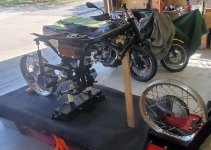
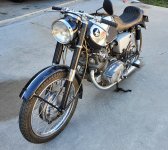
When the bike got to me.
20201206_111233.jpg


Between then and now, ever piece and part has been dismantled and messed with one way or another as would happen in any resto. I actually prefer varying brand bikes to tackle even if you get slowed way down from the shear lack of knowledge. As I'd no idea what the finite details of a correct CB72 were meant to look like, what parts were there or missing, these pictures just below are of me finger assembling the bike first before final assembly. Doing so allows me to create a "final" list for bits that I need or bits I forgot to send out for plating etc. I do like Swiss cheese but when your brain starts to look the same? There will be issues.

As a tease, ya can't expect visible, clear, light corrected pictures right? I promise the final pictures for this road trip will be and without background "noise" too.
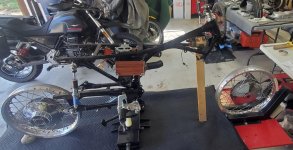
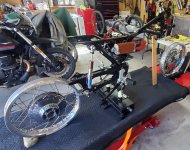
Side View tease.jpg3.4 right rear tease.jpg3.4 right front tease.jpg

The engine is ready for assembly as well so I am getting there.
Thanks for stopping by and I look forward to adding to this more soon enough.
 
Last edited:
After all that buildup, you better post a pile of pictures... :) definitely an interesting piece to work with, the 72 models were pretty rare in the US, at least in my part of it. Looking back, the CA72 I had at age 15 was more rare than I even understood at the time.
 
Quite a unique project. I liked that term 'drive by' and have heard 'sympathetic' used also for a patina retained resto. Either way, I'm looking forward to comments and observations on this old ride.
 
#1
OK, I've been threatening to post some words about the wonderful luck I fell into when asked by a friend to resurrect his 1961 CB72. You know, the baby Hawk.

It has been one heck of a journey filled with intrigue, heartache, and joy. (OK, that seems a bit dramatic huh?) If bored, follow along and ask questions. I'm happy to answer best I can. And yes, if I'd had any inkling I would share this, this photo would have been nicer.

Not being a writer means jotting all this down hasn't been easy as I think and talk oddly so the not easy part pertains to wanting the story to make sense. Nonetheless I couldn't pass up sharing the journey with others hoping to convince even one more person to do the same. I promise you, it is worth it. However, there is one thing we need to agree on now. As I told my friend who brought the bike to me for the resurrection , if I hear anyone taping their fingers on the table about the time it takes for me to post the next bit, you are Fired! Completely out of my will. Got it? 20201206_113257.jpg
 
Last edited:
#2
Baby steps and yes there are lots of pictures. Just not yet, and I know...I'm so nice. Note too, that the first few words here may be seen as covering ground already covered way above but here we go.
This journey has been beyond fantastic. Personally, I won’t say that I will ever do this kind of thing again but, this has provided me with irreplaceable memories and am beyond grateful I was afforded the opportunity to bring this CB72 back to an earlier time. I will not say back to life as it purportedly ran before I got it although I am not real sure for reasons to be seen below.

Once the owner dropped the bike off and I started to dismantle it, the ball was quickly in play. To my surprise, several months later my friend decided this should be a full-on restoration. (Play the sound of tires screeching) Wait, wut? I did not realize the long-term repercussions this mid-stream change-up would bring about. Nothing insurmountable mind you, but certainly a speed bump. Most of the difficulties were because, at that time, I did not see all that could or would be affected by this change.

Steps/parts I had completed and put away awaiting their turn to be bolted back on came back to haunt me. Mentally these parts had been dealt with but once I pulled them out for use, it was obvious that they did not meet the full restoration criteria. OK, no doubt some of this is age and poor memory but I will strongly suggest you make much more comprehensive lists than I did so that you can avoid some of my pitfalls.

My point is this: Do your level best to make-a-plan and now sleep on that thought. Mull it over for a few days and make any changes deemed necessary, then move forward with that plan. Though significant change along the way is possible it can really interrupt flow and add a bunch to the time it can take to get it done.
 
Last edited:
#3
Some folks ask me why I say I’ll likely never do another early motorbike. Fair question and I will admit that in this case, as it could be with many old machine, early Japanese motorbikes have some odd nuts, bolts, and screws not found on more modern bikes. The early JIS dimensions (Japanese Industrial Specification) had some odd thread pitches, head sizes and markings when compared to a metric bolt used today. If memory serves, JIS changed in 1967 so that these fasteners would be interchangeable worldwide.

For example, there were no markings on any bolt head, some bolt heads are a different height and use a different spanner size than that we are accustomed to today on a similar bolt size. Did I mention there were some odd thread pitches used that don’t exist today although admittedly, not sure any of the odd thread pitch was found here by me. That’s not a yay or nay, I’m just making a point about old JIS hardware.

This means that at almost no time can you simply ring up your favorite hardware supplier and order what you need. Although hardware like this can be found, it isn’t always easy to find. Consequently, you spend lots of time resurrecting old bolts. Either the ones you have or ones you can purchase from another dismantler online as an example.

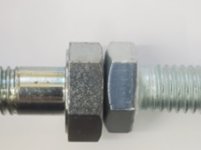
The picture below may not be a particularly good example, but you get the idea. Old vs. new. Not terribly clear here, but the shank is the same diameter but the head? Worlds apart.

Size Diff.jpg
 
Last edited:
#4
None of this would have been an issue if I had continued down the drive-by resto path as appearance did not matter so there was no need to worry about bolts etc. However, when the project became a full-on restoration, life changed dramatically.

I did my best to restore many of the fasteners by filing, sanding, re-plating them etc., but so many were beyond salvage or simply, as I looked around, the wrong fastener for the place on the bike and at times hard to fathom this hadn’t been an issue. This forced me to spend time researching the correct size fastener and then search again just to find them. Having never done any early Hondas before, I had absolutely no idea what any part of this was really meant to look like. This is a good time to mention that the parts book typically lists the bolt/fastener dimensions which helps a great deal IMO.

I was gifted what I call friends in high places so I always had something to fall back on! Many folks have taken this same journey so don’t let my words make you think it is so hard you shouldn’t make the journey, but accept that the trip can be a doggone PITA. The clean version of “it is a PITA project” is a "its a Pretty Interesting Traipse Around a seemingly never ending project." See? A PITA.

Lastly, the farther I got into it, the more I learned that Honda varied part specs every “several hundred” units back in the day and admittedly this is just me trying to make a point as I have no hard facts here beyond my own eyes seeing things on this bike, other bikes, and other ppl’s thoughts shared with me.

Think about it. As Honda was rapidly growing, suppliers made bits that fit specifications that Honda required at that time. I'd guess too that On Time Delivery was becoming a part of the equation as Honda was growing exponentially. There’s no question the various supplier’s parts were different from other suppliers of the same part in one way or another in these early days best I've seen. Trying to determine what parts on my bike were from the factory vs. some fool like me making something fit just to get on down the road, had its moments.

Regardless I found this to be a great part of the joy in the process. And I’d be the last to claim I have it right. Truth is, my learning feels that it would be hard to claim that all the parts are now as delivered in ‘61 with 100% accuracy.
 
Last edited:
#5
Through my overly lengthy description of this CB’s resurrection, at no time is anyone to take my words as anything more than a this is how I did it as we all know there are a 1000 ways to skin a cat. I’ll be the first to admit that when I see another way to do something that is both less time consuming and produces a result that is as good as or better than, and equally safe (if applicable) than that I just accomplished, I take the newly discovered way and run with it. I do not have any problem with being shown/taught other methods. Truth is, that is exactly why I do this. The education.

Another issue was one of over restoring. The owner, and others who have helped me, know this idea has caused me great angst. Bottom line, each of us has our own end-result pictured so who am I to question other’s choice over that which I made? No matter what any of us do, the bike will never be exactly as it rolled off the line back in the day so I had to get over it.

The owner really wanted to keep the original Honda supplied Yoshimura factory seat without regard to how it looked even though I found a NOS one in a box along the way. I’d guess the seat remains because of the memories but never asked, so I can’t say. I’ve also kept the Yoshimura look-alike “racing megaphones” pipes that are mufflers. As these are not perfect, but close, I looked for a new pair but alas as best I can tell, the original mfg. of these is long gone.

Now that there was a theme, I tried very hard to use original bits and pieces without going overboard. Other than a few places you can see that the bike has lived a life, literally, everything I touched was first looked at for salvation before replacement with NOS if at all possible. Attempting salvation of parts added ages to the job but the end has come.
 
Last edited:
#6
I have owned Japanese bikes from the 60’s on into the 70’s and 80’s and, at least on the bikes I owned, there was never a perfect polish job on anything. When new, did the parts on my early bikes look great and have a tremendous shine? You bet, but up close you could clearly see polishing marks etc., which is common when shining something quickly under a time frame as would happen in early forms of mass production for example.

I have decided to call these early attempts at a good polishing shine the “Good Enough” method. I am not complaining at all just pointing out my own struggles with over-polishing (my opinion of) when looking back to how the parts were originally produced which frankly, and based on my limited experience and knowledge, over-polishing is almost impossible not to do! Thus, I also called the polishing I did the same, Good Enough, which was the best line I could draw mentally to stop myself before bringing the parts to a perfect mirror polish. Of course, my good-enough is easier and less time consuming than a mirror polish job but we will not go down that path now, will we?

And finally, I must mention that in my quest for parts and answers, I met some fantastic folks and retailers along the way and without whom I would never have been able to complete the task. Not in a million years.

  • Tim Miller (the everything man who I would argue strongly should have restored this bike but then I would miss out on all the fun so that was not happening) Master welder, machinist, fabricator etc., etc. Restores these old things right here in Texas! A blessing to all of us. [email protected]
  • William Silver. AKA Mr. Honda. Bill has endless knowledge and his information package is priceless. You are making a mistake not to buy his info from him. IMO of course!
  • PopsHonda (Ebay Store for parts)
  • David Silver Spares https://www.davidsilverspares.com
  • CMSNL (parts) https://www.cmsnl.com/
  • Honda Classics (UK) https://www.honda-classics.co.uk
  • NOS Parts Now (also an Ebay store)
  • Violet Crown Refinishing (paint work in Austin Tx)
  • KG Industries LLC (gun kote product on engine case covers)
  • Heidenau Tires (there are lots of choices out there but these guys have old looking but new tires and at reasonable prices)
  • e3steve (online forum name is the only one I’ve got) for his colored wiring diagrams. A godsend to this old “blind” guy. This bikes harness is slightly different and that will be shared.
  • Clauss Studios. Beyond fantastic and helpful. https://www.claussstudios.com/index.html
  • There are bound to be other suppliers I've used and fingers crossed I remember and list them as they come to mind as it is because of them that this bike completed the journey.
 
Last edited:
#7
Jumping right on in.

In hind sight, I should have taken more time to document what bolts came out of where on the bike and compared my list against what the bolts should be against the OE parts book. The parts book was a tremendous help but was not always accurate/correct. Not sure I have ever seen a perfect parts book but the good thing was that most of the type-o’s were easy to spot as you thumbed through the information so coming up with the right length and diameter bolt was simple enough.

Of course, the first thing you do is to strip the bike to the frame. Make sure you take copious pictures which I thought I was doing but can tell you for some crazy reason, I did not take any pictures of the frame under the tank just after removing the tank. Lacking these pics was not a show stopper but having to find the info elsewhere adds to the research/reassembly time. You have been warned. There are never enough pictures IMO.

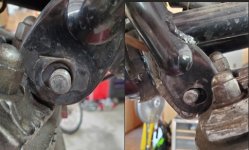
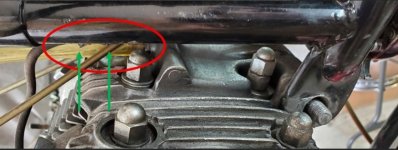
As I pulled the bike apart, I did not notice much other than some ugly wires needing tidying up and a very distorted front upper engine frame mount. I have seen things wear over time but I was not understanding how so much damage to the mount was possible. Loose bolt over a long time? Let us not forget that the engine in this bike is a stressed member so by definition is the down tube relying heavily on the mounting bolts to be secure. These holes are huge relative
the bolt.

.Bolt Waller.jpg
 
Last edited:
#8
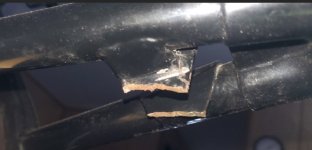
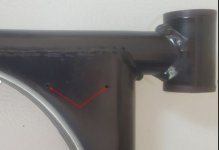
Still scratching my head over these enlarged holes and as I was pulling the engine out of the chassis, I noticed something cut from the frame. I couldn’t see what these cuts were for as there was nothing missing as best I could tell at the time. Don’t forget, the CB was all new to me. Once I could take a hard look at the parts list I saw that the cuts had been engine mounting tabs/ears on the chassis that had originally been the rear-upper engine to frame mount. Yes, the CB72 was designed for a pair of upper mounts for two upper bolt connections to the chassis. This was odd and no way did I understand why this had happened. Original owner had passed and took this knowledge with him.

This is a poor picture but then, I never got a great one. Remember my suggestion to take endless pictures? You can toss the ones you do not need but you can’t find ones that do not exist right?First Cut.jpgSecond Cut.jpg
 
Last edited:
#9
Along the way I learned that the cylinder head cover that was on this bike as I received it, is not the correct cylinder head cover for the CB. Perhaps the CL, but I never asked. The correct cover has another bolt-boss cast in roughly where the arrow is pointing to the cut off bits from the chassis which are meant to be the second engine mount tabs on the frame. Look at the picture above, and then scroll down and you will see the correct cover with the added “lug” cast in. See? I may be slow, but I am trainable.

As the days and months went by, and as I gained greater knowledge of the bike, I realized that the bike had been down on not one, but both sides at some time in its life so perhaps during one of those oopsies, the aluminum cylinder head mount was damaged and replaced with one from a CL scrambler of the era? Um, why? Parts were most likely available back then so what gives? Lord knows and if this frame could only talk?

It became prudent to measure the frame for straightness and in doing so I found no bends or kinks so decided to keep the frame choosing to remove the old now cut-off earless tabs and replace them. I found a trashed CB chassis with the needed tabs so I removed the complete tabs from the old trash, reassembled the external engine bits of the engine (crankcase, cylinders, head, upper cylinder mount) to place back in the frame as a jig to hold the tabs in place prior to welding them where they belonged. Do not forget that we repaired the enlarged front mount holes at the same time.
 
Last edited:
#10
Once done with replacing the brackets I felt the holes in them were not as tight a fit as I felt they should be, so I made some bushes to tighten the hole size to fit this upper rear engine mount bolt without any slop. As in none. In hind sight we should have checked fitment and welded the holes up before adding them to the frame but hindsight is perfect and as we've discussed, that cat can be skinned in oh so many ways.

Shimed hole.jpg
 
Last edited:
#11
At this time if needed I would have replaced the steering head bearings and races but somewhere in this bike's life, the OE ball bearings had been replaced with a tapered roller set-up which was without glitch so I left them after a clean and re-grease and moved on. Now that the chassis was whole, I had it powder coated and set it aside.

Swing arm:

The OE phenolic (or Bakelite?) bushes were toast so I replaced them with aftermarket bronze bushes along with new OE collars (the part that rotates in the bushing) which was easy to do beyond a few minutes spent helping the parts become friendly with each other so they’d rotate easily together.

At the same time the lower rear shock mount rubber bushings were replaced. The original ones were in such poor condition that the bolt hole was no longer in the middle as the bush’s rubber was severely cracked and used up.

Staying with our theme of saving parts and finishes that were still acceptable, the rear swing arm did not need to be repainted/powder coated though there was a little paint touch up needed where the chain slaps the arm close to the pivot of the arm and chassis.

It was about this time that the two small bolt holes seen on the upper left side of the swing arm (when looking down onto the top of the arm) near the arms pivot had me thinking overtime. What the heck went here? Yet another mystery to solve.
Swing Arm Tag Holes.jpg
 
Last edited:
#12
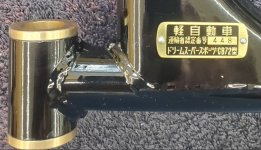
After digging a bit, I discovered that the CB72 was permitted some sort of tax break in some countries to help folks buy them and this area of the swing arm is where the “tax stamp” was attached.

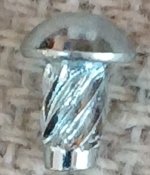
In my case, and as far as I can tell with all the early-ish CB-72’s, the stamp was a riveted-on metal plaque which in later years became a stick-on printed thing. The word rivet here is a bit of a misnomer as these things which also hold on the electric start’s plaque are really what's called a drive screw, also known as a U-drive screw or hammer drive screw. This is a round-headed, unslotted self-tapping fastener that is installed by hammering rather than turning. Yuup, I’ve never heard of this. On this bike they are tiny, as in >7mm top to bottom. Here is a picture.
Hammer Screw.jpg
Looking below you’ll see that the Left picture is a rivet-on early plaque as this bike would have. But of course, it is NLA (no-longer-available.) OK, I did find a couple but they were awful IMO so I am back claiming NLA! On the right is the green stick-on stamp found on later bikes.
Tax man commeth.jpg
 
Last edited:
#13
The metal reproduction plaque done for this project mounted on this bike’s swing arm with those odd hammer-screws. The plaque is dimensionally 100% the original. And notice the new swing arm bushings as well? As previously mentioned the swing arms come with phenolic bushings (Bakelite perhaps?) but these aftermarket bronze bushes are far more robust. Admittedly this new plaque is not OE but certainly better than either of the well worn unsalvageable (to me) plates so this is a deviation that was worth it IMO.

And whilst looking, please note those bronze swing arm bushes. And too, that this swing arm is the original paint.

Racing to pay the Tax Man.jpg
 
Last edited:
Great work and attention to detail. I am surprised that the paint is in such good condition. The swing arm looks like it just got back from powder coating.
 
boddy,
This was one of only three parts that snuck through without any repainting. Not seen here is where the chain rubbed on the other side of the arm which will get damaged again so I touched it up knowing that area is doomed. The other two parts were 1) the tool box, and 2) the headlight nacelle. Thanks for asking.
 
#14
Rear Shocks

Since I was at the back of the chassis, why not attack the rear shocks? Both had a huge dead spot when cycling them through their motion. Having done shocks for years (car racing silliness) I already knew the common reason why this would be but still wanted a look-see not to mention it behooves you to open them, clean them up, and add fresh oil to them.

Ironically, a friend was curious about these shocks and how they functioned not to mention he wondered if we could make the shocks work better. I will say one thing about “work better” as that is a very complex pair of words. I’ve been messing with shocks for years and promise you that each of us want different behavior. Happily, in this case greater control was all my friend was looking for. As he is a quick study and these shocks dead simple, this took no time. I’m amazed at the state of shock development already on this CB 72 even if I say that ignorantly as I’ve no idea what was truly state of the art from back in the day but nonetheless, I was impressed.

I've done a "how does it work" drawing for a CL (didn't have my early CB shocks apart at the time so borrowed a dismantled shock from a friend to help him wrap his head around their function). I now know that Honda changed these ever so often and too, my shocks are a tiny bit different than these, but basic function is the same. My guess is for the valving but truth be told, could simply be easier lest costly way to build them. I. Do. Not. Know. If I figure out how to include those drawings on the forum, I will do so sooner than later.

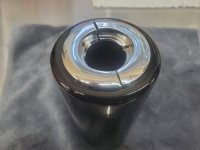
Before you can even touch the bare shock body, you must take the spring covers off. The upper cover is painted the overriding color of the bike, black in my case, and considerably thicker than the polished lower part. I'm nut sure but it is my impression that the lower covers on these early bikes are relatively rare, and are wafer thin, aluminum covers. I have some Reynolds wrap that is thicker! If memory serves, these lower covers were changed out in later years to something more robust. But lest we forget, robust is also synonymous with heavier. Removing them this is simple enough as they are held together with a pair of split collars. Getting them off poses a different problem however.

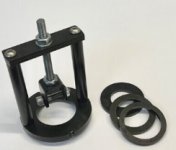
Oddly, I have several different spring compressors but because Honda covers the springs with these shiny enclosures, none of my tools would work. Thus the obvious choice for me was to use a 20 ton press. Carefully. In hind sight I could have purchased this tool from Honda Classics in the UK
Rear Shock Spring compressor.jpg 20231122_123900.jpg The tool on the left compresses the spring by depressing the black outer cover down and away from the split collars.

The only reason I did not purchase the tool was for the simple fact that I’ll bet I’ll never need this style again. However, in hindsight I feel the buck$ would have been well spent to alleviate the angst of using a press without the potential damage to the wafer thin covers. You'll hear me say it often but I am trainable.

Once compressed enough, say 10mm or so, the split collars can be lifted out. Once the split collars are out the cover comes off along with the actual suspension spring. The spring sits on the shiny lower cover leaving you the bare shock! Now you are off and running!

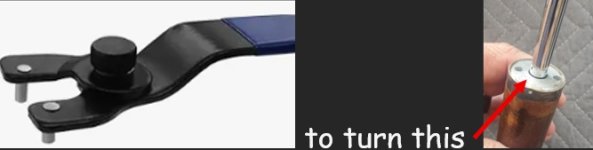
Maybe I got too excited because you still need on last odd-ball tool, commonly referred to as a pin-spanner tool, to open the shock. If you don't have one or wish to purchase one, these are easy to make if you have some metal bits laying around. Unfortunately, I use this tool often enough to have one in my tool box.
Doing the splits.jpg
 
Last edited:
#15
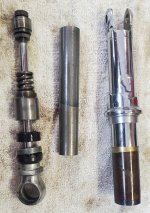
Shockingly simple... moving on, be ready for a mess as the shock body is full of oil. Clamp the shock's lower mounting eye, on this bike this eye is part of the shock body, into a vice, and take the pin-spanner tool and unscrew the cap and carefuly, so as to not make a giant mess, pull the shaft / guts out. The tube you see in the middle of the picture is the "double wall".
Ya Got this now.jpg
As an FYI, If you don't see an external reservoir on a shock, then the shock is a double wall or twin-tube, as is this Honda shock. By far and away the most common construction out there. . As the shock shaft goes into the body, compressing as you hit a bump for example, the shock shaft is displacing oil and that pesky stuff has to go somewhere.

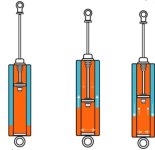
These simple pictures might help explain / show how the double wall does its job better than simple words.

Shocking discovery.jpg
Left piston is stationary. You can see the level of the oil in the Double wall which is the outermost two short columns of orange.
Center shock is going into compression. As the shock shaft moves into the body, notice that those two outer orange columns are rising due to the shaft displacing additional oil
Right shock is moving into rebound and getting longer. As the shaft moves back out of the body, oil is pulled back into the main part of the body as the shaft exits the top of the body.

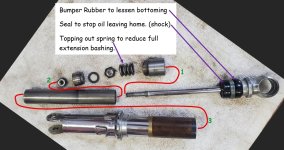
Before getting too deep here, go back up and look at the top picture of the shock in 3 pieces. The far right part is the main body and obviously is chrome. However you'll note the lower part (in the picture) has some brown funk on it and best I can determine, it is there to keep the spring from slapping or scraping on the body as it grows and shrinks over bumps. Since my shock body's chrome was in good shape, I didn't have to consider how to replace the "funk" after re-chroming! Proof that being lucky so often displaces good. I've not really thought about a replacement and wont ever because moving forward I'll never see this again. I'm sure there is a myriad of products you could apply to the body to achieve the same result.
 
Last edited:
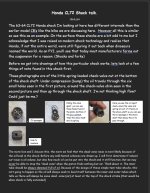
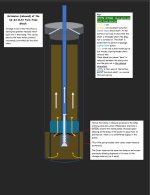
How the CB/CL shock controls the oil to dampen the thing. I tried as a PDF with no luck but will try as three pictures back to back. OK this worked. This is fun, but not the bike journey. Along the way ya get distracted. This was one of those times. This is something I did a few years ago to a friend so forgive the odd discussions that I missed before posting. I may fix it but for now, pretend it is your name!

Pic # 1 of 3
Shock Talk 1.jpg
 
Last edited:
That was interesting to learn about the CB77 shocks. I can see that your shocks and internals were in very good shape. If you had needed a seal, spring or valve, I am guessing you would have to scavenge the parts from another shock since I've never seen the internals offered by Honda.
 
That was interesting to learn about the CB77 shocks. I can see that your shocks and internals were in very good shape. If you had needed a seal, spring or valve, I am guessing you would have to scavenge the parts from another shock since I've never seen the internals offered by Honda.
boddy, next few posts show my bikes shocks apart but yes they are good. These are so simple there isn't much to go wrong but yes, I'd find other shocks to take parts from. IMO, the only part that might be a issue is the seal. I replaced one. I feel I could print one or get Claussstudios to make some. All the best.
 
#16 More shock stuff.
Some words here may be redundant but I'm playing the "old man" card. Part of reaching the later stages of ones life is the right to be forgetful.

Moving on:
If you go back to post #15 to look at the picture of the recently opened shock, these words might make sense. From the left, we have the shock rod with the inner workings of seals, piston and bottom out spring. Next, you will find the inner-tube that the shock piston rides directly in-on, and finally the outer chromed shock body. If you recall, we discussed the double wall stuff above but will touch on it again briefly here.

Considered a double-wall shock which happens to be the most common shock construction today. As there is no remote reservoir the double wall gives a place for the displaced oil to go as the piston shaft moves into the shock body. Higher performance shocks typically have a single body with a remote reservoir to capture the displaced oil. Another way to deal with the oil displacement.

Notice the odd brown-ish stuff (the funk) on the shock body? The body is the shiny chrome piece on the right side of the picture? This brown stuff is on the lower part of the body in this picture. Best I can tell this is an anti-scuff resin-like material (I’ve no clue what it is) therefore I will guess two reasons for its existence. 1) to stop scrapping of the spring on the body which also 2) keeps the scraping noise from our sensitive ears as the suspension cycles. IMO an open exhaust would achieve the same. But as a hooligan, I digress.

Having dismantled both of these, and now see how simple they are, I’m not 100% sure you need to dismantle any more of the shock valving etc. from the shaft but if you make that choice, that too is easy. The important part is to keep track of how it came apart. Photo everything. Before, during and when done. As I dismantle something I've never touched, like this Honda shock, I pull it apart and lay it out as it comes apart.
Internals.jpg

One part after another in the same order each piece came out of the body and off the shaft. Clearly I could have taken a better picture, however you can see that the shaft goes into the bits in this order (line #1) Once those bits are on the shaft you tighten the nut, seen next to the number 2 above, onto the shaft. It direction is critical so put it back on the same as it came off. Next is that greyish tube can be slid over the bits on the shaft (#2) but I found that with the chrome body in the vice standing upright with its opening at the top, placing the tube into the chrome body first before placing the shaft and bits into it was easier. Now you do the oil dance (oil fill procedure below) prior to tightening down the "nut" seen between the two rubber parts far right above into the shock body. (#3) This "nut" is the part that you had to use the Pin Tool for mentioned above.

Now before you make the determination to completely dismantle the bits off the shaft, answer one question. Was it leaking oil? If not there is no particular need to take it completely apart but you do need to put in the right amount of new, fresh shock oil no matter what. So start by cleaning the heck out of the shock valve / bits and shaft. Now reinstall the clean piston and shaft all the way the bottom of the shock body, pour some shock oil into until full, and then carefully stroke it. I mean literally full with the piston/shaft fully compressed leaving just enough room to screw the shock’s cap back on. Best to leave a bit too much oil and to let it dribble out as you tighten the cap back on. Try for zero air trapped but a tiny bit wont’ hurt for our use here, but I promise, this isn’t hard to achieve.

If memory serves:
  • Fill with oil: Pour the fresh oil directly into the open damper body/tube. Fill it most of the way—enough to submerge the piston when inserted, but leave some headspace to avoid hydraulic lock or excessive pressure on assembly.
  • Insert the piston/rod and bleed air: So slowly insert the damper rod/piston while gently pumping it up and down (short strokes) to work the oil through and purge trapped air. Keep the unit as vertical as you can. When I assembled lots of shocks back-in-the-day, I actually had a cup that slid over the shock body with a rubber seal to catch the oil you pushed out getting the piston and shaft back in. Life was grand and much cleaner. Any way, you may need to top up oil a bit as it displaces and any air escapes. The goal is full oil with minimal/no air bubbles for smooth action.
  • Reassemble the rest: Once bled and at the right level (often slightly overfilled then with the shock fully compressed so that all the shaft is in the body too. Try to pretend this isn't messy), now reinstall the "nut" using your Pin Tool. Now test compression/extension by hand—it should feel controlled and smooth without harshness or free play. As an FYI, my shocks had large dead-spots when changing shaft direction. Very common and almost always because there is too little oil. I said almost! BTW, both shocks should feel the same. Well, as close as our calibrated arms can come.
I tried several weight oils before I settled on 15wt shock oil but YMMV (your mileage may vary). We aren't racing so your feel is what this is all about. Good shocks help the spring absorb bumps, but also control the rebound (release of the shock springs energy) hopefully eliminating a pogo feel.

As mentioned, if the bits look good, clean nicely and the seal is OK, then you are probably OK without complete disassembly. If after assembly with new oil they feel funky, complete disassembly is in the works to see why the shocks differ. Since I have done endless shocks, my choice for a complete disassembly was one of personal curiosity and education as well as what the heck, why not?

More to come.
 
#17
If needed, further disassembly:

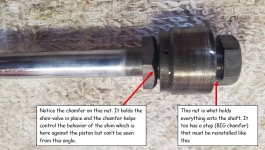
Unscrew the nut at the bottom of the shaft and the piston with valving shim comes right off. I have a clamp for shafts so breaking the nut loose was cake. As can be seen, the piston and valve are dead simple but IMO very cool considering the age of these parts.
bits are bits.jpg Top Hats.jpg

A keen eye will notice that the shaft’s nuts (either side of the piston in the pics above) have important chamfers on them so need to go back on the shaft in the same position seen.

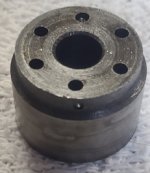
There is only one valve shim and a pair of bypass holes. These are holes that permit oil to bypass the valve when closed (valve looks like a thin washer in these pictures) The two bypass holes I speak of are in the (roughly) twelve o’clock and 6 o’clock holes seen on the face of the piston below. They exit to the outer surface of the piston. Look closely at this picture below. At the 12 o'clock and 6 o'clock holes seen on the top surface, notice some extra light. That is where the bypass holes are which allow oil to "bypass" the valve shim.
Detroit Piston.jpg
When the piston is moving up in the tube (shock is extending after a bump for example) the thin valve shim is forced flat to the surface via oil pressure thus closing the holes and resisting the heck out of the piston’s movement. However, the two bypass holes permit some/more oil to bypass the closed shim thus reducing resistance.

As an FYI and not that you need to do any of this, Bypass holes are easy to change in size making some of the shock tuning relatively easy. This hole is quite often changed in modern shocks and some shocks even have an externally adjustable bypass hole. (also called "the bleed") These early Honda shocks have simple shock valves but yet to me, these were advanced for the day. I don't know that as fact, but having messed with many modern shocks and now reflecting back to these in their day? What can I say. Today you would have valves (the thin washer shim things) on both sides of the piston and by varying the shim’s thickness and number of them (stacks as it were) so you can better control the oil movement through the piston. Discussing shocks is a rabbit hole so I will leave that here for another day.

As a side note, I’ve disassembled other older Honda shocks that look similar on the outside but are not the same internally. These other shocks had an additional valve (foot valve?) on the shaft in addition to the piston/valve on the shocks for this bike. I do not know if these other shocks are even for another CB but certainly appeared the same from the outside. Different for sure. Point being, you may not have what I have. I’ve learned that this randomness is one of the gifts of the early bikes! Like a box of chocolates, you never know what you have until open.

Since we were restoring the bike as-was, other than all the bits functioning, I was not going to change anything other than filling the shock with a shock oil weight I felt I liked. No dyno testing, but only the experience of and old guy on a dead simple shock. For sure, the rebound control is greater than the bump control so don’t expect resistance to your pushing and pulling the shock to be the same in both directions. Just saying, and as always, YMMV !

When reassembling, watch for an upper seal that that can be too sticky from age or overtightening of the shock top. And don’t forget, if the seal is too loose the shock will weep! Finding the happy median was a PITA but it is possible. My friend had a stash of old seals (all old) so I got to fit several until I was happy and I only needed one. Go figure.

Someone could do a solid by making some of these seals for the early Honda resto crowd. Maybe we ask ClausStudios to do this? They have helped me a bunch. More on them later. Oh, and if this has happened along the way after I did my shocks, fantastic! In a pinch, I think these could be printed. Would take some trial end error, but feel it could be done.

Per the plan of doing only what really needed to be done, I did not have the bodies re-chromed which also left the resin like anti-scrape sound deadener on them as seen in pictures. So IMO, a win!
 
Last edited:
#18
The shock’s spring covers were in need of a great deal of attention so I addressed that. Both the upper colored part, and the thin-ass aluminum foil bottom parts needed some dents removed prior to a finish. The uppers were powder coated and the bright aluminum foil lowers took some time to salvage. Understand that I’m at best an OK polisher and a know nothing-er when discussing anodization removal so had to learn how to do that.

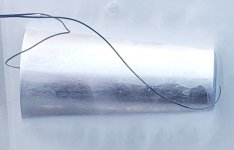
Prior to any polishing, I’d need to remove the clear anodization first from the thin aluminum shiny covers. As these covers are razor thin, I began by putting a small amount of acid into a warm water tub and let them boil away the anodizing in constant fear of them vaporizing. The wire is to avoid touching the solution. No electricity involved here.
Boiling away in Margville.jpg

If you look closely, you can see the bubbling ghostly white areas with fingers eating away the anodizing. Looks like a fog which is a hard to see in the water. After much too much time had passed with poor results and not wanting to wait for yet another birthday, I felt I could make greater progress by going all in so heavy duty oven cleaner spray was brought to play and in minutes, I was done. Go figure. Thank you Inter-Web!

Now I had to carefully remove the dents and then polish them to get them back to their earlier luster. In actual fact we used a tight fitting Delrin bar inside the covers and lightly tapped the dents out. Once that hurdle was done, we kept the delrin bar in them as they were polished. Mainly out of fear of crushing them but once I overcame my fear of over polishing, I did the deed and then reassembled the shocks with the covers. Speaking sweet nothings to the press, you know , with fingers crossed I carefully returned to it to collapse the shock suspension spring enough to get the retaining clips back in place and Voila’, done deal.

Running out of things to do at the back of the chassis I figured it time to mess with the forks.
 
Last edited:
#19
Forks:

This early CB has the heavy-as-a-ships-anchor steel lower forks. When you look at the sheer amount of machine work to the parts, I found it all to be way cool but honestly not much to do here. Pull them apart, clean them, making sure the bushes are not worn out and that the seals are good. If you are in there, I’d replace the seals just because but you do not have to unless worn or leaking. Make sense?

I’m that dork that is lazy enough to say “self, if you re-assemble it, ride it, only to find a leak or some extra slop its guaranteed you’ll be one P-O’d son of a gun so just replace the seals while in there, OK?” Makes for happier evenings chillaxin instead of working. But then that’s just me.

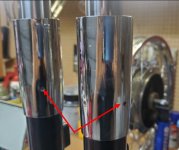
Once the forks are removed from the bike and the upper fork covers and bits are off (headlight ears etc) you might end up like me wondering how in the heck the doggone thing comes apart. I first looked at the bottom where the axle goes through hoping to find a bolt where modern bike forks typically have them but nope. Scratching my head I noticed two small holes in the lower part of the chrome covers. Could those be a clue?

Magic Fork.jpg
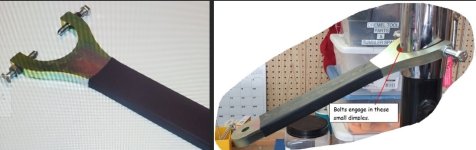
Short answer yes. The Chrome cover has some real beef to it and is more than just a pretty face. It is also the part (like a nut) that holds the fork together. The tool needed is also available but like anything, not too hard to make if you have the time. I am a tool junkie so purchased one.

Forked Devil.jpg

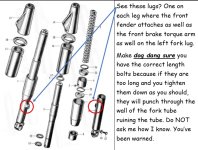
Here is yet another time I took way too few pictures so I’ve included a picture out of the CB72 Honda parts catalogue.

Stuff is stuff.jpg
Once the upper left three parts in the picture are removed (which happens as soon as you remove the forks from the triple tree) there are not too many parts involved. Other than figuring out how to pull the inner fork tube from the outer lowers which we've gone over, the only real PITA was removing the lower fork tube bushing. There are four (OK, maybe three, I forget) small tapered bushing-retainer pins that need to be pushed out but can be plenty irritating to reinstall. Once back in, they must be smooth to your finger on the inside so don’t be afraid to massage them as can be seen Honda did back in the day. This pic is before they were pulled apart. Like anything, you don't have to change the bushings. If you feel slop or can measure enough loss where you see wear patterns on the bushings, then change them. Other wise, don't bother pulling them as there is no need.

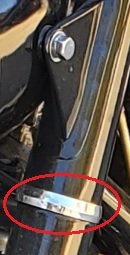
Eye candy.jpg

You see the eye candy ring above in the red circle as well as in the parts picture farther up sitting just beneath each Headlight mount bracket with ears? They are made out of pot metal and mine were very corroded and awful. I'd no clue what to do to bring them back to life so made two more but out of stainless steel. Dead simple to make.

There might be some bearing on this.jpg

All that is left is to clean all the bits up and reassemble. Again, other than the pins for the lower bushing and screwing the upper part back on, it’s all very straight forward and dead simple. Nothing fancy to share here and the bushings are still available out in the inter-web.

On assembly, and since I’ve no knowledge or experience with the forks, it was suggested that I used 220cc of 15wt shock oil, which ironically was what I chose for the rear shocks and was in hand because of it so why not? And unlike the shock, this can easily be changed if not to your liking. BTW, the small oil drain bolts at the bottom of each fork, love to leak so be prepared with new screw seals. They are small flat washers like you might see on a typical automobile’s oil drain plug, just much smaller in diameter. Changing the quantity of fork oil can change the dive behavior of the bike on the forks. Use more if you want a bit less dive (sometimes hard to tell) This happens because you are reducing the volume of air above the oil. Less volume causes the air pressure to rise quicker as the forks compress in dive giving greater resistance to more compression.

And again, too few pictures but you will see them assembled and on the bike later on.
 

Attachments

  • Fork parts is parts.jpg
    Fork parts is parts.jpg
    78 KB · Views: 6
Last edited:
Back
Top Bottom