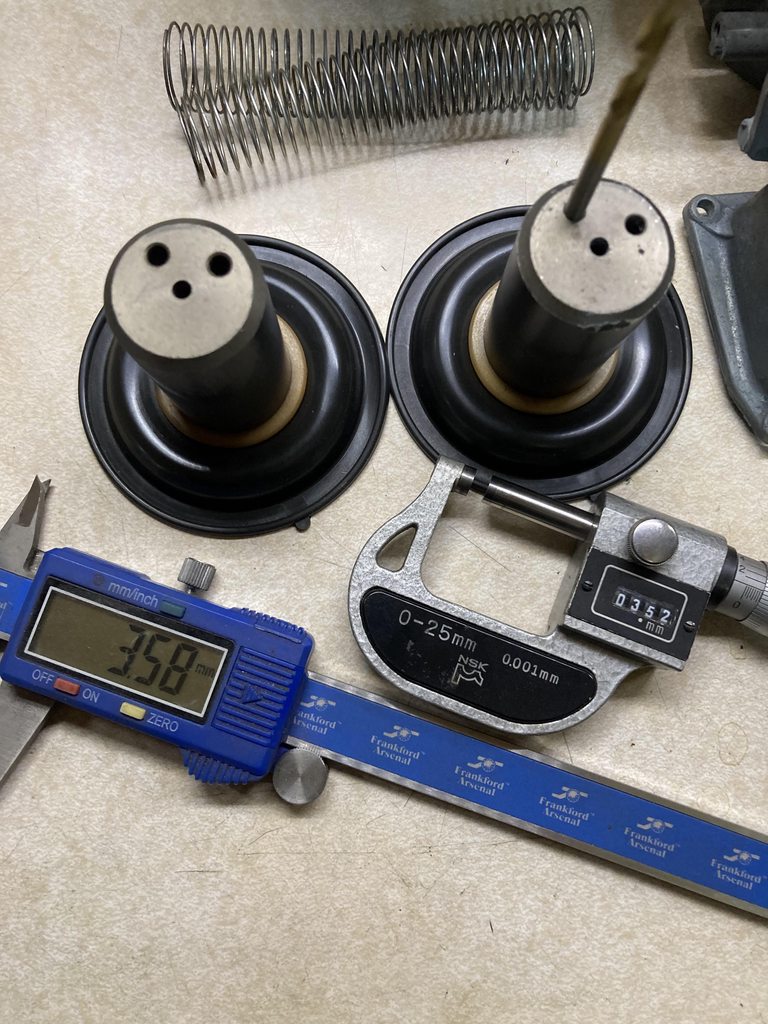
The only time I needed my mic was to get around the outer rib on the diaphragms to measure their thickness in the middle. 95% of the time I just grab my digital slide calipers but the parallel jaws won't work for that but they do have the small tips for measuring the inside diameter of holes.
The decent $25-35 slide caliper I have will resolve to hundredths of a mm, or 5 ten thousandths of an inch and will convert from mm to inch, or back, with the push of a button. Keeps my arithmetic brain cells lazy.

It also has a zeroing button to reset accuracy or to measure just the differences between two items. It does not have a vernier scale for manual measuring but 357 watch batteries are common as dirt.
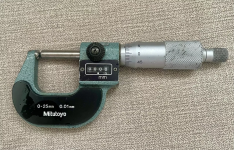
It's definitely my most important measuring tool. My 25mm mic was purchased back in my FIAT days to measure valve tappet shims but its too small to measure the snap bore gauges for our bike cylinders, I'd need like a 100mm for that. I bought the snap bore gauge set that Oldtimer wanted to sell but haven't bought a big mic to use with that yet.
So, for this job, I'm using the inside tips of the slide, which is hard to do with consistency and accuracy, backed up by finding the closest drill size from my number, letter, fractional drill bit index set from HF. This set says that a #28 bit is .140" (3.56mm) but I measure it at 3.50mm with the slide and 3.52 mm with the mic. I figure either all these HF bits are slightly undersized or (more likely maybe) there is a convention of working tolerance involved when actually drilling, such that holes end up being very slightly larger than the measured diameter of the bit. IOW, this 3.50mm bit may drill 3.56mm holes, just guessing. I'm missing the next larger numbered size, #27, which is supposed to be .144" (3.66mm), but I'd bet that it is also undersized if measured, but may drill 3.66mm holes.
I'm so glad I don't live inside a real precision machinists head, I just want to fix these carbs. Here is what I've found, before I lose it.
SUMMARY: of lift holes and diaphragms (in a nutshell, from 4 sets of carbs).
---Almost all the diaphragm thicknesses are .27mm, + or - .02-.05mm in different spots on the same item. Except the new repro ones from Scrambler which are almost a tenth of a mm thicker.
---Almost all the lift holes in the slides are 3.50mm, +or- .02mm. Except for one of the slides from my ebay carb set, that is larger, at 3.58 measured only with the inside tips of my slide caliper, not a precision pin gauge set and micrometer.
GOAL: Apply PJ's logic and remedy to enlarge slide lift holes to account for thicker aftermarket diaphragms.
--- One of the ebay slides is already at the increased amount recommended by PJ (+.04-.06mm). I'll leave poor little Wellenuff alone.
--- Other slide needs reamed or drilled (with a bit I don't have) to match the other ebay slide. I may have a conniption if forced to watch a bunch of youtube watchmaker videos.
Other common-sense considerations (doncha hate that guy).
-All lift air must pass thru the plastic golf tee anyway, #16 on parts diagram, 16132-286-004, no variants listed. Would the 4 holes in this need reamed too?
-David Silver Spares lists replacement slides with diaphragms at $75 each (16111-286-034) or $235.29 each (16111-287-004, special order only). No specs available on hole diameters or diaphragm thickness, although probably more trustworthy than congressional testimony. An expensive gamble for me but not Congress because it's not their money anyway.
-Maybe Scrambler's diaphragms are actually as flaccid as OEM anyways and as I've heard said, 'it's not the meat, it's the motion'.
Makes me long for the mindless simplicity of twisting nipples and rust removal.