


On the SOHC CM/CB 400/450 series Honda refers to the big ugly can under the engine as a "Power Chamber" although you'll find reference to pre-muffler, expansion chamber, etc. I'll stick with Power Chamber.

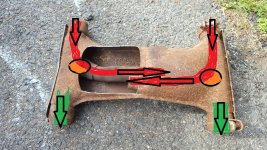
Exhaust gasses enter one side turn and exit towards the opposite side, from there the gasses can expanded and have 2 exits through either muffler. The Orange spots in the picture are where the bypass holes exist.
It's been long established that the longer the primary exhaust pipes are the lower in the rpm range where power is produced. Shorter pipes produce more high rpm power. It seems Honda wanted to have the best of both worlds, real good low rpm and high rpm at the same time. Normally you get to choose one or the other. Good high rpm power while sacrificing low rpm power. Or you can split the difference and get good mid range rpm power and sacrifice less of the high/low power.
In the picture you can see the Red inlet gas path emptying into the chamber and exiting thru the Green outlets. Honda in their design has added a number of holes in the curved section (Orange) that allow high pressure/rpm gasses to travel straight thru. The gasses under low rpm/pressure will follow the curvature of the pipe which extends the pipe length for low rpm power but when the pressure rises some/most of the gasses will go straight through which gives high rpm power.
Honda apparently went through 23 different versions of this before settling on the design. The internal pipes change sizes also at different points
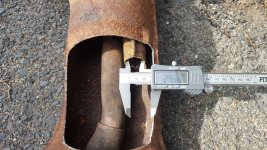
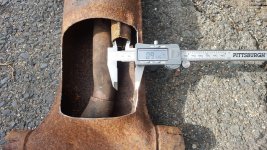
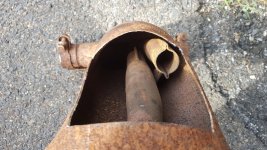
The Power Chamber also serves as a balance/crossover tube, like the ones you see on older Brit bikes. Those tubes tend to balance the exhaust pressures between pipes resulting in smoother power.
For more information concerning exhaust systems pickup a copy of Scientific Design of Intake and Exhaust Systems, written in the 60's and still used as a reference by engineers.
I can't remember which member uploaded these pictures originally but I do appreciate it.
Just researched the Honda part numbers. Seems there are 2 versions, by engine size not transmission. Interestingly the 1986 CB450SC uses the 400 version. There's no info on the Sankei numbering.
Assemblies where 18310-413-013 is used
Note to add here. The 450 version has the holes in the curved pipe for better flow. The 400 does not have them.
Exhaust gasses enter one side turn and exit towards the opposite side, from there the gasses can expanded and have 2 exits through either muffler. The Orange spots in the picture are where the bypass holes exist.
It's been long established that the longer the primary exhaust pipes are the lower in the rpm range where power is produced. Shorter pipes produce more high rpm power. It seems Honda wanted to have the best of both worlds, real good low rpm and high rpm at the same time. Normally you get to choose one or the other. Good high rpm power while sacrificing low rpm power. Or you can split the difference and get good mid range rpm power and sacrifice less of the high/low power.
In the picture you can see the Red inlet gas path emptying into the chamber and exiting thru the Green outlets. Honda in their design has added a number of holes in the curved section (Orange) that allow high pressure/rpm gasses to travel straight thru. The gasses under low rpm/pressure will follow the curvature of the pipe which extends the pipe length for low rpm power but when the pressure rises some/most of the gasses will go straight through which gives high rpm power.
Honda apparently went through 23 different versions of this before settling on the design. The internal pipes change sizes also at different points
The Power Chamber also serves as a balance/crossover tube, like the ones you see on older Brit bikes. Those tubes tend to balance the exhaust pressures between pipes resulting in smoother power.
For more information concerning exhaust systems pickup a copy of Scientific Design of Intake and Exhaust Systems, written in the 60's and still used as a reference by engineers.
I can't remember which member uploaded these pictures originally but I do appreciate it.
Just researched the Honda part numbers. Seems there are 2 versions, by engine size not transmission. Interestingly the 1986 CB450SC uses the 400 version. There's no info on the Sankei numbering.
Assemblies where 18310-413-013 is used
- 1978 CB400A A - MUFFLER
- 1978 CB400TI A - MUFFLER
- 1978 CB400TII A - MUFFLER
- 1979 CB400TI A - MUFFLER
- 1979 CB400TII A - MUFFLER
- 1979 CM400A A - MUFFLER
- 1979 CM400T A - MUFFLER
- 1980 CB400T A - MUFFLER
- 1980 CM400A A - MUFFLER
- 1980 CM400E A - MUFFLER
- 1980 CM400T A - MUFFLER
- 1981 CB400T A - MUFFLER
- 1981 CM400A A - MUFFLER
- 1981 CM400C A - MUFFLER
- 1981 CM400E A - MUFFLER
- 1981 CM400T A - MUFFLER
- 1986 CB450SC A - MUFFLER
- Assemblies where 18310-MC0-670 is used
- 1982 CB450SC A - MUFFLER
- 1982 CB450T A - MUFFLER
- 1982 CM450A A - MUFFLER
- 1982 CM450C A - MUFFLER
- 1982 CM450E A - MUFFLER
- 1983 CB450SC A - MUFFLER
- 1983 CM450A A - MUFFLER
- 1983 CM450E A - MUFFLER
- 1985 CB450SC A - MUFFLER
- 1985 CB450SC AC - MUFFLER
Note to add here. The 450 version has the holes in the curved pipe for better flow. The 400 does not have them.
Last edited: