(Not so) Budget drag bike project - DOHC 450, of course

Someone did a mythbusters style video, they wound up putting a router (the power tool) on a speed control (spindle side up) and used a laser tachometer. They slowly turned up the speed until the disc just broke apart.
 
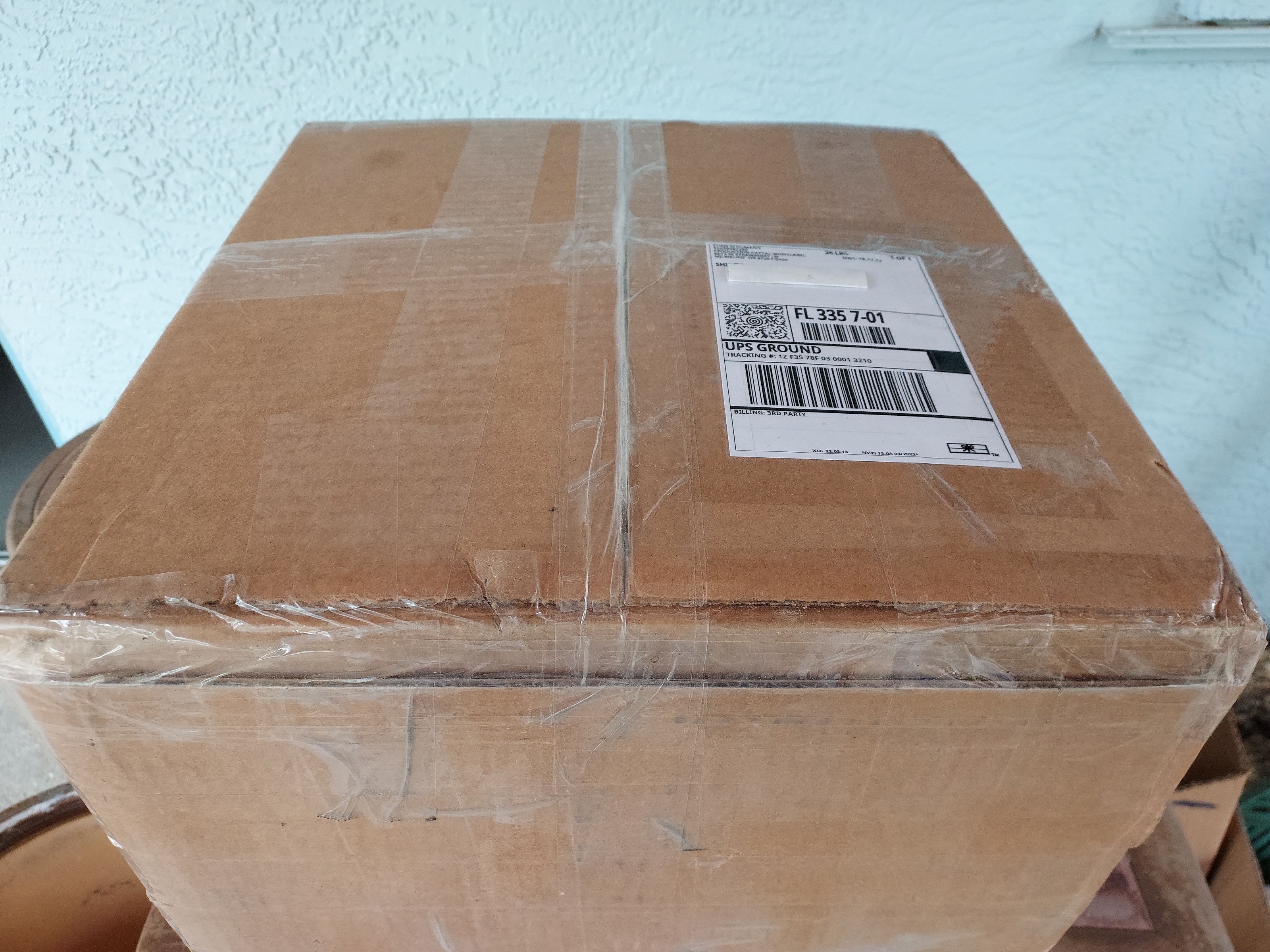
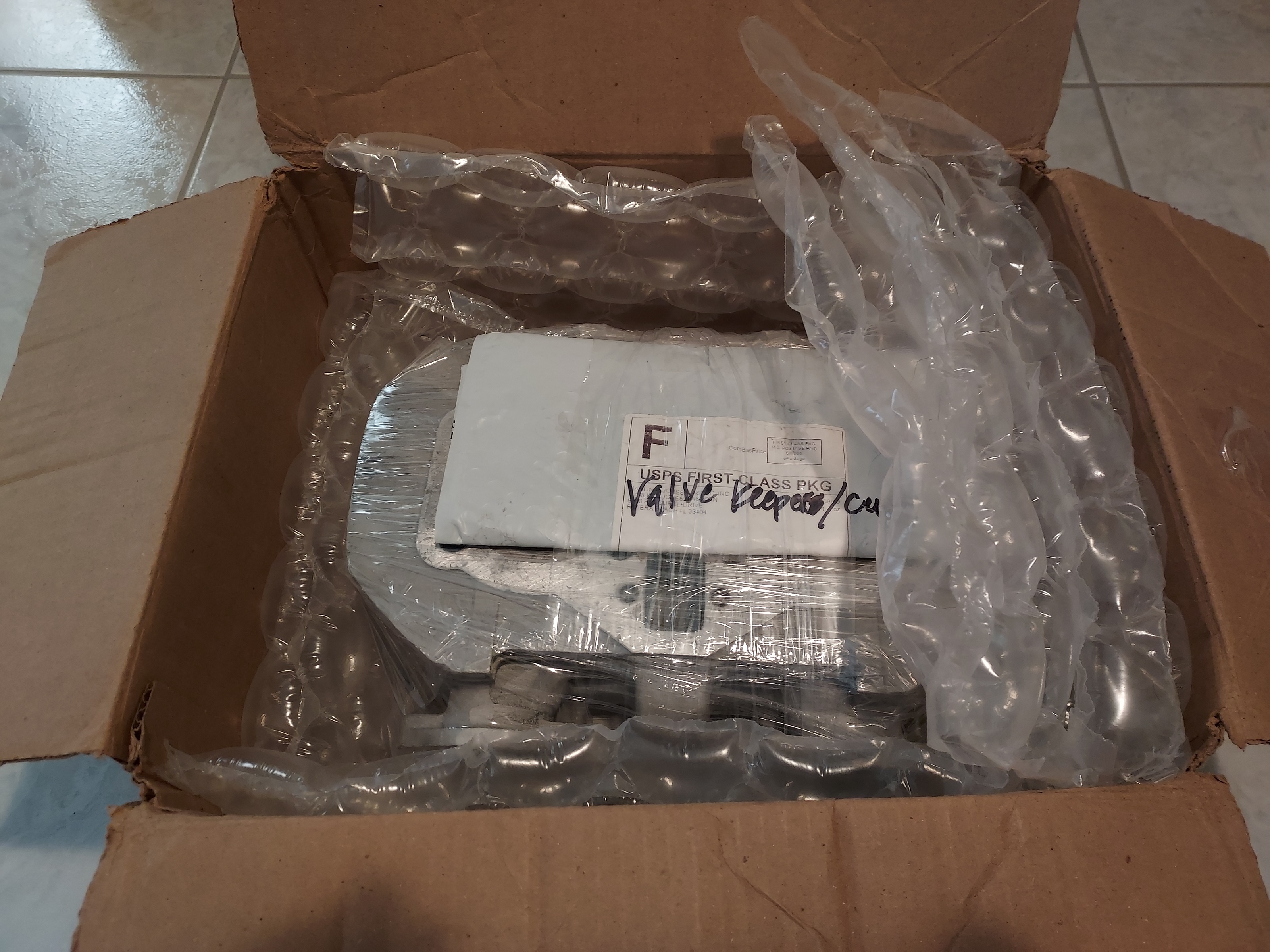
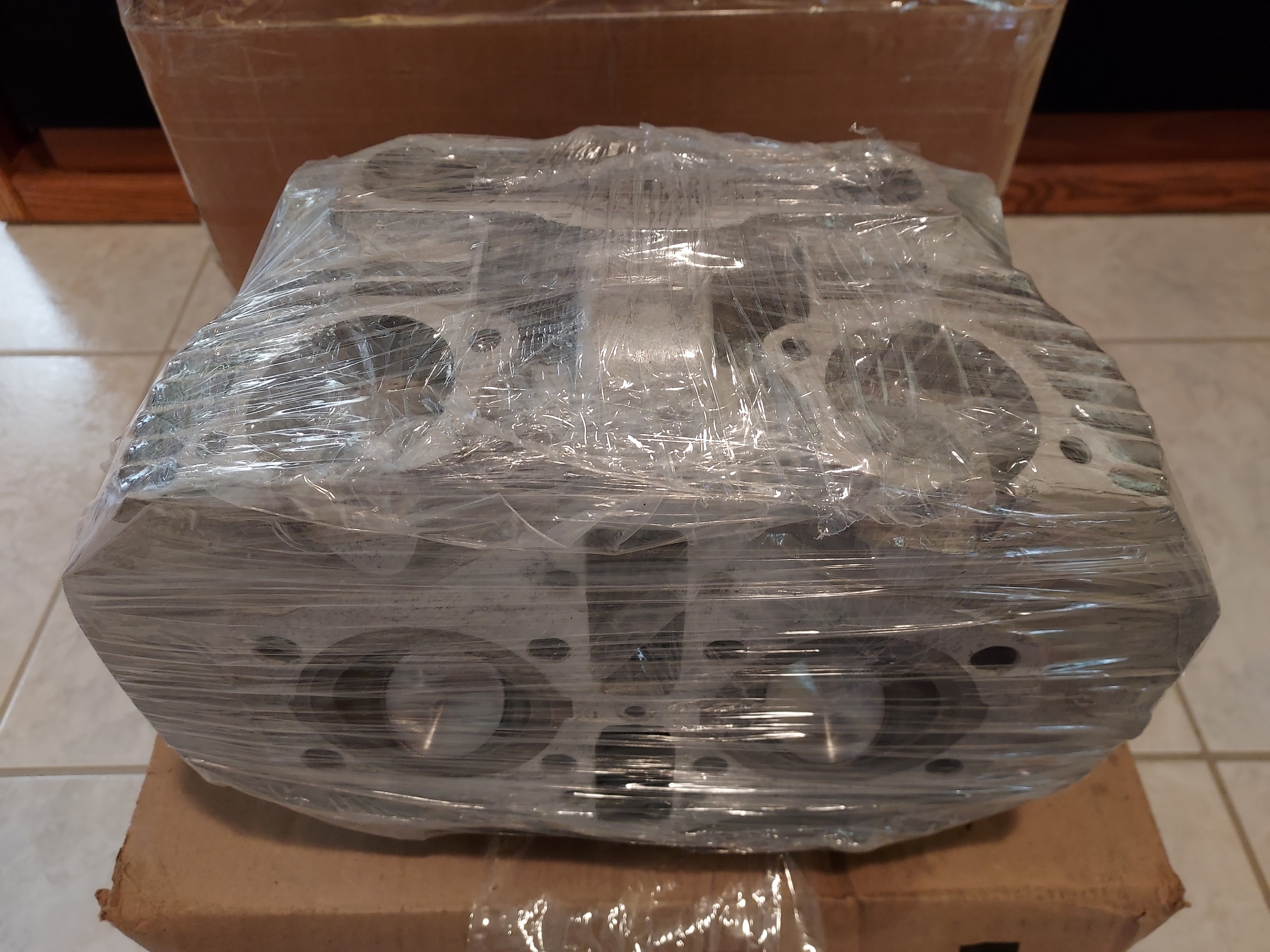
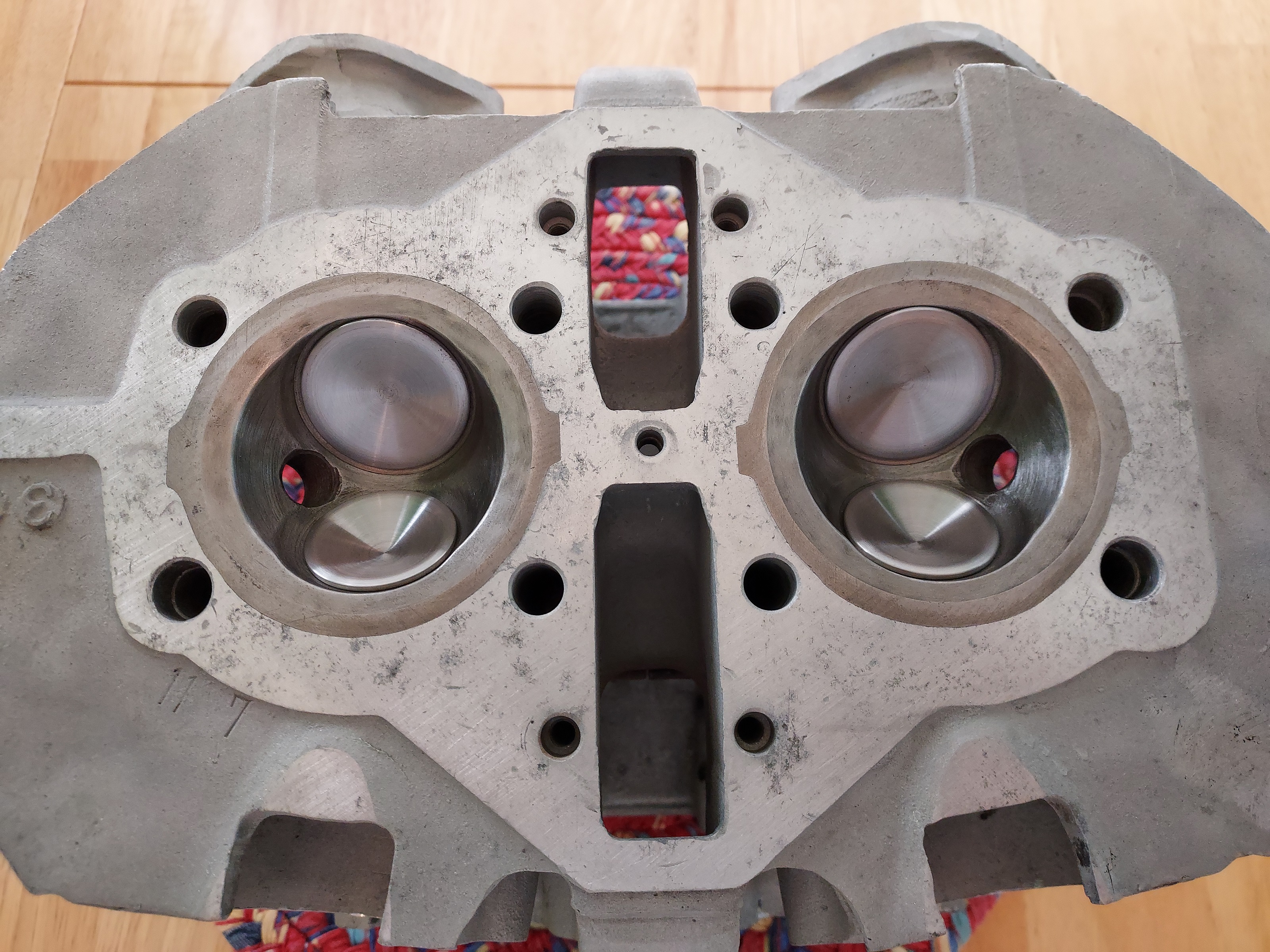
I feel like there should be music and some kind of special introduction... after 378 days, my head has been returned to me. :)

kl2kcJZ.jpg


njxBf0W.jpg


WQM0xKE.jpg


cIxVPjj.jpg


UlTsgGb.jpg


4IvEGEb.jpg


OFgLMno.jpg


5U5Slet.jpg


bz4PNnV.jpg


B8g9aca.jpg


Yay!
 
If you consider paying for your own expensive Christmas present, then yeah I guess. :rolleyes:

It won't necessarily pick up in a hurry as I have other projects around the house going on too, but over the next few months I can start working on the bottom end so as the summer goes by the engine can get assembled with the hope of running it this fall. But, it's nice to finally get it back.
 
LOL... I don't think so, but I didn't actually try. Yeah, it looks pretty good and when I think about how much dremel time that probably took, I'm glad I didn't do it. Plus he made new titanium valves and installed the NOS torsion bars I picked up before sending it to him.
 
I wouldn't mind getting my head rebuilt. I've been abusing it for 76 years and some of its connections are getting a little unreliable.
 
I feel like there should be music and some kind of special introduction... after 378 days, my head has been returned to me.

Looks really good there Tom, he did a great job..... I feel better too. My gauges for the CB350F have been in Holland for 6 months now, so only a fraction of that year + time. :)
 
I wouldn't mind getting my head rebuilt. I've been abusing it for 76 years and some of its connections are getting a little unreliable.

If only that other head was so easy to get rebuilt. Mine could stand a little refresh too :dizzy:
 
Looks really good there Tom, he did a great job..... I feel better too. My gauges for the CB350F have been in Holland for 6 months now, so only a fraction of that year + time. :)

Yeah, it looks nice. I'm looking forward to making more horsepower this time. I guess good things are worth waiting for... just maybe not quite that long
 
Very cool. Precise, tiny, intentional scratches are something to get excited about. That titanium jewelry is pretty impressive too. Anything special about the seats or guides?
 
Very cool. Precise, tiny, intentional scratches are something to get excited about. That titanium jewelry is pretty impressive too. Anything special about the seats or guides?

No, I could have gotten bronze guides but this engine will only be used for short runs at the track, not lots of miles at high rpm, and I was trying to conserve costs where I could. The valve seats are stock as well.
 
Budget and sensible. I guess spring choices may have more to do with cam particulars than valve mass.

I'm far from the most knowledgeable guy in that area, but I'm also restricted to using the stock valve spring setup since coil conversion is pricey and the use of titanium valves was suggested to me by Schumann. They're lighter than stock which is an advantage, of course, but there's still the limits of the torsion bars to consider with the more radical cams I'll be using. Terry Naughtin ran a set of these cams for a year with stock torsion bars so I'm trusting his experience, and I added some insurance by buying a set of NOS torsion bars to hopefully ensure long(er) life. Since this engine won't get pounded continuously like a road race engine would, I'm hoping this combination will be durable enough for some fun trips to the track but it won't be every week, twice a week like I did in the early '70s
 
That looks like some great porting work! I bet you will surprise some people when you get it on the strip.
 
Tom...... I might have a "top-secret" suggestion for further easy and inexpensive performance improvement for this engine.....
Will reveal it during our next phone conversation....;);)

Here's a hint.........

Untitled.png
 
Last edited:
Tom...... I might have a "top-secret" suggestion for further easy and inexpensive performance improvement for this engine.....
Will reveal it during our next phone conversation....;);)

Here's a hint.........

Pretty sure I have an idea what you're referring to. Yeah, we're due for a conversation...
 
The proof is in track times. This engine really responds to tuning and good parts. I think you'll be pleasantly surprised.
 
Well since the budget is now blown, I certainly hope so... other than not degreeing in the cams (even more expense for adjustable sprockets), pretty much everything on this bike will be done (at least a little) more scientifically than my old one where good parts, a little bit of talent and a fair amount of luck worked out really well
 
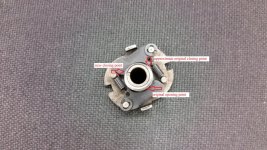
I'll also be using a modified advancer with the breaker cam lobe trimmed down to less than half the points-open duration to ensure it will get plenty of dwell and rev cleanly to well past the rpm range the engine will turn, probably around 10,500 to 11,000.

Was this modification done though a local machine shop or was it part of the work that Schumann did for you?
 
Was this modification done though a local machine shop or was it part of the work that Schumann did for you?

It was done on the bench grinder in my garage, then filed smooth and finished with emery cloth. The reason it doesn't have to be precision is because it's the backside of the lobe that you remove. Letting the points close sooner and stay closed longer (while still opening in the same location) is all you're doing, and as long as the "exit" ramp doesn't cause accelerated/excess wear to the rubbing blocks on the points, the other area the points don't touch doesn't have to be perfect. This one didn't turn out as nice as the one I did almost 50 years ago so I didn't post a picture of the actual area involved, it wasn't brag-worthy but effective.

breaker cam.jpg
 
It was done on the bench grinder in my garage, then filed smooth and finished with emery cloth. The reason it doesn't have to be precision is because it's the backside of the lobe that you remove. Letting the points close sooner and stay closed longer (while still opening in the same location) is all you're doing, and as long as the "exit" ramp doesn't cause accelerated/excess wear to the rubbing blocks on the points, the other area the points don't touch doesn't have to be perfect. This one didn't turn out as nice as the one I did almost 50 years ago so I didn't post a picture of the actual area involved, it wasn't brag-worthy but effective.

View attachment 15238

Thanks for the explanation and photo -- it helps me (maybe others, too) learn as I follow along with your build. I haven't had any exposure to drag strip performance modifications, so everything is new to me.
 
Thanks for the explanation and photo -- it helps me (maybe others, too) learn as I follow along with your build. I haven't had any exposure to drag strip performance modifications, so everything is new to me.

This is really a modification that would work on anyone's 180° twin still running points, and it doesn't add to performance except to help eliminate points float at high rpm and increased dwell for stronger spark at all speeds. I learned it in high school from a Gordon Jennings article in Cycle magazine, along with how to make an energy transfer magneto out of a stock alternator on the SL90 which also worked and allowed me to run that strictly off-road project bike without a battery.
 
(ancientdad:) This is really a modification that would work on anyone's 180° twin still running points, and it doesn't add to performance except to help eliminate points float at high rpm and increased dwell for stronger spark at all speeds. I learned it in high school from a Gordon Jennings article in Cycle magazine, along with how to make an energy transfer magneto out of a stock alternator on the SL90 which also worked and allowed me to run that strictly off-road project bike without a battery.

Cool stuff. In Steve's lesson on dwell times he mentioned the possibility of heating up the coils at low RPM a if the dwell is increased. For a drag bike that's obviously not a concern, but what about road use?

Looking at your photo a bit more, those advance springs look really fresh. Did you find NOS springs, a replacement, or what?
 
Cool stuff. In Steve's lesson on dwell times he mentioned the possibility of heating up the coils at low RPM a if the dwell is increased. For a drag bike that's obviously not a concern, but what about road use?

Looking at your photo a bit more, those advance springs look really fresh. Did you find NOS springs, a replacement, or what?

Those springs are original AFAIK, just got lucky with that advancer I guess, haven't touched them. Remember I'm running that advancer on my red 450, that picture is from the one I modified for it. I plan to do the one for the drag bike as well, just haven't done it yet. So I guess that answers the long-term reliability question about the coils since I've put over 2700 miles on the red bike since the original build, including idling around Barber in the late summer heat for a week at the vintage festival in 2018 and all the other riding before and (especially) since.
 
Remember I'm running that advancer on my red 450, that picture is from the one I modified for it. I plan to do the one for the drag bike as well, just haven't done it yet. So I guess that answers the long-term reliability question about the coils since I've put over 2700 miles on the red bike since the original build, including idling around Barber in the late summer heat for a week at the vintage festival in 2018 and all the other riding before and (especially) since.

Fair enough and good to know.
 
Took some time to fiddle with the 4 speed transmission shafts and gears in the last couple days. In thinking about the track the bike will be run at most often, it's likely to be the eighth mile rather than the nearest quarter mile (Gainesville) since the eighth mile is the closer one to me (despite being 70 miles away). Unless, of course, the "soon to be built" eighth mile track only about 20 miles from me at a facility now about 2 years old called Leadfoot City is eventually built. After announcing the intent to build an eighth mile strip soon after they opened, I suppose they encountered the typical resistance from the county that is probably behind so many drag strip closures. They say it's now in the permitting stage so hopefully it will become a reality.

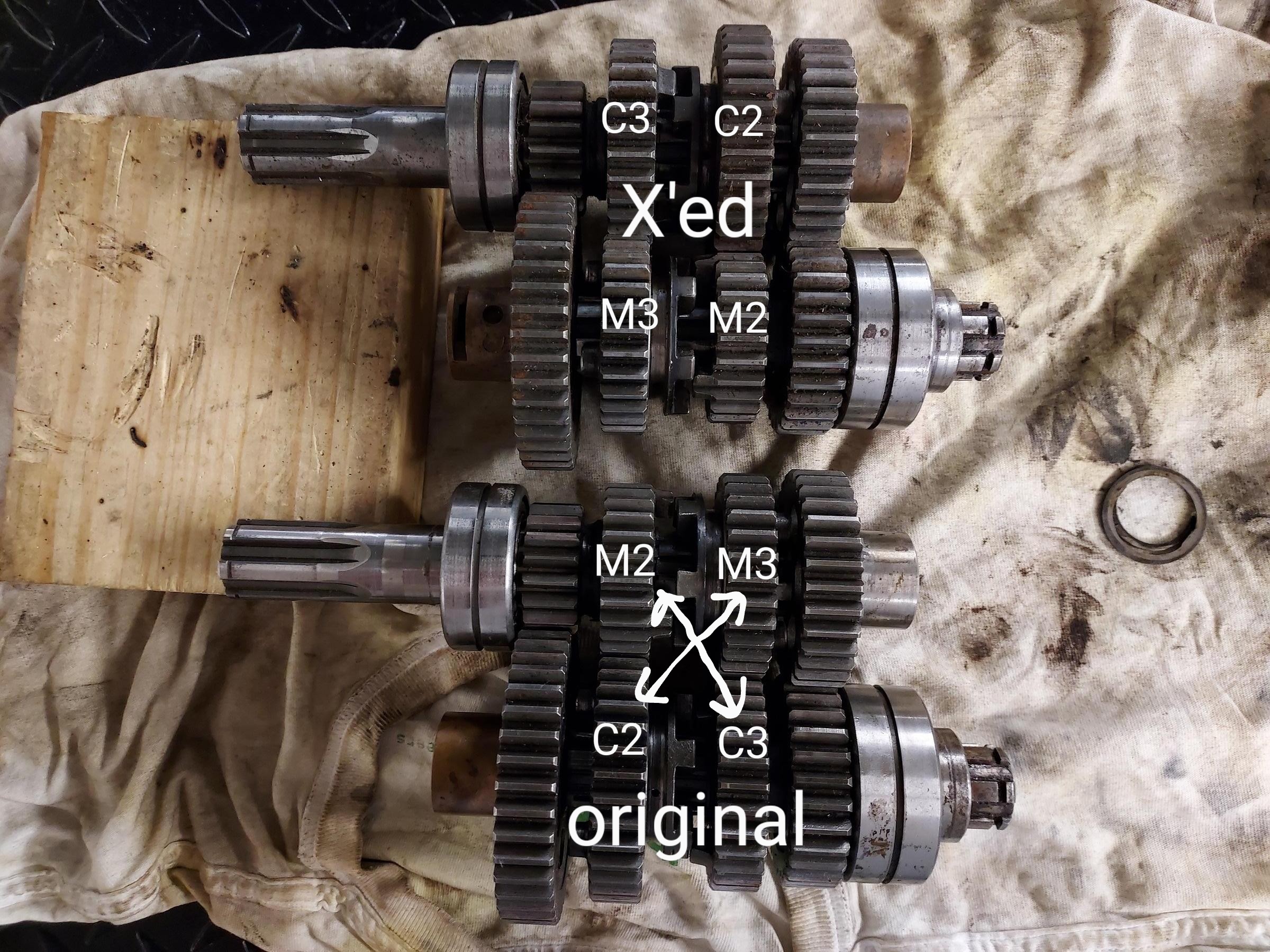
So in thinking about running primarily in the eighth mile, I started thinking about those who have X-ed their 305 transmission gears and wondered if the 4 speed 450 could be done that way. I haven't taken the time to find the info from Bill Silver on doing it with the 305 transmission but with a spare set of shafts and gears I decided to try it with no instructions.

Top set is X-ed (middle 2 gears), bottom set is original. Since they fit and mesh together the same as the original configuration it seems like it might be correct.

OaAgv6B.jpg


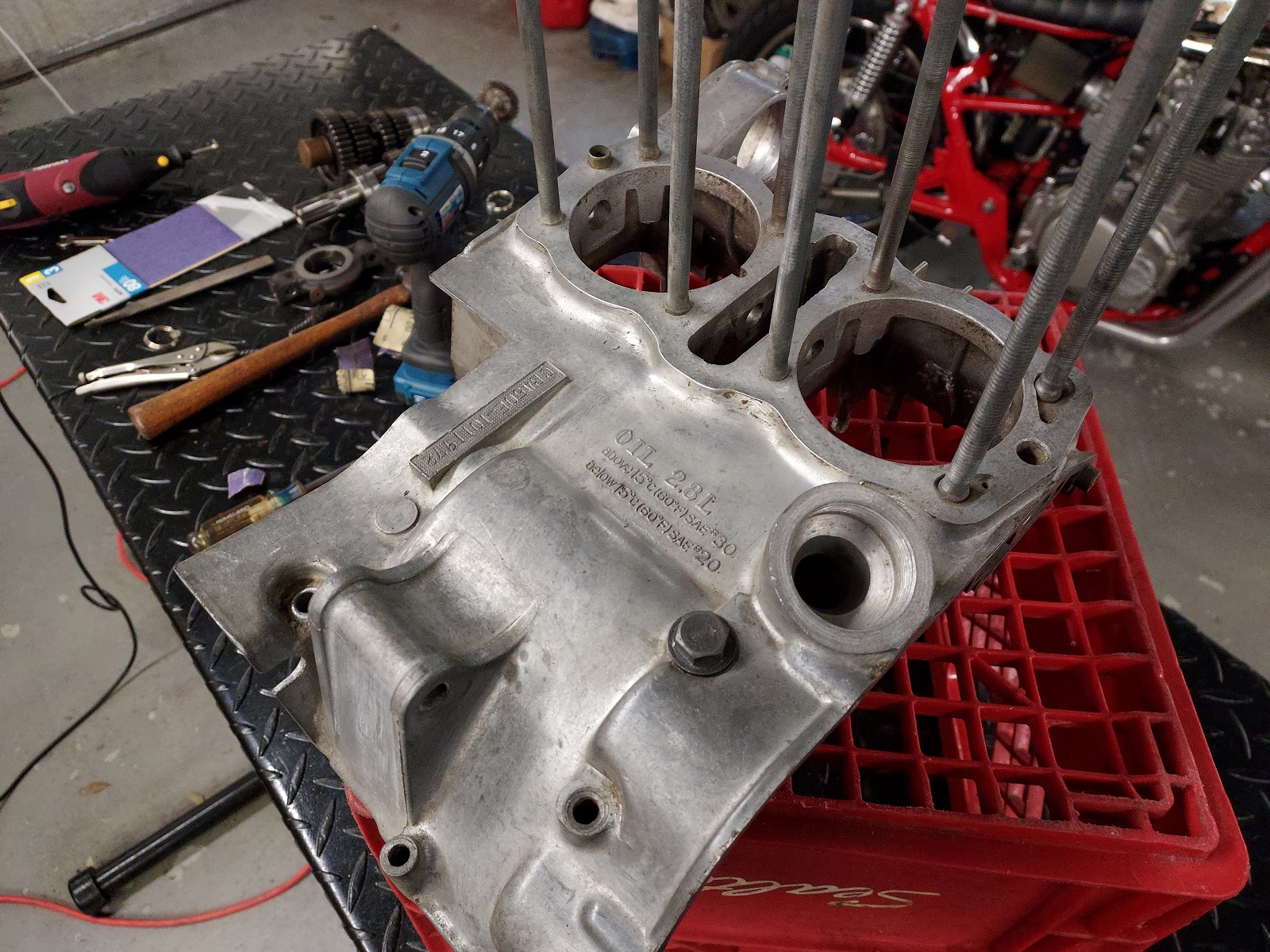
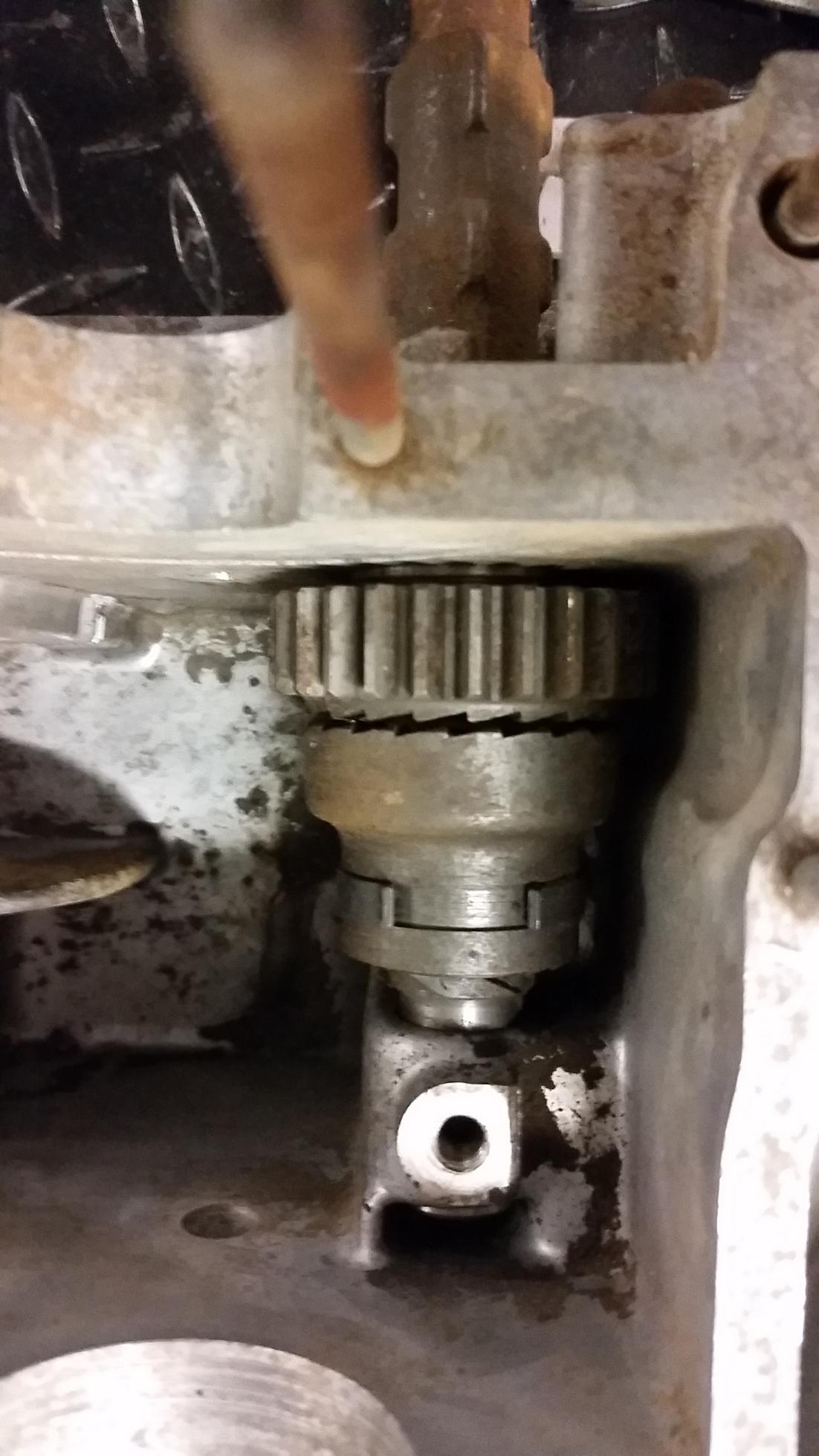
BUT, even if it is correct... I'm afraid there might be another issue that can't be overcome - clearance to the inner casting wall between the crankshaft area and the transmission area, it seems the larger gear second from the left on the mainshaft (top shaft of the upper set) may not clear the crankshaft casting wall and I'm not sure there's enough meat on that casting to safely relieve it for enough clearance. Consequently, it would be difficult to attempt to test the idea and validate both the shifting correctness and resulting ratios.

Anyone with knowledge of the idea and thoughts on it, please let me know what you think.
 
Intriguing idea! Will the shift drum select the correct gear in the preferred sequence?

re stress. My 4 spd case is together and I don’t recall if that gear sits over a web/rib in the lower case or if the top case has interference...or either. But in general, some small local relieving would have no effect on overall case strength. Just keep in mind big corner and fillet radii are your friend(s). Also keeping in mind that diminishing strength returns relate to the more material removed, the weaker that area.

Can you lay the preferred gear cluster in the top, then bottom case and post photos?
 
Looking at the gears, the larger gear once fit and unless there’s a specific relief or pocket to accommodate the diameter it’ll still fit only on the other side. My recollection is the case wall in question is flat, no relieving.
 
Looking at the gears, the larger gear once fit and unless there’s a specific relief or pocket to accommodate the diameter it’ll still fit only on the other side. My recollection is the case wall in question is flat, no relieving.

I should have taken a picture of the upper case with and without the shafts in it. I'll do that tomorrow and get multiple angles of it. I'm just concerned about what might happen in the crankshaft area by relieving the area enough to clear the gear because it will open a path connecting the two sections that are currently separated. I do have the other upper case without studs to test with but I really hate to hack up a 4 speed case since they're harder to find (in the event I need another one for whatever reason)
 
Look for a stress vector. That is, where is the load applied and at what magnitude. In Vector analysis, the result is just that. You can swag it pretty closely by just knowing the direction. Intuitively I think you’ll be okay.
 
Dude, I sent you a gearing calculator but I don’t think that’s what you want in this instance.
 
I communicated with Tom about the mock-up of the X-ed transmission and made a mark-up of his photo. Is my mark-up correct? Are the gears are swapped in a criss-cross or X pattern, as the name suggests? It looks like M3 and C2 must be flipped around as well. Is the numbering in the mark-up correct? (M2/C2 for second gear and M3/C3 for third gear in the original configuration?)

dfD0ghB.jpg


Something doesn't seem right to me because the X-ed gear ratio for second (0.967) would then be the reciprocal of the original ratio for third (1.034). Similarly, the X-ed gear ratio for third (0.714) would be the reciprocal of the original ratio for second (1.400). Those don't seem desirable. What am I missing?
 
I could be wrong, but it looks like the x'd gear set will be faster in 3rd than 4th.
stock: 1st- 2.41, 2nd- 1.4, 3rd- 1.03, 4th- .90
x-ed : 1st- 2.41, 2nd- .96, 3rd- .71, 4th- .90
gear tooth count from the cmsl parts book.
 
I could be wrong, but it looks like the x'd gear set will be faster in 3rd than 4th.
stock: 1st- 2.41, 2nd- 1.4, 3rd- 1.03, 4th- .90
x-ed : 1st- 2.41, 2nd- .96, 3rd- .71, 4th- .90
gear tooth count from the cmsl parts book.

That's exactly what I was finding. It allows you to get to high speeds with lower RPM, but actually leads to larger gaps between gears rather than smaller gaps, as claimed for some of the 305's where people talk about the 2-3 X swap.
 
Thanks for all the responses guys. Even if it would be feasible with respect to ratios, I'd still have the issue of the crankcase wall to contend with and based on what you've responded with it looks like it wouldn't work the same way on the 450 as it does on the 305 anyway. I also PMed Bill Silver to ask if he'd ever done it and his response was that he didn't think it would work on the 4 speed 450.
 
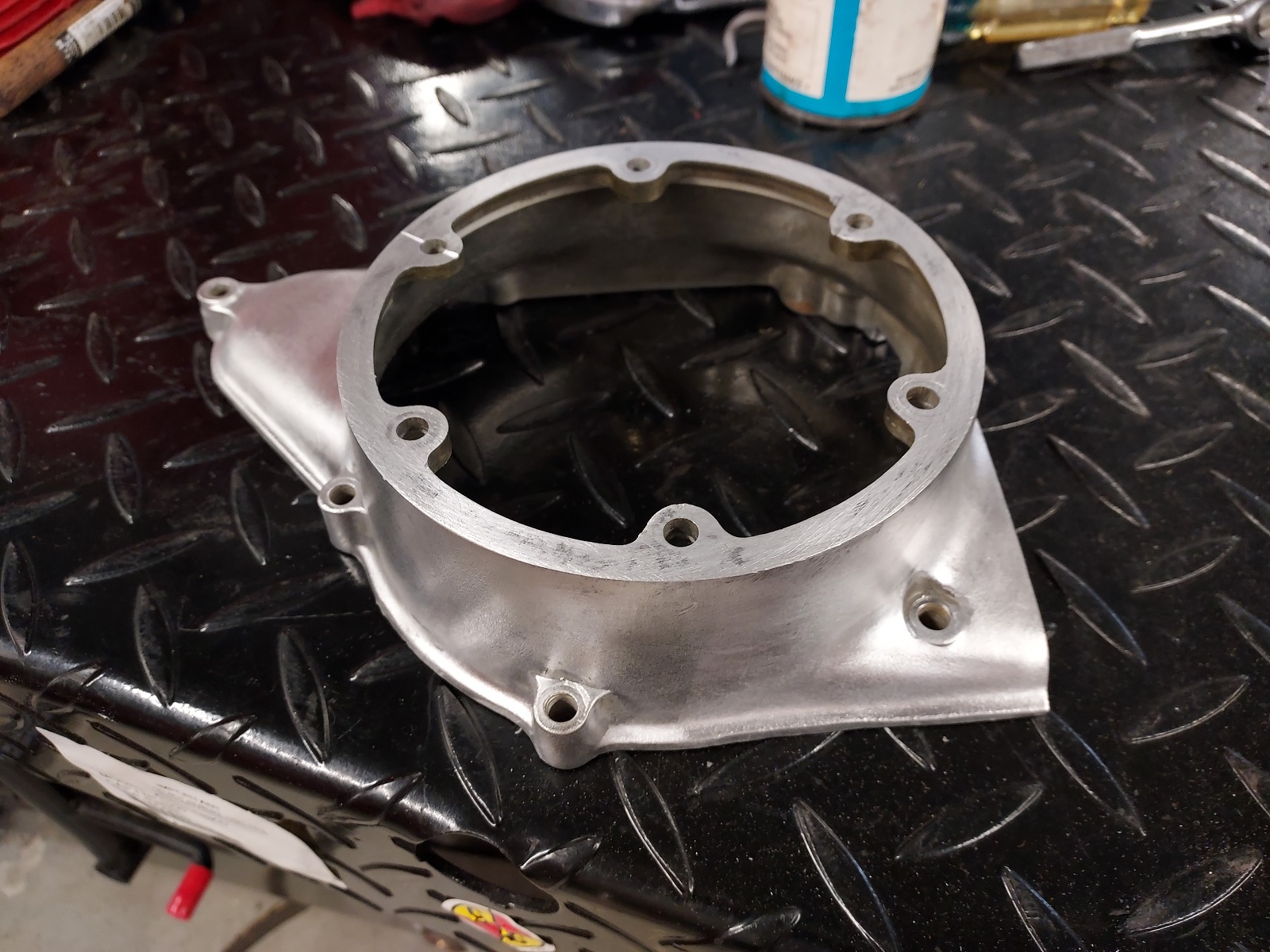
Finally cleared out a few other projects (more for my wife than me) and cleared the lift to get back to the bottom end. When you build an engine from accumulated parts there's always something, or a few somethings, that you don't realize you don't have until later. Since there's a difference in the oil filter covers between 4 speed and 5 speed, as well as a difference between the oil filter cups and their retention methods too (remember the broken off 6mm bolt in the end of the crankshaft), I came to realize I did not have the oil filter cover. Found a lightly scratched one from DSS for $35 plus shipping since there weren't any on eBay. A few tiny scratches are immaterial on this project considering some of the other parts around it.

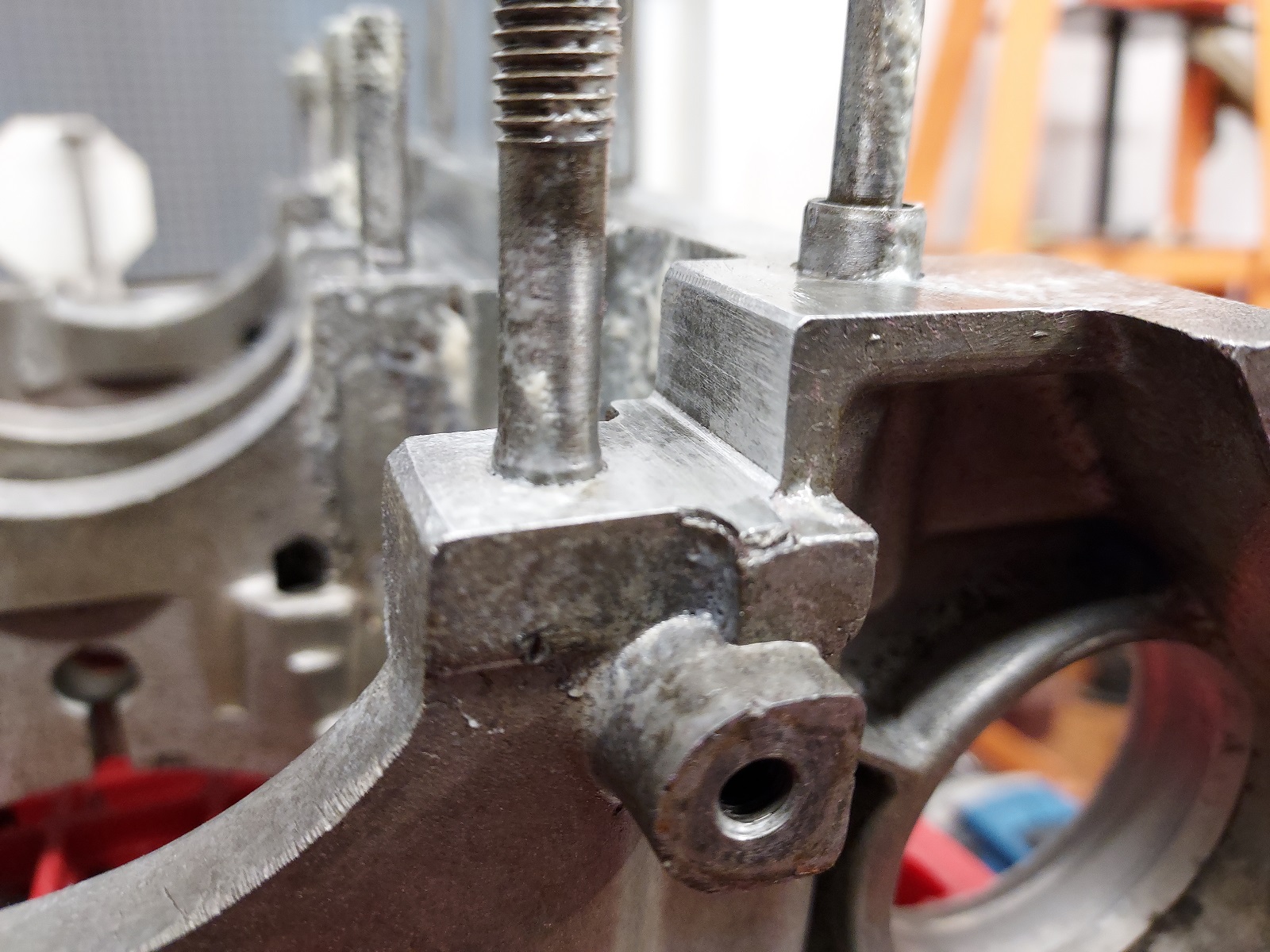
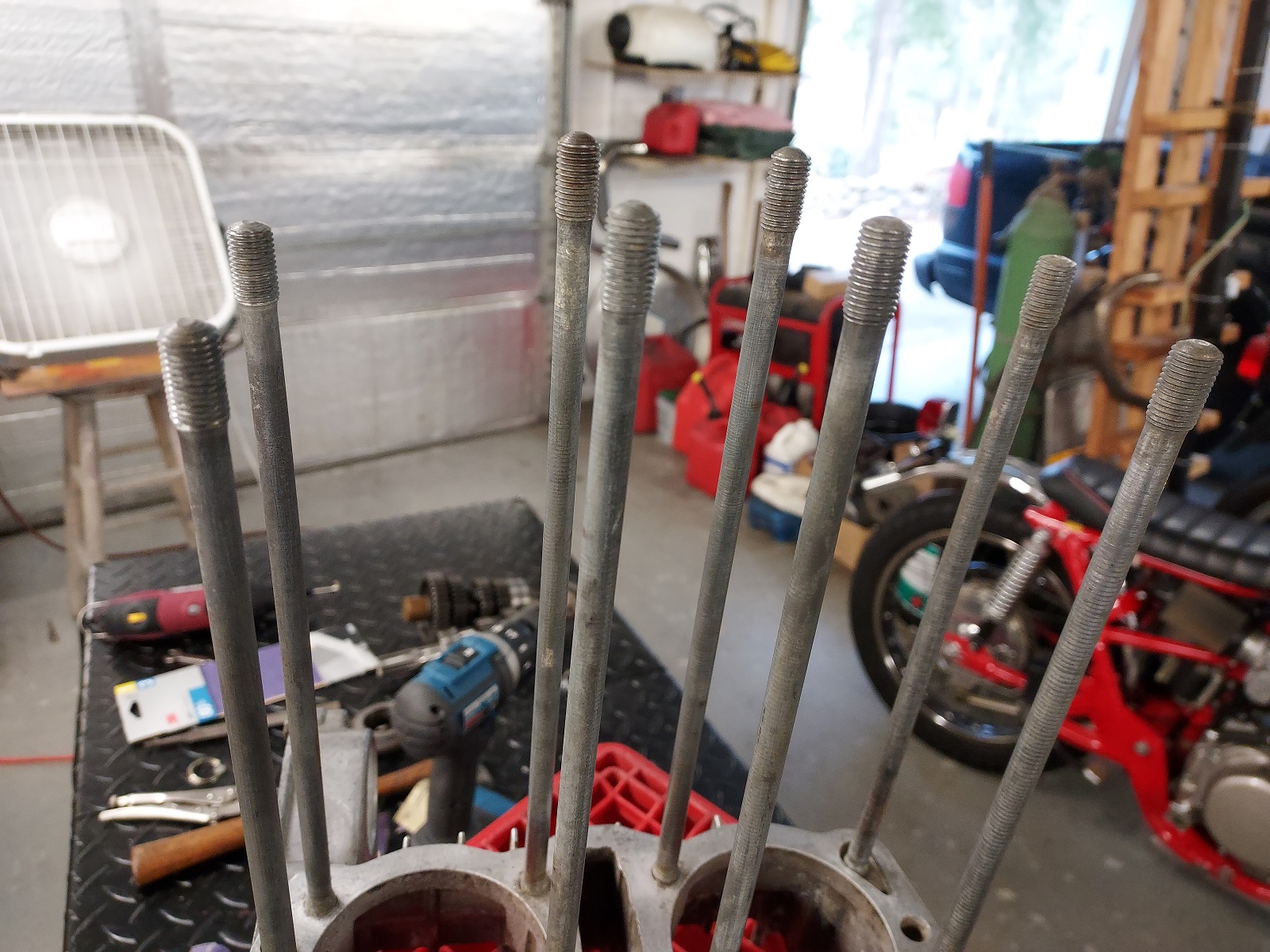
Set out to clean up the rusty crankcase studs and cylinder studs on the upper case, first a view of how rusty one lower case stud is (out of focus, top of picture)

8Q0MAie.jpg


After lots of cleanup with emery cloth and a small brass wire wheel

nnkMGA4.jpg


1mnMcGN.jpg


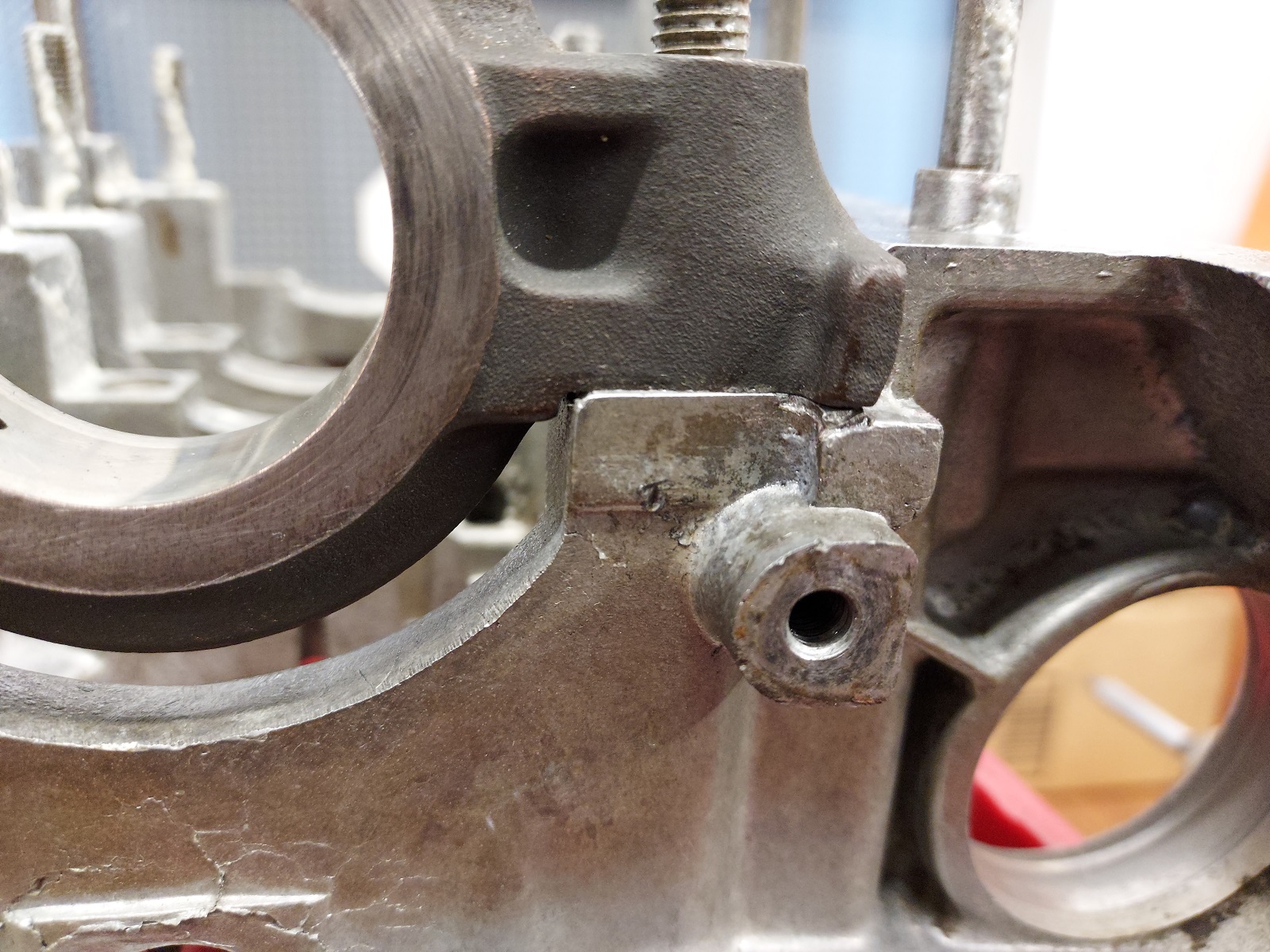
I lubed them up with white spray grease to prevent any return. Then while checking the fit on the outer races of the crankshaft bearings over the mounting studs, discovered that the upper case was significantly corroded causing a lot of binding so the vertical and horizontal surfaces had to be cleaned up with fine sandpaper wrapped around a flat file and skinny flat screwdriver

xzrUEOS.jpg


xj176rK.jpg


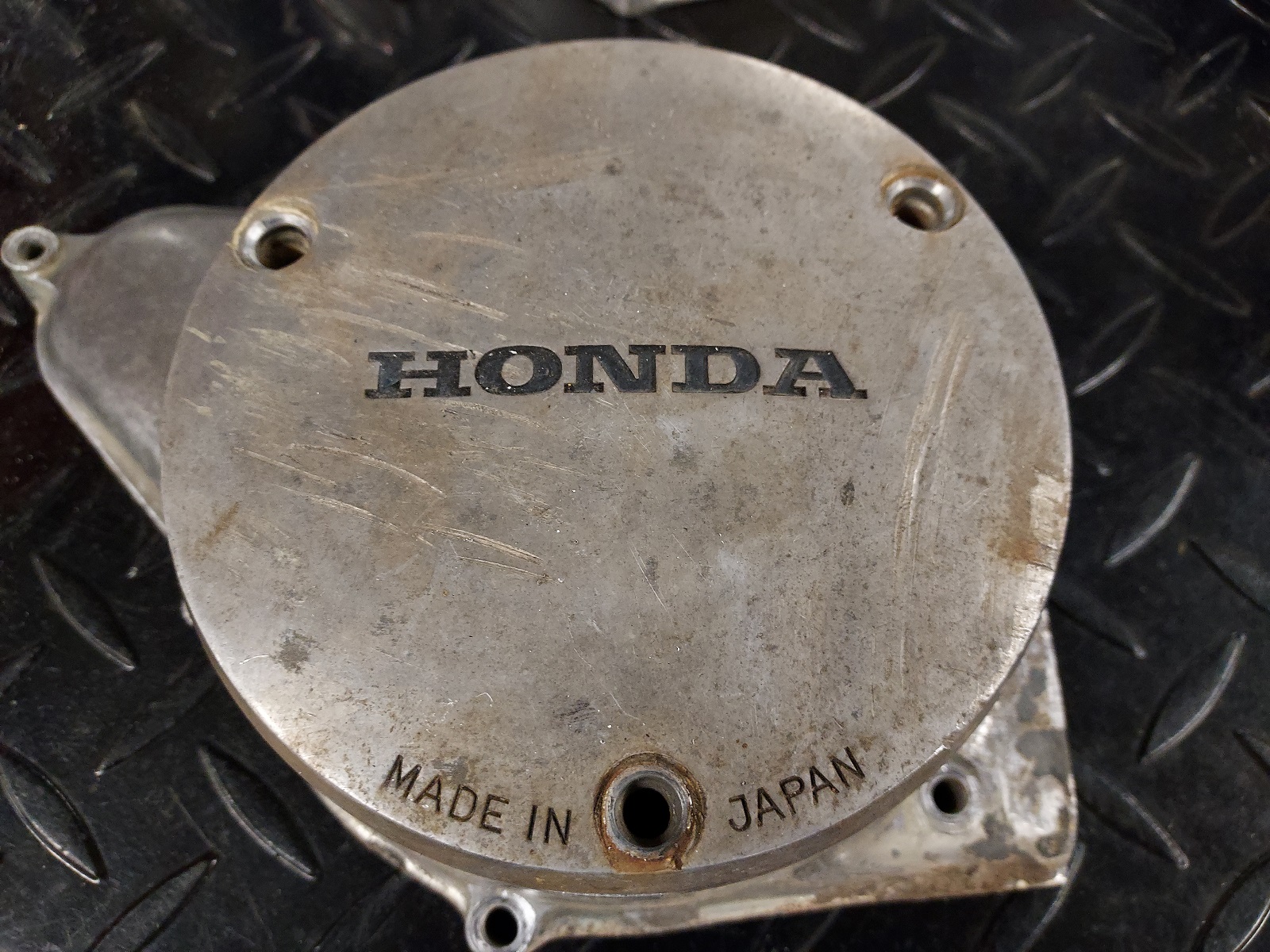
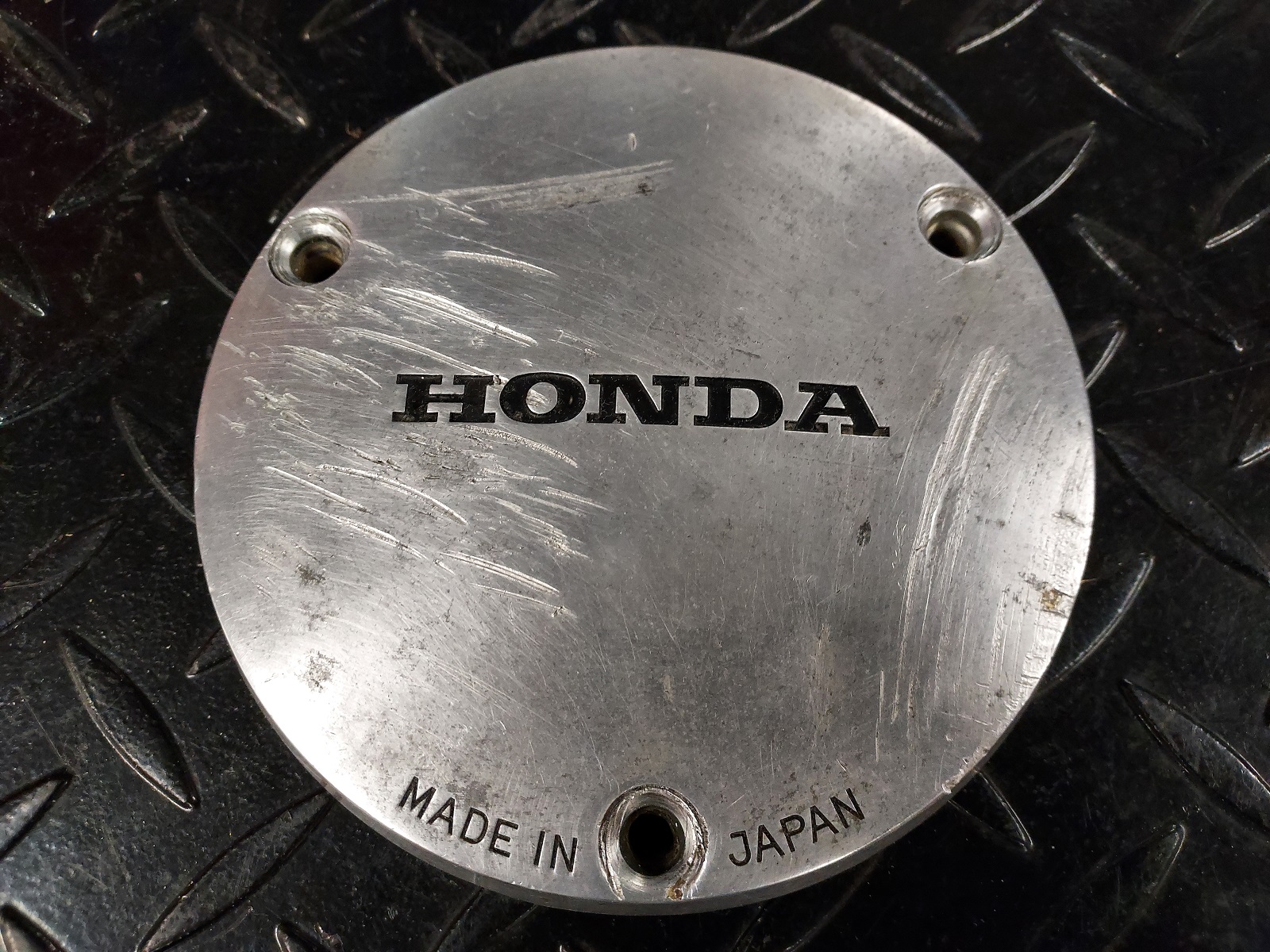
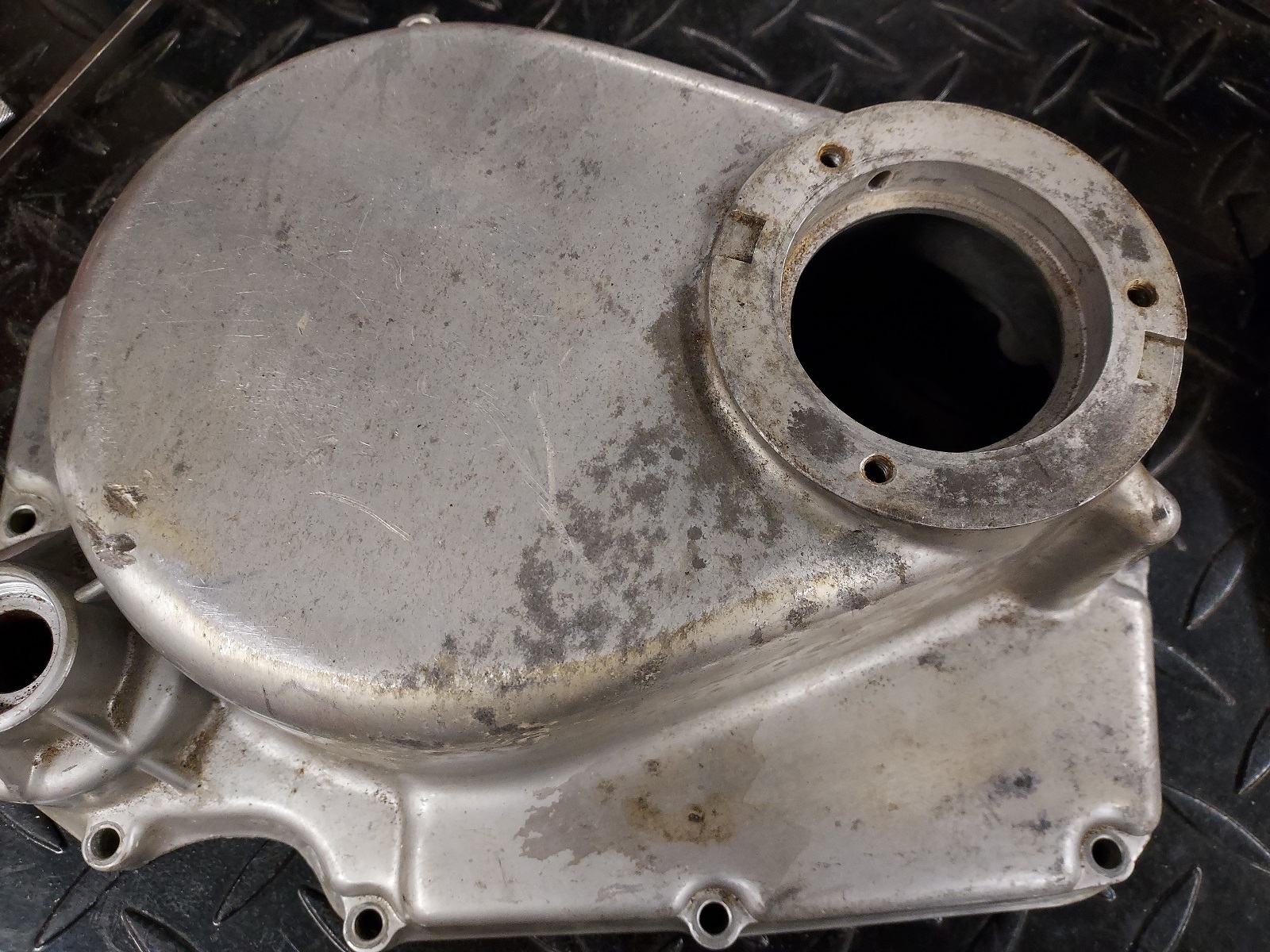
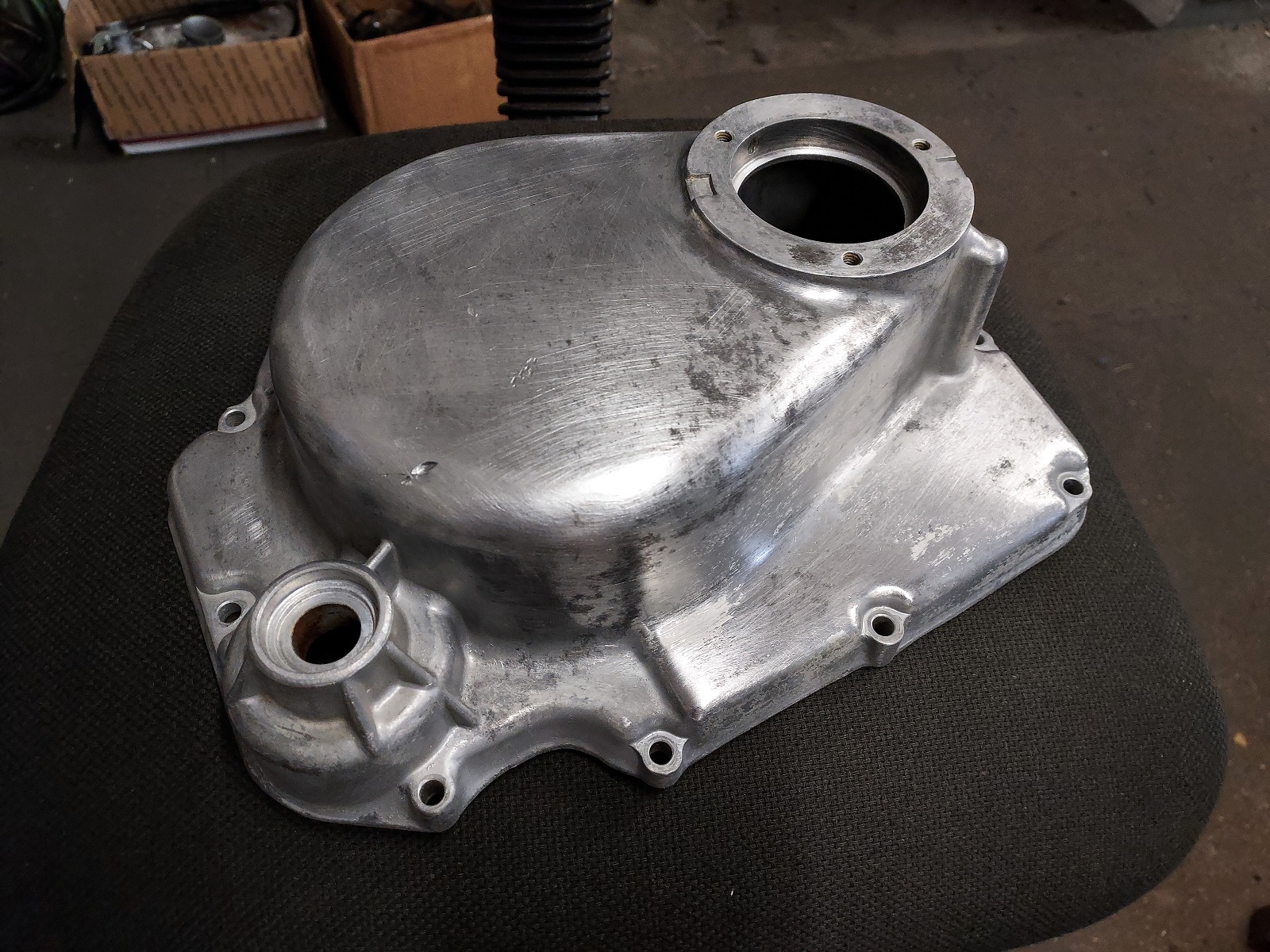
Even the outer covers must have sat outside or in some sort of storage with more exposure to dampness. I'll be leaving the rotor cover as is after cleanup with a scrubby pad and hand cleaner, these engine parts all lived a tough life and they show it

poWB1h9.jpg


after, good enough for this bike

R0d4VQA.jpg


Left crankcase cover

waZ5qWl.jpg


MLfscia.jpg


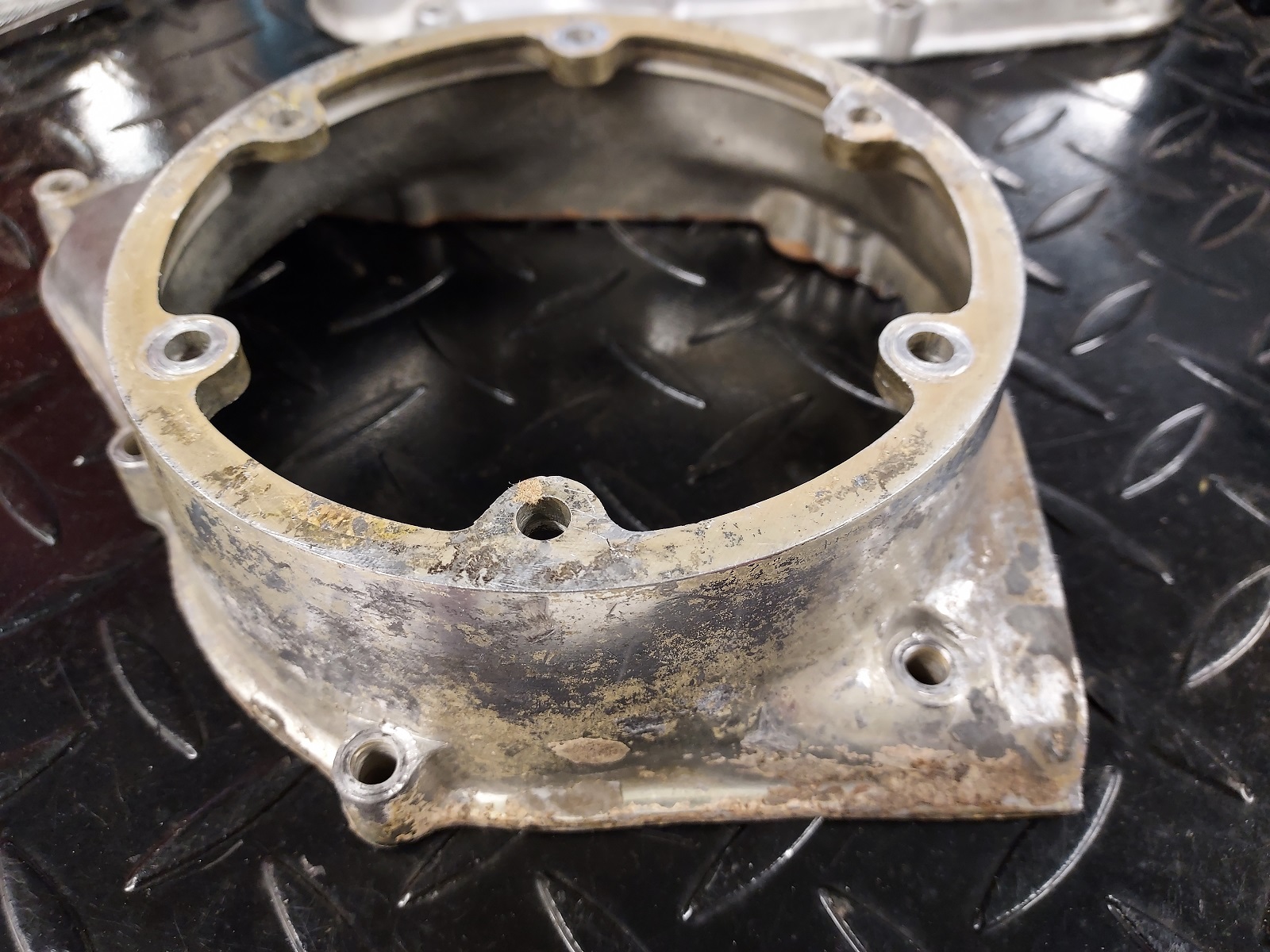
I lightly wire-brushed the left crankcase cover but since the right cover was larger and much harder to reach all the areas equally, I had to hand sand and wire-brush so the finish isn't the same. As a result I'll be painting them satin black
 
Last edited:
Right crankcase cover even had corrosion in the sealing area for the oil filter cover, obviously sat open and disassembled. It also had the start of a small mud-dobber nest in one of the oil filter passages

fOJD3KR.jpg


IGWY5rI.jpg


5O7zgLh.jpg


Overall view before, mass corrosion and some crash damage

Qw7NMKL.jpg


after, good enough to paint

0lMGwmt.jpg


ZCMds74.jpg


hbQcuIS.jpg


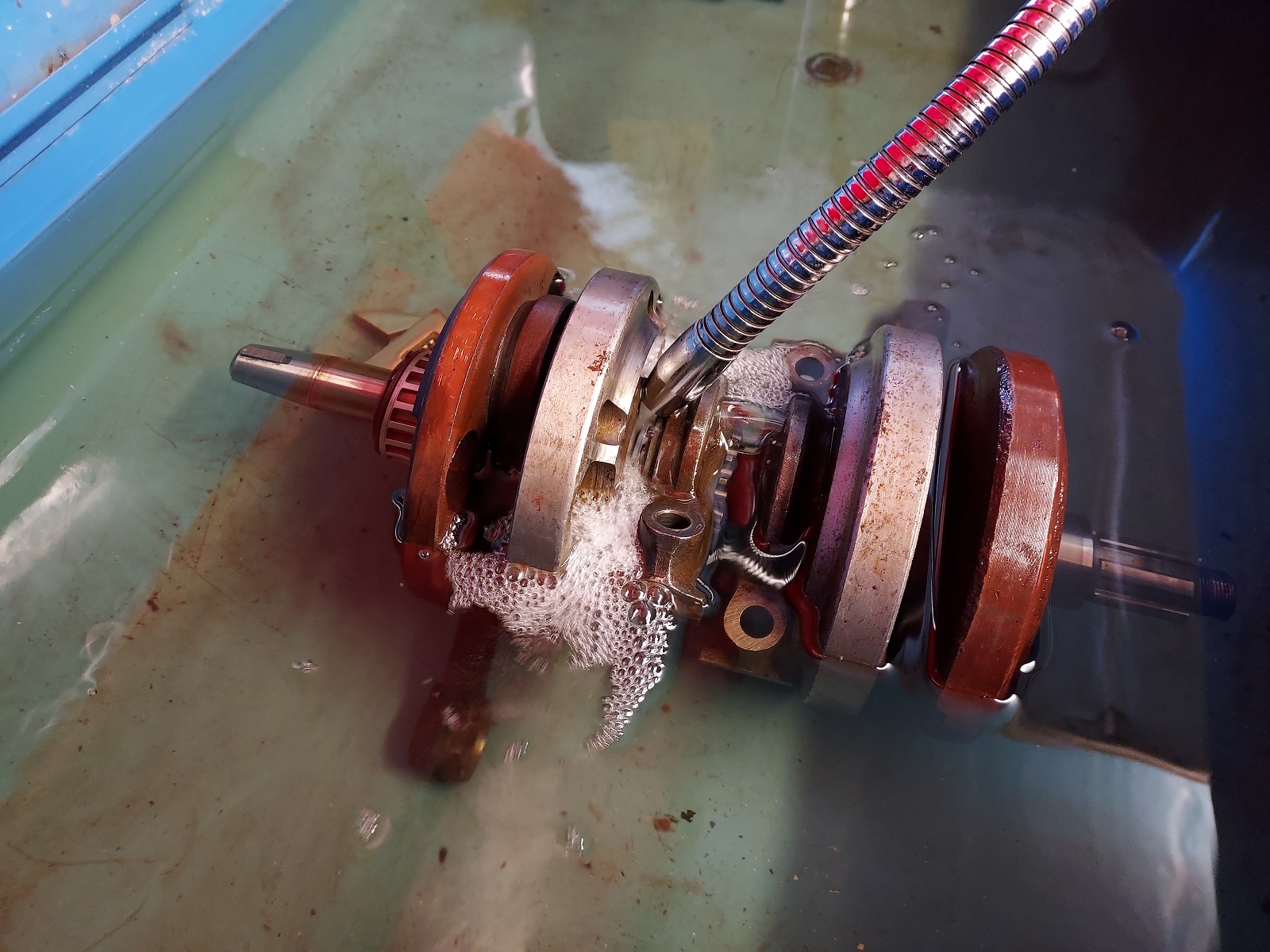
Oh yeah, and I've been soaking/rinsing the crankshaft too. And to think HF told me when I bought this parts washer almost 6 years ago that I shouldn't use anything but water-based solvents in it. Good thing I didn't listen.

TKL2G3Y.jpg
 
Last edited:
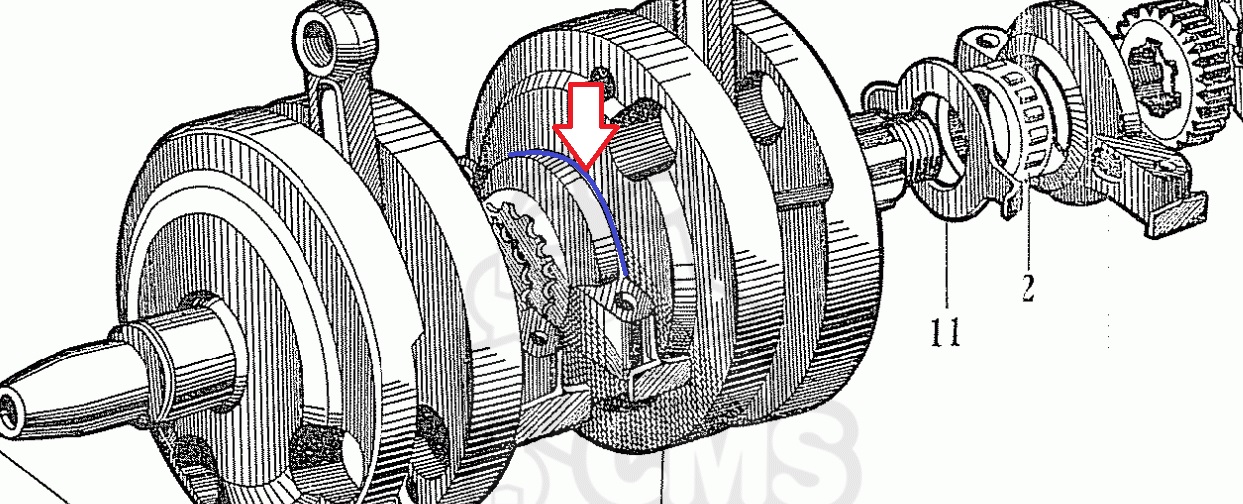
Had a nice visit with VHT member and 450 oil pump design genius Jays100 yesterday. He happened to be in Florida for his job and was able to take some time to drive over. He took my wife and I out for a very nice lunch and we enjoyed a couple cold ones in the garage afterward. Of course we talked about everything Honda and the 450 in particular, and he shared a few thoughts and ideas with me about cleaning up my 4 speed crankshaft oil passages.

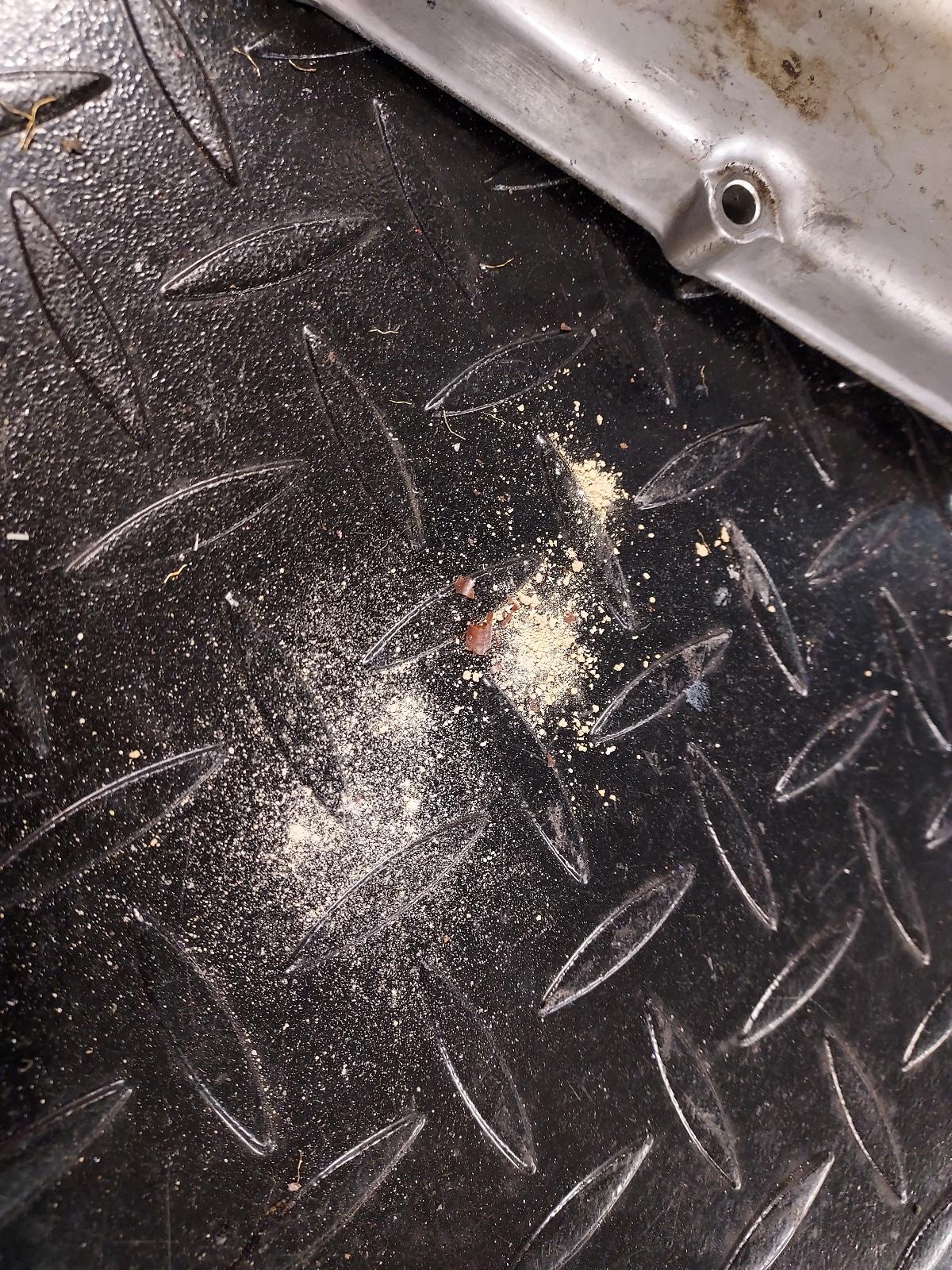
With respect to that last subject, I had made some progress scraping loose the modest amount of buildup in the curved and circular channel in the inner crank throws where the feed holes are for the big end rod bearings. After finding something I could use to get in there to scrape the (essentially) centrifuged micro-debris stuck in each side, there was a small scattering of it on the bench. It looked like just gray crud, but I wanted to see if any of it was metal that could be picked up with a magnet. To my surprise, virtually all of it was.

ZnZMeoq.jpg


The debris stuck to the magnet tip is illluminated with LED light from a flashlight, it isn't really bright color as it looks in the picture.

So now more fun will be had. Most, if not all, of the accumulated debris is out of one side but of course some of it ended up falling into the main bearing on that side as it came loose because you have to retract the outer main bearing race to get to the curved groove machined into the the inner side of the crank throw.

This is a basic look at where it accumulates, behind the main bearing outer race is the half-circle groove machined into the inner crank throw. I couldn't find an image online, and I'm pretty sure my phone camera wouldn't focus properly on it with all the other parts of the crankshaft in varying degrees of closer to the lens.

0iwNEoA.jpg
 
Last edited:
Sounds like a good time, Tom! Good to see an update on this project.

It was Brody, Jay is as nice a guy as he seems. Wish he could have stayed longer, we had a lot of fun conversation. I learned he once worked for the legendary Russ Collins at RC Engineering! He took a look at the port work Chris Schumann did for me and was favorably impressed, he believes it will run well. Now I just have the burden of getting things right while putting it all together to ensure I get the most out of the good professional work I've had done.

But first I have to get the crankshaft as clean as I can get it.
 
The best thing you can do to your crankshaft is to take it apart, clean and press back together.

While I'm sure that is true Jensen, unfortunately it is not something I can do myself and there is no one anywhere near my area who I could trust to do it for me, regardless the price.
 
Back
Top Bottom