Mousetown, my own 73 CL350

I found this on eBay earlier this summer and I don't think it had ever been used.

Screenshot_20250723-104851.png

I had to buy a power adaptor in order to plug it into a wall socket, but it seems to clean plugs fairly well. I have yet to reinstall a cleaned plug, but with the scarcity of non-resistor plugs I wanted to give it a go.

I'm using the ND W24ES-U plugs also and I think I have two unused NGK B8ES plugs for a rainy day.
 
And do not use that BP8ES with the Projected tip.
Right, I did not. Not sure how they ended up here. Would have to do a clearance check with a spare head, piston and silly putty blob gauge first.

I had to buy a power adaptor in order to plug it into a wall socket, but it seems to clean plugs fairly well. I have yet to reinstall a cleaned plug, but with the scarcity of non-resistor plugs I wanted to give it a go.
I had one that ran on 12volt, not as good as the ones that run on compressed air. Must be sure to clean out all abrasive media, when done. Probably better to burn them clean, as Jensen had suggested to me. I had only degreased in gas, then wire brushed these used ND W24 ES-U plugs for a short term use. They never last as long as new ones.
Depending on how that cleaner works they can reduce the spark plug heat rating.
That makes sense. Cleaned plugs didn't last as long as new either. Sometimes a handy cheap-skate tune-up tool, though.
 
Sometimes a handy cheap-skate tune-up tool, though.
Good for in-a-pinch testing purposes at the very least. My father had one when I first started riding and we cleaned many a plug in it, but as you mentioned the plugs that were fouled didn't clean up well enough to last very long. Not sure if the lead in gas back then had anything to do with it.
 
"after loosening the eccentric rocker shafts the cam housing slipped right out"

Hey ballbearian, I also have a slight leak behind the left side cam housing. Haven't disassembled it yet to find the exact source, but
I've ordered the two o rings and have a cheapie replacement gasket.

What position should the motor be in before starting to remove it?
TDC with all 4 valves loose?
Do I need to do anything with the camchain tensioner before I start?
 
Good for in-a-pinch testing purposes at the very least. My father had one when I first started riding and we cleaned many a plug in it, but as you mentioned the plugs that were fouled didn't clean up well enough to last very long. Not sure if the lead in gas back then had anything to do with it.
I would say probably, because I've never had real issues with 2T plugs fouling in the mopeds unless you ran it incredibly rich and you would know that because it would "four stroke".
 
Yes and remove all tension on cam, or you'll scratch the soft aluminum cam journals.
rXwQ9de.jpg
 
"after loosening the eccentric rocker shafts the cam housing slipped right out"

Hey ballbearian, I also have a slight leak behind the left side cam housing. Haven't disassembled it yet to find the exact source, but
I've ordered the two o rings and have a cheapie replacement gasket.

What position should the motor be in before starting to remove it?
TDC with all 4 valves loose?
Do I need to do anything with the camchain tensioner before I start?

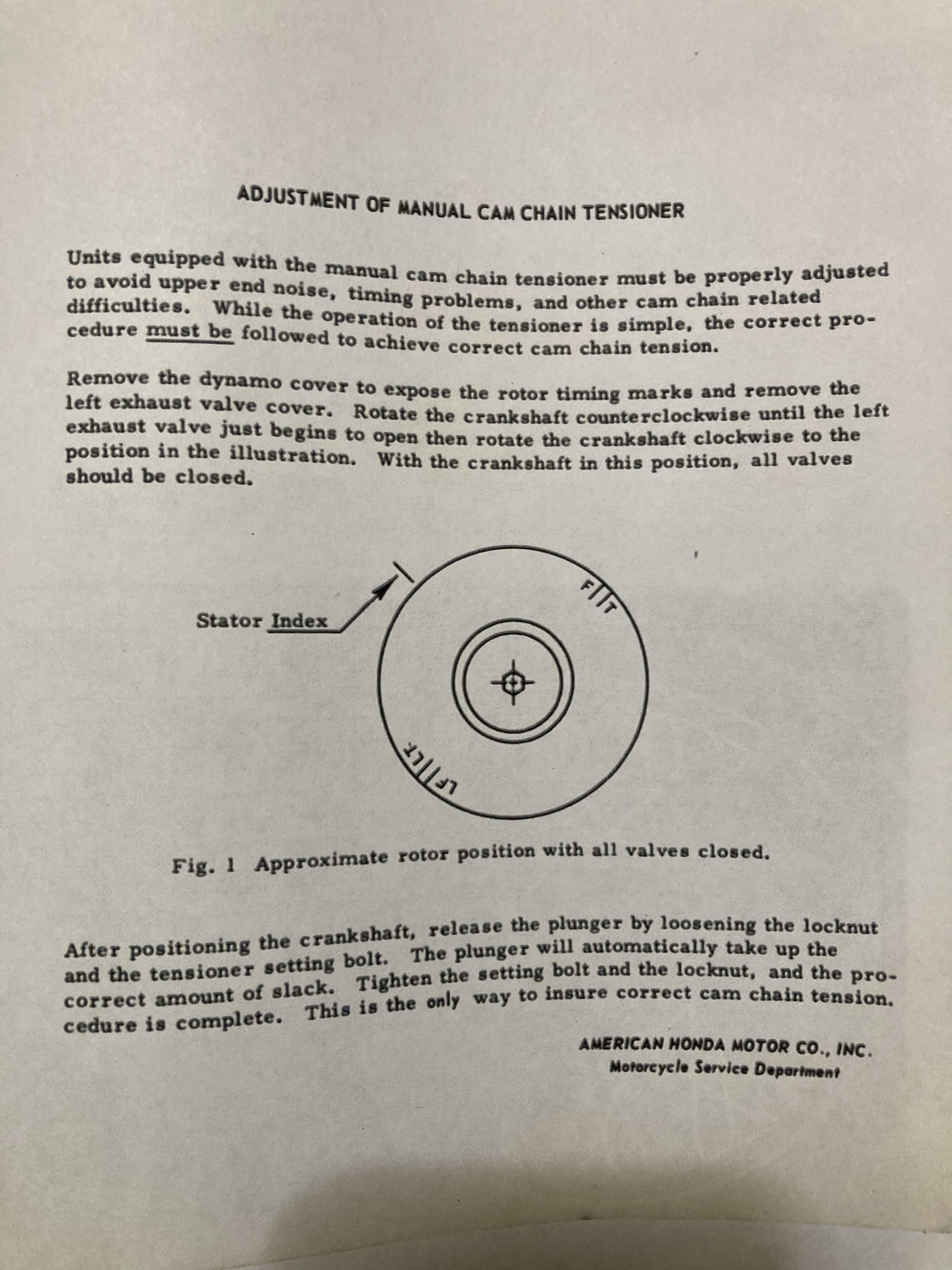
Rotate the engine so the cam pin is at approximately the 5 oclock position ... same place the tensioner is adjusted at.
Remove the tensioner.
Back off all the adjusters.
I lube the rocker arm adjusters and the bottom of the support and of course the cam.
I use allen head screws instead of the JIS screws but if using the screws I use my 12V impact to snug them up.

Not Ballbearian but Im waiting for paint to dry ...
 
Not Ballbearian but Im waiting for paint to dry ...
Please and thanks. I failed 'waiting for paint to dry' class twice.

Thanks guys!
Don't put your gasket on backwards, like I did. Post 655 shows the original correct way on the black one. The dual use gaskets (right or left side of head) have a 6mm hole not needed when used on the left cam. That hole caused a minor leak when I flipped it (copper sprayed one).
My main leak was at the cam box to head joint nearer the front corner.
 
Thought I would post on measuring plug resistance. The red probe touches both the tip and the ground prong. Must be doing it right because I got 0.01 ohms when meter setting at 20k ohms. All of the new ND W24 ES-U plugs were the same but most of my NGK plugs had either no continuity or way high, like 10k++ ohms.
With new tested 5k caps, I’m ready for the restart.
IMG_1717.jpeg
 
Hey BB! So my understanding is that you should read 0 ohms from top of spark plug to inner electrode - it's just a wire, well insulated from ground that is the metal body(ground) that includes the little arm that sits over the inner electrode that carries the high volts and zaps between electrode and ground. These meters don't measure real accurate at 0 ohms, so you may read 0.01, or 0.8ohms, or 2 ohms or 8 ohms. For best results set to lowest 200 ohm range. It should just be a short(0 ohms) from tip to electrode, and it should be open(super high resistances) from tip to ground case. If you wanted to test that, go with the highest range 2000K. I'm not aware of spark plugs having built in resistors, I don't think plugs have that, they are simple things. I could be wrong. I do believe some of the wires or end plugs have resistance like 5K ohms, I think that is just to reduce emissions so you don't upset the guy in the car next to you listening to AM radio or god forbid interfere with his cell phone reception.

I have the same meter, plus a few more, I am fond of the HF red meters as they include the on/off switch so you don't have to be flicking that rotary knob all the time.

Carry on! I got my bike out today and no juice. Turned out just the battery nut came loose. I knew it would be something easy.
 
I left the meter set on 20k (from checking caps) and you can't see the decimal point. I mostly wanted to show the location of the probe tips. Usually, I got 0.002 at that setting, for non-resistor plugs, so.
Sure, there are resistor plugs (NGK BR8ES, R for resistor) 5k ohm resistors built in. I've been told that balance with total coil resistance is needed to keep other bad things happening, besides neighbor irritation.
Since I'm a beginner, I never thought I deserved a good meter and accumulated several HF units when they used to give them as freebies. They do love fresh batteries and still disagree from time to time.
I just know the bikes run bad if the plugs/caps aren't right. Even some new stuff isn't right, a lot of vendors sell junk. I'm done paying for NGK antiplugs, ND W24ES-U for me. Many resistor anticaps out there too.

Glad it was easy. Keep your nuts tight.
 
Thanks BB for trying to keep me honest. Not an easy proposition. If the plugs have 'R' in the name then surely they must have a resistance built in that you could measure. If it's 5K ohms then 20K ohm meter range should be good to measure.

I don't know how my battery nut came loose, it just happened and my bike had no electrical juice. I was in a hurry so took the car. When I got back it's the first thing I checked and sure enough it was almost falling off.

Just goes to show, always keep your nuts on tight. Gonna take the 2 wheel gas machine to work this morning, a simple joy. I was looking into power comparisons of electric bicycles compared to our gas powered machines. Mine is around 40 horse power. A typical electric bike has a 500W motor say, that's like 0.67 HP. This was after a news report about modern bicyclist racers, and they have a gauge that tells them how much power they are generating in watts per kilogram.
 
Some rain’s coming so I rode the 11 mile test loop. It does 80 mph near red line with the stock CL gearing and quick.
Still leaked maybe a teaspoon but less stumble 3-4K rpm. I don’t know, back to checking the basics, points/timing, float level, air/fuel screw.
Sweet corn is in. Yum.IMG_1720.jpeg
It’s a fun ride and has a 5th gear too!
 
I free- handed another retorque. Maybe north of 30ft/lbs now. It was done cold.
Really? I'm replacing the gaskets on my CB350 right now. The FSM seems to say 13-14.5 ft-lbs, right? I'm interested in going a little higher, but don't want to pop a stud. In this thread, LDR mentions 13-18 ft-lbs.

So, 18 ft-lbs should be okay?
 
Really? I'm replacing the gaskets on my CB350 right now. The FSM seems to say 13-14.5 ft-lbs, right? I'm interested in going a little higher, but don't want to pop a stud. In this thread, LDR mentions 13-18 ft-lbs.

So, 18 ft-lbs should be okay?
You could probably go 20, I've gone over the factory torque spec on my 450 by at least 5 lbs safely.
 
I pretty much always go slightly above factory torque spec, usually in the 25ft/lb range. (I even bought a 3/8" drive torque wrench before I worked at dealers, haven't had it tested for over a decade now though)
It does match up with beam type and electronic ones pretty good so I guess good investment 50 years ago?
I don't go much higher than that even on 390cc 'CB360' as things can distort through over tightening (if you've worked on air cooled Beetle motors it's mentioned in many books)
On CB350, if you fit 10mm studs from XS650 it's possible to clamp down tighter but that's quite rare even on race motors.
One thing you should remember, torque wrenches are never 100% accurate (even very expensive ones or electronic) so whatever torque you set is usually in the +/- 5%~10% range
 
Last edited:
I would not recommend what I did. I was only trying to stop a leak. If the motor comes out for a new gasket and check the surfacing of the mating areas, I will also closely examine the stud threads with a thread pitch gauge for stretching. As AD said, another 5ft/lb is no big deal.
 
The points and advancer could be conspiring to befuddle my 3-4K rpm stumble hunt. Going to check advance curve too.
FSM says start advance at 16-20K rpm and full advance at 32-38K rpm.
Straight line extrapolation (not really a curve) shows 20 degrees at 2.5Krpm and 25 degrees at about 2.75-2.9K rpm, and 30 degrees at 2.9-3.2K rpm.
Protractor and sharpie will be applied to rotor face, left and right.

There are probably other charts around too.

Could be baggy advance spring syndrome or Tin Man cries, "oil can"
 
Last edited:
Can you describe the stumble? I'm assuming it occurs as you accelerate, but if you run along in that 3–4k range does everything feel/sound smooth from the ignition?

A couple of my bikes had been sitting a really long time before I got them running and I experienced a stuck/sticky advancer on one or two. If stuck, it was like the ignition would break up as the full advance speed was reached, making it almost impossible to push through to higher rpm. If sticky, it would sound similar, but eventually push through and the ignition would clean up after the advancer freed.
 
Last edited:
Back
Top Bottom