Blue Dream CA78

What grit flex hone do you guys like? I got a 180 grit on the way. If these cylinders are not too belled or oval, do you think honing is a possibility (if the std pistons are salvageable)?
 
S'cuse my drawring. I took it apart and updated my specs. The weird rivet catches and funnels oil into the bearing sleeves. The swaged tabs broke, of course, so maybe drill and tap a short screw for re-assembly if re-using the sleeve bearing and rivet. I did not measure the fixed/cast in place/ pressed in steel outer sleeve but retaining that is probably smart, even with Delrin.
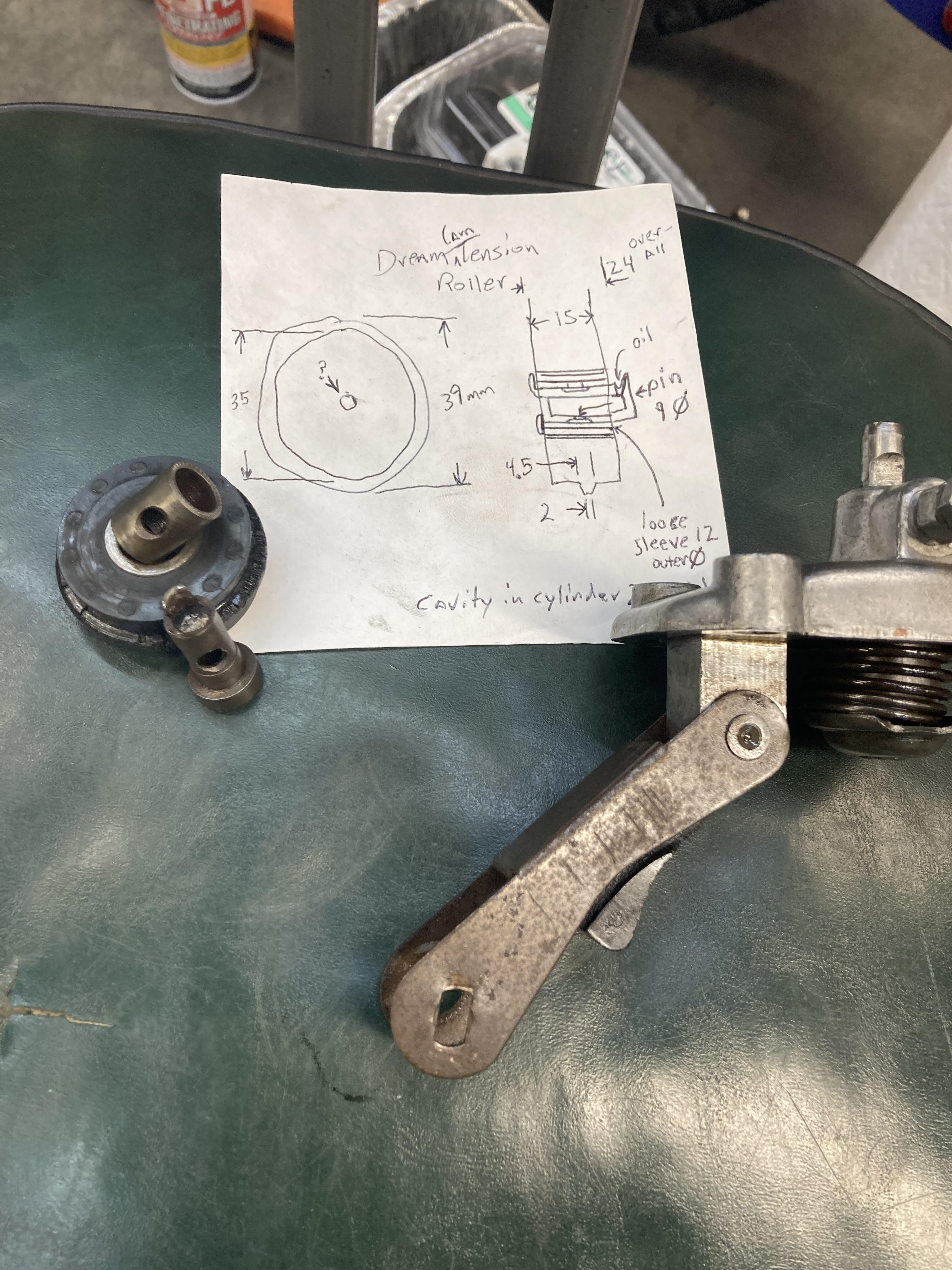
Ncp5KDx.jpg


This kind of a side project because I have 1 useable tensioner right now and I have bigger fish to fry.

So did you squeeze that tab to allow you to push the pin through the roller and apart. I am considering the Cappellini part after I meet with my machine shop guy tomorrow. We are installing the new pistons and barrels back on my motor. (pics to come). I will get his opinion on the used tensioner I bought off EBay, as noted it looks decent, yet the rubber is very hard.

Can't help you with the honing etc; as this is my first foray into a full rebuild of a motor to this level and detail. I try to buy bikes that need less motor and mechanical work and cost. LOL.
 
180 grit will be fine. You want to wet hone the cylinders so plenty of engine oil on the walls. It doesn't take a lot so run at medium speed. Full strokes where the hone comes out of the cylinder partially on both ends. Do 3 in strokes and 3 out, stop/clean/inspect. Repeat as needed. You only want to clean up the surface w/o removing much material. Once done then it's inside micrometer or bore gauge time to see where you are at. The top discoloration may not go away but as long as there's no ridge line it's of no concern.
 
So did you squeeze that tab to allow you to push the pin through the roller and apart. I am considering the Cappellini part after I meet with my machine shop guy tomorrow. We are installing the new pistons and barrels back on my motor. (pics to come). I will get his opinion on the used tensioner I bought off EBay, as noted it looks decent, yet the rubber is very hard.

Can't help you with the honing etc; as this is my first foray into a full rebuild of a motor to this level and detail. I try to buy bikes that need less motor and mechanical work and cost. LOL.

I pried and tried to not break the two tabs but one broke. My plan is to use a screw to reassemble. I do not think hardness is an issue per se but may indicative of eventual failure from being brittle. As stated above, Bill Silver suggests using steel or hard nylon for racing applications. If it is soft, like OEM, it may be quieter. I would look for fractures and spinning freely, also adjustment rod should slide without binding.
 
Thanks for the info there. I did contact Bill and he suggested using the Cappellini set if I was going to do a change out from OEM. I sent him a listing for an EBay seller of an early CB450 DOHC used tensioner with many different wheels attached. The seller wanted around $75 US for the set, so Bill suggested the Cappellini set. Cappellini do also sell just the middle roller part with a screw to reassemble in two diameters, less the gear roller. I think the EBay seller wants around $35.US for just that part.

I still have lots of time to decide which option to use, as that part can be changed out easily with the motor fully assembled I would expect.
 
180 grit will be fine. You want to wet hone the cylinders so plenty of engine oil on the walls. It doesn't take a lot so run at medium speed. Full strokes where the hone comes out of the cylinder partially on both ends. Do 3 in strokes and 3 out, stop/clean/inspect. Repeat as needed. You only want to clean up the surface w/o removing much material. Once done then it's inside micrometer or bore gauge time to see where you are at. The top discoloration may not go away but as long as there's no ridge line it's of no concern.

I shall proceed, since you did not say it's trashed. I thought the bores looked hone-able but, when I saw the top rings, it didn't bode well. Long ago I was shown to use a 3- stone hone and also to use a cleaned measured piston upside down with feeler gauges for lack of a bore gauge. I'll clean and measure and post here. Thanks Jim for helping to keep me on track.
 
Thanks for the info there. I did contact Bill and he suggested using the Cappellini set if I was going to do a change out from OEM. I sent him a listing for an EBay seller of an early CB450 DOHC used tensioner with many different wheels attached. The seller wanted around $75 US for the set, so Bill suggested the Cappellini set. Cappellini do also sell just the middle roller part with a screw to reassemble in two diameters, less the gear roller. I think the EBay seller wants around $35.US for just that part.

I still have lots of time to decide which option to use, as that part can be changed out easily with the motor fully assembled I would expect.

$35 sounds worth it. Easy to change any time.
 
I shall proceed, since you did not say it's trashed. I thought the bores looked hone-able but, when I saw the top rings, it didn't bode well. Long ago I was shown to use a 3- stone hone and also to use a cleaned measured piston upside down with feeler gauges for lack of a bore gauge. I'll clean and measure and post here. Thanks Jim for helping to keep me on track.
I can't say one way or the other since there's no real obvious damage. I would get the hone done and then a trip to a machine shop who will have a bore gauge to properly check the cylinders. Those top rings are pretty screwed up so this needs real careful inspections of the bores and the pistons.
NOTE: after honing the bores have to be scrubbed out with Hot water and Dawn to remove any debris, a light spray of WD40 after dried.
 
Thanks Jim. I just finished Very careful cleaning out ring grooves and quick measured pistons at wrist pin center: 59.89-59.85. Flex hone just arrived. Waiting on new std. rings to measure side gap. Will probably buy bore gauge because I can't find a shop to work with near me.
 
Last edited:
Surely someone makes these wheels. Trying to understand why the pivot/rivet head looks so weird. An oval allen and nut would have plenty of room.

Zv03wf3.jpg
That funny shaped rivet head is shaped that way for oiling purposes, catches a bit of oil to keep the bearing in the roller from running dry.
 
Yes, Mike. I finally figured it out, lol. The primary chain adjuster has the same pivot but it still got stuck fast. The oil can go in but it doesn't have a way to drain out so accumulated grit can cause it to seize anyway. Perhaps a small design shortcoming.
 
$35 sounds worth it. Easy to change any time.
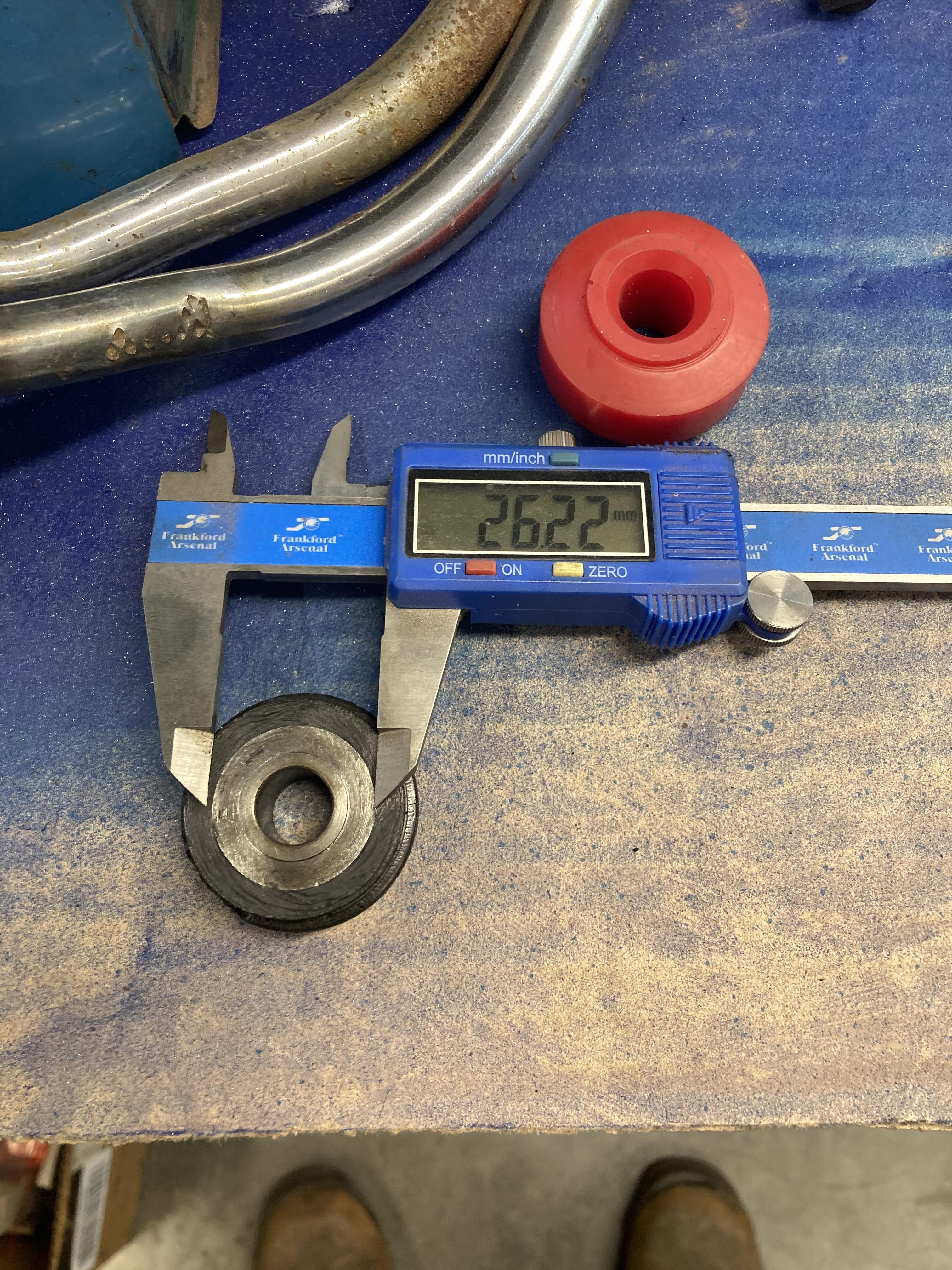
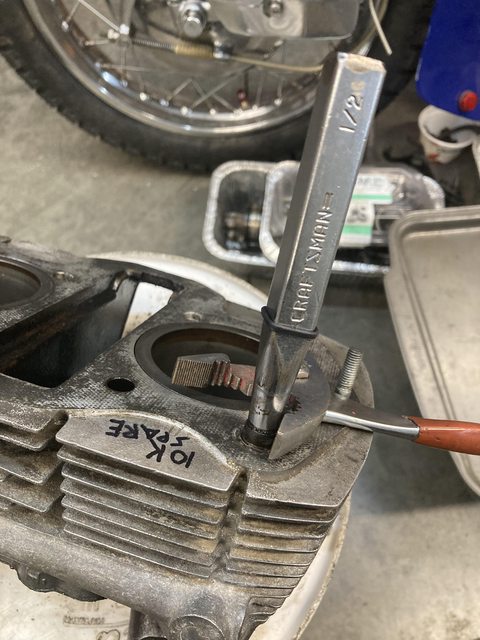
The fixed outer steel sleeve was more substantial than appeared. Used a wire wheel to remove thin amount of rubber concealing overmolded large bushing. Probably Delrin with only the loose inner sleeve is the viable home repop. I may tinker more down the road but will currently run my one good used unit. Thought I would post pic for the curious.

CYa9hXq.jpg
 
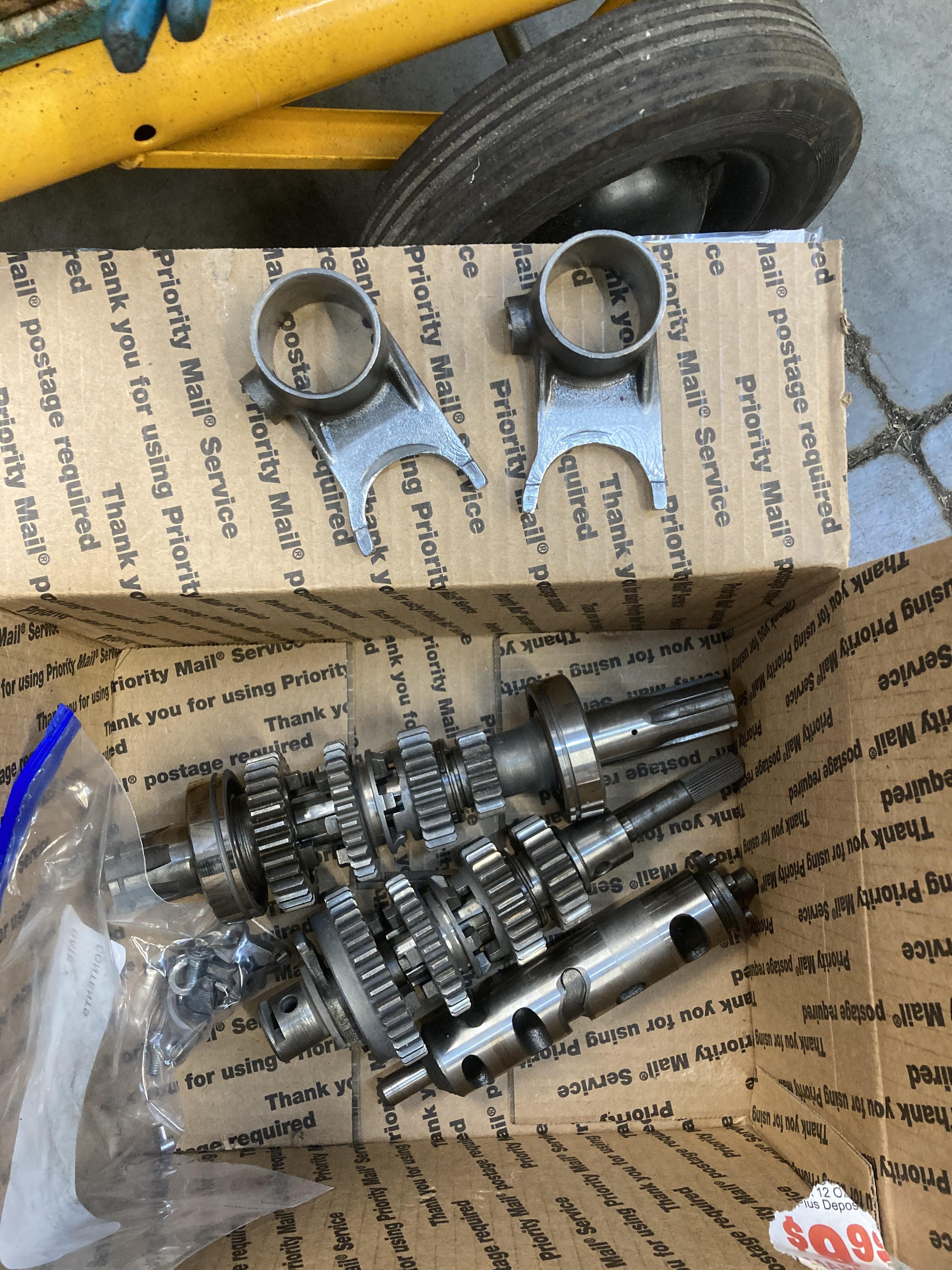
Replacement shift forks

I got my trans parts lot from ebay and was a little disappointed at the true condition of the forks. Seller did not show this side in ad but said only 5K miles. Oh well, a few bits I can use. I should measure perpendicularity in 2 axis and tip widths to see which candidates will get used (or straightened). There is a fair amount of radial wear on the C bushing and everything in general.
YNBLwMF.jpg
 
I bought a set of trans shafts, gears, shift drum and forks for my 4 speed 450 bottom end and that seller did the same thing, took careful pictures that did not reveal how badly the forks were gouged. Despite yours looking better than mine, I'd only use the one on the right and only if there were no other options.
 
Hi,

It's hard to say if the seller spoke the truth about the 5K miles or not (he probably was), however, not fair not the show both sides in the add. If you look carefully at the outgoing shaft were the rear sprocket is attached, I would say it's from a low miles bike. I'm curious how the kick-starter shaft looks like, it says almost everything about the oil quality and maintenance schedule performed by the PO(s).

Those early transmissions are a complete gamble. Much depends on maintenance, the used oil, and how the bike is handled by the PO. I have seen transmissions with 30 K plus miles on it, and still very usable, and I have seen transmission with just 7 K miles on it that where ready for a complete overhaul. Look very carefully at the state of the tooth of the higher gears (hardening issue's). Like I mentioned earlies, it's better to weld them up and to grind them down and make them fit the gear. Tolerances then weren't as good as the tolerances now. Honda had to learn a lot and they got it right with the late CB72's and CB77's and 450's. The later shift forks, just like clutches are much better then the early ones. Remember, only the late clutches had dampening between the gear and the clutch basket. No dampening in the transmission isn't good for the gears and forks either.

Jensen
 
I got my trans parts lot from ebay and was a little disappointed at the true condition of the forks. Seller did not show this side in ad but said only 5K miles. Oh well, a few bits I can use. I should measure perpendicularity in 2 axis and tip widths to see which candidates will get used (or straightened). There is a fair amount of radial wear on the C bushing and everything in general.
That is unfortunate for sure, yet it shows a lack of honesty on the sellers part as they likely avoided showing that side with the wear. The one on the right is usable if you cannot find any other options. Unless you can find a shop that will do the work as Jensen suggests, yet any shop I have used would cost a fortune to do any small custom work like that. I am having my kick starter knuckle hard chromed to take up the wear in the side case bushing where the elbow goes through for the kick starter. That is $175.00 just for that hard chroming and then machine back to the spec that I gave them to size it.

As Tom noted this is my first and last 305 build. I love the bike and its looks, yet the parts are too few and far between and silly prices when you do find something available.
 
Last edited by a moderator:
I love the bike and its looks, yet the parts are too few and far between and silly prices when you do find something available.

The silly prices are something of the last 5 to 10 years, I remember buying a lot of NOS parts for these bikes before that time. I have boxes full of pistons, rings, gears, shafts, cranks, camshafts etc, mostly bought in batches. Nobody wanted them, dreams weren't sought for, parts where cheap, especially the dream parts (but most parts are interchangeable between with CB72 / 77 parts, which where already more expensive). The parts I mentioned are not interchangeable, thus cheap. Nobody wanted to have a dream, everyone wanted a CB77 or a CL77.

Pistons.jpg
 
Your very fortunate and astute in buying when the opportunity was there for your bikes and parts. I could have used the big ball bearing on the crankshaft end, as every ball bearing in the motor was damaged with micro abrasion of varying degrees. Some were quite notchy and others you could just feel the abrasion as the bearings were hand rotated. That large crank bearing was only available from one seller that I could find and I looked for other sellers or options.
I took a hard pass on his almost $400.00 Canadian price for the part, since mine was useable, yet it would have been nice to replace. Fortunately all the caged roller bearings on the crankshaft were fine. A larger contact patch over the ball bearings likely saved them from serious wear.
 
Good luck wit your build, keep those dreams on the road. Once the engine is done, you'll have a nice ride. Those dreams are now sought for, for as long as it lasts. I always take my C77 (350 cc kit) with pleasure on winding back roads, and since the styling is somewhat "strange", it does turn heads. I added a set of (original) stainless steel mufflers which are a little louder then the steel versions I have.
 
I will use some of the parts and will leave Dewey the seller not negative feedback just because I could have been more picky about pics, etc. I will send him a note however to clearly show areas of wear or damage in the future. If it was not an oversight, then he is the one who lives with his conscience.

Jensen that is some fine wine you got there.

Flyin900, yours will, probably, have longevity well beyond my old girl. But, when I finally let the clutch out, there will be joy.
 
I'm sorry it turned out being less than his pictures.I remember he even had a phone number in his listing back in 2015 when I purchased from him,because I asked him details.
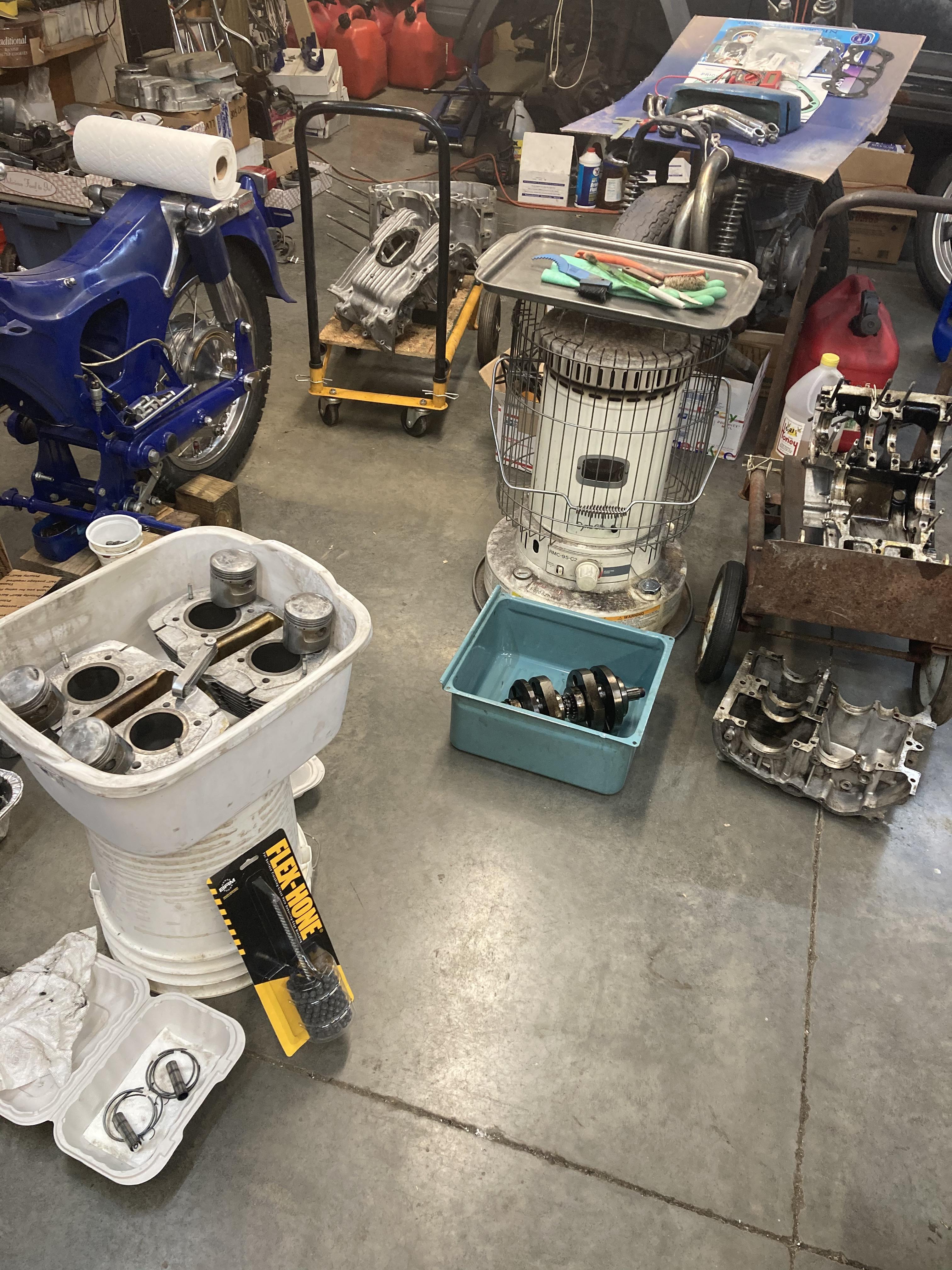
 
Parts cleaning and choices.

More of both.

BXYQyQE.jpg


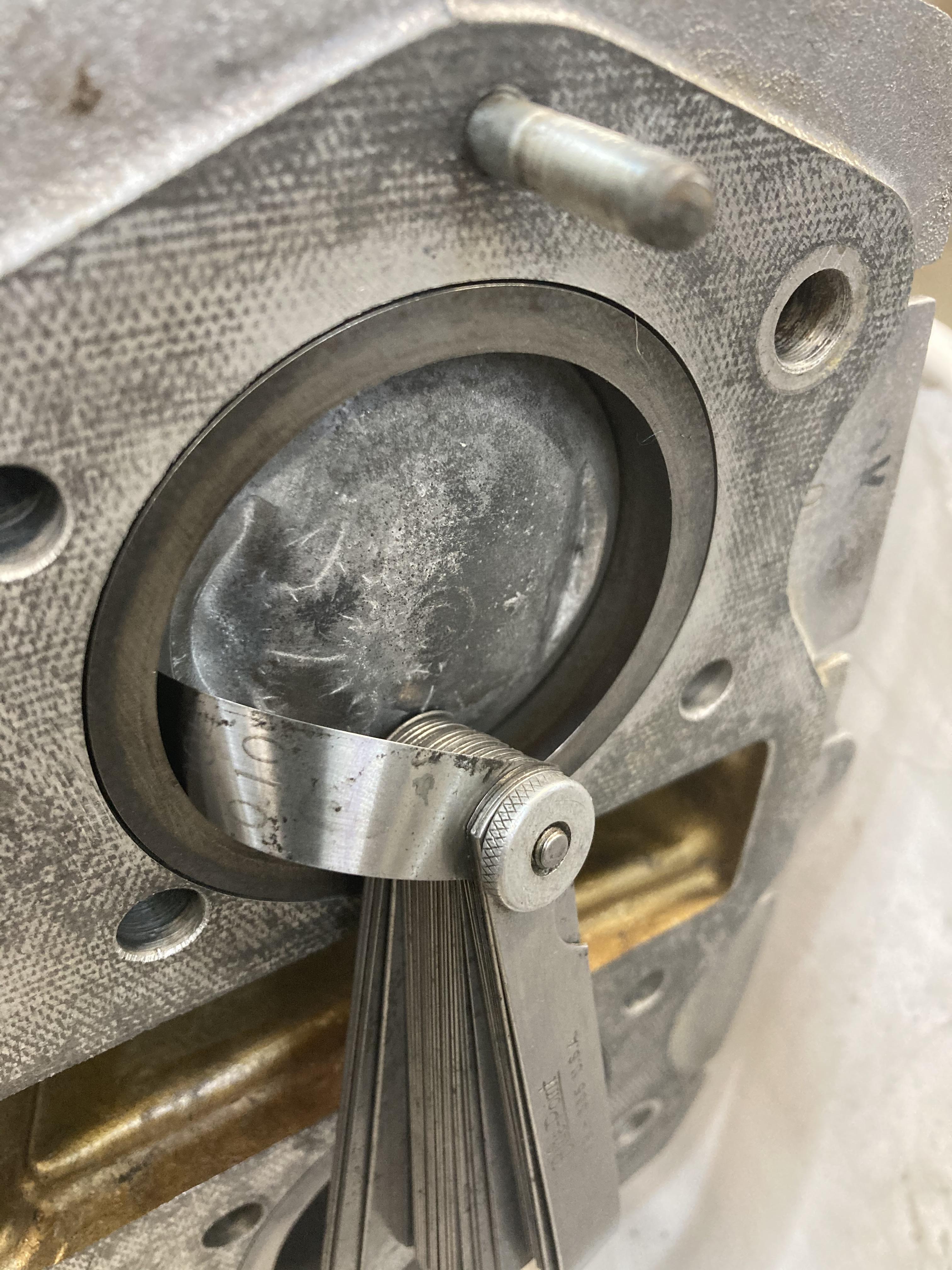
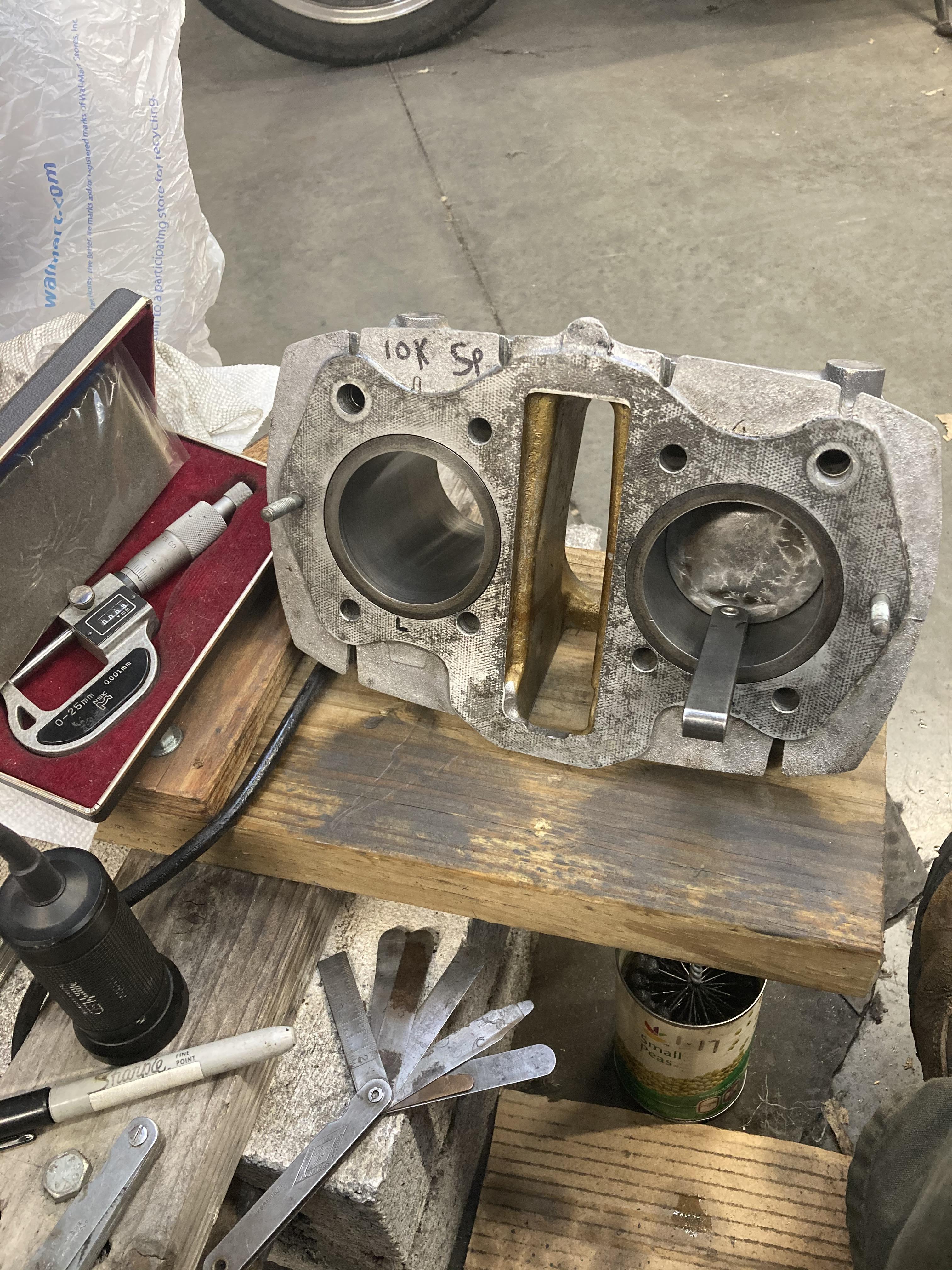
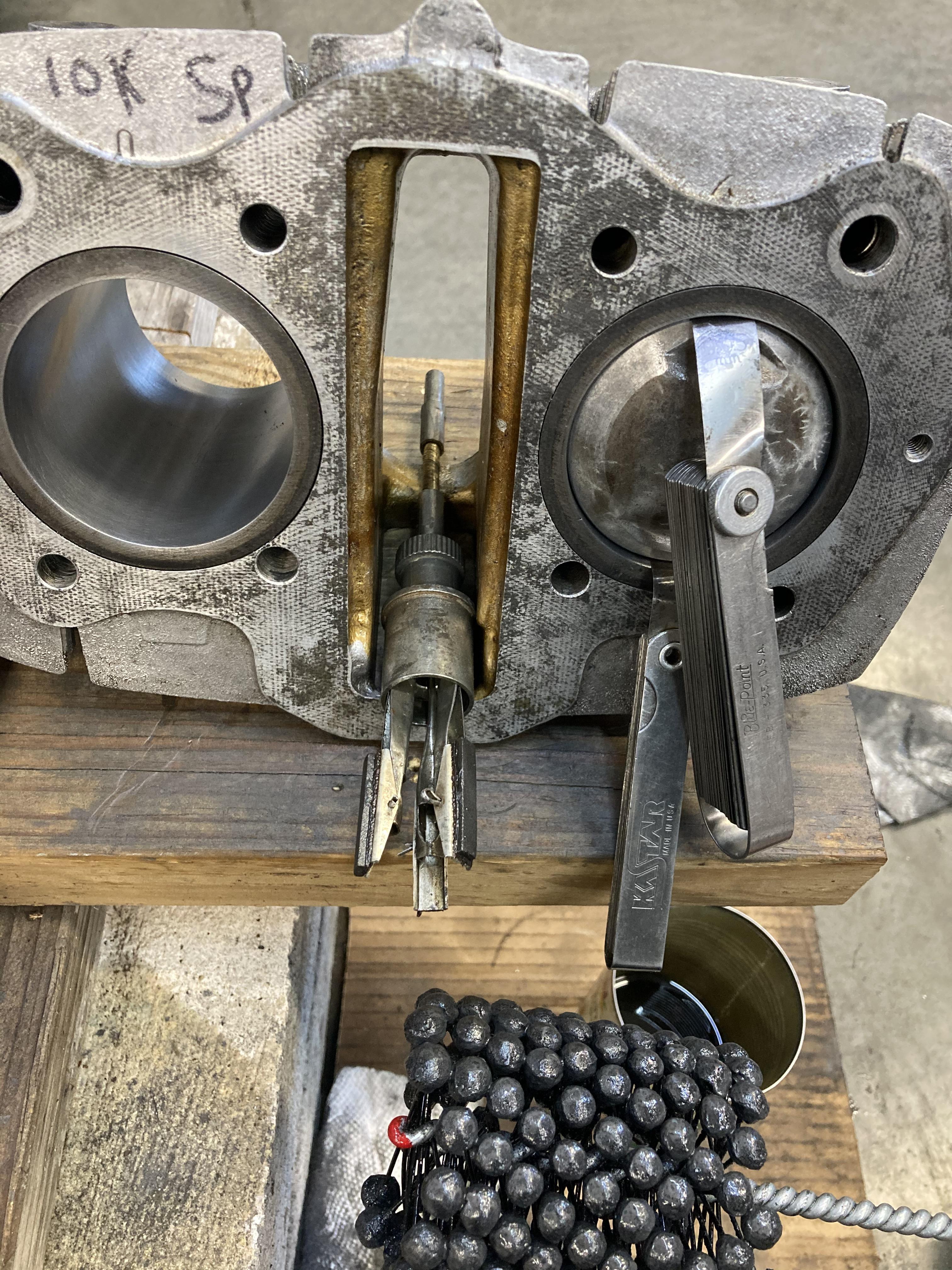
Old Timer, Bill H sold me his gauges. Very nice of him. I was shown this way, years ago, for a quick idea about the condition of pistons/bore. This is before honing. This is the best combo at .004" or .10mm, (the other is .006/.15). The old FSM says "Piston & Cylinder, minimal clearance, repairing limit, .06 more or .0023". I was hoping to just put new rings and get 2-3K miles out of it.

jnVY4Ok.jpg


Rings are on the way here. Down the road plans may be just around the corner now. I know, for sure, I don't know near enough.
 
Last edited:
I like that idea better than using a drill bit, since it still ends up marring the knock pin, as you can't get a drill bit to fit snugly. It does allow you to remove them without collapsing the dowel though. One thing I did notice is the dowels on these motors have way thicker cross section than the newer ones used now.

Heat from a torch too helps release those stubborn ones. :lol:
 
Honing and clearance?

I honed for 2x15 seconds, low r.p.m.s, one stroke/second, soaked in 10-w30 oil.

y50qC4I.jpg


These are the worst scratches of the 4 bores. Can barely feel with finger pad, but can feel definitely with fingernail.

WLpPerj.jpg


I am thinking it needs more, but I stopped to measure and to measure differently than before. The feeler reaches the full length past the skirt and the piston is at bottom with end of skirt even with end of liner. I got .04 and .05mm. Book says +.06 max and Bill Silver's rebuild handbook specs say .10 limit.

oUzYBzg.jpg


I don't know if measuring like this is a waste of time, or if this is the correct place on the piston and bore to measure (at BDC). New Std. rings and Bill H's gauges are coming soon, so more to play with.

Any guidance is appreciated.
 
I have a 3-stone glaze breaker which works fair but not preferred.
I like that bead hone:what grit hone is it ?
 
How much does the ridge at the top need to be reamed or honed?

ALL "vertical" scratches and the top ridge needs to be gone.........

To verify proper piston to bore clearance, I slice my (desired clearance) feeler lengthwise in thirds and position the 1/3 "slips" at 120 degrees apart around the inserted piston.......

Feel free to phone.......
 
Do you have a local machine shop to measure those cylinders and do the work if needed? My motor had 15K miles, so I chose a set of .5 over new pistons, since it was that size or 1mm over as the two choices. My machinist friend said that if I had chosen a .25 over piston set, if that size was available the bore and finished sizing required would have been out of spec.

In other words, I needed the .5 O/S sized pistons to work correctly, after the machining was done.

I am not an expert by any means, yet some of your feeler gauge measurements are really close to the maximum spec and you still have the top ridge and those scrapes to remove from the cylinders.
 
Do you have a local machine shop to measure those cylinders and do the work if needed? My motor had 15K miles, so I chose a set of .5 over new pistons, since it was that size or 1mm over as the two choices. My machinist friend said that if I had chosen a .25 over piston set, if that size was available the bore and finished sizing required would have been out of spec.

In other words, I needed the .5 O/S sized pistons to work correctly, after the machining was done.

I am not an expert by any means, yet some of your feeler gauge measurements are really close to the maximum spec and you still have the top ridge and those scrapes to remove from the cylinders.

Thanks for the back story on your motor. I'm no expert and probably don't even qualify as a novice. :). I just ordered 1.00 OS CB piston set and am going to find a shop with a boring bar. My original plan was to build a "temporary" engine with the best bores, best pistons, best head and rebuild the other stuff properly. That may not fly. I will enjoy in the learning process but realize that years of experience and training can't be gleaned in a single go.
 
ALL "vertical" scratches and the top ridge needs to be gone.........

To verify proper piston to bore clearance, I slice my (desired clearance) feeler lengthwise in thirds and position the 1/3 "slips" at 120 degrees apart around the inserted piston.......

Feel free to phone.......


I'm working on those scratches and ridge. Thanks for the call invite. I'll email a heads up from [email protected] before I call from 240-527-5349. I'm sure I'll have measuring questions.
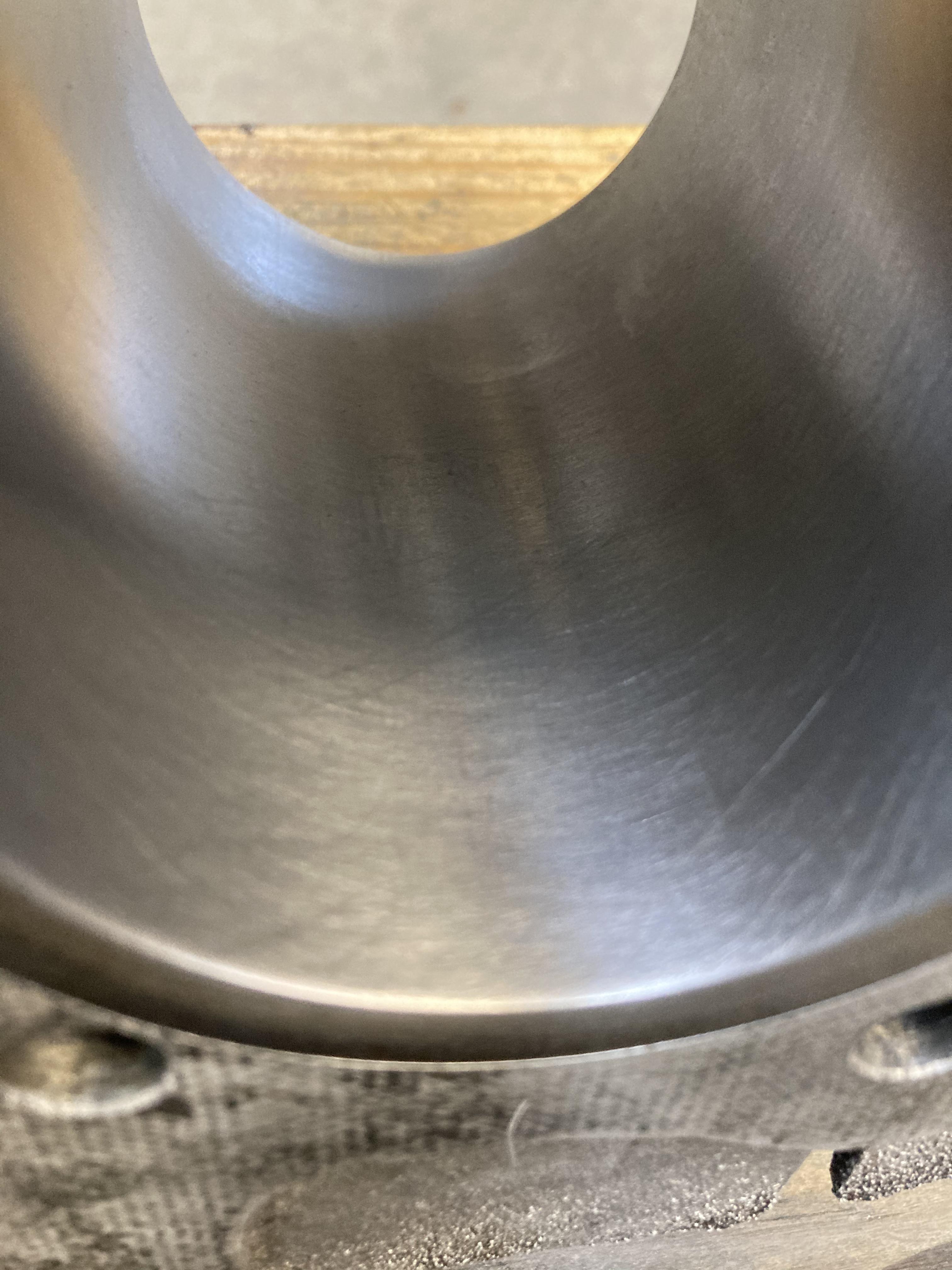
 
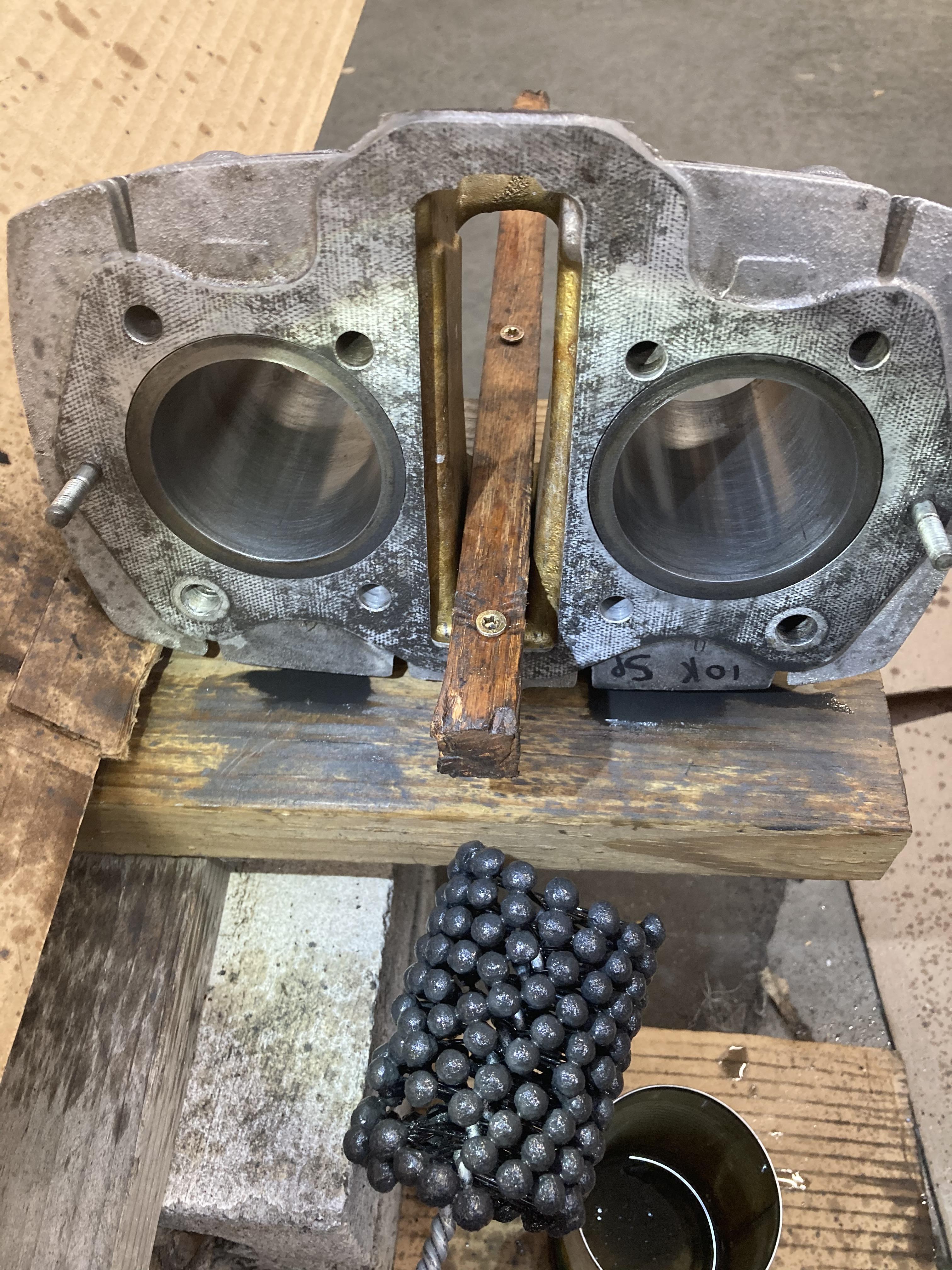
I've spent 2-3 hours on one cylinder removing the ridge and scratches. There is still one scratch that is stubborn on the right in pic.

NJJ8E8y.jpg


The ridges are hard to remove all the way around, maybe due to my cheap 3 stone and flex hone, so I kept changing the position of the block thinking it might be me and the hand drill too. There is a little bit left of them.
YtZgcIX.jpg

Still no gauges yet to use. Two .002" feelers barely fit, so not much change it seems. OS 1.00mm English CB/CL piston/ring sets from Scrambler are coming and I think I may have a local shop lined up, thanks to 2wheel, for boring.

With two engines, I get to learn and have a good shot at a good outcome.
 
Still no gauges yet to use. Two .002" feelers barely fit, so not much change it seems. OS 1.00mm English CB/CL piston/ring sets from Scrambler are coming and I think I may have a local shop lined up, thanks to 2wheel, for boring.

With two engines, I get to learn and have a good shot at a good outcome.

Those look much better now and that last little scratch really looks minimal, yet I know nothing. :lol:

I used the same piston kit that you bought from Scrambler Cycle; just the .5mm O/S sizing. My machinist guy said they were good quality and when he measured the pistons both were identical in size and spec, which is good.

So are you still in spec with that .002 measurement? Are you planning to build one motor with just new rings and another with the 1.0mm O/S piston kit?
 
For scratches all I'm seeing are a couple minor diagonals which are probably from the 3 stone honing tool.
.002" gauges on either side mean there's .004" piston to cylinder clearance, sounds like way out of spec.
 
For scratches all I'm seeing are a couple minor diagonals which are probably from the 3 stone honing tool.
.002" gauges on either side mean there's .004" piston to cylinder clearance, sounds like way out of spec.

Those look much better now and that last little scratch really looks minimal, yet I know nothing. :lol:

I used the same piston kit that you bought from Scrambler Cycle; just the .5mm O/S sizing. My machinist guy said they were good quality and when he measured the pistons both were identical in size and spec, which is good.

So are you still in spec with that .002 measurement? Are you planning to build one motor with just new rings and another with the 1.0mm O/S piston kit?

I called Steve. He was really helpful. I need to up my measuring game a lot. Yep, the FSM says .0023"clearance limit. 2wheel may have found me a local shop for boring. Yea, Rodney! Sorry the pic didn't work showing the scratch that can be felt easily. I'm going to hone and ream the other cylinder until the pistons arrive. Even failure is educational for me.
 
On another note what did you find with both your oil spinner chain and the larger clutch primary chain condition wise on these items? I have been working on these finding replacements on my build.
Did you reuse your old chains since they are fine, or decide to not persue any replacement because of lack of availability?
 
On another note what did you find with both your oil spinner chain and the larger clutch primary chain condition wise on these items? I have been working on these finding replacements on my build.
Did you reuse your old chains since they are fine, or decide to not pursue any replacement because of lack of availability?
At this point I do not plan on replacing either one. They are still dirty with old thickened oil and whatever, so after cleaning and refitting on clean sprockets I 'll know if they are too far gone. The fact that replacements are not readily available suggests that lack of demand may also be a factor. Also, I don't think I've heard of failure due to wear to be very common. Having decent sprockets is a big part (half)

of the equation too. A new chain on badly worn sprockets will not retain it's specs very long and vice versa. This is why they are replaced together if at all possible. Example: If you take a very worn situation like a rear drive that the teeth look like sharks fins (not symmetrical) and you pull outwards on the chain, lifting it from the teeth, and can see mucho daylight between the valley of the sprocket teeth and the side plates of the chain. How much of the load do you think is carried by each of the total available roller to tooth connections? In a perfect world only half or less (<50%) are "working" and in a shark tooth example maybe 5-10% of that 50%. I know this from years in the bicycle world where it is easy to prove; press on the pedal and see how few links cannot easily be moved under tension, meaning only those are really working.

The oil spinner is not under much resistance. There is a short span with both the spinner and the primary drive set up, so little deflection side to side is possible, as well as vertical slap. I would wrap each chain around it's sprocket and stretch it tight by hand to see if 25% of the tooth to sprocket contacts were tight and be happy with that. Bear in mind that the smaller the sprocket the greater the angularity of each tooth (they are radial, not linear) and therefore naturally subject to less force distribution per tooth, as in the small oiler sprocket. Side wear on the cog, due to the improper assembly, is mostly inconsequential, unless unnatural lateral forces has messed up the the bearing surfaces on your oil filter shaft. I would replace sprockets, if you must, because they are, possibly, more available and use the best chain I had and reassemble. If convenient, or benly as they say in Japan, post pictures of the damaged parts so we all can see the fruits of improper oil spinner shaft reassembly.
Sorry for the long ramble.
 
Thanks that is a good explanation. The primary chain sprockets are quite robust and running in an oil bath seems to keep any wear to a minimum. I cannot detect the wear on either the crank gear or the clutch basket gear, they are very good with no deformation. The test is supposed to be if there is contact wear with the upper crankcase or the top outer side case cover according to Bill Silver. My upper crankcase has some minor wear from chain contact, so I decided to search for a replacement.

The oil spinner was badly damaged with both the gears worn down on the sides and the chain was stretched. I don’t know if I still have the parts for pictures. If I do I will attach them to the post.
 
Sneaky petcock leaks, Boring, Gauge Fu

YCniYvi.jpg


My buddy Charles needed to do his maintenance (valve adjust) so I said time to ditch the HD petcock and use the rebuilt original that's been on the shelf for a year. It leaked. A little from the lower packing and also the screw threads due to worn out sealing washers. Redrilled the packing holes a bit and new aluminum washers did the trick. I decided to test mine too and it leaked bad from the lower packing, even at the lever. The problem was too thick of the cork lower packing washer prevented the upper packing from seating around it's beveled edge. I thought of making a new thinner lower packing (the one with the passage holes) but brazen desperation kicked in and I reduced it's thickness on my inverted belt sander. It worked and I got a cheap manicure. And Charles got a longer crossover hose so he can lift the back of the tank to get to his tappet covers without draining tank.

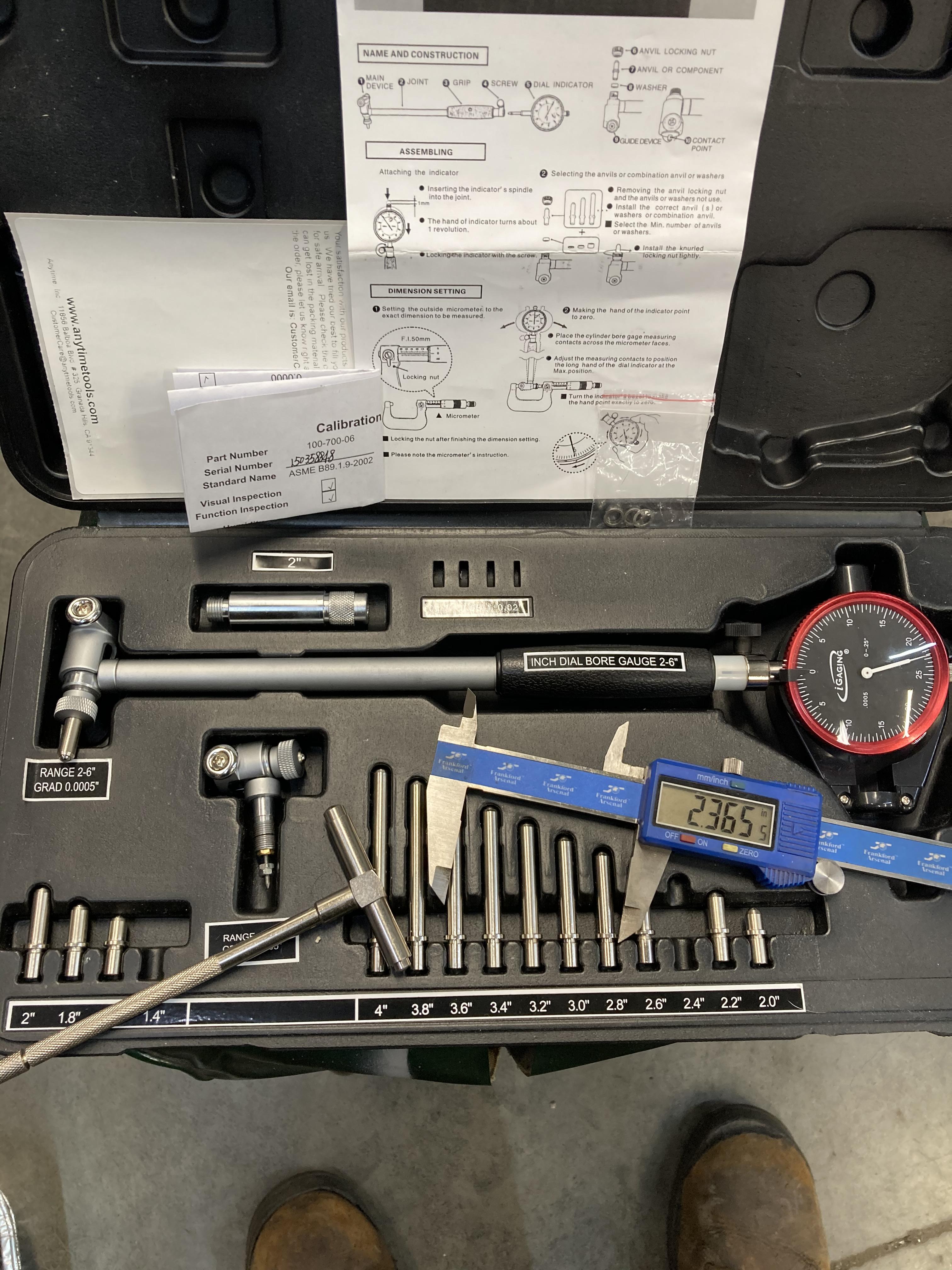
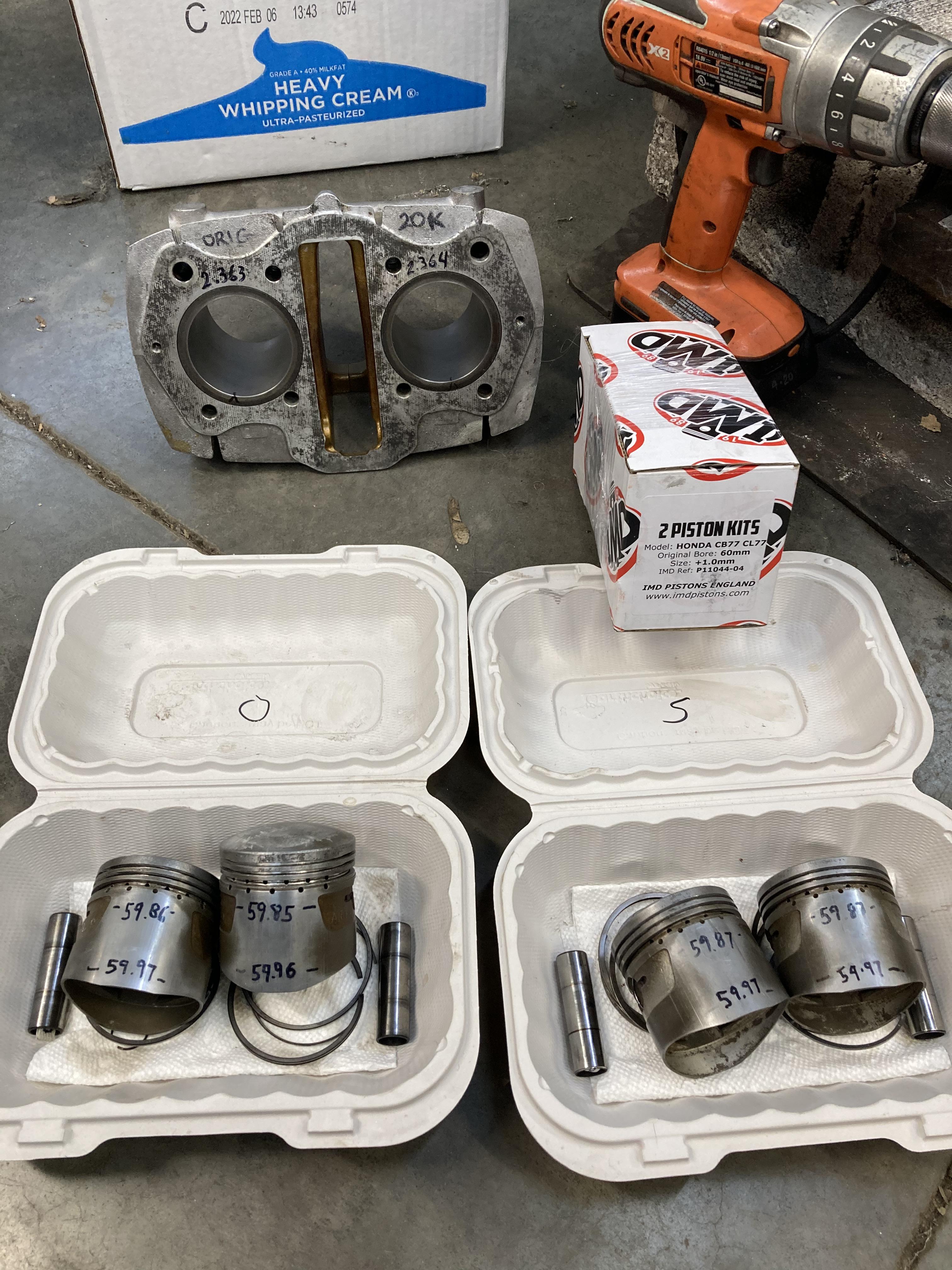
New pistons 1mm over, telescoping and bore dial gauges arrived. I remeasured bores in both cylinder blocks (not that much difference) and decided to send one out to the new to me machinist with a set of the pistons. Nice fellow and I hope to do more with him in the future. He has not done any twins that he can remember, mostly MX and other off road racing stuff. He did seemed surprised when I asked if he could do less than .001 inch. I handed him a copy of Bill Silver's spec sheet ( since the FSM is hard to read, spread over several pages), he nodded. We will know in 2 weeks, or more, if I'm glad I didn't take in both blocks.
I need a bigger micrometer to backup my digital calipers. Eventually, wisdom gained and tools will get used on the 350's
V82u9gr.jpg

zNrdFlv.jpg

Small end rod bushes seem good but will measure.
Heads and valves up next.
Still playing with cam chain tension roller re-bake options, but I have a rock hard good used one.
Plenty to do while I wait. G-man's countershaft bearing upgrade kit also arrived. Looks really nice, even has the internal spiral oil ways.
 
Thanks that is a good explanation. The primary chain sprockets are quite robust and running in an oil bath seems to keep any wear to a minimum. I cannot detect the wear on either the crank gear or the clutch basket gear, they are very good with no deformation. The test is supposed to be if there is contact wear with the upper crankcase or the top outer side case cover according to Bill Silver. My upper crankcase has some minor wear from chain contact, so I decided to search for a replacement.

The oil spinner was badly damaged with both the gears worn down on the sides and the chain was stretched. I don’t know if I still have the parts for pictures. If I do I will attach them to the post.

Almost hard to believe that mis-located thin shim could trash chain/sprockets that much. Shaft/journal damage makes sense to me. I know for sure, I don't know enough.
 
Almost hard to believe that mis-located thin shim could trash chain/sprockets that much. Shaft/journal damage makes sense to me. I know for sure, I don't know enough.

It wasn't the washer that was incorrect, they jammed that little metal post on the spinner shaft somehow into the wrong spot and it also damaged the angled slot on the outer removable round cover. It did a number on both the metal drive gears and the chain, so I ordered a replacement used spinner and chain. The gear was good on the used spinner, yet the chain didn't pass the hang test.

I have replaced so many parts in this engine with new that new chains while an additional expense and possibly not needed; I am in too far to not do the replacements.
 
New pistons 1mm over, telescoping and bore dial gauges arrived. I remeasured bores in both cylinder blocks (not that much difference) and decided to send one out to the new to me machinist with a set of the pistons. Nice fellow and I hope to do more with him in the future. He has not done any twins that he can remember, mostly MX and other off road racing stuff. He did seemed surprised when I asked if he could do less than .001 inch. I handed him a copy of Bill Silver's spec sheet ( since the FSM is hard to read, spread over several pages), he nodded.

Just an opinion on the IMD pistons that come with their own set of specs. If they differ from the Bill Silver specs or the Honda specs; I would go with those that match the piston kit. The bore tolerances are tight on Honda engines for sure, yet my machinist did some further research and used the upper level of the spec supplied by IMD.
 
Back
Top Bottom