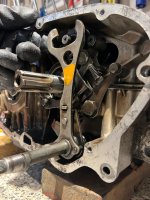
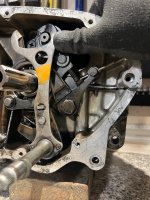
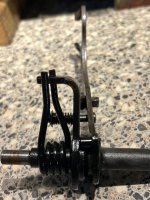
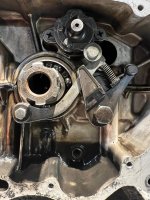
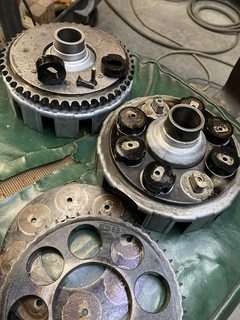
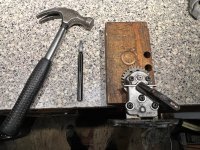
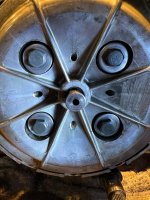
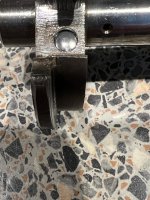
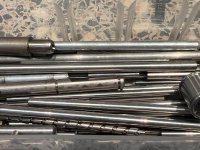
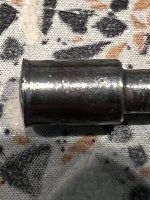
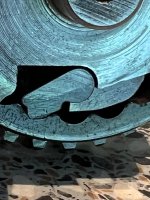
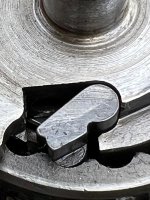
The rings are there to keep a part of the plates in place. I heard different reasons why they are there. The clutch works fine without them.What purpose do the two clutch rings serve? Are they related to the change from six friction discs to five?
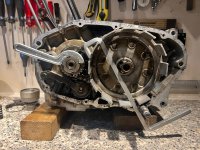
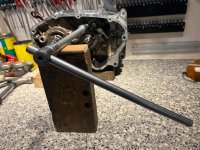
I will look it up, forgot it.What is that special tool that you used to block the clutch outer?


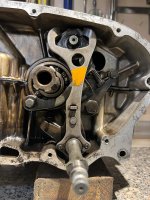
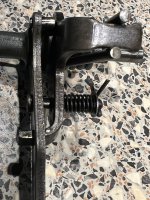
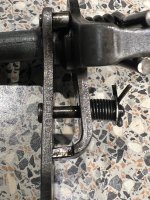
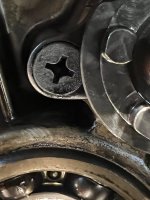
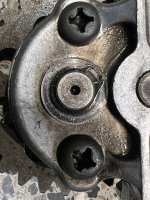
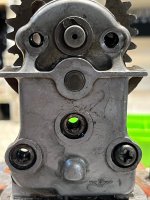
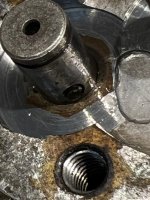
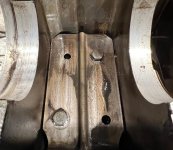
If you mean the extended stud on the bolt (darkened with oil) directly under the crank, It is the stop for the shifter return spring and it also extends into the crankcase and stops the ratchet and it's pawl on the end of the transmission countershaft. The ratchet must be rotated to clear the end of that bolt upon re-assembly or the ratchet will be displaced from it's proper position (ask me how I knowThe large bolt has two functions, holding the guide, but also functions as a stop bolt for the kick-starter mechanism.
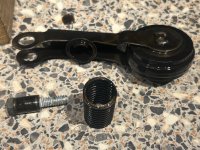
Actually, your primary chain and it's tensioner wheel and arm, do not show much stretching or slack being taken up by the tensioner. I fitted a NOS primary chain to my acceptable gears and had about the same distance between the rubber wheel and the bottom of the case wall. It will be interesting to me to see how much slack you will have when you replace any worn parts there.
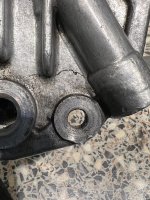
The axle on the drum stopper seems very large compared to the same piece on a CB450. Any play on your drum stopper?


I mis-spoke, I meant under the main shaft, not the crank.the extended stud on the bolt (darkened with oil) directly under the crank,
I mis-spoke, I meant under the main shaft, not the crank.
My kickstart arm does not return easily now, because I was not careful when I put that bolt back in and pushed the ratchet out of proper alignment. Bill Silver's rebuild guide warned of that and I forgot. It seems to shift fine....for now, but I worry that I may have possibly ruined the repair/upgrade parts on the countershaft, from G-man/Graham Curtis as well. I really should pull the motor and remove the lower case to inspect and correct, also would like to check on the roll pin modification to the advancer unit that Steve/66Sprint inspired.


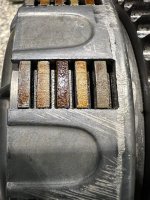
If you reuse the basket, would you do anything to dress the fingers (with an oil stone maybe) or use as is?
I figured you would have a replacement oil pump housing, but I'm surprised the PO would've have replaced the part after it was damaged. I would think it would have been much easier to source at the time.
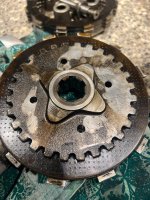
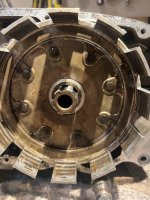
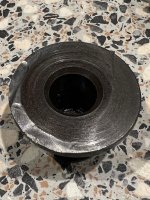
As for the clutch sprocket, do those lines visible on the top of the teeth result from wear or the machining process?
Thank you, Jensen, for such very kind words, I'm almost speechless. I hope you don't mind my frequent commenting, as I'm enjoying this thread more than you may know. True understanding of truth requires a pure communication via a pure language such as music. This tangible realm of motorbike repair is a pleasant workroom to ponder in the ethereal in which we simultaneously exist. My desire is to be a benefit to others and without guile in my dyslexic journey in both realms.Thanks, I didn't respond specifically because it didn't make sense what you wrote.


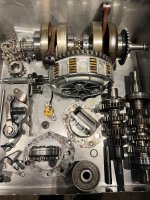
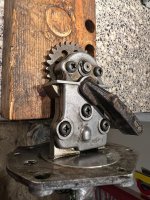
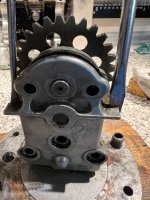
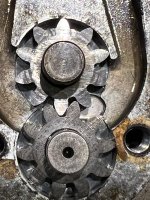
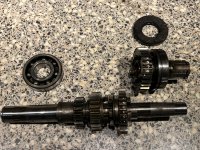
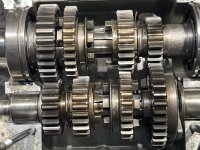
I'm amazed at the differences in parts manufacturing between these bikes and the models from the next generation. Those two gears in the second to last photo look like something from the 1800's to me. I would expect a modern gear to have a greater number of shorter teeth.
I hope you don't mind my frequent commenting, as I'm enjoying this thread more than you may know.
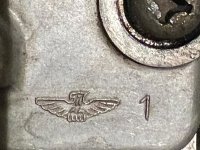
That bird also appears on speedometer drive units.
It's great to see you have the later deep splines on the crank and it's primary gear, also the undercut engagement dogs on the gears. Perhaps there are no off-set cotters if this bottom is a 'virgin'.
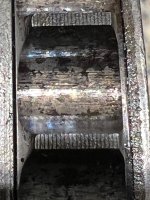
I think your clutch basket is also a later type, based on the arch shaped reliefs on the outer surfaces of the fingers. I lightly dressed the impact notches on the edges of those fingers and don't think any increased tolerance between them and the tabs on the friction discs is very critical. I have noticed quite a bit of variance there between different disc sets and baskets. I could not make out, from the pic, if you have the improved later pressure plate with the additional 4 oil drillings near it's center. So many subtle changes made by Honda during the run of this series motor are pretty interesting.
I would love to hear your engineering opinion on gear type pumps vs. piston, or others, concerning alleged damage to the molecular structure of the oil.
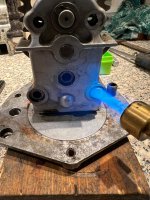
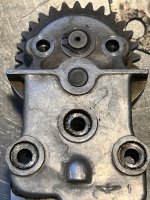
The earlier oil pumps did not even have the tin 'hat' to aid the falling oil return to the sump area, so I did not replace my crumbling rectangular rubber seal at it's top edge.
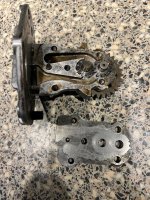
The very thin paper gasket used between the gear case halves had to ordered so that the gear side clearance could be set correctly on mine.
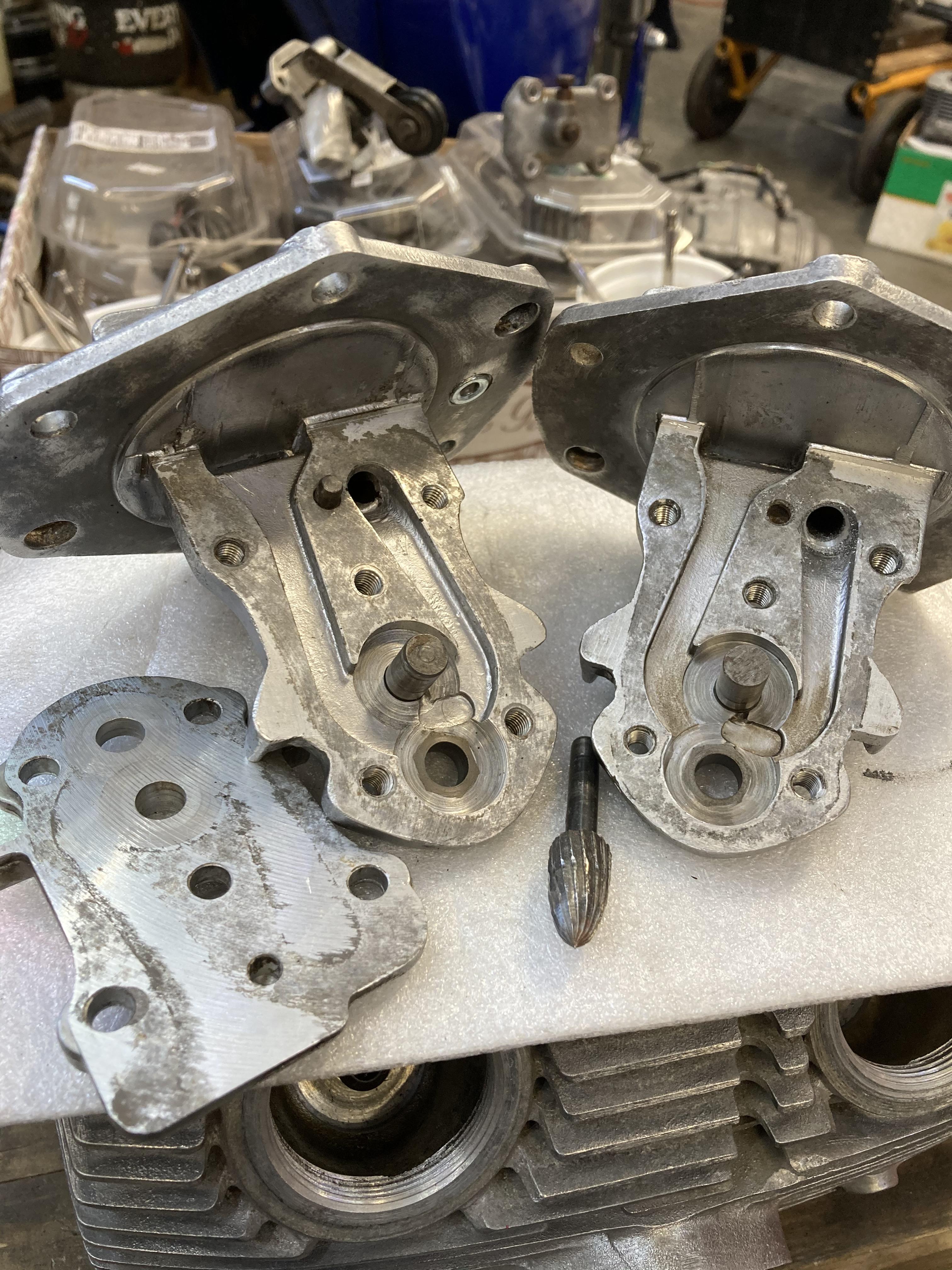
I also did some 'porting' of the gear case exit in the pump body to reduce turbulence (cavitation?) and increase flow as was suggested by someone on a facebook group, an accomplished woman from Sweden, I think, who runs sew-up tyres on her race bicycle. That got my respect, instantly.
You are right. I was thinking of those gears as driving the pump rather than being the pump! Makes much more sense now.Maybe you misinterpreted the picture, or I wasn't clear, the gears I have shown are the oil pump gears, these gears pump the oil.
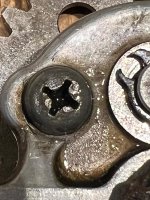
While I may not reply or like as often as I might I want to let you know that I really appreciate your taking the time to document the work you are doing and the techniques you use to accomplish the work such as repairing an original screw so that it can be used again. I also enjoyed comparing this engine to my 1965 S90 and the differences and similarities in the engineering such as the oil pump gears which is different then the 2 types in the S90. Perhaps the engineers were having a competition with a bottle of prime sake the prize for best micro oil pump design.Not so many people respond to this thread, and that's logic. Not many people tinker with these early bikes,
Not off-hand. It was from one of the two larger 250/305 facebook groups a couple years ago, but I will try to find her post and copy it if possible.Do you have a link ? or a name ?


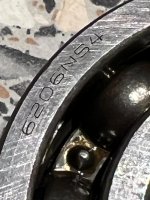
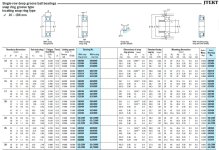
If these bearings are not usable, is it easier to find a correct replacement or add a set-ring groove to a standard bearing?Both bearings are specials, not in size, but due to the set-ring groove. I will clean them in an ultrasonic cleaner and hopefully being tested good afterward.
I'm curious how one would go about repairing that kind of damage. It looks like it's taken a good beating.The secondary shaft bearing, however, has to be replaced or repaired.
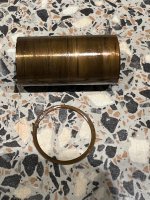
I see in the fiche that the ring should sit near the middle of the bushing. Is it a press fit by design?The washer below the busing should be part of the busing itself.
On both of the motors I had, there was damaged parts. One was similarly worn on that end countershaft bushing due to the kickstart pawl being installed backwards. It seems that end thrust is a problem that is further exacerbated by that worn out bronze C bushing.The secondary shaft bearing, however, has to be replaced or repaired. It has a lot of damage due to the kickstarter mechanism. The kickstarter mechanism and the way this transmission is build up, is the real weak point of this engine, I have not found any engine I disassembled that had a good usable kickstarter mechanism that needed no new parts.
No, it simply slides over the kick shaft, but the tiny 1+mm ridge is supposed to keep the gears properly positioned. Tim McDowell at Classic Honda Restorations, here in Maryland, has them reproduced for around $90. I'd rather buy Graham's kit and kill two or more weak design birds with one stone.I see in the fiche that the ring should sit near the middle of the bushing. Is it a press fit by design?
I see in the fiche that the ring should sit near the middle of the bushing. Is it a press fit by design?
Your shaft is not too badly worn, as they go, and Graham's kit will further protect it.
I'm curious how one would go about repairing that kind of damage. It looks like it's taken a good beating.

I could not make out, from the pic, if you have the improved later pressure plate with the additional 4 oil drillings near it's center. So many subtle changes made by Honda during the run of this series motor are pretty interesting.

Thanks for answering. I hadn't even thought of a shim (or any separate piece) and was imagining how one could remove and replace damaged material.Normally I use a lathe to take the damaged area off, and replace with a hardened shim (1.0 mm). If the wear isn't exceeding the 1.0 mm depth, it is a good solution.
Is it possible to photograph this? One of the PO's must have had a big foot.Another issue with the shaft that is not visible in the pictures is that the pin that pushes the pawl against the inside of the gear is a kind of mushroom, in a way that it is stuck in the shaft
A nice way to spend a Saturday. I imagine it's not too warm at the beach there at this time of year? Maybe 15 C?Tonight I will go deeper into the transmission, yesterday I didn't do anything with the bikes, and spent the day on the beach with my wife, walked 15 km, grabbed a fancy dinner in a beach club, watched the sunset on the beach and drove back home.
A nice way to spend a Saturday. I imagine it's not too warm at the beach there at this time of year? Maybe 15 C?
Is it possible to photograph this? One of the PO's must have had a big foot.
Thanks for answering. I hadn't even thought of a shim (or any separate piece) and was imagining how one could remove and replace damaged material.


You seem to be firing on all cylinders right now — CB72, CB77, SS50, and a small fleet of early CB450's! It's fun to see all of it moving along.Building the SS50 will be an in between job during the in between job, because I promised my my wife's sister's husband that we will make a trip together.
Yes, that's it. The angled holes would seem to draw out excess oil from the center by spinning (can see lightened marks from rinsing action).I found a picture you're looking for, it was displayed in the start of this thread, this picture shows the oil holes


The larger diameter would generate more force on the particles to remove them. It has, obviously been very effective.It looks larger to me based on the photos.
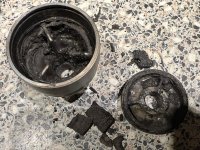
Absolutely agree.In my opinion, the filter was never opened up in 31.000 km.
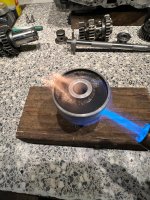
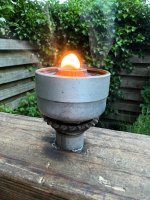
Thanks, and yes, scented heavily, the whole neighborhood enjoyed the smoke screen tooThat's a nice looking candle you created and scented, too!
Absolutely agree.
I bet it's not totally plugged or your small ends wouldn't look decent.I wonder how the crank looks like after 31.000 km with this amount of crud in the filter.


I bet it's not totally plugged or your small ends wouldn't look decent.


Motorcycles, photography, and optics! Very nice shot — the lens flare adds so much depth. Is there a filter of some kind or is that flare solely due to the aperture?