A meticulous restoration of a CB72 '67 (and a SS50Z K3)

Clutch inner, with the clutch ring still installed (made of thin gauge spring steel, 2 of them) to keep a few plates in place. Not necessary to take them off while taking the inner clutch part off, but have to be removed later.

clutch wire.jpg

Once out, you can clearly see how much debris is sticking to the backside of the clutch inner:

backside clutch.jpg

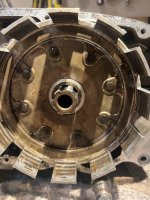
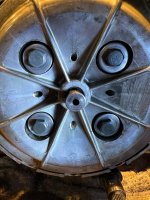
And finally, a clear view on the clutch outer, which is also covered with a layer of debris. The clutch outer is remarkably good, not much wear at all.

clutch outer.jpg

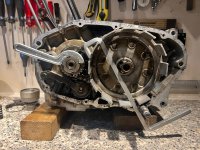
To remove the clutch outer, the crank sprocket has to come loose, so that clutch outer, chain and sprocket can be removed as a group. And what tool is better than the standard Honda tool from the toolbox ? To keep the outer from turning, I blocked it with another Honda tool that is used in a completely different way then it was designed for ;)

clucht removing tool.jpg

The crank nut came loose after a few soft knocks with a plastic hammer (after unlocking one lip of the lock washer). It's clear to see that the bolt was locked with "loctite". The rubber wheel is still pliable, so that's good news.

primiry chain .jpg

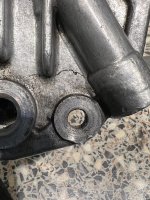
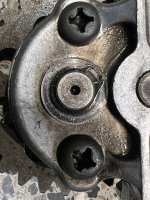
Next job is to remove the gear change mechanism, including the plate that holds the shift drum in place. The two countersunk bolts are the most stubborn ones in the whole engine, and I'm wondering if I can save them too.
 
Two questions:
  1. What purpose do the two clutch rings serve? Are they related to the change from six friction discs to five?
  2. What is that special tool that you used to block the clutch outer?
 
What purpose do the two clutch rings serve? Are they related to the change from six friction discs to five?
The rings are there to keep a part of the plates in place. I heard different reasons why they are there. The clutch works fine without them.

What is that special tool that you used to block the clutch outer?
I will look it up, forgot it.
 
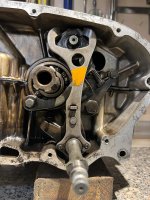
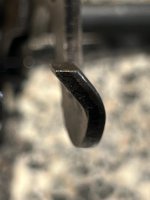
Many functions and implementations of these functions are different in this engine, so is the shifting mechanism. The shift pedal is situated on the left side (normal), but since the rest of the engine is "mirrored" the shift shaft itself is short, easy accessible from the left side of the engine. The shift shaft actuates the shift drum directly by a large, vertical actuator.

shifter_1.jpg

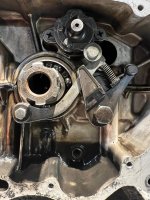
In the picture below it is clearly visible that the shift shaft is short and the end of the shift arm are pointed inwards.

shifter_2.jpg

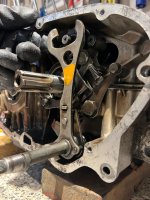
Here I push the shift arm against the drum to put it in the next gear with my thumb.

shifter_3.jpg

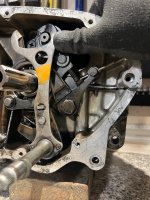
The movement is blocked by the center of the drum on both side (up- and down shifting). When the drum has rotated, the shift arm will return to the mid position due to the spring

Afbeelding van WhatsApp op 2024-05-14 om 23.16.36_09f654c8.jpg

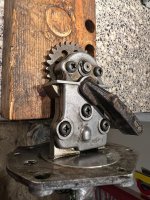
After removal, you can see it's a complex part

shift mech_3.jpg

Below the area to inspect for wear


area of possible wear.jpg

And once removed out of the engine, the rest of the mechanism is visible.

once removed.jpg

The large bolt has two functions, holding the guide, but also functions as a stop bolt for the kick-starter mechanism.
 

Attachments

  • Afbeelding van WhatsApp op 2024-05-14 om 23.16.36_a5cfb432.jpg
    Afbeelding van WhatsApp op 2024-05-14 om 23.16.36_a5cfb432.jpg
    299 KB · Views: 2
The axle on the drum stopper seems very large compared to the same piece on a CB450. Any play on your drum stopper?
 
The large bolt has two functions, holding the guide, but also functions as a stop bolt for the kick-starter mechanism.
If you mean the extended stud on the bolt (darkened with oil) directly under the crank, It is the stop for the shifter return spring and it also extends into the crankcase and stops the ratchet and it's pawl on the end of the transmission countershaft. The ratchet must be rotated to clear the end of that bolt upon re-assembly or the ratchet will be displaced from it's proper position (ask me how I know :rolleyes: ).

Actually, your primary chain and it's tensioner wheel and arm, do not show much stretching or slack being taken up by the tensioner. I fitted a NOS primary chain to my acceptable gears and had about the same distance between the rubber wheel and the bottom of the case wall. It will be interesting to me to see how much slack you will have when you replace any worn parts there.
I had an earlier good clutch outer with fairly worn but still very usable sprocket teeth and another with good teeth but a broken clutch basket finger and loose rivets, which I drilled out and disassembled. I do remember tightening the rivets on one, due to some rotational play between the basket and the sprocket.
CYxHOWom.jpg

I used the earlier basket, IIRC, which required a 2mm bronze thrust ring behind the outer, but was not listed in my parts fiches. The earlier version had a matching earlier clutch inner that did not have the disc separator wires, which would not have worked with my additional disc and steel that I used anyway. I may be confused that the bronze bushing was needed on the earlier one, it may be for the later one.
 
Actually, your primary chain and it's tensioner wheel and arm, do not show much stretching or slack being taken up by the tensioner. I fitted a NOS primary chain to my acceptable gears and had about the same distance between the rubber wheel and the bottom of the case wall. It will be interesting to me to see how much slack you will have when you replace any worn parts there.

I have a few NOS sprockets, clutches and chains, and will put them on for measurement. If it differs too much from the set that came with this engine, I will replace a few parts.

The axle on the drum stopper seems very large compared to the same piece on a CB450. Any play on your drum stopper?

No play at all, it's actually a little binding.
 
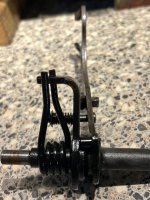
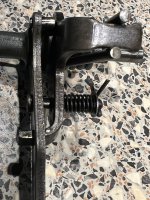
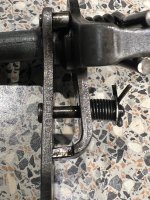
The shift arm itself is a 2-sping system, one for axial movement (a relatively large spring), just like the 450's, but also one for a radial movement (small spring).

shiftarm_1.jpg


shiftarm-2.jpg

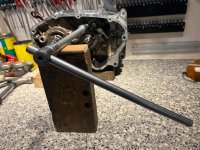
Before I forget to loosen the bolts that holds the shift drum plate. I better do it now because the last 4 bolts are difficult to get out

T-wrench.jpg
 
the extended stud on the bolt (darkened with oil) directly under the crank,
I mis-spoke, I meant under the main shaft, not the crank.

My kickstart arm does not return easily now, because I was not careful when I put that bolt back in and pushed the ratchet out of proper alignment. Bill Silver's rebuild guide warned of that and I forgot. It seems to shift fine....for now, but I worry that I may have possibly ruined the repair/upgrade parts on the countershaft, from G-man/Graham Curtis as well. I really should pull the motor and remove the lower case to inspect and correct, also would like to check on the roll pin modification to the advancer unit that Steve/66Sprint inspired.
 
I mis-spoke, I meant under the main shaft, not the crank.

Thanks, I didn't respond specifically because it didn't make sense what you wrote. I have estimated you as a person who thinks about his own text as a piece of music in which the false note swells to the level where you are triggered to improve it yourself. I have deep respect for such a character and self-reflection ability.
My kickstart arm does not return easily now, because I was not careful when I put that bolt back in and pushed the ratchet out of proper alignment. Bill Silver's rebuild guide warned of that and I forgot. It seems to shift fine....for now, but I worry that I may have possibly ruined the repair/upgrade parts on the countershaft, from G-man/Graham Curtis as well. I really should pull the motor and remove the lower case to inspect and correct, also would like to check on the roll pin modification to the advancer unit that Steve/66Sprint inspired.

Furthermore, I ordered two of G-man's upgrades, but still waiting. I'll use them for both engines, the CB72 and the C78. Thanks for the warning, and I'll assemble the bolt before I put both cases together to avoid issue's.
 
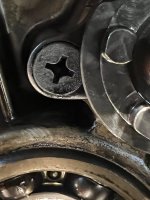
Started with the bolts of the neutral switch, they came out, but it took a lot of preparation and force, but nevertheless, after plating useable again. Next thing are the screws / bolts of the shift drum plate, and after heating they came out, useable.

not forget to loose these.jpg

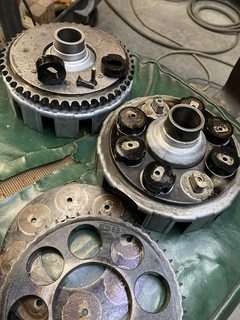
There was a question about the type of clutch, and since the engine was never opened (at least that's still my opinion), I expected the clutch to be the 5-plate type, and it was.

5-plate clutch.jpg

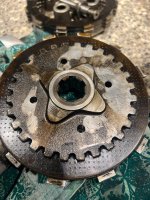
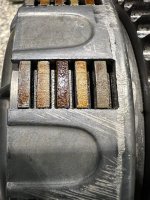
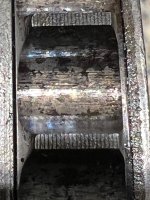
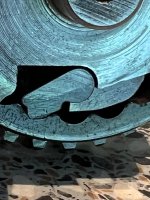
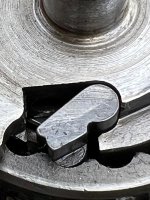
The clutch sprocket is showing the wear I expect with a 31.000 km on the odometer, I don't know if I'm going to re-use the clutch sprocket itself. The basket, however, is in perfect shape and almost show no wear. I think this engine / bike did run long distances because normally the clutch basket fingers are in much worse shape at this kind of mileage.

clutch sprocket surface detail.jpg

The oil pump is another story. It was clearly to see that the oil pump was taken out by the PO's, First the visibility of liquid gasket (Honda didn't use liquid gasket on the pump boddy), and once out, on the butchered screws.

Soon I found out that the oil pump housing is damaged, and shows a large crack. To make the oil pump oil-tight, liquid gasket is used.

oil pump damage_1.jpg

and the other side:

oil pump damage 2.jpg

I think one of the PO's put a chisel between case and oil pump housing to get it out, and damaged the (thin) bottom of the pump, or someone used the wrong length collar. The PO also tried to open up the pump with the wrong tools, and damaged a view screws / bolts beyond repair / reusability.

someone was here before.jpg

The pump is one of the last parts out of the engine (shift drum will be removed tonight), so I pre-cleaned everything and made the parts ready for the parts-washer.

ready for cleaning.jpg

Opening the oil pump, opening the (very stubborn) oil filter and remove the gear selector drum and forks are the last steps in disassembly of this bike before cleaning, measuring and decision what to re-use and what to replace. I think I have most parts and all the gaskets in house, so I think I don't have to order anything except modern Viton O-rings and oil seals, before reassembly (I have a few NOS oil pump housings as well).

Both crankcases are very dirty and full of sludge, I will pre-clean them as well, before inspection and measuring (flatness / damaged threads etc.).
 
Last edited:
In the previous picture of the clutch basket I think I can see the slightest indication of marks on the fingers from the friction plates. If you reuse the basket, would you do anything to dress the fingers (with an oil stone maybe) or use as is? The fingers on my XL350 were heavily worn (leading to trouble shifting to neutral) and I was lucky to get an NOS replacement from CMS.

I figured you would have a replacement oil pump housing, but I'm surprised the PO would've have replaced the part after it was damaged. I would think it would have been much easier to source at the time.

As for the clutch sprocket, do those lines visible on the top of the teeth result from wear or the machining process? I'm guessing the wear is shown by the deviation from a perfect rectangle (rounded corners mainly on the top left of the teeth shown in the photo)?
 
If you reuse the basket, would you do anything to dress the fingers (with an oil stone maybe) or use as is?

I will use a file to clean the fingers, or a piece of wood with a glued piece of sandpaper to it. This way the plates can move freely. The plates of the CB72 are prone to stick over time not using the bike, I'll search for replacement clutch plates.

I figured you would have a replacement oil pump housing, but I'm surprised the PO would've have replaced the part after it was damaged. I would think it would have been much easier to source at the time.

The date on the cylinder head is 6-3-89 (6 March 1989), and it wouldn't a surprise that this is around the time when the oil pump work was done as well. At that time a CB72'67 was apiece of junk with no value, so not wise to invest money in it.

As for the clutch sprocket, do those lines visible on the top of the teeth result from wear or the machining process?

No, it's wear.
 
Last edited:
Thanks, I didn't respond specifically because it didn't make sense what you wrote.
Thank you, Jensen, for such very kind words, I'm almost speechless. I hope you don't mind my frequent commenting, as I'm enjoying this thread more than you may know. True understanding of truth requires a pure communication via a pure language such as music. This tangible realm of motorbike repair is a pleasant workroom to ponder in the ethereal in which we simultaneously exist. My desire is to be a benefit to others and without guile in my dyslexic journey in both realms.

It's great to see you have the later deep splines on the crank and it's primary gear, also the undercut engagement dogs on the gears. Perhaps there are no off-set cotters if this bottom is a 'virgin'.

I think your clutch basket is also a later type, based on the arch shaped reliefs on the outer surfaces of the fingers. I lightly dressed the impact notches on the edges of those fingers and don't think any increased tolerance between them and the tabs on the friction discs is very critical. I have noticed quite a bit of variance there between different disc sets and baskets. I could not make out, from the pic, if you have the improved later pressure plate with the additional 4 oil drillings near it's center. So many subtle changes made by Honda during the run of this series motor are pretty interesting.

I would love to hear your engineering opinion on gear type pumps vs. piston, or others, concerning alleged damage to the molecular structure of the oil.


The earlier oil pumps did not even have the tin 'hat' to aid the falling oil return to the sump area, so I did not replace my crumbling rectangular rubber seal at it's top edge.
The very thin paper gasket used between the gear case halves had to ordered so that the gear side clearance could be set correctly on mine.

I also did some 'porting' of the gear case exit in the pump body to reduce turbulence (cavitation?) and increase flow as was suggested by someone on a facebook group, an accomplished woman from Sweden, I think, who runs sew-up tyres on her race bicycle. That got my respect, instantly.
 
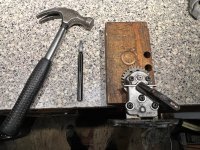
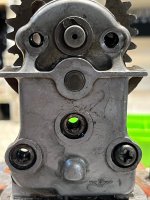
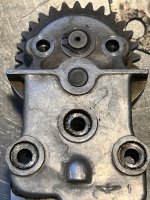
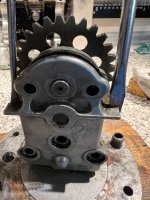
Tonight the oil pump disassembly, and that can be an issue. The 5 bolts are sometimes very stubborn, and in the past I lost the battle on a few. In the past I tried a few things, but as usual, the KISS way is the best. Using a "poor mans" press (glue clamp) to hold the pump tight on a flat piece of wood, clamping it down with force via the pin of the gear shaft.

oil pump _1.jpg

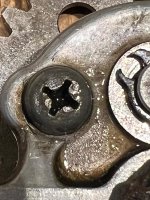
Since some heads are butchered, I first have to repair it, otherwise the JIS bit will slip out of it. I do this with a dowel pin driver and a hammer. After I re-constructed the head of the bolt, I use brake cleaner to clean the bolt, and wipe it dry afterward.

oil pump 2.jpg

After a while the bolt head is decent, and ready to take out.

strange (2).jpg

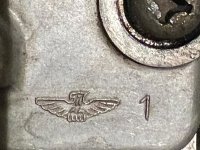
I wonder why there is a bird in the molded part of the pump. It's probably a mark / logo of the supplier.

strange (1).jpg

There is always one that is stubborn, and it's often the last one :ROFLMAO:


there is always a stubborn one.jpg

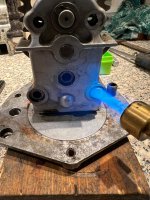
Heavily butchered by the PO, the JIS bit, even after re-constructing could not turn it loose, so bringing in the heat.

heat is sometimes the only way.jpg

After heating the bolt, the bolt gave up. All bolts are re-usable after tidying them up and plating.

finally.jpg

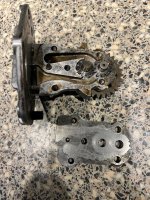
Opening the pump can be tricky, but prying with two screwdriver works 9 out of 10 times.

opening the pump.jpg

Finally, the inside of the pump.

opened.jpg

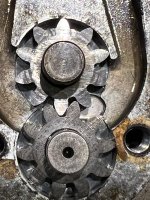
These engines have a gear pump, on is driven by the crank.

gears.jpg

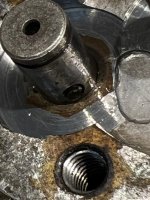
The driven gear is locked by a tiny pin, always being careful not to lose that pin while wrenching.

Afbeelding van WhatsApp op 2024-05-17 om 22.46.55_5ba84407.jpg

Another planned job for tonight was the oil filter, but I couldn't get it open. It's now soaking in diesel, hoping it will give up.
 
I'm amazed at the differences in parts manufacturing between these bikes and the models from the next generation. Those two gears in the second to last photo look like something from the 1800's to me. I would expect a modern gear to have a greater number of shorter teeth.
 
I'm amazed at the differences in parts manufacturing between these bikes and the models from the next generation. Those two gears in the second to last photo look like something from the 1800's to me. I would expect a modern gear to have a greater number of shorter teeth.

Maybe you misinterpreted the picture, or I wasn't clear, the gears I have shown are the oil pump gears, these gears pump the oil. These are not transmission gears or driving gears. The design is inline with the function of the gears.

I hope you don't mind my frequent commenting, as I'm enjoying this thread more than you may know.

Not so many people respond to this thread, and that's logic. Not many people tinker with these early bikes, and on top of that, there is another website dedicated to the 250's and the 305's. However, the quality of yours responses are a sheer joy, and I take the time to respond accordingly. It's the quality of responses and questions of a few that keep this thread going for me.

The style of my treats are a little different from most others. In general, I'm not answering questions, but instead make a complete thread, a huge "how to" and add a lot of clear and high resolution pictures. The idea is that I learn people how to catch a fish, instead of giving them fish whenever they are hungry. So, hopefully, over time, this thread will guide others.

That bird also appears on speedometer drive units.

I knew it looked familiar, but couldn't remember where I saw it, thanks Ballbearian.

It's great to see you have the later deep splines on the crank and it's primary gear, also the undercut engagement dogs on the gears. Perhaps there are no off-set cotters if this bottom is a 'virgin'.

Yes, I'm happy to see nobody was in here before (so it seems, but you never know for sure). I'm glad that I have the "latest" technology like undercut gears.

I think your clutch basket is also a later type, based on the arch shaped reliefs on the outer surfaces of the fingers. I lightly dressed the impact notches on the edges of those fingers and don't think any increased tolerance between them and the tabs on the friction discs is very critical. I have noticed quite a bit of variance there between different disc sets and baskets. I could not make out, from the pic, if you have the improved later pressure plate with the additional 4 oil drillings near it's center. So many subtle changes made by Honda during the run of this series motor are pretty interesting.

The latest clutch basket is used in this engine, and I will make a detailed picture of the pressure plate, but I think it's the latest version too. All perfect and an excellent starting point for a more rideable bike in modern traffic.

I would love to hear your engineering opinion on gear type pumps vs. piston, or others, concerning alleged damage to the molecular structure of the oil.

Actually, I don't like gears pumps, but there are no choices to be made here. The gears pumps damage the molecule structure of the oil indeed, and that's why these engines, with or without a good oil filter, need a regular oil chance, synthetics or not. However, I will use a paper filter setup in combination with a full synthetic 10W60, but will change the oil on a regular basis.

The earlier oil pumps did not even have the tin 'hat' to aid the falling oil return to the sump area, so I did not replace my crumbling rectangular rubber seal at it's top edge.
The very thin paper gasket used between the gear case halves had to ordered so that the gear side clearance could be set correctly on mine.

Yes, I read about it somewhere, and I'm not sure how to coop with that. I think I will upgrade the pump, either by G-man, or Cappellini, or by myself. More flow is necessary, especially with the 10W60, since thicker oil has lower cooling capacity. Adding an oil cooler is also a serious consideration. This engine has a very limited amount of crankcase oil (low volume), the oil gets hot quickly. I will add a certain volume to the crankcase with the modified oil pump, but I would like to have even a larger volume.

I also did some 'porting' of the gear case exit in the pump body to reduce turbulence (cavitation?) and increase flow as was suggested by someone on a facebook group, an accomplished woman from Sweden, I think, who runs sew-up tyres on her race bicycle. That got my respect, instantly.

Do you have a link ? or a name ?
 
Last edited:
Not so many people respond to this thread, and that's logic. Not many people tinker with these early bikes,
While I may not reply or like as often as I might I want to let you know that I really appreciate your taking the time to document the work you are doing and the techniques you use to accomplish the work such as repairing an original screw so that it can be used again. I also enjoyed comparing this engine to my 1965 S90 and the differences and similarities in the engineering such as the oil pump gears which is different then the 2 types in the S90. Perhaps the engineers were having a competition with a bottle of prime sake the prize for best micro oil pump design.
 
Last edited:
Do you have a link ? or a name ?
Not off-hand. It was from one of the two larger 250/305 facebook groups a couple years ago, but I will try to find her post and copy it if possible.
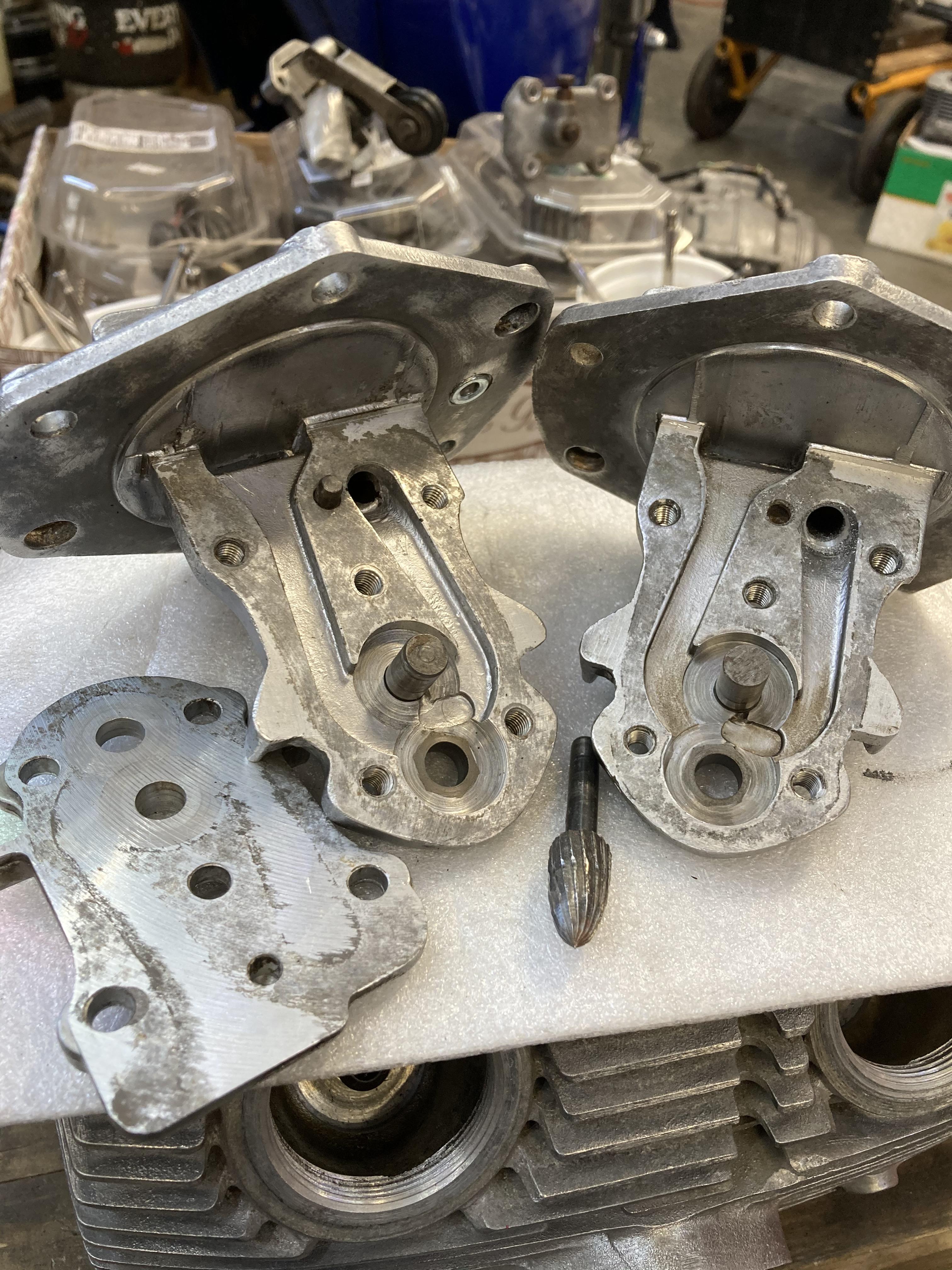
Apologies for the large pic here, but it shows an unmodified body on the left and my 'porting' on the right one, with the tapered reamer I used.

TnPyq73.jpg
 
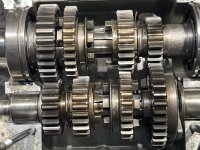
As usual, except the 450's, the devil always seems to be in the transmission when I'm working on an engine of that era, in the case of this CB72, there are serious issues with the transmission. But first a picture of the top crankcase where the locator pins for the crank bearing are shown. Early and late engines have some different size and shape pins, mine is late, as you are able to see.

crank case top.jpg

At the bottom half, the oil separators are fixed with bolts, they were easy to get out, so no problems here.

oil seperators.jpg

Below the primary transmission shaft. Both bearings are specials, not in size, but due to the set-ring groove. I will clean them in an ultrasonic cleaner and hopefully being tested good afterward. The oil seal is also a special size, hard to get in modern rubber compounds / materials like Viton. The gears look good at first sight, but after cleaning I can judge them better. The shaft is OK, not much damage, just normal wear, and no need for replacement.

primairy transmission shaft.jpg

The secondary- or kickstarter -shaft or actually an auxiliary axle itself seems to be in good shape, and that is a good thing.

secundairy transmission shaft.jpg

The secondary shaft bearing, however, has to be replaced or repaired. It has a lot of damage due to the kickstarter mechanism. The kickstarter mechanism and the way this transmission is build up, is the real weak point of this engine, I have not found any engine I disassembled that had a good usable kickstarter mechanism that needed no new parts.

secundairy bearing.jpg

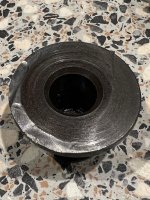
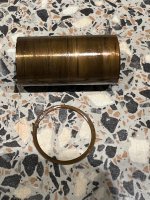
Another damaged part is the kickstarter gear bushing. The washer below the busing should be part of the busing itself.

secundairy shaft bush.jpg
 
Both bearings are specials, not in size, but due to the set-ring groove. I will clean them in an ultrasonic cleaner and hopefully being tested good afterward.
If these bearings are not usable, is it easier to find a correct replacement or add a set-ring groove to a standard bearing?

The secondary shaft bearing, however, has to be replaced or repaired.
I'm curious how one would go about repairing that kind of damage. It looks like it's taken a good beating.

The washer below the busing should be part of the busing itself.
I see in the fiche that the ring should sit near the middle of the bushing. Is it a press fit by design?
 
The secondary shaft bearing, however, has to be replaced or repaired. It has a lot of damage due to the kickstarter mechanism. The kickstarter mechanism and the way this transmission is build up, is the real weak point of this engine, I have not found any engine I disassembled that had a good usable kickstarter mechanism that needed no new parts.
On both of the motors I had, there was damaged parts. One was similarly worn on that end countershaft bushing due to the kickstart pawl being installed backwards. It seems that end thrust is a problem that is further exacerbated by that worn out bronze C bushing.
Your shaft is not too badly worn, as they go, and Graham's kit will further protect it.
I had asked him about adding a groove and internal spring clip on the other end bushing, which he supplies, to help control positioning. He said, it may be a good idea to integrate that feature, or another change, in his future production of his kits.
 
I see in the fiche that the ring should sit near the middle of the bushing. Is it a press fit by design?
No, it simply slides over the kick shaft, but the tiny 1+mm ridge is supposed to keep the gears properly positioned. Tim McDowell at Classic Honda Restorations, here in Maryland, has them reproduced for around $90. I'd rather buy Graham's kit and kill two or more weak design birds with one stone.
 
I see in the fiche that the ring should sit near the middle of the bushing. Is it a press fit by design?

No, it should be a one piece part, no assembly. Due to the pressure and wear, the (protruded) ring will get thinner, until it reached the state that it breaks off the bush.

Your shaft is not too badly worn, as they go, and Graham's kit will further protect it.

Indeed, but measurements are for me more important than visual wear (in this case). I have enough NOS kickstarter shafts for replacements, so not a big deal if I have to replace it. Another issue with the shaft that is not visible in the pictures is that the pin that pushes the pawl against the inside of the gear is a kind of mushroom, in a way that it is stuck in the shaft. I can't get it out, never seen that before. The pin is probably hardened, so not easy to drill out, but I'll try to save the shaft if measurements are positive.

The kickstarter shift of the C78 has the wear I expect, on the bearing surface, but this one (CB72) seems to be in a healthy state.
 
I'm curious how one would go about repairing that kind of damage. It looks like it's taken a good beating.

Normally I use a lathe to take the damaged area off, and replace with a hardened shim (1.0 mm). If the wear isn't exceeding the 1.0 mm depth, it is a good solution. However, I will use the kit of Graham anyway, but will also rescue this one if the internal diameter is within specification.

Tonight I will go deeper into the transmission, yesterday I didn't do anything with the bikes, and spent the day on the beach with my wife, walked 15 km, grabbed a fancy dinner in a beach club, watched the sunset on the beach and drove back home.

Afbeelding van WhatsApp op 2024-05-19 om 08.28.34_84e27a55.jpg
 
Last edited:
I could not make out, from the pic, if you have the improved later pressure plate with the additional 4 oil drillings near it's center. So many subtle changes made by Honda during the run of this series motor are pretty interesting.

I found a picture you're looking for, it was displayed in the start of this thread, this picture shows the oil holes

clutch untouched.jpg
 
Normally I use a lathe to take the damaged area off, and replace with a hardened shim (1.0 mm). If the wear isn't exceeding the 1.0 mm depth, it is a good solution.
Thanks for answering. I hadn't even thought of a shim (or any separate piece) and was imagining how one could remove and replace damaged material.

Another issue with the shaft that is not visible in the pictures is that the pin that pushes the pawl against the inside of the gear is a kind of mushroom, in a way that it is stuck in the shaft
Is it possible to photograph this? One of the PO's must have had a big foot.

Tonight I will go deeper into the transmission, yesterday I didn't do anything with the bikes, and spent the day on the beach with my wife, walked 15 km, grabbed a fancy dinner in a beach club, watched the sunset on the beach and drove back home.
A nice way to spend a Saturday. I imagine it's not too warm at the beach there at this time of year? Maybe 15 C?
 
A nice way to spend a Saturday. I imagine it's not too warm at the beach there at this time of year? Maybe 15 C?

Nope, 19-22 C, no wind. Hot, walking bare foot in the ice-cold see to cool-off a bit. Many bikers on the (back)road with only a t-shirt and soft shoes.

Is it possible to photograph this? One of the PO's must have had a big foot.

Yes, I will, today or tonight before or after heating up and trying to free the pin.

Thanks for answering. I hadn't even thought of a shim (or any separate piece) and was imagining how one could remove and replace damaged material.

The surface is damaged because of the pressure from the pawl, over the years, that leads to wear. The material is relatively soft, so easy to damage, the pawl itself is hardened. To improve the surface with a hardened shim, the wear will be more to both sides.

Here are my footsteps in the wet sand to prove it (I have to set the horizon straight later) ;)

Afbeelding van WhatsApp op 2024-05-19 om 08.28.34_3a4f2e69.jpg
 
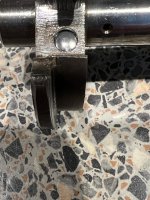
As promised, pictures of the kickstarter pawl actuator pin (I don't know the official name for it), as taken from the bike. As you can see the pin sits deep (I did that, thinking it would jump out because it's spring-loaded). Luckily for me, the bore is all the way through the kickstarter, but the diameter of the last part of the bore is very small in diameter.
mushroom pin sticking.jpg

Luckily I have lots of hardened pins / shafts, taken out all kinds of printers, copiers etc.

hardened steel pins.jpg

Found a hardened pin of 1.3 mm, and had to use a hammer to get it out. But after a few blows it gave up and pin and spring came out. Still don't understand how this pin could look like that.

detail of pin.jpg

To see if the pawl is still useable, I assembled pawl, shaft and gear.

pawl _1.jpg

I also made a picture under an angle, this way it's clear to see how the pawl should be mounted.

pawl 2.jpg

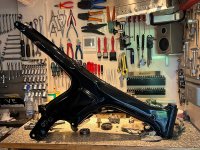
Last week, I got some stuff back from the painter, a frame and the CB450 K0 buddy seat pan. Building the SS50 will be an in between job during the in between job, because I promised my my wife's sister's husband that we will make a trip together (I got this SS50 from my wife's sister's husband). The SS50 was complete, but couldn't get a license plate and paperwork. I said that I was able to find a frame with paperwork (which I did). My wife's sister's husband gave the moped to me a few years ago, but I had to promise him, that whenever I found a frame with papers, we would make a summer trip. Since the moped was complete, and I already rebuild the engine, this will take a week or so.

inbetween job.jpg
 
Building the SS50 will be an in between job during the in between job, because I promised my my wife's sister's husband that we will make a trip together.
You seem to be firing on all cylinders right now — CB72, CB77, SS50, and a small fleet of early CB450's! It's fun to see all of it moving along.

I assume you're familiar with the expression "firing on all cylinders", if I'm wrong let me know. =)
 
I googled it, because I wasn't familiar with the expression. A Dutch saying which has more or less the same meaning will translate as like "keeping all the balls in the air".

Don't forget the Kawasaki KR1-s, as I'm regularly working on that bike too. It's a twin, but that's how far it goes when it comes to similarities, being a two-stroke 180 deg crank, firing every 180 degrees of crank turns. And regular maintenance on the CB400F and CD50H takes it's time too.
 
I found a picture you're looking for, it was displayed in the start of this thread, this picture shows the oil holes
Yes, that's it. The angled holes would seem to draw out excess oil from the center by spinning (can see lightened marks from rinsing action).
 
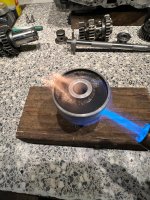
There was one job that I didn't finish, and that's the oil filter, so yesterday I tried to open it up. First attempts didn't work out, so going to the next level. After soaking in penetrating oil for days, I heated the filter a bit until the oil ignited.

heating up.jpg

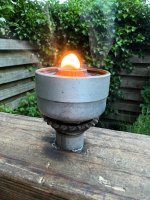
After half an hour, the fire finally stopt burning.

candlelight.jpg

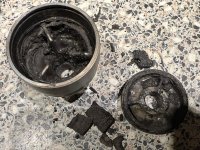
And finally, it gave up.

oil filter.jpg

In my opinion, the filter was never opened up in 31.000 km.
 
Last edited:
I like the fact that the cap on the dohc CB450's have threads to help with the cap removal. I would have assumed that later bikes would all have this feature, yet it was not the case for my 1976 XL350.

How does the diameter (or volume) compare to the filter on the 450's? It looks larger to me based on the photos.

That's a nice looking candle you created and scented, too!
 
The ball transmission bearings sizes are pretty standard, one is a 6206, the other one is a 6305.
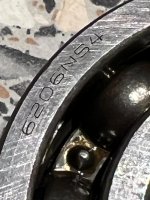
bearing_1.jpg bearing type.jpg

The problem lays in the NS4 and HS4. I did a search through our bearing suppliers and found these:

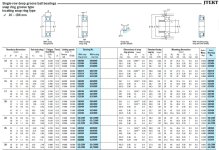
6206N S4.jpg

6305 S4.jpg

I have to check the groove dimensions, and position. I think (assumption) that S4 stands for the clearance of the bearing, but not sure. Today, clearances of bearings are coded with a C and a number C1, C2, C3, C4. The higher the number, the larger the clearance. It's also possible that Honda ordered specials, with their own codes, not sure. I did email to Koyo (JTEKT), and find out. Both bearings have a groove (N), but only one is marked with N, the 6305 appears not to have the N, but has a groove as well. That makes me wonder if the N on the CB72 bearings have the same meaning as in the table above.

Meaning of bearings codes in general (after all, I'm an engineer ;) )

Prefixes:

K: Cage with rolling elements
L: Removable bearing ring
R: Ring with roller set
S: Roll body made of stainless steel
W: Stainless steel deep groove ball bearing

Code:

Ball bearing:
(6)002: The first number represents the bearing type. For example, ball bearings are type "6", a deep groove bearing.

6(0)02: The second number refers to the bearing series. Which indicates the robustness of the bearing. The scale goes up from 9 to 4. As you go higher in the scale, the thickness of the inner and outer ring (usually together with the ball size) increases. Higher on the scale can therefore handle more load.
9: Very thin
0: Extra light
1: Extra light
2: Light
3: Average
4: Heavy

60(02): The last 2 numbers refer to the inner diameter (bore size) of the bearing. Numbers 00 to 03 have a standard designated inside diameter.
00: 10mm
01:12mm
02: 15mm
03: 17mm
Numbers greater than 03 have an inner diameter that is 5 times larger than the last 2 digits. 05 therefore means an inner diameter of 25mm.

Suffix:

2 RS: Bearing with rubber seal on both sides. RS provides a better seal but more rolling friction than 2Z.
RS: Bearing with rubber seal on one side, one side open.
2 Z / ZZ: Bearing with a metal seal on both sides.
Z: Bearing with a metal seal on one side, one side open.
E: Reinforced design
P2: Highest precision
K: Bearing with conical bore

Deep groove ball bearings:

A: ball filling opening
2RS : 2RS1
2RS1: splash-proof
2RSH: splash-proof
2RSL: low-friction seal
2RZ: low-friction seal
2Z: dustproof, SKF designation
C2: radial clearance smaller than standard
C3: radial clearance larger than standard
C4: radial clearance greater than C3
E: reinforced ball set
GJN: polyuream-based grease (-30-150oC)
LHT23: lithium-based grease (-50-140oC)
LLU: splash-proof, bearing designation of NTN
M: brass cage
MA: brass cage centered outside
MB: brass cage centered inside
N: groove in outer ring without snap ring
NR: groove in outer ring with snap ring
open: open bearing
RS1: splash-proof on one side
RSH: splash-proof on one side
RSL: low-friction seal on one side
TN9: fiberglass polyamide snap cage
Z: dustproof one side
ZZ: dustproof, same as 2Z
 
Last edited:
The transmission and specifically the kickstarter shaft are prone to wear, but most parts of the transmission are re-useable. I have to wait for the set of G-man, and then start rebuild the engine, starting with the transmission. All gears are in a health state, dogs are good, kickstarter gear has some play due to a bad bushing, but the issue is covered by the set of Graham.

transmission.jpg

btw, my other hobby is photographing, this morning I made a nice shot when walking.

early walk.jpg
 
Looks great on those gears. Judging from the wear marks, your dog engagement depth looks very good. Perhaps there is no need for either off-set cotters.

Nice shot of that sunlight phenomena. There is a term for that (crespuncular?), which makes it seem that the sun is a lot closer than they say it is, perhaps it is. I don't know as I haven't measured. :D
 
Motorcycles, photography, and optics! Very nice shot — the lens flare adds so much depth. Is there a filter of some kind or is that flare solely due to the aperture?
 
You've had some nice close up shots and I've wondered if you used something more than a good cell phone for these shots. These high end cell phones do a good job with camera and audio. It's the compelling reason to spend the money on the higher end on these. But I don't think they do all that well on close up imaging.
 
Motorcycles, photography, and optics! Very nice shot — the lens flare adds so much depth. Is there a filter of some kind or is that flare solely due to the aperture?

I started with photography when I was young, got a camera when I was 12 years old (birthday present), from that time it went down hill with the spoken word, and the foundation was laid for my future, being a person who works exclusively with images. Via Physics into photonics, into machine vision and robotics. Photography is making composition of light, same like machine vision. Judging a product by an image is nothing more than taking a picture that shows what you want to see, and not showing where there is no interest in, I call that contrast.

No, unlike my work as a senior machine vision architect, I use no filters , and no software for my private pictures. It keeps me sharp on composition and judging the possibility's.

I use a Nikon F3, loaded with B/W film, and I have two digital Nikon's one for normal use (not altered), and one with a visible-cut-off filter (transmits only long waves) for IR imaging. Furthermore I have a UV camera, but that's a vision camera and a thermal camera (also a vision camera) to take pictures in the range of 4 um to 12 um.
 
Back
Top Bottom