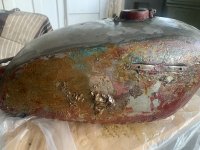
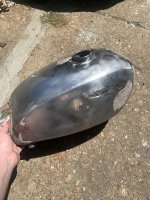
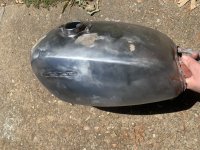
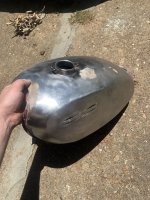
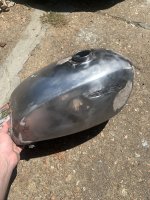
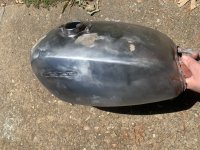
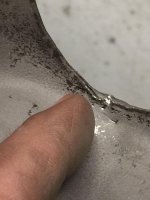
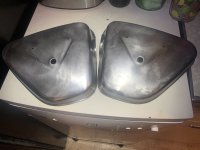
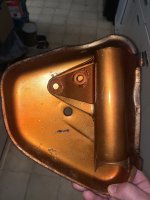
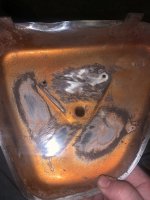
1971 CL450 that sat for 40 years.

I've used the same spray can that Tom showed as well as the aircraft product that comes in a non-spray can. I like the non-spray version for tanks, where you want a thick coat. I assume you pay more for spray versions also.
 
I've used the same spray can that Tom showed as well as the aircraft product that comes in a non-spray can. I like the non-spray version for tanks, where you want a thick coat. I assume you pay more for spray versions also.
Yes, I prefer the thick stuff in the can you brush on. A quart should be plenty.
 
I assume you pay more for spray versions also.
Yes you do of course, quantity buy always helps the end cost. But I use it so seldom that I've had trouble with it actually eating through the can the liquid is in and seeping out onto the shelf in my garage (hideous smell too), so I've gone to paying more for less to avoid the waste.
 
Yes you do of course, quantity buy always helps the end cost. But I use it so seldom that I've had trouble with it actually eating through the can the liquid is in and seeping out onto the shelf in my garage (hideous smell too), so I've gone to paying more for less to avoid the waste.
I had that happen with the MEK/acetone mixture I used to remove a tank liner.
I put the used solution in an empty acetone can and after about a year I noticed it was actually corroding the metal of the can!
The can of Klean Strip I have has not demonstrated that propensity.
 
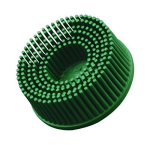
Most of these chemicals are illegal to sell in California. There are substitutes, but they don't work too well. I've mentioned it before, but here I go again. You can get these in Roloc size or full size for a grinder. Different colors are different grits - this is a 50. They are good on curved surfaces, and they work fast. Look for 3M bristle disk. There are copies that look the same, but they are generally crap.
1723737920566.png
 
Last edited by a moderator:
To try something a little different I just bought and applied some Jasco paint stripper. Brushed on a heavy layer. Gonna post results in about 30 mins

 
There ya' go! Another coat & soak and you should be down to metal.
So I just read why modern paint strippers aren't as effective as the old stuff. Methylene chloride was banned in 2019 by the EPA. It is no longer an ingredient in aircraft removers and paint strippers. I would use your "strip-x" sparingly, as I'm sure it has it in it.
 
Yes, they banned it in paint stripper but not anywhere else. Go figure.
I guess too many people were using it without proper ventilation or precautions.
 
How do all you experienced strippers remove the remnants of the stripper before starting in with paint?

My Rustoleum aircraft stripper can says just use mineral spirits.
 
How do all you experienced [paint] strippers remove the remnants of the stripper before starting in with paint?
I will use a hose sometimes, but other times I sacrifice some old towel or sheet and wipe it off, say, on a tank that has been taken down to raw metal.

Then I would use a wax/grease remover to prep the surface before applying primer or paint.
 
After about four more 30 min layers of Jasco paint stripper, it was no longer removing any paint/primer off of the tank. There was quite a bit left.

I returned to using the abrasive paint remover disc, but this time I was careful and more cautious. No need to have the trigger all the way down on the drill to 3000RPM, I found out that half way worked just fine. Ballbearian’s suggested fine wire wheels came in and I used that around the badge holders and filler neck.

I discovered something about the bondo that may work in my favor. It’s currently higher than the metal. I noticed that there was only red paint above the bondo. I’m thinking that while the tank had the blue and orange layers, that the bondo was applied then.

Not much left to do, I am pleased with the results thus far.

IMG_9506.jpeg

IMG_9507.jpeg

IMG_9508.jpeg
 
Took it upon myself today to start on the tail-piece and the underside of the tank. My paint remover wheel has reached its limits on what it can reach. I have some longer brush-style wheels on the way to help with that, recommended by ballbearian.

It’s probably overkill at this point, but I am enjoying removing the paint. I may start on the side covers while I wait on the brush wheels to get here.

Some very light flash rust developed on the bottom after I rinsed off the paint stripper and didn’t properly dry it. I went over the entire tank lightly with 400 grit sandpaper to alleviate any big scratches from the stripper wheel.

IMG_9510.jpeg
 
Tonight I wanted to do a rough draft of my soon-to-be paint job. (60% humidity/80F This will not include primer or a clear coat)
I plan on doing this when the weather cools off.

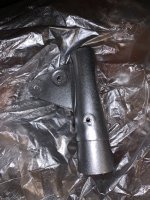
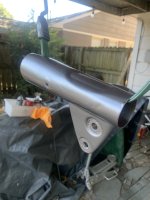
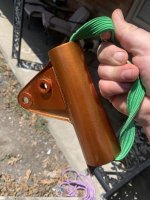
When the fork ears were pulled off of this bike, they ended up being “elongated” CB350 ears to fit the CB450/550 front end. Basically, one set of CB350 ears were chopped in half and shoved into another. I have no use for these and I don’t think anyone else will either.

1st I hit the fork ear with 400 grit sandpaper after removing some paint. Then I used a wax/degreaser.
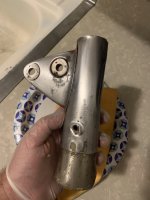
IMG_9513.jpeg

Next, I laid out two light layers of silver metallic basecoat: 10-15 mins in between.
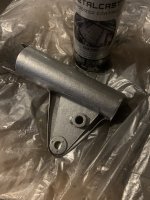
IMG_9514.jpeg

The next step on the can said to lay the third coat heavy, this is where I disagree. I ended up getting a run. Thankfully this is what practice is for. I will stick to light coats.

IMG_9515.jpeg

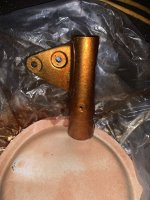
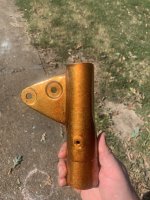
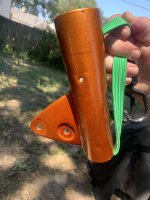
After 1.5 hours of drying, I laid down my 1st light layer of orange candy coat. Instructions say to lay down two light layers, then follow up with a third heavy coat. I beg to differ.
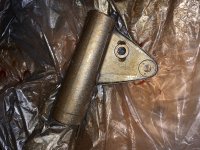
IMG_9518.jpeg

While doing 10-15 min intervals, this was after the fifth light coat.

IMG_9519.jpeg

After sticking to my “light coat” mentality, part of the ear wasn’t getting paint to stick. It was running off. Thankfully this was a trial run.

With this being my first time painting anything, it will be good for me to learn what is a light coat vs heavy.
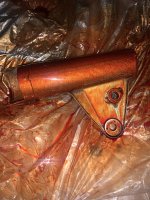
IMG_9520.jpeg
 
Last edited:
I know this was only practice, but I would look into hanging the part so you can keep the can upright and paint all sides.

Hopefully, you just need to dial back what "heavy" means to avoid runs. To me, a light coat has very little overlap and may not provide perfectly even coverage, whereas a heavy coat is done with just enough overlap to provide even coverage. Runs often occur when the can is moving too slowly or stays in one spot too long.

The silver metallic looks good and I like the color shown in the next to last photo that you achieved with the metalcast product. I wonder if the adhesion issue was related to the too heavy silver metallic coat not drying sufficiently in that area where the orange ran off? Do the instructions call for 1.5 hours of dry time between base and candy coats?

I agree with your own assessment that many light coats may be better than fewer heavy coats.

Edit: I tried reading the application instructions on pictures of the cans on Amazon, but couldn't make out every word. It looks like the silver was supposed to be 2-3 light coats — I didn't see anything about a heavy or wet coat. For the color, it seemed to suggest a final wet coat and that all coats be done within an hour. Otherwise it requires seven days to paint on top. I also saw that it is supposed to be oil and gas resistant, which is a little surprising. Maybe you could include the exact instructions here for us to read?
 
Last edited:
The hard part of painting metallic colors is trying to keep the flow of paint even so the metal in the paint is evenly applied. If you aren't moving at a steady speed and at a consistent distance from the part you're painting on each coat, you can get heavier areas and those areas often have more metallic content than the thinner, lighter-applied areas. Keeping an even flow of paint as you move, letting off the spray head at the end of each pass to avoid "doubling up" on the quantity of paint applied at the ends of each pass, and just being consistent in your distance from the part you're painting as well as the speed of your passes, is key to getting an even finish.
 
The hard part of painting metallic colors is trying to keep the flow of paint even so the metal in the paint is evenly applied. If you aren't moving at a steady speed and at a consistent distance from the part you're painting on each coat, you can get heavier areas and those areas often have more metallic content than the thinner, lighter-applied areas. Keeping an even flow of paint as you move, letting off the spray head at the end of each pass to avoid "doubling up" on the quantity of paint applied at the ends of each pass, and just being consistent in your distance from the part you're painting as well as the speed of your passes, is key to getting an even finish.

Thanks for the tips. I had a LOT of fun painting on that fork ear last night. Now I’m just looking for my next test victim to practice on. I keep noticing random objects in the house to try it on. I wonder how my kitchen toaster will look in candy orange.
 
Thanks for the tips. I had a LOT of fun painting on that fork ear last night. Now I’m just looking for my next test victim to practice on. I keep noticing random objects in the house to try it on. I wonder how my kitchen toaster will look in candy orange.
You're going to want to build yourself a painting jig. PVC and cheap 2X scrap are your friends here. Anything that you can do to bring the object up to about 3-4' off the ground will really help to keep the can upright with a tiny bit of downward tilt (20ish degree angle is ideal). This will really help keeping the paint flow uniform - I've worked with that metalcast stuff... man, it is a beast to get right. I like light/light/medium/medium if you're going to be putting clear on top. Those Rustoleum and Duplicolor metallic rattlecans love to get runny on you.
 
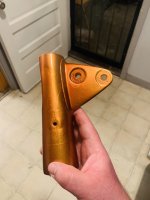
Last night I cleaned up the other side of the fork ear, and attempted to paint again. This time trying my best to correct my form and fix small mistakes. I leaned the fork ear standing up and attempted to kneel down so that the spray comes out at a 90 degree angle. The can ended up being tilted slightly forward.

This time around for the silver metallic, I did three super light coats, remembering not to double up on the passes. No runs, turned out good.

IMG_9523.jpeg

For the thin orange candy coating, it must be applied 20 mins after the last silver metallic coat, to avoid wrinkling and orange peel. This was after five super light coats.

IMG_9526.jpeg

This morning after drying

IMG_9529.jpeg

I vigorously shook the can for one minute before each coat.

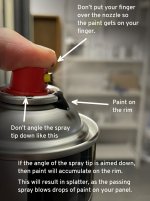
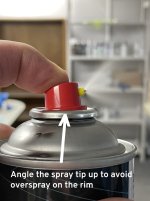
Unfortunately I’m noticing a problem with paint sputter/splattering on the can nozzle. I found these pics online, hopefully they help with the next test.

IMG_9527.jpeg

IMG_9528.jpeg
 
Hopefully you can continue dialing it in. Those pictures illustrating bad and good technique are nice. I sometimes get a little paint on my finger or the rim if I'm not being careful and this is a good reminder not to do that!

Maybe super light was too light?
 
So, if there is a VHT white cone “Dunce” hat, then I definitely deserve to wear it. I just figured out my spray can problems…

Today I went outside and was excited to practice new techniques. I suspended the test piece from above so that it was eye level. I let the can sit in the shade for a while, since I just brought it out of my house(70F). I shook it like a mad man for a few minutes. I was ready to practice slower and more consistent spray techniques.

Paint was sputtering out of the can, paint was glooped up all over the test piece. It was running like crazy. I got super frustrated and called it a day. I was extremely mad that I had wasted money on a terrible dupli color can.
IMG_9546.jpeg

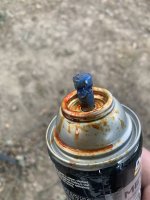
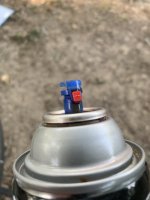
Lo and behold, after reading about 15+ articles/threads about dupli color cans. I finally found the answer. These cans come with a red “plug” that’s inserted into the nozzle. Everyone thinks these are to keep debris out, so people remove them. I was guilty of this too.

I found the plug and re-inserted it. Now the cans spray perfectly. A lot of time has been wasted over the past week, but also a lot was learned.

IMG_9547.jpeg
 
^^^Well, I was not aware of that. But I haven't bought Duplicolor paint in forever either. Glad you found that.
My previous paint attempts were with the main nozzle piece missing... This was with both the silver metallic and candy orange cans. I can't wait to see what my next attempt looks like.
 
My brother laughed at me and pointed out that the red plug is detachable, allowing you to adjust the spray's fan to either horizontal or vertical.
 
So, when the line on the red tip is horizontal like the one in the photo, is the spray pattern vertical or horizontal?
 
So, when the line on the red tip is horizontal like the one in the photo, is the spray pattern vertical or horizontal?
Upon me looking real close, the red tip is actually more rectangular than square. When the rectangle is vertical, it's spray pattern comes out vertical.

To answer your question, the horizontal line comes out with a vertical spray pattern.
 
Last edited:
Well here is my first official practice run with working cans.

I wasn’t concerned with sanding or using filler primer as this is a test piece.

Three light layers of silver metallic

IMG_9550.jpeg

These pics are after four light coats of orange, and then two medium coats.

IMG_9551.jpeg

IMG_9552.jpeg

IMG_9553.jpeg

I am very pleased with the results. I was being a little bit overcautious with getting runs in the paint. All light coats had full coverage. I need to get better at hitting the top and bottom of the piece versus staying focused on the sides too much.
 
Looks great. I know you're just practicing spray technique but next time try smoothing the old paint edges with the wet sand before the silver layer. Those scratches and edges will dissappear.
 
Looks great. I know you're just practicing spray technique but next time try smoothing the old paint edges with the wet sand before the silver layer. Those scratches and edges will dissappear.
I went over it with the 400 grit sanding sponge that you recommended. I think I have used it so much that it's now toast. Luckily I have three more.

I didn't really care at the time, seeing that it's a test piece. But now that it's done, I wish I would have taken that extra time.
 
I went over it with the 400 grit sanding sponge that you recommended. I think I have used it so much that it's now toast. Luckily I have three more.

I didn't really care at the time, seeing that it's a test piece. But now that it's done, I wish I would have taken that extra time.
The 400 is almost too aggressive for blending layers and, truthfully, I've never tried that with water, but they may work better that way and even last longer too. I'm still kinda new to learning a 'wet' technique but so far have found that is definitely the way to go.

Looking forward to following your learning curve as well.
 
Why not beat blasting the parts ?
There is a “Rick’s Powder Coating” here in Memphis, TN that does bead blasting. I suppose it may have been $25-$50 per part to have them blasted but I’m not sure.

I have never stripped paint before so it was fun for me to learn that process myself. A $16 corded drill, some wire wheels, and some paint stripper probably put me at around $40-$50. Plus, I think they would have blasted the bondo away on the tank since no one knew it was there.
 
I have never stripped paint before so it was fun for me to learn that process myself. A $16 corded drill, some wire wheels, and some paint stripper probably put me at around $40-$50. Plus, I think they would have blasted the bondo away on the tank since no one knew it was there.

Yes, so you can replace it with bondo you trust, and when it's a gas tank, detect leakages as well. I really like to know what my starting point is.
 
Yes, so you can replace it with bondo you trust, and when it's a gas tank, detect leakages as well. I really like to know what my starting point is.
Bondo should never cover even surface rust. I usually don't trust it and so remove it and replace with new, properly mixed Bondo on totally clean metal.
It is easy to work with and easy to sand and shape.
 
I personally have not ran into any surface rust on the bare metal of this tank. I have never experienced any gas leaks either. Of course I can't see below the bondo, which was probably applied around 1983 or so.

Is it generally agreed upon here, that the old bondo should be removed?
 
If any of the bondo areas are still too low, then you'll be adding bondo anyway, so may as well start fresh. The small pint size can of bondo is fairly cheap. Just do a small area at first, the bondo hardens pretty fast.
 
First I take as paint off by sanding, or / and chemical paint stripper. If there is bondo, I burn it away / remove it. Next step is to fix the dents as good as possible, second step is to beat blast.
Then epoxy bondo is used to fill up the dents that remain. If there are any holes, or pin holes, I ask a very nice co-worker to weld it. The paint shop will use epoxy and paint it.

Lot's of work ? yes
Costly ? yes
Reliable ? yes,

Never have to look again after this work, it's durable, trustworthy and nice.

tank.jpg

tank_2.jpg

tank_3.jpg
 
First I take as paint off by sanding, or / and chemical paint stripper. If there is bondo, I burn it away / remove it. Next step is to fix the dents as good as possible, second step is to beat blast.
Then epoxy bondo is used to fill up the dents that remain. If there are any holes, or pin holes, I ask a very nice co-worker to weld it. The paint shop will use epoxy and paint it.

Lot's of work ? yes
Costly ? yes
Reliable ? yes,

Never have to look again after this work, it's durable, trustworthy and nice.
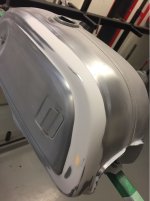
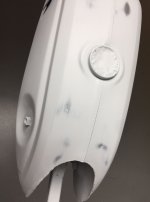
These photos nicely show the building up and smoothing each layer till there is a smooth and primed tank ready for final paint steps.
 
Just wanted to post an update on the paint job.

First, I would like to thank everyone’s comments and all of the help/advice I have received. I have never really painted anything before, but the confidence is developing day by day.

It’s coming along slowly but surely. I got a little burned out of applying/sanding bondo on the tank. Still an art that is new to me. It was time to take a break and start on the side covers.

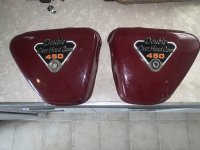
I couldn’t help but put my new repro badges on when I got them months ago (knowing that they would have to come off again). My original ones had snapped pegs, so the badges would turn when I tightened down the side covers. Also, one of the rubber grommets finally gave out and tore. I got lucky and found a NOS one on eBay.

IMG_9574.jpeg

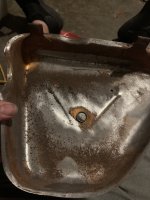
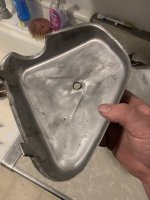
Next, I used a drill and wire brush set to remove the paint. Then, I hit them with 320 grit sandpaper. Found something interesting on the back of the side covers. A complete layer of rust hidden under the original paint. I was scuffing up the back of the side covers for black paint, when I noticed the rust was being uncovered everywhere.

IMG_9702.jpeg

IMG_9578.jpeg

IMG_9710.jpeg

IMG_9713.jpeg

IMG_9719.jpeg

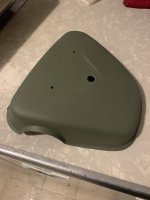
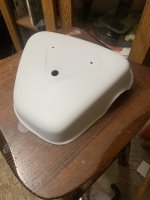
I applied a rust reformer paint on the back sides, then green metal etch primer, followed by white filler primer on the front. Tomorrow I will do some careful wet sanding. The big day will be soon where I apply the silver metallic basecoat and candy orange layers. I’ll most likely have some clearcoat questions!


IMG_9715.jpeg

IMG_9704.jpeg

IMG_9723.jpeg

IMG_9730.jpeg
 
Last edited:
Back
Top Bottom