1971 CL450 that sat for 40 years.

I have decided to set that carb to the side for now. I have a matching left 14H carb on the way that will solve my current issue.

Right now I am working on the points. I went through Tom’s instructions about three times. I am not 100% confident with multimeter readings yet, sometimes I have further questions about the readings.

I tried verifying my work with a 12v test light with a single clip. I clipped it to the left point and then set the tip of the light inside the screw hole on the stator cover. I turned the igntion on, then turned engine over past the LF & F marks and never saw the light come on at all. I made sure the points gaps were open, then clipped the light to the engine fins for ground, then tried to probe the coil connector where the points leads connect to and didn’t see the light come on either.

Either I did the tests wrong or I am currently not getting power to to the points.
 
I have decided to set that carb to the side for now. I have a matching left 14H carb on the way that will solve my current issue.

Right now I am working on the points. I went through Tom’s instructions about three times. I am not 100% confident with multimeter readings yet, sometimes I have further questions about the readings.

I tried verifying my work with a 12v test light with a single clip. I clipped it to the left point and then set the tip of the light inside the screw hole on the stator cover. I turned the igntion on, then turned engine over past the LF & F marks and never saw the light come on at all. I made sure the points gaps were open, then clipped the light to the engine fins for ground, then tried to probe the coil connector where the points leads connect to and didn’t see the light come on either.

Either I did the tests wrong or I am currently not getting power to to the points.
The other wire to the coil is the supply from the switch. Is it hot? Don't leave the key on for very long, at a time, the coils can burn out.
 
The other wire to the coil is the supply from the switch. Is it hot? Don't leave the key on for very long, at a time, the coils can burn out.

Yeah I was very quick when I had the ignition on, when doing these tests. I placed my hand on them at the end and they were cold.

Edit: Now that I think about it, I believe my kill switch lever is activated.
 
Last edited:
There's a better way to do all that without overheating the coils or running the battery down: leave the key switch off, turn the kill switch to "off" (that isolates the coils from the rest of the wiring). Place a piece of paper between the contacts for the right side points to keep them "open" while you adjust the left side. Connect one lead of your test light to the battery positive post and the other lead to the points wire connection. The test light will be on with the points closed and off when the points open. Make your points/timing adjustment to the left side, the move the paper to the left side points and adjust the right side points. Done, no burnt points or overheated coils, you can fuss with the timing all all day and not run the battery down.
 
After changing the oil, I filled all cam lobes with oil. I am waiting for my replacement carb to arrive, plus some 3.5mm drain line, and then I’ll be able to fire it up.
I guess I should have been more specific, but when I suggested pumping the cams full of oil I meant to do it right before you put the valve covers on and then fired it up. Now that the covers are on and it will be days before you do start it, you've lost the advantage you would have had because the oil will drain away to the bottom end through the stud oil passages and out the cam orifices into the cam chain tunnel. So it will be just like starting the bike after it sat cold for a week.

The breather tube runs down behind the engine, beside the left upper rear (triangular) motor mount plate and down to the bottom of the center of the frame, just below the frame in the middle.
 
I guess I should have been more specific, but when I suggested pumping the cams full of oil I meant to do it right before you put the valve covers on and then fired it up. Now that the covers are on and it will be days before you do start it, you've lost the advantage you would have had because the oil will drain away to the bottom end through the stud oil passages and out the cam orifices into the cam chain tunnel. So it will be just like starting the bike after it sat cold for a week.

The breather tube runs down behind the engine, beside the left upper rear (triangular) motor mount plate and down to the bottom of the center of the frame, just below the frame in the middle.

That actually did cross my mind that I pre-lubed them too early. I have no problem redoing it. Would this be a recommended practice every time the bike sits for a while?
 
I don't do it with my 450 after it sits for a month or so. Once you have it running and the oil flow confirmed, just a careful warmup is all it takes.
 
Last edited:
The 14H carb I ordered will be coming with a factory #125 main jet installed. Is it common practice to keep it that way, or use a #130 main jet?
 
The shouldered bolt is the same as the rear fender bolts on the 450 and no, it appears no one has them including David Silver, Partzilla, CMSNL. You'll need the rubber grommet for the bracket, the reason the bolt has a shoulder to begin with. Worse comes to worst, you could go to Ace Hardware and pick up an 8mm bolt the right length, then look through their tubular spacers and find one the right size and length to fit and use a 10mm flat washer with it that would fit over the spacer.

Just saw these from Bobco

 
The shouldered bolt is the same as the rear fender bolts on the 450 and no, it appears no one has them including David Silver, Partzilla, CMSNL. You'll need the rubber grommet for the bracket, the reason the bolt has a shoulder to begin with. Worse comes to worst, you could go to Ace Hardware and pick up an 8mm bolt the right length, then look through their tubular spacers and find one the right size and length to fit and use a 10mm flat washer with it that would fit over the spacer.

Just saw these from Bobco


I’ll go ahead and get those ordered.. thanks again AD. I’m gonna owe you, when this is over with!

Edit: Haven’t done research on the rubber grommet yet, I’ll see what I can figure out.

Edit#2: Got these on the way.

 
Last edited:
I have looked at about 5 different 14H carbs online, and I’m not even seeing a spring on there. Did someone put this on?
 
I have looked at about 5 different 14H carbs online, and I’m not even seeing a spring on there. Did someone put this on?
Yep, that's why it looks wonky. They probably had trouble with the choke auto-closing on them a bit while riding and didn't think to remove the little piece of spring steel that rubs a notch in the lever to hold it in the open position, they can be adjusted.
 
Yep, that's why it looks wonky. They probably had trouble with the choke auto-closing on them a bit while riding and didn't think to remove the little piece of spring steel that rubs a notch in the lever to hold it in the open position, they can be adjusted.

Do you think I should remove the Willy Wonka spring?
 
Do you think I should remove the Willy Wonka spring?
Yeah, you should be able to just unwind it from around the shaft. In your second picture, the little spring steel piece held by one screw underneath the shaft area of the choke lever is the thing that can be re-tensioned against the choke lever to keep it still while riding.
 
Yeah, you should be able to just unwind it from around the shaft. In your second picture, the little spring steel piece held by one screw underneath the shaft area of the choke lever is the thing that can be re-tensioned against the choke lever to keep it still while riding.

Roger that. Other than that, the carb looks very clean.

One thing I’ve been wondering. This carb comes with a #125 main jet. It has the Keihin star on it, so I assume original. I’ve only studied these bikes for a couple of months, but I’ve never heard of the 450’s using anything less than a #130.
 
Roger that. Other than that, the carb looks very clean.

One thing I’ve been wondering. This carb comes with a #125 main jet. It has the Keihin star on it, so I assume original. I’ve only studied these bikes for a couple of months, but I’ve never heard of the 450’s using anything less than a #130.
Hard to say, but there could have been a slight change between years or the carb(s) could have come from a CL with the high pipes so possibly a slight jetting difference for that reason. A difference of 5 between jets isn't much.
 
Hard to say, but there could have been a slight change between years or the carb(s) could have come from a CL with the high pipes so possibly a slight jetting difference for that reason. A difference of 5 between jets isn't much.

That makes sense. I’ll probably put a #130 in it, since I don’t have a second #125.

Is this a bunch of extra stuff added as well..? Trying to have enough room on the shaft to “connect” the carbs together.

 
I think I could fix this by swapping over the shafts from my 723A onto the 14H..

Would that be a difficult procedure?
 
Update: I buttoned everything back together to give it another start.

The right cylinder is not firing. This started to happen right before the journey of repairing/replacing parts. 2 months ago when the right cylinder wasn’t firing, it showed 140psi compression cold. This is what was fixed/replaced since.

Replaced wiring harness
New condensers
New caps(w/ resistors)
New spark plugs (non-resistor NGK B8ES)
New coils
New rectifier/regulator combo
Replaced spark advancer

Set static points timing
Adjusted valves
Adjusted cam chain

Replaced o-rings on follower shafts
Replaced gaskets on all cam bearings
Oil change
Cleaned both carburetors. I am using 95% original internal pieces. Fuel mixture screw 1 turn out. Idle adjuster screw 3/4 turn out after screw touches. #125 main jets.

The bike stuttered to start, I tried again with the choke closed. Fired up. It was at very low RPMs(800).It is colder here (40F). When I gave it a little gas to the 1100 rpm range, it would stay idle. I checked both exhaust pipes. The right cylinder side is still cold, even after all of these parts replaced after 2 months.

I checked spark for the right cylinder, it is strong and bright.
The battery is new and fully charged.

One thing that I will mention, as I am trying to think of as many details as possible; I use clear fuel line and when I filled the gas tank up with the petcock valve open, the left carb fuel line filled up instantly. The right carb fuel line was stubborn. I only saw a drop or two of fuel. I disconnected the fuel line from the carb and fuel started coming out of the petcock at a normal rate. I then reconnected it to the carb.
 
Last edited:
I know you don't want to think this way, but the first thing I'd suggest doing is re-checking compression on the right cylinder. In theory nothing should have changed, but since I could not watch every step you took in the cam bearing gaskets and o-rings replacement it causes concern about the (however remote) possibility of a bent valve due to the process. So make sure both cylinders still show the compression numbers they had previously and then go from there.

If both compression readings are the same as before, then it's possible the float needle is stuck in the carb on the cylinder that isn't firing and the bowl is empty. Did you drain the bowls while the bike sat? If not, and ethanol-infused fuel sat in the bowls for that time, the needle could be gummed up a bit. Did you open the bowl drain screw to see if fuel came out of the carb on the dead cylinder?
 
I know you don't want to think this way, but the first thing I'd suggest doing is re-checking compression on the right cylinder. In theory nothing should have changed, but since I could not watch every step you took in the cam bearing gaskets and o-rings replacement it causes concern about the (however remote) possibility of a bent valve due to the process. So make sure both cylinders still show the compression numbers they had previously and then go from there.

If both compression readings are the same as before, then it's possible the float needle is stuck in the carb on the cylinder that isn't firing and the bowl is empty. Did you drain the bowls while the bike sat? If not, and ethanol-infused fuel sat in the bowls for that time, the needle could be gummed up a bit. Did you open the bowl drain screw to see if fuel came out of the carb on the dead cylinder?

Fantastic update..

The compression for the right and left cylinder read 145psi. Choke fully open, wide open throttle during test. 8-10 kicks.

I didn’t see anyway to access the bowl drain screw while the carb is on the bike. It’s not accessible on the outside, like the left carb is. I took the right carb off, and unscrewed the drain screw. No fuel came out. I took the float bowl off, disassembled everything on that side of the carb and then reassembled it. Put it back on the bike and voila!… fuel flowed straight to the carb. The right cylinder is firing now. Maybe a piece of junk got caught on that side or maybe installed slightly wrong..

**Posting video for audio purposes


A couple of takeaways. The idle is set at 1000-1200rpms, when the choke is fully closed. When I begin to open it, the Rpm’s start to rise 2k+. I did forget to use a clamp on the right air filter, to the carb. What size are the air filter clamps? My right one is a crappy aftermarket one.

The left carb float bowl is also leaking. Not from the drain nipple, but from around the bowl. I’ll check and try to reposition the aftermarket rubber gasket.

The engine also sounds way way better.. it doesn’t sound like a lot of clanking metal. It sounds very smooth. I know it’s not perfect right now. But to work on this bike for hours every night for the past two months, to finally hear it coming together and sounding ok was very very gratifying. I can’t describe the feeling
 
The idle is set at 1000-1200rpms, when the choke is fully closed.
First, I'm happy that all is well with the engine and it's running and mechanically sounding good. Congrats on the progress.

But, with respect to the words in bold above, the fact that you've adjusted the idle speed with the choke on, and the fact that the choke is keeping the idle speed down means there are still adjustments to do. If you're sure the static timing is correct on both sides, at LF and F, and you're sure the advancer springs are not at all sloppy allowing too much advance too early which would contribute to a high or rising idle speed, then you still have to dial down the idle speed screws (not the mixture screws, address the idle speed first) until it will idle without choke after warming up. Remember that the choke is only for cold starts and does not have any connection to idle speed like the later models that had an idle speed 'ramp' included in the throttle linkage.
 
First, I'm happy that all is well with the engine and it's running and mechanically sounding good. Congrats on the progress.

But, with respect to the words in bold above, the fact that you've adjusted the idle speed with the choke on, and the fact that the choke is keeping the idle speed down means there are still adjustments to do. If you're sure the static timing is correct on both sides, at LF and F, and you're sure the advancer springs are not at all sloppy allowing too much advance too early which would contribute to a high or rising idle speed, then you still have to dial down the idle speed screws (not the mixture screws, address the idle speed first) until it will idle without choke after warming up. Remember that the choke is only for cold starts and does not have any connection to idle speed like the later models that had an idle speed 'ramp' included in the throttle linkage.

Excuse me for any miswording.

Before starting the bike, I had pre-adjusted the screws.

Idle adjustment 3/4 turn out after the screw touches.

Mixture screw 1 full turn out.

I’m still understanding the science behind carbs. How the fuel and air work together.

Correct me if I’m wrong, but if I open the choke and the RPMs raise, does that mean there is currently too much air? Would I need to counter that with more fuel? Aka tightening the idle screw slightly, to open the throttle plate more to let more idle fuel in?
 
Terminology is everything to communication for some areas of these bikes.

carb.png

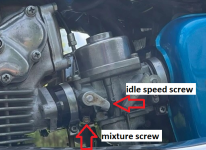
The mixture screw adjusts the amount of fuel (in the case of your carbs) that mixes with the incoming air and only works properly when the idle speed is set at 1200 rpm, +/- 100 rpm. The idle speed screw adjusts the arm on the shaft that opens the throttle plate, to adjust the amount that the throttle plate is open at idle which, yes, controls the amount of air coming into the carb at idle. There is no "3/4 of a turn out" on the idle speed screw. When the tip of the screw is touching the stop on the carburetor body then the throttle is fully returned to idle at that point - but how many parts of a turn to the right (tightening the screw against the spring installed to hold it where you put it after adjustment) is how the throttle plate is opened to adjust the idle speed only. Did you follow Bill Lane's 450 carb setup guide? If not, check your PMs.
 
That is normal. Understanding carburetors and how they work would help you a lot, because when you have a basic understanding of the parts and what they do it's easier to understand other little things, like that bowl vent.

Since the carb is not pressure fed with fuel no fuel pump on our bikes), it's done by what is referred to as gravity feed. When a liquid flows into a container it displaces the air in the container, and the air needs to go somewhere. As the engine runs and the carb is constantly sending fuel/air mix into the engine, it is also constantly being refilled with fuel flowing from the tank through the petcock and into each carb bowl. As the fuel comes and goes, the bowl has to have 'breathing' capabilities and that little brass nipple sticking out of the casting in the carb body is a tiny vent coming from the float bowl below. Look at the casting in the carb and notice how it makes a 90° turn downward and goes down to the rounded area where the float rises and falls inside the float bowl. That casting is hollow and the brass nipple has a small hole in it to allow just enough passage of air to let fuel in and out of the float bowl as the engine uses it from the tank. This link below by our resident expert Mike Nixon is good reading material to help you understand carbs better.

 
Finally got the idle settled down with the choke fully open.. I made a lot of adjustments and kept count of the amount of turns. I believe the mixture screws are 1-3/4 turns out, and the idle screw is maybe at 3/4 turns in. I am dialed in at approximately 1200rpms.

I checked under the bike for any more oil leaks, and found two. I have already fixed about three leaks.

The two leaks are coming out of the bottom of the clutch/front sprocket cover. Any recommendations on how to proceed?

I do remember AD mentioning a certain wire connection/grommet that sits in between the left covers, and needs to be sealed.
 
Last edited:
I have not entered this phase of the bike yet, but out of curiously I checked out the writing on tires. Wondering if either are original.

Front writing:
Dunlop K77
3.25x19

Rear writing:
Nitto NT-180
4.60 S18

I’m assuming that’s 4.60x18
 
Last edited:
I have not entered this phase of the bike yet, but out of curiously I checked out the writing on tires. Wondering if either are original.

Front writing:
Dunlop K77
3.25x19

Rear writing:
Nitto NT-180
4.60 S18

I’m assuming that’s 4.60x18
Since the bike sat for decades, I'd guess the front tire is original since it's a Dunlop, one of a few brands that Honda used then and it's the original size. The rear tire should not be a 4.60-18, it's a bit too large to properly fit the rim without bulging the center of the tread face. The stock tire size is 3.50-18 but you can run a 4.00-18 though it is a tad oversized for the rim as well. If you want the bike to look period-correct you can still get the proper size Dunlops for it, but if you want the best handling and traction you should go with modern tires. I put modern Shinko tires on my 450, a 90/90-19 on the front and a 100/90-18 on the rear. I could have gone with a 100/90-19 on the front but I wasn't sure of the fit so I went with the smaller and though it does leave a little bit bigger gap to the fender, it handles great. The smaller, more appropriately-sized tires turn as they should, not slow-feeling and roly-poly because of the way a larger tire changes the feel of the steering.
 
Since the bike sat for decades, I'd guess the front tire is original since it's a Dunlop, one of a few brands that Honda used then and it's the original size. The rear tire should not be a 4.60-18, it's a bit too large to properly fit the rim without bulging the center of the tread face. The stock tire size is 3.50-18 but you can run a 4.00-18 though it is a tad oversized for the rim as well. If you want the bike to look period-correct you can still get the proper size Dunlops for it, but if you want the best handling and traction you should go with modern tires. I put modern Shinko tires on my 450, a 90/90-19 on the front and a 100/90-18 on the rear. I could have gone with a 100/90-19 on the front but I wasn't sure of the fit so I went with the smaller and though it does leave a little bit bigger gap to the fender, it handles great. The smaller, more appropriately-sized tires turn as they should, not slow-feeling and roly-poly because of the way a larger tire changes the feel of the steering.

I will definitely be looking for tires that have the best safety and traction, as this will be my first bike to ride on. I am liking the prices of Shinko tires that I am seeing, about 40-50% less than going for period-correct.. I am not sure how they got a 4.60x18 tire to fit on the rear of this bike then. Hopefully it’s the original wheel and nothing was modified..

Off-topic tire question: Are there any seals inside the front sprocket/clutch cover that could be causing the two oil leaks that are coming out of it? I have not taken off the cover to investigate yet. I did buy an oil seal kit for this bike.
 
I am not sure how they got a 4.60x18 tire to fit on the rear of this bike then. Hopefully it’s the original wheel and nothing was modified..
Based on the pictures I've seen of your bike, the rear wheel appears to be original but more pics of it would help to be sure. Installing the 4.60-18 tire wouldn't be that much more difficult, but it's at least a half inch or more beyond the max size for that stock rim width.

Off-topic tire question: Are there any seals inside the front sprocket/clutch cover that could be causing the two oil leaks that are coming out of it? I have not taken off the cover to investigate yet. I did buy an oil seal kit for this bike.
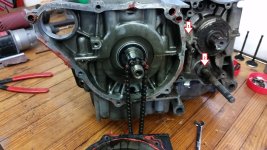
there are 4 seals inside the front sprocket cover, 2 of which are common possibilities for leakage - the shift shaft seal (#2) and the clutch rod seal (#1). The countershaft seal (behind the front sprocket) is less likely to leak though it certainly could, and the shift drum seal (behind the neutral switch) is up high in the upper half of the crankcase so it's even less likely to be one the seals leaking. So the most likely seals woulds be these, #1 and #2

seals.jpg
 
Rear wheel:
Original rear wheel as far as I can see.
More missing muffler screws. Top right one looks bigger than the rest
Removing it will tell you if it's just a larger-headed metric screw or a sheet-metal replacement, or an SAE screw stripped into the metric hole. Heat shield screws often came loose in the CL mufflers because of heat expansion and the fiber washers behind the heat shield Honda used in an attempt to keep the shield cooler.
Little bit of oil came out of the gear shifter
Actually, out of the hole in the front sprocket cover for the shift shaft which isn't unusual when there's oil present in that area. From the clean look of the area under the clutch rod and seal, it looks to be the clutch rod seal leaking or possibly the square-ish grommet around the alternator wires.

BTW, yet another thing that's easy to notice with respect to how many parts are wrong on this bike - the forward lower motor mount bolt at the front of the left footpeg bracket is way longer than the original would be. This engine has been out and apart maybe more than once, and I swear this bike has so many things that do not back up the story you were told that an old guy dropped it off when it must have been maybe 10 years old. If true, that old guy either bought it with a ton of stuff wrong with it in the bike's short life, or he did some terrible work on it himself.
 
Last edited:
Original rear wheel as far as I can see.

Removing it will tell you if it's just a larger-headed metric screw or a sheet-metal replacement, or an SAE screw stripped into the metric hole. Heat shield screws often came loose in the CL mufflers because of heat expansion and the fiber washers behind the heat shield Honda used in an attempt to keep the shield cooler.

Actually, out of the hole in the front sprocket cover for the shift shaft which isn't unusual when there's oil present in that area. From the clean look of the area under the clutch rod and seal, it looks to be the clutch rod seal leaking or possibly the square-ish grommet around the alternator wires.

BTW, yet another thing that's easy to notice with respect to how many parts are wrong on this bike - the forward lower motor mount bolt at the front of the left footpeg bracket is way longer than the original would be. This engine has been out and apart maybe more than once, and I swear this bike has so many things that do not back up the story you were told that an old guy dropped it off when it must have been maybe 10 years old. If true, that old guy either bought it with a ton of stuff wrong with it in the bike's short life, or he did some terrible work on it himself.

Muffler screws:

According to the parts diagram, it looks like these screws are supposed to be 6x14. I’ll give them a look when I get a chance. Also, I’m having trouble finding the tiny screw on the diagram that would go in the top of the muffler(pictured above). I do hear something metal rattling around in the muffler. Could very well be that screw.

Clutch rod seal:

Any safe precautions needed to be taken before getting this seal out? Is it as simple as prying it out? I believe it to be just the church rod seal leaking, after double checking everything. The electrical grommet is dry underneath. The shift shaft seal doesn’t have any wet oil below it.

Cleaning:

I would love to clean this area back to clean metal. Any safe spray cleaners I could use? Brake or carb cleaner? Thanks again for all the help

And I agree. This bike sure developed a lot of wrong/missing parts for it to only have been ridden for 10-12 years.
 
Last edited:
Pull the clutch rod out of the engine (note which way it goes in, round end inward, dimpled end outward), then pry the seal out with a screwdriver. Just don't gouge up the aluminum outer perimeter where the seal goes in. Clean the area up if you want, but in 500 miles it will look that way again because you have to lube the chain and that's where 90% of the gunk comes from. As to those screws/sheet metal bolts in the top of the muffler, they were put there by whoever 'owned' this bike to close up rust holes in the muffler, not from the factory. FYI, Honda never used flat blade headed screws in anything except maybe the points screws in the older bikes, always JIS (phillips-like) screws when screws were used.
 
Oh and BTW, your front sprocket is worn and needs to be replaced, and the chain looks like it might be an o-ring chain which will cause trouble for your clutch lifter arm in the front sprocket cover because of the extra width added by the o-rings sealing the lube in the link pins. So, we need to get a good side view look at your rear sprocket to see it if needs to be replaced too before you buy a new DID chain and new sprockets.
 
Oh and BTW, your front sprocket is worn and needs to be replaced, and the chain looks like it might be an o-ring chain which will cause trouble for your clutch lifter arm in the front sprocket cover because of the extra width added by the o-rings sealing the lube in the link pins. So, we need to get a good side view look at your rear sprocket to see it if needs to be replaced too before you buy a new DID chain and new sprockets.


Having an issue or two with this oil seal. So far, I have done very light prying with a flathead. The old seal is paper thin, and very brittle. Also, where my finger is pointed, there is an “indention” in the metal.

Edit: Wow. It just came to me. The oil seals have metal in them. I’m prying off the outer layer of the seal. SMH. LOL. We’ll save that one for the blooper reel.


I bought this oil seal kit from 4into1. They have this one listed as “main shaft seal”. those guys in Houston has the same kit, and it’s listed as “clutch rod seal”.

Edit; I’ll be using this one. It fits

 
Last edited:
That is the correct seal, and believe it or not, both descriptions are correct. those guys in Houston calls it by what it does (and what I've always called it, one of the few things we agree on) but it IS on the end of the transmission mainshaft. The metal with hole in the center is the small end mainshaft bearing outer, as long as you don't hammer on it you'll be fine. Go from a downward angle with the flat screwdriver and get under the outer lip edge of the seal, then push toward the bike. It might take some pressure but it will come out. Those seals are somewhat notorious for popping out on their own and dumping all the engine oil in the street, and if not noticed in a hurry can lead to the destruction of the top end of the engine. You'll want to wipe the opening completely dry of oil, use some carb spray on a rag to clean the area where the seal goes to be oil-free, and then put a smear of gasket glue (Gasgacinch will work) on the outer flat rim of it before putting it in to help keep it there.
 
That is the correct seal, and believe it or not, both descriptions are correct. those guys in Houston calls it by what it does (and what I've always called it, one of the few things we agree on) but it IS on the end of the transmission mainshaft. The metal with hole in the center is the small end mainshaft bearing outer, as long as you don't hammer on it you'll be fine. Go from a downward angle with the flat screwdriver and get under the outer lip edge of the seal, then push toward the bike. It might take some pressure but it will come out. Those seals are somewhat notorious for popping out on their own and dumping all the engine oil in the street, and if not noticed in a hurry can lead to the destruction of the top end of the engine. You'll want to wipe the opening completely dry of oil, use some carb spray on a rag to clean the area where the seal goes to be oil-free, and then put a smear of gasket glue (Gasgacinch will work) on the outer flat rim of it before putting it in to help keep it there.

The only sort of gasket sealant I have is Honda Bond-4, for rubber to metal contact. Would that suffice?
 
Back
Top Bottom