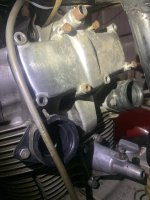
1971 CL450 that sat for 40 years.

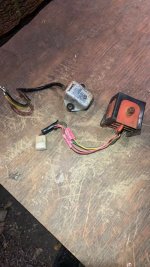
You have the correct battery. Just verify all the wiring or fix any hacks to make it to spec. It may not be all that bad but do it right ,or it's wrong. You need to check the diagram even to put in the new rec/reg unit (colors may not be the same). Get a bullet connector kit and crimper too, so you can keep the stock connectors and not cut the original harness unnecessarily.
I have had access to online manuals, but I do not have a physical copy, yet. I would like to get one. I’ve seen difference brands Clymer etc. I’m assuming acquiring one from the original creators themselves would be the best bet.
 
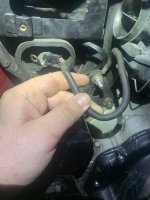
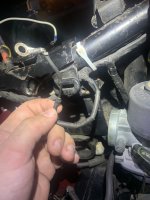
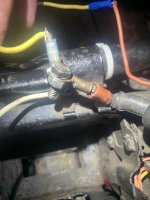
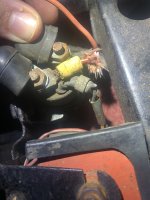
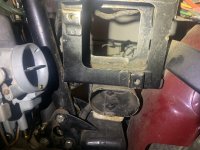
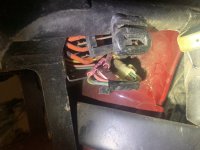
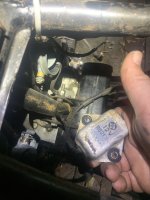
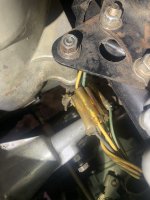
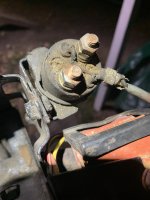
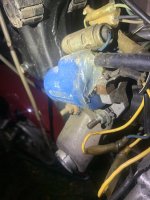
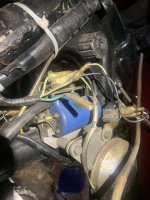
Just a few more pictures of the current wiring before I get started on the regulator/rectifier..

AD7ECBBC-53F4-4B0D-B7B0-A8D08D176CED.jpegBEB9CE2A-759D-4E8C-A9E7-CF3D1128F499.jpeg
5034F121-8476-4649-9828-A767B5E3D2C2.jpeg
1C00FF7D-BC03-425E-A1EB-936F9BECC378.jpeg
BCCBB23E-7B44-472B-BBA1-48B4CF1C7EA4.jpeg
B32FAC60-9635-45FE-A89C-6249925658B9.jpeg
1A773E0E-060E-4C33-999D-CC83C504EF05.jpeg
14BB1309-9BDA-4189-9B02-47A33E962FBE.jpeg
 
Starting on the removal:

54D64C00-B224-404E-B036-952B14DBE1A2.jpeg
991EE37D-7A2B-44F3-A110-7CB1BF640FE7.jpeg
57705CD9-356D-4685-855F-3199C4F54388.jpeg


What is the best way to clean electrical terminals? I have steel/brass bristle brushes. What spray would I use?
 
If the solenoid works I wouldn't bother. Sparck Moto/vintage connections (same guy) sells terminal extraction tools for the connectors as well as wire, proper crimp tool, new connectors and terminals.

I recommend you look at the wiring diagram and get the tools over at vintageconnections.com and fix the wiring with the right parts. Most wiring will be 18AWG on the bike. However, its possible one of the wires coming off the solenoid could be 14AWG. Ancientdad will have to confirm that as the wiring diagram doesn't tell you that.

The initial investment for the tool and connectors is pricey, but with the unknown wiring mess and get things cleaned up with fresh connectors goes a long way with reliability.
 
If the solenoid works I wouldn't bother. Sparck Moto/vintage connections (same guy) sells terminal extraction tools for the connectors as well as wire, proper crimp tool, new connectors and terminals.

I recommend you look at the wiring diagram and get the tools over at vintageconnections.com and fix the wiring with the right parts. Most wiring will be 18AWG on the bike. However, its possible one of the wires coming off the solenoid could be 14AWG. Ancientdad will have to confirm that as the wiring diagram doesn't tell you that.

The initial investment for the tool and connectors is pricey, but with the unknown wiring mess and get things cleaned up with fresh connectors goes a long way with reliability.
I have never done electrical wiring before, but i am up for the task. I didn’t know I’d be getting my electrician apprenticeship working on this bike haha. I agree that’s it’s best to be done right the first time, so that I’m not hunting down electrical gremlins later..
 
Any tips/suggestions on replacing electrical wiring would be greatly appreciated. From my understanding, tool wise, I’ll need to order a terminal extraction tool and crimp tool. What about a wire stripping and gauging tool? Also, I noticed that he does sell kits. I would hate to order the wrong one, or one that’s too large. I Suggestions on that would be appreciated as well.

Edit: Well now that I think about it, it would probably be wise for me to visually look and see what I need on the bike. Haha
 
Last edited:
Any tips/suggestions on replacing electrical wiring would be greatly appreciated. From my understanding, tool wise, I’ll need to order a terminal extraction tool and crimp tool. What about a wire stripping and gauging tool? Also, I noticed that he does sell kits. I would hate to order the wrong one, or one that’s too large. I Suggestions on that would be appreciated as well.

Edit: Well now that I think about it, it would probably be wise for me to visually look and see what I need on the bike. Haha
I've always just used a fine pick for pushing the tiny lock tab back for extraction from the plug blocks but a nice crimper (instead of generic automotive type) would be a nice treat. I always solder mine now as well as my crude crimps. Maraakate is an electrical whiz so he does things right. I'd go with his recommendation on what to get and ancientdad really knows these DOHC 450's.
 
Danager: I'm not an EE or anything like that. I've just learned over the years mostly from one of my other hobbies (Ham Radio). However, what you'll be doing is simply removing the copper terminals from the plugs, then you trim off the copper terminal, strip the wire about 1/4" then crimp a new connector on and reinsert. This will eliminate any doubt that the terminals are dirty and corroded. The reason your bike may already have hack wiring could be from someone who didn't want to do that and instead used whatever misc automotive wire they had on hand and just crimped it together (poorly). And yes, you can use a pick tool or a tiny flathead that's ground down a little bit for terminal extraction... however if you order any of this other stuff from Matt you may as well throw the tool in there.

Here is the crimping tool (recommended because it has the correct dies): https://www.vintageconnections.com/products/ratcheting-crimping-tool
Here is the terminal extraction tool: https://www.vintageconnections.com/products/terminal-extraction-tools?variant=46219459526977
Here is the terminal connector (Male): https://www.vintageconnections.com/products/6-3-spade-terminals?variant=46129847370049
Here is the terminal connector (Female): https://www.vintageconnections.com/products/6-3-spade-terminals?variant=46129847435585

If you'd like, he also has the bullet connectors
Female: https://www.vintageconnections.com/products/3-5mm-bullet
Male: https://www.vintageconnections.com/products/3-5mm-bullet?variant=46131253707073

And finally here is the wire: https://www.vintageconnections.com/collections/wire. He has multiple options, in most cases you'll be working with 18AWG.
 
Thank you Maraakate. Last night was my 1st time ever looking at a wiring diagram. Also my 1st time looking at electrical parts to order, and on top of that, trying to look at the wires to see what I need to order. After about 30 mins of looking at these three things, the dots weren’t connecting for me yet and I gave up to try again today. You have painted a clear picture and it makes sense now. I’ll take a closer look at the links you sent me and put in my order tonight.
 
Sounds good. Wherever you need help discovering which wire goes where or how to route it let us know and I'm positive someone here can guide you through it.

Additional tips for you:
  • When you nip off the old terminal connector and strip the wire back take a good look at the wire. If it's green then you have to keep trimming back until it's good. Sometimes you may have no choice but to solder and heat shrink tube it to extend the wire. If that happens, I think it's a good idea to "double up" on the heat shrink tubing so it doesn't rub through.
  • If you have to peel back the tape then be certain to use the correct wire harness tape. Matt has it.
  • Same goes for PVC sleeving. Matt also has this.
  • After you reassemble put some dielectric grease on the female plug and then put dielectric grease on the back sides of the connectors where the terminals push through. This will prevent corrosion in the future.
  • The early ignition switches are better than the late 70s models, however it's a good idea to check them for voltage drop. Sometimes the contacts the spring loaded bearing rides on get a little dirty. If they cause 1.0V or more of voltage drop this is charging you're being robbed of. The points ignition on these bikes need a good battery that charges easily. However, let's focus on the wiring first then I can show you how to do the voltage drop test and repair.
  • If you must clean a terminal try using an eraser first. If corrosion is minor then an eraser can clean it up without removing too much material. Beyond that I like to try a piece of red scotch brite, very carefully. If you do this, really look closely at the crimp. If the exposed wire is discoloured then it's no good and you need a new terminal connector.
  • For turn signals take the lens off and remove the bulb. Make sure it's not nasty in the bulb holder. You can take a bit of scotch brite and clean it up then put dielectric grease on the bulb terminals and put it back in there.
  • If you haven't checked the horn yet don't be surprised if it doesn't work. Sometimes the diaphragms get stuck from sitting outside for a long time. Spray some penetrating fluid in the horn diaphragm and have a helper hold the horn button while you whack the back or side of the horn with a RUBBER mallet. Usually this will get them going again. If not then try to loosen the nut and screw adjuster on the back of the horn and turn it in and out while holding the button.
It all sounds a little daunting, and those wiring diagrams can be annoying to read, even for me. But keep at it and you'll be rewarded with reliable electronics. It's one of the most missed things on a "new to me" bike of this vintage. You have good motivation to do so because of the automotive wiring job someone else did, so it needs repaired and gone over anyways.
 
For turn signals take the lens off and remove the bulb. Make sure it's not nasty in the bulb holder. You can take a bit of scotch brite and clean it up then put dielectric grease on the bulb terminals and put it back in there.

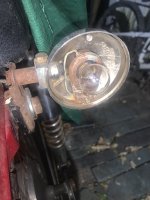
All of the turn signals are fine, except for the rear right. I was gonna post about it later down the road, with pics. The bulb will not come out. I believe it is too corroded/rusty. And since it is locked in, the PO used a bit of force when turning the bulb and it started fraying the wire, it’s literally connected by a hair. You have to get the angle of the turn signal just right to get it to come on.

If you haven't checked the horn yet don't be surprised if it doesn't work. Sometimes the diaphragms get stuck from sitting outside for a long time. Spray some penetrating fluid in the horn diaphragm and have a helper hold the horn button while you whack the back or side of the horn with a RUBBER mallet. Usually this will get them going again. If not then try to loosen the nut and screw adjuster on the back of the horn and turn it in and out while holding the button.
The horn actually works! I couldn’t believe it. That’s the last thing I suspected to be operating correctly. It sounded like a dying goose with a low battery but sounds fine now with a charged one.

Further question: Would it also be necessary for me to order some ring terminals for the positive/negative battery cables?
 
Depends on their condition, but usually the battery cables and the ring terminals on them are OK. If the positive one going to the solenoid is nasty post a picture so we can judge it. Usually you can clean those up OK.

For the rear light you may have no choice but to replace. I don't know where to get new bulb holders that are decent quality as I never had to replace it before, but someone here might be able to recommend something.
 
Depends on their condition, but usually the battery cables and the ring terminals on them are OK. If the positive one going to the solenoid is nasty post a picture so we can judge it. Usually you can clean those up OK.

For the rear light you may have no choice but to replace. I don't know where to get new bulb holders that are decent quality as I never had to replace it before, but someone here might be able to recommend something.
If you want to refurbish your vintage tailight these may have some possibilities.
 
Ah yeah, not bad. Didn't know about those. Have you used those before? I've had some bad luck with cheap ones in the past on mopeds where they just spontaneously broke after a year and I just ended up finding a genuine used CEV assembly.
 
Ah yeah, not bad. Didn't know about those. Have you used those before? I've had some bad luck with cheap ones in the past on mopeds where they just spontaneously broke after a year and I just ended up finding a genuine used CEV assembly.
I bought some 9mm for a speedo project that I never finished, or maybe they were 7mm. They are cheap but look like they'll work. Shame to trash a vintage one just because the socket is rotten.
 
Yeah if it's just something minor and the rest is OK cosmetically you want to try and save it. If it's all rusted and nasty in there I wouldn't bother unless it was an emergency thing to keep me going until I can source it.

If you can make it fit OK. I saw some of the reviews saying that the crimps are weak which is what I was expecting at that price point. What I would do is solder on the bulb end and then crimp with new bullet connectors on the other end. Ideally I'd use the same colours to avoid confusion for the next guy.
 
Yeah if it's just something minor and the rest is OK cosmetically you want to try and save it. If it's all rusted and nasty in there I wouldn't bother unless it was an emergency thing to keep me going until I can source it.

If you can make it fit OK. I saw some of the reviews saying that the crimps are weak which is what I was expecting at that price point. What I would do is solder on the bulb end and then crimp with new bullet connectors on the other end. Ideally I'd use the same colours to avoid confusion for the next guy.
First I'd try to clean up the old one with a worn small dremel green scotchbite wheel on a 15mm one.
 
Can't just post a few pictures of different angles showing the rust/corrosion?
The rust/corrosion is under the bulb, settled in the socket. I was going to video trying to turn the bulb to show the motion that it’s “stuck” in. And also to show how the hair wire is hanging on for dear life under the bulb. I can add pictures as well.
 
The rust/corrosion is under the bulb, settled in the socket. I was going to video trying to turn the bulb to show the motion that it’s “stuck” in. And also to show how the hair wire is hanging on for dear life under the bulb. I can add pictures as well.
I hear you, but a bulb rusted in a socket is actually pretty common. After the bulb breaks loose from the metal base, you typically end up using a pair of pliers to remove the base of the bulb, clean up the rust on the contacts inside and use some dielectric grease to keep the rust from returning when you put a new bulb in. Worst case scenario the socket is too rusted to use and you replace the turn signal assembly if the socket can't be replaced (been too long, can't recall if they're replaceable). I actually have a few turn signals lying around from my 450 that I'll never use, in case you need one.
 
I hear you, but a bulb rusted in a socket is actually pretty common. After the bulb breaks loose from the metal base, you typically end up using a pair of pliers to remove the base of the bulb, clean up the rust on the contacts inside and use some dielectric grease to keep the rust from returning when you put a new bulb in. Worst case scenario the socket is too rusted to use and you replace the turn signal assembly if the socket can't be replaced (been too long, can't recall if they're replaceable). I actually have a few turn signals lying around from my 450 that I'll never use, in case you need one.
I have not tried to take any action yet, as far as breaking the glass on the bulb or taking the assembly apart. If nothing can get figured out, I’ll probably end up contacting you about one of those turn signals!
 
I have not tried to take any action yet, as far as breaking the glass on the bulb or taking the assembly apart. If nothing can get figured out, I’ll probably end up contacting you about one of those turn signals!
Just to be clear, I didn't mean intentionally breaking the glass part of the bulb, but when the bulb is rusted in the socket it usually ends up happening. I usually just twist the glass part loose (and if it's stubborn, ALWAYS use a rag or heavy gloves over the glass in case it breaks) and then take needle nose pliers to twist the base of the bulb loose in the socket. Remember, the bulb goes in and makes a slight turn to the right to latch when clean and working properly, so you'll want to push inward slightly and try to turn to the left when you're breaking it loose to remove the remnant.
 
These bulbs do need to be pushed gently in a small amount in order to turn them counter-clockwise for removal.

There are small prongs on the sides of the base that lock into the socket to prevent the bulb from working its way out through vibration.
 
Last edited:
These bulbs do need to be pushed gently in a small amount in order to turn them counter-clockwise for removal.

There are small prongs on the sides of the base that lock into the socket to prevent the bulb from working its way out through vibration.
The other three turn signal bulbs act as they should. Gently push, turn, bulb out. This one is stuck. Would wd40 help?
 
Ahh.. I see the problem now. The socket is spinning with the bulb.


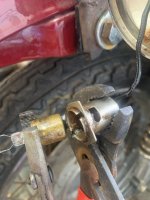
The wire hanging on by a hair finally gave out.
2D84CA0E-FB15-4A7B-8062-E77199C2F371.jpeg
 
A penetrating oil like PB Blaster would probably work better than WD40, but, if that's what you've got handy, you may as well try it.

Maybe if you apply pressure somewhere on the socket as you try to turn the bulb, you will get it. I would try to lube it first.

When a bike sits a long time, once simple tasks can require huge amounts of effort, as you're experiencing here with a simple bulb. Hope this bulb comes free soon.
 
WD40 is cheap and penetrates pretty good, I like the PBblaster for bolt threads better. WD is a good cleaner too. That uninsulated wire is a ground for the socket base to the lamp housing, you can re solder it.
There is a cross head screw to remove the socket for the housing. I can see it through the glass, it is below the bulb. Not much slack in the black positive wire there, unless you can pull out the black rubber seal plug and undo the black from the harness.
A lot of work for just a turn signal lamp, huh? Hopefully your socket can just be cleaned up and the spring in the base is still working to keep the bulb contact contacting.
 
WD40 is cheap and penetrates pretty good, I like the PBblaster for bolt threads better. WD is a good cleaner too. That uninsulated wire is a ground for the socket base to the lamp housing, you can re solder it.
There is a cross head screw to remove the socket for the housing. I can see it through the glass, it is below the bulb. Not much slack in the black positive wire there, unless you can pull out the black rubber seal plug and undo the black from the harness.
A lot of work for just a turn signal lamp, huh? Hopefully your socket can just be cleaned up and the spring in the base is still working to keep the bulb contact contacting.

I’ve always heard that joke, “how many “x” does it take to change a light bulb?” This situation definitely applies. AD’s offer of a turn signal is feeling pretty tempting. 4into1 sells affordable turn signal reproductions, but staying OEM will be the goal for this one.
 
I’ve always heard that joke, “how many “x” does it take to change a light bulb?” This situation definitely applies. AD’s offer of a turn signal is feeling pretty tempting. 4into1 sells affordable turn signal reproductions, but staying OEM will be the goal for this one.
:ROFLMAO: A lot, maybe more. Truthfully yours is average or better compared to the stuff I get. When they're dry there is always oxidative matrimony. That's why the WD (my bud calls it Wanker Douche) is called for. I finally started buying it by the gallon and use a pumper can. I won't touch a bolt with wrench without a shot. Shines old chrome good too.
Save AD's kind offer for one that's smashed to bits. The replacement ones are cheap chrome over plastic, you have OEM, accept no substitutes. Give it the old WD and she'll settle for you all nice.
Welcome to the Kingdom of Rust.
 
Ahh.. I see the problem now. The socket is spinning with the bulb.

The wire hanging on by a hair finally gave out.
And this is exactly why a simple picture describes what you were unfamiliar with and trying to describe. When you first mentioned the wire as "it’s literally connected by a hair", my first impression was you meant the bulb glass had already come loose from the metal base and the tiny wires connecting the filament were what you were trying to describe. That's the ground wire that came loose in the picture because the turn signals are mounted in rubber grommets, which means the bulb situation is not as dire as described in words. So spray copious amounts of penetrant around the bulb base and keep working it, and you can solder the ground wire back on later if the socket is repairable.
 
And this is exactly why a simple picture describes what you were unfamiliar with and trying to describe. When you first mentioned the wire as "it’s literally connected by a hair", my first impression was you meant the bulb glass had already come loose from the metal base and the tiny wires connecting the filament were what you were trying to describe. That's the ground wire that came loose in the picture because the turn signals are mounted in rubber grommets, which means the bulb situation is not as dire as described in words. So spray copious amounts of penetrant around the bulb base and keep working it, and you can solder the ground wire back on later if the socket is repairable.
After an absurd amount of WD40 and 15 mins of soaking, it still needed some motivation with pliers.

6B81368E-9C38-44DB-A40E-DA544DCCF8FB.jpeg
 
Glad it came out successfully. If you had any Evaporust around it would remove all the rust without damaging what plating is left (vinegar will remove the rust but can also remove the plating if left too long). Once you have it rust-free you can paint it inside and out with silver paint, then scrape the lead contacts and the inside edges of where the little 'pins' on the bulb latch into the sides of the socket and use either dielectric grease (or my favorite, which is always on hand if you own a chain drive bike, a can of PJ-1 chain lube with thickening agent and graphite in it) to prevent further corrosion. It must have gotten water in it at one time due to a cracked lens or sitting under a flow of rain runoff for it to have gotten that bad inside.
 
Glad it came out successfully. If you had any Evaporust around it would remove all the rust without damaging what plating is left (vinegar will remove the rust but can also remove the plating if left too long). Once you have it rust-free you can paint it inside and out with silver paint, then scrape the lead contacts and the inside edges of where the little 'pins' on the bulb latch into the sides of the socket and use either dielectric grease (or my favorite, which is always on hand if you own a chain drive bike, a can of PJ-1 chain lube with thickening agent and graphite in it) to prevent further corrosion. It must have gotten water in it at one time due to a cracked lens or sitting under a flow of rain runoff for it to have gotten that bad inside.
Thanks for these pointers and tips. Upon looking at the turn signal diagram. I think mine are missing the gasket. Also, I see that the turn signal bulbs are single filament “Stanley 1073 (12v23w)”. Instead of ordering some, my local autozone has these in stock. Would be curious if they would work fine.

 
I know this post has jumped around a bit lately. With the discovery of a ‘hack-man special’ with the battery cables, and a turn signal bulb that had fossilized. I am awaiting a few parts and tools to get those fixed. In the meantime I decided to “prep” the CL450 for the upcoming valve/cam chain adjustment. I have been reading AD’s earlier comments to get them engraved in my head, about the proper way to go about doing it.


**All bolts came right out, I was shocked. No struggle.

The four bolts shown, are shorter than the
rest.
271537CF-D32E-484F-85B8-851B949C7F2E.jpeg

Intake side:
888D2A3A-6AEB-4D87-8228-F19382C5CB27.jpeg
64B8D632-8467-44D2-8E3D-E88238C2C754.jpeg
4BD29CAE-5CF1-4BEF-81AF-965BD45B5A33.jpeg

Exhaust side:
A4DCE5BD-E6B1-4639-A7C7-30C1E1B14CB5.jpeg
2E1ECEC8-EF71-466C-839E-16976AA0E77D.jpeg

Noticed a lot of goop on one coil and an unplugged ground wire near the other one:
2B470559-34EC-4D63-AE3D-661793292F60.jpeg
622E1A0B-60FE-42B9-B571-F509DC4373D6.jpeg

Thanks in advance.. just trying to take baby steps and soak it all in
 

Attachments

  • A29CEB70-C216-49AD-9C18-5489A6BED754.jpeg
    A29CEB70-C216-49AD-9C18-5489A6BED754.jpeg
    1.5 MB · Views: 9
Last edited:
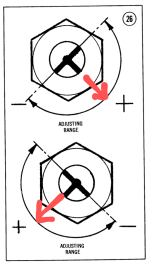
Take a look at the valve adjusters. Three of them are visible at all times and the fourth is under the points cover (left exhaust). There is an indicator on the adjuster that should always point away from the spark plugs (forward on exhaust side, backwards on intake side). The picture below comes from the FSM and will help you identify the marks.

Screenshot_20220627-073022~2.png

The goop on the coil makes me wonder if the spark plug lead was replaced. New coils and a new condenser aren't a bad idea.

I have a 1972 CL450 parts bike and the wiring harness is still on the bike. I'd be happy to give it to you if you want to go that route. I may have the rear turn signal assemblies as well, but I'd have to look because they are not on the bike at this point.
 
Last edited:
Take a look at the valve adjusters. Three of them are visible at all times and the fourth is under the points cover (left exhaust). There is an indicator on the adjuster that should always point away from the spark plugs (forward on exhaust side, backwards on intake side). The picture below comes from the FSM and will help you identify the marks.

Screenshot_20220627-073022~2.png
Thanks for pointing that out! I’ll be going over the FSM here in a little bit.

I have a 1972 CL450 parts bike and the wiring harness is still on the bike. I'd be happy to give it to you if you want to go that route. I may have the rear turn signal assemblies as well, but I'd have to look because they are not on the bike at this point.
Those are very kind offers. I couldn’t decide if I wanted to spend the $$
to repair the current wiring(buying electrical tools/connectors/terminals etc).

Or order an OEM spec main harness made from Sparck Moto($119). Both options would cost about the same. I’m thinking I’m gonna purchase the harness from SM.

The turn signal luckily still has potential. Frank recommended me an affordable solder kit to reattach the ground wire.

I would hate to get that harness from you, and you need it down the road.
 
I would hate to get that harness from you, and you need it down the road.
It's nice of you to think that way, but I wouldn't offer it if I felt I needed it for my strategic reserve. Same goes for the rear signals. I got the parts bike primarily for engine parts and have already given away quite a few other pieces that I don't need.

Feel free to follow up by PM, if interested.
 
Note that the PO or dealership or whoever repaired the gray turn signal wire at the flasher with a section of neutral switch wire (light green w/ red). The green ground may be for another market that has an additional component in the area, though I can't think of what it would be.

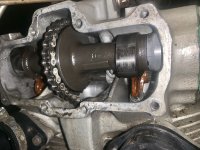
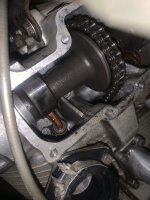
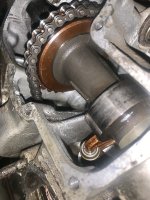
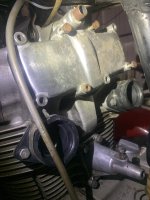
Your cams look pretty typical of a used 450 that has had average care, and the followers may well be a little bit "dished" with wear, but they look serviceable at this point. You'll learn more when the valve adjustment time happens. Odd-looking white stuff on the cam chain, hopefully not significant corrosion as that can be dangerous for cam chain reliability.
 
Note that the PO or dealership or whoever repaired the gray turn signal wire at the flasher with a section of neutral switch wire (light green w/ red). The green ground may be for another market that has an additional component in the area, though I can't think of what it would be.

Your cams look pretty typical of a used 450 that has had average care, and the followers may well be a little bit "dished" with wear, but they look serviceable at this point. You'll learn more when the valve adjustment time happens. Odd-looking white stuff on the cam chain, hopefully not significant corrosion as that can be dangerous for cam chain reliability.
Could this be evidence that I’ll need a new cam chain down the road? Any way to “inspect” this residue to see what it is?
 
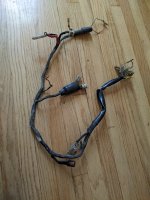
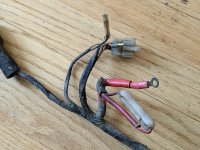
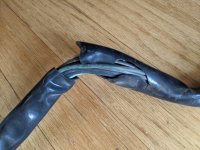
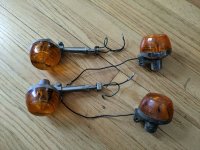
Here are some pictures of the spares I mentioned. The outer plastic sheath around the bundle of wires has one break in it — I would recommend replacing that. Otherwise, the harness appears to be in decent shape.

Wiring harness:

View attachment 25067 View attachment 25068

View attachment 25069 View attachment 25070

View attachment 25073

CL450 front signals and CB/CL350 rear bulb housings:

View attachment 25071 View attachment 25072
Somewhere there is a Hack-man salivating over getting ahold of that good condition harness to slash it up. Haha.

I think it looks great, definitely interested. A rear turn signal housing would solve the disconnected ground wire problem too. Whatever you think!
 
Back
Top Bottom