1971 CB350 . . . 40 year hibernation

Your fork choices don't matter here. Maybe it's just the pic but looks a bent head tube to me. Salvage titles can be a pain, varies by state. Show the welder. I bet plan A (your head stock with this frame) is the best route but check the rest of this frame carefully for any other misalignments.
 
Talk with the frame guy, show him the pictures or maybe make a deal with the salvage yard that you buy the frame and if the frame guy rejects it then you can return it.
 
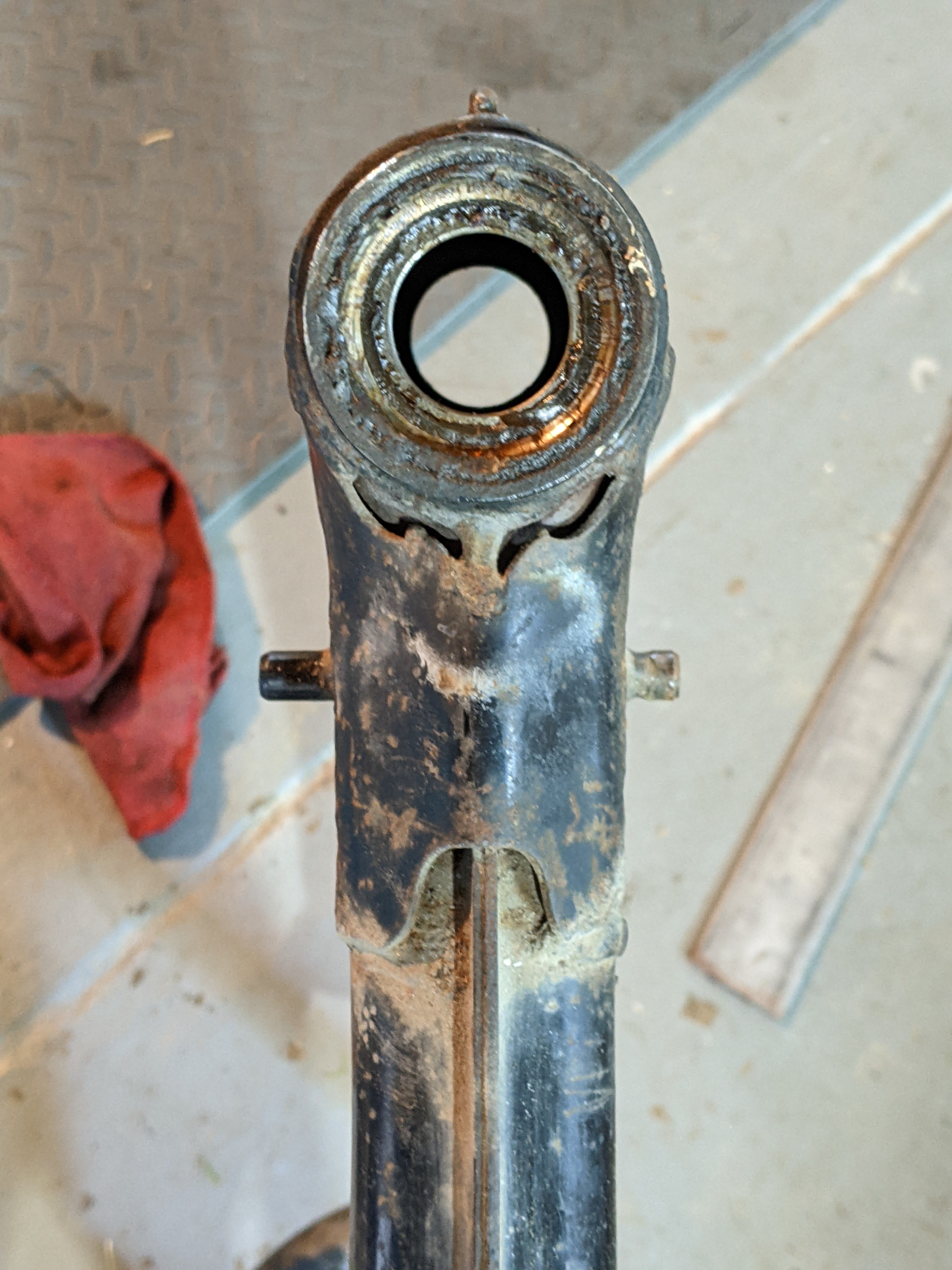
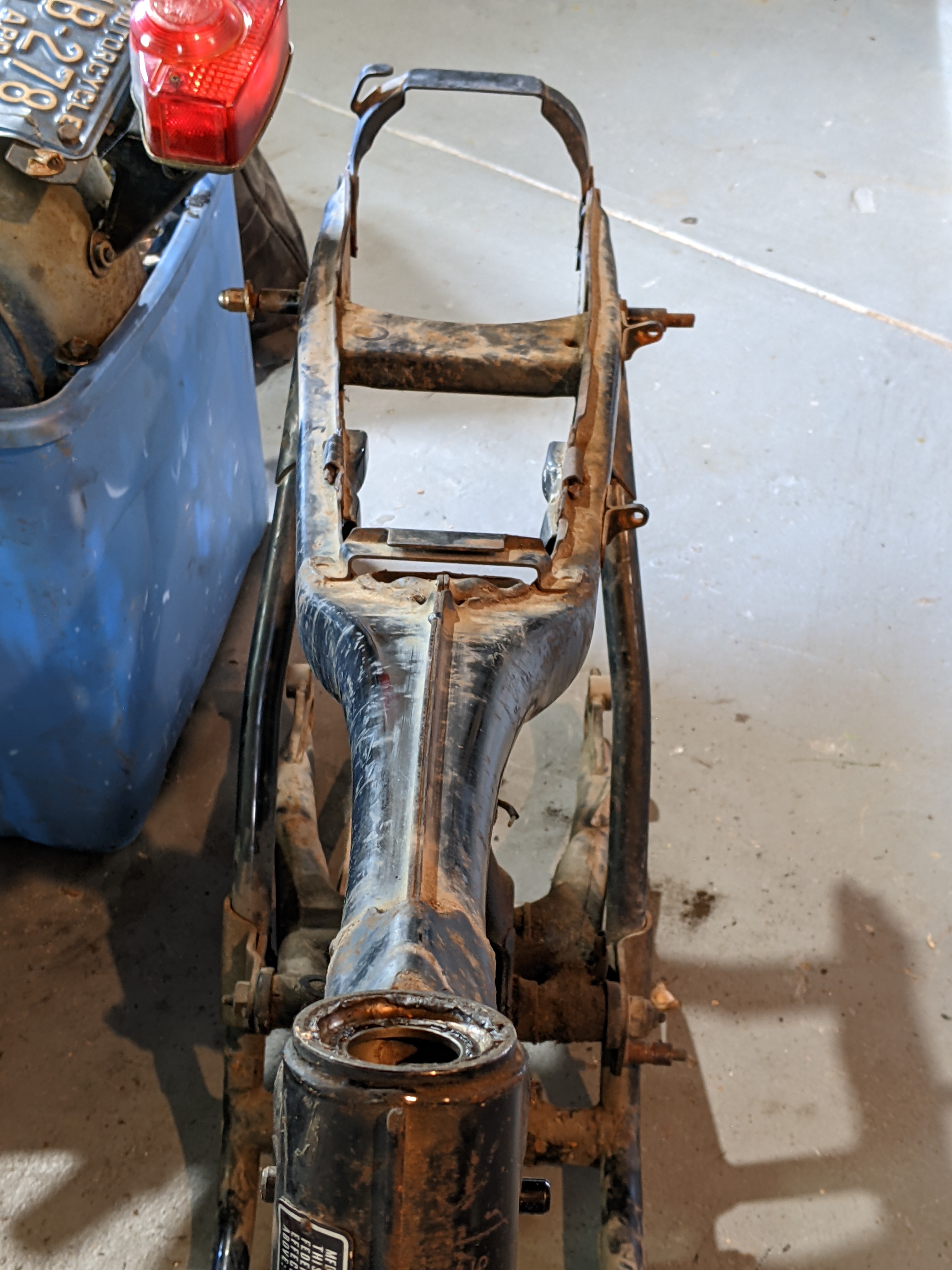
Thanks, Tom. You might be right about the bent head tube. It looks like it may lean towards the rider's right (left in the second photo below).

I was only mentioning the forks to point out that the salvage forks (which might also be damaged) are out of the picture. Here are two additional pictures of the frame. Note that the tank posts actually are different lengths for whatever reason. I find it hard to assess given that the frame doesn't sit perpendicular to the floor (which is not flat in my cellar anyways).

lpzLKk2.jpg

cVDzwtU.jpg


zzecDXu.jpg


7oK9lJp.jpg
 
I forgot to mention that at the shop where I am hoping to have the frame repaired, the owner was hesitant to weld the headstock onto a donor frame. If I go that route I'll need to find someone else. He has a fair concern of liability.
 
I forgot to mention that at the shop where I am hoping to have the frame repaired, the owner was hesitant to weld the headstock onto a donor frame. If I go that route I'll need to find someone else. He has a fair concern of liability.
Welding headstocks is a somewhat specialized operation, it's not normal welding since the headstock needs to be heated red and kept hot while welding.
 
I forgot to mention that at the shop where I am hoping to have the frame repaired, the owner was hesitant to weld the headstock onto a donor frame. If I go that route I'll need to find someone else. He has a fair concern of liability.

I'd probably go a foot more or less so back from the head, top and bottom to chop it, if possible and straight. Get a long straight edge or tight string to measure multiple places the whole length of the frame to head stock to make sure that it is not bowed in the middle or the back end too.
 
I also heard back from the [expensive] frame straightening shop with all the fancy equipment. They said they could check a frame to see if it's bent and could straighten a frame, but could not repair damage to a frame (dents, kinks, etc.). So, that company seems to fit better with the salvage frame than the original, but I'd have to shell out more clams. On the other hand, the paperwork from that shop could help with the salvage title process.

Peace of mind does has value.
 
I'm late to this, but the steering stop shows the bike had a hard hit that turned the front end strongly enough to cause a fair amount of damage to the stop as well, so I'm guessing the neck of that frame might be tweaked. If it was mine, I'd consider repairing your frame with the lower tube from this donor.
 
I also heard back from the [expensive] frame straightening shop with all the fancy equipment. They said they could check a frame to see if it's bent and could straighten a frame, but could not repair damage to a frame (dents, kinks, etc.). So, that company seems to fit better with the salvage frame than the original, but I'd have to shell out more clams. On the other hand, the paperwork from that shop could help with the salvage title process.

Peace of mind does has value.

Frame racks are expensive machines. Particularly if it's the "3D" or "laser" guided types. You can probably get it done much cheaper with someone who has the old school "pod" type setup where there are pods in the floor of the shop with chains to attach to the frame. Check rinky-dinky body shops that have just the owner and maybe a painter and a helper. Likely they'll have that and do it cheaper.

OT, but I will say I always hated pods. Hated setting them up for the body guy when I was a helper. Those things are very dangerous. I refused to pull frames with that setup and had the body guy do it. If those chains twist on those old pods those things go flying with more force than a bullet and will instantly kill you.
 
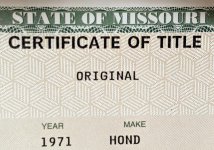
Title #1: The new title for the original frame is finally in my hands, ready for a trip to the DMV to complete a legal sale.

View attachment 16338

Getting a title on an old bike is a great sense of victory - you got it done in spite of a thousand potholes and blowouts. Somehow I always feel like I beat the system, even though I had to do a lot of kissing up along the way.

Congrats!
 
Getting a title on an old bike is a great sense of victory - you got it done in spite of a thousand potholes and blowouts. Somehow I always feel like I beat the system, even though I had to do a lot of kissing up along the way.

Congrats!

Thanks, Bob! I know exactly what you mean!
 
Thanks, Bob! I know exactly what you mean!


Congrats on the title! Anybody tried the Vermont process on an abandoned bike? I got a nice '74 CB 350 from an estate sale with no title. I need to sell it but the Ohio PO has been unresponsive for some reason :) I know it's heresy, but I've got too many projects and not enough time. Ron
 
Frame racks are expensive machines. Particularly if it's the "3D" or "laser" guided types. You can probably get it done much cheaper with someone who has the old school "pod" type setup where there are pods in the floor of the shop with chains to attach to the frame. Check rinky-dinky body shops that have just the owner and maybe a painter and a helper. Likely they'll have that and do it cheaper.

Thanks for sharing your experience with this. I'm still weighing my options and plan to at least visit the shop with the frame rack. This may be wishful thinking, but since the frame is stripped bare at this point, I'm hoping the repair will be easier for them and will fall on the low end of their range. I don't plan to build tons of bikes (maintenance and improvements keep me busy enough) and I hope to avoid damaged frames from here out, so I may opt for the more expensive repair if I am convinced it will be better. Won't hurt to check in with some old school body shops along the way. If I go the old school route, I'll make sure I'm a safe distance away, i.e., at home!
 
Congrats on the title! Anybody tried the Vermont process on an abandoned bike? I got a nice '74 CB 350 from an estate sale with no title. I need to sell it but the Ohio PO has been unresponsive for some reason :) I know it's heresy, but I've got too many projects and not enough time. Ron

I don't know if any VHT members have used Vermont registration specifically on an abandoned bike, but the general topic has been discussed a couple of times. Try here.
 
Thanks for sharing your experience with this. I'm still weighing my options and plan to at least visit the shop with the frame rack. This may be wishful thinking, but since the frame is stripped bare at this point, I'm hoping the repair will be easier for them and will fall on the low end of their range. I don't plan to build tons of bikes (maintenance and improvements keep me busy enough) and I hope to avoid damaged frames from here out, so I may opt for the more expensive repair if I am convinced it will be better. Won't hurt to check in with some old school body shops along the way. If I go the old school route, I'll make sure I'm a safe distance away, i.e., at home!

The "3D" ones with "towers" have the same danger of chain breakage, but they are designed to attempt to keep the chains from twisting which would increase that risk. In either case, yes, don't be near it while they do it. If a shop invited you back there to witness it then they clearly don't care about liability.

Also, I doubt this will happen, but make sure they are not heating the frame in order to straighten it. This weakens the metal. This may sound obvious to some here, but it's incredibly dangerous to the customer if they get hit again near that area. The integrity of the frame becomes compromised. Insurance companies will instantly total a vehicle if they find out the frame has been heated as such in order to do a frame straighten repair. This is probably a non-issue in your case, but just more of a general FYI from my days back in auto body land.

I don't know if any VHT members have used Vermont registration specifically on an abandoned bike, but the general topic has been discussed a couple of times. Try here.

I have used the VT loophole with great success on my DT250 and CB550. If anyone needs help filling out these forms PM me and I will fill out the PDF for you and all you have to do is print out the PDF and put a check in the mail. Don't pay someone $100-$200 for that privilege when you can do it yourself for 10 minutes of your time.
 
I visited the frame straightening shop this morning. It's $200 for measurements and evaluation and another $500-600 to straighten. This is lower than his typical jobs because he'd be working with the bare frame so there are no disassembly/assembly fees.

By eye, he thinks there may be 0.5-1 degree of camber in the steering tube, but it will be a couple of weeks before he can get it on the rig. He does provide paperwork to document repairs and it seems that is helpful when dealing with salvage titles.
 
I visited the frame straightening shop this morning. It's $200 for measurements and evaluation and another $500-600 to straighten. This is lower than his typical jobs because he'd be working with the bare frame so there are no disassembly/assembly fees.

By eye, he thinks there may be 0.5-1 degree of camber in the steering tube, but it will be a couple of weeks before he can get it on the rig. He does provide paperwork to document repairs and it seems that is helpful when dealing with salvage titles.

Wow, at that price might make more sense to just find a basket case CB350 with frame if possible. I'm sure there's a 20-something or 30-something hipster doofus that attempted a "cafe racer" with pods and can't get it to run right and messed up the wiring. But, you don't care about any of that, you just need the frame. As long as he didn't take a sawzall to it.

The most offensive part of frame straightening is that takes maybe 30 minutes to set it up, and about an hour (usually less) to pull it. But, with the machines costing $50k or more and subscription fees for the software that's why the prices are a bit ridiculous. Now, to be fair knowing where to pull efficiently is an art unto itself. So it takes training to use these machines. But still crazy how expensive it is.

I just want to be clear I'm not slamming these shops. I just remember the guilt I felt, with billed time from the insurance company for like 4-5 hours of frame straightening time. An hour for setup, the rest for the pulling. Most career techs (not me, I was simply a helper to setup the clamps and chains) can knock out most frame issues in an hour or less. With a motorcycle frame stripped down it should be an hour or two job for anyone competent at it.

For modern cars they have frame pulling points and with the subscription for the computer it tells you exactly where to place the sensors. In the center of the car there's a spinning laser which the computer decodes the distance from the sensors and from there you get your "3D" alignment. This makes it very easy to do, as long as you have had the proper training to know where to pull efficiently and safely. I went more into light body work and then eventually into the paint shop so I never learned that part of it. But, I shadowed a lot of guys who did frame jobs. With that said, at least on cars, one of the ways to check without the computer (which I witnessed from the better techs) is to use a frame squareness gauge. Basically, if it was a front end collision you could check for square at the rad support points. The FSM had measurements to check for this. For a bike, I have no idea how it's determined exactly.
 
Wow, at that price might make more sense to just find a basket case CB350 with frame if possible.
I've already got two basket case 350s, but my luck is such that they both have damaged frames. I got a good enough deal at the junkyard that the frame straightening costs are not a deal breaker and I feel the final result will be better with this option.

For modern cars they have frame pulling points and with the subscription for the computer it tells you exactly where to place the sensors. In the center of the car there's a spinning laser which the computer decodes the distance from the sensors and from there you get your "3D" alignment. This makes it very easy to do, as long as you have had the proper training to know where to pull efficiently and safely. I went more into light body work and then eventually into the paint shop so I never learned that part of it. But, I shadowed a lot of guys who did frame jobs. With that said, at least on cars, one of the ways to check without the computer (which I witnessed from the better techs) is to use a frame squareness gauge. Basically, if it was a front end collision you could check for square at the rad support points. The FSM had measurements to check for this. For a bike, I have no idea how it's determined exactly.


The owner of the shop gets the measurement specs from a company in Germany. He had plenty of old Hondas already, but, on first glance, the 350 twins were not in the system. He's reaching out to Germany to see if he can track the numbers down. He asked if there were other models that used the same frame. I guess the early CB250s would have, but I don't think any others did. If anyone can shed light on that question, I'm all ears.
 
If anyone can shed light on that question, I'm all ears.

Other than what you've mentioned the only one that comes to mind right away, with minor differences but probably nothing that would affect the areas you need repaired, might be the SL350K0

honda-sl350-motosport-1969-k0-usa-frame_bighu0026f0s17_69db.jpg
 
Other than what you've mentioned the only one that comes to mind right away, with minor differences but probably nothing that would affect the areas you need repaired, might be the SL350K0

Good call. It didn't even occur to me in the moment to tell him to look for CL350, so I've passed this along now.
 
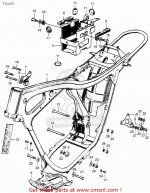
My junkyard deal a few weeks back allowed me to acquire a right side cover in sorta rough condition. The tabs were very tight on the hardened grommets and I felt I might break them if I forced the tabs through. Is this cover correct for a K3? It appears to be based on the parts manual. Assuming it's correct I'll pick up a left cover on eBay.

As0PgQj.jpg


The paint doesn't look like factory quality to me. Is there a good way to remove old paint from plastic covers? Or should I fill the cracks and sand smooth?

Edit: A search led to two possibilities for removing paint from plastic. Rubbing alcohol or brake fluid. Anybody tried these on plastic?
 
I see you have a '71 CB 350 also. Keep at it. Biggest headache I'm having is finding needed parts, that and getting the gas tank clean!:)
 
I see you have a '71 CB 350 also. Keep at it. Biggest headache I'm having is finding needed parts, that and getting the gas tank clean!:)

Thanks for the encouragement. Will look forward to your advice on this thread. I hope the progress here will speed up once I have a solid frame to work around!
 
If it was my frame, I would bead-blast the frame first, then you can see hidden damages also.

Thanks for checking in, Jensen. That's a good idea. I believe the shop where I intend to have the frame powder coated can blast it for me. I'll be sure to talk to them about it when I get to that point.
 
Thanks for checking in, Jensen. That's a good idea. I believe the shop where I intend to have the frame powder coated can blast it for me. I'll be sure to talk to them about it when I get to that point.

AFAIK, most powdercoat shops blast the stuff they prep for PC, the one that did mine blasted it which is how the airborne sand got into the PC when I had it coated again after the frame repairs.
 
Do you have access to a gasoline powered pressure washer? Works good for cleaning parts.

Not easily, but I've been putting off buying either a decent air compressor or power washer for a while. As Tom mentioned, the powder coat folks can probably let me inspect the frame after they prep it, which may allow me to put off buying one of these tools a little longer. In the long run, I definitely want to have both.
 
I've lived in Florida for 61 years and have never seen a bike titled by engine number, but depending on the county you live in anything is possible. Before Honda adopted the 17 digit VIN in the late '70s, Hondas were titled the year they were sold. This is why we go more by the K series than the year on these bikes, because the unsold bikes back then would be titled the following year - or the year after that in some case if they were overstock sitting new in the crate - once they were sold. I worked at a Honda dealership in the early '70s and bought a new CL450K4 which should have been titled a '71, but it was late summer and the title clerk at the dealership asked me if I wanted her to hold the paperwork until after September 1st so it could be titled the next year for resale purposes. I said yes and it was titled by frame number (as they always do in the west central Florida counties) as a '72.


In the mid'70s I owned a '50s pre-unit Triumph 650 with a Lucas magneto, flat tracker from Montana I put back on the road. In the early'80s I owned a '56 HD Servicar 45 flathead, both were titled by the engine number only, there were no VINs on the frame. Being the Triumph was from out of state it had to be inspected by DMV, title was issued by engine number only, no problem. The Servicar was an ex-police department unit, they auctioned it with a engine number only title. I believe today they put a VIN sticker or tag on the frame for old bike like that, don't want to get into a pissing contest with authority.
 
I don't have much free time for this project at the moment, but I have a couple of small updates.

Update on titles. I have two frames: one is damaged on the lower left frame tube and the other was in a collision and has a slight bend in the steering stem. I already have the title for the damaged frame, but got a call that I can pick up a salvage title for the bent frame this week. The bent frame is awaiting correction at a local frame straightening shop, so that's the frame I intend to use.

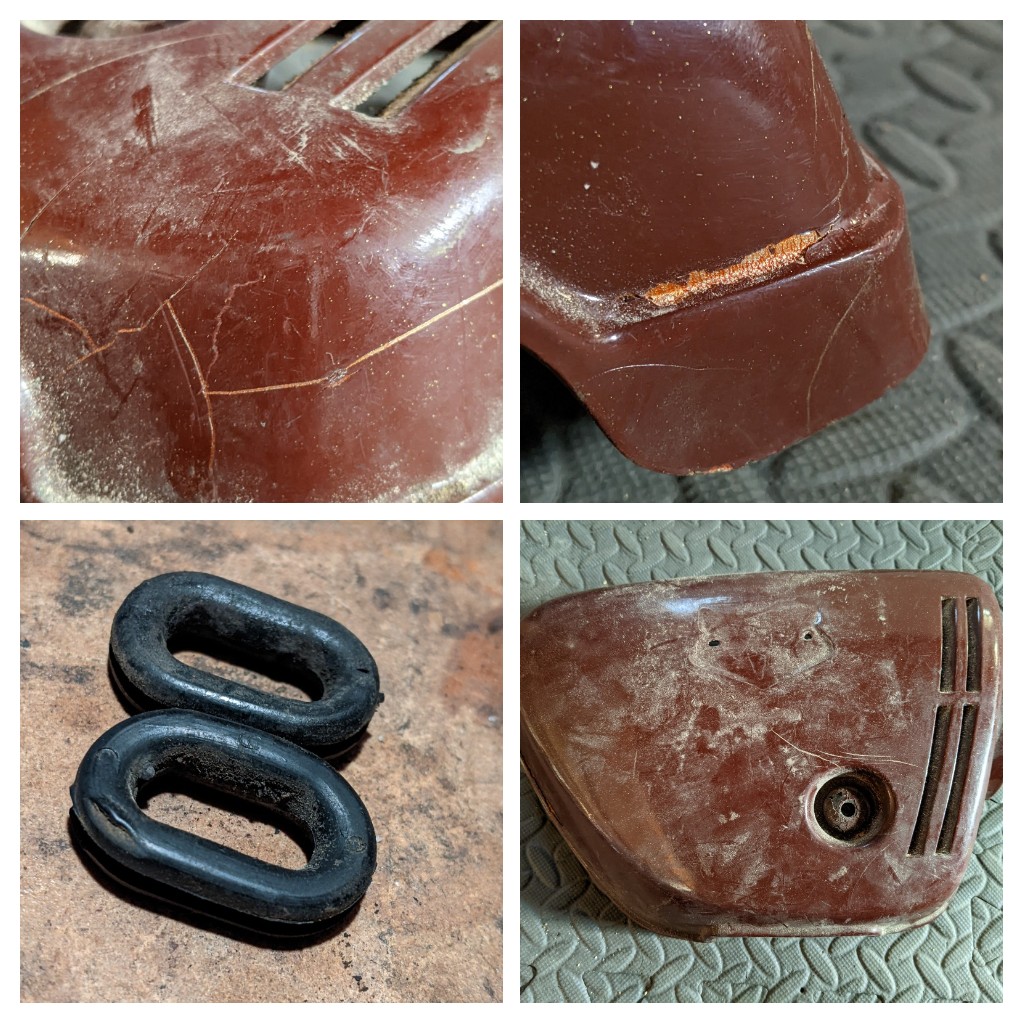
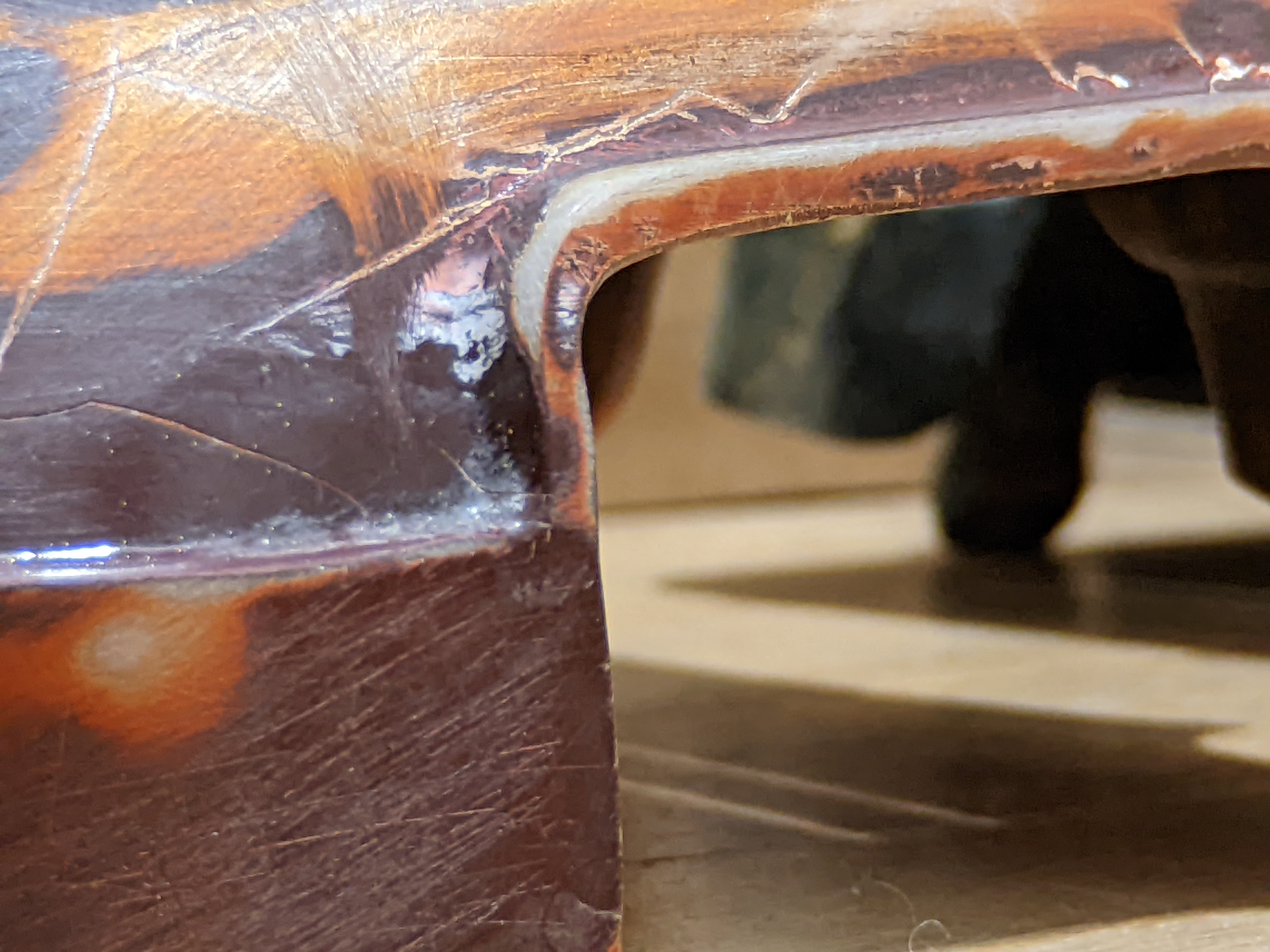
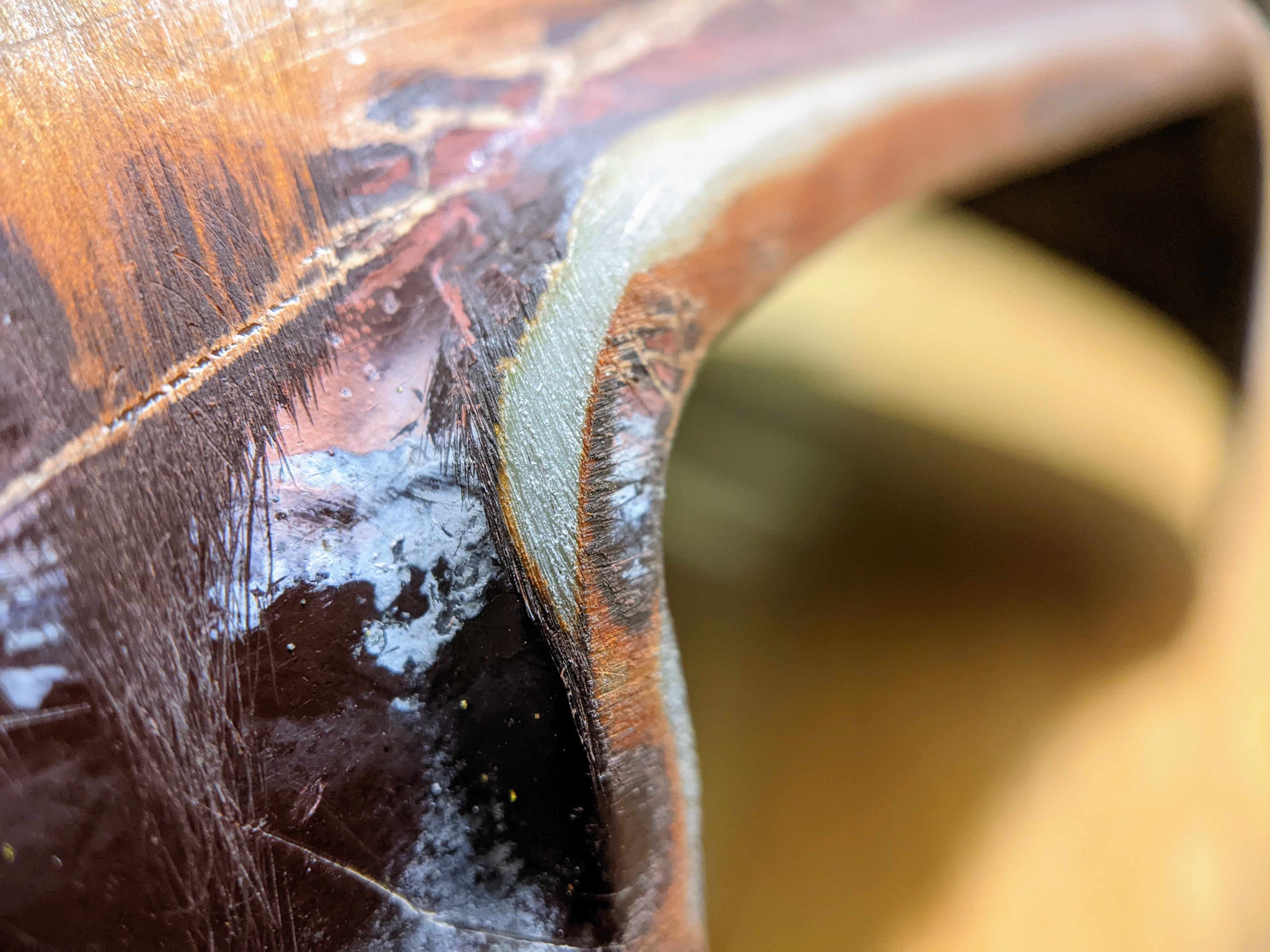
The only work I've done over the last four weeks was to attempt to remove paint from a pair of used side covers I acquired for the project. I soaked them in isopropyl alcohol for a long time and some of the paint wiped off. It didn't work super well for me, but I didn't have a properly sized container to submerge the covers completely. So, I eventually became impatient and started sanding the scratches out by hand. I'll have to do more work to get a nice surface for new paint.

bhe0Ry3.jpg


a4b71RV.jpg


Nru03h7.jpg


These photos were taken using a pair of cellphone gadgets I recently purchased. A company called Moment produces a case that allows one to attach several different camera lenses (that they produce) to certain smartphones. I have their 58mm lens and a 10x macro lens which I think will be kind of cool for small details that my natural eyes cannot otherwise see.
 
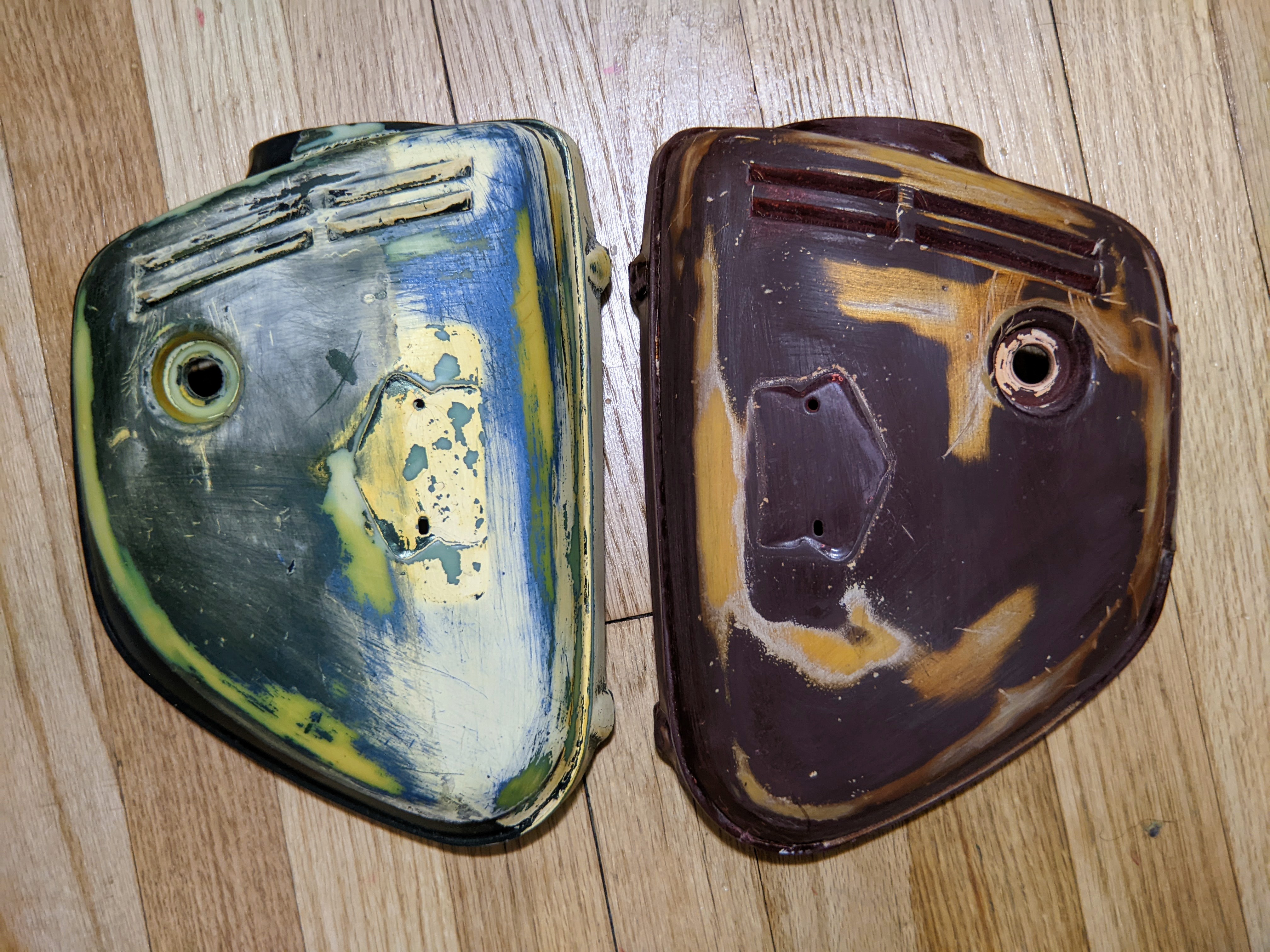
Finally got the camera going, had a bad dongle. I've been working on the tank and side covers getting them ready for paint. The left cover had some damage around the vent slots.. Didn't attempt to remove the paint, just wet sanded and feathered it in, eventually will wet sand with 500 grit then 1000 grit sandpaper before painting. Just like working on model cars when I was young.
IMG_1195.jpg IMG_1196.jpg
 
Last edited by a moderator:
For looking at tiny things like carb jets and maybe threads on tiny screws I use a jewelers loupe. There are hand held ones for $10 on Amazon and some that clip on to the side pieces on glasses. I have one that my father used in his stamp collecting hobby. There are times when it's the only way I can really see what I'm doing, and the ones that you can use without holding them with a hand are really helpful. You have to be able to put the thing you are looking at very close to the lens.
 
Finally got the camera going, had a bad dongle. I've been working on the tank and side covers getting them ready for paint. The left cover had some damage around the vent slots.. Didn't attempt to remove the paint, just wet sanded and feathered it in, eventually will wet sand with 500 grit then 1000 grit sandpaper before painting. Just like working on model cars when I was young.

Looks pretty good!
 
Brief update: I have two damaged frames for this project, one with damage to the lower left frame tube and one that was likely in a front end collision with maybe half a degree of camber in the steering tube. I finally got the salvage title for the latter frame about three weeks ago and took it to the DMV this past week. The salvage frame has been at a frame straightening shop for a good while and after two emails and a couple of phone calls I finally got an update. The shop owner hopes to have my frame measured and straightened in the next week or so.

I don't have much time to work on projects while school is going on, but the sooner I get the frame back the better. I can then move on to powder coating and building a rolling chassis.
 
OR, laying the frame over the engine before making it a roller to make engine installation easier and prevent any damage to the powdercoat. :)

I do want to try that!

I need to check the details, but I think I may only need a rolling chassis to get an inspection for the salvage title and, if so, I'll go back to a bare frame for the motor installation.
 
I do want to try that!

I need to check the details, but I think I may only need a rolling chassis to get an inspection for the salvage title and, if so, I'll go back to a bare frame for the motor installation.

Ah, I forgot about the inspection requirement for some states.
 
I had to have the bike on wheels, standing on the ground, or they wouldn't look at it at the DMV. They also want to inspect the engine number at the same time, although they have no idea what it means. Mine has a K4 engine in it and no one raised an eyebrow, and there was no federal plate on the frame, just the stamped VIN, and once again no one said anything.
 
Go the Vermont route and then when title is in hand go to the CA dmv. Not sure exactly what you are explaining here?
 
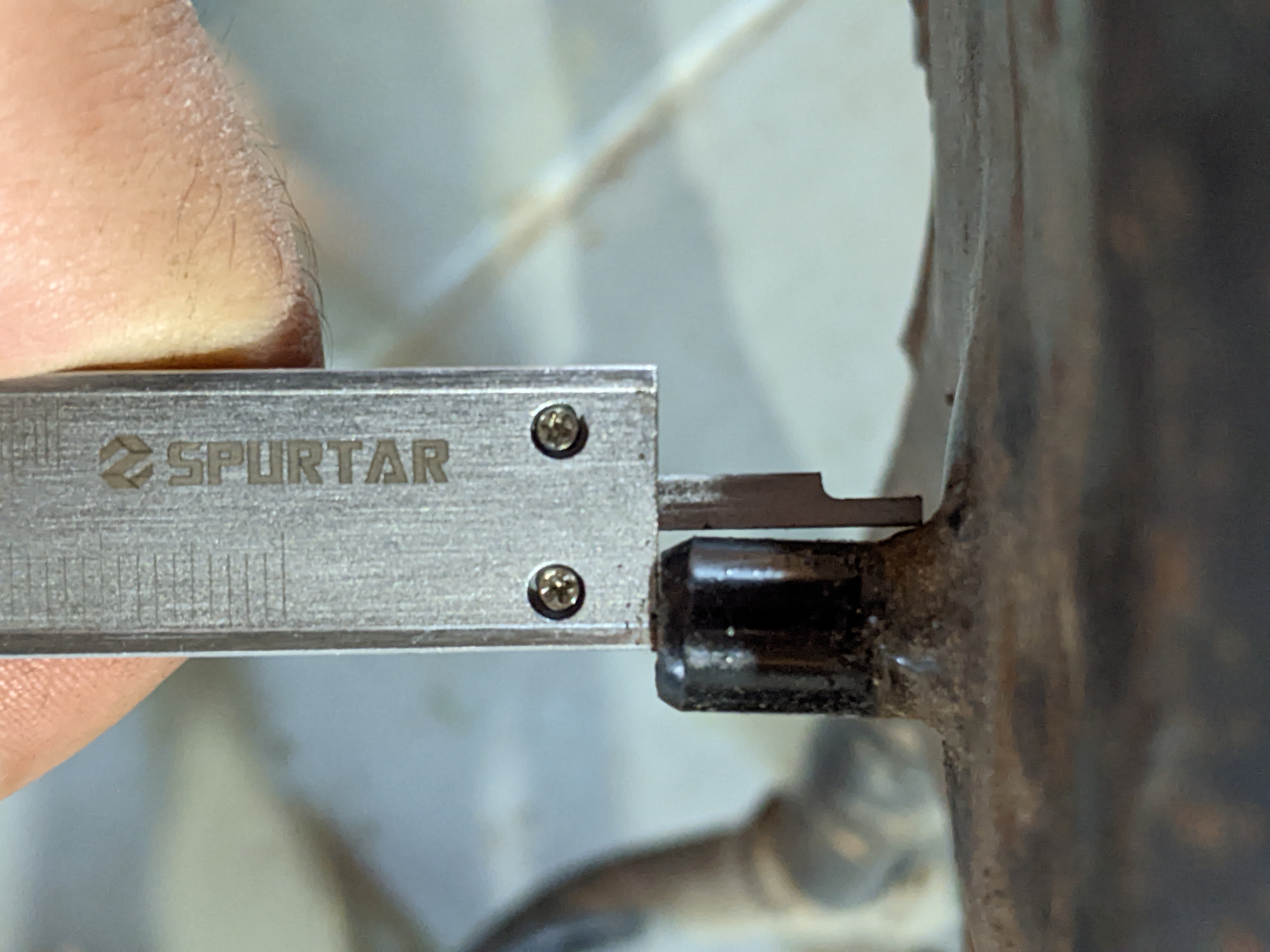
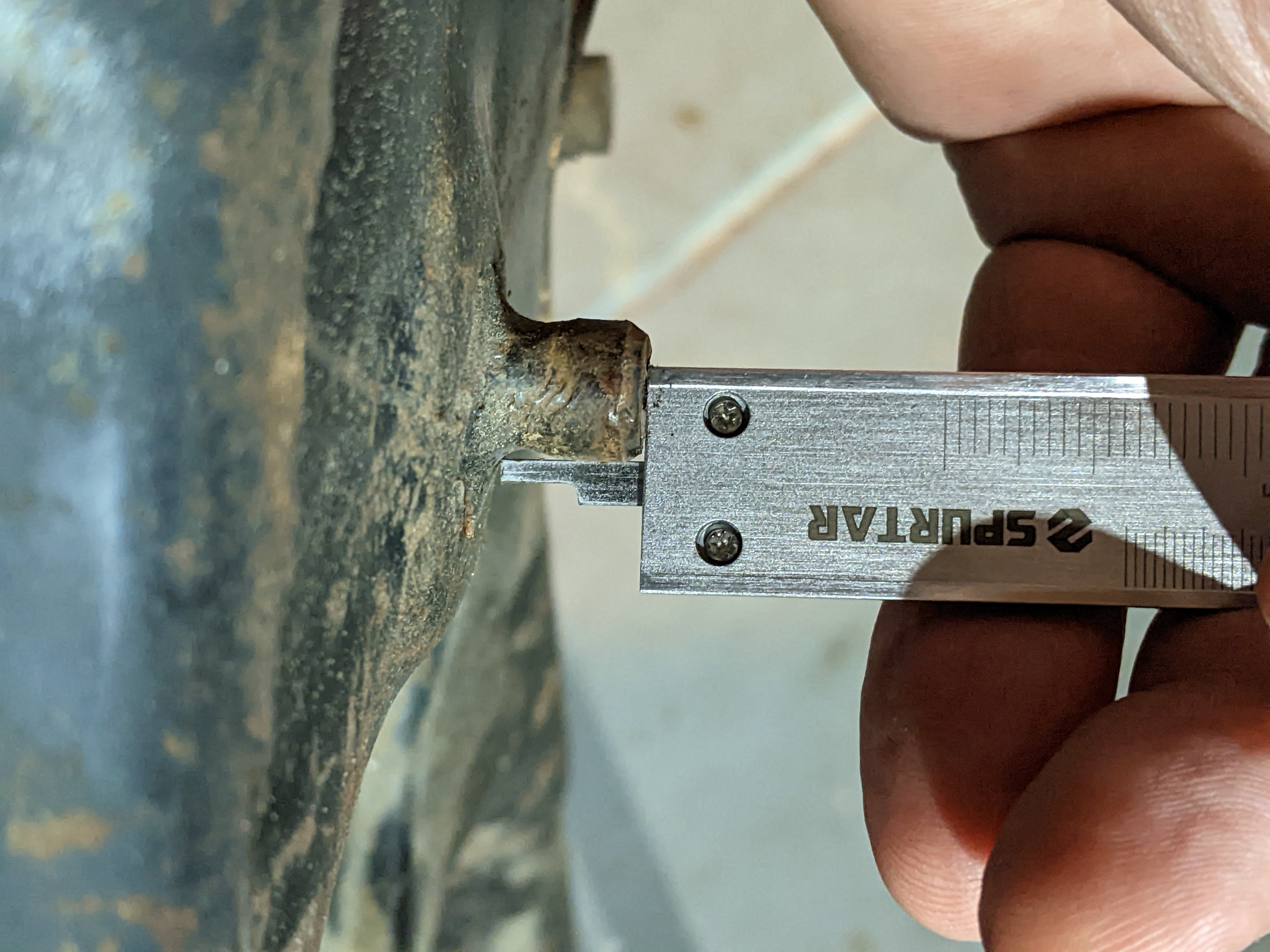
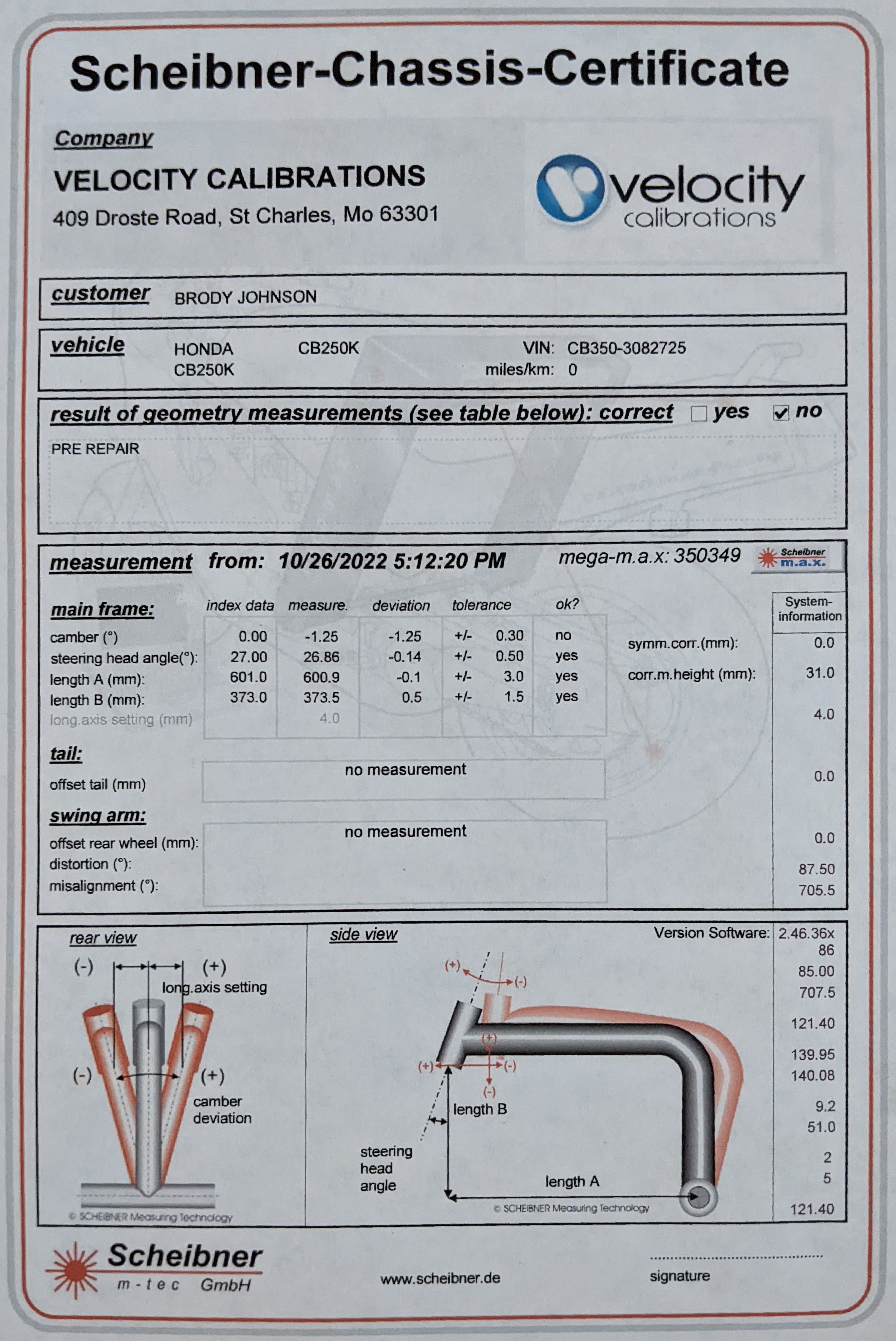
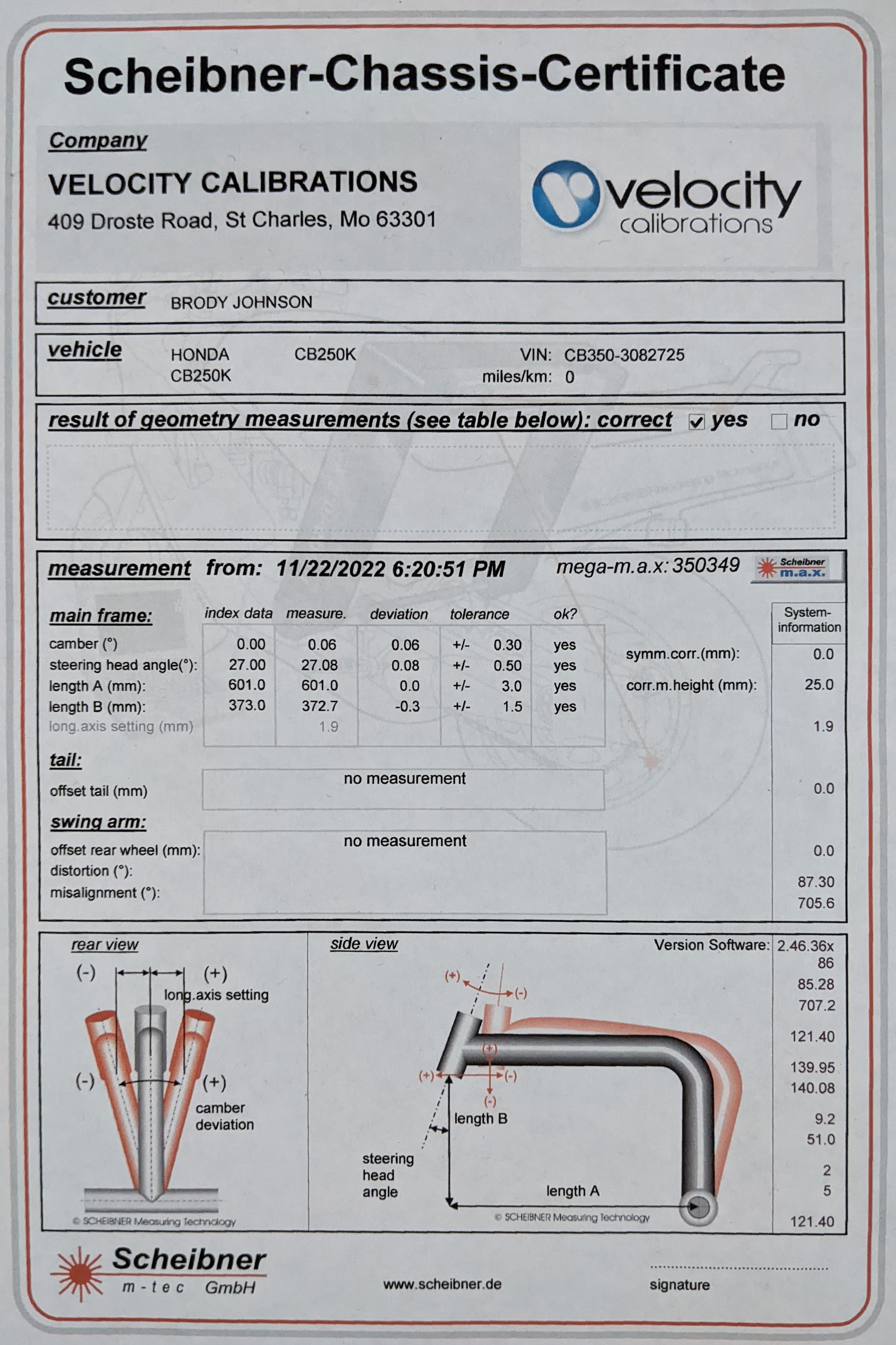
I picked up my straightened salvage frame from Velocity Calibrations in St. Charles, Missouri this afternoon. The owner was able to acquire frame geometry data from Germany for the corresponding CB250 frame and then used his frame straightening machine to correct the camber in the steering tube. I will share the measurements before and after correction below.

8xHU4oo.jpg


QoVxmfp.jpg


I would like to have the frame powder coated. What are the important pieces to have powder coated with the frame? Swingarm, I assume. Fork bridges? Chain guard? Are there other parts that people typically throw in with these for powder coating?

Thanks for reading.
 
Nice diagnostics and repair on the frame, it's impressive. As for powdercoating, I painted my steering stem but took my top bridge and handlebar mounts to get powdercoated and I'm glad I did, they look great in PC satin. Aside from that I had the frame and swingarm done, all other parts I painted. Any additional small parts in PC would last really well and look great too, but the ones mentioned get the most exposure.
 
Nice diagnostics and repair on the frame, it's impressive. As for powdercoating, I painted my steering stem but took my top bridge and handlebar mounts to get powdercoated and I'm glad I did, they look great in PC satin. Aside from that I had the frame and swingarm done, all other parts I painted. Any additional small parts in PC would last really well and look great too, but the ones mentioned get the most exposure.

Thanks, Tom. I figure I may as well include some of those smaller pieces like the top bridge and handlebar mounts, so thanks for mentioning those.

Is your top bridge red, then? Somehow I didn't notice... must be due to that rectangular headlight! ;)
 
Is your top bridge red, then? Somehow I didn't notice... must be due to that rectangular headlight! ;)

Yes, the road warrior headlight distracts a lot of people. :) No, I drew the line at frame and swingarm for the red PC, any more than that seemed too much to me. The top bridge and handlebar mounts (don't forget both halves of them) are satin black powdercoat, and all black painted parts on the bike are satin as well. Since the frame and chain guard were originally a version of gloss black and I painted many of the other black parts satin like the gauges, I went with satin on all of the black parts.
 
The top bridge and handlebar mounts (don't forget both halves of them) are satin black powdercoat, and all black painted parts on the bike are satin as well. Since the frame and chain guard were originally a version of gloss black and I painted many of the other black parts satin like the gauges, I went with satin on all of the black parts.

I think I prefer satin in general, so that sounds good to me. What did you do about swingarm bushings with respect to powder coating? Should I remove the old bushings before or after?
 
I think I prefer satin in general, so that sounds good to me. What did you do about swingarm bushings with respect to powder coating? Should I remove the old bushings before or after?
Either leave the bushings in so the swingarm bore doesn't get power or remove them and be sure they are masked off, otherwise you have to grind off the power coat so the bushings will even fit.
 
I would like to have the frame powder coated. What are the important pieces to have powder coated with the frame? Swingarm, I assume. Fork bridges? Chain guard? Are there other parts that people typically throw in with these for powder coating?

Thanks for reading.

Back when I stripped down and restyled my Sportster in Italy I powder coated rims, frame, the fork lower ends, but also a lot of the small things, such as levers, pedals, whatever brackets I could think of,...I had actually also given the tank and fenders some satin black powdercoat and have not regretted it

EDIT: found a pic as an example:

PC_sporty.jpg
 
Back
Top Bottom