1966 Honda CL160 commissioned build

Thanks to Pete I was able to sort the front wheel speedometer issue. (y) Torqued front axle to 60 ft lbs with no issues.

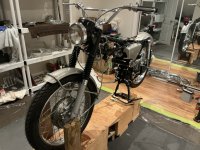
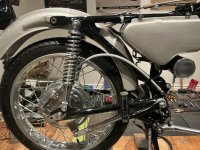
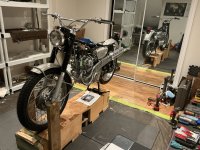
Wheels are both installed and the brakes work as designed. The aftermarket front brake cable needed some tweaking for proper engagement.
Second one (front brake) cable that hasn't been a good fit from the aftermarket Thailand vendors.


IMG_0293.jpegIMG_0295.jpegIMG_0298.jpeg
 
Last edited:
A little more progress on the build with the main step bar on the “needs a solution“ back burner presently.

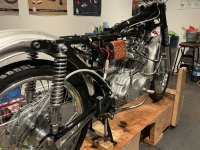
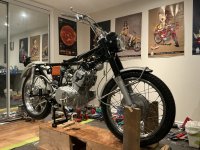
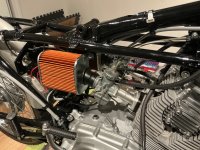
The motor bolted into the frame and the carbs and their air filter mock up is a good fit. Only a few mods needed for the lower bolt mount on the bottom of the air cleaner on both sides. Just need a longer bolt setup as everything lines up perfectly with the filters and surrounding battery box items.
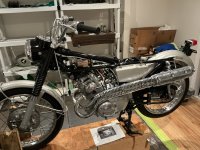
Both side covers mounted perfectly along with the seat and the gas tank. So I am fairly confident that the bike components are all a good compatible fit to the frame and other bike parts.


IMG_0330.jpeg

IMG_0327.jpegIMG_0328.jpeg
 
Wish I knew that executives within American Honda or Honda Motor Co. in Japan were observing the time, effort, and devout passion many of the active members spend here and in their workshops restoring or resurrecting their classic machines...

As usual : VERY NICE WORK you're doing there Flyin !
 
I have finally got around to testing the PO installed gas tank liner integrity, which seems sketchy at best. It is lumpy all over the surfaces where the liner has been applied. It looks solid when dry, so a test initially was done with water, which was an easy pass. I have just tested it now with gasoline for 48 hrs after a full petcock rebuild of the internals. So no flaking of the liner or discolouration of the gasoline as far as I can tell. I will retest the tank again after the fuel cap is internally cleaned of the PO installed gas tank sealer ("don't ask")

So once I can confirm the gas cap venting system allows the petcock to flow well to the carbs, then the gas tank is finished less the cosmetic bling parts.

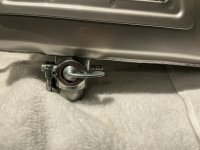
Gas cap in Acetone and it is dissolving the internal painted liner while colouring the fluid red. When the gas cap openings are blown with compressed air then small red chunks and slime come out of the tang opening areas.

3.jpeg

Lumpy "Red Coat" liner I believe is the brand. If it hangs in that will be impressive, as the prep work on the tank internals seems to be lacking before applying the liner.

0.jpeg

Petcock was fully rebuilt and confirmed as leak free as of now, vs the leaky original parts from inside the unit.
2.jpeg


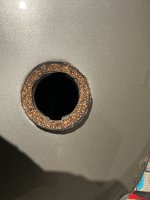
I am trying to use the original gas cap since the "bung" diameter is smaller than most of the small Honda twins from the era. It is around a 30mm outside diameter where the plentiful aftermarket or OEM ones new are cheap, yet a larger sized bung. When I have found a good substitute it has been expensive, so a solvent cleaning and custom cut gasket seal is in order.
1.jpeg
 
Last edited:
I have taken those type caps apart and cleaned up the rubber cup seal inside. It is hard to remove the chrome cover. The first time, i did it by accident with high pressure air. Then found I could ease it off gradually around with a thin flat blade with the bung in a vice.
 
Personal experience with a Red Coat liner in my Yamaha is that it does not stand up to current ethanol fuels. The Yamaha sees little action and has since tinted the gas red over the course of last summer. Not sure what it is doing to my float bowls or internal passages, but I don't expect it to be good. Just my 2 cents.
 
Personal experience with a Red Coat liner in my Yamaha is that it does not stand up to current ethanol fuels. The Yamaha sees little action and has since tinted the gas red over the course of last summer. Not sure what it is doing to my float bowls or internal passages, but I don't expect it to be good. Just my 2 cents.
Ok that is good to know. I will consider lining the liner with a better Casswell's liner, as the surface inside this tank is rough enough to accept another liner. Once sealed it should be good to go, since this liner is solid. The acetone solvent removing the liner inside the fuel cap is a clue to the possible breakdown of the material. We only have ethanol 10-15% gas now up here now at all the gas station pumps, unless to seek out some speciality aviation products.
 
Ok that is good to know. I will consider lining the liner with a better Casswell's liner, as the surface inside this tank is rough enough to accept another liner. Once sealed it should be good to go, since this liner is solid. The acetone solvent removing the liner inside the fuel cap is a clue to the possible breakdown of the material. We only have ethanol 10-15% gas now up here now at all the gas station pumps, unless to seek out some speciality aviation products.
I sure wouldn't put caswells on top of anything but - preferably lightly rusted metal.
 
I agree with Oldjeep on this. Caswell is a quality product, but it needs metal to adhere to. I think you are opening another can of worms if you try to put Caswell sealer over the top of the existing RedCoat.
 
Thanks guys, I realize it would be a crap shoot there. I am going to just run the Red coat liner for now and ask Chris to keep an eye on the petcock screen and fuel bowl for evidence of liner breakdown.
The carb float bowls can be easily popped off too, so a quick easy check of their bottoms will also offer insight into the liner condition.
 
Last edited:
Slow but sure! I have got the exhaust system back on after one stud on the right side of the engine had damaged threads inside the head and pulled out of the head when I installed that collar. :mad: A tip on getting more pipe flexibility on the two header pipes is to remove the front heat shield off the exhaust pipes. This allows you to flex the pipes to align into the head ports easier. (y)
I set the valves and adjusted the cam chain and the points, so hopefully we have something close enough to get it to start and run soon. I am close to moving it into the garage next month and working on getting a running bike from the original mess!

IMG_0341.jpegIMG_0345.jpeg
 
Last edited:
I will be moving the CL160 into the garage next week and then looking to start the bike for an initial run and set up. I believe the two rear outer stud cap nuts need to be cracked to check on the oil flow and feed to the top end. The carbs have a single screw set on each body to set the idle by raising the slide in the bore. Are there any preset adjustments that need to be done to these idle stop screws as a starting point to get the bike to idle?
Any other prechecks that should be done prior or during the initial running of the motor? The motor has a full rebuild with new O/S pistons and rings and all new valves and seats recut to match the new valve faces.
 
Last edited:
I will be moving the CL160 into the garage next week and then looking to start the bike for an initial run and set up. I believe the two rear outer stud cap nuts need to be cracked to check on the oil flow and feed to the top end. The carbs have a single screw set on each body to set the idle by raising the slide in the bore. Are are any preset adjustments that need to be done to these idle stop screws as a starting point to get the bike to idle?
Any other prechecks that should be done prior or during the initial running of the motor? The motor has a full rebuild with new O/S pistons and rings and all new valves and seats recut to match the new valve faces.
There's the obvious stuff of making sure the carb cables are synced for anything off-idle, but the idle set screws I've used 1/2 turn from when they make contact with the slide as my default. I don't think I've had to go more than 1/8 turn in either direction from there.
 
Thanks Pete. I synced the carb slides and the cables when they were off the motor. It was easier to see the changes to the slide movements. I will set the idle screws per your suggestion.
 
We got Chris's CL160 into the cold garage yesterday, as were not having a warm spring around here so far. It's close to freezing most mornings. I will start getting it running once it is a little warmer in there to work on it.
I want to get it moved along back to Chris, as I have a new/used 2003 Honda CB750 Nighthawk coming home this weekend. I want to get the S90 running too as my customer who bought the CB1100F is interested in buying that one too. :D

P1110192.JPGP1110193.JPG
 
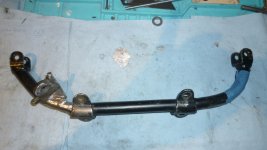
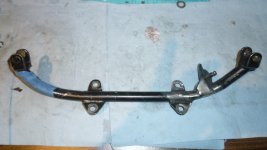
Bob my neighbour and par excellent metal master worker just returned the 1968 CL175K0 step bar which was modified to fit Chris's 1966 CL160 which had the incorrect step bar supplied with the parts batch initially. This step bar needed to be extended on the side stand side by about 5/8" outward to clear the bottom engine case of the CL160 motor. He cut the bar's hollow tubing and inserted an solid round metal bar to extend the outer section that small amount. He needed to bend the round bar to account for the curvature in that outer section. He then formed a split metal collar to fill in the thickness amount to match the rest of the steps outer diameter.
Welded everything back together and ground the outer welded section to match the rest of the round step bars contour. Once I paint it black again, it will be a perfect recreation of what was on there from the factory.

P1110194.JPGP1110195.JPG
 
That’s amazing to me when needed parts can be fabricated!! I definitely do not have that skill set!!!!! Looks great!
 
Back
Top Bottom