#29
Lets finish up the engine. I realize that for many, rebuilding an engine can be daunting but IMO it needn't be.
If you follow these suggestions , it will be hard to screw up but above all don't doubt yourself! Nothing here is rocket science so take it a step at a time. Read up on the task ahead so when you are doing it, most of it won't be completely foreign to you.
1) Get hold of the shop manual.

I got this manual inside a bunch of info I purchased from Bill Silver. Manuals aside, there is so much interesting info separate from manual I got from BIll I still go back and read them to see what I missed. Simply marvelous information.
2) Make sure you have a parts book. (got it with the Shop manual etc) I've seen some that have too few pages so watch out for those. Bill's is complete for this bike. There are some type-O's in the book but your eyes will not lead you astray. I'd bet all this info can be found here on the forum.
 3)
3) Take copious pictures as you disassemble so that if in doubt, you can go to your detailed and plentiful pictures. Do not use me as an example as clearly I didn't follow my own mantra.
4) If / when taking things apart that are known to have small bits that can fall at the most inopportune times, give yourself a safety net. If I have a large area to cover, I use old towels laid down because nothing bounces after hitting a towel so bits wont' get lost. Most common for me is a very large cookie pan with said towel. No matter what you choose, just think about what you'll do IF (when) something sneaks out on its own. BTW , once you know how this engine, or anything your are working on goes together, you will forego the towels. It a process.
5) You can always "phone a friend" aka text or email "those in the know". This very forum as one of those friends so use it. People really like to help so take advantage of that.
As you may now know, the CB72 / 77 crankshafts are made up of 5 pieces and their assembly takes a press and great patience. Think about it. all the pieces need to go together such that all sections are the correct length (and by then, naturally, the OA length of the crank would be in spec), that all parts are "square" to each other, IE, the crank and parts are flat, or perpendicular to each other where it matters and finally, that each part is rotationally in the exact spot. Oh, and DO NOT forget the rods, their needle bearings and cages. I promise that if you did? You'd be so ready to cry.
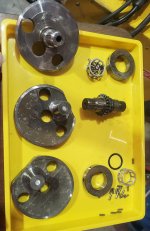
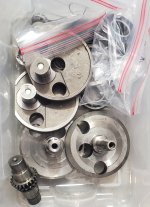
BTW, it takes lots of pressure to get these parts to become one again. If memory serves 7-10 tons. The moaning of the press is indicative that it is having to work. A lot. My brain hurts to even contemplate doing this. Thankfully my man Tim Miller was well versed. Even if I had the capability to do this, that is a press that was in the 15-20 ton range, not sure I would have attempted it myself. A lot of that is my patience level and nor do I need to learn on the only crankshaft I have. Yes, I am happy to admit that I am a slacker
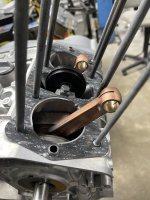
Old news. Pictures, what pictures? How I don't have a pic of the crank with rods just laying on the bench is beyond me. Sorry.
Now we are going to reverse the steps taken do dismantle the engine. As I haven't done a CB72 before, I'm not sure is there is a huge reason for a specific installation order of these large parts. Just take your time.
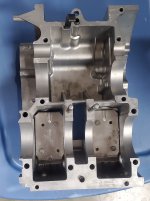
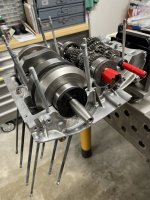
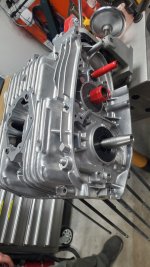
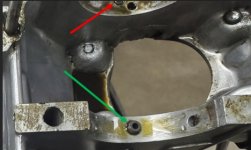
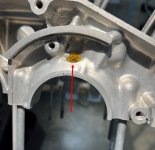
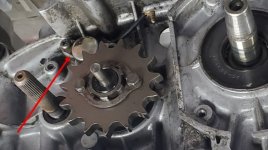
Anyway, drop the built-up crankshaft back in making absolutely certain that the bearings fit over their pins in the crankcase. I'm not sure it really matters since this engine had a pin pushed into the case without engaging the bearing as intended ,yet there was no noticeable damage at disassembly. The pins are there for a reason however so there's that. Indeed, this bearing survived and you can see here where this pin got pushed back up followed with some oil-resistant epoxy placed on the pin's back-side hole hoping to keep it in place. Yes, the crank was laid back into the case
carefully making sure the pins were in place and that the bearings were all happy.
The picture below sucks (by now, no such a surprise right?) but is an attempt to better show what I'm talking about here. The Red arrow points to the pin that was pushed into the case and was not engaged in the bearing. Angle of the picture doesn't show that the pin is flush with the surface. The green arrow shows a pin still sitting proud as they all are meant to be. And then the epoxy repair to the hole after the pin was pushed back up into place.
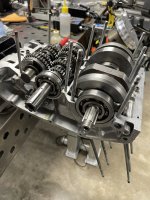
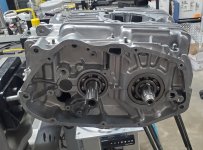
Next the gear stacks and as you are doing this, watch that the three seals are nice and happy. One on the crankshaft, one on each of the gearbox shafts. There are only seals on one side of each shaft. The other side of the shafts, the clutch side, all live in oil so no oil seal needed. If the seals end up cocked, this will be as my Dutch friend says: " Not so very good". Truth is, I'm not sure I've ever had a seal **** itself when being trapped by two crankcase halves. Just look at them and if they look close to vertical, you are good. The halves clamping together will have them behave.
After a final clean of the mating surfaces of the two crankcase halves, apply your choice of sealant to the surface staring up at you. (not both surfaces) Like cards its "thin to win" as you want to avoid extra slop. As an old air cooled Porsche guy, I used something called Drei-Bond and or Loctite 574 but don't recall what was used here. But don't panic as there are several
great options other than my go to sealants mentioned above as a
ll are excellent: Hondabond (or its equivalents: ThreeBond 1184/1194, Yamabond, or Permatex Moto-Seal.) The only product here I've not used is Permatex Moto-Seal but lets face it, Permatex has an outstanding reputation so again, my thoughts are that each of these will easily get the job done.
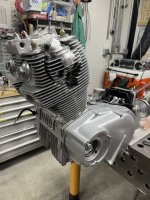
Now Drop the Bottom half of the crankcase onto this bunch of bits and voila...we are getting there.
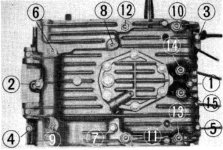
Below is Honda's suggested torqueing sequence for the fasteners of this lower crankcase. Do a search here on the forum as there are some great suggestions that have a suggestions of a different tightening sequence. Of course, you can't go wrong doing it the way Honda did back in the day so if you follow this guide, you are covered regardless. Torques for these is a bit vague so do some spelunking. Again, this forum then "around", as the crankcase torque specs are one of those areas where many points back to general Honda practices (at times I'm not sure what that is) because the original factory manuals are IMO surprisingly vague on the smaller bolts. As I'm a big old chicken, I tend to go slightly under or choose a median value. This I tend to default to a diameter-based approach so M8s are around 15 ft-lbs, M6s 7–10 ft-lbs, always staged in three steps. 1) snug, 2) 50% and 3) use the listed torques mentioned here or what you feel best per forums or others with real knowledge of these. I
do not have any hard knowledge but would not hesitate to use the numbers I list. Let your conscience be your guide.
Now you can start adding all the bits that came off prior to splitting the case. And while you are here, don't forget to verify placement and
function of the shifting mechanisms. If after full assembly you feel you got it wrong you can always go back and look at it but you'll have to drop the outside the clutch cover which holds oil so be ready for a tsunami of oil. Moral here is to work the shift mechanism before moving on as in change gears etc. Whilst
manually changing gears, now might be a great time to install your neutral gear indicator sensor
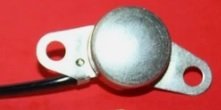
to test on the bench which you may recall lives very near the chain drive sprocket on the right side of the engine? This is a simple on-off switch which activates a lamp in the Nacelle when in neutral.
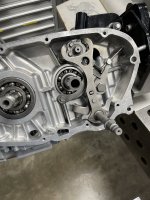
Here is a picture of the neutral switch installed and regret that the only pic I have is this "pre clean" picture. Nasty.
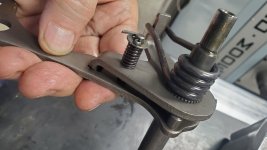
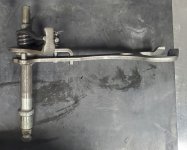
Gear Selector mechanism. Resplendent in dirt. Dang it all as I've clearly misplaced some photos as I'm not seeing my clean bits. Seriously though, work this and watch how it does its job. Very cool if you ask me. When you are working it, you may have to "jog" the chain sprocket since the engine isn't running so gears are just sitting there.
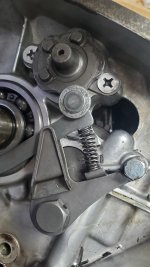
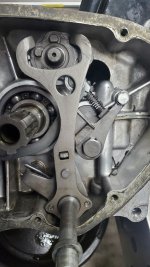
I'll drop a few more pictures of the before the bottom of the crankcase was dropped back on. I'm so irritated with my lack of pictures at the moment but spilt milk and all... you know the rest.
Reminder here. GREEN words indicate I came back and added something. It is lame here, but I've no doubt I'll be going back and adding sections I forgot, then it will be a sea of green.
Later



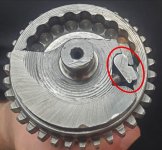

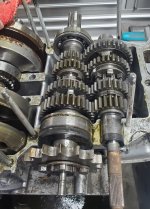
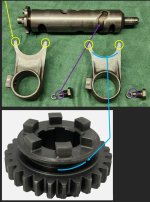
 Dogs are wear items but when these edges get too worn, you may want to replace the gear/gears. As you can see here these edges look sharp and precise. As they wear, these edges grow, as in the radius gets larger and less defined. If you look close, you can see that the sides of the dogs, lets call it their left and right side (not top or bottom?) are tapered in. They have a reverse cut which helps the dogs pull each other together under load. As the edges become rounded corners, there is less and less taper to grab to the dogs become less effective. Oh yes, the still work but shifting may need to be more authoritative with damage and age.