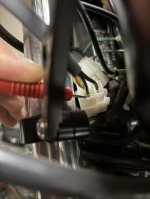
Not getting anything with fresh battery

Blarfnugle

Member
Joined
Jun 15, 2026
Total Posts
11
Total likes
4
Location
New Jersey
Hello everyone, working on my 1974 CB360T and I have nothing, no lights, no engine turn over, etc and I'm a little overwhelmed by the service manual on what to test, plus the images are a little unclear as to where I should be putting the multimeter prongs. I've uploaded a video where I go over everything I've checked but I'll also list it here.

Fuses (7A and 15A) continuity checked
Silicon rectifier replaced with new regulator/rectifier, no idea if it actually works but the old one had a prong ripped out so it definitely didn't work
verified continuity of wires in the magnetic switch
verified continuity of positive and negative terminals
Derusted and painted the battery box with VHT spraypaint
Unseized the engine
cleaned the points and verified points gap
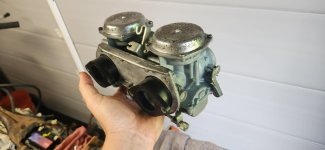
Cleaned the carburetor
Replaced the Carb gasket
Replaced the Battery with an AGM battery

Here's the video showing the bike and what I've done so far :

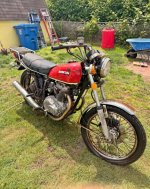
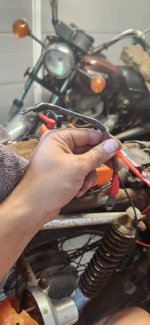
I've also attached more photos of the bike, it was ROUGH before I got it and I'm already surprised at how much better it looks. rs6pJUmM.jpg7LBE_m6W.jpgkyVyWG9w.jpg
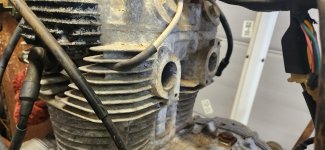
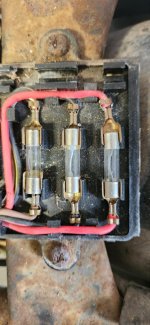
5ND9RwE9.jpggSs5E3W9.jpg
 
Take a look at the main switch where the key goes. There is a wiring diagram in the manual and it shows how things should connect for the various key positions. I recommend making sure that your switch is working on all of the positions. The main switch is responsible for getting battery power everywhere else.
 
Last edited:
That a look at the main switch where the key goes. There is a wiring diagram in the manual and it shows how things should connect for the various key positions. I recommend making sure that your switch is working on all of the positions. The main switch is responsible for getting battery power everywhere else.
Do I just check for continuity? I haven't checked to see what the service manual has to say about that.
 
Yes. The main switch connects to the harness though a multi wire plastic connector. I would disconnect there so you can check continuity between the leads with the key in different positions. Red will go to the battery and when the key is turned to the run position, I believe there should be continuity from red to black and brown to brown/white. Double check on the diagram.
 
If you can access the ignition switch connector plug, I would set your multi meter to 20V and put the + probe to the red wire in the back of the connector block and the neg wire of the tester to a ground point on the engine or frame. You should get at least 12v.

With the ignition switch in the ON position put the + probe of the tester on the black wire of the connector block and the neg probe to ground. You should get 12V coming out of the switch. If you are getting zero or low voltage on the black wire then the ignition switch probably has corroded contacts. You might be able to take the switch apart and clean the contacts. Pictures of the back of the ignition switch will help.
 
Last edited:
Couple of questions:

1. Do you have voltage at the fuse with the red wires on both sides? Place the positive probe on either contact for that fuse, negative probe on the negative terminal of the battery.

2. When you say checked continuity of the fuses - did you mean through the fuse and clamps? Because none of those look seated in the clamp. You can pinch them a little to tighten up the clamp.
 
If you can access the ignition switch connector plug, I would set your multi meter to 20V and put the + probe to the red wire in the back of the connector block and the neg wire of the tester to a ground point on the engine or frame. You should get at least 12v.

With the ignition switch in the ON position put the + probe of the tester on the black wire of the connector block and the neg probe to ground. You should get 12V coming out of the switch. If you are getting zero or low voltage on the black wire then the ignition switch probably has corroded contacts. You might be able to take the switch apart and clean the contacts. Pictures of the back of the ignition switch will help.
Thanks, I'll try that tomorrow and upload pics.
 
Yes. The main switch connects to the harness though a multi wire plastic connector. I would disconnect there so you can check continuity between the leads with the key in different positions. Red will go to the battery and when the key is turned to the run position, I believe there should be continuity from red to black and brown to brown/white. Double check on the diagram.
I will try that tomorrow!
 
Couple of questions:

1. Do you have voltage at the fuse with the red wires on both sides? Place the positive probe on either contact for that fuse, negative probe on the negative terminal of the battery.

2. When you say checked continuity of the fuses - did you mean through the fuse and clamps? Because none of those look seated in the clamp. You can pinch them a little to tighten up the clamp.
1. I didn't think to put the negative probe on the negative terminal. I was just testing to make sure the fuse wasn't burnt out.
2. Are they not? They're pretty firmly in there, I have to slide them out with a pair of needle nose pliers.
 
2. Are they not? They're pretty firmly in there, I have to slide them out with a pair of needle nose pliers.
He mentions it because those older brass fuse clips get hot and lose tension with age, and less than tight connections at those glass fuses creates higher resistance and the heat generated by that higher resistance can cause the inner end(s) of the glass fuses to melt away sometimes, making it look good but the fuse won't pass current flow. Really it's best to replace that style fuse box with a more modern ATC blade fuse style.
 
1. I didn't think to put the negative probe on the negative terminal. I was just testing to make sure the fuse wasn't burnt out.
2. Are they not? They're pretty firmly in there, I have to slide them out with a pair of needle nose pliers.
OK - I went in and re-watched the video. You've got continuity through the fuse from at least one clip - the one on the red wire looks super suspect, but that could be lighting/angle (and the fact that the fuses these were built for were slightly longer in the 70's). No big deal there.

So let's start with some basics to check:

1. Check continuity/resistance from the negative battery terminal to the engine block and frame. I have that same meter, the numeric value it shows when it beeps is the resistance in KOhms. For that main ground point, that number needs to be as close to zero as possible. Rust is not a great conductor - based on the rust level, that will likely need to be cleaned up to get solid contact.

2. We've got to figure out what's going on here:
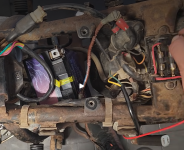
1781631222998.png

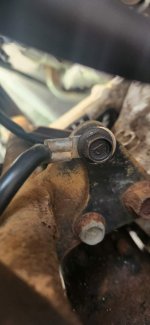
First, whatever is going on with that daisy chain from positive terminal to solenoid is dangerous. If that open connector hits the frame, you've built yourself a short-term welding rig. At the very least, insulate it for now.
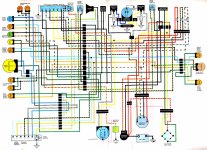
Second, it doesn't appear that the main battery positive feed (red wires) is connected into the ignition or charging systems at all. That 4ga from the positive battery terminal to the solenoid is just for the starter. Here's a simplified color wiring diagram that might make it easier:
CB-CJ-CL360.jpg

Down at the bottom is that relay. There should be a second ring terminal with a red and a red/white that attaches to the positive terminal of the battery, it'll be coming off the back of the terminal block next to the relay in that screengrab above (although, it looks like that things been hacked up a bit). Once that is connected, flip the meter to 20V DC and clamp the black probe to that negative battery terminal and touch the red probe to the lower clamp of the main fuse (red wires in the fuse block). You should see something around 12.7V.

That's the first step. Once we've got power to the bike, we'll tackle the rec/reg wiring and then progress to the ignition system.
 
Last edited:
1. Check continuity/resistance from the negative battery terminal to the engine block and frame. I have that same meter, the numeric value it shows when it beeps is the resistance in KOhms. For that main ground point, that number needs to be as close to zero as possible. Rust is not a great conductor - based on the rust level, that will likely need to be cleaned up to get solid contact.
I cleaned the ground point, after testing continuity, resistance flickers between .01 and .00 ohms.
4GV1jK7Y.jpg
First, whatever is going on with that daisy chain from positive terminal to solenoid is dangerous. If that open connector hits the frame, you've built yourself a short-term welding rig. At the very least, insulate it for now.
Second, it doesn't appear that the main battery positive feed (red wires) is connected into the ignition or charging systems at all. That 4ga from the positive battery terminal to the solenoid is just for the starter. Here's a simplified color wiring diagram that might make it easier:
That's my extension wire, I used it because the battery was too far, it has also been taped up to reduce the risk. e0mxXLKY.jpg
Down at the bottom is that relay. There should be a second ring terminal with a red and a red/white that attaches to the positive terminal of the battery, it'll be coming off the back of the terminal block next to the relay in that screengrab above (although, it looks like that things been hacked up a bit). Once that is connected, flip the meter to 20V DC and clamp the black probe to that negative battery terminal and touch the red probe to the lower clamp of the main fuse (red wires in the fuse block). You should see something around 12.7V.

That's the first step. Once we've got power to the bike, we'll tackle the rec/reg wiring and then progress to the ignition system.
See attached video, I believe I did it correctly.
 
If you can access the ignition switch connector plug, I would set your multi meter to 20V and put the + probe to the red wire in the back of the connector block and the neg wire of the tester to a ground point on the engine or frame. You should get at least 12v.

With the ignition switch in the ON position put the + probe of the tester on the black wire of the connector block and the neg probe to ground. You should get 12V coming out of the switch. If you are getting zero or low voltage on the black wire then the ignition switch probably has corroded contacts. You might be able to take the switch apart and clean the contacts. Pictures of the back of the ignition switch will help.
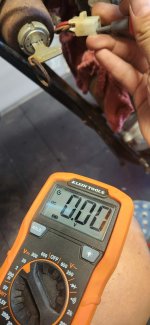
So I tested the ignition switch according to your instructions and the manual. Didn't get anything regardless of ignition position. h3pG5Mu0.jpg
 

Attachments

  • 91Itst6F.jpg
    91Itst6F.jpg
    90.3 KB · Views: 0
So I tested the ignition switch according to your instructions and the manual. Didn't get anything regardless of ignition position. View attachment 58631
it’s kind of convoluted, but you need to test it with the plug connected to the harness. Basically connect the two block together and use the probe to reach in the back side of the terminal block on the pin.


Like this. Get that little piece of crimped connector with the probe, but everything connected.
IMG_2861.jpeg
Back of the red wire, every key position should read hot.

Back of the black wire should read hot in “run”

Brown should also read hot at one of the key settings (I can never remember what it’s called on the switch).

Then we need to check the ground (green wire) in the headlight bucket for continuity to the negative terminal.
 
With the battery connected, you should see battery voltage at both ends of the main fuse, also battery voltage at the red wire on the ignition switch connector. With the key switch on, there should be battery voltage at the black wire in the switch connector, jiggle the key on and off while you test( in case the switch contacts are dirty). With both the key switch and the light switch on, all three fuses should show battery voltage.
 
OHH, understood. I'll have to try that tomorrow. Is that with the battery in or unplugged?
Battery in, everything connected. Basically, you want all initial testing to start at the "outside" of that diagram up there, gradually working toward the battery at the center (if there's an issue).

The red wire coming into the switch carriers your 12V+, what you're testing for is the switch working properly and sending that voltage out to the appropriate circuit. Once you've established that the positive side is indeed working, then it leaves the ground side as the culprit - presuming it's wiring related and not every single bulb and component failing at the exact same time. (it's wiring).
 
it’s kind of convoluted, but you need to test it with the plug connected to the harness. Basically connect the two block together and use the probe to reach in the back side of the terminal block on the pin.


Like this. Get that little piece of crimped connector with the probe, but everything connected.

Back of the red wire, every key position should read hot.

Back of the black wire should read hot in “run”
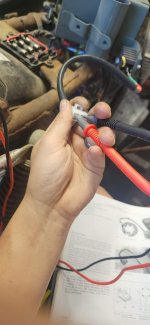
Ok so I tested the way you showed me, Red runs hot on every position, 13.27V. Black is getting nothing.

I've uploaded a video of me testing as well. I tested both continuity and 20V on the multimeter.


I will also say, the lights on this bike are pretty bad, many of the bulbs have been smashed and some are visibly broken. This bike has been sitting for 35 years.
 
The 3 positions of the ignition switch are Off, On and Park. All bike functions, including ignition, are in the On position only. The Park position is only for roadside emergencies runs the taillight only (prior to 4 way flashers on bikes). At this point I'm guessing the ignition switch contacts are badly corroded.

Here is the owner's manual for a CB360 so you can learn the bike's standard functions.


And here's the FSM for it, not sure if you have it or not but you need it.

 
Ok. Your ignition switch is possibly bad - either that or the entire wiring harness is not grounded at all. Let’s rule that out before firing the parts cannon.

Somewhere near the taillight or under the seat will be the wires that run to the taillight. In that bundle is a dark green wire. Check continuity from that to the negative battery terminal. If that’s got solid connection to ground, it’s a bad switch.
 
Back
Top Bottom