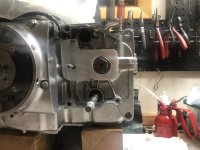


A company called Vintage Performance makes this custom cover to work with the race ignitions. It has cover screws located at 6 and 12 o’clock to fit the modified factory cover. Also has a slider plate to aid with crash protection.

The way I interpret it is that the unit has a static timing of 10’ at idle and an additional 35’ at full advance for a total advance of 45’. This is all controlled electronically, along with rev limiter, by the CDI units.I haven't looked in the 350 FSM, but 45° does seem like more than stock.

It takes a LOT of internet leg-work to find all the bits that are out there for a specialty project like yours. I just benefited from some of your efforts.A company called Vintage Performance makes this custom cover to work with the race ignitions. It has cover screws located at 6 and 12 o’clock to fit the modified factory cover. Also has a slider plate to aid with crash protection.
I understand the premise, I just wondered if 45° total is greater than the stock figure. With only mild mods to the engine, I wonder if that long a lead is going to be helpful. Just found the spec in the FSM, it's apparently 5° at idle, 32° to 38° max.The way I interpret it is that the unit has a static timing of 10’ at idle and an additional 35’ at full advance for a total advance of 45’. This is all controlled electronically, along with rev limiter, by the CDI units.

I believe that by rotating the stator in it’s slots you can retard and advance the timing by a few degrees if necessary.I understand the premise, I just wondered if 45° total is greater than the stock figure. With only mild mods to the engine, I wonder if that long a lead is going to be helpful. Just found the spec in the FSM, it's apparently 5° at idle, 32° to 38° max.
View attachment 42383

With it being computer controlled, I wonder what the advance curve looks likeI understand the premise, I just wondered if 45° total is greater than the stock figure. With only mild mods to the engine, I wonder if that long a lead is going to be helpful. Just found the spec in the FSM, it's apparently 5° at idle, 32° to 38° max.
I'd be curious too, though I wouldn't be using one on any of my bikes because it precludes the use of the stock alternator (if I'm understanding it correctly). And my drag bike engine will run total loss. I just want that crankcase cover with seal built in, and it's probably lighter than the 3/16" flat plate my machinist made for me.With it being computer controlled, I wonder what the advance curve looks like
Check with ElectrexWorld, maybe they will sell you the plate separately?I'd be curious too, though I wouldn't be using one on any of my bikes because it precludes the use of the stock alternator (if I'm understanding it correctly). And my drag bike engine will run total loss. I just want that crankcase cover with seal built in, and it's probably lighter than the 3/16" flat plate my machinist made for me.
Looks like they will, it's listed separately.Check with ElectrexWorld, maybe they will sell you the plate separately?

I was hoping to get to it this winter but it doesn't look that way now, plenty of other distractions lately (household and vehicle-related). And now I'm in prep mode for a week in the mountains in a couple months.Looks like you have a winter project now, too.

I soldered the advancer on my first drag bike at full advance, and it would kick back pretty well once in a while.Wonder if it was hard to start?
Sounds exciting. Good to know this set up could allow track side restarts if needed.I soldered the advancer on my first drag bike at full advance, and it would kick back pretty well once in a while.
It’s an aluminum plate so it’s pretty light weight. Sorry, it’s already installed so I can’t weigh it now.I am going to be curious about the weight of that plate from your kit.


 . Having to slide them in underneath the gasket is not exactly the ideal situation. Anyway, that’s done.
No worries, I'm sure I'll find out. Based on international shipping lately though... might be a while.It’s an aluminum plate so it’s pretty light weight. Sorry, it’s already installed so I can’t weigh it now.


Everything is looking good, but it seems to me you could go this far with the cover. I believe the 2 JIS screws (okay, allens) would be enough to support the clutch lifter mechanism.I modified the left rear cover to save a little weight. I would remove it altogether but, of course, the clutch actuator is part of it.


I was trying to draw an angled line down preserving the smaller hole under the top rear screw, but had a computer skill failure.How about this? This will leave all 4 mounting points in place and only remove the rear portion of the cover.View attachment 42500


If you build a decent road race bike with solid new parts from the beginning, that's not likely to happen.Granted that these bikes have no power, but giving the chain an even more direct path to messing up your foot/boot in the name of style is a little silly.
Not sure if that level of crankcase mods are legal for his class, but it would also be a project for a good aluminum welder. Believe me, I considered it for my drag bike engine but machinist Russ convinced me it wasn't worth the effort for the weight savings.I'm surprised that the starter drive housing isn't amputated somehow.
I've seen that done and was going to suggest it, but wondered if your class rules would allow it. Seems they do, so it could be a consideration. Doesn't look all that complex to fab up.Some riders have completely removed the cover and fabricated a clutch actuator for this purpose.
Shifter shaft support is still there too.I've seen that done and was going to suggest it, but wondered if your class rules would allow it. Seems they do, so it could be a consideration. Doesn't look all that complex to fab up.
Yeah, I've broken an almost brand new 530 DID x ring chain - stuff happens with good parts. (Granted, this was on a 140hp bike)If you build a decent road race bike with solid new parts from the beginning, that's not likely to happen.
Yep, his mostly stock 350 engine would be lucky to break a 420 chain when simply being ridden around a track, I'm sure he won't be powershifting either. Now at the drag strip doing holeshots, different story.Yeah, I've broken an almost brand new 530 DID x ring chain - stuff happens with good parts. (Granted, this was on a 140hp bike)
I’m not sure what mods you’re referring to.Shifter shaft support is still there too.
A different mod topic is the outer swing arm pivot to frame cradle brackets. I'll wait for it.
I was just looking at your reference pic in post #377 and noticing another approach there where the original outer bolt on plates were removed, but other mods were done. I just went back and quick reviewed this thread, including Stan Lippert's comments on frame mods. I don't think you've covered any swing arm, or pivot mods yet, so I'll wait. Seems like a great deal of variety in approaches there.I’m not sure what mods you’re referring to.

It's what makes VHT different than most other forums. We all enjoy these bikes, and enjoy being supportive of others' projects as well. It helps make it more fun for everyone, with a little discovery and learning added to the mix.I'm a new, old guy here and have little interest racing bikes. But I find this build thread very interesting and full of great information. I really appreciate all the effort that has gone into photographing and documenting the process, and sharing it so others can learn. Its also great to see so many helping people chiming in with suggestions and tips.
Thanks, we're glad you're here and appreciate the same things we do.I'm very glad to have found this forum

Hi Art,Hey Emlupi
Great looking racer so far!
So, I see your socket heads on the stator cover have washers underneath and the socket heads on the clutch hsg cover do not. Any particular reason for the lack of washers on that cover? Just wondering. On my Scrambler I used washers under all socket heads because of smaller head diameter of the socket vs. OE screw. Weight reduction??
Also, with the use of ss fasteners...What is the general consensus of reduced torque values in conjunction with anti seize compound? When i did my scrambler back in 2012, I reduced the torques by 10% on those fasteners but in some threads here i've seen up 25% reduction. I'm in the process of a '71 cb350 going back together and defer to your vastly more experienced opinion.
Thanks,
Art