[1984 CM450E] Failed Safety - Seized Brake?

TomatoThePotato

Veteran Member
Joined
Dec 1, 2023
Total Posts
203
Total likes
74
Location
Ontario Canada
Hey guys, I was hoping you guys could help me out here.

Recently, I went to get my bike safetied and the mechanic had failed me for two reasons.

A. My brake lever did not return to its position when let go causing the front brake to be slightly engaged.

B. My throttle had a bit of a dead-zone and would not engage until turned maybe an additional 30 degrees.

For this thread, I’ll only talk about A. There is another thread about B. If you guys are able to help me on that as well.

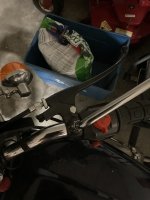
Mechanic said that the lever didn’t return back to its original state which would cause the brake to still be slightly engaged. I knew this was an issue but when I test drove it, it never was a problem and I never felt any resistance so I didn’t think much of it. 38794751-2FAB-42A7-9D19-49B924257B49.jpeg
This picture above, you can see how much of it was still pulled when i left off. Now here’s what I think the issue is. When I had swapped my handle bars, i had replaced all of my cables on this bike except for the front brake cable as I could not find it at all. So I tried to reuse the original one that came with the tall original handlebars and placed some engine oil inside to loosen it up - which it did. Though I think it wasn’t enough to fix it. Now I’m thinking I continue to look for a replacement brake cable. The mechanic however stated that my front brakes are entirely seized from the inside, I was confused because i had opened the drums, replaced the shoes and put anti seize on anything that needed it to ensure nothing would get stuck or i have trouble removing parts if i ever have to. I am not sure what might be the issue.
21254275-B6BA-408B-9AF3-D003957415A2.jpeg
I believe I mentioned this before and someone had mentioned the dots did not allign on the lever, I did fix this but the issue was still there. 7086150D-CE0B-427A-A682-1822E5D4EF73.jpeg
Updated pic^

So yes, those are my issues. I may already have a lead on a replacement brake cable, so I am looking into that at the moment. But is there any other reason why this lever is not going back to its original position ? Are the brakes being seized really true or was the mechanic just trying to get this bike (that could possibly be a death trap lol) off his hands? All support is appreciated.
 
If you have not removed, cleaned, and lightly greased both pivot shafts, that could easily make the brakes stick on. If those shafts are lubed, the springs on the brake shoes will return the brakes to normal running position when you release the lever. The tester did you a favor.
 
If you have not removed, cleaned, and lightly greased both pivot shafts, that could easily make the brakes stick on. If those shafts are lubed, the springs on the brake shoes will return the brakes to normal running position when you release the lever. The tester did you a favor.
I removed, cleaned and greased those pivot shafts when I was changing my drum brakes. I also tested it by pulling on the lever and the brakes did not stick. That was 6 months ago, and I will still be double checking it again. Do those springs wear out?
 
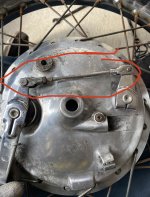
In reference to the first two pictures in your post, it looks like you have the cable adjuster at the handlebar pretty much maxed out, but you have adjustment remaining at the brake drum. As you back out either adjuster, you are effectively increasing the length of the cable sheath and removing excess free cable length. In the second picture, you would decrease the amount of threads showing on the "left", adding more threads on the "right", to tighten the cable. It looks like you could probably get it to an okay setting, but I'm concerned that as the cable stretches, you'll be nearly out of room to tighten it further.

The amount of excess cable (difference between cable length and sheath length) is really important. This is one of the reasons that cables are generally not interchangeable across many models.

The tester did you a favor.
Absolutely. It seems unlikely that the front brake was actually sticking, but, with that much slack in the cable, the effectiveness of the brake would be minimal.

One could argue that the inspector could have adjusted the brake cable, but I think it's better in the long run if they don't. In order to operate a motorcycle safely long term, the rider needs to be able to keep the cables adjusted properly on their own.
 
Last edited:
I very much doubt tester is allowed to do any adjustments as they don't know history of bike.
I did MOT (Ministry of Transport) tests in Britain.
It wasn't difficult to get a pass but some people were totally oblivious to how dangerous bike was to themselves and others.
Brakes were actually pretty low on list of fails, bald tyres most common ( 're-cut' a tread groove so it looked kinda legal, but, with cords are showing? !!!!!)
Steering bearings 'notched' another fail point.
True story,
2000~ 2006
Several Harley Davidson Instructors at MMI actually told me (and others) Harley had 'self centering' steering with a detente for low speed operation.
They had NEVER ridden a HD without faulty steering bearings and really knew no better.
 
I did MOT (Ministry of Transport) tests in Britain.
It wasn't difficult to get a pass but some people were totally oblivious to how dangerous bike was to themselves and others.
Brakes were actually pretty low on list of fails

I remember getting a small bike ( possibly my YG1 ) MOT tested by Basil Partridge, at his Bishops Frome garage. Brake testing was done with a sort of winch contraption, not the usual rolling road. Rider had to sit on the bike, operating the brakes in turn, while the tester tried to winch the bike toward him, via a rope around the headstock of the bike. Brakes on, wheels locked, bike dragged forward. Don't see how this actually tested braking efficiency like a rolling road does.
 
Wow, reminds me of some of the old contraptions used in the Florida motor vehicle inspection stations back in the '70s. They didn't even have a device to test bike brakes, the inspector would tell you to hold each brake individually while he literally tried to pull the bike forward. They had a car lift-looking platform to drive cars and trucks up onto for testing all 4 wheels' brakes on them, and one time I offered to ride my bike up on it and hit both brakes at the point where the wheels would have been on the separate sections of one side of it for front and rear of the bike. Nope, can't do that because of the liability - yet they would let anyone drive their 4 wheeled vehicle up onto it and slam on their brakes, little old ladies and all. And as you can imagine, that was chaotic at times too, requiring the inspector to have them back up and try again, then finally having them get out of the car and letting him do the test.
 
When I replaced my bars and cables, I got new (CM450E) cables from Motion Pro. Adjusted the cables per the Owner’s/Service manual and they’ve been working fine. If it were me, I’d pull the front wheel and drum and double check everything… brakes aren’t an option! If I remember, without looking at the manual, adjust at the drum first, then fine tune with the cable adjustment at the handlebars. Here’s mine as it sits today, the same as when I refreshed them and installed new pads/cables.
(Yes, she needs a wash… road to work is gravel. 🤦‍♂️)
IMG_0264.jpegIMG_0263.jpeg
 
There are far more knowledgeable people than I on this subject but I think doing a tick list of a 'process of elimination' would likely find your culprit.

I am discounting the wheel drum itself as being out of true as I don't know the mileage and it's condition.

Firstly, disconnect the cable at both ends, and as it's a twin leading shoe brake, the connecting rod between the levers, this allows you to check both levers are operating freely by moving each lever by hand, this allows you to check it's returning freely. When refitting the connecting rod it gives you a chance to ensure the adjustment is correct and both shoes contact the drum at the same time. You mention the mechanic said the brake was sticking on, could it have been possible that one shoe was contacting the drum even when the lever was released, by rechecking the rod adjustment you can eliminate this possibility.

I would then check the cable for free movement by reconnecting it to the drum lever only and pulling it then releasing it, this should allow you to ensure the cable operates correctly back and forth.

You mention lubricating the cable with engine oil, depending on the type of inner lining of the cable some lubricants can cause swelling of the inner cable tightening onto the cable causing difficulty in operation, Venhill's recommend a light oil like 3 in 1. It is also possible that the outer has been pinched at some point, possibly between the steering stop and frame?, and is stopping free moment of the cable.

Is the handlebar lever ok and moving freely?, has it been bent at any time?, and ensure it's pivot pin is not restricting movement by being too tight. I have just looked at the pic of the handlebar lever, has it been replaced with a different model?, as the adjuster seems to be at an angle rather than running straight into the lever, look at your pic of the lever adjuster and Tomeben's in his first pic in post 10.

Sorry about longish post, but I think it only comes down to the 3 areas, drum, cable and lever, ensure each is operating correctly and, hopefully, you will find the problem. Its a pain I know but persevere.
 
Last edited:
When refitting the connecting rod it gives you a chance to ensure the adjustment is correct and both shoes contact the drum at the same time. You mention the mechanic said the brake was sticking on, could it have been possible that one shoe was contacting the drum even when the lever was released, by rechecking the rod adjustment you can eliminate this possibility.
When checking the rod adjustment, do you mean the rod that connects both shoes? If so, is there a specific way of knowing if the rod is in its correct position or is it just making adjustments then rechecking? I remember when I first redid my brakes 8 months back, I remember having to mess with the rod a bit by adjusting the nut on it. I was thinking this could also be the culprit. 834AE1AA-F096-4375-B006-3D44B80D9BF5.jpeg
 
It's best not mess with that tie rod adjustment, its purpose is to get both arms parallel to each other, so there is equal leverage and braking force on both shoes.
 
When checking the rod adjustment, do you mean the rod that connects both shoes? If so, is there a specific way of knowing if the rod is in its correct position or is it just making adjustments then rechecking? I remember when I first redid my brakes 8 months back, I remember having to mess with the rod a bit by adjusting the nut on it. I was thinking this could also be the culprit. View attachment 33435
I don’t think that this would cause the issue with the lever. In my opinion, this linkage rod is best adjusted with the brake plate out of the drum. Manipulate the front arm and adjust the rod length so that both brake shoes begin to lift at exactly the same time, not necessarily both pivots turn at the same time. Then reinstall according to book and torque axle with brake fully applied. I think you just need to take slack out of the cable, if both cable adjusters are maxed out and it still hangs like pictured, then your cable is too long.
 
Since you already have the wheel off, and the linkage partially apart, in the interest of safety it may be a good idea to get out the FSM and start over. Not ideal, but again, it’s your brakes - the front one!
 
Last edited:
In case anyone else looks here for brake cable info, I may not have found my front brake cable at Motion Pro. My apologies, and thanks for the PM, Zain.

Since Motion Pro isn’t showing a brake cable available, and CMSNL shows OEM #45450-KB0-000 currently unavailable, try this in post #6:
 
Since you already have the wheel off, and the linkage partially apart, in the interest of safety it may be a good idea to get out the FSM and start over. Not ideal, but again, it’s your brakes - the front one!
Not my bike. I’m not the OP. FWIW, my version of the FSM doesn’t cover this in great detail either.
 
When checking the rod adjustment, do you mean the rod that connects both shoes?
Yes, the rod that connects both levers.

Most people will have their own way of doing it and are happy doing it they way they feel comfortable, there are loads of videos on 'tinternet of adjusting twin leading brakes.

Some say you need two people but I am usually on my own, as my friends are either not into bikes, have better things to do, or possibly think I need a wash!
Mine is on a Triumph but the method will be about the same. I loosen the spindle slightly, bounce the forks with the brake applied a couple of times to centre the drum in the hub and retighten the spindle nut, then disconnect the rod clevis pin at one lever arm, apply the brake so that the lever the cable is attached to touches the drum, I then secure the hand lever to the handlebar by a cable tie just enough to keep the pressure on that lever so the shoe touches the drum, then pull the small lever at the drum until you feel the shoes touching the drum then slip the rod over the top of the lever, you may find it doesn't line up with the hole in the lever to allow you to put your clevis pin or bolt in, you just adjust the rod until it does, once that's done both shoes should be touching the drum, release the lever at the bar and adjust the freeplay in the cable until you are happy with your freeplay.

Now, as I said everyone will have their preferred method of doing it, some may agree, some not, that's fine , not a problem, if we were all the same the world would be a boring place.
 
That was a very good point about the link not adjusted properly.
Going back and looking at the pictures you can see the operating arms are not parallel, that should be the starting position with new shoes and only minor adjustment needed to get full contact on both.
I tend to use a large adjustable on operating arm to pull it tight then adjust the other side to be tight at the same time.
There is usually enough 'slop' in the link so you can apply brake with lever (usually have to tie it off with zip tie or two) then check the 'slave arm' is also tight.
Almost certain it's what tech meant when he said it was sticking, one side is constantly dragging.
Amazing the stuff you forget when it aint been done for years.
 
Back
Top Bottom