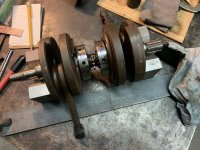
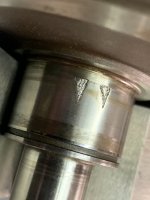
Crankshaft Cleaning

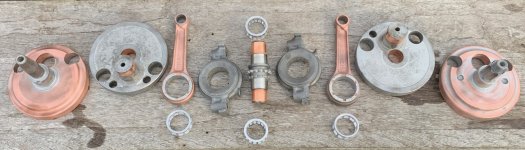
If you can afford a 20t press and a few scraps of metal, it is a straightforward process to pull early Honda cranks apart and do it properly. The big-end pin sludge trap is the most critical as when it blocks it cuts off the cooling/lubricating supply to the cylinder wall and small end.

IMG_1046.jpeg
 
Last edited:
Hi Jensen

NOS cranks can be problematic as the assembly grease dries up and blocks the oil passages. You can wreck a priceless crank by using it without cleaning it properly, first.

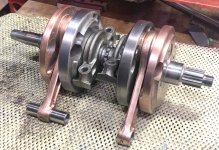
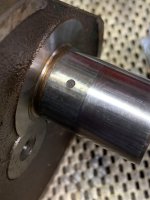
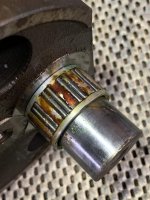
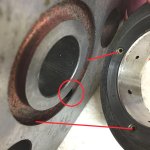
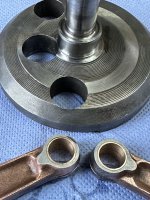
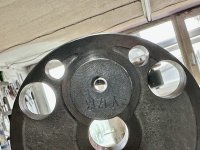
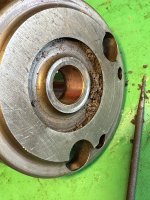
The two images are from a NOS CB77 crank that I stripped & cleaned..

G
Clogged big end IMG_4139.jpgSolidified grease IMG_4138.jpg
 
It’s not hard to imagine getting in deep if you don’t have access to the crankshaft to measure things and inspect.

Buying a used one on eBay is risky. None have enough pictures and you can’t measure a picture. It’s a complex part for sure.

Could easily end up having to buy multiple.

NOS is appealing. But $2k appealing?
 
If you can afford a 20t press and a few scraps of metal, it is a straightforward process to pull early Honda cranks apart and do it properly. The big-end pin sludge trap is the most critical as when it blocks it cuts off the cooling/lubricating supply to the cylinder wall and small end.

View attachment 26338
If these are photos of your personal work G-Man, then I recognize them from some Facebook posts and admire your skills. Very impressive work! I bought a 20 ton press this summer and have some K3-K7 450 cranks I could experiment with. I agree that pressing them apart is achievable for even someone like myself. The real challenge of the job is getting them pressed backed together and balanced. Myself and many others here at VHT would welcome your sharing of other photos and knowledge of this practice if you care to.
 
Putting them back together is easier than taking them apart because the force curve works with you and is easy to control.

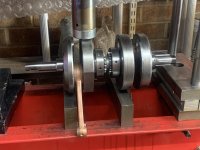
Alignment is pretty straightforward too. I use the press rather than a copper hammer. If you have a dial gauge and a set of crankcases you have all you need. The important thing with the centre section is to get the two crankpins aligned correctly and to get the correct orientation of the cam sprocket. Usually there is a tooth or valley aligned with TDC on the alternator side.

There is no 'balancing' to do. It is all about getting the outer wheels running true to the centre section. The out of alignment can only be at the 9 o'clock and 3 o'clock positions if you consider the crank pin as 12 o'clock. Rest the crank in the cases with the outer bearings off. Measure the runout as shown.


dial gauge IMG_9080.jpg

I do alignment corrections in the press as below. You can nudge the wheels into position like this and use a copper hammer on teh press frame to nudge the last bit with the crank pre-loaded.

aligning in press MG_8853.jpg
 
Your crank is possibly ok, just need to clean it. I don't remember, but with disassembly of the engine, was there already a sign in this direction ?
A sign in this direction?

I know a lot more now than I did then. The internals of my engine were pretty clean. At some point someone cared for the bike. Even when I cleaned out that trap this time, there wasn’t a lot of crud.

I did measure best I could on the first rebuild. I think I measured batter this time.

I really think, and this is a gut feel, this is self induced.
 
Putting them back together is easier than taking them apart because the force curve works with you and is easy to control.

Alignment is pretty straightforward too. I use the press rather than a copper hammer. If you have a dial gauge and a set of crankcases you have all you need. The important thing with the centre section is to get the two crankpins aligned correctly and to get the correct orientation of the cam sprocket. Usually there is a tooth or valley aligned with TDC on the alternator side.

There is no 'balancing' to do. It is all about getting the outer wheels running true to the centre section. The out of alignment can only be at the 9 o'clock and 3 o'clock positions if you consider the crank pin as 12 o'clock. Rest the crank in the cases with the outer bearings off. Measure the runout as shown.


View attachment 26348

I do alignment corrections in the press as below. You can nudge the wheels into position like this and use a copper hammer on teh press frame to nudge the last bit with the crank pre-loaded.

View attachment 26349
Thank you Graham for sharing your skill and knowledge! 😃👍
You make it seem so easy! I will have to study on this and contemplate this for awhile as I am away from my shop and tools. When I have some time back there I will dig out an old crank to experiment with. At that time I am sure I will have some further questions. Thanks again!
 
My conclusion remains the same, the reason behind the problem is lean mixture, in combination with clogged oil ways, thus lack on lubrication at the points that lubrication and cooling was so desperately needed, the piston skirts and cylinder wall. Running way too rich might lead to this, the fuel "cleans" the cylinder walls, leaving no oil layer between piston and cylinder wall.
 
Their only NOS once and not many out there these days it seems. I saw the same listing for the NOS crankshaft and I am glad I didn't choose a CB450 DOHC as a project. Just difficult and complicated motors 50+ years on. I rebuild one in the early 70's with a friends help that needed the crankshaft rebalancing from a C clip left off the end of the crank by a PO while in there doing some work. It was in the stator rotor area and the stator magnet picked up all the roller pins from the cage when it walked out of the end of the crankshaft.

The stray rollers destroyed the stator and unbalanced the crankshaft on that end. Honda shop charged me $30 Canadian to rebalance the crankshaft. Those were the days. ;)
 
Last edited:
Thank you Graham for sharing your skill and knowledge! 😃👍
You make it seem so easy! I will have to study on this and contemplate this for awhile as I am away from my shop and tools. When I have some time back there I will dig out an old crank to experiment with. At that time I am sure I will have some further questions. Thanks again!
You're welcome. Please ask any questions and I'll try to help.

There's a lot of misinformation out there. Essentially the crank on these twins is crucial to lubricating itself, small ends, pistons and cylinder walls. The plates in the bottom of the crankcase are there to 'scrape' old from the flywheels and send it back to the sump. Small end lube comes from the little notches cut into the condrods at the 12 o'clock position. It's a slow process but the 'arteries' in the crank and bearings block up and slowly kill the engine...

This diagram is from the CB72 workshop manual but the same principle applies to every Honda twin with a roller-bearing crank
001 lubrication diagram.jpg

These little jets in the mains feed the centrifuge which spins oil up to the big end. Sometimes I have to drill out the crud.

Difficult to clean these without stripping the crank. A NOS crank will usually have these blocked by hardened assembly grease.


007 big end oil feed.jpg
 
Last edited:
You're welcome. Please ask any questions and I'll try to help.

There's a lot of misinformation out there. Essentially the crank on these twins is crucial to lubricating itself, small ends, pistons and cylinder walls. The plates in the bottom of the crankcase are there to 'scrape' old from the flywheels and send it back to the sump. Small end lube comes from the little notches cut into the condrods at the 12 o'clock position. It's a slow process but the 'arteries' in the crank and bearings block up and slowly kill the engine...

This diagram is from the CB72 workshop manual but the same principle applies to every Honda twin with a roller-bearing crank
View attachment 26394

These little jets in the mains feed the centrifuge which spins oil up to the big end. Sometimes I have to drill out the crud.

Difficult to clean these without stripping the crank. A NOS crank will usually have these blocked by hardened assembly grease.


View attachment 26395
Thanks Graham. I can see how cleaning the small holes in the bearing outer would be impossible if really plugged, without disassembly.

Do you fit new bronze bushings to the small end rods, if replacement rods are hard to find?

Tom Hanna
 
Just for interest. This is what a CB450 big-end oil gallery can look like before and after cleaning.

After thorough cleaning.


IMG_1579.jpeg

Clean centrifuge.

IMG_1580.jpeg

Scraping the dirt out of the centrifuge.....

IMG_1570.jpeg

Not much daylight (or oil) could get through this......

IMG_1573.jpeg
 
Hi Tom

Yes - I use SAE660 bronze bar to bush the small ends. It's a compromise between bush thickness and small-end strength.View attachment 26447
Very good. And repeatable, if necessary. Is it generally sufficient to replace the rollers in their cages on the big ends, as well as the mains? The individual rollers are perhaps available through most bearing supply? For example, I did find caged rollers 26x20x16mm for the 350 transmission shaft end caps that are NLA on Amazon for very reasonable price.
 
Thanks for the pictures Graham ! This shows clearly the issue. I cleaned a few cranks with the draining and flex "mill", method and afterward, pressed them apart to see the effect. It seems a semi-alternative for not too much clogged oil ways. However, it's not possible to clean the last part of the oil way (from the pin centre to the outside of the pin). In my case this oil way were more or less clean. The crud was mainly in the centre bore of the crank pins.

One particular fluid is able to dissolve the sludge or grease, at least the chemical binding of it, and that's acetone. I drop the crank in the acetone for a few days, the sludge won't disappear, but will soften the sludge layer. The stainless steel box with acetone stays outdoors, since it's a nasty and dangerous solvent.

When having a press and fixtures, it's always better to take the crank apart. When I started with these bikes, I didn't have access to a press, and didn't have the fixtures. The tool shop at my work has everything I need for this job, in my former job not.

Yes - I use SAE660 bronze bar to bush the small ends. It's a compromise between bush thickness and small-end strength.

Also for the 450's ? I remember a conversation with you that the 450 rods didn't have enough "meat" around the small end compared to the CB72/77 and dreams....
 
Last edited:
Very good. And repeatable, if necessary. Is it generally sufficient to replace the rollers in their cages on the big ends, as well as the mains? The individual rollers are perhaps available through most bearing supply? For example, I did find caged rollers 26x20x16mm for the 350 transmission shaft end caps that are NLA on Amazon for very reasonable price.
It is 'possible' to get some of the Honda rollers from bearing stockists but mostly, standards have overtaken Honda's choices.

For instance CB450s and some CB250/350 use 3.9mm diameter big-end rollers. I've never found these at a bearing supplier.

CB72/77 big-end rollers are 13.5 long by 2.5 diameter. Standard ones are now 13.8mm long. I have made a grinding fixture so that I can shorten and polish standard rollers which I buy in quantities of 1000.

CB450 main bearing rollers at 13mm long are difficult to find at a good price but stockists keep 5mm and 8mm long rollers.......

G
 
Thanks for the pictures Graham ! This shows clearly the issue. I cleaned a few cranks with the draining and flex "mill", method and afterward, pressed them apart to see the effect. It seems a semi-alternative for not too much clogged oil ways. However, it's not possible to clean the last part of the oil way (from the pin centre to the outside of the pin). In my case this oil way were more or less clean. The crud was mainly in the centre bore of the crank pins.

One particular fluid is able to dissolve the sludge or grease, at least the chemical binding of it, and that's acetone. I drop the crank in the acetone for a few days, the sludge won't disappear, but will soften the sludge layer. The stainless steel box with acetone stays outdoors, since it's a nasty and dangerous solvent.

When having a press and fixtures, it's always better to take the crank apart. When I started with these bikes, I didn't have access to a press, and didn't have the fixtures. The tool shop at my work has everything I need for this job, in my former job not.


Also for the 450's ? I remember a conversation with you that the 450 rods didn't have enough "meat" around the small end compared to the CB72/77 and dreams....
Hi Jensen

That much acetone sounds a little problematic but good if it works. I've just done a CB450 crank and had to chisel out the debris from the centrifuges with several trips to the bead-blaster and ultrasonic cleaner.

As for the 450 rods, I have seen them done by Alpha Bearings but, yes, they seem to have less material around the eye than CB72/77. Some bikes have heavier rods for the touring version which makes bushing easier. C92 rods have a heavier small end than CB92 and it is the same with C72/CB72. Ultimately they all went to the same rod but it gives more options.

G
 
Mine didn’t look nearly as bad as what G-Man posted. I mechanically cleaned that groove and got about 1/2 teaspoon out of each.

I ended up removing the plug on the big crank pin. There was a bit of sediment in that central bore.

It’s soaking in diesel right now. I used a thin copper wire and worked it up the two passages to the outer pin. This wouldn’t provide enough leverage if it were plugged. But mostly sure I feel it reaching the conrod. I can also see it expelling liquid if I blow air in from the outside of the conrod.

I’ll keep doing this for a week or two. Going to pick up a smaller container and switch to acetone for a second dose.
 
Careful with the acetone !, but other then that, good that you bored out the plug, it's a step that most people avoid, but it's not that hard to do.

I tried a few solvents, Acetone works best, second best is IPA (isopropyl alcohol). It's not bad to let it sit in gasoline or petrol for a few days, it will make the scraping easier.

However, the method G-man shows is always preferred above all others.
 
Mine didn’t look nearly as bad as what G-Man posted. I mechanically cleaned that groove and got about 1/2 teaspoon out of each.

I ended up removing the plug on the big crank pin. There was a bit of sediment in that central bore.

It’s soaking in diesel right now. I used a thin copper wire and worked it up the two passages to the outer pin. This wouldn’t provide enough leverage if it were plugged. But mostly sure I feel it reaching the conrod. I can also see it expelling liquid if I blow air in from the outside of the conrod.

I’ll keep doing this for a week or two. Going to pick up a smaller container and switch to acetone for a second dose.
I think steel wire will work best,imo.
 
It is 'possible' to get some of the Honda rollers from bearing stockists but mostly, standards have overtaken Honda's choices.

For instance CB450s and some CB250/350 use 3.9mm diameter big-end rollers. I've never found these at a bearing supplier.

CB72/77 big-end rollers are 13.5 long by 2.5 diameter. Standard ones are now 13.8mm long. I have made a grinding fixture so that I can shorten and polish standard rollers which I buy in quantities of 1000.

CB450 main bearing rollers at 13mm long are difficult to find at a good price but stockists keep 5mm and 8mm long rollers.......

G
Thanks Graham. As I'm looking at the 350 cranks from here, it seems they use 3x12.5mm on the big ends for all, as well as the rods themselves. Currently, there are several SL cranks for sale cheap ($20+20 shipping) and may be a cost effective source for decent replacements with possibly usable small ends. I'm also assuming that the 2 (sometimes 3) crank bearings may not need renewing as bad as the rods, but am finding 4x10mm listed as the common to all for the rollers.

Have you found any particular issues with the 350 cranks?

Tom Hanna-ballbearian
 
I managed to rig up some scrap metal and partially disassembled a spare 350 crankshaft... further disassembly attempts cracked one of the supports so will need to fine tune this before proceeding with a real one.

This crankshaft came from a seized engine, the cam and rockers had an unbelievable amount of wear and the Rt ex valve was stuck open and the Rt piston frozen in place. This crankshaft has been sitting outside for years, great first candidate!

 
I managed to rig up some scrap metal and partially disassembled a spare 350 crankshaft... further disassembly attempts cracked one of the supports so will need to fine tune this before proceeding with a real one.

This crankshaft came from a seized engine, the cam and rockers had an unbelievable amount of wear and the Rt ex valve was stuck open and the Rt piston frozen in place. This crankshaft has been sitting outside for years, great first candidate!

You cracked one of the press supports? That rusty sucker probably needed extra force! Looks like a lot of set up to get the whole crank supported to start breaking it down. I've been looking at one of the 3 foot tall 6 ton ones but wonder if there is enough room to fit the whole crank.
 
You cracked one of the press supports? That rusty sucker probably needed extra force! Looks like a lot of set up to get the whole crank supported to start breaking it down. I've been looking at one of the 3 foot tall 6 ton ones but wonder if there is enough room to fit the whole crank.
I cracked 1 of 2 aluminum support lifts that raised the crankshaft (white pieces in the photo)... Ibeam construction from a bench or something I had laying around. My press is 12 ton and doesn't fit between the support.
 
Last edited:
I cracked 1 of 2 aluminum support lifts that raised the crankshaft... Ibeam construction from a bench or something I had laying around. My press is 12 ton and doesn't fit between the support.
I've seen some big 8inch or more pipe sections for that on youtube press vids.
I don't know if this would cut it.

Cheap and free shipping with prime
 
If all fails, I'd pick up 5-6" dia x 1/4" thick steel pipe (6-12" long) and cut a channel for the rods... but I have a backyard of scrap and welder and not in any particular rush. A 5" dia pipe would do it for the 350 but not sure how big the 450 crankshaft is.

I also have about 2' of burly aluminum angle (around 8" x 3/8" thick) and auto brake drums, thinking of cutting both drums in half and then orienting 90 degrees for support and setting the alum angle vertical to raise things up... too many options!
 
Well, seem to have maxed out my 12 ton press trying to remove the inner counterweight. Bent some stuff but no movement. Aluminum angle held up like a champ but such a hassle to lineup, I'll likely go for the 6" steel pipe and won't update further til I have something notable to share.
 
Better is a 20 ton press, but (@ work) I use a 50 ton press. A rigid frame is key.
Yes , Graham said a 20 ton is good. A very ridged fixture to hold the entire crank while the ends, etc. are removed would be required, so as not to store too much kinetic energy. All force should be applied only to the pins and not absorbed by either the fixture or the press. Hence, a comment I heard several times, that a 20 ton press will deliver 12 tons of force more efficiently and accurately than simply a 12 ton press. I would like to see any pics from Jensen's or Graham's fixture, set up and ready to press.
Most of the youtube vids of this fixture show a large cylinder of pipe (inside diameter > the diameter of the crank weights) with at least a 1/2" wall thickness and some cut out for the rod(s).
 
A 12 tons pres is a 12 tons pres, however, the build-up of potential energy due to flexibility of the frame, and the sudden release of this potential energy to kinetic energy is one of the issue's with a press too light for the job (sorry, physics is my background).
 
A 12 tons pres is a 12 tons pres, however, the build-up of potential energy due to flexibility of the frame, and the sudden release of this potential energy to kinetic energy is one of the issue's with a press too light for the job (sorry, physics is my background).
Thank you. Accuracy is more interesting, in terminology and ballistics.
 
I took one of my crankshafts and worked wire all around/through the holes. Then, rotated the rod around the pin which of course would not turn with all of the debris. So it was push/turn/blow/wash/wash/turn/blow......repeat until it was turning smoothly with no hint of "hitch" where a roller may be skating and not turning. it worked but was intense cleaning/washing for an hour there.
 
I like how it was described to soak the complete crankshaft in solvent for a week to help loosen-up some of the stuff trapped internally.
I will make sure to inspect every crankshaft from now-on,as far as checking the oil-ways and making sure to completely clear them out for best oil flow.
 
A 12 tons pres is a 12 tons pres, however, the build-up of potential energy due to flexibility of the frame, and the sudden release of this potential energy to kinetic energy is one of the issue's with a press too light for the job (sorry, physics is my background).
Yep, I was attempting to take apart a Polaris watercraft crank during class at MMI on a 20 ton press.
Press maxed out, I was going to release pressure when a pin 'let go' and 20 ton bottle jack 'jumped out' and hit me on the head. (I later weighed it, 25 lbs)
There was a tour group looking through windows at time and a bunch of instructors rushed in thinking it was an explosion or truck had crashed through building.
Students were 'impressed' that I didn't get knocked out or even fall down (apparently I said 'damn, that hurt', but, I don't remember)
The previous instructor had swapped bottle jack but made no notes in instructor log plus, he hadn't replaced the bolt between jack and press beam which would have held it in place.
I had more and worse accidents teaching than I had in 43 years riding, racing and crashing motybikes. (this was several years ago now, 2006)
 
After taking into consideration all that has been discussed in this thread so far I decided to try and create a fixture for pressing apart a 450 crank. It probably wasn’t absolutely necessary to spend the time making this but it does seem like it will provide a safe and efficient way of tackling the job.
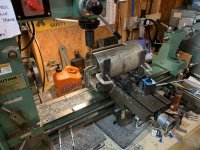
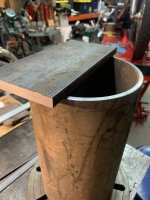
I started by finding a chunk of 6” ID x 1/4” wall steel pipe at the scrap yard and I cut it 11” long. The band saw I have did a good job of making a square cut but it still wasn’t perfect so I was able to square each end much better in the small lathe/mill I have.
72143476840__33262769-625F-4A33-B9DD-144762952C83.jpeg
Next I needed to cut a 1-1/2” x 8” slot for the connecting rods. I chose to mill this slot which was definitely not the fast and efficient way to do it but I thought I might get a cleaner finish using this method. In hindsight I should have just plasma cut the rough slot and then finished it with the mill. Oh well, live and learn. It did turn out fairly nice but took some time and jittery effort since this was kind of big work for my small machine. I always laugh about my Grizzly combo lathe/mill and refer to it as the Easy Bake Oven of shop tools :LOL:
I wish I had room in the shop for a real lathe and mill but this Grizzly is better than nothing and honestly fits well with my level of machining knowledge.
IMG_4698.jpeg

With the work on the pipe done I cut two pieces of 4”x 1/2” flat bar 8” long to use as the top plate of the fixture. Later I cut wedge shaped sections from one end of each plate to provide clearance for the big end of the connecting rod.
IMG_4694.jpeg

With the addition of a few shims this seems close to workable.
IMG_4700.jpeg

IMG_4701.jpeg

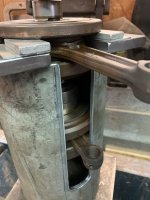
I think this is how I will set up to press it. I’ll stuff some rags in the bottom of the pipe to protect the ends of the crank when it drops. I’ve also cut a 4” long by 1” diameter rod to use as a press pin. Now I just need to wrap my head around any measurements that need to be made, marks to scribe, and notes to take from the crank so that I feel confident that I have all the information necessary to actually attempt putting the pieces back together. I need all that and also the courage to finally just GO FOR IT!
IMG_4702.jpeg
 
As a new spectator to this sport, I must say that is a very nice rig you've set up there.
Off and On with just the ends, seems more straightforward than the center section.

Pretty cool.
 
With your talents and equipment, I think you'll be able to get it done well. What you've put together here looks to be a good setup to do the job, and I'm looking forward to seeing a proper test run. You're welcome to one of my 4 speed cranks to work on for practice.
 
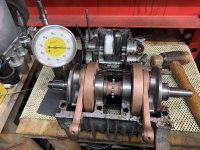
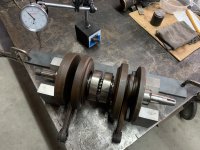
In my last post I had the fixture made for pressing apart the 450 crank. Here is the experimental (and if need be, the sacrificial) crank to use. I’ve got a set of V blocks and a pair of cheap dial indicators. I still need to invest in a copper hammer I guess. Anyway, I know I need to make some measurements. I am assuming for starters I need to measure the overall length of the crank end to end? Then I need to take several measurements between each cylinders counterweights? Then I need measurements between the center two counterweights as well?
In addition to these measurements maybe I need to use feeler gauges to verify clearance between counterweight and conrods as well as clearance for main center bearing cages? All this seems necessary but is it overkill? Am I overthinking this?
In addition to measurements, several scribe marks seem necessary to index all of the counterweights as well as the counterweights being numbered. Is one line of scribe marks enough or is several lines around the crank better? Are scribe marks alone sufficient? One other thing I have struggled with is how to index the center cam chain sprocket relative to the rod bearing journals?
Sorry for so many questions but anyone with experience feel free to help me understand what I need to make note of before attempting to press this crank apart. Thanks!
IMG_4703.jpeg
 
G-man needs to jump the puddle for an in-service, or PJ.

Pretty Cool.
No need to go anywhere, he's a member of VHT and can just weigh in on the pictures. I'm sure that, plus some good suggestions for Chris, will be adequate. But, an in-person tutorial would certainly help.
 
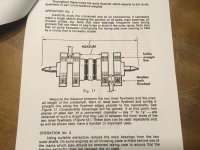
In the earlier posts I should have thanked and given credit to CrazyPJ for supplying the forum with a PDF copy of A Guide to Crankshaft Reconditioning by Alpha Bearings. Anyone interested can get permission to download a copy from the VHT Manuals section. With help from Tom (AD) I downloaded and then printed a copy for myself to refer to in the shop. The design from which I created the press fixture for the crank came from drawings and descriptions included in the Alpha guide and so far I have used the guide to help me understand the reference information that I think I’ll need to put the crank back together correctly.
Thank you PJ for giving VHT access to this informative guide! 👍
IMG_3431.jpeg

In addition to taking the basic measurements shown above I also used feeler gauges to measure and note the clearances between the flywheels and conrods as well as those for the center main bearing cages. I decided to only use one single scribe line across all of the flywheels to avoid any confusion with multiple marks once all the pieces are disassembled. I will also go ahead and cut a couple of spacer bars as suggested in the guide for the center flywheels although I do not yet fully understand exactly how they will be utilized in later steps.
One standing question I still have is how to index the center cam chain sprocket in reference to the position of the rod journals? It seems like the exact position of this center sprocket would be important relative to cam chain timing and the sprockets on the cams? Other than visually noting that it seems that a valley between the teeth more or less lines up to the top of the stroke of the left side rod, I have not found a way to accurately note this detail. Perhaps once I have the outer flywheels removed I can make a scribe marks on each end of the center shaft and the face of its corresponding flywheel?
IMG_4708.jpeg

Hopefully I have the measurements and notes I need because I am getting anxious to go ahead and press this sucker apart! I can only measure and stare at it so long. In the end with this particular crank I am not too worried about making mistakes. I’ve always considered this one a throw away because it has a damaged bearing surface on the rotor side journal. I know someone like G-man could probably grind and resleeve this journal but that is way beyond my skillset. I have wondered if a flywheel with a good journal from a different 450 crank could be used to make this one useable again or would you have to worry then about upsetting the balance of the crank? Someone smarter than me can answer that one for me perhaps? Either way, at this point I am going to forge ahead with this learning experience.
IMG_4704.jpeg
 
Back
Top Bottom