Last edited:
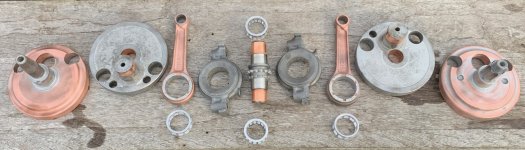
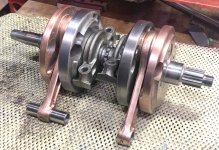
If these are photos of your personal work G-Man, then I recognize them from some Facebook posts and admire your skills. Very impressive work! I bought a 20 ton press this summer and have some K3-K7 450 cranks I could experiment with. I agree that pressing them apart is achievable for even someone like myself. The real challenge of the job is getting them pressed backed together and balanced. Myself and many others here at VHT would welcome your sharing of other photos and knowledge of this practice if you care to.If you can afford a 20t press and a few scraps of metal, it is a straightforward process to pull early Honda cranks apart and do it properly. The big-end pin sludge trap is the most critical as when it blocks it cuts off the cooling/lubricating supply to the cylinder wall and small end.
View attachment 26338


A sign in this direction?Your crank is possibly ok, just need to clean it. I don't remember, but with disassembly of the engine, was there already a sign in this direction ?
Thank you Graham for sharing your skill and knowledge!Putting them back together is easier than taking them apart because the force curve works with you and is easy to control.
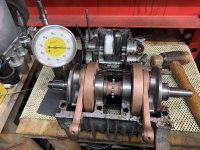
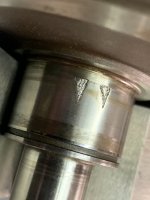
Alignment is pretty straightforward too. I use the press rather than a copper hammer. If you have a dial gauge and a set of crankcases you have all you need. The important thing with the centre section is to get the two crankpins aligned correctly and to get the correct orientation of the cam sprocket. Usually there is a tooth or valley aligned with TDC on the alternator side.
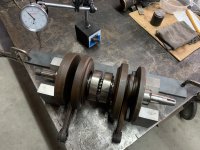
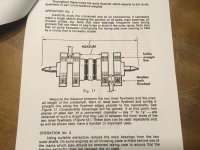
There is no 'balancing' to do. It is all about getting the outer wheels running true to the centre section. The out of alignment can only be at the 9 o'clock and 3 o'clock positions if you consider the crank pin as 12 o'clock. Rest the crank in the cases with the outer bearings off. Measure the runout as shown.
View attachment 26348
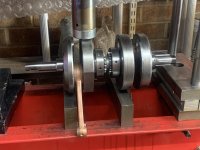
I do alignment corrections in the press as below. You can nudge the wheels into position like this and use a copper hammer on teh press frame to nudge the last bit with the crank pre-loaded.
View attachment 26349
You're welcome. Please ask any questions and I'll try to help.Thank you Graham for sharing your skill and knowledge!
You make it seem so easy! I will have to study on this and contemplate this for awhile as I am away from my shop and tools. When I have some time back there I will dig out an old crank to experiment with. At that time I am sure I will have some further questions. Thanks again!


Thanks Graham. I can see how cleaning the small holes in the bearing outer would be impossible if really plugged, without disassembly.You're welcome. Please ask any questions and I'll try to help.
There's a lot of misinformation out there. Essentially the crank on these twins is crucial to lubricating itself, small ends, pistons and cylinder walls. The plates in the bottom of the crankcase are there to 'scrape' old from the flywheels and send it back to the sump. Small end lube comes from the little notches cut into the condrods at the 12 o'clock position. It's a slow process but the 'arteries' in the crank and bearings block up and slowly kill the engine...
This diagram is from the CB72 workshop manual but the same principle applies to every Honda twin with a roller-bearing crank
View attachment 26394
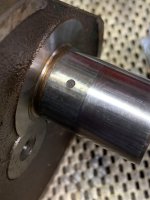
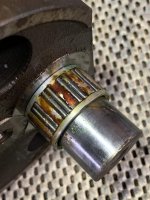
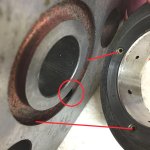
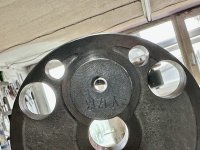
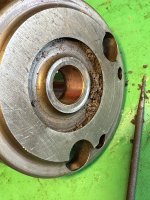
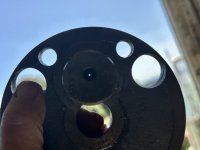
These little jets in the mains feed the centrifuge which spins oil up to the big end. Sometimes I have to drill out the crud.
Difficult to clean these without stripping the crank. A NOS crank will usually have these blocked by hardened assembly grease.
View attachment 26395
Very good. And repeatable, if necessary. Is it generally sufficient to replace the rollers in their cages on the big ends, as well as the mains? The individual rollers are perhaps available through most bearing supply? For example, I did find caged rollers 26x20x16mm for the 350 transmission shaft end caps that are NLA on Amazon for very reasonable price.Hi Tom
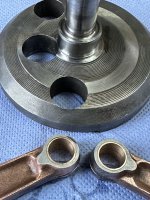
Yes - I use SAE660 bronze bar to bush the small ends. It's a compromise between bush thickness and small-end strength.View attachment 26447
Yes - I use SAE660 bronze bar to bush the small ends. It's a compromise between bush thickness and small-end strength.
It is 'possible' to get some of the Honda rollers from bearing stockists but mostly, standards have overtaken Honda's choices.Very good. And repeatable, if necessary. Is it generally sufficient to replace the rollers in their cages on the big ends, as well as the mains? The individual rollers are perhaps available through most bearing supply? For example, I did find caged rollers 26x20x16mm for the 350 transmission shaft end caps that are NLA on Amazon for very reasonable price.
Hi JensenThanks for the pictures Graham ! This shows clearly the issue. I cleaned a few cranks with the draining and flex "mill", method and afterward, pressed them apart to see the effect. It seems a semi-alternative for not too much clogged oil ways. However, it's not possible to clean the last part of the oil way (from the pin centre to the outside of the pin). In my case this oil way were more or less clean. The crud was mainly in the centre bore of the crank pins.
One particular fluid is able to dissolve the sludge or grease, at least the chemical binding of it, and that's acetone. I drop the crank in the acetone for a few days, the sludge won't disappear, but will soften the sludge layer. The stainless steel box with acetone stays outdoors, since it's a nasty and dangerous solvent.
When having a press and fixtures, it's always better to take the crank apart. When I started with these bikes, I didn't have access to a press, and didn't have the fixtures. The tool shop at my work has everything I need for this job, in my former job not.
Also for the 450's ? I remember a conversation with you that the 450 rods didn't have enough "meat" around the small end compared to the CB72/77 and dreams....
I think steel wire will work best,imo.Mine didn’t look nearly as bad as what G-Man posted. I mechanically cleaned that groove and got about 1/2 teaspoon out of each.
I ended up removing the plug on the big crank pin. There was a bit of sediment in that central bore.
It’s soaking in diesel right now. I used a thin copper wire and worked it up the two passages to the outer pin. This wouldn’t provide enough leverage if it were plugged. But mostly sure I feel it reaching the conrod. I can also see it expelling liquid if I blow air in from the outside of the conrod.
I’ll keep doing this for a week or two. Going to pick up a smaller container and switch to acetone for a second dose.
Thanks Graham. As I'm looking at the 350 cranks from here, it seems they use 3x12.5mm on the big ends for all, as well as the rods themselves. Currently, there are several SL cranks for sale cheap ($20+20 shipping) and may be a cost effective source for decent replacements with possibly usable small ends. I'm also assuming that the 2 (sometimes 3) crank bearings may not need renewing as bad as the rods, but am finding 4x10mm listed as the common to all for the rollers.It is 'possible' to get some of the Honda rollers from bearing stockists but mostly, standards have overtaken Honda's choices.
For instance CB450s and some CB250/350 use 3.9mm diameter big-end rollers. I've never found these at a bearing supplier.
CB72/77 big-end rollers are 13.5 long by 2.5 diameter. Standard ones are now 13.8mm long. I have made a grinding fixture so that I can shorten and polish standard rollers which I buy in quantities of 1000.
CB450 main bearing rollers at 13mm long are difficult to find at a good price but stockists keep 5mm and 8mm long rollers.......
G
drive.google.com
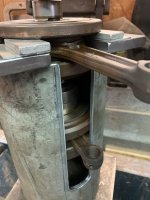
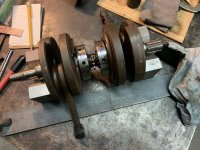
You cracked one of the press supports? That rusty sucker probably needed extra force! Looks like a lot of set up to get the whole crank supported to start breaking it down. I've been looking at one of the 3 foot tall 6 ton ones but wonder if there is enough room to fit the whole crank.I managed to rig up some scrap metal and partially disassembled a spare 350 crankshaft... further disassembly attempts cracked one of the supports so will need to fine tune this before proceeding with a real one.
This crankshaft came from a seized engine, the cam and rockers had an unbelievable amount of wear and the Rt ex valve was stuck open and the Rt piston frozen in place. This crankshaft has been sitting outside for years, great first candidate!
Crankshaft - Google Drive
drive.google.com
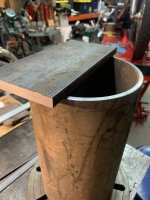
I cracked 1 of 2 aluminum support lifts that raised the crankshaft (white pieces in the photo)... Ibeam construction from a bench or something I had laying around. My press is 12 ton and doesn't fit between the support.You cracked one of the press supports? That rusty sucker probably needed extra force! Looks like a lot of set up to get the whole crank supported to start breaking it down. I've been looking at one of the 3 foot tall 6 ton ones but wonder if there is enough room to fit the whole crank.
I've seen some big 8inch or more pipe sections for that on youtube press vids.I cracked 1 of 2 aluminum support lifts that raised the crankshaft... Ibeam construction from a bench or something I had laying around. My press is 12 ton and doesn't fit between the support.
Yes , Graham said a 20 ton is good. A very ridged fixture to hold the entire crank while the ends, etc. are removed would be required, so as not to store too much kinetic energy. All force should be applied only to the pins and not absorbed by either the fixture or the press. Hence, a comment I heard several times, that a 20 ton press will deliver 12 tons of force more efficiently and accurately than simply a 12 ton press. I would like to see any pics from Jensen's or Graham's fixture, set up and ready to press.Better is a 20 ton press, but (@ work) I use a 50 ton press. A rigid frame is key.
Thank you. Accuracy is more interesting, in terminology and ballistics.A 12 tons pres is a 12 tons pres, however, the build-up of potential energy due to flexibility of the frame, and the sudden release of this potential energy to kinetic energy is one of the issue's with a press too light for the job (sorry, physics is my background).
I would like to see any pics from Jensen's or Graham's fixture, set up and ready to press
Yep, I was attempting to take apart a Polaris watercraft crank during class at MMI on a 20 ton press.A 12 tons pres is a 12 tons pres, however, the build-up of potential energy due to flexibility of the frame, and the sudden release of this potential energy to kinetic energy is one of the issue's with a press too light for the job (sorry, physics is my background).


No need to go anywhere, he's a member of VHT and can just weigh in on the pictures. I'm sure that, plus some good suggestions for Chris, will be adequate. But, an in-person tutorial would certainly help.G-man needs to jump the puddle for an in-service, or PJ.
Pretty Cool.