1971 CL450 that sat for 40 years.

To verify the throttle plate orientation, check for a bevel along the top edge of the plate (there's a bevel on the bottom as well). The sloped edge on top should face towards the rear of the carb body. The purpose is to allow the plate to fit snug in the bore yet have enough clearance to rotate as the throttle is opened. The orientation of the bevel on the bottom should be facing forward for the same reason.

Also, be careful if you do need to remove the throttle plate screws. They can be difficult to remove without stripping.

Would a single drop of PB blaster on each screw be good? Or would that be too harsh of a chemical? If they’ve been removed before, hopefully they are still easy to work with.
 
Would a single drop of PB blaster on each screw be good? Or would that be too harsh of a chemical? If they’ve been removed before, hopefully they are still easy to work with.
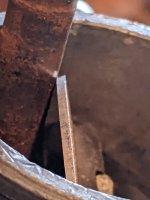
Have you verified whether the orientation is correct or incorrect? If it's correct, you will only need to loosen the screws to adjust the position of the plate. Inspect it to make sure it is not bent. Could very well be the source of the noise you heard.

The screws may be staked in order to prevent them from backing out and ending up in the motor. This makes it harder to remove them, so be sure to use the proper screwdriver. PB blaster and heat may help – I have found that a heat gun is really helpful for loosening stuck threads and keep one on my bench all the time.
 
Have you verified whether the orientation is correct or incorrect? If it's correct, you will only need to loosen the screws to adjust the position of the plate. Inspect it to make sure it is not bent. Could very well be the source of the noise you heard.

The screws may be staked in order to prevent them from backing out and ending up in the motor. This makes it harder to remove them, so be sure to use the proper screwdriver. PB blaster and heat may help – I have found that a heat gun is really helpful for loosening stuck threads and keep one on my bench all the time.


I glanced at the plate this morning. I turned the idle adjustment by hand until I saw the top of the throttle plate. I can’t really see the bevel, or slant that you are referring to. Is it a very subtle slant?

This bike always had the noise of a bird chirping under the seat somewhere. I think we found it.
 
It's very subtle, but you should be able to see it from the profile.

PXL_20231027_160327304.NIGHT.jpg

The screws hold the plate tight against the throttle shaft, but the position of the plate is adjustable because the holes in the plate are larger than the diameter of the screws. Yours could be oriented correctly and out of position or oriented incorrectly.
 
Last edited:
It's very subtle, but you should be able to see it from the profile.

View attachment 26160

The screws hold the plate tight against the throttle shaft, but the position of the plate is adjustable because the holes in the plate are larger than the diameter of the screws. You're could be oriented correctly and out of position or oriented incorrectly.

I’ll double check again when I get home from work.
 
Be sure the screwdriver seats into the screw fully. They are JIS head screws which are slightly different than Phillips head. If the screwdriver doesn't fit right grind the tip off and see if that makes it better.
The PO may have used LocTite on the screws so if they don't budge heat applied will soften the loctite. Heat gun or mini torch will suffice.
 
With reference to the chirping noise when running, it's not likely the throttle plate or shaft moving as much as it could be a slightly leaky gasket on the carb rubber manifolds. We've heard that before and if the noise was happening without you moving the throttle, it was probably the gasket. That's yet another thing you should attend to before putting the carbs back on.
 
With reference to the chirping noise when running, it's not likely the throttle plate or shaft moving as much as it could be a slightly leaky gasket on the carb rubber manifolds. We've heard that before and if the noise was happening without you moving the throttle, it was probably the gasket. That's yet another thing you should attend to before putting the carbs back on.

I actually tended to that a few weeks ago. I know that Honda Bond-4 gasket sealant should be used sparingly, but I applied a light layer around the metal opening of the intakes. I also “lightly” tightened the rubber manifolds. I most likely had those overtightened as well.

Also, the rubber manifolds I bought from 4into1 came with paper thin gaskets. I switched those out with the gaskets from my gasket kit. They are thicker.
 
Last edited:
Were you able to confirm/correct the orientation of the plate?

Maybe you could superglue a screwdriver bit into that mixture screw so you could gently pull on it while turning it out. Just a thought - not necessarily a good idea.

Oh. When you say best are you thinking about how close the throttle arm comes to the stop? It won't touch and the clearance you have now appears normal to me.
 
Were you able to confirm/correct the orientation of the plate?

Maybe you could superglue a screwdriver bit into that mixture screw so you could gently pull on it while turning it out. Just a thought - not necessarily a good idea.

Oh. When you say best are you thinking about how close the throttle arm comes to the stop? It won't touch and the clearance you have now appears normal to me.

Yes forgot to mention I was able to confirm. The slant side is on the “inside” of the throttle plate. And yes I meant ‘best’ as getting that throttle arm as close as possible without touching.
 
Is the harness fully installed? Got that green ground wire placed properly on the frame?

Not fully installed, yet. Waiting on the brake light switch to get here, to finish the headlight bucket.

This is the only place that made sense to me. The bracket at the bottom of the battery box. There was no screw or nut there, so I had to make something up with my box of spare bolts. I’ll have to clean that rusty bolt, but it’s separated by a washer.

 
Further info about the fuel mixture screw. It is no longer making that click noise. And it will no longer tighten. It is spinning freely left, and right. I hear the spring below it squeaking, maybe the spring is lodged.
 
Further info about the fuel mixture screw. It is no longer making that click noise. And it will no longer tighten. It is spinning freely left, and right. I hear the spring below it squeaking, maybe the spring is lodged.
I think that screw should come out so you can check and clean to make sure it is right. If it were mine, I would take a fine file and remove enough of that protective aluminum ridge surrounding the head to get a very small flat blade under it to gently lift as you are unscrewing it.
 
Not fully installed, yet. Waiting on the brake light switch to get here, to finish the headlight bucket.

This is the only place that made sense to me. The bracket at the bottom of the battery box. There was no screw or nut there, so I had to make something up with my box of spare bolts. I’ll have to clean that rusty bolt, but it’s separated by a washer.
While that spot is 'connected' to the frame, it's only by clamping at the top left and right over the frame rails under the seat and at the bottom, clamped to the center rear downtube behind the engine. Not a direct connection to the main frame tubes in any way, only by metal contact so affected by rust and corrosion between the parts. You should use one of the two 6mm bolts (10mm heads) that hold the seat latch/rear tank mount so it gets a connection directly to the frame. Take a look at these two parts fiches, note the battery box mounting in the first one. Bolts (#21) go through half-circle clamps over the upper frame rails and clamp (#16) around the rear downtube behind the engine.

honda-cl450-scrambler-1971-k4-usa-batteryrectifier-magnetic-switch_bighu0030f6s25_f613.gif


And this one shows the ground wire (near and to the right of #4 for the main harness) in the area of the 2 bolt holes for the rear tank mount/seat latch

honda-cl450-scrambler-1971-k4-usa-wire-harnessignition-coil_bighu0030f6s24_ee80.gif
 
While that spot is 'connected' to the frame, it's only by clamping at the top left and right over the frame rails under the seat and at the bottom, clamped to the center rear downtube behind the engine. Not a direct connection to the main frame tubes in any way, only by metal contact so affected by rust and corrosion between the parts. You should use one of the two 6mm bolts (10mm heads) that hold the seat latch/rear tank mount so it gets a connection directly to the frame. Take a look at these two parts fiches, note the battery box mounting in the first one. Bolts (#21) go through half-circle clamps over the upper frame rails and clamp (#16) around the rear downtube behind the engine.

honda-cl450-scrambler-1971-k4-usa-batteryrectifier-magnetic-switch_bighu0030f6s25_f613.gif


And this one shows the ground wire (near and to the right of #4 for the main harness) in the area of the 2 bolt holes for the rear tank mount/seat latch

honda-cl450-scrambler-1971-k4-usa-wire-harnessignition-coil_bighu0030f6s24_ee80.gif


That makes more sense. Thanks for the clarity. I was not super confident with my ground wire placement but didn’t spot that option.
 
That makes more sense. Thanks for the clarity. I was not super confident with my ground wire placement but didn’t spot that option.
This is an example of how you have to study the bike and how it's put together, then think about the components and their needs and how they will work together. Electricity needs solid and clean connections between components, and no matter how clean any simple clamped components are, they will never provide the same level of electrical continuity that a ground permanently attached to the main frame will provide.
 
This is an example of how you have to study the bike and how it's put together, then think about the components and their needs and how they will work together. Electricity needs solid and clean connections between components, and no matter how clean any simple clamped components are, they will never provide the same level of electrical continuity that a ground permanently attached to the main frame will provide.

What is the purpose of the area I attached the ground to? #16 on the diagram
 
What is the purpose of the area I attached the ground to? #16 on the diagram
The U-shaped bracket clamps around the main downtube of the frame behind the engine to give the battery box lower support. Again, study the bike and how it's assembled and you'll get a better idea of how things work with each other. None of the parts that hold the battery box to the frame are clean metal for grounding purposes originally, the battery box was painted and the frame was painted when the bike was assembled so Honda would have used a bolt that goes directly into a mount on the frame itself for the best possible harness ground.
 
I think that screw should come out so you can check and clean to make sure it is right. If it were mine, I would take a fine file and remove enough of that protective aluminum ridge surrounding the head to get a very small flat blade under it to gently lift as you are unscrewing it.

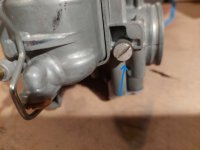
I have filed down the ridged area to be level to the screw. Not seeing any room yet for my tiny flathead. Are there any options for screw extraction? I am not opposed to ruining this screw to get it out.. I still have the original. The other screw pictured is from the other carb.


That's going to be tricky to do without damaging the carb body.

I am currently worried that the threads are damaged, and replacing that screw will just repeat what I’m going through. Worst case scenario, I’ll start searching for a left carb on eBay..
 
I am currently worried that the threads are damaged, and replacing that screw will just repeat what I’m going through. Worst case scenario, I’ll start searching for a left carb on eBay..
Probably for the best, then you can take a bit of risk with less worry once you get a good used carb in your hands, but be sure to go through the new/used one carefully first to be sure of its condition.
 
Probably for the best, then you can take a bit of risk with less worry once you get a good used carb in your hands, but be sure to go through the new/used one carefully first to be sure of its condition.

I have found these so far:


Also, a stripped down carb body. Would this be a headache to transfer over my parts to? The throttle plate etc..


My favorite so far, has been the top one.
 
I agree, when you look close-up at the first one it seems the throttle plate screws have never been touched.
 
Looking at the carb diagram, I think the left one is supposed to be used. My carb kits came with two of each. I installed the right one in both.
 
If you have a compressor you can try to blow out the mixture screw with compressed air. If you have the type with the o-ring stuck in the carb I would try the following:
1. put a few drops of 3 in 1 oil on the mixture screw

2. Remove the screw at the bottom of the carb
carb1a.jpg

3. Open the throttle and cover the hole indicated below in red with your thumb
carb2a.jpg
4. Blow compressed air in to try and dislodge the screw
carb3.jpg
 
I'm pretty sure it's the one on the left with the larger threads.

My rebuild kit came with two of each, I’m assuming for different models/years. I put the ‘right’ screw in both carbs. Could explain the free spinning and stuck o-ring then..
 
Right one screwed out just fine. Still trying multiple methods to get the left one out. The one pictured above.
Since the screw isn't usable with your carbs, I think I'd try gluing something to it so you can tug as you turn the screw. The o-ring may be holding it in place.

I imagine you've tried putting the screw side face down and whacking the opposite side with your palm?
 
Since the screw isn't usable with your carbs, I think I'd try gluing something to it so you can tug as you turn the screw. The o-ring may be holding it in place.

I imagine you've tried putting the screw side face down and whacking the opposite side with your palm?

1st I tried the super glue trick
2nd I tried filing the ridge down to get a flathead under it
3rd I tried hitting the opposite side with my palm, and then a rubber mallet
4th I tried the compressor blow out posted above.

I’m thinking it’s still held on by a thread and stripped. And the o-ring isn’t helping matters. I wish I had a way to think of drilling a small screw into it, and then pulling on that.

I have another eBay carb body on the way that I’ll need to transfer over a couple of parts for. I’m considering throwing this one in the Mississippi River or sending it to one of you guys for a challenge lol
 
I’m considering throwing this one in the Mississippi River or sending it to one of you guys for a challenge lol
If you mailed it, it would probably work itself out in transit.

If it feels like it turns in, maybe you could try to turn it in a ways, then try to power it out from below using a power screwdriver or drill with a screwdriver bit. Gravity will help the screwdriver maintain engagement. Maybe.
 
If you mailed it, it would probably work itself out in transit.

If it feels like it turns in, maybe you could try to turn it in a ways, then try to power it out from below using a power screwdriver or drill with a screwdriver bit. Gravity will help the screwdriver maintain engagement. Maybe.


Lol at the first part. That’s what would happen.

Hate to say that I did try that as well, unscrewing it upside down. It doesn’t want to tighten anymore. Spinning freely both ways now.
 
I have filed down the ridged area to be level to the screw. Not seeing any room yet for my tiny flathead. Are there any options for screw extraction? I am not opposed to ruining this screw to get it out.. I still have the original. The other screw pictured is from the other carb.


Actually recommended filing further in only one spot till the underside edge could be reached and pried under with a very tiny flat blade, like the ones in an eyeglasses repair kit (about 1mm). If the Oring sealing area is untouched it should be usable. If not a small jewelers file then perhaps a 1mm drill bit hole just above, but at the upper edge of the Oring but low enough to pry up on the lower edge of the screw head
 
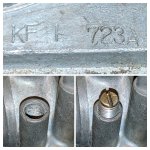
So, this explains a lot.

My right carb is a 14H.

My left carb is a 723A.

That’s why there were different mixture screws.

When I put the aftermarket 14H mixture screw into the 723A carb, it screwed new threads into the carb body and now it’s permanently stuck free spinning. I have a good condition 723A left carb on the way.. I’m curious if running mismatched carbs will be a problem or if I’ll need to get back on eBay..


Not sure why or how I am just now figuring this out. To my eyes the carbs looked identical. There have been about 5-6 times I needed to know the carb’s model and every time it said 723A. I guess every single one of those times I miraculously picked up the left one.
 
Last edited:
There is such a big difference between the diameter of the threads. I bet the threads in the 723A are Ok and the screw is only being held by the Oring.
If you could get it out and the threads are ok then you could proceed. I would then look for a matching right 723A to start with.
Too bad you didn't notice the mismatch and or post a pic with the question regarding what is/are the correct carbs.
 
Not sure why or how I am just now figuring this out. To my eyes the carbs looked identical. There have been about 5-6 times I needed to know the carb’s model and every time it said 723A. I guess every single one of those times I miraculously picked up the left one.
The only clue you had was when you pulled different mixture screws out of the two carbs. Otherwise, it's natural to expect the two to be the same model, although after 50 years it's not uncommon to see this. There were several variations in use during production, so someone looking to cure a problem with one carb might have taken whatever was readily available.

I think you *could* run mismatched carbs, but I would probably prefer to match them. The 14H are preferred by some. I haven't ever run 14H myself because my bike is a 1974 model.
 
Drilling a hole straight down likely results in the screw just spinning with the drill. Have you tried drilling in the slot of the screw at a 45 degree angle? This way you could get some sideways pressure to keep the screw from turning.
 
The only clue you had was when you pulled different mixture screws out of the two carbs. Otherwise, it's natural to expect the two to be the same model, although after 50 years it's not uncommon to see this. There were several variations in use during production, so someone looking to cure a problem with one carb might have taken whatever was readily available.

I think you *could* run mismatched carbs, but I would probably prefer to match them. The 14H are preferred by some. I haven't ever run 14H myself because my bike is a 1974 model.

I may have to cancel my 723a eBay order and get a matching left 14H carb.
 
I may have to cancel my 723a eBay order and get a matching left 14H carb.
I really hope you can get that screw out, which would allow you to run the 723A carbs. I'd be willing to try my hand at removing the screw for you if you want to mail it to me. And I'll cover return postage.
 
Back
Top Bottom