

Danager4792
Veteran Member
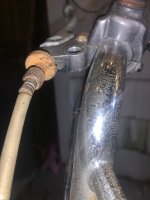
Funny how that happens.Not sure which perch you have, but take a look at the indicated spot in the diagram below, which just happens to be out of sight in both of your photos.
View attachment 25933

Funny how that happens.Not sure which perch you have, but take a look at the indicated spot in the diagram below, which just happens to be out of sight in both of your photos.
View attachment 25933

I have a new throttle cable. I figured all of them would need to be tended to eventually. I appreciate you pointing that out though, that reminds me to start saving some to my parts list.It looks like there is a spot for the switch, so you probably have the correct perch and just need a front brake switch.
Have you ordered all new cables already? If not, I would.

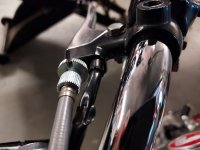
Notice how the lock nut on the front brake cable adjuster seems larger than original and partially covers the hole where the front brake switch goes? Yet another thing on your bike that might not be original. I'll get a pic of mine later for comparison. And yes, I'd replace all the cable at this point. Did you buy a gray throttle cable (original color), or black? Honda went to black cables later but the originals on your bike were all gray.I have a new throttle cable. I figured all of them would need to be tended to eventually. I appreciate you pointing that out though, that reminds me to start saving some to my parts list.
I bought a black one. I didn’t know that about the colors. Also, I was slightly suspicious about that front brake adjuster. I thought that little “cut” in the adjuster had something to do with making room for the cable.Notice how the lock nut on the front brake cable adjuster seems larger than original and partially covers the hole where the front brake switch goes? Yet another thing on your bike that might not be original. I'll get a pic of mine later for comparison. And yes, I'd replace all the cable at this point. Did you buy a gray throttle cable (original color), or black? Honda went to black cables later but the originals on your bike were all gray.
The cut is so it will allow cable replacement without having to include a new adjuster, notice that the adjuster itself also has a cut in it. This is typical on all Hondas of the era, and really all manually-adjusted cables on bikes so it's a familiarity thing. There are so many little details that you wouldn't be familiar with unless you were around these bikes during that era or not long after, while they were still in original form without decades of non-stock replacement parts being added. Stuff like that stands out to me because I know exactly how they were equipped when new. It also helps to study pictures of them when they were new, like old sales brochures.I thought that little “cut” in the adjuster had something to do with making room for the cable.


It can also be a huge disadvantage to be missing a few subtle parts as well. Such as the D-washers, and in this case the brake switch cable. Here’s another item I’m pretty sure missing as well. The silver “bridge”?? When I’m missing parts.. I don’t even know the names of them. Haha. I suppose that’s where the parts diagram would come into play.The cut is so it will allow cable replacement without having to include a new adjuster, notice that the adjuster itself also has a cut in it. This is typical on all Hondas of the era, and really all manually-adjusted cables on bikes so it's a familiarity thing. There are so many little details that you wouldn't be familiar with unless you were around these bikes during that era or not long after, while they were still in original form without decades of non-stock replacement parts being added. Stuff like that stands out to me because I know exactly how they were equipped when new. It also helps to study pictures of them when they were new, like old sales brochures.
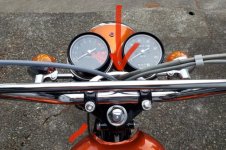
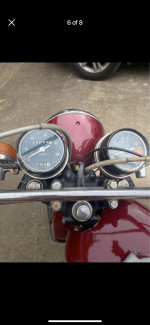
Ahh.. that makes sense.It's a cable guide, though I don't know the exact name Honda called it. When the cables are original and proper fit, they work correctly with it but of course, once the OEM cables are no longer available and you have to buy aftermarket, the lengths may be slightly different which can cause routing needs to change. cables have to be the right length to account for turning the front wheel without them binding or, in the case of the throttle cable, causing idle speed changes by the cable being too short to properly accommodate the turn of the bars, so re-routing cables to account for length differences can lead to removing that part. I couldn't use it on my 450 build since I'm using lower CB400F bars.
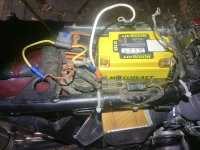
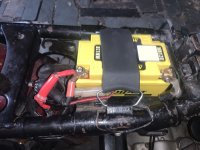
 What about the green ground wire at the ground end of the battery? I see it next to the battery but can't see where the end of it is connected. It needs to be on a 6mm (10mm headed) bolt in the frame somewhere nearby to add a ground for the harness itself.
Yeah, it wouldn't have a fork terminal from the factory, Honda never did that. It would be better with a ring terminal. Green is Honda ground, so as long as it's connected to a clean spot on the frame the harness will get the ground it needs.In the original photo above, do you see the skinny black wire with the ring terminal sticking straight up? It’s in the exact same location as that one, except it’s a green wire with a fork terminal. I meant to ask about it’s location. I’ll take another pic when I get home and find that frame bolt. Currently, my text box options are blank, can’t post a picture.
I really like using a voltmeter with a couple of alligator clip extension wires. Connect black to a ground, red to the point. Set the meter to Ohms and watch for the change in resistance as the points open. This can be done with the power off, so there is no risk of draining the battery or frying a coil. You can disconnect the points leads from the coils for this also.Next on the list is points timing. I would like to review these steps before continuing. The current tool I have for it, is a test lamp with a single alligator clip.

Looks to me like your top bridge has been replaced at some point and may be from a CB750. It has the two little ”nubs” in the center as well as the bottom handlebar perch is molded as part of the top tree instead of bolting through with rubber vibration isolators. Not a big deal but just something I noticed in the above photo.It can also be a huge disadvantage to be missing a few subtle parts as well. Such as the D-washers, and in this case the brake switch cable. Here’s another item I’m pretty sure missing as well. The silver “bridge”?? When I’m missing parts.. I don’t even know the names of them. Haha. I suppose that’s where the parts diagram would come into play.
View attachment 25941
View attachment 25942
Looks to me like your top bridge has been replaced at some point and may be from a CB750. It has the two little ”nubs” in the center as well as the bottom handlebar perch is molded as part of the top tree instead of bolting through with rubber vibration isolators. Not a big deal but just something I noticed in the above photo.
Good eye Chris, I completely missed that. It will change the bar height slightly. I should have noticed that the gauges seem a bit wider apart as well. Forest for the trees when you're focusing on other stuff.Looks to me like your top bridge has been replaced at some point and may be from a CB750. It has the two little ”nubs” in the center as well as the bottom handlebar perch is molded as part of the top tree instead of bolting through with rubber vibration isolators. Not a big deal but just something I noticed in the above photo.
It could even have CB750 forks on it complete, they were all 35mm at that time and the left lower leg had the caliper bracket mounts on them whether it was used or not, that's how my K5 forks are. That would explain the top bridge. If this bike could talk it would have many interesting (and heinous as well, I'm convinced) stories to tell.I will take all the information I can about this bike. It helps with its story. When I told my dad all of the details about the front end, he was suspicious that it had been wrecked before. I would have to look back to be accurate about this from Tom’s comments, but I believe he said the front fender is from a CB, and the front suspension is from a K5
It could even have CB750 forks on it complete, they were all 35mm at that time and the left lower leg had the caliper bracket mounts on them whether it was used or not, that's how my K5 forks are. That would explain the top bridge. If this bike could talk it would have many interesting (and heinous as well, I'm convinced) stories to tell.
Depends on what you'll need, but for example fork seals will be the same so it won't matter, in fact I'd be surprised if it causes much of an issue at all. Honda didn't do that kind of thing much, but back then when the first disc brakes were added to Hondas after the CB750 came out with one they just used some common parts. Mt Dad's CB450K4 was a good example while I was in high school and had my CL450K4, I didn't realize it at the time but his 450 basically had the same front end as the 750 because of the disc brake. If/when something comes up, we'll help you figure it out.When I get to the suspension/front end part of this bike, will I be searching for “750” compatible parts? Or will we need to verify more first That it is 750 forks.
Depends on what you'll need, but for example fork seals will be the same so it won't matter, in fact I'd be surprised if it causes much of an issue at all. Honda didn't do that kind of thing much, but back then when the first disc brakes were added to Hondas after the CB750 came out with one they just used some common parts. Mt Dad's CB450K4 was a good example while I was in high school and had my CL450K4, I didn't realize it at the time but his 450 basically had the same front end as the 750 because of the disc brake. If/when something comes up, we'll help you figure it out.
Test light works fine, but when doing it that way you also have to keenly aware of how long you leave the key on, because whichever set of points is closed for a while will be overheating the coil associated with it. the ohm meter method mentioned by Brody (stl360+450) would be safer.Roger that.. it will probably be a good while until I get to that part of the equation. Right now I’m preparing to do the points. Currently I have a test lamp with a single alligator clip. I have been reading/looking at a mixture of youtube videos, Bill Lane’s guide, and the FSM.
Test light works fine, but when doing it that way you also have to keenly aware of how long you leave the key on, because whichever set of points is closed for a while will be overheating the coil associated with it. the ohm meter method mentioned by Brody (stl360+450) would be safer.
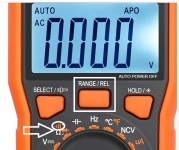
Yep, that would work. You'd want to use it on a low ohm setting, adjusted using the Range button. It appears to have a continuity tone so it might beep when the points are closed and stop beeping when they open.
Not too difficult. Set the ohm meter to ohms, then using the range button set it to a low range like 10 ohms (or use the continuity feature it seems to have based on the picture of it). You can connect the positive clip to the points spring, easier than the small bolt where the wire connects. The ohms setting is marked by the arrow, the audible indicator it seems to have is marked by the white oval and the Range button will adjust the ohms reading range of the readout. If the audible continuity is actually present as it seems to be, choose that and use the tone or beeps it makes to know when the points are closed or open.Roger that. I just ordered it. When I receive it, I’ll most likely need a write-up on how to do the points. So far I know to ground the black clip, and then connect the red one to the point bolt at the bottom. And then set the points gaps to .014” when they are at their widest. But I have never used a voltmeter, or know that much yet about turning the crankshaft to proper positions, etc.
Your base setting for the points plate is here, note the notches in the plate and the cutout in the top of the points base/cam bearing cover. Set the plate at that position, then rotate the engine to set the points gap at .014" (separately, since while both are open at the same time during a portion of rotation they may not both be open fully at that point)
View attachment 26016
This is the proper procedure to follow.
While aligning the points plate with the cutout at the top is a good start, the proper method involves first turning the engine until the breaker cam opens first the left set of points to the fully open position and setting the gap of that set of points at .014", then turning the engine until the right set of points is fully open and setting them at .014", then adjust the left side timing by rotating the points plate so the left points break at LF. You then lock the points plate and check the timing on the right cylinder to see if the points break at the F mark and if they do not, you adjust the gap to get the right points to break at F. If after that adjustment is made, the gap on the right points is less than .012", you go back to the beginning and reduce the left points gap to .012", set that timing by rotating the plate to open at LF, then check the right side again and adjust the right points to open at F.
Yes, it can take a few tries to get both correct, but that is the procedure since there is only one plate that both sets of points are mounted on, so when you rotate the plate to advance or retard the left timing it affects both.
But did you try to adjust the left points? The range of adjustment should allow you to get the points to open, it's unlikely that the fiber rubbing block is worn so much that it can't be adjusted.
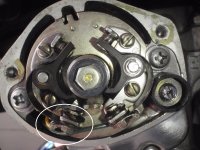
I have a couple concerns: first, the washer on the bolt in the advancer doesn't look like the original. It should be a hardened black washer that has a larger than normal outer diameter to 'cover' the breaker cam lobe to prevent outward movement, and the bolt goes into the washer with no other washers involved (it kinda looks like there might be a lock washer added on top of the flat washer). Second, the left points wire terminal looks suspiciously close to where the points cover will sit and if it's too close it could arc to the cover and kill that cylinder, though it could just be the angle of the picture. A straight-on picture that includes the entire points plate area clearly would help.
But did you try to adjust the left points? The range of adjustment should allow you to get the points to open, it's unlikely that the fiber rubbing block is worn so much that it can't be adjusted.
I have a couple concerns: first, the washer on the bolt in the advancer doesn't look like the original. It should be a hardened black washer that has a larger than normal outer diameter to 'cover' the breaker cam lobe to prevent outward movement, and the bolt goes into the washer with no other washers involved (it kinda looks like there might be a lock washer added on top of the flat washer). Second, the left points wire terminal looks suspiciously close to where the points cover will sit and if it's too close it could arc to the cover and kill that cylinder, though it could just be the angle of the picture. A straight-on picture that includes the entire points plate area clearly would help.
How did you adjust the right set of points? Or did you have to?I have not tried to adjust the left point yet. If I were to move the upper block to the right to make a gap, wouldn’t that in turn move the bottom of the black more to the left, away from the camshaft?
How did you adjust the right set of points? Or did you have to?
It's incredibly simple, but understanding how it works would help. I'll put something together.
I understand. I think the fear of doing something wrong is keeping you from trying to do anything right at the moment, and when I finish what I'm doing to show you how simple it is, you'll be wondering how you didn't already figure it out.I have not touched the right side point yet, they are opening and closing.
The left side isn’t opening, the heel isn’t touching the camshaft
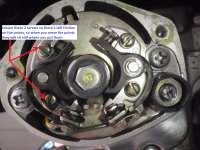
Here is as simple as I can break it down.
View attachment 26050
Then watch this video to understand what I mean. The right set of points adjusts the same way if needed.
I understand. I think the fear of doing something wrong is keeping you from trying to do anything right at the moment, and when I finish what I'm doing to show you how simple it is, you'll be wondering how you didn't already figure it out.
Not sure I'd describe it quite like that, but yes. But they ARE 2 separate adjustments, one for each set of points by loosening the 2 screws on each set.So the camshaft kicking the heel makes the point gaps open.. I thought they were two separate adjustments. Lol. Yeah that’s way too simple..

You removed the throttle plate didn't you?
Looks like it's in backwards which would hold the linkage open.
Yep, someone has been there before you and did it wrong evidently, which is really no surprise considering how long these things have been around. Plenty of time for tomfoolery and hi-jinks.Nope.. never touched the throttle plate. Left it ‘as is’ while I disassembled everything else. I can’t believe it. Thanks a lot.
Yep, someone has been there before you and did it wrong evidently, which is really no surprise considering how long these things have been around. Plenty of time for tomfoolery and hi-jinks.