


Windmill John
Veteran Member
I have a degree in over complicating things and I'm sure this will be no different!
I was just fiddling and came across my question.
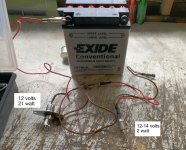
As you can see, series circuit, two bulbs. Let's cut to the chase. Connect to battery negative and only the 2 watt bulb lights; they do work independently.
Now, this could be a perfect example of voltage drop where we pretend the 2 watt bulb is corrosion etc. stopping the 'load' (21 watt bulb) from lighting.
Question time and I'm sure it relates to Ohm's law.
Why did the 21 watt bulb not light at all?
21 watt bulb by itself would be about 0.5 amp using Ohm's.
2 watt bulb by itself would be about 6 amp using Ohm's
Of course I could be wrong.
Bulbs in series (possibly confusing myself now) 21 watt + 2 watt, 23 watt, V=IR. about 0.5 amp.
If that is all correct, why didn't the 21 watt bulb light even a bit?
Is it due to the 2 watt bulb pulling far more current and therefore not enough current to light the 21 watt? If that is correct, I understand it all and have no question.
If not correct, please explain as it might drive me crazy.
.
I was just fiddling and came across my question.
As you can see, series circuit, two bulbs. Let's cut to the chase. Connect to battery negative and only the 2 watt bulb lights; they do work independently.
Now, this could be a perfect example of voltage drop where we pretend the 2 watt bulb is corrosion etc. stopping the 'load' (21 watt bulb) from lighting.
Question time and I'm sure it relates to Ohm's law.
Why did the 21 watt bulb not light at all?
21 watt bulb by itself would be about 0.5 amp using Ohm's.
2 watt bulb by itself would be about 6 amp using Ohm's
Of course I could be wrong.
Bulbs in series (possibly confusing myself now) 21 watt + 2 watt, 23 watt, V=IR. about 0.5 amp.
If that is all correct, why didn't the 21 watt bulb light even a bit?
Is it due to the 2 watt bulb pulling far more current and therefore not enough current to light the 21 watt? If that is correct, I understand it all and have no question.
If not correct, please explain as it might drive me crazy.
.


