The 62 CA95 Basket Case Rescue Log, Start Date June 1st 2024

I do wish these carbs had a bowl drain screw to use the clear tube method to verify the actual float level as a 2nd witness. It's hard to unsnap the wire holder and carefully lower the bowl without spilling any, and then there is the question of how much the level would change when the float is in the gas, displacing a small amount and thus increasing the level. I guess careful experimentation with lowering the bowl could arrive at a good level when simply lowering the bowl. According to the FSM drawings, the actual level seems to be about 2mm from bowl rim, so a lowered bowl should show at least 4, maybe 5 or 6mm from rim.

Give it a shake. A leaky float would be a nice , ah ha moment.

I need to dive back in Charles flat side carb to see what's up there.
 
@Spokes there’s nothing wrong with walking away, taking a breath, counting to… pick a number, regrouping. Carry on as you choose, but we’re cheering for you and the basket case. I liked the thought that a few more miles on her bones would help. Be well.
 
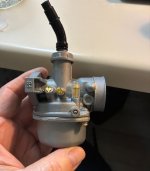
I decided to take a different route with this fuel issue. I bought (ordered) a cheap Chinese carb that's real close to fit the 62. I need to mill the mounting holes into slots to fit the insulator. Reason is to see if this weird issue with the original carb holds true. If the Chinese knock off delivers idle and good throttle, then it's the original carb that's the problem. One of my best friends of 60+ years, mechanic and biker asked me about this nice, clean original carb I've been working on. He asked: Did you ever think why this old carb is so clean after 60+ years? Not really, I replied, he said maybe it was defective, and someone threw it in a box only to be found decades later and sold on eBay. Dave knows the kind of luck that I have. Thus, the idea to retrofit a Chinese knock off.
With intensions to ride, start it, put in gear, begin to release clutch and say, "Speak to me".
I did just as suggested. Idle to about 1/8 throttle, ok, start off idle shift into 1st ok. 1/8 throttle, shift 2nd. 2nd gear 1/8 throttle, ok shift 3rd, 1/8 throttle shift 4th gear. The higher the load, the better the throttle response. If the Chinese knockoff pays out, I have my eye on a real nice modern carb. Only challenge will be is fabricating an adapter as the CA95 studs at the carb measure roughly 37 mm center to center and the carb in mind mounting holes measure 45 mm center to center. I should know more next week.

Thanks all for your responses.
 
I decided to take a different route with this fuel issue. I bought (ordered) a cheap Chinese carb that's real close to fit the 62. I need to mill the mounting holes into slots to fit the insulator. Reason is to see if this weird issue with the original carb holds true. If the Chinese knock off delivers idle and good throttle, then it's the original carb that's the problem. One of my best friends of 60+ years, mechanic and biker asked me about this nice, clean original carb I've been working on. He asked: Did you ever think why this old carb is so clean after 60+ years? Not really, I replied, he said maybe it was defective, and someone threw it in a box only to be found decades later and sold on eBay. Dave knows the kind of luck that I have. Thus, the idea to retrofit a Chinese knock off.

I did just as suggested. Idle to about 1/8 throttle, ok, start off idle shift into 1st ok. 1/8 throttle, shift 2nd. 2nd gear 1/8 throttle, ok shift 3rd, 1/8 throttle shift 4th gear. The higher the load, the better the throttle response. If the Chinese knockoff pays out, I have my eye on a real nice modern carb. Only challenge will be is fabricating an adapter as the CA95 studs at the carb measure roughly 37 mm center to center and the carb in mind mounting holes measure 45 mm center to center. I should know more next week.

Thanks all for your responses.
Good question from your friend. If not actually defective then somehow mis-matched, the FSM lists 4 different carbs (2, 18mm for the C/CB92 125cc) and Keyster lists at least 2 carb kits 0035 (round bowl) and 0042 (later flat side). Honda did make many undocumented changes. I should do a thorough comparison of all 4 examples that are here, it's been piece meal because I don't want to break down the best one on my brown bike right now.

Your last ride report sounded hopeful as if it was struggling for air. Most all have a fixed main air jet in the brass tube jutting towards the air filter, in the throat, which should be 1.5mm and leads to the main jet holder emulsion tube. It could easily get plugged in that location. The lightly pressed in needle jet orifice, which is held in by the main jet holder emulsion tube, should be removed for cleaning through the air main jet. The orifice goes in with the larger hole facing up towards the slide.

If you can hog out the mounting holes on the new knock off by 4mm towards the center and still get nuts on, you may have discovered a new Benly carb work around.
 
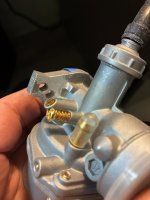
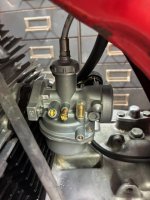
Received my $14.99 Chinese carburetor today. Carb came with an air cleaner, multiple gaskets and fuel filter. I milled, drilled, and modified throttle. I had an extra mount stud and shortened to fit. Too late and too hot to thread nuts and fuel up this evening. Results tomorrow. If successful I will go into detail what I used to mill and locate new holes to mount on the bike. Fingers crossed.

IMG_5615 new carb.jpg IMG_5618 new carb.jpgIMG_5625 new carb.jpg
 
Last edited by a moderator:
Maybe the best kept secret is that you can modify a Chinese knockoff carb for your CA95.
I'm aware the OEM slide is smaller, but I needed to prove a point. There is something screwy about the original style carb I have.

The Chinese knockoff carb goes 1/4 throttle 1st & 2nd before cough. Shift 3rd & 4th full throttle smooth. I don't live near a nice straight away that I can push top end.
I suspect the Chinese carb cannot supply enough low end throttle up fuel because it's not designed for the CA95 displacement.
Next step, now that I know it's carburation I will look at the jets again in the original carb, one last time, But I plan to order another Chinese Knockoff carb closer to what I need.
Below is the tool that was used to mill away excess metal. I used an insulator gasket to align mounting holes. Best kept secret exposed.
 

Attachments

  • IMG_5626 millbit.jpg
    IMG_5626 millbit.jpg
    65.1 KB · Views: 6
I will look at the jets again in the original carb, one last time
Ok just to keep this saga going, I've been thinking about the success with this Chinese Knockoff carb. The bike ran better, not perfect, but better. So, my thinking is smaller carb works better? Could it be that the jets in my original carb are too big? Could it be that the fuel mixture is too rich? So, I take my original carb apart and remove all jetting. So here is what I have found and compare against the manual.
Carb PW20HOV
Main Jet - Spec 95 as found 100
Slow Jet - Spec 35 as found 40
Power Jet- Spec 130 as found 130
Throttle set-Spec 2 as found 3

I've ordered a carb kit with Main Jet 92 with a slow jet of 35.

The jets in my vintage carb are buggered but ok, meaning someone has been in the carb at some point.
All passages clear & clean.
Gotta roll the dice just one more time before committing to replacing the nice vintage carb with a modern modified Chinese knockoff.
 
Main jet replaced. From 100 down to 92. Slow jet from 40 down to 35. Slight float adjustment to deepen fuel in bowl.
Results: Absolutely same running as with 100/40 jets

Replaced 92 with 100 main jet. No change.
Thought I had a "found it" moment when no washer found on flywheel bolt, thinking spark advance maybe be jammed. No difference.

As previously mentioned, the Chinese knockoff carb did better than the original (or so called "should be correct") carb but choked and coughed at 1/4 throttle rather than 1/8. As a continuing side note, the old carb is spotless inside & out. All passages clean, all jets clean or new. I heard from a Honda guy in California. He thinks the carb may be for a CB92 based on the removable fuel port.

I need to put this project aside for more thought. I may tear the engine upper half down again, I really don't want to, but I have exhausted all options like points, condenser, spark advance, fuel (87 & 89 octane)/jets, coil, spark plugs, replaced carburetors to no avail.

My thoughts for tearing down the upper half of the engine is:
I salvaged the original head. Could the head be cracked somewhere without noticeable signs of external leaks? Maybe the head is warped?
By any chance is timing one tooth off and still idle but no throttle up?

The saga continues....
 
Last edited:
Dam Spokes

Sounds like you hit everything, I am down and out at the moment, I had rotator cuff surgery(grind bone, repair to badly tor tendons) bummer part they couldn't reattach bicep at shoulder to shredded and had shrunk(atrophy)
I will try and reread all text see if I see something
 
Gman, here's wishing you a speedy recovery! I hope my story is at least entertaining, maybe making for a good read, or simply an introverted Sherlock Holmes mechanical mystery. At least Sherlock Holmes investigated events someone else did! LOL! But in the scope of things, my project, although sometimes frustrating, means nothing compared to one's health.

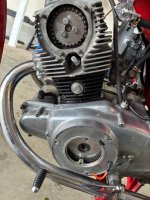
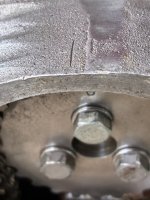
I think I found the issue. Timing. According to the CA95 manual quote: "The crankshaft spiel is opposite the timing mark". Timing mark on the cam shaft at 12:00 and timing mark at 6:00 center line. From the picture attached, I'm not there. Amazing these old engines are so robust they can run"kinda". If this bike had a computer readout, I think the code would have been ID10T. Here is a pic to prove my point.

IMG_5645 timing.jpg
Gman, may you be blessed with a rapid recovery! Thanks for your interest and tagging along!

Chip
 
Last edited by a moderator:
If the carb was from a 125cc C92 or CB92, it would be a PW18, with an 18mm diameter slide, not 20mm as the 150cc C95 or CA95. It looks like they did have the banjo bolt type inlet.
Hard to tell from the off center pic if everything is lining up on the centerline (including sparkplug hole).

Did I only imagine a test ride video? I remember wishing the rpms were higher before shifting.
 
It's hard to explain why us elders save old stuff from the heap. Maybe we would like to be saved and restored better than new. Or maybe we are simply like prospecting. The guys I bought the bike from had a scrap yard. Funny, we got along as if we knew each other for years. I asked them: Why do we fix this old stuff? The answer: I don't know, and we all burst out laughing. Could be prospecting as well and applying techniques to bring out the gem from the corrosion. Example below. The handlebars.View attachment 33440ThereView attachment 33441
There is some corrosion. Just a little chemistry, light abrasive, stainless steel rouge and a buffing wheel. I will brush plate zinc on the corrosion pits and reuse the handlebars. By the way, one other amazing thing, the bars are straight with the original controls and grips! More to come
I would appreciate your explaining this process of brush platiing zinc. Is this using one of the caswell type brush-on klits and how do you keep in the pits. Would love to try this to improve generally good wheel rims with spots of lost chrome.
 
Did I only imagine a test ride video? I remember wishing the rpms were higher before shifting.
No, it was not your imagination. I pulled the video when it dawned on me that I was on the wrong path.
" I remember wishing the rpms were higher before shifting" Bingo! I cannot get higher rpm's! If I stay at low rpms I can motivate down the lane. When I throttle up, I' dead in the water. My thoughts now is the timing is wrong. At low rpm I'm about as far advanced as possible, when I throttle up, the mechanical advance takes me too far. I plan to confirm this theory today.
 
I would appreciate your explaining this process of brush plating zinc. Is this using one of the Caswell type brush-on kits and how do you keep in the pits. Would love to try this to improve generally good wheel rims with spots of lost chrome.
Caswell is not the only company out there supplying zinc plate kits. I use Eastwood Electroplating Tin-Zinc System. Power for the brush plating is two (2) D cell battery pack. Supplied in the kit is a metal handle brush with a polyester brush against a small piece of Tin/Zinc. The brush is placed in the electrolyte solution supplied and connected to positive (anode) and the metal to be plated is connected to negative (cathode). Clean area to be plated and remove rust 1st from the pit using any commercial rust remover. Slowly brush area for spot plating. Tin-Zinc is soft so to fill pits; you have to use some kind of fine steel wool to remove it from surrounding areas. Once polished it's pretty close to the shine of chrome. The plate is thin so a little dab of clear coat after polishing is my recommendation. The kit will allow you to dip and plate parts as well!

Take all safety and precautionary measures while plating. The electrolyte is an acid blend.
 
No, it was not your imagination. I pulled the video when it dawned on me that I was on the wrong path.
" I remember wishing the rpms were higher before shifting" Bingo! I cannot get higher rpm's! If I stay at low rpms I can motivate down the lane. When I throttle up, I' dead in the water. My thoughts now is the timing is wrong. At low rpm I'm about as far advanced as possible, when I throttle up, the mechanical advance takes me too far. I plan to confirm this theory today.
I preface my findings on the fact Honda CA95's from 1959-1963 have subtle differences then those of model years 1964-1965. My engine is made up of different year parts. 1962 head, 1963 upper, 1962 lower, unknown year crankshaft & rods. Let's say for the sake of discussion, the crankshaft is from later years. The cam timing mark as indicated by the strike mark on the head, lines up with the timing mark on the crankshaft (centerline between the two). However, using my micro light looking into one bore, the pistons are not top dead center.
If I move the cam timing mark to the 12 O'clock (BTW the cam chain is still attached) then the crankshaft timing mark is not on center with the cam timing mark, and the pistons are at Top Dead Center.
Is the timing mark on the head related to the timing mark on the original crankshaft? I'm aware ignition fires before Top Dead Center. So,am I smitten by old style cam/new style crank? Here is a shot of the timing mark on the head. Hopefully it's not a mark left from nearly 6 decades of being loose and tumble.

IMG_5652 timing mark.jpg
 
Last edited by a moderator:
Timing assumed good. Tomorrow the engine comes off for a closer inspection of head & valves. Not really bad news, I had to replace the right cover gasket and a couple of new seals anyway as they leaked oil.
 
All the cranks have the keyway at TDC. All the cams line up the same. My early head does have a similar mark for centerline. When in doubt used a straight edge lining up the centers of crank and cam.
Minor changes in camshaft design would have no bearing on this assembly step.
Another pic like in post #413 with the crank keyway facing up the centerline will tell if anything is off at the cam sprocket.

Then check the firing timing, first static then running with a strobe. A 12volt separate battery needed to power the strobe.
 
Many thanks for your advice. I have the engine stripped down enough to drop tomorrow morning. I need to get rid of this nagging feeling that something mechanical might be the answer. I also get to look inside for any aluminum mud or slivers. So far, the oil is clean with some magnetic mud on the drain plug. Although the oil has nearly no miles, the bike has been started dozens of times. Pics and update tomorrow sometime.
Much obliged for your continued interest and support and thanks to all following my mystery.
 
This is a log update. I have reviewed my thread to determine date I've been fooling with getting this engine to run right. January 29, 2025.
Yesterday I began the teardown. Exhaust pipes & mufflers were stored in a corner of the shop standing on paper towels. I think I have the first clue. The muffler draining is from the right cylinder. More to come.

IMG_5654 muffler leak.jpg
 
Last edited by a moderator:
Poor engine performance is due to:
Right cylinder intake and exhaust valves leaking
Left side valves so incorrectly adjusted that I'm embarrassed.
One knock pin missing.
O ring on one knock pin not seated by head gasket
The head gets sent out to a machine shop to cut seats and valve faces.
Once the head is received back, valves to be adjusted while the engine is on the bench.
Make double/triple sure knock pin, O ring and head gasket are properly installed.

Thanks to all for your suggestions regarding carburation & timing.
In the end it was all in my head. (pun intended)
 
Last edited:
Poor engine performance is due to:
Right cylinder intake and exhaust valves leaking
Left side valves so incorrectly adjusted that I'm embarrassed.
One knock pin missing.
O ring on one knock pin not seated by head gasket
The head gets sent out to a machine shop to cut seats and valve faces.
Once the head is received back, valves to be adjusted while the engine is on the bench.
Make double/triple sure knock pin, O ring and head gasket are properly installed.

Thanks to all for your suggestions regarding carburation & timing.
In the end it was all in my head. (pun intended)
Sounds like a plan.
If you already did the seats and valves, they may not need it. After totally loosening the valve adjusters, the valves should be closed and you can leak test the head on the bench by filling the exhaust ports with gas or thin solvent, then look for leaks at the combustion chamber side. Then flip the head and do the same on the intake side.
 
Will do! I put the head combustion side up and filled the dome with isopropanol. Right side drained. Left side held volume added, But I did not back off the valve adjusters.
I will try as suggested. But just to clarify "seats & valves" I bought new valves & guides. Installed guides and reemed guide bore to match valve stem diameter.
As far as seats. I lapped new valves into old seats. I searched for a seat cutter and even bought a couple of kits without success. but frustration ruled and I just lapped the new valves into the old seats. Two major project regrets. 1.) Not sending out the head to have machinist do the valves. 2.) Not having the cylinders bored 1st thing. Additional regrets is going against my memory and setting cam & crankshaft timing mark according to how the book indicated. (or my lack of clarity) Not replacing ignition components during the build and doubting myself when setting rocker adjustments while the engine was on the bench.
I will try loosening tappets adjusters to check valves seal again.
Thanks!
 
I don't fill the combustion chamber, I fill the ports. set head on it's side. All valves must be closed, if easier to remove tappets, rockers and even the cam, then leak test.
Let's slow down and get the head done right.
 
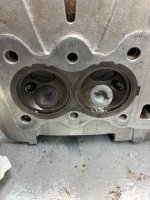
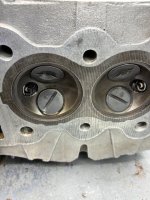
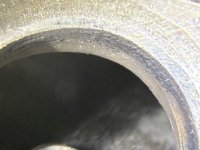
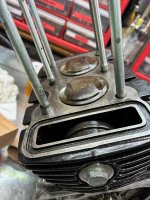
Complete as instructed. Three of four valves weep. (see pics)IMG_5660 valve weep.jpgIMG_5658 weepi.jpg Head gets shipped out Thursday for seat and valve cut. $40.00 + shipping to and fro.
 
Last edited:
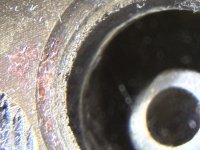
$40 is a good price for sure. Price based on stripped and clean head with loose valves. As far as the seats are concerned, I hope the machinist can resurface the valve seats. I acquired a new tool after lapping in the new valves. An illuminated magnifier. Had I seen the seats this close from the get-go I would have opted for seat cut rather than lap in new valves. I will know more in a week if the seats can be cut, or the head is kaput. IMG_5667 seat.jpgIMG_5671 seat.jpg
 
Spokes happy your getting closer to figuring it out, I am hoping this winter to go thru rest of bike and get motor in and hope I have everything dialed in correctly.
Gman
 
Gman, Keep up on your recovery and therapy and you will be good to go.
My project, that I have to remember, was beginning with the worst of the worst and creating a bike. All of the perceived frustration was back kicks for not doing the right thing off the bat but rather assemble the bike and see what happens. Hopefully by the end of July the story ends.
Thanks for following along!
 
See what the shop says when they get it there. I'm pretty sure some shops can actually replace the seats, if needed. Not sure what costs would be.
Were the valves you lapped used? I think new replacement valves are still available if the shop recommends it.
 
Fingers crossed on the seat cut. I installed valves and new guides. Head goes out tomorrow, I should know something by mid next week.
 
Well, I found out about the cylinder head today. Good news, valve seats can be cut, and new valves seated. The head is flat, so no machining needed. Not so bad news, but sadly, my- self installed and reamed valve guides are junk. Costs valve job was $40.00 per side and extra costs for guide removal, reem, reinstallation will be determined. I'm guessing an extra $150ish. Even if total costs, including shipping range around $250, the cost is better than the $400+ as quoted by another shop out west.

If I do another bike (never say never) it would have been best to send out cylinders for fresh bore & pistons and head for new valve job.

Only one caveat remaining. The crankshaft. The crankshaft, when received felt tight with some lateral movement. I did not measure lateral movement. If I recall correctly, the CA95 crankshaft cannot be rebuilt (maybe it can, and I just don't know). One nagging concern is new valves, seats & guides, newly bored cylinders with .75 over bore & new rings creates compression possibly better than new and wipes out the rod bearings.
 
Glad to hear the good news and sorry about the bad news on the valve guides. I don't have a reamer to use to measure and have only checked by feel for any that seemed, what I would guess, as being too worn. There is a discussion and drawing, in the FSM pg. 18-19, about them and the vent drilling to the intake guide. I would check to make sure that is not plugged with compressed air, just because, but I'm not sure how critical that is to motor function, maybe longevity somewhat. Compression is sealed by the valve faces and seats. The drilling is connected via a rubber tubing to the air filter.

Honda did have problems with the early (prior to 61, I think) 2 bearing cranks. ours are the later 3 bearing design and are pretty robust. I don't think your increased compression is a worry. I do think that years of poor storage and rust could cause abrasive materials to excessively wear, or even plug the oil passages that would cause problems to the big end rod bearings and center crank bearing (and cylinders, rings, etc.). The lubrication diagram on page 57 appears to only show the 2 bearing type, which feeds only from the one end. The 3 bearing type may have a center feed and distribution from there to both big end rod pins, similar to the later designs, like the 350s. This would be my major area of concern.

I have yet to clear out a 150 crank and am not real familiar with them. G-man, in the UK is the only one I know who has pressed apart a 150 crank and replaced bearings and rods. Actually, just rods I think.

Once the crank and rod bearings and oilways have been thoroughly flushed out, assessment of radial and axial wear can be measured as per the FSM discussion on pages 36-38. Without Vblocks the crank case could probably be used to check. A dial gauge would be nice, but I've yet to get one. I'm thinking the specs listed are conservative and acceptable wear limits could well be more, maybe double.

Has anyone heard of a Honda crank failure?
 
I don't have a reamer to use to measure and have only checked by feel for any that seemed, what I would guess, as being too worn. There is a discussion and drawing, in the FSM pg. 18-19, about them and the vent drilling to the intake guide. I would check to make sure that is not plugged with compressed air
Guides are new. I bought a reamer matching the new valve stems. I left my lathe and machining tools & gauges when I left Georgia, so I reemed new guides with my drill, free hand. I messed up the new guides. Sloppy guides likely caused dripping oil at the exhaust flange as previously reported.
I have yet to clear out a 150 crank and am not real familiar with them. G-man, in the UK is the only one I know who has pressed apart a 150 crank and replaced bearings and rods. Actually, just rods I think.
Thanks. I was referring to the rod bearings. The three main bearings in the engine look and feel nice.
Has anyone heard of a Honda crank failure?
Yes. Me. 2008, my first CA95 rebuild. Engine running nice, riding home from work, country road, perfect blue-sky, mid 80's Bowling Green, KY day, and back tire locks up. Pulled in the clutch and was able to bang her into neutral. My 1st cardiac stress test. 56 years old and pushed the bike 3.5 miles home without having a heart attack.
The fault was mine. Low oil.

I've cleaned and flushed the crankshaft and all oil passages in the 62. What I've learned since, being a manager in the largest Japanese bearing manufacture site, Koyo, is that rust can compromise case hardening. I still have the original crankshaft (one rod busted at the piston pin) for the 62. While I wait for parts and service, I may just dissect it to learn about the quality of the rod bearings.

Thanks again for your response!
 
The fault was mine. Low oil.
I admire your honesty.

Glad your machinist can fix the guide issue. I know that is beyond me, having done some back in my FIAT garage days.

I must admit that I do suffer from dirty crank anxiety.
I'll avoid seeking out a shop with a 20 ton press, as long as I can. I bought a set of rods on sale on ebay for a S90 (fits 160 according to G-man) but I don't know if 150 rods can be found.
Maybe your machinist has a press too. Oh boy, another chapter in the saga.
 
I may just dissect it to learn about the quality of the rod bearings.
I was able to open up (cut away) the piston rod at the crankshaft (scrap crankshaft) and have a look inside.
caged needle bearings. (likely Koyo) In this case, the rod was stiff and locked up, the needle bearings are rusty. Properly lubricated needle bearings have nearly infinite life.
Inside every automotive alternator is needle bearings. I once calculated the number of revolutions an alternator spun at 100k miles. I estimated 1 x 10^14
So, I feel better about the used crankshaft in my 62,
 
I was able to open up (cut away) the piston rod at the crankshaft (scrap crankshaft) and have a look inside.
caged needle bearings. (likely Koyo) In this case, the rod was stiff and locked up, the needle bearings are rusty. Properly lubricated needle bearings have nearly infinite life.
Inside every automotive alternator is needle bearings. I once calculated the number of revolutions an alternator spun at 100k miles. I estimated 1 x 10^14
So, I feel better about the used crankshaft in my 62,
Barring rust, grit or lack of oil, they may be almost immortal.
 
While waiting for my cylinder head return from Daves Machine, Hartville, Ohio (Can't have too many Dave's in your life) I get a chance to clean gasket surfaces in preparation for reassembly.
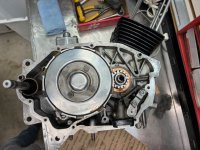
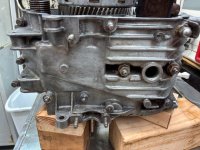
Sometimes back pedaling putting together engines from pieces parts gives an opportunity to address nagging issues. In my case, my engine dripped oil. Seems the CA95 engines (especially engines are built from mix & match parts) have a chronic seepage from the bottom gasket face, right side cover and bottom case stud bolts. Oil drain plug dripped as well, so new tight fit crush gasket(s) on order.
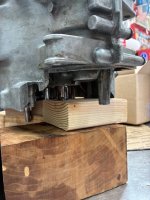
So, this time around I placed the engine on her side and cleaned matting surfaces with acetone. Case to be cleaned as well with new "O" rings at the oil filter access cover. I plan apply a thin coat of the same oil-resistant, heat tolerant, silicone gasket material on gasket before reassembly. Being that this step will be while the engine is her side, the gasket applied silicon will be allowed to cure free of oil for a couple of days. While I'm at it, I ordered new OEM Phillips head screws. I did not care much of the look or feel of the chrome hex drive screws previously used. Only the small 10mm case studs wept oil, so they get removed, cleaned and packed with the same gasket material and allowed to cure.

IMG_5715 Motor Side 7 8 25.jpgIMG_5716 motor 7-8-25.jpgIMG_5718 motor 7 8 25.jpgIMG_5717 motor 7 8 25.jpg
 
Last edited by a moderator:
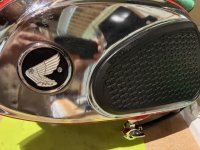
Just a couple of entries. While waiting on my cylinder head to arrive (Hopefully mid next week) I installed my new and slightly damaged tank panels. Nicer chrome, some blemish but light years better than the ones that came with the bike. As mentioned, a new right side case gasket installed with a light coat of high temp silicone sealant applied before installing right side case and new screws from eBay originally sold for the Honda 90. Small studs on underside resealed as well.

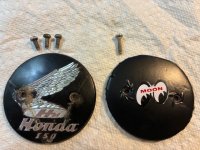
I took a chance on a couple of Asian aftermarket badges. Nice, but thicker than originals so the original JIS screws too short. Tapped out the badge JIS threads with a M3 x .5 tap and installed longer screws from my spares collection. Bagged up is my fractured, but "fixed" left side tank badge and one homemade prosthetic "moon eyes" left side badge with three (3) original JIS screws and one longer JIS screw from unknown source. Bagged up badges and screws available to good home, no charge but shipping to any forum member.
 

Attachments

  • IMG_5774 old badge & screws.jpg
    IMG_5774 old badge & screws.jpg
    105.5 KB · Views: 6
  • IMG_5748 side case screws.jpg
    IMG_5748 side case screws.jpg
    98.1 KB · Views: 6
  • IMG_5746 new side gasket.jpg
    IMG_5746 new side gasket.jpg
    113.3 KB · Views: 5
  • IMG_5765 new badge.jpg
    IMG_5765 new badge.jpg
    95.2 KB · Views: 6
Looks really nice. I can sure appreciate the amount of work it takes to polish up the previously silver painted side covers. The early toaster tank chrome panels look good too and I do prefer the pointy shaped knee pads on them over the later style. I haven't seen any reproduction rubber pads, so I hope mine last a long time. I was wondering if a plaster mold could be made then cast some with liquid Flex-seal. Clauss Studios would probably make some but they would keep your good originals for themselves. No thanks.
The metal badges are the way to go and will last a lot longer than the brittle original plastic ones. My originals cracked from me overtightening the screws so they are now in archive and metals on my rider bike. Same metal repops on my C200. I found some nice repops for my dream that the plastic was cast over a metal backer but the producer only made them for the CA77 and some other 77s.
 
I can sure appreciate the amount of work it takes to polish up the previously silver painted side covers
Thanks. One lesson learned from past builds like the 62 is the likely disassembly of the engine after completion, or oil & gas mishaps messing up newly painted engine parts.

I haven't seen any reproduction rubber pads, so I hope mine last a long time. I was wondering if a plaster mold could be made then cast some with liquid Flex-seal.
If for some reason I needed to replace the knee pads on the early CA95's I would probably cheat and have a set of slip-on covers made from roll & tuck black (or some other color) vinyl.

Thanks for the complement and response!
 
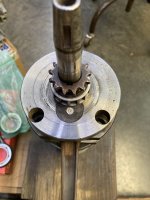
This entry is note to self and readers interested regarding TDC mark on CA95 engine crankshaft. My cylinder head with new valve guides, cut seats and faced valves should deliver back to my shop this Friday or Saturday. I wanted to absolutely, without doubt know exactly where TDC is on the crankshaft.
When the cylinder head arrives, I will post more pics of the finished product and exactly where TDC is on the cam shaft. I'm bent on making sure timing is set correctly.
In addition, I plan to adjust tappets while the head is off and comfortably and conveniently right in front me. So, IF there is some issue with this engine's performance, I can feel confident Timing and valve adjustments won't be a "could be".
1st set of pics. Crankshaft position while pistons are at TDC.
 

Attachments

  • Timing Mark TDC IMG_5833 Timing Mark TDC.jpg
    Timing Mark TDC IMG_5833 Timing Mark TDC.jpg
    2.1 MB · Views: 5
  • Timing  TDC Pistons IMG_5832.jpg
    Timing TDC Pistons IMG_5832.jpg
    1.3 MB · Views: 5
Verified. Don’t forget that the top side will be between two teeth because there are 13 teeth on that crank cam sprocket. Odd number so it has to be. The key ways for both the sprocket and the rotor are in line and are at TDC of the crank.
IMG_1708.jpegIMG_1709.jpeg
 
I would not adjust valves until the cam chain is on. I would not put the tappet screws in the rockers even, that way you can turn everything without having the valves open and risk hitting pistons.
 
Thanks, will do. My thoughts on the valve adjustments were simply the distance between the cam lobe (at rest) and rocker tappet would be fixed regardless of the head assembled or loose. My assumptions come the from vehicle assembly line and one would think this step would be done before the engine was assembled at the plant.
I will proceed with caution. My goal is to finally hit the starter button and fire up a smooth-running engine.
 
My thoughts on the valve adjustments were simply the distance between the cam lobe (at rest) and rocker tappet would be fixed regardless of the head assembled or loose.
Clearnce measured between tappet and valve stem, not at the cam surface.

My point is that you don't want any valves open while moving crank to TDC for cam chain installation. After chain is on then valves can be adjusted on the bench.
 
Clearnce measured between tappet and valve stem, not at the cam surface.
oops, that's what I meant.10-4 about chain and valve/piston possible clash while fiddling with timing mark alignment.
I will line up timing marks and install cam chain & tensioner, before tappet screws get installed, then do clearance at the tappets.
Gotta love old age. Thanks for the heads up!
 
oops, that's what I meant.10-4 about chain and valve/piston possible clash while fiddling with timing mark alignment.
I will line up timing marks and install cam chain & tensioner, before tappet screws get installed, then do clearance at the tappets.
Gotta love old age. Thanks for the heads up!
I've got CRS too (Can't Remember ... Stuff). I was going to always wear an Oring on my finger for a reminder, but I can't remember why.
 
Back
Top Bottom