Testing CB360 Regulator/Rectifier questions

Blarfnugle

Member
Joined
Jun 15, 2026
Total Posts
18
Total likes
10
Location
New Jersey
Is there a way to test the regulator rectifier without running the bike? The book shows that it should be possible but I'm getting some strange results. Following the manual screenshotted below. Screenshot 2026-06-28 012416.png

Testing continuity with Klein Tools MM325 Multimeter: No results on any of the terminals in any combination
Fwd/Reverse Bias Test/Diode Test: Each test consisted of putting the prong into the point and testing other points with the opposite prong. So 1+ means the positive prong went into point 1 and the negative prong went into the other points.

1+ : Readings on all other points, point 2 reads .886 and others read .476
2+: No readings
3+ Point 2 reads .483, nothing on other points
4+: Nothing on any points
1-: No readings on any points
2-: point 1 reads .886 and others read .476
3-: Point 1 reads .471 nothing on other points
4-: Point 1 reads .481, nothing on other points

Can someone look at my test results and let me know if this regulator/rectifier is working properly? Not sure what to make of these results because from what I read the charge should flow 1>2>3 and 1>4>3 so I'm not sure why I am getting results between points 2 and 4.

Thanks in advance.
 
The manual appears to have a typo because it doesn't make sense to connect both leads to (2) for the second test. It was also written for analog testers.

Using the diode tester setting on your digital multimeter, 1+ should give the voltage drop for each path. Note that (1) to (3) goes through two diodes, so I would expect the greatest value on that connection. I believe this replaces the "second part" of the manual test regarding continuity, where the typo occurs.

The first test I believe is reverse bias and would be 1- in your notation. This should give OL for all other terminals, still using the code tester setting.

These two tests seem good in your case.

Other tests:
  • 4+ should give a reading for (3) only
  • 2+ should give a reading for (3) only
  • everything else should be OL
Your other results seem anomalous. Can you double check using the diode tester setting only?
 
Many folks dump the separate rectifier and regulator components in favor of modern rec/reg combo units. Sparck Moto offers a compatible unit at a reasonable price, but there is no shortage of alternatives.

I just found my old rectifier and tested it. Seems to be good and matches what I wrote above. My meter doesn't automatically do the voltage reading in diode tester mode, I had to push SEL. But I think on yours it happens automatically.
 
Last edited:
FWIW, the old rectifiers were inefficient when new. They used up some of the watts you need to charge the battery by converting your output to heat. So I would recommend getting a new reg/rectifier. The newer units have less voltage drop (losses), generate less heat, and regulate a a slightly lower voltage, saving the battery from cooking. The stock regulator regulates to 15V +/- 1/2 volt. At 15.5 volts, the battery tends to get boiled and lose electrolyte. With a modern rectifier, such as Sparck's model, your battery will charge at lower RPM, regulate to a lower (14-14.2 V) keeping the battery from being overcharged. I have a little inside knowledge on Matt's (Sparck Moto) regulator, as I helped in in testing them for the market. I have one of the first ones he designed. Works great.

You can find generic regulators that work, but the quality varies. Sparck Moto's unit, while made in China, was made, tested, and built to Matt's specification. So while it looks like the other generic regulators, his is better and more consistent quality. I get no recompense or anything from Matt, his product is just good. If you want a Sparck Moto regulator, it's here: Sparck Moto
 
The manual appears to have a typo because it doesn't make sense to connect both leads to (2) for the second test. It was also written for analog testers.

Using the diode tester setting on your digital multimeter, 1+ should give the voltage drop for each path. Note that (1) to (3) goes through two diodes, so I would expect the greatest value on that connection. I believe this replaces the "second part" of the manual test regarding continuity, where the typo occurs.

The first test I believe is reverse bias and would be 1- in your notation. This should give OL for all other terminals, still using the code tester setting.

These two tests seem good in your case.

Other tests:
  • 4+ should give a reading for (3) only
  • 2+ should give a reading for (3) only
  • everything else should be OL
Your other results seem anomalous. Can you double check using the diode tester setting only?
Yep, this was some cheap regulator rectifier that I had bought before I discovered VHT and was recommended by a FB group member, I was looking at either Sparck Moto or those guys in Houston.
4+: No results
2+: No readings on any points

So based on these tests, it appears that this regulator/rectifier is faulty. Luckily I can get a refund and I'll order a proper one. That'll teach me to trust the opinions of strangers on the internet!
 
The only thing that bothers me about this is that the only way to go from (1) to (3) is through (2) or (4).

You got continuity from (1) to (3), but apparently have no continuity from either (2) or (4) to (3).
That's what I was worried about as well. The only thing I can think of is that the wiring connection is wrong.
 
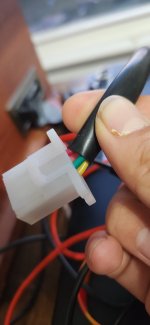
I guess it won't matter if you get a Sparck Moto rec/reg, but maybe the one you purchased is just set up differently. Does it have four or five wires? Picture?
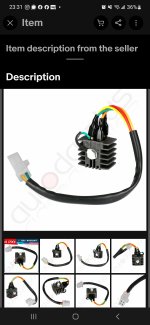
It has 4 wires, the colors of which match the Honda manual. Here are some pics i took as well as1000030018.jpg from the ebay that I bought it from. 1000030393.jpg
 
It's hard to say what the internals look like in that one. They advertise as rectifier/regulator, yet its physical appearance matches the dedicated OEM rectifier. At least it appears to have been inexpensive.
 
Back
Top Bottom