(Not so) Budget drag bike project - DOHC 450, of course

That's the chain he sent me, along with the master link. Report back how you did flaring the pins. I finally got up the nerve to put the engine into the frame, but I can't until I'm confident about the master link. Might just buy one with hollow pins, from 4into1.
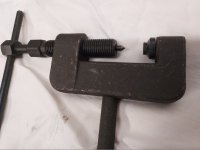
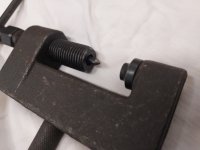
I've used a center punch and hammer, with the link backed up by a dolly or heavier hammer, and I've also used the below-average Stockton chain tool. The tip that was intended for the job didn't last, it bent quickly but I was able to put a taper on the end of the pin intended for breaking the chain to use it for flaring the pins in the previous picture.

20251010_092935.jpg

20251010_092953.jpg
 
Did that finally work on the solid pin master? The piece they call a riveter in the kit has a rounded head and seems completely useless flaring the solid pin.
 
Did that finally work on the solid pin master? The piece they call a riveter in the kit has a rounded head and seems completely useless flaring the solid pin.
AD’s setup is what I’ve used as well. If you get it squared up it flares almost too easily - a quarter turn too far and you’re starting over.

That round pin went straight to the trash for me.
 
Did that finally work on the solid pin master? The piece they call a riveter in the kit has a rounded head and seems completely useless flaring the solid pin.
I've never used one of those master links. Normally the chain comes with one and it goes in the drawer or the trash, but this chain I ordered over a year ago did not come with any master link since it was endless. And since I've never actually bought one or used one, I wasn't aware (if true) that you could/should flare the ends of it after pressing on the side plate, which would make sense except the pins seem a lot harder and I wonder just how they flare because of it. I've always used the DID master link from 4into1 (or from Honda prior to that). And yeah, that Stockton tool has some useless tips included and I only used it to break a chain once. And it sucked. Now I just carefully grind the heads off the pins on one side of the chain and then use the chain tool just to push the link pins through the side plate.
 
Quite coincidentally, I took delivery of a DID cam chain today, intended for a 175 engine rebuild. It is an endless chain, so I ordered a matching 'soft' link to go with it. It turned out to be one of the impossible solid pin masters. I can't understand those, the side plate seems very difficult to press into place, some sort of tool seems to be required. And then what, is pressing it on sufficient or do you need to push it on further then peen over the rivet heads ?

Fortunately, I have a hollow pin link in stock, which fits. They have a stepped shoulder, so you can't push the side plate on too far. I use a final drive chain tool modded exactly as Tom's photo shows, to mushroom the rivet heads.

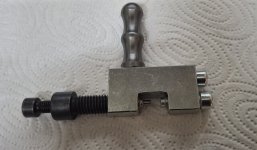
To break the chain, either when breaking an endless chain as delivered, or when fitted to the engine, I use this dedicated 219t chain breaker. It is very easy to use, tightened with an allen key, not shown in my photo here. Pushes the link pins out very cleanly, with minimal effort, and of course, no filings to fall into the engine. I bought it from a site dedicated to go karts, think some use 219t as final drive chains. I've used the tool a lot, and it shows no sign of wear, a nice tool. I've looked in vain for the original advert.

1760128979300.jpeg
 
Well, two steps forward and one step back as they say. "Borrowed" an inch-pound torque wrench from my local Auto Zone, torqued the center main bearing cap and was ready to put the lower case on. Decided to pull the cam chain out so I could rotate the crankshaft to see how the bearings felt and sounded. Ugh. Wondered about what might be wrong, so I removed the center main cap and checked everything, seemed fine. I thought about the fact that the primary drive gear was off the crank and wondered about axial play because the right cylinder crank throw (obviously the left side upside down) was really close to the main cap and the crank does shift left-right slightly because the oil filter assembly isn't on the end of the crank and tightened, which would align the end play. I even tried slipping the lower case on and lightly tightening the outer four main bearing bolts, didn't matter. It sounds perfectly fine as it rotates, but eventually hits a slight snug spot after somewhere between 8 to 10 revolutions. Before I put the lower case on, I suspected the right crank throw was just slightly rubbing the main cap but if that was true it would have felt that way on each revolution.

So, the crank has to come back out and the outer roller bearings dropped out for inspection. Oh well, after 5+ years to this point, not gonna make much difference.
 
So, you're thinking that the roller bearings may be worn more than you hoped and this tight spot is just working itself into position every so often due to the rolling around of the ball bearings in the races?
 
So, you're thinking that the roller bearings may be worn more than you hoped and this tight spot is just working itself into position every so often due to the rolling around of the ball bearings in the races?
I only visually inspected all the rollers from the two inner bearings, and replaced about eight that had small minor corrosion spots on them. Areas that could barely be felt, but I had extras so I changed them anyway. But I didn't look at the rollers in the outer bearings individually, just a partial visual by sliding the outer race partly off. Both looked okay and I thoroughly rinsed them with fresh solvent in the parts washer, then squirted some fresh oil into them. All of them seemed to roll smoothly at the time. But I must have missed something.
 
I was being a little silly here, forgetting about the rollers and thinking of a standard sealed bearing. It looks like one roller pin goes for $17 on CMS! Do you have spares?
 
I was being a little silly here, forgetting about the rollers and thinking of a standard sealed bearing. It looks like one roller pin goes for $17 on CMS! Do you have spares?
Wow, I hadn't bothered to look it up yet because I do have a fair amount of spares, but I haven't inspected each and every one of them either. IIRC there are 17 total in each bearing.
 
At least you found the problem before just running it and causing damage. Also, nice that it can come apart without dis-assembling the crank. It must take several revolutions for the one bad spot roller finds the one bad spot on the inner or outer.
 
At least you found the problem before just running it and causing damage. Also, nice that it can come apart without dis-assembling the crank. It must take several revolutions for the one bad spot roller finds the one bad spot on the inner or outer.
Yeah, later on today I'll lift the crank out and see what I see. Almost has to be one or two rollers that take a few revolutions to line up "wrong"
 
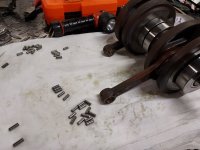
Today I learned that the later 5 speed crankshafts, along the way known for some right side main bearing problems, had the roller diameter size increased by 1mm to 6mm each on the outer bearings. I was not aware of this change aside from knowing about the main bearing issues (of which I've only seen one personally, and it sounded like an ugly growling noise). While inspecting and washing the right center bearing and the right outer bearing rollers, I briefly freaked out when there were only 16 of the outer until I compared them. I'm always amazed at how much difference in tangible size only .040" feels like. Hopefully this solves the problem.
 
That seems like a good catch on your part! I think I quoted the wrong price for these rollers, the 5mm and 6mm ones are about $3 apiece, it's the retainer pins that are expensive.
 
That seems like a good catch on your part! I think I quoted the wrong price for these rollers, the 5mm and 6mm ones are about $3 apiece, it's the retainer pins that are expensive.
Yeah, I noticed that today while looking up the differences between the 4 speed and 5 speed crankshaft rollers.
 
I went through both of the outer bearings, and the right inner bearing again, and did find a few rollers that either had dark spots on them from light corrosion due to sitting, as well as a small dark spot in the lowest part (during the engine's slumber) of the outer race for the left (alternator) side. Carefully cleaned them up, went through all of the extra rollers I had left to choose from and was lucky to find enough to finish replacing any that looked questionable. It's a good thing none of the 6mm rollers were involved because I would have to disassemble the other spare engine I have with both pistons stuck, or order new ones. I'm ready to move on.

20251015_150607.jpg
 
Interesting fact about the change to larger and fewer rollers possibly causing problems. Graham Curtis developed a kit for the 305 trans shafts that went to more and smaller rollers to overcome the chronic wear on that shaft. It seemed counter-intuitive to me to have smaller rollers with a smaller contact on their matching bearing surfaces, but the extra number of them must off-set that aspect.
It's so worth it to inspect every surface and hole on these to find the unexpected. I'm sure you'll find the culprit.
 
More progress this afternoon.

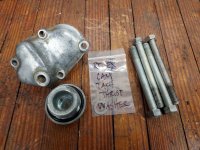
First, my care package from Chris arrived today with some of the missing parts from this assemblage of random bits - the elusive tach drive thrust washer, 4 freshly vapor blasted front motor mount bolts for the 5 speed lower case width, the right intake cam bearing and the drain plug, and he even provided a new o-ring for the drain plug too. That's the thoughtful guy he is. (y)

20251016_145020.jpg

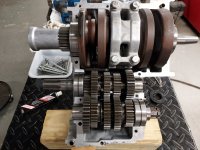
Torqued the main bearing cap, did one final visual check of everything and got out the new tube of Hondabond. Lightly slathered up the clutch rod seal and the countershaft seal, put them into place just after this pic and then put sealant on the lower case.
20251016_144314.jpg

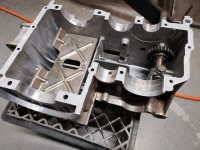
A little flash rust on the windage tray, no big deal. I used some of the phosphoric acid to clean it up previously, it was a lot worse.
20251016_151355.jpg

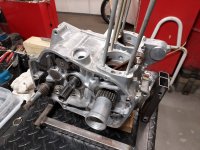
Torqued the lower case bolts (no I did not use the in-lb wrench on the 6mm bolts, just my hand), flipped it over and put the last four 6mm bolts in the top. Dragged out the engine stand Chris gave me years back and slipped the bottom end into it. Since my front motor mount plates are repainted, I just put a block of wood under the front of the lower case, plenty stable enough.
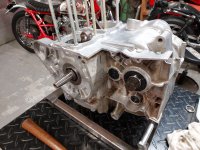
20251016_155433.jpg

20251016_155517.jpg

At long last, machinist Russ's lathe-made starter hole plug got installed. He didn't machine an o-ring groove into it, so I found one in my Dad's huge old selection of them and added a tad of Hondabond on the o-ring. Russ drilled and tapped it (1/4"-20, and when I asked him if he used a metric bolt he told me only SAE hardware in his shop, LOL). Not feeling overly trusting of a coarse thread bolt on the inside of the engine, not that it could actually go anywhere if it did come loose, I bought an external star washer for it and used a little drop of loctite on it as well.
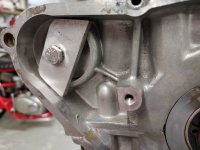
20251016_162737.jpg

I was a little sloppy with the Hondabond :rolleyes:
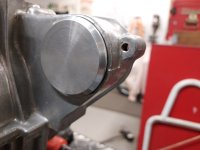
20251016_162809.jpg

20251016_162932.jpg

At that point my back told me it was time to quit. But I did snake the cam chain around the crankshaft before I called it a day. Literally forgot to do it before the main bearing cap after having the crankshaft in and out 3 times.
 
The starter plug is very nice and that's a good bit of progress. (y)
Thanks! Yes, it's starting to feel good. And the left side of the bottom end will be a piece of cake with that flat cover from Electrex. I just have to remember to remove the woodruff key after setting cam timing and later the ignition timing. Once the engine is together and off the lift, I have to put the roller up on it again and partially disassemble the front end to do some final tightening of parts left finger tight until I could see how the mods to the front forks went. I'd love to drop the frame over the engine on this one too, but after getting ahead of myself a bit with all the harness and wiring work, I'm not really in the mood to disassemble all of that. So maybe with both wheels off it will be light enough... we'll see.
 
I'd love to drop the frame over the engine on this one too, but after getting ahead of myself a bit with all the harness and wiring work, I'm not really in the mood to disassemble all of that. So maybe with both wheels off it will be light enough... we'll see.
You mean light enough without the wheels to drop the frame over the motor despite leaving the electrical, forks, and swingarm on? I guess you'd pull the fork tubes, too.
 
You mean light enough without the wheels to drop the frame over the motor despite leaving the electrical, forks, and swingarm on? I guess you'd pull the fork tubes, too.
I'd probably try without removing the forks, though it will add to the weight. Too much wiring and cable arrangement done already, shouldn't have gotten ahead of myself but I was on a roll when that stuff got done and it would only have to be done after getting the engine in otherwise. If not, I can always do it the old fashioned way, it's a short hoist from the floor to the lift surface with it fully lowered.
 
I don't want to be a spoilsport, but what keeps the O-ring in place ? I'm afraid that oil will seep through, especially when there is a little pressure difference between the inside and outside of the engine. An O-ring has be be kept in place by a groove, from one, or both sides.
 
I don't want to be a spoilsport, but what keeps the O-ring in place ? I'm afraid that oil will seep through, especially when there is a little pressure difference between the inside and outside of the engine. An O-ring has be be kept in place by a groove, from one, or both sides.
I'm counting on the Hondabond on the o-ring will help it seal, and the bolt is tightened enough that the o-ring is compressed to about half thickness. Easy enough to fix later if necessary.
 
Thanks! Yes, it's starting to feel good. And the left side of the bottom end will be a piece of cake with that flat cover from Electrex. I just have to remember to remove the woodruff key after setting cam timing and later the ignition timing. Once the engine is together and off the lift, I have to put the roller up on it again and partially disassemble the front end to do some final tightening of parts left finger tight until I could see how the mods to the front forks went. I'd love to drop the frame over the engine on this one too, but after getting ahead of myself a bit with all the harness and wiring work, I'm not really in the mood to disassemble all of that. So maybe with both wheels off it will be light enough... we'll see.
The last couch here had removable cushions that now live in the Honda hauler van for just such an occasion. Laying the bike over the engine with it raised on the cushions a foot or so then gradually lowering down around engine. The next 350 job here will get that treatment.
 
Did a few more mundane tasks yesterday afternoon, final gasket surface cleanup on a number of parts, gathering more loose small parts as the needs arise (knock pins, circlips, washers, etc) and slipped the shift shaft into the lower case. My straightening effort on the bent shift shaft was almost perfect, slid right through the lower case with no issues. Hopefully the tiny spot on the shaft near the sealing surface, caused by the effort to straighten the shaft, will seal properly after my extensive filing and polishing of the area. Managed to get the challenging little circlip on the shaft and into the groove outside the large flat washer without (further) distortion of the circlip, they can be a PITA.

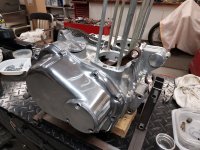
Then I just had to slip the covers on the bottom end to get a couple of pictures that have only been in my head so far.

20251018_163508.jpg

20251018_163539.jpg

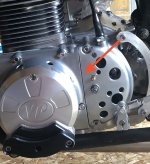
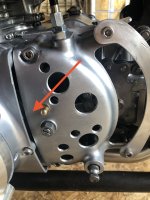
The only "design flaw" in the Electrex flat cover is that they made it the exact shape of the gasket surface and it doesn't mate to the front sprocket cover well at all, leaving the less than desirable visual gap between them. I suppose I could fab a sheet metal plate to go over the two screws in the top and bottom rear of the Electrex cover to span the gap, but I'm not sure the effort would be worth the bother. I suppose I could also come up with a replacement clutch lifter mechanism with a lever and revised cable attachment point, but I'm not sure that is worth the bother either.
 
If the gaps were to save weight, why didn't they just lop off the starter motor mount too and make some flat block off plate and recommend lopping off the corresponding parts on the cases?
As you said, probably not worth the bother.
 
But, what were they thinking? How do they expect someone to use this without it looking sort of misshaped? It would be interesting to have their answer.
 
I'm counting on the Hondabond on the o-ring will help it seal, and the bolt is tightened enough that the o-ring is compressed to about half thickness. Easy enough to fix later if necessary.

If it starts leaking, you could use a hose clamp to keep the O-ring in place. It's not a perfect solution, but will have the same effect as a O-ring groove.
 
If it starts leaking, you could use a hose clamp to keep the O-ring in place. It's not a perfect solution, but will have the same effect as a O-ring groove.
If it happens, I'll do a better repair than that. As we say here in the US, I'll cross that bridge when I come to it. And in this case, IF I come to it.
 
But, what were they thinking? How do they expect someone to use this without it looking sort of misshaped? It would be interesting to have their answer.
It's really only intended for race engines Bob, and many probably use a different clutch lifter mechanism as well for less weight and to make it easy to get to the front sprocket at the track too, so with both of those thoughts in mind they designed it for minimal size/weight without stock engine cosmetics being considered.
 
Got a few little things done yesterday afternoon, too many trips to the store and doctor appointments lately keep interrupting my flow along with the usual seasonal household needs.

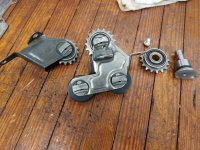
Cleaned up all the cam chain guides and rollers, had a couple of sets to work with so I chose the better combination after a thorough cleaning. Had to dunk one of them in Evaporust for a while to get it cleaned up, then a solvent bath, dry and a little lube for now. I've had the cylinder head covered after getting it back from Schumann and had to check to be sure the upper guide sprocket in the top of the head was actually removed, first time I've had one of those out in a long time.

20251022_163146.jpg

And I forgot how much fun it can be getting the shift detent rollers back in place

20251022_163052.jpg

Blew all the oil passages out with air again to be sure as well. Almost time for the clutch and Jay's very first 450 oil pump to be installed.
 
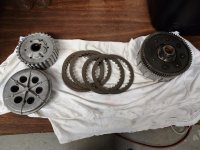
Continuing the crawl to assembly. Washed all the clutch parts separately in a drain pan to keep the new solvent in my parts washer clean for the top end parts. Steel plates will need a little cleanup but otherwise look good, fiber plates had a few funny spots so a new set is on order.

20251025_141223.jpg

20251025_153706.jpg

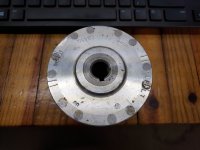
I have a couple of rotors, chose the more damaged one to use strictly for the timing marks and I need to make an index mark on the Electrex crankcase cover. As with so many of these parts from the one engine, it's been badly abused and essentially ruined though this view doesn't show much.

20251025_144146.jpg

20251025_144343.jpg

Just lovely. I wonder what they thought the unused threaded area in the center of the rotor was for when they removed the bolt....

20251025_144259.jpg

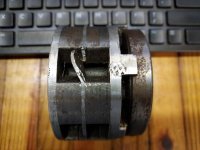
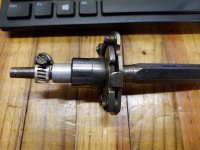
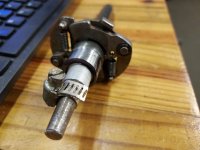
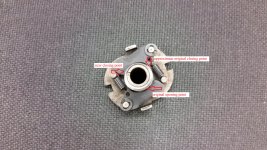
And on an entirely different topic, since machinist Russ is 70 miles away and I do not have any equipment even close to what I really need, I rigged something to help me more properly hold the advancer to trim some off the backside of the cam lobe so the points close sooner. It's amazing how much time you can spend just looking for a few bits in all of your junk stuff to put something together. I had nothing close enough to the diameter of the center of the advancer, so a drift punch's taper was the best fit and I had to hold it tightly in place with something... looks prehistoric but it should work for what I need to do.

20251025_153555.jpg

20251025_153621.jpg
 
So your goal is to steepen the backside of the lobe to increase dwell at high RPMs?
Yes, increased dwell is the goal of course and it's more like flatten the backside of the lobe, I did a less pretty job of it on the advancer for my red 450. I learned this from a Gordon Jennings article back in the '70s.

breaker cam.jpg
What tool(s) will you be using? Dremel? File?
It's fairly hard steel and a file would work but take quite a while (and my hands and wrists have had enough lately). As long as the tapered drop-off on the lobe is smooth enough so it won't excessively wear the heel of the points, the surface where you remove the material doesn't have to be perfectly smooth because the points don't touch it during rotation. I'll use the bench grinder with a decently square-edged wheel and then file the closing ramp smooth like I did previously, and though the work was hand-held and a bit crude last time it doesn't wear the points on the red 450 at all (or no more than it did in original condition)
 
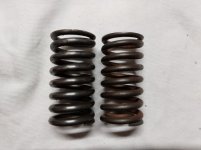
Learned something new today. Checked both the 4 speed and 5 speed FSMs for clutch spring specs, but the K0 manual only talks about measuring the tension of the springs at a specific length (26.5mm) but unfortunately that is not the full length measurement of the relaxed spring, and no specs for new and serviceable limit. The 5 speed FSM has a length spec but the 4 speed and 5 speed springs have unique product codes so they are different. Having never paid any attention to them side by side before, I discovered that the 5 speed springs, while almost exactly the same length overall (some of my 4 speed springs measure slightly shorter than others) the 5 speed springs are made of thicker wire and a simple squeeze test tells me they're a tad stronger. So the light bulb came on and I figured I'll use two 5 speed springs opposite each other along with the four best 4 speed springs (or four 5 speed springs with two 4 speed if that isn't enough). In the past I've used a couple of spark plug washers over the posts on two opposite springs to add a little extra pressure to the 5 speed clutch, but this should render that unnecessary.

20251029_153420.jpg

The new EBC fiber plates arrived today and the combination should be up to the task.

20251029_133643.jpg
 
I'm still amazed at how good this crankshaft looks (hope that doesn't jinx it). Last time I saw small ends that nice was a long time ago, pretty sure the red 450's crank isn't this nice.

20251029_172900.jpg

Best I could get on this one, damn auto-focus. But it looks damn near as nice as the first one. I did clean up some extremely light rust stains in both with some worn 600 paper

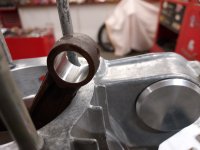
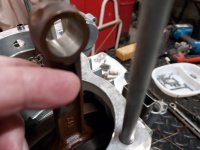
20251029_173237.jpg

And the amount of rod tilt

 
I'm still amazed at how good this crankshaft looks (hope that doesn't jinx it). Last time I saw small ends that nice was a long time ago, pretty sure the red 450's crank isn't this nice.

View attachment 51635

Best I could get on this one, damn auto-focus. But it looks damn near as nice as the first one. I did clean up some extremely light rust stains in both with some worn 600 paper

View attachment 51636

And the amount of rod tilt

you're a lucky man !
 
Wow, that seems really good. Almost like new? Is there a worst position, like 1/2 way between TDC and BDC?
Seems pretty much the same all around. The engine allegedly only had 3000 to 4000 miles on it and as you've seen along the way, many parts from it seem to show it's true. I sure hope it works out as well in practice as it does in theory, but I do know it will have plenty of oil available.
 
Once I installed the rotor I installed the outer cover. This will fill in those gaps you see at the junction between the front and rear covers.

IMG_7975.jpeg

However, there’s no free lunch in this case. The thickness of the ignition plate will now leave a gap in the depth of the two surfaces as below.

IMG_7972.jpeg

For me, it’s not about aesthetics so I don’t much care. For others, maybe it’s different.

Great post and some really nice work.
 
Once I installed the rotor I installed the outer cover. This will fill in those gaps you see at the junction between the front and rear covers.

However, there’s no free lunch in this case. The thickness of the ignition plate will now leave a gap in the depth of the two surfaces as below.
Yeah, except I won't be reinstalling the rotor permanently, I'm running total loss ignition on this to be able to remove the rotor, stator and other unnecessary weight. And the removal of the rotor lets the engine accelerate faster too. I bought a big battery to handle an evening's run time without the charging system, same thing I did back in the '70s very effectively. I'll probably just put up with the mismatched look, most will be too busy looking at the stub of the crankshaft sticking out and rotating anyway. The 4 cylinder guys who remove the electric start on the later engines that don't have kickstart use a large hex nut bolted to the end of the crankshaft so they can use an external starter motor to get the bike running, I won't need to do that.
For me, it’s not about aesthetics so I don’t much care. For others, maybe it’s different.
Yeah, pretty much the same here. I know the crowd at the track in Clearwater pretty well, they'll all be expecting the bike to be slow because it's a small engine with ancient 2 valve technology so they'll be plenty busy nit-picking lots of other areas, same thing happened when I ran my red bike there in 2019. :rolleyes:
Great post and some really nice work.
Thanks very much. It better turn out halfway decent for all the years I've spent gathering stuff and waiting to finally put it together.
 
View attachment 51182

The only "design flaw" in the Electrex flat cover is that they made it the exact shape of the gasket surface and it doesn't mate to the front sprocket cover well at all, leaving the less than desirable visual gap between them. .
Since this discussion reared its head again and since aesthetics DO matter a bit to me AND since I do seem to have more than enough old sprocket covers, I’ll add to my list the small project of making a more “streamlined” cover for you. Only caveat is I‘m reluctant guarantee when I might get such a thing done. But I am adding it to my list nonetheless!
 
Last edited:
Since this discussion reared it’s head again and since aesthetics DO matter a bit to me AND since I do seem to have more than enough old sprocket covers, I’ll add to my list the small project of making a more “streamlined” cover for you. Only caveat is I‘m reluctant guarantee when I might get such a thing done. But I am adding it to my list nonetheless!
That's an awesome offer Chris, I really appreciate it. Despite a fair amount of progress recently, it will still be a while before I'll need the cover.... so you're saying there's a chance... 🤣🤣
 
Bit of a learning experience that I must confess to on the new oil pump. My pump is the first one Jay built and I've had it waiting for this project far too long, as evidenced by the age of this thread. So a week or so ago when I pulled it out of the plastic bag I put it back in after taking the installation pictures back then, I did not give one thought to long term protection for it. It had light oil in it and I simply bagged it back up, put on top of my father's old toolbox (staging area for the drag bike hardware, LOL) and didn't touch it until recently. I failed to realize that the gears would still corrode inside the bag when given enough time in Florida humidity, even in my much-better insulated garage. As a result, I had to disassemble the pump and try to scrape all the deposits and resulting "burrs" out of the teeth, and it still turned really hard with tight spots in places. So, Jay sent me a fresh set of 2nd gen gears and I just reassembled the pump with the new gears. These gears seem to create less foaming action in the oil too, so overall it's a win-win but this should be a word to the wise for those who buy his pump for future projects. Take the time to run something thicker and clingier through the pump if you plan to let it wait for a while, and wrap it up better than just a loose plastic bag around it like I did.

20251119_143850.jpg

Oh, and the pump ran in that oil for well over 10 minutes at medium speed on my drill with that little foam in it.
 
Another lesson learned about finding/having a trustworthy machinist... just as Chris Schumann discovered that the "machinist" who cut the seats excessively on the used head I got from him (along with other mostly useless parts acquired sight unseen based on trust at the time, poor move on my part) causing the valves to sit deeper in the head than he expected, which required him to make a second set of titanium valves for me, along with the fact that the guy bead blasted a dirty head so blast media was stuck in the goo in cracks and crevices and had to be scraped out by hand.... now I find that the blast media also roughed up the machined openings in the head where the cam bearing covers fit. I went to fit the cams in place and found that the bearing covers had to be forced into the head, and a couple of them were tight enough that I didn't get them all the way in flush or I would have needed to hammer them back out. It's a deal I wish I'd never made to get rid of my V65, and every time I find something else wrong or useless as a result of this parts/labor/cash deal I made for the bike it makes me sicker about it. And of course, now I have concerns about the cylinder boring he did for me as part of the deal.... good thing I have a spare set of cylinders I can send to Nixon to get done right if need be.

No pictures to show of it, just had to carefully use some worn emery paper to smooth the roughed up areas so the bearing covers fit the way they should now. I guess I'd better wash up those cylinders and get a close look at what kind of job he did before I get too much further or there will be yet another delay for remedial machine work. Thankfully I'm about out of bad things to discover in this hodge-podge of pieces being cobbled together, all the rest of the parts are well known to me and from good sources. *sigh*
 
Last edited:
Back
Top Bottom