No headlight, errant brown wire and 11 volt

Windmill John

Veteran Member
Joined
Jun 4, 2022
Total Posts
793
Total likes
351
Location
East Sussex, England
Different bits in the title, but 11 volts on brown wire is possibly bothering me more than headlight.
Right, clarity… Just wanted to check electrics, connected battery, all other lights and horn good.
Headlight not working. No feed to wires feeding headlight plug. I’ll be checking left hand switch gear.
But whilst staring in the bowl, I noticed a loose brown wire. Tested it and giving 11 volts with ignition on and black test lead to earth.
During the rebuild, I had cleaned all the contacts I could find. The brown wire is slightly thinner gauge than the browns in the white block it goes to.

I’m going to settle down with a circuit diagram, but in the meantime, on the off chance 🙄😊 hoping someone might shed light on the wire.
11 volts, I’m guessing voltage drop. Battery across terminals is giving 12.3 volts; I will charge later, but that’s enough for testing.
Battery positive to engine block still gives 12.3 volts. Is there some secret earth point hiding…
.
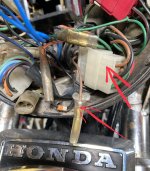
IMG_0341.jpeg
 
The brown in the headlight bucket is just a spare. Brown = running lights. In some jurisdictions they were required to be “always on” and they’d run through that circuit - same as the taillight.

11 volts is mildly concerning. What’s the thru-switch output in the white and blue to the headlight?
 
Obviously I’m in the UK, but the front indicators are on with ignition; American import I’m happy to leave as is.
I need to get into the handlebar switch. There is no power to the white or blue at the bulb contacts.

The only browns I could see in the Clymer was CDI; we’ll ignore that. And parking light. Rear light did come on in the ‘P’ position; not sure if headlight side should come on but it didn’t.

Yes, 11 volts… I checked a couple of contacts in the headlight bucket with black lead to earth and got from 10.8 to 11 volts.
Luckily I closed my eyes and blocked it from my memory 🙄
 
The headlight brown wire is a switched off the ignition switch spare as Pete noted. You have an issue with something causing that low reading, as you should be getting close to battery voltage on all circuits. Start by probing other 12VDC circuits for a voltage spec. Check the taillight and the power to the coils etc.

Check your main ground cable from the battery to the frame area and make sure you have a good ground to start with off the battery.
 
Thanks to you both.
As part of the ‘getting it running’, I did:
Removed and cleaned up main earth connector to frame.
Removed whole back end to clean and paint mudguards, which involved disconnecting all wires there, cleaning.
Coils were removed to access valves and this gave me the opportunity to clean the earth contacts there.

Next time I’m in the shed, I’ll go through all connectors again, probing voltage and checking.
Maybe when I check the ‘L/H’ switch in the bars I’ll discover something.
When I was in the headlamp shell the first time, I disconnected all connections, lubed and cleaned.

Yes, I want my 1 volt back!
 
Obviously I’m in the UK, but the front indicators are on with ignition; American import I’m happy to leave as is.
I need to get into the handlebar switch. There is no power to the white or blue at the bulb contacts.

The only browns I could see in the Clymer was CDI; we’ll ignore that. And parking light. Rear light did come on in the ‘P’ position; not sure if headlight side should come on but it didn’t.

Yes, 11 volts… I checked a couple of contacts in the headlight bucket with black lead to earth and got from 10.8 to 11 volts.
Luckily I closed my eyes and blocked it from my memory 🙄
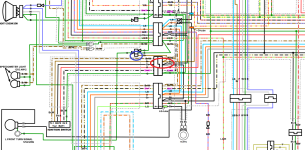
More than likely bad grounds (unless the battery is just undercharged) - just as an FYI - there's a separate brown circuit from the ignition switch that runs straight back to the taillight (red oval), your dead-end end brown is the blue circle.1781717866863.png

That switch connector on all of my CX's and GL's (basically same exact wiring layout) was an issue.
 
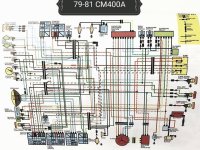
Thanks Pete. I did search for a colour diagram for mine, but no go. I did, in 2021 whilst furloughed, colour in a black and white CX500 wiring diagram. It’s still on the CX site.
 
Assuming this machine is wired "lights on", all the time, power from the electric starter switch is fed to the dimmer switch via the brown/white wire. When the start button is pushed, the lights go out and power is shunted to the starter relay (yellow/red) to crank the engine.
 
Last edited:
Okay, I’m afraid a little confused here.
12 volts both sides of headlight fuse.
I did a continuity test from the three wires in the handlebar light switch and got continuity to the three other ends in the headlight shell.
Just as an aside, I connected power from battery straight to the blue connector then the white connector on the headlight and headlight lit both low and high; that was using the earth from the headlight.
I’m still in the shed looking into it, but not sure where next.
 
Sorry Pete, won’t be able to check until tomorrow afternoon. I’ll fill in here once done.
I’m not scared of electrics, just struggle with them!
Looking at the wiring diagram, I guess as the yellow/black at the handlebars comes from the fuse, I should get 12 volts between that and earth.
Then that leaves via either the blue or white to the headlight and I should get 12 volts on either depending on switch position.
 
Okay, I obviously made a Mistake at some point as I’m sure I got 12 volts either side of fuse as per Jim; not now.
So, embarrassing myself with not thinking of checking power to switch, sorry Pete, tests as follows; only had short time in shed.
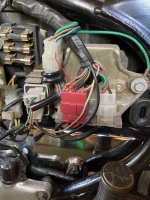
Only 0.6 volts at yellow/black at handle bar switch. Tracked that into headlight, 0.6V. Tracked that to red block as per picture, 0.6V. Tracked that to back of fuse box, 0.6V and 0.6V on the red/black wire other side of fuse.
I have to go out now, but will continue later.
Jim/Pete, I see the red/black goes to starter button as alluded by Jim, sorry. As bike cranks, I was hoping not to pull that switch apart, but hope that there is access to get to red/black to circuit test.
I guess I can initially test it in headlamp shell.
IMG_2026-06-19-084706.jpeg
 
Just continuing from above as I got in the shed. Forgive me if I’m jumping around or giving red herrings.
I tested continuity from headlamps shell to fuse. All good. No idea why I did this as I’d already checked voltage.
I decided to check red/yellow at starter relay and got that same 0.6 volt.
Where do I look next!?
In my naive ignorance, if:

  • The red/black and red/yellow show 0.6 volts, is the feed to the starter button the black one? (Guessing here)
  • Could there still be a break physically in the starter button switch?
  • Something else?

Thanks again in advance.
 
Hold up - which side are we trying to troubleshoot here? Or what condition? The thread subject is a headlight, but is this a no crank/no start issue? If it's a no crank/no start there's a whole slew of things on the safety interlock side of the starter relay on the 400A. Is this a new issue?
 
No, no new issue, bike turns over fine, still headlight.
I knew I’d probably introduce the incorrect thing.
Maybe I’ve gone in the wrong direction. Electrics or electric routing (read wiring diagram) is still a struggle.
I was just trying to see where power came from for the headlight.
Just a recap if I recall correctly:

Only 0.6 volts at yellow/black at handle bar switch. Tracked that into headlight, 0.6V. Tracked that to red block as per picture, 0.6V. Tracked that to back of fuse box, 0.6V and 0.6V on the red/black wire other side of fuse.
I understand and I might be wrong, but the other side of the starter button is red/yellow? I put my meter black lead on battery negative and red lead on the red/yellow at the starter relay and still red 0.6 volts. As mentioned I may be going off piste.
 
One of your switches may not be switching the battery voltage correctly or is intermittent.

I would go to the black wire on the horn if you have battery voltage there with the ignition on then your ignition switch is passing the voltage to the black wire

Then for the headlight and starter the black wire goes to the right handlebar switch and passes voltage base on the starter push button, button not pushed should send voltage to fuse through Black/Red and leaves the fuse as Black/Yellow

if your push button is dirty or broken then it might not be passing the voltage correctly even in the not pushed position.
 
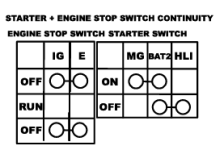
That may be the right model but the button logic for the Starter button is not what mine says

1781906572558.png

Bat2 in the incoming voltage on the black wire and it is applying the power to either the Starter solenoid or the Headlight circuit.

In the other diagram you can't cross the black/red and the yellow/red
 
Come on you two, sort it out, I’m in a crisis here 😉
The starter button feels fine, but appreciate that might not apply to the wiring.
I guess what I’ll do first is, open the switch and check for 12 volts on the black. If no 12 volts there, then start from scratch.
All help very much appreciated.
 
Eureka!!! I have light!
Thanks for all pointing in that direction. Dirty contacts in starter button.
I‘m embarrassed… if someone else said to me, my car/bike doesn’t start, lights don’t work etc and the vehicle is over 10 plus years old, my first comment is check your earths. In this case it wasn’t earth but dirty contacts! I should have known.
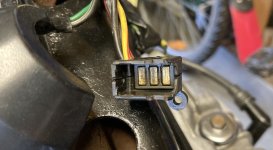
Once I confirmed 12 volts on black and checked continuity on the other two wires back to the headlam bucket, it was time to open the switch. You can see what it was like in the picture.
One last job… I said 12 volts above… Actually 11.5… More backtracking and contact checking 🙄
Thanks again Jim, Pete, David, Mike and esmith250624
IMG_0346.jpeg
 
Come on you two, sort it out, I’m in a crisis here 😉
The starter button feels fine, but appreciate that might not apply to the wiring.
I guess what I’ll do first is, open the switch and check for 12 volts on the black. If no 12 volts there, then start from scratch.
All help very much appreciated.
There is zero need to open the switch without testing throughput first. This can be tested at the block inside the headlight bucket.
 
I had tested it earlier. I think I just got myself confused. In hindsight, obviously black to yellow/red was fine as bike cranked.
But the carbon/muck build up was sufficient to totally stop the black to red/black connection; if I recall, there was 0.6volts.

Anyway, now resolve and thanks again. I didn’t realise how simple the design was/is. Power to headlamp, the default position, then power to starter (relay) when button pressed. Some newer bikes use relays etc to cut off headlight, but what a simple elegant way used here.

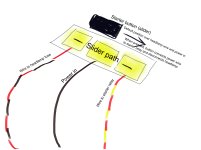
For any simple people like me 🙄, here’s a ‘diagram’ of the starter button wiring! Admins please feel free to delete once you’ve finished laughing.
IMG_0801.jpeg
 
Good to hear that you found it. Yeah you may still have some voltage drop in your wiring system. The ignition key switch comes up alot on here as a contributor if all other fitting are checked and cleaned. There are ways of testing to verify before disassembling the ignition switch. You said you wanted your 1 volt back,
 
Confused of Worcester here, late to this thread. Does your CM400 have the headlight on ( day time running light ) all the time ? If so, I'm assuming it's an import ? UK bikes didn't have this, did they ? For example, my 1999 CB600 still has a lighting switch, none of the later legislative complications.

Or is for when the engine is cranked with the headlight switched on ? I must try this on the CB600, turn the lights on then try starting the engine, see if lights turn off when starter is operated. I know it has switches on the clutch and side stand, along with a diode in the fuse box, so that it won't crank if in gear or side stand down without pulling the clutch lever. And yet my 175's manage without all that complication, or warnings not to drink the battery acid.
 
Yes, it’s an import.
It’s a very simple design I discovered. You read about relays involved to turn off headlight when cranking, but this design is elegant in its simplicity. As you can see from my CAD designed diagram above, ahem, the yellow areas are the brass contacts. The slider is the size to cover two of those contacts.
So, at ignition on and also the default slider position, the power in wire and headlight circuit are connected; so yes, headlight on with ignition on.
Then, when you press the starter button (contact slider) it just moves off the headlight circuit, breaking the circuit and connects power in wire to the starter circuit.

I’m so pleased I opened the switch and learned a bit more. Yes I can rebuild a carb blindfolded, but electrics are still a stretch.
 
Right, just to finish this thread and another example of why I’m not the sharpest tool in the box at times; too many times!
I gained a little more voltage after a better cleanup of the paint by earth connector near the CDI and the one earthing the electrical components chassis under the left cover.
I decided to disconnect the headlight rather than drain the battery whilst testing. I gained power at the rear lights. It was at that point I woke up and remembered this is an American bike! Electrics 101, all voltage is used up in a circuit. It has running lights! The rear light is on at ignition, so is the headlight; so are the indicators. I disconnected the headlight, then the rear light, then one of the indicators and I was up to just over 11.5 volts. That’ll do I told myself 👍
I knew some of this theory, just struggle sometimes putting it into practice.
Just for clarity, this 11.5 volts was in the headlight bowl, not at battery. Battery was over 12.3 volts.
 
Back
Top Bottom