need advice: big bore kit on Honda 125

Paul F

Veteran Member
Joined
Jun 2, 2020
Total Posts
240
Total likes
43
Location
Amherst, MA
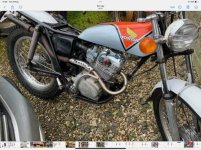
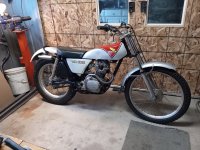
i'm considering a teardown and refresh of the '75 TL125 engine and along with it a "big fin" overbore jug, piston, rings, etc. available from the UK from eBay seller colin lee from AV TAYLOR LTD, newcastle upon tyne.

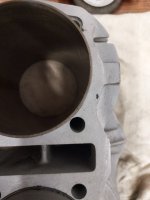
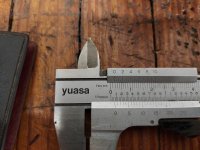
my question is about the wall thickness of the skirt and how thin is too thin? the stock bike has a 3.75 mm wall skirt. the options include boring the cases to 68mm MAX from the stock 63.5 (see pic from eBay)
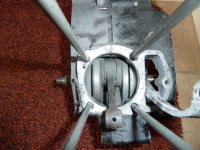
68mm case bore top view.jpg

after the case if bored to 68 MM, a 150 CC jug will give me 3.5 mm wall thickness, a 175 CC jug will have 2.25 mm skirt wall thickness and his 190 CC jug will have only 1.25 mm skirt wall thickness.
the 150 will have best longevity and future maintenance options, but will the 175 skirt wall be too thin?
 
The thicker the wall the better as far as cylinder distortion goes, meaning out of round and taper, in the long term.
If building a grenade motor then go with the biggest bore knowing it's a grenade waiting to go off. :ROFLMAO:
 
The 1979'-84' XL125S engine cases came with the cylinder spigot size of 70mm(they used the same cases from the XL185S but engraved the XL125S eng.# into them)which allows the use of the 63mm OEM Honda XL185S piston and jug or you can install an XR200R piston(65.5mm stock)and cylinder,then install an XL185S crankshaft which has an 8.2mm longer stroke which will give you a 'stock' size XR200R.
I have an 82' XL125S bottom end(the 79-84' XL125S has a 6 speed transmission too ! )which I've installed an XR200R top-end and XL185S crankshaft and this is in my 81' Honda CB125S road bike :)
 
Last edited:
i've heard of this being done. for trials they suggest using 2nd gear from the TL case.
 
I have parts. I like to hunt Ebay for a complete 79-84' XL125S bottom-end.
 
Last edited:
do the heads on the 70mm bore cases have a top mount to the frame or a rear mount like the TLR200?
 
do the heads on the 70mm bore cases have a top mount to the frame or a rear mount like the TLR200?
Those are all rear mount.
I made a mount that extends back to that rear mount by welding pieces of flat steel to my stock upper engine/coil mount. The frames also have a rear-most bolt hole which is open;I use it to give the stronger engine extra support and it helps stiffen the frame for better handling.
 
yep, i think that would be too much change for this bike. they were only sold here from '73-'76 and the one i have is in pretty good condition so i don't want to re-engineer it too much.
the wall thickness of a stock liner with a 1mm oversize piston is 3.25 mm, so i may use a 61mm bore jug with 68mm OD liner and have 3.5 mm wall with future bore
possibilities. that way i can keep my stock head with top mounts, correct carb intake angle, stock snorkel and air box/ side covers and increase cooling with the big fin 150cc jug.
 
yep, i think that would be too much change for this bike. they were only sold here from '73-'76 and the one i have is in pretty good condition so i don't want to re-engineer it too much.
the wall thickness of a stock liner with a 1mm oversize piston is 3.25 mm, so i may use a 61mm bore jug with 68mm OD liner and have 3.5 mm wall with future bore
possibilities. that way i can keep my stock head with top mounts, correct carb intake angle, stock snorkel and air box/ side covers and increase cooling with the big fin 150cc jug.

I understand you not wanting to overstress the engine too much, but when it comes to Honda cylinder sleeves you can safely go further than most would believe. I've run (the hell out of) 2 DOHC 450 engines overbored 4mm (S-16) from 444cc to 497cc, both with 12.5:1 and 11.5:1 compression ratio respectively, and both were/are incredibly reliable.
 
do you know what you were left with for a wall thickness on the sleeve skirts?
 
I remember long ago TOOLS1 saying a 2.5mm wall thickness was more than plenty, I quoted him in my thread about the idea of a big bore CM450.
 
I remember long ago TOOLS1 saying a 2.5mm wall thickness was more than plenty, I quoted him in my thread about the idea of a big bore CM450.
i was looking through that thread yesterday but didn't see that. thanks for mentioning it.
i'm going to research the case bore size of an early 70's cb450 that ancientdad mentioned and figure 4mm overbore to calculate wall thickness in that instance.
 
do you know what you were left with for a wall thickness on the sleeve skirts?

I've never bothered to measure the thickness, but the eyeball test says it's at least 2 to 3mm. I know that virtually all of the ring-compression taper is gone. I have a set of cylinders bored 4mm over waiting to be used on my drag bike engine, if I have time this weekend I can measure them.
 
When a CB750 is over bored to 836cc it's a 4mm overbore, I understand that does away with most of the taper at the sleeve bottoms.
That's 61mm stock 736cc and 65mm at 836cc 4mm over.
 
I have a set of cylinders bored 4mm over waiting to be used on my drag bike engine, if I have time this weekend I can measure them.
from what i am seeing online, 4mm overbore has been common on the cb450 since the 1970's, and the dimension i'm seeing for cylinder liner OD is 77mm leaving a 1.5mm wall thickness.
it would be interesting to learn what you actually have there ancientdad.

if what i am reading is correct, it should be ok for me to go up to a 175cc 63.5mm piston in a 68mm OD liner leaving 2.25mm wall thickness. :unsure:
 
Really? 2.25mm = 0.088" is thick enough?

I just looked up stock CB750 sleeve OD to go with the figures I added above, 65mm bore for 836cc, stock Sleeve OD is 69.5mm.

So yes 2.25mm wall thickness, and on a CB750, 836cc is considered a reliable combination, not radical in the least.
 
from what i am seeing online, 4mm overbore has been common on the cb450 since the 1970's, and the dimension i'm seeing for cylinder liner OD is 77mm leaving a 1.5mm wall thickness.
it would be interesting to learn what you actually have there ancientdad.

if what i am reading is correct, it should be ok for me to go up to a 175cc 63.5mm piston in a 68mm OD liner leaving 2.25mm wall thickness. :unsure:

Had a chance to go check those cylinders. I'm well below average at reading precision instruments, but I believe it's .065" (1.651mm). While it is thin, keep in mind that my red 450, which is run hard 75% of the time I ride it and went through 5 days in a very hot October around the property of Barber at sometimes walking speed due to traffic, has 3000+ miles on the 4mm over top end with a set of cylinders done exactly as these and all is very well.

20230903_125728.jpg


20230903_125914.jpg
 
thank you for that AD! (y) this is encouraging news indeed.
so i guess a 2.25 mm wall thickness is not too extreme after all, considering this is a trials bike usually run at low speed, low rpm.
the additional fin depth on the new jug might also reduce distortion on the cylinder sleeve.

the eBay seller sent me this pic.

big fin TL125.jpg

and the stock honda jug.

small fin tl engine.jpg
 
I also thought about the stroke on that engine, can't recall if it's oversquare like the other small singles and most of the twins if not all. The stroke on the 450 is 57.8mm so significantly oversquare, meaning less time the piston skirts spend deep in the sleeve where it's thinner so if the 125 is also fairly oversquare that will help too.
 
Paul F.,what brand of high performance piston have you decided to run in your TL125;will you be using this Trials bike for Trials riding and slow maneuvers such as climbing very steep obstacles ?
 
Those pictures are bringing back memories. That was the first bike to really catch my attention and is probably the reason Hondas mean so much to me now.
I've really got to buy a place of my own and set up shop again, too bad everything affordable is so far to the northeast from where I am now.
 
AD, the original spec is 56mm x 49.mm and upgraded to 175 will be 63.5mm x 49.5mm

TL125 specs.JPG

bilbikek411, this is the kit i was looking at, just the 63.5mm version

big bore kit

a snapshot of my situation is that i'm 63, owned one of these as a kid and will be riding it on a small trials section in my yard, short dirt trails, open grass yard, pile of dirt about 6 ft tall, maybe a log obstacle or two, lol.
 
I think it will hold up well Paul, but give it some time around local fire roads or somewhere you can go through some varied rpm ranges while getting some cooling air for the first few miles after the top end work
 
good tip, AD, thanks.
the owner of a farm near me said i could ride their land if i wanted, they have many acres of open fields to ride the perimeter of.
he used to have an airstrip on the property for his personal use.
 
Perfect for putting some miles on the fresh bore with good airflow until you go through a few heat cycles.
 
AD, the original spec is 56mm x 49.mm and upgraded to 175 will be 63.5mm x 49.5mm

View attachment 24376

bilbikek411, this is the kit i was looking at, just the 63.5mm version

big bore kit

a snapshot of my situation is that i'm 63, owned one of these as a kid and will be riding it on a small trials section in my yard, short dirt trails, open grass yard, pile of dirt about 6 ft tall, maybe a log obstacle or two, lol.
Ok. Do you plan on setting your compression to keep it close to stock?
Trials bikes like low compression,as they're climbing over a sharp obstacle at very low rpms.
 
Last edited:
Just the increase in bore size compressed into the same combustion chamber will bump it up half a point, maybe more, but anything under 11 to 11.5:1 will be more than reliable.
 
Trials bikes like low compression, as they're climbing over a sharp obstacle at very low rpms.

i was reading about this and how some have either machined the piston top or used a dished piston to keep compression stock.
if the top of the piston is thick enough, i can remove some material on my lathe, but again, the question is how thin can i go?
once i have the stock piston in hand i can measure it for comparison.

another thought was to add a balanced steel plate to the flywheel to increase tractor-like performance.
 
i was reading about this and how some have either machined the piston top or used a dished piston to keep compression stock.
if the top of the piston is thick enough, i can remove some material on my lathe, but again, the question is how thin can i go?
once i have the stock piston in hand i can measure it for comparison.

another thought was to add a balanced steel plate to the flywheel to increase tractor-like performance.

I like the idea of the heavier flywheel. Would be good if you could install the heavier flywheel of a TLR200 to it; probably a different size taper.. plus the crank bearings are different;meant to fit into '446' cases(TLR200/XR200). The ATC185 has a 63mm dished stock piston;could possibly fit with mods,possibly XL185 crank and jug.. I have a 'beat' ATC185 piston;it's yours to measure,etc. for the price of shipping.
I have a balanced TLR200 crankshaft and flywheel and was considering installing it into my XR200 engine.
 
Last edited:
I have a balanced TLR200 crankshaft and flywheel and was considering installing it into my XR200 engine.
that will definitely add to your low-end tractability in tight terrain, slow mud traction and long hill climbing. the tl / tlr cranks are already weighted more than their xl /xr counterparts and the individual flywheels are heavier as well, so you'll have a nice hybrid trials-enduro. thanks for the offer of a piston, but i think my best course will be to contact the eBay seller for some specific piston measurements. he has a reputation for good communication from what i see.
 
I was taking your calculations at face value, didn't bother to do the math. Makes sense without the math though when compared to my 450, 444 to 497 = 53 / 2 = 26.5 per cylinder at 4mm oversize.
 
Back
Top Bottom