My ‘71 CL350

Honda still has a surprising amount of parts for 50+ year old models.
I used the stock washers as well. However they don't seem to hold up well to repeated on and off of the heat shield as I've had to do on my CL. You know, because the exhaust blocks everything on the left side of the bike. :rolleyes:
 
Well, I have been doing a little work here and there as I have had time. Sometime I feel like I am making progress, sometimes going backwards, which I will question with hopes of some good direction.

But first… Feeling fears I may have messed up.

Changed the oil, just drained hot and refilled, as a flush. Kicked to move the oil, the ran the starter for about 10 seconds prior to allowing combustion, allowed to idle for about 2 minutes prior to a short ride, around 1/4 mile for the oil to fully flow. Drained. Oil clean.

Got a full gasket kit ready to do good. Wanted to check the oil cup slinger, clean as needed. Also was going to check the oil pump screen for peace of mind. Removed kick starter to remove crank case, removed the bolts and tried to remove cover to only slap my forehead realizing I needed to remove foot pegs. Case gasket looked in great shape, not sticking on either side, loose on the dale rods. Just screwed it back on and only focused on the oil slinger. Very clean by the way. Refilled with rotella and 2oz zinc additive.
Where I am afraid. Any chance I could have dislodged the oil pump gasket? Should I now remove the foot pegs and take the cover off to check? Am I fearing for nothing? I have not kicked or engaged the starter or anything.

Worst case/best case?
 
Removing the right crankcase cover will not disturb the oil pump. As long as the cover gasket was placed correctly on the dowels you should be good to go.
Thank you bobby for the peace of mind. I was completely ready to drain it again, remove the foot pegs again for the second time in 4 months to do what may have been done.
 
Questions.

I know points have a lifespan. I have no clue what that is/feels like. These points came with my bike among many boxes. They have fired up, sparked, got me moving.


Here is a second plate with NOS points I recently installed. I am of the feeling of putting these on to start fresh.


Thoughts?

Here is a spark plug wire end rubber cap that has split. This is the 3rd to split. I only have 2 more replacements left, if I need to replace and the ones on there split.


Is this a sign of something to be concerned about happening?

Lastly, I have yet to change out my tires, tubes, and rim strips. The hold up is figuring out the best way of removing the front tire. Is there a trick of getting the front off the ground safe and stable with a typical jack? Hack position? I was looking at a motorcycle jack along these lines.


Good enough?
 
Lastly, I have yet to change out my tires, tubes, and rim strips. The hold up is figuring out the best way of removing the front tire. Is there a trick of getting the front off the ground safe and stable with a typical jack? Hack position? I was looking at a motorcycle jack along these lines.
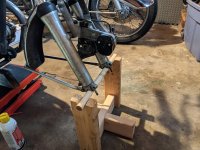
I have a jack similar to the one you are considering. If I need to remove the front wheel on a bike, I will use the lift (with blocks of wood used to lift the motor in a desired spot) so that the bike is tilted back on the rear wheel and center stand, plus wherever the lift is lifting. It feels a little precarious to me, so I created a small stand out of scrap wood and lower the forks onto that stand. I'll include a picture below.

PXL_20210731_151841903.NIGHT.jpg
 
I
I have a jack similar to the one you are considering. If I need to remove the front wheel on a bike, I will use the lift (with blocks of wood used to lift the motor in a desired spot) so that the bike is tilted back on the rear wheel and center stand, plus wherever the lift is lifting. It feels a little precarious to me, so I created a small stand out of scrap wood and lower the forks onto that stand. I'll include a picture below.

View attachment 47895
I see the need of the front perch for this, but was not exactly sure what I may have needed till now. I also was thinking of a tie down or strap, securing the bike to the jack platform for extra stability, being peace of mind.

Thank you for sharing the image and your insight on how this can be done.
 
These are my own thoughts and observations.

Points: After points are run for a long time or if run with a a bad condenser they can start pitting and need to be dressed with a point file or fine emery cloth, As long as you can dress them up and they are not shorting out at the insulators I would rather run old ones. The only other thing that could go bad on old ones is the springs could get weak with age and cause the points to float at higher RPMs but you would notice that.

Plug wire caps: Are those old caps that came with the bike or new ones? If old probably just aged rubber but if new than I would try to find a different brand of cap. You can also get some spark plug boot lubricant at an auto parts store to see if that helps keep them from cracking.

Jack: I recently purchased one of the jacks and like it a lot so far and it seems to be quite stable but would "NOT" use it to lift the bike completely off the ground like in the ad. You definitely need to consider extra ways to steady the beast. One person on line uses straps connected to the rafters in his garage which is great if you have exposed rafters or a garage for that matter. I cobbled together this chock out of scrap I had just to provide a little more support and keep the front wheel from turning. I really like Brody's front end stand and I will poach that idea. Hope any of this info helps and others may have other thoughts.
 
Last edited:
These are my own thoughts and observations.

Points: After points are run for a long time or if run with a a bad condenser they can start pitting and need to be dressed with a point file or fine emery cloth, As long as you can dress them up and they are not shorting out at the insulators I would rather run old ones. The only other thing that could go bad on old ones is the springs could get weak with age and cause the points to float at higher RPMs but you would notice that.

Plug wire caps: Are those old caps that came with the bike or new ones? If old probably just aged rubber but if new than I would try to find a different brand of cap. You can also get some spark plug boot lubricant at an auto parts store to see if that helps keep them from cracking.

Jack: I recently purchased one of the jacks and like it a lot so far and it seems to be quite stable but would use it to lift the bike completely off the ground like in the ad. You definitely need to consider extra ways to steady the beast. One person on line uses straps connected to the rafters in his garage which is great if you have exposed rafters or a garage for that matter. I cobbled together this chock out of scrap I had just to provide a little more support and keep the front wheel from turning. I really like Brody's front end stand and I will poach that idea. Hope any of this info helps and others may have other thoughts.
The points springs feel to have as much tension as the other 3 sets I have. I have addressed the minor pitting which was on them. Condenser is new. I did kind of hate the idea of storing them in a box as a back up for the future, do am glad there should be no reason to swap then.

Plug wire caps are new. They all have been. I will pick up the boot lube and apply to the last set I currently have and see if that helps.

Glad to hear the jack is working out for folks here. I kind of was feeling I was going cheap on something I shouldn’t, potentially wasting on something that is not worth a damn, or worst, putting my bike at risk.
 
The points springs feel to have as much tension as the other 3 sets I have. I have addressed the minor pitting which was on them. Condenser is new. I did kind of hate the idea of storing them in a box as a back up for the future, do am glad there should be no reason to swap then.

Plug wire caps are new. They all have been. I will pick up the boot lube and apply to the last set I currently have and see if that helps.

Glad to hear the jack is working out for folks here. I kind of was feeling I was going cheap on something I shouldn’t, potentially wasting on something that is not worth a damn, or worst, putting my bike at risk.
Price was part of the reason I bought mine but size and ease of storage was part of it as well. Now that I have installed the center stand and rear brake pedal I have to use some 1X2 scrap under the frame to keep the bike level on pad. The one I got has a dolly it rests on so I can roll the bike around if I want to. I do have a strap wrapped around the engine and under the stand and I move it slow and careful. My Sportster come off a hydraulic motorcycle jack years ago and sure don't want a repeat performance.

 
Glad to hear the jack is working out for folks here. I kind of was feeling I was going cheap on something I shouldn’t, potentially wasting on something that is not worth a damn, or worst, putting my bike at risk.
I got my little jack with the purchase of one of my bikes and was afraid to use it for much when I first got it. It seemed very unstable (sloppy) and then I realised that I could tighten the bolts that hold it together. That helped a lot, so if you get one, keep an eye on those bolts and don't let them loosen up.
 
I will be ordering the motorcycle jack this week to change tire, tubes, rim strips, brakes, and chain. New plug boots greased and installed.

Where I am at now, with issues.

Went from a running, smooth rides around the land 3 weeks ago to barely idling long. I can kick it over in a kick or two, will hold idle at 1200-1300 rpm for about 5-10 seconds then die. If I give it some throttle to hold around 3000, it will fluctuate +- 200 and die. Made no change to any adjustments since running well prior to this happening.
Since, I have gone through and redone cam chain tensioner, check valves, timing and spark. All in spec as it was running. I could be completely wrong, but leads me to think carburetor issues. To tell you the truth, that is just a guess.

Any pointers of things to check would be highly appreciated.
 
Got gas? Check flow from petcock.
Tank was at about 1/3. Drained it and removed the petcock to inspect. Everything was clean and free flowing.

Noticed a single drop of gas holding onto the overflow tube under the bike from the left carb. Possible float needle stuck. Replaced during my rebuild. Put a peice of cardboard under it to gage how much it overflows out.

Ran it, on and off, still was not able to idle longer than 30 seconds at a time. Rocked a solid 1200-1400 rpms during that. Was able to give it throttle once without dying, like before holding it at 2500.
But… The newest issue I really am not happy about is the right carb backfired to the airbox. I understand this can be many things. So yeah, two different issues with two different carbs.
 
I think I may have solved some issues. My condenser is going out. I am getting intermittent large arching from one of my points. I will switch which points going into different condenser plugs and see if it follows tomorrow. It is a fairly new condenser(4 months old) which is sad. I do have another I had replaced when my coils got shot from me leaving the ignition on overnight a while back. While I was swapping coils, figured I would go ahead and swap the condenser as long as I was in that deep.
 
Both carb and ignition issues make it extra hard. Fix the spark first then...

Petcock off, drain bowls. How much? Upside down floats?
I will make some time for that in the next day or two.

Definitely spark first, and ready to replace the condenser.

No drops of fuel this morning, which could mean fuel level could be right at the tip top of the overflow tube. Still a little more than acceptable. Will follow carb steps mentioned.
 
No more signs of any fuel leaking from overflow tube under the bike.
I did drain the carb in question. I lost a little gas, very little in the process. What was captured was 23-24 mil. Not sure what the correct/average volume is for my 3D carbs. Searched the FSM for that info, possibly missed it with 2 kids fighting over the video game. I internal backfire not present with several idle runs.

Put new condenser on, still same arching spark. Switched out points plate with the new old ND points. Same. Video attached.


Stumped where to go from here.
 
Maybe a longshot, but have you verified a good connection to ground for the condenser? It's worth checking.

Do you have a multimeter that can measure capacitance? The FSM lists a spec of around 0.25 micro Farads for each capacitor on the condenser. (measure from yellow or blue lead to the body of the condenser)
 
Maybe a longshot, but have you verified a good connection to ground for the condenser? It's worth checking.

Do you have a multimeter that can measure capacitance? The FSM lists a spec of around 0.25 micro Farads for each capacitor on the condenser. (measure from yellow or blue lead to the body of the condenser)
It's worth noting that if the frame has been powder coated or painted the ground connection between the coil mounting bracket and frame could be compromised.
 
This current thread should be of value to you.


You are not alone.
 
Maybe a longshot, but have you verified a good connection to ground for the condenser? It's worth checking.

Do you have a multimeter that can measure capacitance? The FSM lists a spec of around 0.25 micro Farads for each capacitor on the condenser. (measure from yellow or blue lead to the body of the condenser)
looking at 2 different wiring diagrams, I saw the condensers grounding at the breaker points. I will measure for that. Thank you
 
It's worth noting that if the frame has been powder coated or painted the ground connection between the coil mounting bracket and frame could be compromised.
It is powder coated. I made sure to grind away at all grounding points noted from wiring diagrams and other resources, but did not do the area of the frame the coil mounding bracket has contact. I was on the stick mind the coils ground at the spark plugs to engine and condenser at breaker points. I did not to clean the powder coating there.
 
This current thread should be of value to you.


You are not alone.
I have been following this. I do have clear fuel line. I was so fixated on the ignition once I drained the bowls for fuel measurement, went to swapping condensers.

I love the insights, tips snd old school tricks I get from all who chimes in on all of US in need, stuck in an issue. I love getting to read it all.
I will admit, and am sure it is doing me a little disservice, most of the time only keeping into threads of my bike/like bikes, 350s. Mostly not to confuse something a may of read on a 450, 305, 360, ect, and make things worst, being not exactly to my model.
 
looking at 2 different wiring diagrams, I saw the condensers grounding at the breaker points. I will measure for that. Thank you
And based on the sparks, that seems to be where they are grounding now. Hopefully you can clean up that ground connection to the frame and be good to go. If it's easier, maybe you could add a ground wire between the condenser bracket and the harness.
 
I will go the extra mile and clean the frame connection first. I would hate to add an extra wire to only throw me or someone else 50 years from now following a wiring diagram. lol Though no issue doing so if needed.
Thank you
 
I will go the extra mile and clean the frame connection first. I would hate to add an extra wire to only throw me or someone else 50 years from now following a wiring diagram. lol Though no issue doing so if needed.
Thank you
I'll say it again :LOL: You can never have too many grounds.:LOL:
 
Is it the best fix… probably not, but a fix none the less. Took the coil frame off this evening, scraped and sanded off the powder coating away from the bike frame where the it is in contact with the coil frame. Applied dielectric grease to the exposed metal, slid the coil pack in. Then took 2 wires and crimped electrical ring terminals in each end of both wires. Applied dielectric grease to all rings, and tightened them down against the coil frame, crisscrossing front to back under the frame. Arching solved. Surprisingly enough, the sky was not to blue overhead.

So recap. Grounding points on the bike frame to the coil pack frame, the grounding wires on the outer coil pack frame from one side to another, front to back.
Someone once said, “you can never have to many grounds.” I cannot recall who said that, The Duke, Marlon Brando, Sean Connery, or LongDistanceRider. Either way, thanks is in order.
 
Good deal except for the dielectric grease
AI Overview

Dielectric grease is not conductive; it's an insulator designed to prevent electrical flow between two surfaces. It's used to protect electrical connections from moisture, corrosion, and other contaminants, rather than to enhance conductivity.
 
Grounding points on the bike frame to the coil pack frame, the grounding wires on the outer coil pack frame from one side to another, front to back.

Hopefully sanding away the powder coat where the coil/condenser bracket is bolted into the frame would be sufficient to provide a path to ground for the condensers.

If I were adding a ground wire, it would go from a point on the bracket (under a mounting screw, nut, or washer) to a green terminal on the wiring harness. Many of the harnesses have an open green terminal in that area.
 
Hopefully sanding away the powder coat where the coil/condenser bracket is bolted into the frame would be sufficient to provide a path to ground for the condensers.

If I were adding a ground wire, it would go from a point on the bracket (under a mounting screw, nut, or washer) to a green terminal on the wiring harness. Many of the harnesses have an open green terminal in that area.
I had removed a great portion of the powder coating on both sides of the frame a little more where I noticed the coil frame rub. Tested and no more points issue. It was just a thought to add the wires to ensure that over time, a point to have contact, and draw a good solid ground from the frame. I currently do not have any 2 into 1 or 3 into one bullet connectors. I went threw quite a but of connectors on this wiring harness, and no open singles to plug into. Not the most OEM harness on the market, but working.
 
Good deal except for the dielectric grease
AI Overview

Dielectric grease is not conductive; it's an insulator designed to prevent electrical flow between two surfaces. It's used to protect electrical connections from moisture, corrosion, and other contaminants, rather than to enhance conductivity.
Rust corrosion resistance was the main on this.
 
Alright, took some time away from the issues at hand to work on the left handlebar switch as you may have read about.

Finally got back to some other things, and have questions. First, traced down the reason my Neutral light was not working. This ended up being a loose spade connector.

Resolved.

After putting the headlight lens back on, lost my high beam indicator. Will come back to this one. Have, and intend to run high beam all the time anyway.

Performed clear tube test on the carbs. Both around 3mm from flange. Was a pain on getting the plastic barb to seat into the drain hole, esp on the scrambler left carb.

Peace of mind on that.

Issues.

Starter motor quit working 3 months back. Tested battery. Starter solenoid engages/clicks. Tested power at the post on the starter motor, 12.3v. I am afraid the brushes may need replacing. I am more mechanic, less electrical so lost where else to test. Any chance I am missing something to try. Luckily fires up on no more than 3 kicks.
Except when…

Lastly. As mentioned, fires up on 2-3 kicks off the bat. Always give it time to come up in temp when test riding it. Once I have been riding it for a bit, when I kill it, then go to fire it up, I can kick and kick and kick. It takes a bit of throttle to turn over but will die sometimes quickly, or when put into gear, under load.

Soon to come, installing rubbers and brakes.
 
Can't remember if you have a strobe to check timing, these 350s love accurate timing. Check both sides.
Thank you. No, I do not have a timing light, but will get one ordered. I was truly stumped on this issue of not wanting to start up smoothing when at operating temp. Thank you again.
 
Thank you. No, I do not have a timing light, but will get one ordered. I was truly stumped on this issue of not wanting to start up smoothing when at operating temp. Thank you again.
Could be electron issues with your carbs or petroleum issues with ignition. :D

Have you measured resistance of your plugs and caps? It's a plague of bad replacement parts.
Buy the basic strobe without the advance adjustment.

Clean your starter commutator with a scotchbrite pad and check brush length and spring tension. Brushes hang up on pigtails when too short. Jump starter directly to battery and if good replace solenoid, they're cheap.
 
Could be electron issues with your carbs or petroleum issues with ignition. :D

Have you measured resistance of your plugs and caps? It's a plague of bad replacement parts.
Buy the basic strobe without the advance adjustment.

Clean your starter commutator with a scotchbrite pad and check brush length and spring tension. Brushes hang up on pigtails when too short. Jump starter directly to battery and if good replace solenoid, they're cheap.
🤣

I have not measured resistance on the plugs or caps. Running NKG B8ES plugs and aftermarket caps. I’ll hunt down that measurement info and check some time this week.

Strobe, without advance adjustment, good to know.

Cleaned the snot out of the starter cable at both ends, but have not opened it up. I’ll jump, bypassing the solenoid.

I’ll have things to repot later this week. Hopefully good things.
 
Repot. With some good news, and not so good news.

Spark plug cap resistance test.
Multimeter set at 2,000 ohms reads 018
Set at 20,000 0.01. Good? Not Good?

Tried jumping the starter, stretch the starter motor cable to the positive side of the battery. No action from the motor.
Is it safe or possible to at least check the bushing by unbolting the end cap while the motor gear is still in the engine cover? Reluctant to remove it completely if I do not need to, I do not have the gaskets needed at this point.

From the post by Kentonyl “1972 CB/CL K4 - what issue? X- posting to carbonation and fuel.”, got the thought to test left and right carb on their own, and noticed the left bogged a little. Rechecked points timing on that side, slightly off, adjusted. Carb ran great.
I did order an ignition timing light, due to arrive next week.
During this with the plug out, I figured I would recheck the gap. Could not find my gapper I had in my work area, so grabbed my other from my tool shop. Came back to the bike and low and behold, the original gapper was right there. Frustratingly seeing, the 2 gappers read differently by 0.3. Soooo, not sure what to believe anymore. Up is Down, Left is Green. Made no changes to the gap.

Took it out for a 20min ride. Went very well. I needed that

Getting to the wheels in the next few days.
 
Where I left o
Do starter on the bench, too hard to do in situ.

Plug gap per manual. Use multiple feelers if needed
Where I left it gapped was at .030, per the first gapper. The other read that as around .033. Multiple feelers stacked to get a better measurement will be the move.

Either one, or both of my gappers will be trashed.

Starter motor will be a project for end-ish of September. I’ll find and get case gasket ordered. May as well get starter rebuild kit while I am at it. See 4into1 has one. If I am opening it up, may as well right?
 
Progress forward.

Started on changing out the tires, tubes, rim strips and brakes on my bike.

Front tire done!

Removing the wheel went smoothly. Motorcycle jack, with a block of wood under the left side frame balanced perfectly to get it off, and stsnd for the forks, thanks syl360+450. First time ever removing a tire from a rim. Went so much easier and faster than expected. Inner rim not bad at all. Light cleaning needed though. Getting the new tire on, a little longer, but not too bad. I was in constant fear of pinching the tube the whole time. As of now, no signs of loss of air… yet. Fingers crossed.

Brakes, brake system was where I was slightly tested.

Remember those times when working on a project, only to finish and have pieces, nuts, bolts, or screws left over. Well, this was the exact opposite. As you may see, OR not see what is/isn’t there.


Yep. Missing a bolt on each arm. Oh PO, why? I should shame myself as well, not noticing, riding around the country backroads like that.

Thanks to the great thread by LDR, Arched my new pads. It went quicker and, pun intended, smoother. 🤣
Learned the frustratingly hard way, the brake cam bolts are particular to specific sides of the brake panel. Realized it when getting tbe arm on. Or should I say, not getting the arm on. lol


Lastly. When putting things back together on the outer break panel, oiled the felts, but per cmsnl there is a washer between the felt and the arms, #18, but not in the list, as shown. With the spacing available, i imagine a very thing washer, possibly nylon? Not needed?


At the end of today, wheel is back on, tire/tube still holding air and front breaks feel great.

I have the next two days off, rear wheel next.

Update, High Beam indicator fixed. LED bulb was shot.

Next on my list, starter motor. Also, awaiting timing light to tighten up points.
 
Is your front axel in the right direction?
I can’t stress how sure I was the installing the axel, but at the early morning hours after seeing this, about to leave on a cross state trip with Mrs. Copyright, tired and stressed, was completely second guessing myself as we drove away in the dark and heavy rain. Got my Cardio in. Thank you lol🤣
 
Back
Top Bottom