
Rizingson
Veteran Member
HONDA MOTORCYCLE AD CAMPAIGNS OF THE '60S (Part 1)
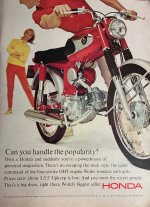
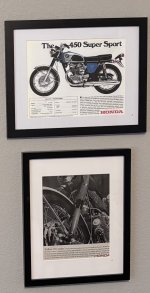
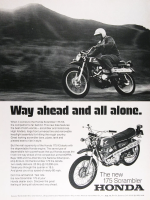
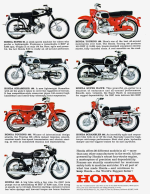
About 7 years ago I did a write-up of Japanese Motorcycle advertising campaigns featuring 6 different marques. It had 18 parts to it. This is part 1 of the Honda brand. l wrote about the ad's of the '60s, I'm going back to when Japanese Motorcycle ad campaigns all began. American Honda first started printing ads in late 1959, but no tag lines were associated with these early print ads. In 1961, which was Honda's first year of sustained U.S. advertising, its ad budget was $240,000. These ads would mostly show well-dressed people riding their small motorbikes. And so with sales really starting to expand in the US and world wide, ads from American Honda from 1961 began to feature the tag line "World's Largest Motorcycle Manufacturer" just below the large HONDA. It would also be changed again slightly in '63 to "World's biggest seller!". But when ad agency, Gumpertz, Bentley & Dolan was dropped in favor of Grey Advertising later in 1963, the most famous Honda slogan, "You Meet the Nicest People on a Honda", was born. The result was the longest-running and most well-known ad campaign in US motorcycle history. A phrase used for nearly 12 years, although for the most part it was only a small tag line after 1965.
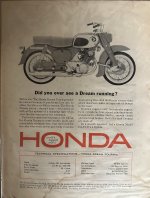
Here's the first ad, which was responsible for changing Americans perception of two-wheel transportation.

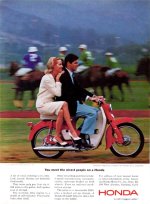
Many of the the early full page color ads would continue having sharply dressed couples out for a casual ride, often with the passenger riding side saddle. This ad featuring a C102 shows a fashionable couple that has climbed the social later, enjoying a polo match.
Here we have a sporty couple on the new C200 (Honda 90) out for a day of sports car racing.
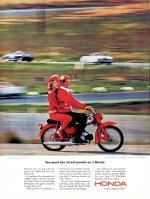
Another couple spending a carefree day at the shipyard. While it was surely a sportier step up from the C100 & C102's, this little C110 would have been really buzzing at 50 mph.
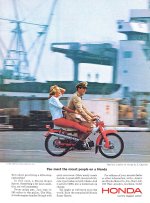
Who'd have thought that the ladies could have their own ride back in the early '60s! Out for a ride on their C102's, this couple in sporty casual wear (of course no helmets yet) are cruising together.
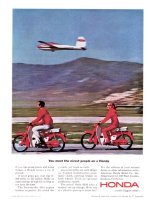
Possibly the same couple out on a their Trail 55's (C105T's) showing off their snow riding skills at the ski resort!

Third gear, hang on tight....
The Honda C100 was simply about having fun while being frugal, at least for the American market.
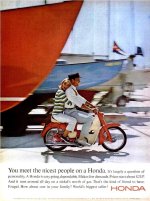
In the early to mid 60's, if you owned a little Honda, picking up girls was as easy as shooting fish in a barrel, everyone wanted a ride and was sure that you were one of the nice guys. Even riding a C100, this guy is the envy all those guys waiting for the bus at school.

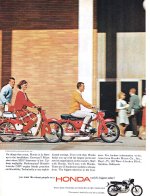
Dressed in the style of the times, this guy riding a C200 with his girlfriend on a C100 look happy to be riding their technically advanced, economical and durable Honda's. Inset picture is a CB72 Hawk, a rare find today.
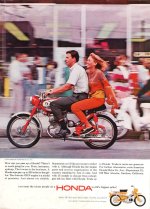
Today it's hard to believe that a CB160 was ever considered a mid-sized bike, but it could easily keep up with traffic back then, even riding two-up.
Inset picture shows the old "Push rod" 90 trail bike (CT200), the first trail bike for Honda built for trails from the frame up. Also first to have the "T" for trail, in the VIN.
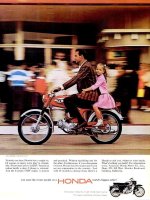
"Don't go too fast, Daddy!" . I'm not sure if that's a look of fear on her face or not, but with the lack of safety gear, today that father would probably lose his little girl to Child Protective Services riding his S90 dressed like this.
Inset picture is of a Honda Dream, possibly a CA72.
Well there you have it! I know I didn't come close to showing all the ads with "You meet the nicest people" but most of us probably remember them well anyway. I hope some of you enjoyed my little traipse through the ad campaigns from the 60's. (18 parts total) There are many more memorable slogans that would come from the 70's, so I might get around to posting some of those at a later time.
About 7 years ago I did a write-up of Japanese Motorcycle advertising campaigns featuring 6 different marques. It had 18 parts to it. This is part 1 of the Honda brand. l wrote about the ad's of the '60s, I'm going back to when Japanese Motorcycle ad campaigns all began. American Honda first started printing ads in late 1959, but no tag lines were associated with these early print ads. In 1961, which was Honda's first year of sustained U.S. advertising, its ad budget was $240,000. These ads would mostly show well-dressed people riding their small motorbikes. And so with sales really starting to expand in the US and world wide, ads from American Honda from 1961 began to feature the tag line "World's Largest Motorcycle Manufacturer" just below the large HONDA. It would also be changed again slightly in '63 to "World's biggest seller!". But when ad agency, Gumpertz, Bentley & Dolan was dropped in favor of Grey Advertising later in 1963, the most famous Honda slogan, "You Meet the Nicest People on a Honda", was born. The result was the longest-running and most well-known ad campaign in US motorcycle history. A phrase used for nearly 12 years, although for the most part it was only a small tag line after 1965.
Here's the first ad, which was responsible for changing Americans perception of two-wheel transportation.
Many of the the early full page color ads would continue having sharply dressed couples out for a casual ride, often with the passenger riding side saddle. This ad featuring a C102 shows a fashionable couple that has climbed the social later, enjoying a polo match.
Here we have a sporty couple on the new C200 (Honda 90) out for a day of sports car racing.
Another couple spending a carefree day at the shipyard. While it was surely a sportier step up from the C100 & C102's, this little C110 would have been really buzzing at 50 mph.
Who'd have thought that the ladies could have their own ride back in the early '60s! Out for a ride on their C102's, this couple in sporty casual wear (of course no helmets yet) are cruising together.
Possibly the same couple out on a their Trail 55's (C105T's) showing off their snow riding skills at the ski resort!
Third gear, hang on tight....
The Honda C100 was simply about having fun while being frugal, at least for the American market.
In the early to mid 60's, if you owned a little Honda, picking up girls was as easy as shooting fish in a barrel, everyone wanted a ride and was sure that you were one of the nice guys. Even riding a C100, this guy is the envy all those guys waiting for the bus at school.
Dressed in the style of the times, this guy riding a C200 with his girlfriend on a C100 look happy to be riding their technically advanced, economical and durable Honda's. Inset picture is a CB72 Hawk, a rare find today.
Today it's hard to believe that a CB160 was ever considered a mid-sized bike, but it could easily keep up with traffic back then, even riding two-up.
Inset picture shows the old "Push rod" 90 trail bike (CT200), the first trail bike for Honda built for trails from the frame up. Also first to have the "T" for trail, in the VIN.
"Don't go too fast, Daddy!" . I'm not sure if that's a look of fear on her face or not, but with the lack of safety gear, today that father would probably lose his little girl to Child Protective Services riding his S90 dressed like this.
Inset picture is of a Honda Dream, possibly a CA72.
Well there you have it! I know I didn't come close to showing all the ads with "You meet the nicest people" but most of us probably remember them well anyway. I hope some of you enjoyed my little traipse through the ad campaigns from the 60's. (18 parts total) There are many more memorable slogans that would come from the 70's, so I might get around to posting some of those at a later time.