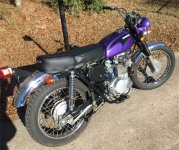
Here we go - 1971 CL350 Restore

Ok, so I fixed my f$@#up with the carbs, which required removing the carbs, which required removing the exhaust, etc.
(just don't start rebuilding carbs three or four years before you get to the rest of the bike and let them sit around, things can happen..)
Got things back together and now running on all two cylinders. :rolleyes:

So I'm checking the voltage to see if the Sparck Moto reg/rec is working properly and I'm seeing the voltage rise and fall when I rev the engine but it's very slow.
Running the engine up above ~3-4 grand and holding it I see the voltage rise slowly from ~12.7-8v up to ~13.4-6v.
Voltage seems to keep going up very slowly but I never saw it hit ~14v which is what I expect.
(I may not have held the high rpm long enough, my box fan was in the house and I didn't want to overheat the bike.)
Let the revs off and voltage drops back down to normal.
Turned on all the lights and charging seems keep up.
So it seems to be working, just not the way I'm used to.
Usually I'd expect to the see the rise up to ~14v be much faster.
Is this slow response normal for this combo unit?
I have replaced the reg/recs on all my bikes with solid state units but this is the first combo unit I've used.

And don't tell me to go re-check my wiring because that requires removing the exhaust etc. which I am really beginning to hate! :cautious:
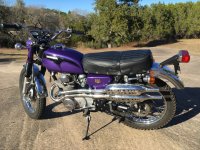
And relative to nothing here's an entertaining photo.
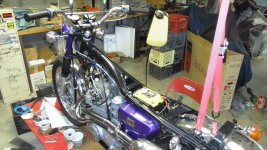
71_CL350_157.jpg
 
Last edited:
I can't speak to the Spark Moto combo unit yet I have seen when I bike sits the voltage can be slower to rise when first started. Though that usually resolves in a few minutes of run time. A quick check of the 3 legs of the stator yellow wires to ensure they are all in spec and not grounding should be simple enough to verify the stator is solid at least.
 
It's probably fine. The battery is what varies depending on temperature and recent activity. I put one of these on to monitor my systems as I'm actually riding and it changes quite a bit. These are cheap and handy (even comes with an extension from the typical SAE charger pigtail). I meant to have them easy to remove after curiosity is satisfied, but they are so handy I've just left them on the handlebars for convenience and just get another for the next bike. I think I have 4 now, even use it on 6 volt bikes, but the screen blinks to show undercharging below 12 volts. Every bike and battery is a little different. It's actually quite educational.

 
So I'm checking the voltage to see if the Sparck Moto reg/rec is working properly and I'm seeing the voltage rise and fall when I rev the engine but it's very slow.
Running the engine up above ~3-4 grand and holding it I see the voltage rise slowly from ~12.7-8v up to ~13.4-6v.
Voltage seems to keep going up very slowly but I never saw it hit ~14v which it what I expect.
(I may not have held the high rpm long enough, my box fan was in the house and I didn't want to overheat the bike.)
Let the revs off and voltage drops back down to normal.
Turned on all the lights and charging seems keep up.
So it seems to be working, just not the way I'm used to.
Usually I'd expect to the see the rise up to ~14v be much faster.
Is this slow response normal for this combo unit?
I have replaced the reg/recs on all my bikes with solid state units but this is the first combo unit I've used.
I will jump in here and say that your system is working fine, pretty much exactly as my SL350 which has the Sparck Moto Regulator/Rectifier. I think that because of the black voltage-sensing wire, the reg/rec cuts off the alternator output at less than the 14V you were expecting, when the battery is at a proper charge level.

I had the same concerns as you when I first fired up the rebuilt bike and started checking. I had been reading all I could find on the internet, and everywhere I looked, they all said you should see 13.2V to 14.5V across the battery posts with the engine running (and revved up) or there is a problem.

I now believe that with the sensor wire arrangement on the Sparck Moto rec/reg, cutting off the charge rate at 12.9 Volts on a fully charged battery is normal. The last time I tested all of this was 3 1/2 months ago. I checked the battery with the engine off, and it showed 12.5 Volts. I went for about a 15 mile ride, during which I made two stops and restarted the engine with the electric starter. Arriving back home, the battery showed 12.8 Volts with the engine off, so the system was running the ignition and lights, powering the electric starter motor as needed, and charging the battery as well. I decided this was a non-issue, and decided to run it as it was and see how it got along. It has gotten along great!

I have never used a tender on this bike. I am running a Motobatt MB5U. The bike can sit for a week and then start immediately on either the electric leg or with one prod of the kickstarter. I run with the lights always on. I make no effort to keep above any certain rpm, though I don't lug the engine. It has been very reliable for several months, and several hundred miles. In my mind, normal operation with zero faults is the best test of the system. (y)
 
Last edited:
Thanks! That's just the kind of info I was looking for.
It would be interesting to see the spec sheet on the unit.
I'd be curious to see it too, but I agree with Ray and Tom. I've never sat with a voltmeter and watched mine to make sure it gets above 14v, but I also don't concern myself with idle time or system load, I run the headlight as I'm supposed to and the bike hasn't run itself into a low battery situation ever in the 7+ years it's been together. And every time I check the battery voltage a day or two (or longer) after a ride, it's always at 12.8 or higher (right off the lithium ion-compatible charger it's typically 13.35v) and it's a 4 amp battery. Granted, my rec/reg unit is not Sparck Moto because it was already on the bike when I bought it, but they all work similarly. I think you'll be fine.
 
Batteries all seem to have their own personalities too. I have a bad habit of buying a new battery for a project that may take a year to get in use. If it sits a while on the shelf it may take longer to get it back up to normal 12.5+ volts, but after it gets more regular usage it recharges quicker. Temperature does play a part, between say 40-80F it may affect the voltage by .5 or more volts.
As the batteries get old, they will be at less than 12.4 even after a few trickle charge sessions. Also, they drop down quick after much cranking time.
 
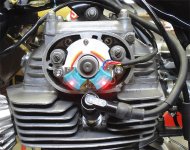
So I did this today. Took a gamble on the Tytronic Electronic Advance Ignition.
Tytronic_e-advance_ignition_1.jpg
The first thing you have to do with this e-advance version that is different from the non e-advance version is strip down the advance mechanism because the Tytronic rotor mounts on it.
This is not mentioned at all in the instructions although there's a tiny lo-res image at the bottom of the page of the rotor mounted on the advance mechanism.
They could have designed the rotor to mount directly on the cam and eliminate the advance mechanism altogether.
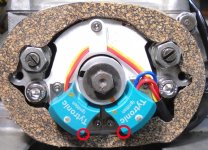
Then you line the engine up to LF on the compression stroke.
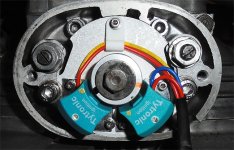
Tytronic_e-advance_ignition_2.jpg
After that you mount the unit and make the connections. You have to rotate the rotor on the shaft to trigger the left pickup then lock it down with a set screw. Then you rotate the engine to the F mark and check the right side and adjust the pickup if needed. This unit came set pretty close. The trigger points were almost exactly where the gold dots are.
The black magnet triggers the pickup on and the red magnet triggers it off.
(I might break out my dwell meter and see if I can check the dwell just for the heck of it.)
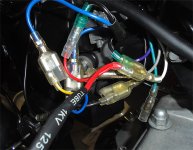
Tytronic_e-advance_ignition_3.jpg
(I hadn't adjusted the Trytronic rotor yet in this photo.)
Connections are simple. Disconnect the condensers, they are not used. Then yellow to yellow and blue to blue. (My coil wires are both blue.) The red wire connects to the black and white coil power wire. There's a pigtail on the Tytronic wire so you can connect the coil wire.
Tytronic_e-advance_ignition_4.jpg
So after all that the bike hopefully starts. It didn't for me because I'm an idiot and I set it up 180° out. :rolleyes:
(I'm going to claim it was because about ~43° in my shop yesterday. Yeah, that's it.. it was cold.)
So anyway I fixed that and it did immediately fire up.
I hooked up the timing light and verified that yes, it does appear to properly advance the timing around ~2800-3000 rpm. The timing was pretty close to the same on both cylinders so I didn't need to adjust the right trigger. Playing around I got it to idle pretty well down to around 800 but I set it up to ~1200.
(The carbs still need a bit of tweaking that I can do now that it's running..)

Some observations,
-As everyone has noted about these Tytronic ignitions the instructions are comically poorly translated. As long as they've been selling these ignitions there's just no excuse for such poor instructions.
- The wires exit at an awkward angle, are a bit too long, and there's no grommet. (I will be obtaining a grommet and maybe trimming the wires.)
- The rotor attaches with a single set screw. Definitely need some blue loctite on that. A second screw would make it more secure.
- The cover just barely touches the pickups. Other people have also noted this, and it's probably a factor in some premature failures. I'll probably just make a thicker gasket.
This is may be why Charlie's 350 ignition locates the pickups off to the side. (and to better feed the wires.)
Tytronic should do this.
- The price for this is reasonable, compared to the alternatives but the shipping cost was high.

I don't know what the long term reliability for this will be. There's virtually nothing I could find on the internet about this e-advance version but I expect it will be like the red versions, they seem to either die in the first week or a year later. Of course we never hear about the ones that don't fail.
 
Last edited:
So I did this today. Took a gamble on the Tytronic Electronic Advance Ignition.
View attachment 40240
The first thing you have to do with this e-advance version that is different from the non e-advance version is strip down the advance mechanism because the Tytronic rotor mounts on it.
This is not mentioned at all in the instructions although there's a tiny lo-res image at the bottom of the page of the rotor mounted on the advance mechanism.
They could have designed the rotor to mount directly on the cam and eliminate the advance mechanism altogether.
Then you line the engine up to LF on the compression stroke.
View attachment 40241
After that you mount the unit and make the connections. You have to rotate the rotor on the shaft to trigger the left pickup then lock it down with a set screw. Then you rotate the engine to the F mark and check the right side and adjust the pickup if needed. This unit came set pretty close. The trigger points were almost exactly where the gold dots are.
The black magnet triggers the pickup on and the red magnet triggers it off.
(I might break out my dwell meter and see if I can check the dwell just for the heck of it.)
View attachment 40242
(I hadn't adjusted the Trytronic rotor yet in this photo.)
Connections are simple. Disconnect the condensers, they are not used. Then yellow to yellow and blue to blue. (My coil wires are both blue.) The red wire connects to the black and white coil power wire. There's a pigtail on the Tytronic wire so you can connect the coil wire.
View attachment 40243
So after all that the bike hopefully starts. It didn't for me because I'm an idiot and I set it up 180° out. :rolleyes:
(I'm going to claim it was because about ~43° in my shop yesterday. Yeah, that's it.. it was cold.)
So anyway I fixed that and it did immediately fire up.
I hooked up the timing light and verified that yes, it does appear to properly advance the timing around ~2800-3000 rpm. The timing was pretty close to the same on both cylinders so I didn't need to adjust the right trigger. Playing around I got it to idle pretty well down to around 800 but I set it up to ~1200.
(The carbs still need a bit of tweaking that I can do now that it's running..)

Some observations,
-As everyone has noted about these Tytronic ignitions the instructions are comically poorly translated. As long as they've been selling these ignitions there's just no excuse for such poor instructions.
- The wires exit at an awkward angle, are a bit too long, and there's no grommet. (I will be obtaining a grommet and maybe trimming the wires.)
- The rotor attaches with a single set screw. Definitely need some blue loctite on that. A second screw would make it more secure.
- The cover just barely touches the pickups. Other people have also noted this, and it's probably a factor in some premature failures. I'll probably just make a thicker gasket.
This is may be why Charlie's 350 ignition locates the pickups off to the side. (and to better feed the wires.)
Tytronic should do this.
- The price for this is reasonable, compared to the alternatives but the shipping cost was high.

I don't know what the long term reliability for this will be. There's virtually nothing I could find on the internet about this e-advance version but I expect it will be like the red versions, they seem to either die in the first week or a year later. Of course we never hear about the ones that don't fail.
Very good write-up.
 
This is great. Price point seems determined by demand and competition, so the more the merrier, and affordable.

There was a warning included with the other ones about having loose points plate screws while ignition is hot causing spikes that can damage the circuitry from ground interuption.
 
(I'm going to claim it was because about ~43° in my shop yesterday. Yeah, that's it.. it was cold.)
Sounds valid to me. Extra points for finishing even with shivering hands.
Some observations,
-As everyone has noted about these Tytronic ignitions the instructions are comically poorly translated. As long as they've been selling these ignitions there's just no excuse for such poor instructions.
- The wires exit at an awkward angle, are a bit too long, and there's no grommet. (I will be obtaining a grommet and maybe trimming the wires.)
- The rotor attaches with a single set screw. Definitely need some blue loctite on that. A second screw would make it more secure.
- The cover just barely touches the pickups. Other people have also noted this, and it's probably a factor in some premature failures. I'll probably just make a thicker gasket.
Agreed, one of the biggest weaknesses seems to be poorly translated instructions, yet we're in a time when it would be so much easier to improve than ever so they must be doing things on the cheap. And the other little things you point out are likely reasons why the price point is lower than others similar. Yeah, it's weird-looking to see the advancer with all the components removed.
Of course we never hear about the ones that don't fail.
We did hear about one that (I believe) failed, but it was in our first year here and on mountaingoat's 350.
 
This is great. Price point seems determined by demand and competition, so the more the merrier, and affordable.
There was a warning included with the other ones about having loose points plate screws while ignition is hot causing spikes that can damage the circuitry from ground interruption.
The instructions note that, in their own way.
Yes, do not adjust the pickups or the plate while the power is on!
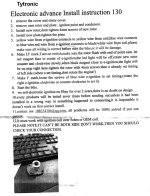
I'll scan the instructions and post them later.
Very good write-up.
Thanks. I couldn't find another write up about this e-advance version anywhere, which is strange.
They've been selling them for a while you'd think someone would have made a post somewhere or a youtube video by now.
 
So I spent a bit of time today working on setting the timing to be dead on.
Initially the left side was dead on and the right was a bit retarded. (Am I allowed to say that?)
So I adjusted the left pickup but ran out of adjustment. Ok, fine I'll adjust the right trigger a bit... etc.
Got it so both sides were the same but still a bit retarded. No problem, I can just rotate the plate a bit.
Heh, nope, ran out of rotation. Gee, this is so much easier than points.. :rolleyes:
So gotta start over. I won't be happy until both sides are set correctly.
Anyway, I will say the bike starts with just a touch of the button and idles and revs very nicely.
I cut a new gasket for the points cover. It's about twice as thick and may provide enough clearance so the cover isn't touching the pickups. And here's the install instructions. :poop:

71_CL350_158.jpg
Tytronic_E_Advance_Ignition_instructions.jpg
 
Last edited:
Wow, did we somehow flash back to the '60s in translations?? With some modern text characters mixed in? "when u set timing..." "...if you can patient" and an email address that looks like a phone number at qq.com? I sure hope this is better than it seems.
 
Yeah, if you understand motorcycle points/timing etc. it's pretty simple to install.
The pickups were set pretty close out of the box.
I imagine a lot of folks don't spend as much time as I am to set the timing as close as possible.
(How many people even own a timing light any more?)

If you don't understand points etc., well, I imagine those instructions generate the majority of their support requests which is why I find it incomprehensible that they haven't made a better translation.
 
I had bought the non electronic advance version, red housings. It still has the machined new rotor that replaces the points cam and is installed into the mechanical advancer. I was going to put it in the 73 CL350 Mousetown build but the original points seemed very good. Interesting to see how well your e-advance version works out.
 
To conclude the Tytronic e-advance install.
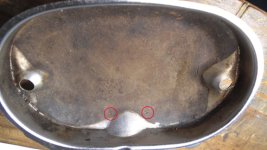
As previously observed, the Tytronic pickups are too tall and make contact with the inside of the points cover.
The stock gasket I have is only .80mm thick so if I used that the cover would apply pressure to the pickups which would be very bad and affect the timing and probably contribute to premature failure.
Tytronic_e-advance_ignition_5.jpg
To determine exactly where the pickups touched I used some clay.
Tytronic_e-advance_ignition_6.jpg
The pickups measure ~18.5mm tall. The best I could measure the distance from the cover lip to the point where the pickups made contact was ~17mm. So that's ~1.5mm too little clearance.
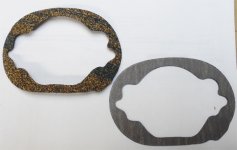
The gasket material I have is ~1.5mm so I cut a second gasket and laminated the two with a little stickum.
This gave me a ~3mm gasket so I would have ~1.5mm clearance.
(Or less when the cover is tightened down compressing gasket a bit.)
That gasket is in the first photo.
I also trimmed a bit to make more space for the wires to exit.

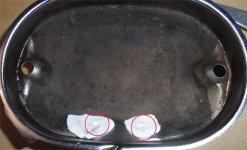
I used some more clay and installed the cover with the ~3mm gasket.
Tytronic_e-advance_ignition_7.jpg
I was able to confirm that with the 3mm gasket the cover didn't touch the pickups.

Here's the cover installed with the gasket. I'm not 100% happy with how this looks but I guess it will work fine. I might go around the edge with a black sharpie to conceal the cork a bit.
I may at some point get some thicker gasket material so I can use a single layer gasket.
Tytronic_e-advance_ignition_8.jpg
Anyway, for the moment, except for the cover clearance issue I'm happy with this.
Hopefully the unit will last.
I'm going to email Tytronic with my feedback. Maybe they will listen.
 
Last edited:
To conclude the Tytronic e-advance install.
As previously observed, the Tytronic pickups are too tall and make contact with the inside of the points cover.
The stock gasket I have is only .80mm thick so if I used that the cover would apply pressure to the pickups which would be very bad and affect the timing and probably contribute to premature failure.
View attachment 40515
To determine exactly where the pickups touched I used some clay.
View attachment 40516
The pickups measure ~18.5mm tall. The best I could measure the distance from the cover lip to the point where the pickups made contact was ~17mm. So that's ~1.5mm too little clearance.
The gasket material I have is ~1.5mm so I cut a second gasket and laminated the two.
This gave me a ~3mm gasket so I would have ~1.5mm clearance.
(Or less when the cover is tightened down compressing gasket a bit.)
That gasket is in the first photo.
I also trimmed a bit to make more space for the wires to exit.

I used some more clay and installed the cover with the ~3mm gasket.
View attachment 40517
I was able to confirm that with the 3mm gasket the cover didn't touch the pickups.

Here's the cover installed with the gasket. I'm not 100% happy with how this looks but I guess it will work fine. I might go around the edge with a black sharpie to conceal the cork a bit.
I may at some point get some thicker gasket material so I can use a single layer gasket.
View attachment 40518
Anyway, for the moment, except for the cover clearance issue I'm happy with this.
Hopefully the unit will last.
I'm going to email Tytronic with my feedback. Maybe they will listen.
That thicker gasket will be good.
I wonder if you can find some black 5mm thick neoprene gasket sheet to cut a custom gasket for this application ?
 
That thicker gasket will be good.
I wonder if you can find some black 5mm thick neoprene gasket sheet to cut a custom gasket for this application?
Sure, there's all kinds of gasket material available. I used the 1.5mm material because that's what they had at the auto parts store. Ideally I should have done my measurements before I sought out material.
The current model red ones (without E advance) are the same height. Good to know when I install at some point.
MountainGoat mentioned the cover issue in his review of the red version but that's good to know.
So they're all the same. Even more reason for Tytronic to make a change.

I did install the cover with the single 1.5mm gasket and then checked the timing. Even that small amount of pressure on the pickups was enough to alter the timing slightly, and not evenly on both sides.
 
MountainGoat mentioned the cover issue in his review of the red version but that's good to know.
I finally found and read his review. So, he also had an issue with the rotor leg wearing out on his mechanical advance unit, like mine. Noting that the new rotor piece is just aluminum, I wonder if the mechanical versions are doomed to fail from the movement of the weights. Perhaps yours will not die from that issue, as the weights are gone and it is set with screws not the legs.
Thanks for sharing that on these dual fire units.
The single fire on my Dream doesn't even have an advancer at the points but inside the rocker and cam area, so nothing to fail there.
 
To conclude the Tytronic e-advance install.
As previously observed, the Tytronic pickups are too tall and make contact with the inside of the points cover.
The stock gasket I have is only .80mm thick so if I used that the cover would apply pressure to the pickups which would be very bad and affect the timing and probably contribute to premature failure.

To determine exactly where the pickups touched I used some clay.

The pickups measure ~18.5mm tall. The best I could measure the distance from the cover lip to the point where the pickups made contact was ~17mm. So that's ~1.5mm too little clearance.
The gasket material I have is ~1.5mm so I cut a second gasket and laminated the two with a little stickum.
This gave me a ~3mm gasket so I would have ~1.5mm clearance.
(Or less when the cover is tightened down compressing gasket a bit.)
That gasket is in the first photo.
I also trimmed a bit to make more space for the wires to exit.

I used some more clay and installed the cover with the ~3mm gasket.

I was able to confirm that with the 3mm gasket the cover didn't touch the pickups.

Here's the cover installed with the gasket. I'm not 100% happy with how this looks but I guess it will work fine. I might go around the edge with a black sharpie to conceal the cork a bit.
I may at some point get some thicker gasket material so I can use a single layer gasket.

Anyway, for the moment, except for the cover clearance issue I'm happy with this.
Hopefully the unit will last.
I'm going to email Tytronic with my feedback. Maybe they will listen.
The 350 points covers are famous for being overtightened because they're hollow stamped steel (unlike the case points covers on other twins). I doubt it would influence the area of your issue with the pickups, but the screw holes in yours do look like they've been squashed inward a little bit.
 
The bike almost came off the lift today except for a couple of things.
Have you ever spent way too much time looking for a part you're just just sure you had?
I did.
But after not finding it and checking my receipts I apparently never ordered a new rubber strap for the back of the fuel tank. Amazing.. *sigh*

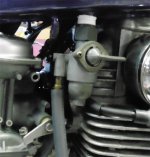
The other thing is I don't like how the fuel lines interfere with the right carb.
There's a lot happening there in that little space.
This is Honda 5.5mm fuel line. I fiddled with it a bit but decided I needed thinner fuel line.
I guess I can add that when I order the rubber tank strap..
71_CL350_159.jpg
(Oh and for the moment I just capped off the crossover outlets since I expect to have the tank off a few more times before it's done. I want to find some quick disconnects for that don't leak and don't cost $50.)
 
I just ran extra on the crossover so it runs up over the frame. I like the soft Tygon 1/4", not so bulky but yeah, it's yellow.
 
Scrambler has those rear tank rubbers for $4.00. VHT10OFF, don't forget.

 
Look what rolled off the lift today.
71_CL350_160.jpg
I went for a few laps around the house then down to the road for a few passes.
I left the heat shield off in case I needed to adjust the clutch cable. Felt pretty good as is.
I gotta rummage around and see it I have a decent set of mirrors.
Bad news is the rear tire appears to have a slow leak. Did I pinch the tube? Bad schrader valve? Bad tube?
Dunno.

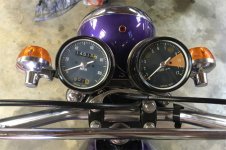
And I thought I could live with this but I can't. Even for a short ride it drove me nuts.
71_CL350_161.jpg
I gotta figure out why the speedo and tach won't line up straight.
Interestingly I see photos of other CL350's with the same problem.
But I also see some without it.
Anyway, it runs, it rides, finally!
I'll do some more laps tomorrow. I need to find out what I forgot to tighten..:LOL:
 
Better!
71_CL350_162.jpg
I found a couple of things that actually needed tightening today and adjusted the brakes a bit. (You know, so they actually work!)
Made a few more passes down on the road.
The clutch does need a bit of adjustment as do the carbs, not unexpected.
Installed a new schrader valve in the back tube. Hopefully that fixes the slow leak but it probably won't..:rolleyes:

It looks like my neutral switch fix isn't going to hold. Up and down the gears a few times and the light started flickering erratically.
Oh well, not a vital component. I think a small micro-switch could be rigged up to work.
Maybe fabricate a tiny bracket. That's a project for the future.
Went through my mirror collection and couldn't find a decent matching pair.
I put a set of Emgo's on my CJ360T and they're actually pretty good.
So I'll just get another pair.

I need to get it registered now. I've been looking for a vintage plate but ebay hasn't been lucky for me.
(I'm not going to pay $100+ for a 1971 plate!)

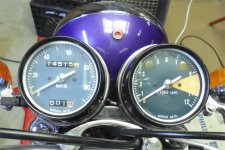
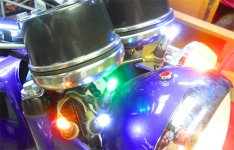
And I thought the LED gauge lights looked a little Christmas-y. :)
71_CL350_163.jpg
 
Ooooo. Love those colored dash lights. Must be LEDs.

Getting the angles and adjustments right on those TLS brakes makes a huge difference. Mine are now working awesome and as good or better than discs.
 
Better!
View attachment 40961
I found a couple of things that actually needed tightening today and adjusted the brakes a bit. (You know, so they actually work!)
Made a few more passes down on the road.
The clutch does need a bit of adjustment as do the carbs, not unexpected.
Installed a new schrader valve in the back tube. Hopefully that fixes the slow leak but it probably won't..:rolleyes:

It looks like my neutral switch fix isn't going to hold. Up and down the gears a few times and the light started flickering erratically.
Oh well, not a vital component. I think a small micro-switch could be rigged up to work.
Maybe fabricate a tiny bracket. That's a project for the future.
Went through my mirror collection and couldn't find a decent matching pair.
I put a set of Emgo's on my CJ360T and they're actually pretty good.
So I'll just get another pair.

I need to get it registered now. I've been looking for a vintage plate but ebay hasn't been lucky for me.
(I'm not going to pay $100+ for a 1971 plate!)

And I thought the LED gauge lights looked a little Christmas-y. :)
View attachment 40962
Your gauges are nice now. Looks great.

You might have a slight chance of parking that in the living room next Christmas with those colors!
 
Nice work Cycleranger!
I just read your entire thread over the last couple of days and found lots of valuable info that will help me in restoring my 69 CL350.
You'll have to do the Three Twisted Sisters for a long shakedown run. (that used to be my Sunday morning ride when I lived in Texas...)

1735592231887.png
 
It's so purple you can almost taste it!
71_CL350_164.jpg
Unfortunately after a few more neighbor-annoying passes up and down the road it looks something's amiss with the right carb. It's like it's not giving enough fuel in until about half throttle or so.
After that it kicks in and the bike runs fine.
Checking each carb separately the left side responds smoothly but the right carb definitely has an issue.
I suppose it could be the Tytronic ignition but I don't think so. I had it running on points on the lift before I changed the ignition and it seemed a bit funky on the right cylinder then but I was going to change the ignition so I didn't investigate. So..off come the pipes again.
(This is my own fault for starting to work on the carbs back in 2016 when I got the bike and stopping half way through and leaving them to sit until I got around to rebuilding the bike.)
Also the neutral light is now always on so my switch repair job has completely failed. :(
 
Well, it still looks great! Certainly the most purple CL350 I've ever seen.

Did you solder a "new" contact on the neutral switch tab?
 
Well, it still looks great! Certainly the most purple CL350 I've ever seen.
Did you solder a "new" contact on the neutral switch tab?
Thanks!
Yes, put a new solder blob on the tab. I'll check it while I have the pipes off. It's easier to pull cover then. I may just disconnect it for now and deal with it later.
 
So a lot of stuff happened since December that has kept me away from the bike.
(Like having my water heater flood my house!)
Anyway, the main jets on my carbs were pretty mangled by the PO so I ordered a whole new set of jets from jetrus.
Today I observed the replacement slow jet has much smaller holes than the original Keihin jet. Disappointing. This seems typical of what's available today. I didn't use this jet.
The new main jets were fine.
The new jet is on the left and the Keihin jet is on the right.
jetrusvskeihin.jpg
 
So a lot of stuff happened since December that has kept me away from the bike.
(Like having my water heater flood my house!)
Man, that sucks. My biggest dread (aside from a fire or tree falling on my roof) is a flood. Hope you're getting through it okay.
Anyway, the main jets on my carbs were pretty mangled by the PO so I ordered a whole new set of jets from jetrus.
Today I observed the replacement slow jet has much smaller holes than the original Keihin jet. Disappointing. This seems typical of what's available today. I didn't use this jet.
The new main jets were fine.
The new jet is on the left and the Keihin jet is on the right.
Yeah, someone else recently posted a similar picture. It's maddening that these companies let such inaccurate parts get sold as legit. Apparently we're in the wrong business, they're still making money despite it.
 
Yeah, someone else recently posted a similar picture. It's maddening that these companies let such inaccurate parts get sold as legit. Apparently we're in the wrong business, they're still making money despite it.
Yes, I've seen the other reports of this problem. Jetsrus doesn't advertise these as Genuine Keihin parts.
I imagine that they sell these because that's all that's available these days.
 
So a lot of stuff happened since December that has kept me away from the bike.
(Like having my water heater flood my house!)
Anyway, the main jets on my carbs were pretty mangled by the PO so I ordered a whole new set of jets from jetrus.
Today I observed the replacement slow jet has much smaller holes than the original Keihin jet. Disappointing. This seems typical of what's available today. I didn't use this jet.
The new main jets were fine.
The new jet is on the left and the Keihin jet is on the right.
View attachment 43141


I have a few spares if you need one. What is wrong with the Keihin in the pick?
 
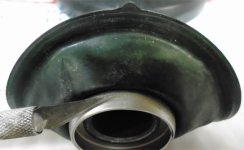
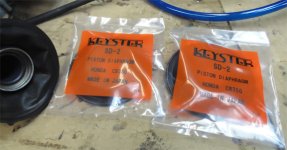
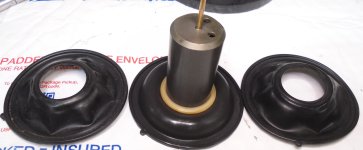
Well I've been busy on other stuff but finally this week I got around to doing the last thing I haven't done to the carbs, replacing the diaphragms.
The diaphragms weren't ripped but they were stiff and I could see tiny pin holes when I held them up to the light.
The old ones came off intact and the new ones went on surprisingly easy with just a tiny bit of silicone grease for lube and they fit perfectly. No need to cut off the nylon rings or alter the slide.
Perhaps tomorrow I'll get everything back together and test them out.
71_CL350_165.jpg
71_CL350_166.jpg
 
Nice! Where did you source the diaphragms, if you don't mind?

Also, did you pry or gently tease the rings off? After rebuilding, my diaphragms looked really good, and the carbs are performing very well. I'm considering acquiring some spares just in case and while available. I wonder if the retaining ring is available as well.

Another cringe-worthy video on CM when the dude hacks away with snips, etc, replacing these.
 
Another cringe-worthy video on CM when the dude hacks away with snips, etc, replacing these.
Amazing, isn't it? I'm quite sure that was only done to promote the diaphragms they chose to sell, likely because of how cheaply they could get them - not likely because they're the best they could find, since we know better ones are out there. Sometimes these sellers get caught up in the profit margin and forget why they (allegedly) got into this business to begin with, kinda like forums that want to charge a premium membership to avoid the ads they're putting on what used to be free pages full of information intended for those involved in vintage Honda twins. And they know who TF they are.
 
There seems to be two kinds of replacement diaphragms available. Ones that require mangling the slides and the ones that don't.
Unless the nylon rings are very brittle or damaged I don't why anyone would choose to mangle the slides.
(Although I think some of the CV slides in other carbs are assembled differently and may not leave a choice but to remove/replace the nylon ring.)

Of the ones that don't require mangling the slides on the 350 carbs Keyster seems to be the only name brand available.
The others appear to be generic reproductions from where ever. They reportedly vary somewhat in thickness or stiffness which may indicate they're not all coming from the same factory.

(There's one video out there I watched where the gentleman installs this style diaphragm while employing an excess of liquid soap as a lubricant. I don't know where he sourced his diaphragms.)

I got the Keyster diaphragms from SCI ( https://www.siriusconinc.com/ ) in Canada. That was the only place I could find them and be assured they were legit and because of that I paid a little more.
I did find a couple of sellers who claimed to be selling Keyster parts but the packaging was different and I couldn't be sure they weren't counterfeit.

The old rubbers peeled off my slides pretty easily because they weren't crumbling and petrified like some some I've seen and left no residue in the groove. With these replacements there's no need to mess with the nylon ring at all.
The new diaphragms slipped over the top of the slide and I got them fully seated in the groove between the top bulge and nylon ring by going around a couple of times with just my thumbnail.
You want to kind of work them in so they're seated evenly all the way around and not stretched to avoid any creases in the diaphragm.

As as aside I did notice that both slides had faint marks/impressions that lined up with tab.
(Difficult to photograph properly) I assume this is from the alignment jig used during manufacturing.
I enhanced that with a bit of marker before I removed the old rubbers. It's not difficult to get the proper alignment if you pay attention.
In hindsight I guess I should have taken a few more photos of the process but it went so quickly and easily I didn't really think about it.
71_CL350_167.jpg
 
Last edited:
Back
Top Bottom