Hanging idle after load - 1973 CB450

bh450

Member
Joined
Jun 7, 2026
Total Posts
19
Total likes
6
Location
NYC
The bike:
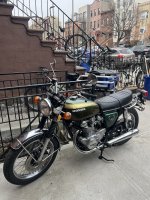
  1. Honda CB450 1973
  2. All stock except - Pamco Electric points with an electric advancer

Initial symptoms
  1. Bike idled properly at 1200rpm and started from kick
  2. After riding, the bike would sit at 3K rpm and white smoke would emit from the left exhaust.
  3. Left spark plug was black and wet. (fixed)
  4. Left exhaust leaks dark liquid (unclear if gas or oil or both). Right side is healthy. (fixed)

Current symptoms:
  1. Right side exhaust is hotter than left.
  2. Bike idled properly at 1200rpm and started from kick
  3. After riding, the bike would sit at 3K rpm and white smoke would emit from the left exhaust.
  4. After replacing the carb boots and the most recent test ride around the block, the bike starting at an 1200rpm idle successfully engaged the gears without the hanging idle. But a couple minutes in, the bike gear slipped transitioning from 2nd to 1st, getting stuck in neutral. After getting back in 1st, the bike would not hold idle and died. I pulled over and the bike would not start until after a minute with the bike fully off. Upon starting up, the idle jumped to 3k and remained. Worth noting, this was the first time i rode with the headlights on. After getting back home, I noted the left side was sluggish would only respond if i manually lifted the left side idle screw to flood that cylinder with gas.
  5. The left side exhaust is popping.

Completed Maintenance (not in this order):
  1. Reset cam chain
  2. Set valves at 0.04mm (the manual states 0.03mm, but the smallest I own is 0.04mm).
  3. Cleaned carbs (they were in good shape).
  4. Reset float bowls to 20mm, they were around 22mm.
  5. cleaned petcock and replaced incorrect O-ring,
  6. Recharged battery.
  7. Replaced both spark plugs and plug caps - running zero resistant plugs with 5ohm resistant caps
  8. changed oil
  9. Replaced gaskets at valve covers (these were clearly not removed by previous owner).
  10. Rerouted clutch cable which was rubbing against throttle cables. Reset clutch cable.
  11. Resynced throttle cables.
  12. Resynced carbs by running on one cylinder at a time. left side first with air screw at 1 full turn out, lower idle screw until 1100 rpm, turn air screw up and down to find highest rpm. Repeat on right side. Then reconnect both spark plugs and run bike. Turning each idle screw an equal 1/8th turn at a time, finding the idle at 1100rpm.
  13. Replaced rusty gas cap and seal.
  14. Loosened clutch cable to 3/4” play per spec.
  15. Checked air leaks by spraying carb cleaner on carb while bike running. No leaks found at the boot or carb.
  16. Replaced carb boots.
  17. Compression is 160 left, 162 right - engine warm

My understanding is the right side is running lean (exhaust is hot), the left side is not producing equal power. Replacing the plugs and plug caps removed the smoke from the left side and improved overall performance. I am starting to suspect there is some timing issue, but my understanding of electric ignition with e-advancers is they are set it and forget it….unless the guy who installed it did so incorrectly. Unfortunately I no longer own a strobe so I have not been able to check timing.

At this point, Ive read so many of the hanging idle and related threads and cannot seem to find an issue that speaks to the idle only occurring after the bike is under load. This sounds to me like an air leak, but not sure how that relates to the left side under performance. Please let me know your thoughts.


Thanks!

1973 CB450IMG_9392.jpeg
 
Last edited:
As much as you may not want to do this - do you still have the original points?

Resetting everything to stock is a great way to eliminate uncertainty.

That said, I had a hanging idle on my 350 that was the result of a hysterically bad carb sync. It sounds like you’ve already completed that though.

The only other obvious culprit would be a vacuum leak. I’ve had that happen with bad aftermarket boots/intake gaskets. Check w/ starter fluid or carb cleaner around the intakes and see if there’s any change in idle speed. Check cold and hot.
 
A hanging idle can often be related to ignition timing, the mechanical advance (loose springs), air leaks, poor synchronization of the carbs, or issues with the throttle cable. In your case, the electronic ignition assumes responsibility for two of the usual culprits.

I think my dynamic timing light cost about $40 at Harbor Freight. Given that you haven't checked the function of the electronic ignition, that's where I would start. My understanding is that Pamco no longer exists, so there is no support available for that product. Were you given any paperwork on its function?
 
As much as you may not want to do this - do you still have the original points?

Resetting everything to stock is a great way to eliminate uncertainty.

That said, I had a hanging idle on my 350 that was the result of a hysterically bad carb sync. It sounds like you’ve already completed that though.

The only other obvious culprit would be a vacuum leak. I’ve had that happen with bad aftermarket boots/intake gaskets. Check w/ starter fluid or carb cleaner around the intakes and see if there’s any change in idle speed. Check cold and hot.
Hey, unfortunately, I do not have the original points.

I was thinking a vacuum leak too. Sprayed everywhere with carb cleaner and found nothing. Decided to swap the boots anyways, so now I have the those guys in Houston replacements. No change.
 
A hanging idle can often be related to ignition timing, the mechanical advance (loose springs), air leaks, poor synchronization of the carbs, or issues with the throttle cable. In your case, the electronic ignition assumes responsibility for two of the usual culprits.

I think my dynamic timing light cost about $40 at Harbor Freight. Given that you haven't checked the function of the electronic ignition, that's where I would start. My understanding is that Pamco no longer exists, so there is no support available for that product. Were you given any paperwork on its function?
Yeah, sounds like I need to check his work. He did not provide any info on the pamco. Not the most helpful seller I have to say. He had the bike for 6 months. I think he changed the points, changed the oil, replaced tires, polished the side covers and listed the bike.

I have no experience with e-points or e-advancers. My old 350 was points and had a similar issue fixed by resetting the advancer.
 
At least a dynamic testing light will help you see what the ignition is doing currently. If it's firing on the F/LF marks and the idle is high, then I would say you could look elsewhere for the cause of the high idle. If the high idle goes along with a greater advance angle, then it points to the ignition (no pun intended).

I have no idea if these instructions are correct to your unit, but found this on the 4-into-1 website.

If the Pamco unit is the issue, you could go to another electronic ignition or collect the parts needed to return to mechanical ignition timing, which it sounds like you've used previously with your old 350.
 
Okay, the strobe light arrived, and I found some time to test the bike. Here's the update -

The timing was way off. Very advanced on both sides. The variation was different between the two cylinders.

I rotated the plate counterclockwise to retard the timing. I couldn’t correct the timing completely. The left side is now a couple of degrees advanced, and the right is a few degrees retarded. At full advance, neither side can hit the mark. both retarded.

I took the bike on a 10 min ride -
At first, the bike had no hanging idle, but after a few minutes of stop-and-go traffic, I lost the left cylinder, and the bike died. I turned the bike fully off, then, after a few tries, got it to start. The hanging idle returned, though now would drop back to 1100rpm after stopping at the light. The bike started to smoke out the left exhaust lightly. A few minutes later, I lost the left side again. After more tries, I started the bike and rode slowly, and made it home.

This ride is not fully unlike the last ride, though now the hanging idle is not indefinite. At the very least, this Pamco was not set right and does not appear to operate correctly.

I ordered an advancer on ebay which should get here soon, but have been undecided if I should find a points plate and condenser or hop to the Charlie's e-points kit. Both seem to have drawbacks. I am just hoping this actually fixes the issue, and doesn't lead to more searching.
 
I'm glad you were able to start making progress on the diagnosis at least.

I would think the state you describe with one firing a few degrees early and the other a few degrees late would get you home okay and if it's getting close to the full advance marks, that will help. If not, try not to go over 3000 to 3300 rpm.

Two more thoughts:
  • I wonder if it's moving somehow while you're riding.
  • The poor timing may have caused plug fouling that exacerbated the whole problem.
 
Last edited:
I'm glad you were able to start making progress on the diagnosis at least.

I would think the state you describe with one firing a few degrees early and the other a few degrees late would get you home okay and if it's getting close to the full advance marks, that will help. If not, try not to go over 3000 to 3300 rpm.

Two more thoughts:
  • I wonder if it's moving somehow while you're riding.
  • The poor timing may have caused plug fouling that exacerbated the whole problem.
hmm, I checked everything, nothing is loose (from what I can tell). Plugs are healthy.

Okay, so I reset the points. The left side is good both at idle and at advance. The right side is good at advance but slightly off at idle. Not sure I can get it corrected with the Pamco. At idle, the right side is on the T mark.
Here is a video of the bike at idle after the corrected timing and subsequent carb sync. This is before I take a ride.

After riding, I noticed the clutch cable was riding on the throttle cable. I rerouted the cable, so they never touch. Took it on another ride and the same hanging idle reoccurred. If the points are not the problem, spark is strong, this must be a carb issue again. It sounds and feels like the left side is flooded with gas. But Ive opened and cleaned these carbs several times and set the bowl to 20mm. Not sure what the issue could be. Any ideas?
 
In the pre-ride video, it sounded like it was using a wee high and I think I saw about 1400 RPM on the tach. When you cupped your hand in the exhaust gasses, the right sounded like it had greater back pressure. I trust that you can feel it better in person than I can through the internet, but it might help balance things to turn the idle screw out slightly on the right carb to bring the idle side down and balance the back pressure more.

I'd like to hear the hanging idle before suggesting anything there. A little trick I ran into once with hanging idles was that flicking the kill switch off and then back on could sometimes help reestablish the low idle without killing the motor. Kind of like opening a dryer super fast to throw one more sock in.
 
In the pre-ride video, it sounded like it was using a wee high and I think I saw about 1400 RPM on the tach. When you cupped your hand in the exhaust gasses, the right sounded like it had greater back pressure. I trust that you can feel it better in person than I can through the internet, but it might help balance things to turn the idle screw out slightly on the right carb to bring the idle side down and balance the back pressure more.

I'd like to hear the hanging idle before suggesting anything there. A little trick I ran into once with hanging idles was that flicking the kill switch off and then back on could sometimes help reestablish the low idle without killing the motor. Kind of like opening a dryer super fast to throw one more sock in.
Here is a video from the ride right after fixing the timing.


Definitely agree with the point on tuning. i believe i did some tweaking before taking off. As for the kill switch trick, didn’t try on this ride, but i have in the past. when turning the bike back on, I was still at a high idle. Hopefully this video helps show. After this ride, I fixed the cable routing, thinking that was the problem.
 
My first observation from both videos is the cam chain sounds a little loose, though that is not the cause of your idle situation. Have you done the full tune-up? Cam chain adjustment, valve adjustment (.0015" or .002" clearance, no larger), along with the Pamco timing? As to that, I'd go back to points and stock advancer first to ensure the parts (mostly the advancer) would be ready for a Charlie's Place EI. Changing from points to EI isn't a solution, it's an improvement in consistency and nothing more because the weaknesses of the mechanical advancer will still be there. And, you're sure this Pamco has e-advance? Did you check to see that there's not actually an advancer the pickup rotor is attached to? We haven't seen any of that up close, and it's hard to understand why a piece of electronics that actually works would have changed its behavior.
 
What did you do around the 1:00 mark that settled the idle to about 2000 for a second? Was that closing the throttle? If so, your throttle cable is too tight. It needs to have a bit of slack before it starts to open the throttle plates.

It also seemed like when you turned the bars the idle went even higher as is the 2-1 cable junction might have one or both cables jumping out. Maybe not because it seemed like the throttle arms were down on both carbs, but worth checking.

If neither of the above, have you checked for air leaks? I saw one, but it was in your left pant leg and won't affect the idle speed. 🤣

I don't like to let my bike idle at 3000+ rpm for that long. Probably doesn't hurt anything, but makes me feel like the toast has been in too long and I manually pop it out so it doesn't get burnt.
 
What did you do around the 1:00 mark that settled the idle to about 2000 for a second? Was that closing the throttle? If so, your throttle cable is too tight. It needs to have a bit of slack before it starts to open the throttle plates.

It also seemed like when you turned the bars the idle went even higher as is the 2-1 cable junction might have one or both cables jumping out. Maybe not because it seemed like the throttle arms were down on both carbs, but worth checking.

If neither of the above, have you checked for air leaks? I saw one, but it was in your left pant leg and won't affect the idle speed. 🤣

I don't like to let my bike idle at 3000+ rpm for that long. Probably doesn't hurt anything, but makes me feel like the toast has been in too long and I manually pop it out so it doesn't get burnt.
After that ride I surmised the cables where fighting each other. The clutch cable was riding the throttle, so I rerouted both and reset the slack. The next ride, the hanging idle returned.

I couldn’t find air leaks and I swabbed the carb boots out for new ones, swapping out the pants next 😂

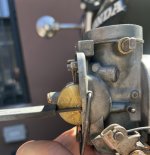
My guess is fuel is leaking into the cylinder. Usually that would be a high float level. I have it set to 20mm, see below. Maybe I should lower it and see if the problem disappears. Not sure how else fuel would leak or where other air leaks could occur. or what other problem could cause the symptom.
IMG_0025.jpeg
 
My first observation from both videos is the cam chain sounds a little loose, though that is not the cause of your idle situation. Have you done the full tune-up? Cam chain adjustment, valve adjustment (.0015" or .002" clearance, no larger), along with the Pamco timing? As to that, I'd go back to points and stock advancer first to ensure the parts (mostly the advancer) would be ready for a Charlie's Place EI. Changing from points to EI isn't a solution, it's an improvement in consistency and nothing more because the weaknesses of the mechanical advancer will still be there. And, you're sure this Pamco has e-advance? Did you check to see that there's not actually an advancer the pickup rotor is attached to? We haven't seen any of that up close, and it's hard to understand why a piece of electronics that actually works would have changed its behavior.
Yep, first thing I did was reset cam chain per the FSM, loosening and tightening the adjustment screw when the rotor is at LT. Then valves set at tight 0.04mm. Don’t have the 0.03 feeler gauge listed on the FSM, but I know a tad loose shouldn’t hurt the bike.

I have an advanced arriving today, was struggling to find a good points plate and debating continuing with an EI, so haven’t replaced those. The pamco is an E-advance. there’s not mechanical advancer behind the plate. I also can’t quite understand why the Pamco would act incorrectly. That said, I do have it pretty close now after my last adjustment.
 
Yep, first thing I did was reset cam chain per the FSM, loosening and tightening the adjustment screw when the rotor is at LT.
That's probably why it sounds a little bit loose - the position to release the adjustment lock bolt is 90° past LT on compression stroke, and it should be done while the valve covers are off so you can watch the left intake follower open and close the valve prior to reaching LT.
 
The only issue I have with your float level theory is that more fuel in the bowl should not raise the idle. Too much fuel at idle usually causes the motor to bog down towards a stall.

If you shut off the fuel flow with the bike idling, the engine speed should eventually climb as the fuel level in the bowl goes down. That's because the mixture leans out as the fuel level drops.
 
That's probably why it sounds a little bit loose - the position to release the adjustment lock bolt is 90° past LT on compression stroke, and it should be done while the valve covers are off so you can watch the left intake follower open and close the valve prior to reaching LT
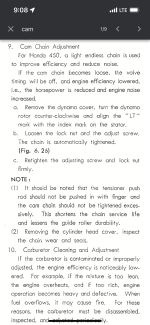
Sorry yes, pretty certain that’s how I set it since I was using the CM guys video plus some forum posts. Walking and writing isn’t the best. That said, I don’t see the 90 degrees past on the manual, see below. now wondering if I was looking at the manual and forgot. I’ll def redo the adjustment today to be sure.
 

Attachments

  • IMG_0027.png
    IMG_0027.png
    742.1 KB · Views: 5
The only issue I have with your float level theory is that more fuel in the bowl should not raise the idle. Too much fuel at idle usually causes the motor to bog down towards a stall.

If you shut off the fuel flow with the bike idling, the engine speed should eventually climb as the fuel level in the bowl goes down. That's because the mixture leans out as the fuel level drops.
hmm well it does eventually bog down. If I keep riding for a few minutes, the left side dies and i have to wait to restart the bike.
 
Sorry yes, pretty certain that’s how I set it since I was using the CM guys video plus some forum posts. Walking and writing isn’t the best. That said, I don’t see the 90 degrees past on the manual, see below. now wondering if I was looking at the manual and forgot. I’ll def redo the adjustment today to be sure.
You're right, that's one of those things that wasn't conveyed correctly in the FSM but there's a service bulletin about it and it was recently posted. I assume you've seen this thread, and though the service bulletin posted later in the thread is about the 350, the same principle applies to the 450.

 
You're right, that's one of those things that wasn't conveyed correctly in the FSM but there's a service bulletin about it and it was recently posted. I assume you've seen this thread, and though the service bulletin posted later in the thread is about the 350, the same principle applies to the 450.

Okay, yes that’s what I thought. Read through that and fairly certain I followed those instructions for the adjustment. Perhaps not a bad idea to run through the adjustment again just to be sure.

I am assuming this is likely not the culprit of the hanging idle and eventual loss of power.
 
hmm well it does eventually bog down. If I keep riding for a few minutes, the left side dies and i have to wait to restart the bike.
Have you done a float level check with the clear tube method?
 
Sorry yes, pretty certain that’s how I set it since I was using the CM guys video plus some forum posts. Walking and writing isn’t the best. That said, I don’t see the 90 degrees past on the manual, see below. now wondering if I was looking at the manual and forgot. I’ll def redo the adjustment today to be sure.
Unfortunately, many of the really old FSMs don't capture updates from Service Bulletins, etc.
 
Okay, so quick recap since there are a few threads going and I want to see if I am capturing everything.

Generally when I ride,
1. The bike starts at 1100-1200rpms.
2. idles okay for a block then either jumps to 3k rpm and sits or the left side boggs down, engine speed drops, and the bike stops.
3. when restarting the bike, the same two symptoms occur sometimes in different order. during high idle, if i shut the bike off then restart, I am right back at 3k rpm. if i kill the fuel, the bike runs for a couple minutes then the engine speed slowly drops till the bike dies.

The timing -
1. at 3k rpm, both sides hit the advance marks with the pamco EI.
2. at 1100rpm, the left side is on LF and the right side is on T.
Likely going to swap to mechanical points and advancer.

Carbs -
cleaned and floats at 20mm per prior pics.
fuel cables and clutch cables don’t interact, both have some play before engaging.
Carbs tuned by matching back pressure at 1100rpm, finding highest rpm with mix screw on both sides, verifying equal back pressure again.

Cannot find any air leaks and carb boots replaced.

Sounds like I need to -
1. tighten cam
2. set valves
3. double check timing
4. clear tube check for floats
5. retune carbs
6. ride

anything i’m missing?
 
And to be clear - because it was mentioned earlier by Brody but I didn't see a complete response - there has to be some free movement in the separate throttle cables at the carbs as well as some free movement at the throttle on the bars, both so cable movements while turning the front wheel don't influence the idle and just off idle throttle movement when you're trying to start from a stop and have to turn while slipping the clutch.
 
And to be clear - because it was mentioned earlier by Brody but I didn't see a complete response - there has to be some free movement in the separate throttle cables at the carbs as well as some free movement at the throttle on the bars, both so cable movements while turning the front wheel don't influence the idle and just off idle throttle movement when you're trying to start from a stop and have to turn while slipping the clutch.
Thanks for catching that! Yes, I rerouted the cables and reset slack, so there is play at both the throttle and carbs. turning the handle bars doesn’t move affect the cable anymore.
 
Okay, so quick recap since there are a few threads going and I want to see if I am capturing everything.

Generally when I ride,
1. The bike starts at 1100-1200rpms.
2. idles okay for a block then either jumps to 3k rpm and sits or the left side boggs down, engine speed drops, and the bike stops.
3. when restarting the bike, the same two symptoms occur sometimes in different order. during high idle, if i shut the bike off then restart, I am right back at 3k rpm. if i kill the fuel, the bike runs for a couple minutes then the engine speed slowly drops till the bike dies.

The timing -
1. at 3k rpm, both sides hit the advance marks with the pamco EI.
2. at 1100rpm, the left side is on LF and the right side is on T.
Likely going to swap to mechanical points and advancer.

Carbs -
cleaned and floats at 20mm per prior pics.
fuel cables and clutch cables don’t interact, both have some play before engaging.
Carbs tuned by matching back pressure at 1100rpm, finding highest rpm with mix screw on both sides, verifying equal back pressure again.

Cannot find any air leaks and carb boots replaced.

Sounds like I need to -
1. tighten cam
2. set valves
3. double check timing
4. clear tube check for floats
5. retune carbs
6. ride

anything i’m missing?
I think going back to points and stock advancer (with no slack in the return springs for the weights, which is what puts some people in this position to begin with), then following the correct order of points adjustment and timing according to the FSM, should get you running normally. Then switching to an EI like Charlie's will be simple.

This is the synopsized version of the FSM points and timing adjustment procedure.
-----------------------------
The correct method involves first turning the engine until the breaker cam opens first the left set of points to the fully open position and setting the gap of the left points at .014", then turning the engine until the right set of points is fully open and setting them at .014", then adjust the left side timing by rotating the points plate so the left points break at LF. You then lock the points plate and check the timing on the right cylinder to see if the points break at the F mark and if they do not, you adjust the gap to get the right points to break at F. If after that adjustment is made, the gap on the right points is less than .012", you go back to the beginning and reduce the left points gap to .012", set that timing by rotating the plate to open at LF, then check the right side again and adjust the right points to open at F.

Yes, it can take a few tries to get both correct, but that is the procedure since there is only one plate that both sets of points are mounted on, so when you rotate the plate to advance or retard the left timing it affects both.
 
I think going back to points and stock advancer (with no slack in the return springs for the weights, which is what puts some people in this position to begin with), then following the correct order of points adjustment and timing according to the FSM, should get you running normally. Then switching to an EI like Charlie's will be simple.

This is the synopsized version of the FSM points and timing adjustment procedure.
-----------------------------
The correct method involves first turning the engine until the breaker cam opens first the left set of points to the fully open position and setting the gap of the left points at .014", then turning the engine until the right set of points is fully open and setting them at .014", then adjust the left side timing by rotating the points plate so the left points break at LF. You then lock the points plate and check the timing on the right cylinder to see if the points break at the F mark and if they do not, you adjust the gap to get the right points to break at F. If after that adjustment is made, the gap on the right points is less than .012", you go back to the beginning and reduce the left points gap to .012", set that timing by rotating the plate to open at LF, then check the right side again and adjust the right points to open at F.

Yes, it can take a few tries to get both correct, but that is the procedure since there is only one plate that both sets of points are mounted on, so when you rotate the plate to advance or retard the left timing it affects both.
okay, will try this. I’ve done timing with points on a cb350, so fairly familiar though out of practice.

Found a points plate on ebay, should be here next week. advancer is arriving today. Not familiar with the Pamco install process so unsure if there any other parts i need to buy to return to stock. if anyone knows would be super helpful, but ill look deeper to see if im forgetting anything.

pending rain, will likely reset cams and valves plus run the clear tube check on the floats today to see if those were incorrect.
 
Found a points plate on ebay, should be here next week. advancer is arriving today. Not familiar with the Pamco install process so unsure if there any other parts i need to buy to return to stock. if anyone knows would be super helpful, but ill look deeper to see if im forgetting anything.
As long as you have the condensers, points plate and wires to connect to the coils/condensers, the advancer is all you need (though having the proper bolt and correctly-sized hardened flat washer for the advancer would be best)
 
Back
Top Bottom