CB500T Head gasket replacement

lassmanjm

Well-known Member
Joined
Sep 18, 2020
Total Posts
75
Total likes
0
Location
Pittsburgh
Hey everybody! Just got my '75 cb500t and of course it's already loosing power and has sprung quite a leak right below the head. I'm convinced that it's just a head gasket leak, and replacing that should solve the problems. I wanna check the engine compression before doing anything, but I'm pretty sure I will still have to replace the gasket. Does anyone have any recommendations on where to buy gaskets or any tips on the process? It's my first time working on a bike so I want to be cautious. Thanks!
 
You could check compression of course, but since you want to solve the oil leak the engine has to come out of the frame to do that and you'll be taking the entire top end apart anyway so you'll be able to fully inspect everything at that point. Under most oil leaking circumstances, the head gasket is only leaking oil and not compression. If it did have a compression leak, which is rare on these engines and when you get it apart you'll better understand why, you'd know pretty quickly as it would not likely run on that cylinder or not very well if it did fire. As for gaskets, it's kind of a tough time for some parts availability. I like to use Vesrah gaskets but my usual place to buy them has been low on stock since Covid-19. It seems they have one complete set right now, I'd jump on it. Check the link in my reply to your Intro, there's a link in it that gives you lots of options for identifying and finding parts

https://4into1.com/vesrah-complete-gasket-set-vg-152-honda-cb450-cl450-1968-1974/
 
Thanks! Just got some vesrah gaskets off that site. I figured the leak in the head gasket was the reason for the poor performance. If the compression is low, is there something else I should check for?
 
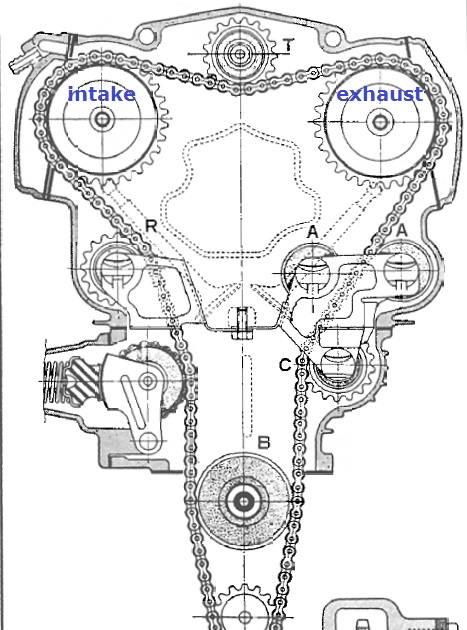
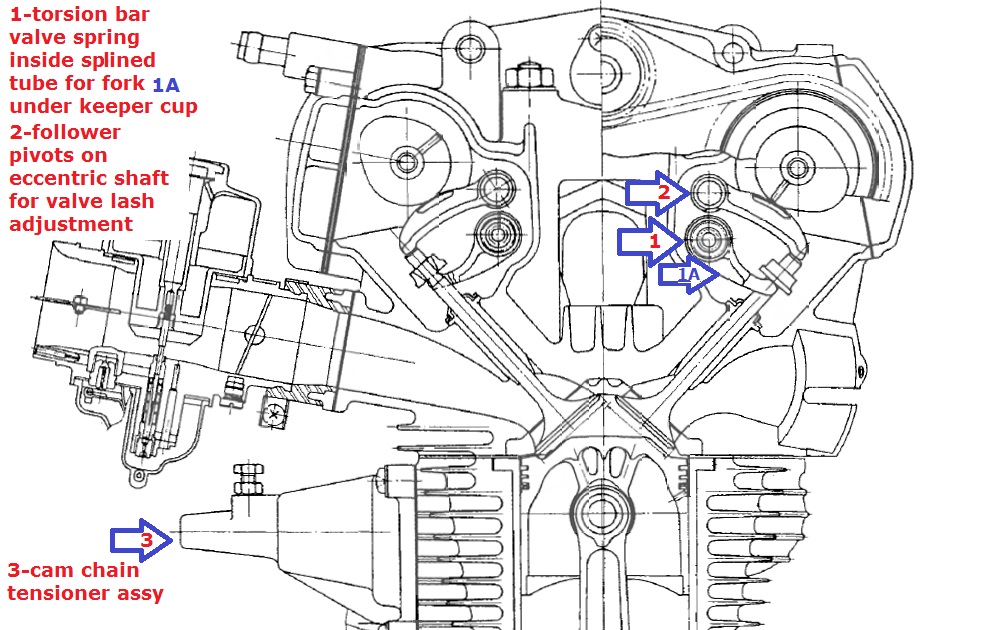
If you're going to tear it down for the leak, you'll do best to just wait to inspect everything. If you're not familiar with this engine, you're in for a treat - the cylinder head is as unique as anything you'll ever see from that era. There's no way to predict what parts are going to be serviceable and what you'll need to replace, so just get the big old lump out of the frame and get it on the bench, then come back and we'll talk about proper disassembly of it. And BTW... DO NOT watch the those guys in Houston Collective 450/500T top end teardown video, it is FULL of improper methods. In the meantime, go to the link for the FSM library in your welcome package and download the manual for it. Read up on the top end disassembly. Here's a visual primer, the top end of the 500T is essentially the exact same as the 450.

hHacTTx.jpg


8GvHZ92.jpg
 
Thanks so much! I just ordered a compression tester, so that'll be the first thing I do in the next couple of days. Will I need anything other than the gauge and adapters for the test?

I should have the engine taken out by the end of the week and I'll be sure to let you know as soon as I do. Thanks for all the help!
 
The plugs in the 450/500T engine are 14mm size, 1.25mm pitch, so you'll need to have that size to fit the plug hole. Still not sure why you are going to test compression when you're going to tear down the top end anyway, the parts will tell the story. No matter, and since you're pulling the engine you may as well pull the carbs off first before you do the test, or hold the throttle wide open for the test and turn the engine until the gauge stops rising.

Let me reiterate though... please do not start disassembly until you read the top end teardown section of the FSM and check with us to make sure you do things the best way.
 
For sure! I'll be sure to check in as soon as I have the engine off. Thanks for looking out!
 
No worries, it's what we do here. We want as many of these great bikes to survive and stay on the road for as long as possible. (y)
 
Hey, quick update! I ran a compression test a few days ago and got ~150 (factory spec is 170) and putting a little oil in the cylinders didn't seem to change the results (so it's likely not bad rings). This doesn't seem too bad to me, especially since we know the head gasket is bad. We got the engine off the bike and we're gonna crack into it today or tomorrow. Any tips?
 
Tip #1 Don't watch any those guys in Houston videos on the breakdown/disassembly of the engine.

Do these in order

1. Rotate the motor until you're at TDC
2. Remove cam chain tensioner.
3. Break/separate the cam chain.
4. Loosen the head nuts and remove head. Careful not to let the ends of the cam chain fall down to the crank.

Now you can safely remove the cams

Things you will need to assemble this motor

1. gasket set
2. Hondabond (if you are intend to split the bottom cases)
3. Replacement allen bolts (if you're like me and don't want to deal with the JIS bolts going forward). If you choose to keep everything OEM then you will need a good set of JIS screwdriver bits.
4. A cam chain. This is by far THE best chain (OEM) and THE best/cheapest place to get one (even with the shipping cost it's still the cheapest) and Frank is a pretty stand up guy to deal with.

https://www.ebay.com/itm/Honda-CB-4...T128-mit-Schlos-timimg-cam-chain/361472845175
 
^^^I would add to what he said with: once the head is on the bench and you're ready to disassemble it, use a flat screwdriver to lever the camshafts using the sprocket teeth to rotate them until the valves are closed before removing the cam bearings. You want no load of opening a valve on the cams when removing the cam bearings. Once the cams are rotated to where all valves are closed, they will spin freely in the bearings (the short distance they can rotate before starting to open a valve). This is the point where the cam bearings will come off without resistance, so no damage will be done.
 
For the price, I'd absolutely do it if you plan to keep the bike. They don't often fail, but if they do it's a catastrophic event - valves stop moving and immediately one (or more) gets hit by pistons that do not stop moving.
 
You're already there and done most of the hard work once you disassemble the motor so might as well replace what you CAN replace and have some peace of mind.
 
Also, wouldn't I have to take apart the whole engine tho replace the cam chain? Like I'm only taking off up to the head right now, and to get a new cam chain in I'd have to get it around the crank shaft right?
 
You can't really make a list before tearing it down and inspecting everything. Take plenty of pictures of all the parts and post them here, we'll go over it all with you. Typically the 450 and 500T can need follower attention if not cam lobes as well, based on the warm-up habits (or lack thereof) of the PO. The cam chain guides and rollers can be suspect in them too but usually just aging, they rarely fall apart or disintegrate except for the all-rubber center roller and tensioner roller.
 
Also, wouldn't I have to take apart the whole engine tho replace the cam chain? Like I'm only taking off up to the head right now, and to get a new cam chain in I'd have to get it around the crank shaft right?

No - remember, you have to break the cam chain to take the head off, so you'll have the 2 ends, one of which you can use to zip tie the new chain to and slip it around the crankshaft sprocket while the top end is off. Something else not yet mentioned: the factory master link (staked together, or possibly an aftermarket link pressed together) is usually where you take the cam chain apart, but since you'll be replacing it then you can break the chain anywhere. You're going to end up pulling the cylinders as well because the base gasket is likely to break loose and probably get damaged in the process. You wouldn't want to short-cut things and end up pulling the top end apart again later if the base gasket starts leaking...
 
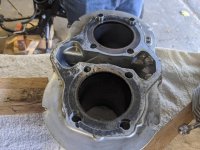
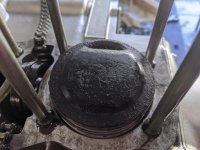
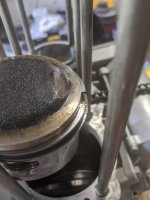
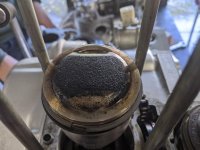
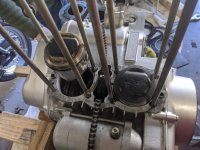
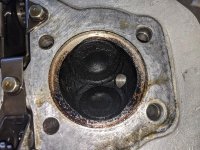
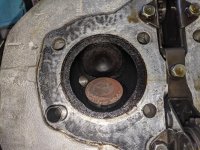
Hey guys, thanks for all the tips. Finally got the head and cylinders off. Everything is looking pretty good! The gaskets didn't look to broken up, but did look rather cheap which could account for some of the issues. The bike was definitely running quite rich, especially the left cylinder (which I already knew) as there is a ton of black buildup on the spark plugs and piston heads. Everything is looking pretty good though! The cam lobe and cylinders are smooth as butter and everything seems to be in pretty decent shape. I'm going to clean everything up and replace the piston rings and hopefully that should solve the compression issues. Here are some photos! Let me know if you notice anything or want me to snap some pics of anything else! Thanks!!

IMG_20200930_135428.jpgIMG_20200930_135420.jpgIMG_20200930_135404.jpgIMG_20200930_135353.jpgIMG_20200930_140129.jpgIMG_20200930_135351.jpgIMG_20200930_135348.jpg
 
Looks like it sat for a while at one point in its life, looks like some small spots where rust began around the rings but it doesn't look like it will be an issue, a hone should clean it up. If you're just going to put new rings in it, you should be sure all the rings are free in the lands all the way around the pistons. You should also consider replacing the wristpins, at least inspect them. Your pictures only show one cam lobe and it's not the one that suffers the most, the left exhaust. Pics of all the cam lobes would be nice, and you should plan to take the head apart and inspect all the followers too for any dished wear.
 
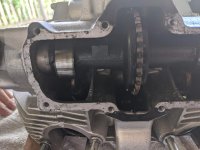
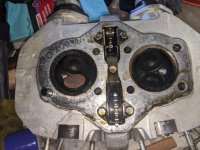
Yeah the odometer reads only ~7k which I was a little skeptical of at first, but everything seems to have very little wear. I just bought new rings off 4into1. Not sure the brand but the gasket set I got from them seems good quality. At this point I really just have to start cleaning all the gasket surfaces and start reassembling. Do you have any recommendations for cleaning? I bought some carb/parts cleaner and was scrubbing things with a sponge, but it wasn't really doing the trick for some of the surfaces. Here are some more photos of the head, (it's upside-down fyi). Again the cam lobes all feel very smooth. I'm a little unsure why the one valve is a completely different color than the rest though. Thanks!


IMG_20200930_175952.jpgIMG_20200930_175938.jpgIMG_20200930_175923.jpgIMG_20200930_175920.jpgIMG_20200930_175916.jpg
 
So I take it you're not planning to disassemble the head to inspect the cam followers? Or the tips of the valves? Or replace valve stem seals while you're there? Just new rings and run the rest of it like it was? How long do you plan to keep this bike? Going to flip it once running again? You can do as you like, of course, but if it were mine and I planned to keep it for a while, or the long term, I'd be inspecting every piece of it, lapping the valves at the least, replacing valve stem seals and inspecting the followers for any dished wear. You're already there, and it isn't like it's any simpler to do it later if needed.
 
No I was definitely planning on taking apart the head! Probably have to anyhow to get the cams in the correct orientation. I just meant for the cylinders/gasket surfaces which I'm focusing on right now. Definitely hope to keep the bike for a long time so I'd like to take care of everything!
 
I haven't gotten to taking the head apart and I kinda want to get the pistons/cylinders taken care of and put them back together before moving to the head. So do you have any suggestions for how to clean the gasket surfaces?
 
Just plain old hard work, any shortcuts often result in gouging the aluminum or removing some aluminum from the surface by digging too hard with a sharpened chisel or gasket scraper. I've tried practically everything, paint remover, carb spray, some of it helps but mostly it's just time and patience while carefully scraping. Trust me, it's the bane of all of our overhaul existences.

I want to try to clarify something I think you might not have clear in your mind, and if you do then correct me. You don't orient the cams while putting it together, it would be impossible to set the cams at their timing marks while assembling the head. Just as I alluded to about disassembly of the cams from the head so you don't have to force the cam bearing caps off the cams (like those guys in Houston's video incorrectly shows), you have to put the cams back in the head in the positions where all valves are closed, then use a flat screwdriver (as I mentioned a few posts earlier) to lever the cam sprocket teeth against the valve cover opening in the head to turn the exhaust cam until the mark comes up and aligns with the index on the right exhaust cam bearing next to the cam (tach drive side). The intake cam can't be positioned before you put the head on, as the mark comes up just as one of the intake valves is beginning to open and the cam will spring back since the lobe is just starting up its ramp on the follower. You align the intake cam after the head is on, right before you lift the lower section of the cam chain to the sprocket and slip the master link in. To which point, the cam chain is connected in the intake valve cover during assembly because the exhaust cam does sit still when the mark is aligned since it has both valves in play, which helps hold it in place.
 
Ok! Thanks for the tips. That makes sense. I'm gonna focus on everything below the head for now and I'll let ya know when I get up there! Are you noticing anything I should replace so I can order it sometime soon?
 
I don't want to sound critical, but until you take apart everything you plan to take apart, we can't see all the other possible things you might want to replace like valves, followers, wristpins and cam chain guides. This is why I suggested you disassemble the head so these things can be inspected and you can post pictures. I realize you're in uncharted territory here, but if you want to order all the stuff you need at one time (which probably wouldn't work exactly that way anyway, since one single place is not likely to have everything you need because you're dealing with an engine that is 45 years old and parts aren't readily available like newer bikes), it helps to have it all apart first and inspected to determine what needs to be replaced
 
Ok thanks! Just been cleaning the gasket surfaces and am gonna start taking apart the head soon. Unfortunately I had an accident and my friend knocked a piston to the floor. It feel about 3 feet onto concrete and received a couple dings. They sanded out pretty well but I'm still nervous. Should I just replace it? I found an nos piston on ebay for about $100 and I think it might just be worth it for some peace of mind.
https://www.ebay.com/p/1037455291?i...jnmIp6U0TMmfBsDHSbGNiUsaAphZEALw_wcB&thm=1000
 
Do the side of the engine the piston's go into matter? This was the left piston, do I specifically need a left piston or are they the same?
 
NEW pistons are all the same (unless oversize for boring/rebuild purposes), but your pistons should stay in the cylinders they were worn in as not all cylinders and pistons wear the same. Post pictures of the piston so we can take a look at the dings that happened when it fell.
 
The dings actually sanded out really well. I was just poking around online and people said to be very weary of micro cracks. The drop may not look like much but it could have messed up the structural integrity. I can post some pictures later today or tomorrow!
 
Alright, just been cleaning things for a little. Gonna get started taking apart the head but I'm a little uncertain. The manuals I've looked at haven't been super helpful and I can't really find any videos. Do you have any tips on the procedure?
 
Alright, just been cleaning things for a little. Gonna get started taking apart the head but I'm a little uncertain. The manuals I've looked at haven't been super helpful and I can't really find any videos. Do you have any tips on the procedure?

What manuals are you looking at? The FSM is the only thing you need and if you don't have it yet, it's in our library. Aftermarket manuals are well known for inaccuracies just like jets in aftermarket carb kits, and you certainly don't want to subscribe to any practices seen in some (or most) of the videos out there. To save me a lot of retyping, I found these from earlier in this thread. It's not a step by step exactly, but it outlines the basics. There are 4 screws in each cam bearing to remove them, and the key is to turn the cams until they're not opening valves before you start disassembly. Then the parts disassemble without undue stress and/or damage

https://www.vintagehondatwins.com/f...sket-replacement&p=15651&viewfull=1#post15651

https://www.vintagehondatwins.com/f...sket-replacement&p=16222&viewfull=1#post16222
 
Last edited:
Ok thanks, this thread has a lot in it and I forgot you had mentioned some stuff. So I'll have to remove the torsion bars, correct? Will I need the special tool they mentioned (the valve lifter), or is there another way to do this?
 
First, get the cams in proper position and remove the cam bearings. Then you will see the torsion bars. If you leak test the valves and they pass, and you don't plan to replace anything that is still functional, you don't need to remove the torsion bars... that's only required for removing the valves. Again, the manual steps will show the procedure and pictures. No, you don't need a special tool for the torsion bars, you just tap them out from the center but we'll cover that later. Get the cams out and we'll go from there. Better to keep this one step at a time instead of loading you up with info that gets buried in earlier posts.
 
Ok! I got one cam out and I'll get the other later today. How do I do a leak test? I've seen online the ones with water and compressed air.
 
I've seen it done both by filling the combustion chamber with a fluid like acetone or even parts washer solvent, and I've seen it done by filling the ports (with the same fluid) as well.

BTW - pictures, pictures, pictures...
 
I actually think it might make sense to just take apart the head and take off the valves just to clean them. I am a little worried about the one rusty exhaust valve. Does it make sense that it is the only one that is rusty, and is that a big problem? Or should I just clean it and not worry?

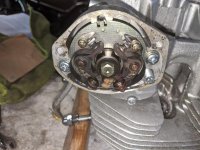
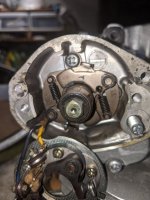
I've gotten both the intake side head covers off and the intake cam shaft out, as well as the tachometer gearbox. I'm on the last step of getting the exhaust cam out but I'm not fully sure how to get the point base off. So I first removed the two screws to get the point cover off to see this:

IMG_20201010_181412.jpg

Then I removed the locking bolt and the two screws to get this:
IMG_20201010_181512.jpg

So now I need to take off the center bolt correct? To do this I need to counter torque the camshaft via the gear other wise it will just rotate, right? I wasn't entirely sure so I just wanted to check with ya'll before I made a mistake. The last person really overtightened some stuff on the engine so I want to make sure I'm doing the right thing before I wail on it.

Once the camshafts are out I'll need to get the torsion bars out. I've seen a couple things online (one those guys in Houston collective video that I'm not sure I trust), so I have a bit of an idea. Any tips on the procedure?
 
Also, to replace the valve stem seals, do I need new valve cotters and valve spring retainers? In one of the videos I watched it seemed like they were broken off. Is there another non-destructive way of removing them?

Thanks!
 
Yes, the bolt in the end of the exhaust cam that holds the advancer has to come out to remove the advancer from the cam so you can see the other screws in the cam bearing/points base. You'll have to hold the cam with something but the 6mm bolt (10mm head) won't be that tight so even a pair of channellock pliers around the camshaft body (obviously, NOT one of the lobes) would be enough to hold it still. I should have mentioned that earlier but I figured it was self-explanatory since you can see one of the screws behind the advancer. Yes, the valves have to come out of the head to replace the valve stem seals. No, the cotters and "spring retainers" do not need to be replaced. I'm starting to get the impression you haven't read the disassembly portion of the FSM. The valve springs ARE the torsion bars and they do not have conventional spring retainers.

Again, I don't mean to sound critical - but either you watch those guys in Houston's videos and do it their way, or you stop watching their videos completely and listen to us. You decide, so I don't have to re-type things I've already said more than once. If you choose to watch those guys in Houston's videos, I can't help you.
 
Sorry, I've been referring to the fsm almost exclusively but this is my first time and I'm just a little confused on the valves. The fsm says to use the valve opener tool and says to remove the cotters and spring retainers to access the valves and the stem seals. It doesn't elaborate any more so I just am unsure of that procedure. Ive gotten the cam shafts out and now I just need to deal with the torsion bars and valves.
 
Thanks for all the help though! I really appreciate it. I'm a novice when it comes to repairing engines and the advice is so helpful.

One other thing though, I just got the piston rings I ordered off 4into1 and there aren't any markings for the top of the rings. I know there is supposed to be a beveled edge at the top, but it seems like both edges are beveled. Does this mean the orientation doesn't matter, or am I missing something?
 
Okay, good. This part is different, but not tricky or complicated, just different than the conventional valve spring engine.

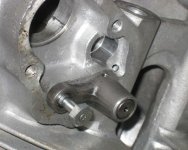
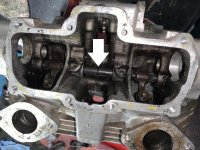
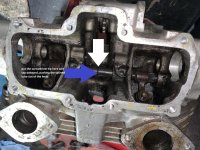
After removing the 6mm bolts (head size 10mm) that hold the torsion bars in the head as seen below...

torsionbarmount.jpg

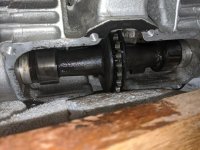
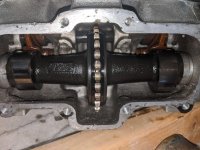
you then go to the inner area of the head, where the arrow in this picture points to the gap at the ends of the torsion bar splined holders. Take a flat screwdriver and use a hammer to tap on the end of one of the tubes toward the outside of the head. The splined tube will move outward, bringing the torsion bar with it and the torsion bar will pop off the dowel pin that locates it where the 6mm bolt goes in to hold it in the head. You do the same to remove all 4 torsion bars, then there will be no spring pressure on the valve cotters and the "cotter cup" can be removed from the valve, then the valve from the head so you can inspect them and replace the valve stem seals

450head.jpg

450head.jpg
 
Last edited:
Thanks for all the help though! I really appreciate it. I'm a novice when it comes to repairing engines and the advice is so helpful.

One other thing though, I just got the piston rings I ordered off 4into1 and there aren't any markings for the top of the rings. I know there is supposed to be a beveled edge at the top, but it seems like both edges are beveled. Does this mean the orientation doesn't matter, or am I missing something?

Post pictures of the rings. The chromed ring is generally the top ring of the two compression rings but there should be something to identify which side goes up.
 
Awesome thanks! I'll get started on those right now. Any advice on the piston rings and rusty valve?
 
Oh sorry, posted those at the same time. I'll take some pictures right now. Thanks!
 
Alright, here are some photos of the rings. I'm having a real hard time finding any difference between the two outside edges. I'll try to find a magnifying glass to see if that helops

WO-46dylVwb19XFCktclVOByTTs0Mm7ZPha8HRoK5RX3JHEJvzzsxIl7fmxSB2_BC4QiMyBAGDtn3YRgjlla8s2MBv5eUi0s4TOsN2jbJhw5GwiJFB2DOhElXRkSWEQout34XRv14GG1TS2vCPB7fwLB8_wo3ff4zSOMiIYXe9scv94aG075Q_Aq8TIP_Rc_zN5uZRH-tnHeosrvMy9cq0koi3LH6iLJYJhR3NWU4LdN2HJ99yYqfYLqqmM7LFzDer2oVn7qU6rmQ3CYt3TOtcmhmWB4GYsNtUTH_FGWNWuRyMUwNabbtVWP2AkP2QnaMP4tfcekhRHX36TIahhmTcJXwRnm2gvWTXKQ2o_Va63vGsZV3pXZjjCjMp-VwA8UaOHcbtK8OMwLrTPAYC4NuqHl3VRim9zm1VitSNbaHjH_QFSebW8NCI6ttdYh90QIgZRqOEmAapKyvEhbef-TGL77jV7Y2Zb1Gu2U9keOJYyJgusJHHGUuTiSF_5Cc3_V-i2de5wdXOSIJUEmWZ5VvOCMhDEn9xdmk34kMQwB0yxSuSSidCb9cCGowF8nKKhdwBjZ_ls451b9sU6WbCwe8FslIEp25EBHV97udkVobTXbKySKAcJGetHDCjJ9mTY19DxM6FzofZv2ju9Fws7yKcbMLpa_lBLvme_a1Rad1yohqoOnP0BidxrpZgvtPw=w727-h969-no


31P28fAAFqbeJ9LrHsdaw97_wYG-6NzPb7YjBUgyKOTAv-Bt-mtIJu8sD5AkBLW_wHxSHu_FEruPcz-mEZqMXbUrQV3SYyT9UUzOkq4dcr2lTslF1CK6uWgwoeybAm8Dq2BC6W0gB9H519engcv9H09mET6UsFfi6VL7eFv2cHXstk9UucejLwjA8BIyCELjJqaCc0eM6FB-YadLDSAME9UXzJn8HfcFYNLegiDzVLxqXoDAkUVGvmjtkEefDtprWhiJaJuI3bREnXBS20rJzEuWDFFEgmyeJaSs2-si_y3ydnMosEo9NMBD9O2p96NoljupOoMS2SJ83uBQJPaSI__Asee3U8RW0Hw_4Q197j1iD-Xxnwiu-46WYcU6SHjg2pgJNvtHGr3mCBo90TwZvPvz6RIj4-chtFoSS4gUljTqwTbaCTm_8Ux9xPzED3vBEn5M45qDeyh6mPN_bi455LX4CKR8rwrEyWI1KXIi-e-DNaJM1Pv5ACszB4aA6eaR3Ia1rPIfWQGLPgJvFEvYaEbSbCBxC-drrBzOWA6hT5Y_V1B7WzGvffF_nFwNMz0R5TaBqQ13Gv6AXBm9Me6oIIiIoiXtv_Ah6Yo_kftPULOx4_P1BW8Bzr72HkEBQ825eMLKGGQ_JbBhpUlnzi1navaW8sSq74TQhCKLtlxS4lM4_3T_DLqp5d9GNxshVg=w727-h969-no

S4ET8QKoyCjvMBtZbbdh7CkbsfXUXrKC3-m5u_VOHdjMUUiJixVrtWpznBfxYLO9rSCsujsgI0XemTGDJjx1ttay0IIn0j-DNmEvAwv1j6LosT10iI8qMrzqcylZTiiNI5epDQxR5SWmeM8hv3GoHvCfH1biwg89LujhHt63ssNIvZD0Zmkf85Q9eDXcV8RKch2Fb165-0iMrqaW7_A05Se6QsRvDs7GcvLNKbhad50FFT4pewRkh4wFBgT5Ri0YEfgHC0LmZCuNyycuUBLSzz7uKjpn8feVxP13PfMBxUSNTPwT8ZZy0Mm5vUeWltvPyml6r5385_GP2PgfdvaswKZ-IlFpcr18syJz46ur-eyCZ7Qc0Lve9g5MqaIXAbkEehXX08JqJCtFVz4eLYcoJ0trnSmO0hpKLRgWV3EqI8EJLH2w0ON3b3l7C3TQ48tLXYWsjf6CwVyWprwV_ySO9BH8fGG4inpw0zcOHRtQ6KS6B-Nd94UFeVRyJjMkgteIkeN5-OjZ9URNAJIgfJwdS4W70q46yE3tAYsDJ1QiICM_K9MDvFmQeXtKQqBFk7kR3DN1L--Z_kBxXFV-TCx9WWZkopYYiK2phzEKYARTGkBBO8QdjGZyQ8VSr4W21De-aZWDSZxP4wCA7BNpCHXNGRDakfYpmw5DfUXBPH5Jozwlsem7pBhjfTqqPDmt1w=w727-h969-no

76XJWo45IesI9YwpRvSBEOc5jeyF8wFWoaV4tCKobOS3elZZZ9Q9FOHmyj677NuJu4UNAhR9uJ5CmDqm2LPOJ2B1YV7I5edW16nWIawyjMgrzrfvMP9sJJblzXd139WjdYfa3k30NNmIjSm_CqGHFQya96TJFZRhD8QZYn8VqNv6onWJBJk83KlnFcBz5QvrAJu2QGGzv1f2wjOzxQYm8llNrCHRjKZ-4uQOKP4gmrRZ3La-106YaI4YFondlrsdsUvHm04cvEH8AQT1KQsQ2m77M5QjeF79WQq7_0mY9nrMDPUzSXl_tHxE_gVR1Yfr4YUzz8uDavYpPKqWPZhj2_cHFLp8bYV_KD8pMQS7Ub02rsOm0QjGezHMG076eMtxEHazcjO6C_CTtYYW5sqTURH2uNuiEhMxZt5j2pMrN0OVGBQHFiH6c_XCE7gz5-8YPdFGvl6kKwvtGCLEWJre1k7Y6qosQnW5hAlEiab2PFDMWMcN-Ao7ZE5OugCBQ6ErT_gXwCqbk7JrYKl_D8rqdE8ExnT5W8dhelAdhxEawza7fxxJw3s1B99lJwhp8vDy9u24L7ROuoystAYDBHZ-p8HB8H2PZMS4u7U5_Gw-oUlP55DAVrsWMjkQi0OYLzR0kqqlUJVdCVmAuQZIwCLcsrNexvp6zYL0HfkEHGEHqRNcBwdi6cL6ysJKiIwqSQ=w727-h969-no

QE1rc9Ylq6HUWaH8F7AqaBhny3J7FdgE3DYdvOshGwA11gNnTLqDfyGh7aYct7LyPIeupqGHYRF9fj2cCV19IR1iUGX4DNI9jusDhMuMznJgUDAboIrQJ2wKtWgBIMpmTVqOTz8-WC5e0agg5G5CIEi-ozquWoI7nEFdu05-V4sOmymSMCJfPh15VvtKK6eCH97tRSdrRBzzh6Qrs8ZfP9XMlyKz7vuGCk9ulkzmZ_ZjuVG3LsKlLgPPuDM_Z-hLtgVYIilzHJMXA2hBzfvuZ-9opua7EAz1Rpyfvclb0PJeTQseExN3AcU1CfVcySXQAetCkpJ7OY8224ZLa82hL-jaytPWmbf7VP-h72aPPx9QLgYzYSVoQmxArhXkEyb6pLln7Dk4eaG7GTlPGNzWU_h1gfEgZJcOWnuiOhedn9Qix44vyhvjZda9POQ8TdamZ30-xbqJobU2vttKBO2pTEfJGGLeB1mG7y7qyXJyrsQ3aJKOwb3Md3Yi07WAKxEhG6bAwwZSFGOo6jPWSyH8N3-l5uRKEmTFJGVlrowIm1GtRlVdo4vKDlGAtQlMBEVx84O6pYR1WHCKmyuJ-WHCFj2aJ6H8MDPx7AL-LhHzrDWCX7qHvbKLBXbsYYxXozhcTFypAeW6Z_DHx5GSDgZ9W--ZJbZvU_vHUzyERn43QyGbNOQjvYzBg10c-HwaMg=w727-h969-no

uMnCoxrNLj6wkre4pE25tGaG0wE5S6nSTldLQXB5q4QdCna97qnrMZPHoAIkm833Zd9D2t9JShE8skm5bE6YTb1Wv3krWCO4KFOiPgPxS5Qs2DA48KoToWVQ9fFpKCb378NcsyYMepvCSsxtGlcXlxQQeNJzjCL3p4dpvuF1Byrx3J3dlRaOUKD96En0AtOXXO2e0_m0NlKyXFUaJ5vvYe_4vEyiRVc0CynLm09GvrDN1C-KsQ91NRcntuIlRguTOVqvzOhQiTERQkUldknnpkM4GvPu6Hyod97rBraFDQFYNmBWm11jAnVhGoJ183CO-Umq3kra6-Npe0O4Fo0_f4N577kauL5IuY4wfh-YbE3c_NYTnNTejS6tPdPB9EYl2aSjEfNwNB5Si7VFr3LlwNOkPSqik8ST1rCK71ywDvOtSuJsR5kgwhO24Am_o4F5Z7KEnz64PTyFVCnHmLBQKeg0skulClXqNLDpPPJJTv8MPeSMBsUxykyRSGJCBcoQsY9rJKU0k1Z8xw4MWXznqQkXiezzCdXsWimv7r7MDeptevE910_lpsHXEwlHYIOkqMHhiQB5lvc1QrF3RymqOEJYsu-mlGm5kDHvUEZkVn4Z2JcP6Pcrp1sL2lXxKNWU2bDlpifr2_fTAmRKUzurcnS5UbV9obFH3mRSEpb5b8ERZCmlNkXtI_2OvVfOYw=w727-h969-no

rhhY4kr4UWaR-mMtvHE3eJw5gaTWfgKlPcjmL54b9_uXR9VsxL7h0bJjC8sweS_4ba81rAgeiAHjptr1Lzp-IxQt8Ji7g-KwvWw-KCLcxZ1eJnN13FuPNO8oAH8gdlBNM1GDdhKHvbS3joK0LoQyCHWinYph3MwVnWslAjmZME_NhdT7HOoGDKqQIib7H01j5hXsFaItdL3jQATqg5exqjcHuj3qRINA3XxT7maeWMsqtEpBUsvYrIFHubYa_jUVtNQ0A7niMUskFWlMLKOfXZQN8h9g5vc9Eh39QGJkte-pLuuGsa2XLxIET_7822xK2krNWlIAKTMj7RDrXzX1LvQqY1zHyfYC7-om20WW3YapZqTyGeMpifcsQDlNu6D-VC6NsdnnfXV3LiYHBjYVrZlZswKGgbDYgGfSfXeh0erHRgeWUUxN6nOEeiGTu8gQ9ZJVfHhzYK71qhJgfktKho6sa3yMP2f-QkKQEVNtWS_AVB_aBIDkHAApYjTp58zLnBLzizSPOV3emklJ2V80l9g-YmvoKYnomP8cWKPxTcHp9-Rpj9JsQHtPxhHWclT7P8ep2T9F6NOWJzvP6l7mA5zeZaYdSaRkXGpssN7Ynb8W2IIUl-Kw2my8DtVRNn0r2vhrARpykHron1Oods0kCtoAdyfTgjohw3RM5TZxv8uyS3RNgyPh7VXvyvtVvA=w727-h969-no

ux06w-_rqnYcufzjx-VGDAxSflc0BwQkzhvy_OCAJ5sXE1UkYvGX9XhWeTqTx3576wMH4Wh86oiNIgWuPThIVUfNtz6wBANcGKbouws5BlXxDVAdSkqvSb-PZ3XdD_xqARcgJY0q31e20GfhObVNpY6LlRVUHTmcC45aas6mjxBnmI32mqevzmjChjbbiGu9_UHHrYR_ztTpeflhTYshfEQnS9KaxUQ3l5arVL2sXWNe2tFuifY0b7abUCWeNUNh21iXUl5taG5aqG74jQMprI5WmP2Hvn8VgLo8S46PxsukFDCCAGJb55lKcttTmjeabHFjL4MXAAib9o3QF19PJdD4oEe1RzHVvNSyys7QCm0J6zLhGttlDSmVfDSrBi2WkMPlO_CBGkdW2KySQK7hzxwBu3mAFaIL4l9hWzRHvJwnO6GUxm7n5Zvtx5Jx2hZTQTI28-Fr9ZGo506YmP3o8pwlGNvbRGTUt4A6MH6PNvPI79D9sqhWkyEq3U8HGIMKSzcsfLoUkJ0VtuQ6-_musfF12DRKAxPagy5SSCty7xUhzjIOHXTbr8eh276n_kvCxInPBG338Ge3TCnjhuyyzPC28CytHeQnWfTalJxx8rCfpWyB97Xu26Gr4aCRWQSvgndtqxV-By3WQ8l7Mbm7pDI8sgU10Qx4YvAEzAGDlNG1KukTB86LFrNBROTyyw=w727-h969-no

J9wjR_sf65U0M7vng3f-QT9VGfMZ0Rfids2CuaWUhO3kosPQuEiSDUOtcC-X45ZnJ_OL_CAjAXcYzcJ-Lxj5JUbbkeEx7uH_zfsjvCC9MzlaRZ7gbzMCy9PRnzzLcr755zJDc3hZEsD6B9kznCA7EswOnQr14Ja6O6I7d3pCCUxIrRDP-U4RBNK1SssKhfbAXX56YMHrgIWtrJ-2c0BOTph7bcBzi3HulTOLjXa4ennFBgccZ8_pmdnaTRhbLr6wfU6fBp4kwaQEOntx67VMmfS9t-qOARopzcg_4qVWCLOOLDhWzEKEKWqRmCutO5gsgA1-3YQWrXkAnT9toHc_zEApG5PGOeew21md8bgD3kfxMEz9CB3BJPQCqKH2z_39qqj4rFuUqbujyNNkl65EqIrP-4xzYq7PpCWMScxcz4g6OmLHFNh6IeT3p5RPKXJ6f0YSy63y-cAsnw7Gau1Dg66Bj_S-ab76hiq5vp3YsWJF6q5f7ZzdtmH2lL9HWa9PXaBYPzb7v0dKoL-JJrSFwNiKCMEkta5k1qSKnzBrYMUGZsfu7XGewY3M63qKBkcqcwmDhWw91c6G03STCiE5VyvTO5XFuGypFBQ31P0NBoegBdByr2BGhjpV64GfeWVJSeItXfy7Q7TrtyBp667woAgyMsLL1-cFq9-KMk6dmUiNJByj-0elrQvnaHGfDA=w727-h969-no
 
In some of the pictures the wood is better focused than the ring. Is that a number or letters I see in this pic? If so, that's likely the upper side. Of the 2 compression rings, the chromed one is the top

ring.png
 
That's just a smudge, no writing unfortunately. I'll try to look at it under a magnifying glass. I just got the torsion bars off. How do I get the retainer and cotter off? The fsm just says take them off...
 
Only friction is holding them now, since there's no valve spring. Just push the cotter cup down and the cotters will fall out or can be lifted out with a magnet.
 
Back
Top Bottom