CB360G yard find — ongoing project log

stl360+450

Veteran Member
Joined
Aug 6, 2021
Total Posts
5,066
Total likes
2,612
Location
St. Louis, Missouri, USA
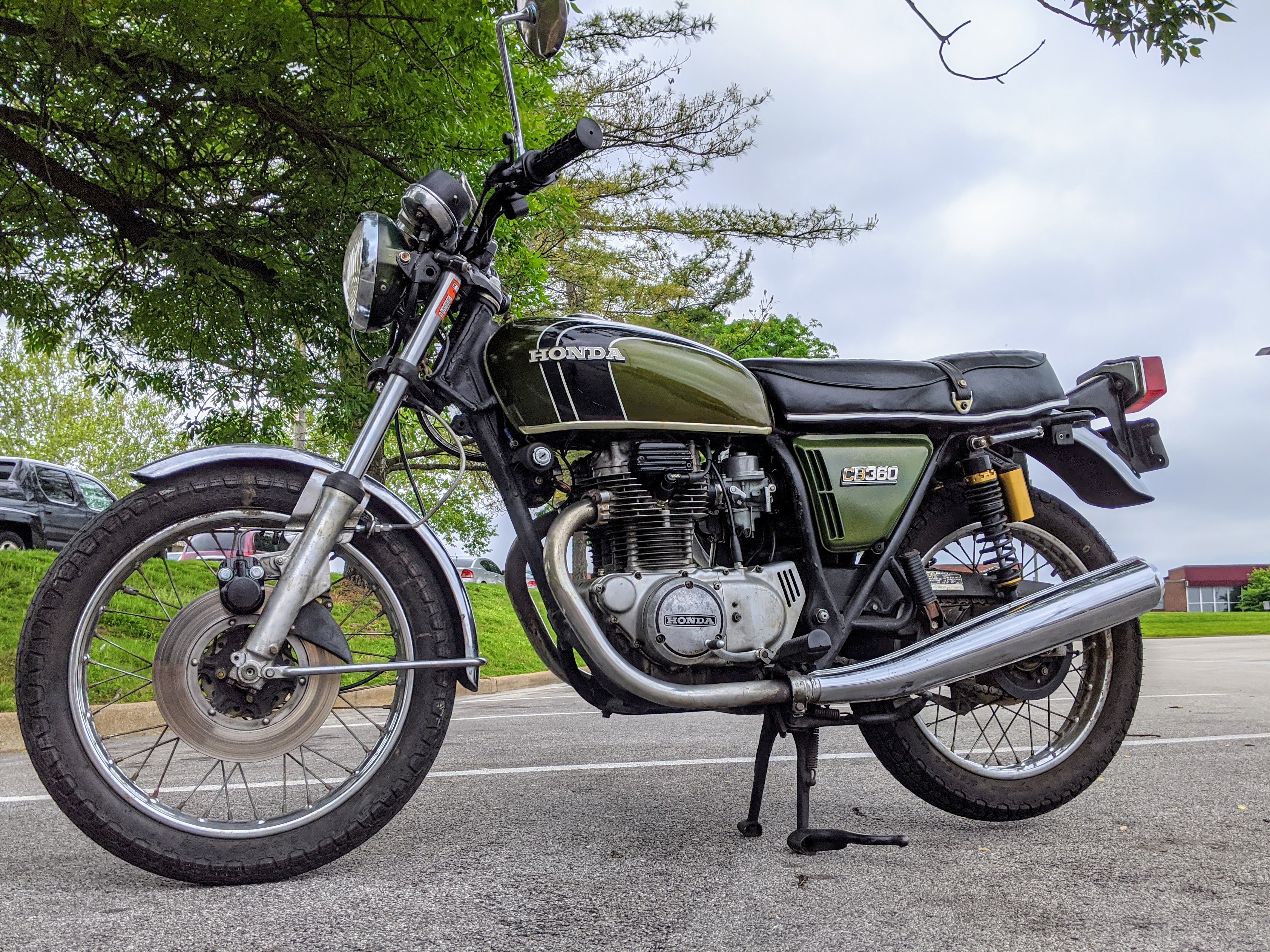
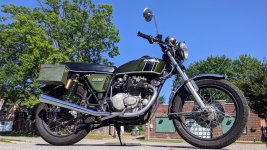
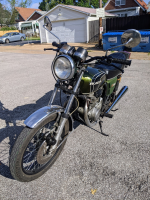
I joined VHT in August 2021 having already owned my 1974 CB360G for seven years. In that time I have added close to 4,000 miles on the odometer after getting it back on the road in late 2014. Due to its rough condition when I found it, I have replaced countless original parts, sometimes with aftermarket products and, in a few cases, with components borrowed from other CB models.

Contents: (added 18 May 2026)

The starting point:
Ra1GihG.jpg


Status in August 2021:
Y4JzFlM.jpg


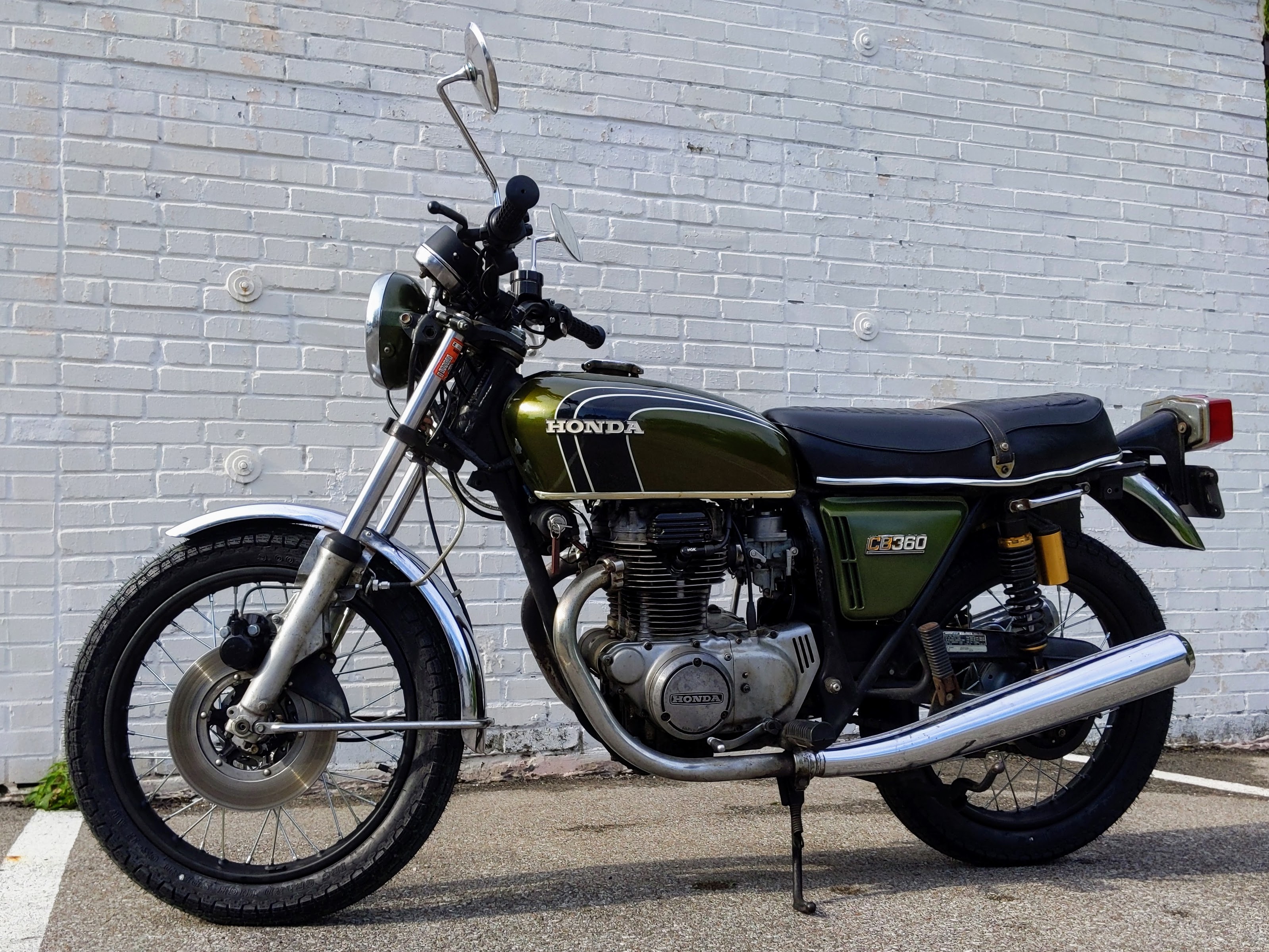
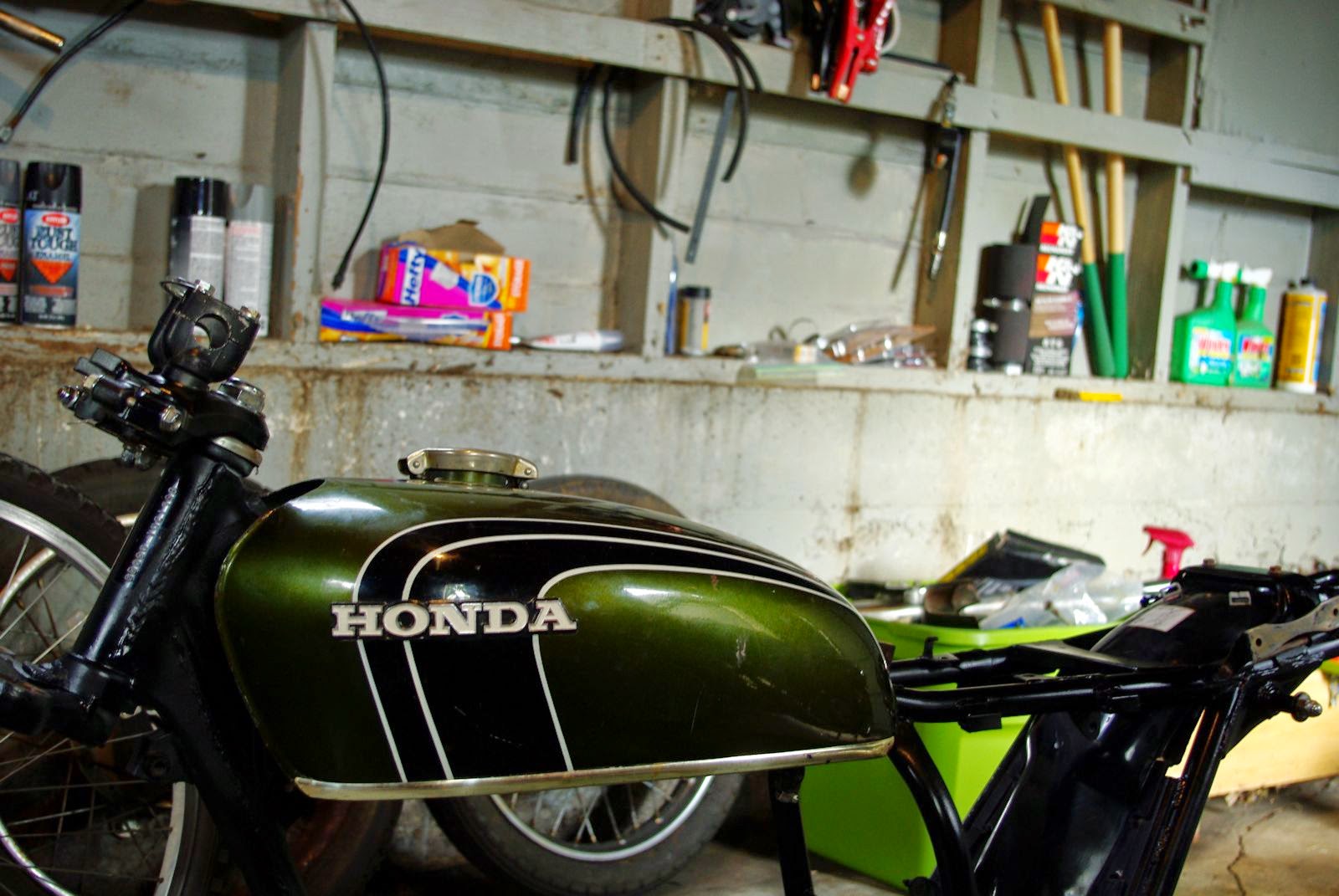
The CB350 tank stands out right away and was purchased at the local salvage shop (Archway International Motorcycle Salvage) because I was taken by the color and decided I would make it work. Besides, the original tank had rusted to the point of no return and I wasn't particularly fond of its design/decals. I later got some help from a local auto parts store with rattle cans to mimic the candy paint on the OEM side covers. I'm still working on my wetsanding/buffing skills, but it was fun to see how the candy paints work and to get the side covers sort of close to the paint on the tank.

The tank:
fHFc3BD.jpg


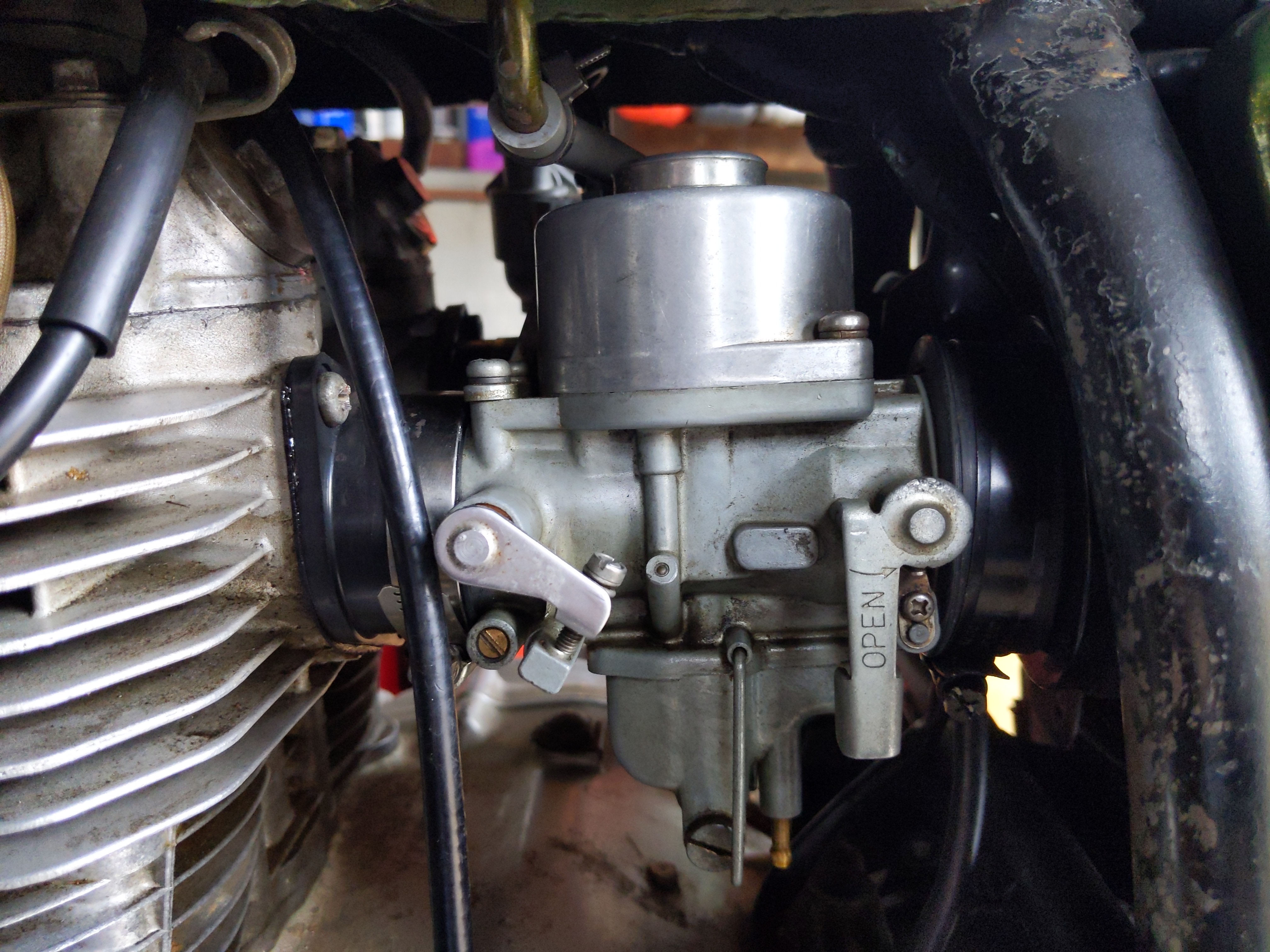
The other main borrowed component is the set of Keihin 723A carburetors that I acquired with the purchase of a 1972 CL450 parts bike. I needed the engine to get my CB450 back on the road and ended up with lots of extra parts. I had run an eBay-purchased set of OEM CB360 carbs on the bike for a while, but I had a lot of issues with them, particularly with the synchronization screw and I more or less decided on a whim to try the 450 carbs instead. Use of the 450 carbs required some modifications that I will detail later in this thread.

The carburetors:
XqJCSL1.jpg


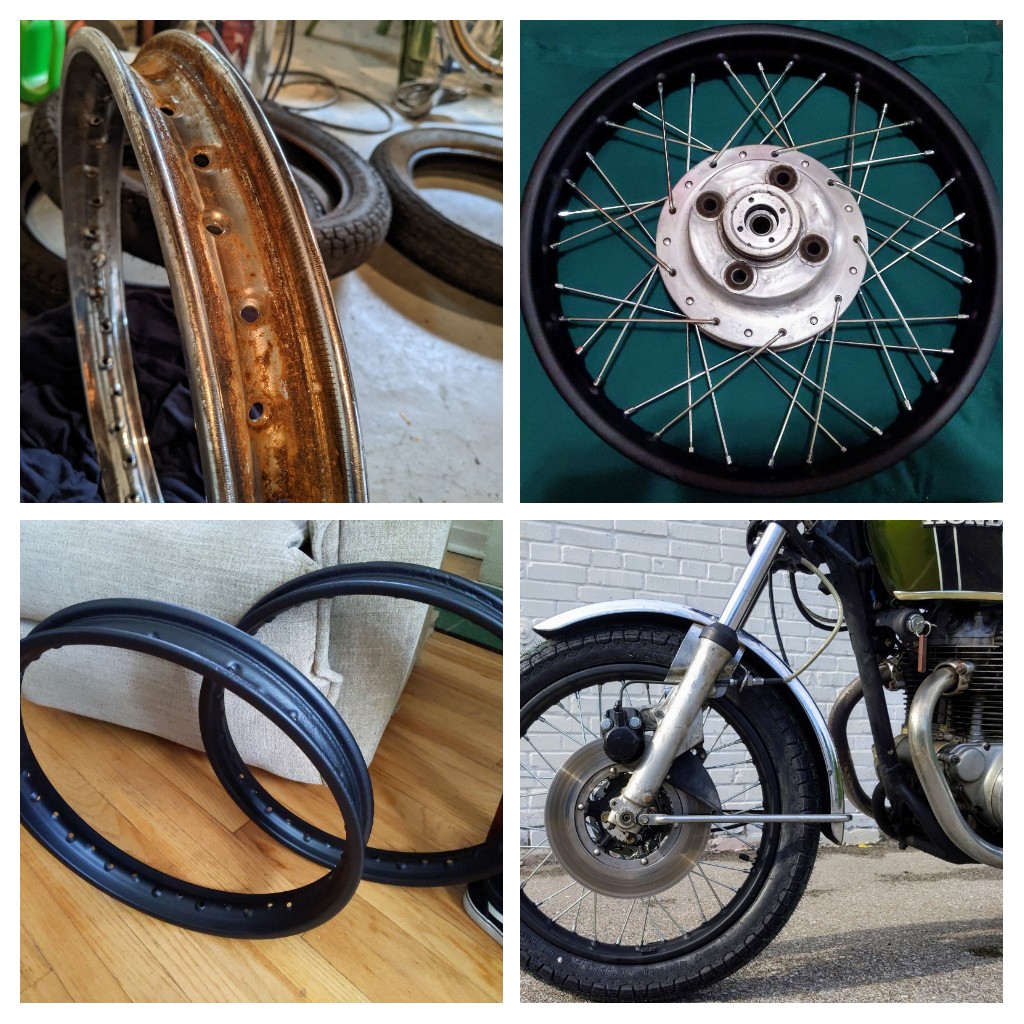
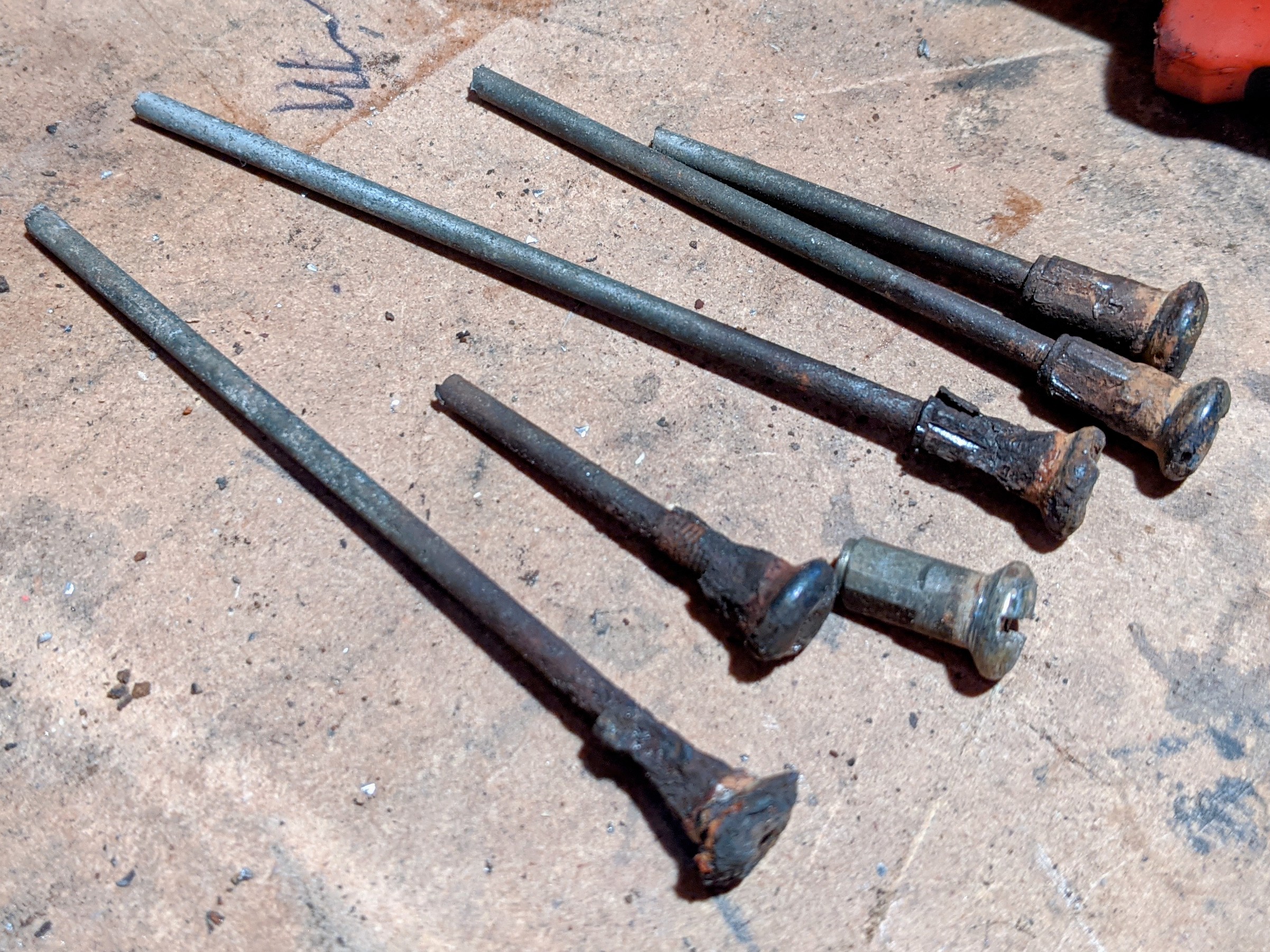
This summer I decided to make some cosmetic (and safety) improvements to the bike. The first task was to do something about the rusted/corroded wheels and spokes and to replace the original wheel bearings while I was at it. Some of the spokes were so corroded that I had to cut them off with a Dremel. I took the rims to Cycle House Performance here in the St. Louis area for powdercoating and was pretty happy with the results. I chose not to powdercoat the hubs and used a new set of nickel-plated spokes.

Corroded spokes:
l7T3xvq.jpg


Rims before & after:
LKsmAmp.jpg


Bike with newly coated rims:
9PaLYZ7.jpg


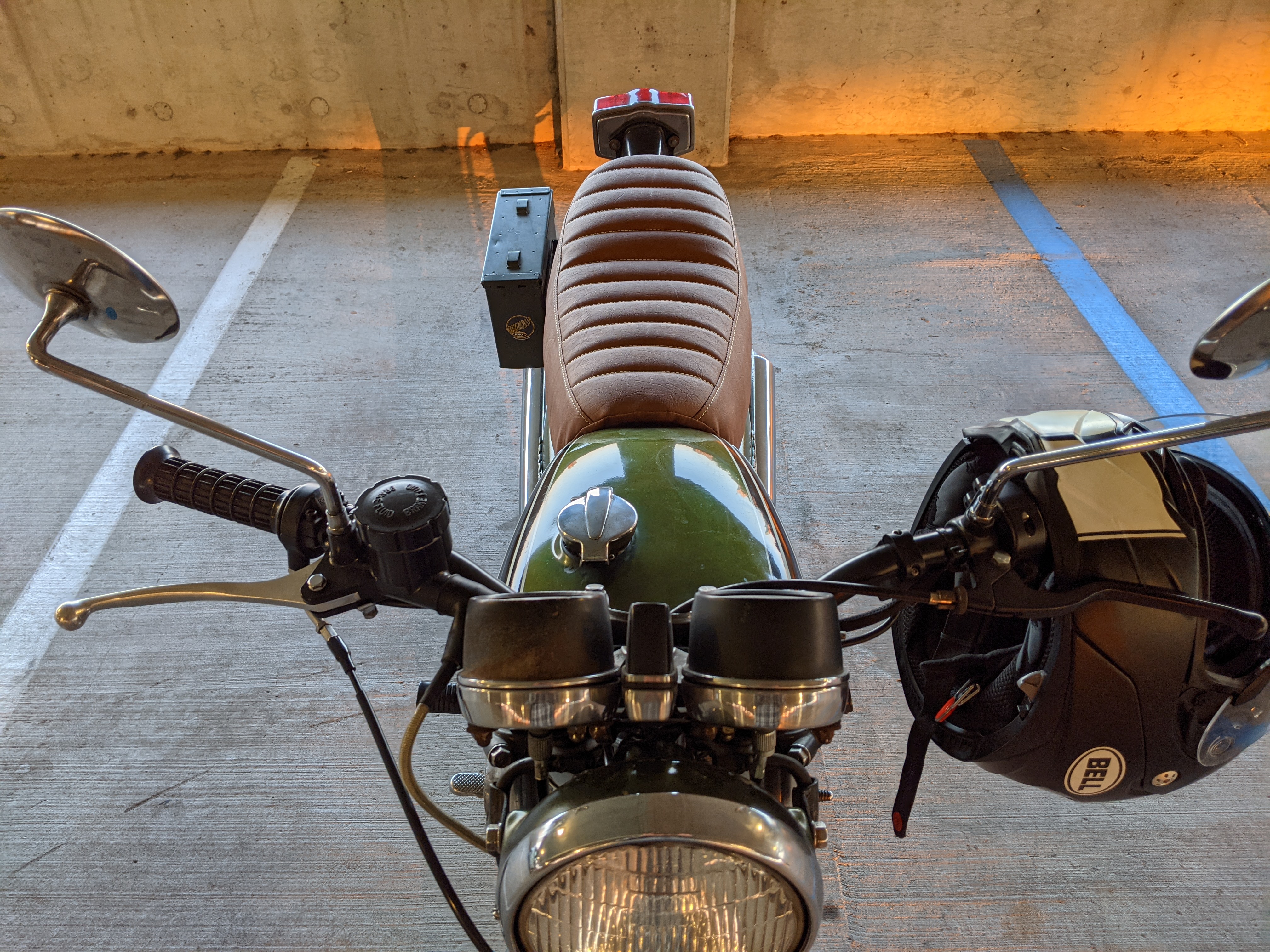
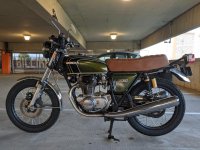
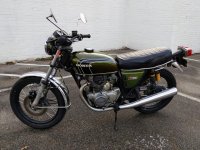
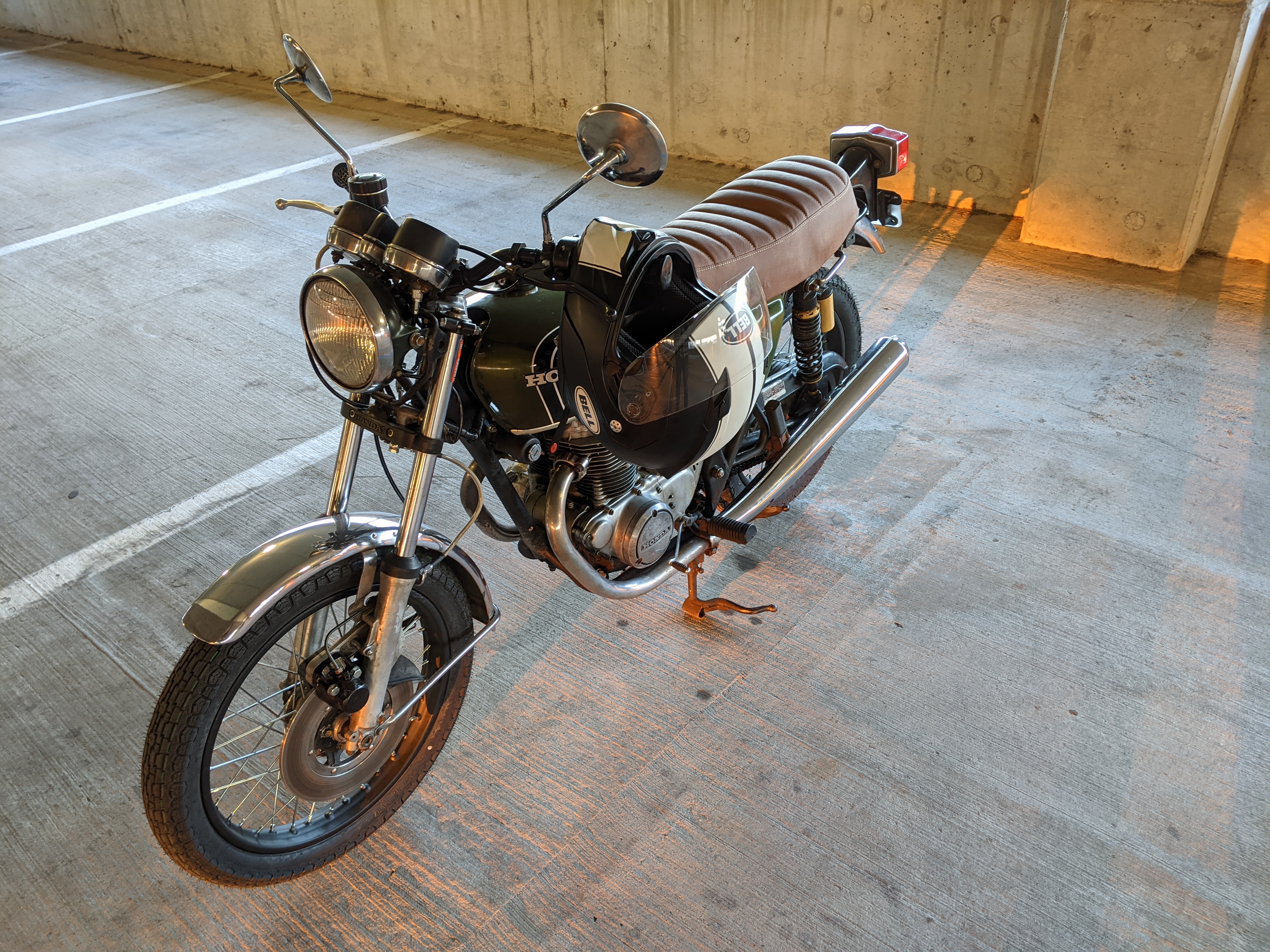
Another cosmetic change I wanted to make was with the seat cover. I went to a local auto upholsterer (Gravois Auto Top) and asked the owner if he would be willing to do a custom cover for me. I picked a material and got on his schedule a few weeks later, when he completed the work in one day. It took a little while for me to adjust to the much lighter color of the new seat cover, but it has grown on me. I'm curious how others will react to it.

Bike with new seat cover:
7VYsBsY.jpg


laXw16W.jpg


That's it for this first post, but I plan to at least add some information about the carburetor modifications in the near future.
 
Last edited:
Personally I think the seat goes quite well with the paint. Whole thing looks very good. Congratulations on some fine work.
 
Before I say it most will already know, but I'm not a brown seat guy - but the shop did do a nice job on it. I like the 350 tank on the bike, if you didn't know you wouldn't be able to tell. I always thought Honda carried the metal-covered forks too long on the CB350 and the 350 tank on a bike with clean forks is a nice combo, makes the bike look quite different. Nice overall results, the bike looks really good.
 
Personally I think the seat goes quite well with the paint. Whole thing looks very good. Congratulations on some fine work.

Thanks, J-T!

Before I say it most will already know, but I'm not a brown seat guy - but the shop did do a nice job on it. I like the 350 tank on the bike, if you didn't know you wouldn't be able to tell. I always thought Honda carried the metal-covered forks too long on the CB350 and the 350 tank on a bike with clean forks is a nice combo, makes the bike look quite different. Nice overall results, the bike looks really good.

Thanks, Tom! I've seen some brown seats that I've liked and others that I couldn't stand. I thought this one looked good at the shop, but was really taken aback when I got it on the bike for the first time. I'm good with it now, but may put together a back-up seat with a traditional black vinyl cover. They're easy enough to swap out.

Definitely wouldn't look good with a red frame, so I know where you're coming from!
 
Great save and restoration, Brody!
I really like the subtleties and personality of your changes from a stock bike, to one that most would think is stock, without out going overboard on customizing all of it. I like the seat, especially with your paint color choice; they did a great job on the cover.


Tom - 1982 CM450E / Midwest USA
 
Great save and restoration, Brody!
I really like the subtleties and personality of your changes from a stock bike, to one that most would think is stock, without out going overboard on customizing all of it. I like the seat, especially with your paint color choice; they did a great job on the cover.

Thanks, Tom! There was a short period where I went a little too far with an emgo fairing and 12" shorty mufflers, but I got over all that fairly quickly!
 
I mentioned in the first post on this thread that I am running Keihin 723A carburetors on my CB360. These carburetors come from my 1972 CL450 parts bike and I wondered if they would work on the 360 after I had problems with a cheap set of used 360 carbs found on eBay. The price was right, so I ran a Google search to see if this had been done before and I found a thread on HT by krukster86. That was enough confirmation for me to try it.

Required Modifications:
  • A 450 throttle cable must be used.
  • The bolt spacing on the 360/450 insulator boots are different, so I filed the through holes on a set of 450 boots in order to mount them on the 360.
  • The spacing of the intakes on the head is also different, so I "modified" (i.e., bent) the choke linkage in order to fit the space.

PXL_20210930_133737385.jpg PXL_20210930_133459510.jpg

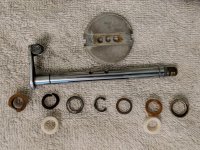
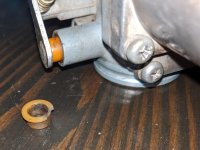
It worked well enough to keep me from shopping for a better set of OEM carbs, but I had two problems: (1) starting the bike took a lot of kicks and (2) it had poor off-idle response when warm. After reading a thread about the felt seals on the throttle shafts, I decided to replace those seals along with a cracked plastic shaft end cap on the RH carb. These repairs did not solve either of the issues, but I was still happy to eliminate a potential vacuum leak.

IMG_20191102_104506.jpg IMG_20191107_135736.jpg

After joining VHT this summer, I looked up the HT thread again and found that krukster86 had moved over to VHT. I contacted him by PM and found out that he ultimately rebuilt his 360 with factory carbs. However, it was interesting to hear that he had similar issues with the setup, both with the starting difficulty and off-idle response. I started checking all of the fundamentals again and noticed that my right cylinder had lower compression than the left by slightly more than 10%. I tracked this down to a loose valve clearance on the right intake valve. After I set it to the FSM spec, the compression came up to the same level as the left cylinder and the off-idle issue cleared up. At that point, I started playing around with the float height and jet sizes to see if I could improve the overall running condition of the bike.

Current Settings:
  • float height: 20mm
  • main jet: 130 (it would bog down with 145)
  • pilot jet: 40
  • slow jet: 40

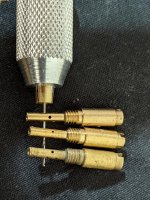
The slow jet is an aftermarket jet from 4-into-1, but I opened up the cross-drilled holes with a small hand drill as shown below. The jet at the bottom is an original Keihin slow jet, the one in middle is aftermarket and unmodified, and the one at the top has been drilled out.

PXL_20211002_201135973.NIGHT.jpg

While I was playing around with different jet combinations, I noticed that my left carburetor was showing no effect to mixture screw adjustments. I could turn it all the way in or out to 2.5 turns with no change in running condition. And, worse, the left cylinder was not firing at idle unless I opened the throttle plate considerably. I got to thinking about that and it eventually occurred to me that I may have installed the throttle plate in the wrong orientation after replacing the felt seals. When I checked the carb, I found that it was oriented properly, but decided to swap it out for another throttle plate I had on hand. It's possible that I simply didn't have the plate positioned correctly on the shaft, but this change made a big difference. The carb now responds to mixture screw adjustments and the both cylinders are firing at idle.

I hope to share video or audio of the bike running to see how it sounds to others, but, at this point, I'm happy with how it runs on the 450 carburetors. It's still takes a little extra work to start in comparison to my CB450, but not an unreasonable amount. To start it, I apply the choke and kick it several times with the throttle wide open before closing the throttle and kicking it again. This usually does the trick.

I'll try to follow up with a video in the next week or two.
 
Nice in-depth recount of what you did, and glad you got it to a point of good rideability. I find it interesting that you have success at the hard starting problem by kicking it with the choke on and the throttle wide open. That usually doesn't work well, so I wonder if it is too rich with the choke on and the throttle at idle
 
Nice in-depth recount of what you did, and glad you got it to a point of good rideability. I find it interesting that you have success at the hard starting problem by kicking it with the choke on and the throttle wide open. That usually doesn't work well, so I wonder if it is too rich with the choke on and the throttle at idle

Thanks, Tom. My unconfirmed theory about the choke on and throttle wide open is that it gets the needle out of the way and allows the motor to pull fuel through the main jet in addition to the idle circuit, priming the motor for the subsequent kick.
 
Thanks, Tom. My unconfirmed theory about the choke on and throttle wide open is that it gets the needle out of the way and allows the motor to pull fuel through the main jet in addition to the idle circuit, priming the motor for the subsequent kick.

I'm not sure that would happen at that low a rev (kickstart) and subsequent vacuum level, but I'm far from a carburetor expert so I suppose it's possible. I'm guessing the fact that the carbs are at least 2mm larger (if not 4) than the stock 360 carbs allowing in a larger flow of air is part of it all.
 
I assume the "blipping" it seems to be doing is the wind? Seems to increase as the speed does. Otherwise it sounds good, you wouldn't know it had different carbs.
 
I assume the "blipping" it seems to be doing is the wind? Seems to increase as the speed does. Otherwise it sounds good, you wouldn't know it had different carbs.

I'm not entirely sure, but it might be the end of the chin strap flopping around randomly due to the wind. I've been trying to figure that out as well. The phone was in a chest pocket, so not too far from my chin and helmet.
 
I rode the bike with the brown seat cover for a few months and ended up buying another seat pan for a second option. I have never been a fan of the original cover design, but managed to fit a cover for a CB450 on the pan after making some modifications to the foam.

PXL_20210928_121101801.NIGHT.jpg PXL_20220118_213153274.jpg

The black cover looks much better to me.
 
I've seen very few Brown seats that work well with the paint work. Has to be just the right color match between them to work.

Agreed. I made the mistake of picking a material without having the bike there for comparisons. The brown was much lighter than I expected once I saw it on the bike. This seat may not work well with my bike, but it may work for someone else.

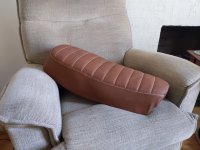
To me, a brown seat looks fine on a recliner in the living room...

Like this? (Probably not.)
PXL_20220120_182848999.jpg
 
Some recent threads elsewhere on VHT got me thinking about something that was discussed here, namely, that I have found it easier to start my 360 with the choke on and the throttle wide open while using the dohc 450 carbs. I didn't have a good explanation for why this should be the case. I hadn't realized that the two small holes just at the throttle plate (Keihin 723A) are not metered by the mixture screw, only the hole in front of the throttle plate is metered in this way. So, I believe, opening the throttle allows fuel-air mixture to be drawn at a higher rate through those secondary holes and helps "prime" the cylinders for starting.
 
Some recent threads elsewhere on VHT got me thinking about something that was discussed here, namely, that I have found it easier to start my 360 with the choke on and the throttle wide open while using the dohc 450 carbs. I didn't have a good explanation for why this should be the case. I hadn't realized that the two small holes just at the throttle plate (Keihin 723A) are not metered by the mixture screw, only the hole in front of the throttle plate is metered in this way. So, I believe, opening the throttle allows fuel-air mixture to be drawn at a higher rate through those secondary holes and helps "prime" the cylinders for starting.
That does make sense, there's probably enough vacuum created with a closed choke to pull from the 1st transition port, although with the throttle plate closed the vacuum should be higher and draw plenty of fuel thru the metered port but not necessarily.
 
I would think a slightly cracked throttle would be more efficient in this respect.....

This seems consistent with my experience. It often catches when I lift one idle adjuster ever so slightly with my left hand while kicking it over. I will try to be more systematic next time, since starting with the fewest kicks is indeed my goal...
 
Over the years, while watching some owners whose right hand "went down with their foot" while kickstarting our vintage twins, I've learned that for the most part Honda twins like the throttle left at or really close to idle while the choke is on during a cold start, and often on warm restarts as well (though the latter really depends on the bike and any mods done to it). I never understood where the whole turning the throttle while kicking the starter lever thing came to be tied together, maybe from the ownership of some more cantankerous brand.
 
Another thought.......

IF you are using the 450 insulator/manifold boots on the 360, the " port mismatch" might contribute to the inefficiency to deliver enough fuel (even on choke) for easy starts.....Particularly at low airflow volumes....
Cracking the throttle increases the airflow volume ...(Remember the ideal air to fuel ratio is ~15/1 by weight, and it takes a lot of air to have significant weight)
 
Another thought.......

IF you are using the 450 insulator/manifold boots on the 360, the " port mismatch" might contribute to the inefficiency to deliver enough fuel (even on choke) for easy starts.....Particularly at low airflow volumes....
Cracking the throttle increases the airflow volume ...(Remember the ideal air to fuel ratio is ~15/1 by weight, and it takes a lot of air to have significant weight)

This is a good point also. I am using 450 boots and I didn't do anything to account for the port mismatch, beyond crossing my fingers. Thanks, Steve.
 
This is a good point also. I am using 450 boots and I didn't do anything to account for the port mismatch, beyond crossing my fingers. Thanks, Steve.

Can you port match with the motor in the bike? I know the best way clearly would be with the head disassembled on the bench… maybe sticking something suitable down to block the valves and clean up really well with a shop vac??


Sent from my iPhone using Tapatalk
 
Can you port match with the motor in the bike? I know the best way clearly would be with the head disassembled on the bench… maybe sticking something suitable down to block the valves and clean up really well with a shop vac??


Sent from my iPhone using Tapatalk
Hey, RockReef, I was hoping someone who actually knew the answer would reply to this question, but that didn't happen. I agree with you, though, that it would be better to do this with the head on the bench. Stories that begin with machining work on a motor in the frame usually don't end well.
 
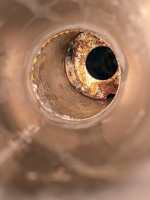
I mentioned in another thread that my CB360 fell over while parallel parked in front of a restaurant in midtown St. Louis on a very hot day (102 F). There were signs of recent work on the asphalt, likely related to some utility or other, but I didn't expect the center stand to punch through the asphalt like it did. Nevertheless, it did, and I decided to try a pair of slip-on mufflers available from Thaliand (via eBay).

Here are a few pictures of the muffler: header-side, exhaust-side, and a close-up of the manufacturer etching.

1695585866555.png 1695585885039.png 1695585946926.png

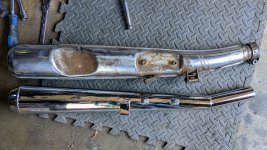
The next picture compares the design of the OEM left muffler with the slip-on replacement. The tab for the stand is not in the right place, but neither the side stand nor the center stand make contact with the muffler in my case. I had actually replaced my center stand with one from a CL360 many years ago when I was running 12" shorty mufflers for a couple of years. The OEM muffler appears to have much greater internal volume.

PXL_20230902_141102260.NIGHT.jpg

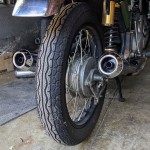
Here are a couple of pictures of the mufflers installed.

1695586075857.png original_0ec75e71-421a-442a-818d-9cd9e3f442dd_PXL_20230902_203621734.jpg

Finally, let's see if I can embed a video. They do not sound as nice to me as the OEM mufflers, so I will probably keep an eye out for another right-hand OEM muffler, but I think they'll be fine for the time being. Overall, I'm happy with the purchase.

 
Last edited:
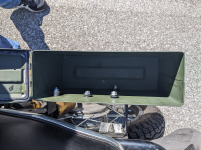
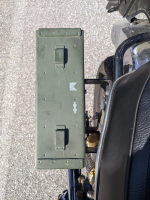
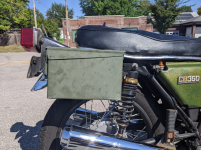
I also had to replace my ammo can pannier, but I think it was damaged by vibration and lack of proper support rather than from the fall. I always intended to add a fourth bolt to the previous ammo can, but never did. My improvement for this go-around is to add grommets and spacers (that I had to drill out from #10 to 6mm) with some neoprene washers thrown in for additional vibration absorption.

1695586294518.png 1695586318289.png 1695586343057.png

I still have a VHT sticker to add to the new box, but I need to find a nice replacement for my old Japanese flag sticker.
 
Last edited:
The new mufflers are not as loud as I thought they would be, certainly a plus considering the reputation for aftermarket.
 
I finished my work on the CB360 this morning by swapping out the handlebar and brake lever. I compared the two bars (below) and I don't see any damage to the old one, but I still wanted to replace it. It's cheap insurance. The bike as it sits now with the matching GP-style brake lever and the new bar.

1695586448103.png
 
Last edited:
Good handlebars don't often get bent when a bike just falls over, at least smaller bikes like the 350 and 360 anyway. Looks good now and I've used those levers before, they work well.
 
Good handlebars don't often get bent when a bike just falls over, at least smaller bikes like the 350 and 360 anyway. Looks good now and I've used those levers before, they work well.

I wasn't super confident about these handlebars being 'good' since they only cost about $30, but they do seem okay. I guess I'll keep the old bar around for a rainy day.
 
Nice job on the ammo cans. I'd still keep an eye on that upper bolt and if needs be add some large OD (1.5") fender washers to distribute the stress. I like those bars and levers too.
If the noise, timbre, pitch is acceptable at sustained cruising speed then those good looking pipes will be a plus for traffic safety around town.
Dig them green bikes, eh?
 
Nice job on the ammo cans. I'd still keep an eye on that upper bolt and if needs be add some large OD (1.5") fender washers to distribute the stress.

Thanks, Tom. I was even thinking about using two pieces of flat steel on the inside of the can for extra support. One horizontal and one vertical, each spanning two of the bolts. Think that would help?

Dig them green bikes, eh?
Guilty as charged. I do have non-green bikes, too, though.
 
Thanks, Tom. I was even thinking about using two pieces of flat steel on the inside of the can for extra support. One horizontal and one vertical, each spanning two of the bolts. Think that would help?


Guilty as charged. I do have non-green bikes, too, though.
The upper central hole might have the worst flex, due to it's central location, away from edges. Just adding to that or both top holes may do the trick. Oops, I just noticed, you did a forth hole, Maybe all good now.
 
The upper central hole might have the worst flex, due to it's central location, away from edges. Just adding to that or both top holes may do the trick. Oops, I just noticed, you did a forth hole, Maybe all good now.
Cool. And I had been telling myself to add that fourth bolt for the last year and never did. Feels much sturdier and I hope the grommets and spacers will help, too.
 
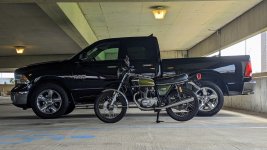
Rode the CB360 to school today. Returning to the bike at quitting time, I was struck by how small it looked. Doesn't feel that way when I'm riding.

PXL_20230905_201844351.NIGHT.jpg

The new mufflers get a B for sound quality. Not too loud, but they lack the nice, smooth sound of the OEM pipes.
 
Last edited:
Over the years, while watching some owners whose right hand "went down with their foot" while kickstarting our vintage twins, I've learned that for the most part Honda twins like the throttle left at or really close to idle while the choke is on during a cold start, and often on warm restarts as well (though the latter really depends on the bike and any mods done to it). I never understood where the whole turning the throttle while kicking the starter lever thing came to be tied together, maybe from the ownership of some more cantankerous brand.
I've never done WOT. I don't think that works very well. I have found that cracking the throttle about 1/8 to 1/4 can help if it's stone cold. Like sitting in a cold garage for a week. Cracking 1/8 helps on hot restarts for me. I.e. filling up. Seems to work well on all the bike carbed bikes I own.
 
I've never done WOT. I don't think that works very well. I have found that cracking the throttle about 1/8 to 1/4 can help if it's stone cold. Like sitting in a cold garage for a week. Cracking 1/8 helps on hot restarts for me. I.e. filling up. Seems to work well on all the bike carbed bikes I own.
On your 400, it works because there is an accelerator pump to help. My statement applies to all bikes that have CV carbs without accelerator pumps or standard slide carbs. I've worked on thousands of them over the years and have found that anything more than about 1/8 throttle applied while cranking is counterproductive to vacuum draw. WOT only works when one is significantly flooded.
 
My year doesn't have accel pumps, the CB550 and the DT250 also have no accel pumps. The CB550 and DT250 are traditional slide carbs.

I've never tried WOT to unflood a vehicle. After a few cranks if it doesn't start then I stop and take a look. Worst case if it's been sitting for months with some questionable gas might take about 5 or 6 cranks to get it going.
 
My year doesn't have accel pumps, the CB550 and the DT250 also have no accel pumps. The CB550 and DT250 are traditional slide carbs.

I've never tried WOT to unflood a vehicle. After a few cranks if it doesn't start then I stop and take a look. Worst case if it's been sitting for months with some questionable gas might take about 5 or 6 cranks to get it going.
Surprised your 400A doesn't, I thought all the SOHC 400/450s had accelerator pumps. WOT reduces vacuum draw to a minimum so no additional fuel gets drawn in.

Now back to Brody's thread.
 
The slow jet is an aftermarket jet from 4-into-1, but I opened up the cross-drilled holes with a small hand drill as shown below. The jet at the bottom is an original Keihin slow jet, the one in middle is aftermarket and unmodified, and the one at the top has been drilled out.

View attachment 10507

It's been known by a few of us for years the cross drilling's in aftermarket pilot jets are too small.
Trek97 (Eric) on Do The Ton pointed it out around 2017
They are 0.60mm instead of original 0.80mm, I always check them and have drilled out 'hundreds' of sets.
Even genuine Kei-Hin are now made with the 'small holes' and need modifying to 1970's spec
 
Back
Top Bottom