CB160 engine noise at around 3000rpm

Boverdude

Member
Joined
Jan 15, 2022
Total Posts
31
Total likes
7
Location
Brooklyn
IMG_5358.jpeg


Been living with this noise for the 2yrs I have had this bike. It has persisted through a top end rebuild and a cam chain replacement. Doesn't seem to be getting any worse bit is annoying.
seems to come on around 3000rpm and doesn't seem to be a rattle as it only happens when the bike is under load.

Any ideas?

 
Last edited:
I can't hear anything that seems off there. It is something that you maybe can hear while riding more than the audio track indicates. These bikes are old and have some noise from the top end as part of the character in every Honda I have owned. If you have been riding it for that length of time and nothing had broken or grenaded apart.... keep on riding it. ;)

What specifically noise wise are you hearing in the operation of the bike?
 
I don't hear anything all that unusual either, maybe a little valve ticking but cell videos often accentuate the high tones. Do you have the throttle cables synced at the carb tops so the slides both rise at the same exact time? Might just be me, but it seemed to be a bit light on one cylinder while running steady.
 
I don't hear anything all that unusual either, maybe a little valve ticking but cell videos often accentuate the high tones. Do you have the throttle cables synced at the carb tops so the slides both rise at the same exact time? Might just be me, but it seemed to be a bit light on one cylinder while running steady.
It’s that buzzing sound. It’s not there between about 1000 and 3000 rpm’s. It appears and gets louder as I open the throttle. At first I thought it was detonation but changing the fuel octane didn’t make a difference. I did notice one of the rocker arms had some wear and I replaced it last time I took the head apart.
 
I can't hear a buzzing sound myself that sounds unusual, so I am of no help here. I can say that obviously as the RPM increases the engine noise will also increase from just general valve train operation and cam chain and associated tensioner hardware. Are the tensioner rollers new when you replaced the cam chain, or did you reuse the old parts including the tensioner plunger assy?
The carb sync is important as AD noted with the raising of the slides being as accurate as possible between left and right sides. Personally I cannot determine as well as AD there with that issue.
 
I can't hear a buzzing sound myself that sounds unusual, so I am of no help here. I can say that obviously as the RPM increases the engine noise will also increase from just general valve train operation and cam chain and associated tensioner hardware. Are the tensioner rollers new when you replaced the cam chain, or did you reuse the old parts including the tensioner plunger assy?
The carb sync is important as AD noted with the raising of the slides being as accurate as possible between left and right sides. Personally I cannot determine as well as AD there with that issue.
I replaced the both the rollers, but didn’t replace the pushrod assembly. Might try and see if I can make a better video.
 
Are you sure there isn't a loose piece of sheet metal, that is resonating to a certain frequency engine vibration?
It definitely sounds like it but, I haven't found anything. Bike has been completely stripped down and put back together.
 
With the rear wheel well off the ground on the main stand have you ran the bike through the gears in a stationary position? This might replicate the under load condition and allow you to hear any possible vibrations from the chassis.
 
Last edited:
I think I hear it - it really sounds like something is drying out, or there’s a bearing that’s ever so slightly off. You said the top end was rebuilt, which would seem to eliminate that, but if there’s an oil passage blockage below that you could have a culprit - have you checked too end oil flow?

Is the noise more prevalent on one side versus the other? This might be a good one for the old school mechanic stethoscope.
 
I tried the old screw driver to the ear trick and couldn’t really identify the noise. Seemed like I could hear it better from other ear. Looked through the valve adjustment caps and seems like there is plenty of oil there.
I am really baffled by the fact that the noise is not present at low rpm’s.
 
That's what makes me think bearing, the noise is very similar to a slightly worn clutch idler bearing, but it'd be really obvious what side that's coming from. What kind of shape is the exhaust in? If it was anything serious, it would present itself, but possibly something loose just enough to give it some resonation? If it's not variable side to side, it's going to be something rotational in the core.

I get where you're coming from on this. Had something similar with my truck, but it was only at low RPM and it seemed I was the only one that could hear it and it was a slightly crooked exhaust bracket that had flexed the copper crush washer just enough create the noise and the only reason it went away was becasue you couldn't hear a dang thing in that truck over 3000 RPM
 
If you mis-routed your cam chain, the adjuster ain't doing squat and the chain will slap the head tunnel. Impossible to tell when assembled, no way to see or feel the chain and there is no way to tell if the adjuster is taking up the slack. The end of the adjuster spring loaded push rod will also get slapped.
Check your centrifugal oil filter for fine ground metal or drain and check the oil, if metal in oil, good chance that's the issue.
 
I hope that is not the case. Wouldn’t it be impossible to get the timing right with the chain routed incorrectly?
 
I hope that is not the case. Wouldn’t it be impossible to get the timing right with the chain routed incorrectly?
No, if mis-routed through the tensioner the tensioner can't tension but the chain will still drive the cam. That's why it's easy to get wrong, because you don't realize it when assembling.
 
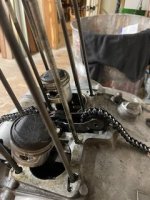
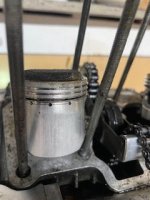
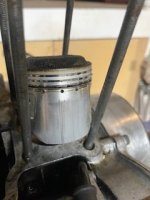
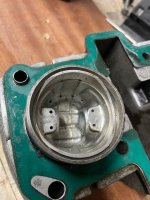
So I took apart the top end. Cam chain was routed correctly but it looks like I am getting wear on the piston skirts. Could be the sound is from piston slap.
I had the cylinders rebored and put new pistons and rings in about 2,000 miles ago.

Take a look at the pics, any input would be great.


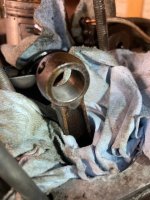
Cam chain routing.jpg


right piston.jpg

Left piston.jpg
 
Pretty loose fit, from the look of it. Those pistons shouldn't be touching the cylinder walls in the area of the rings, some dark discoloration is normal there, the rings normally keep the top of the pistons from rubbing the cylinder walls. Put the piston back in the cylinder and see what kind of clearance there is between the piston skirt and the bottom of the cylinder. You might try a new, unworn piston in the hole to see if the old ones are undersized, or the guy doing the bore job screwed up his measurements. Those streaks in the skirts are most likely from dirt, during assembly.
 
The piston tops appear to have lots of carbon with only 2K on a new build. The top of that right piston seems to have a divot on the front left side area. Not a cause of your issue, yet once you sort that out it is something that should be addressed. A carb or ignition check should be on your check list too.
 
The carbon thing is weird. Thought maybe valve guides but she doesn’t smoke at start up after sitting over night.
A friend was following me recently said he thought he saw some smoke on the over run after wide open throttle.
 
I can't see much in those small pics but that's a lot of scuffing. How are the small end rod bores? You may have a plugged crank and no splash feed of oil.
 
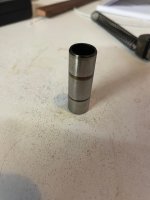
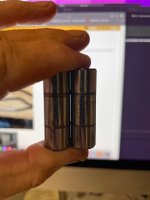
Not sure about these lines on the wrist pins but the little end bores seem ok. No discoloration on the underside of the piston that I would imagine you would get if there was no oil or excessive heat.

Pistons seem pretty tight in the bore. No rocking back and forth.

wrist pin.jpg

small end.jpg
piston underside.jpg
 
Doesn't look bad. No play and if they measure under limit then good. I've seen pretty bad from plugged cranks and it just doesn't make sense to build without addressing that.
Not sure about skirt wear. Maybe check your ring end gaps if they were way loose.
 
At 2K miles the piston skirt wear is excessive, probably due to too much piston-cylinder clearance. Also it appears the bores were not scrubbed clean prior to assembly.
During the boring and honing process metal bits/debris get embedded in the walls that require a through scrubbing with hot water and soap(Dawn) or copious amounts of clean solvent. They're only clean when a white cloth is rubbed on the walls and shows no dirt residue. Paper towels are forbidden.
 
Yes, I guess I wrongly assumed the machinist would have cleaned the bores. In other news it looks like my wrist pins are pretty worn. Have to assume the rod end bores are also worn.

I can get a 0015" feeler gauge thru' those gaps.

wrist pins.jpg
 
Use the end of the wristpin where it isn't worn to check the small end of the rod for clearance. That's a fair amount of wear on a wristpin, you usually see the wear lines but typically not that much actual wear.
 
The ends are also worn. More slop in the rod then in the new pistons. Ordered some new pins, if the rod ends are shot I have to decide if I want to take a gamble on a used crank and rods or buy new rods and deal with that adventure and expense.
 
Well, unless you have a 20 ton press and proper tools to rebuild that crankshaft, a good used one is the best alternative.
 
Yes, I guess I wrongly assumed the machinist would have cleaned the bores. In other news it looks like my wrist pins are pretty worn. Have to assume the rod end bores are also worn.

I can get a 0015" feeler gauge thru' those gaps.
I'm sure the machine shop cleaned up the bores when done but they aren't that thorough and leave lots of little stuff behind assuming the end user will be doing a thorough scrub down.
 
Another option is to ream and bronze bushing the rod small ends IF the big ends are good enough and the crank sludge traps and passages to the big ends can be flushed and cleared out (see our recent crank cleaning thread). If buying a used crank, a thorough flush and clean would have to be done for sure.
When asked, my machinist said they've done the bushing fix before but didn't say if the crank was disassembled but did say they have a crank press.
G-man, member here, has done this kind of repair before and on 160's, IIRC. He may also know which rods can be used.
Also see page 35 of the FSM about rod wear and deflection.
 
I looked at p35. Looks like I have a little over 1mm of deflection for the first measurement. No idea how to take the second measurement (level of parallel). I have done quite a few top end rebuilds but have never split a crankcase. I am a little intimidated if I'm honest.
 
Taking the cases apart isn't as intimidating as your thinking. It does require removing the clutch and oil pump and shifter mechanism somewhat to flip the cases over and remove the bottom case. Lots of help on here from members who have done it. Just follow the FSM as you may have a hidden bolt under yout oil drain plug that can trip you up if your not aware it is there.
The max deflection on the CL175 Sloper conn rod is 3 mm, so if yours is only 1 mm I would say your pretty good there.

I would be more inclined to think your issues maybe the bore job not being in spec and the lack of further cleaning of the bores when you got the cylinders back.
I just had my CL175 overbored and when I checked the cylinders they still had some swarf in the crosshatching of the honing job. When I picked the parts up the shop indicated they had cleaned the bores with soap and water, yet there was still some material on the white cloth when I did a further cleaning. If your bore is a little sloppy or the rings were not checked for the correct end gap this maybe where the issue really was in the rebuild.

Still maybe worth pulling the cases apart to see how the tranny is and clean the crankshaft area in a soaking per Ballberian's procedure.
 
I looked at p35. Looks like I have a little over 1mm of deflection for the first measurement. No idea how to take the second measurement (level of parallel). I have done quite a few top end rebuilds but have never split a crankcase. I am a little intimidated if I'm honest.
Not too bad. Pg. 129 lists big end axial (up and down, check in all positions of crank) as .1-.4, I bet that's not too bad either. As AD said, small end bore is the main question, with new pins or the un-worn ends, there shouldn't be much detectable slop. I can't remember if I found a spec for pin to bush clearance, I might have just guessed based on other model specs. Depending on the feasibility of getting the small ends re-bushed, one may choose to live with something near the max, but not with knowledge that there is little to none oil splash getting there. IOW, flush your crank or flush your $ and labor.
Splitting the cases is not as bad as it seems and they usually need a good clean out of the sump area and oil pump after all these years. Just keep the trans shafts together and take pics of all to reassemble the same way.
 
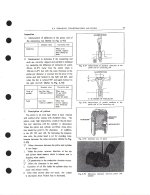
Here's you spec as you noted for the CB160. The 3 mm deflection is the max spec. Checking you small end bore wear spec on the con rod and the piston/ring clearance is where I would suggest you concentrate. More of a chance you have issues in those specs than in the crankshaft, other than as suggested cleaning and confirming your getting oiling circulated correctly.
If the wrist pin bore is within spec or close then new pistons and pins and rings with an in spec bore by a competent shop is a good start on resolving the issues. Checking the internals and cleaning the lower case will also rule out any issues down below there too.


CB160.jpg
 
My new wrist pins came today. Fit is a lot tighter but I'm assuming not tight enough.


I think they should have more resistance in the wrist pin bores. I know mine in the CL175 did have more resistance than that easy slide method you have there. There doesn't seem to be a spec that I can find for the bore or outer pin diameter in the FSM.

See what others say that have more experience here. I would expect you would be into some money to have the crankshaft taken apart and then either the rods replaced or as BB suggested a bushing made and pressed into the old ones.
 
Yeah, they slide but can you rock it in there? Example: On 350's spec is about .002-.008mm or about .0046" difference/clearance, so barely can feel it.
 
Yeah, they slide but can you rock it in there? Example: On 350's spec is about .002-.008mm or about .0046" difference/clearance, so barely can feel it.
Had to push the like meter to 1000 for you ;)

The more I think about it you likely good if there isn't any real slop. Using the above spec you can measure to see where your at presently. For the amount of riding time your likely to do, look more to your bore and ring gap specs to see where they ended up. If those items are off enough your wear could have been more of an issue there.
 
The new pins are much tighter but here is still a tiny bit of rock.I don't have fine measuring equipment but if I lay one of my hairs inside the con rod eye the wrist pin won't go in. Human hair is about0.001".
 
Had to push the like meter to 1000 for you ;)

The more I think about it you likely good if there isn't any real slop. Using the above spec you can measure to see where your at presently. For the amount of riding time your likely to do, look more to your bore and ring gap specs to see where they ended up. If those items are off enough your wear could have been more of an issue there.
I hadn't noticed the likes. I don't get it, You're a lot more likeable than me.

Back to topic, I think you're right too about the pin slop, doesn't sound even close to bad. It's just that the last couple motors were pretty sketchy there. I mean if these old bikes have been rebuilt at least a couple times but nobody bothered to clean the cranks really well. The skirt wear could be also made much worse without adequate oil splash.
 
The new pins are much tighter but here is still a tiny bit of rock.I don't have fine measuring equipment but if I lay one of my hairs inside the con rod eye the wrist pin won't go in. Human hair is about0.001".
That’s what I like about the members. Who needs a micrometer or calipers… when just a hair will do.
 
Movement goes away with oil. Waiting to hear back about price of a crankshaft rebuild. If its crazy expensive I might just put her back together and it is still noisy save the project until next winter. I only do about 800 miles a year.
 
Movement goes away with oil. Waiting to hear back about price of a crankshaft rebuild. If its crazy expensive I might just put her back together and it is still noisy save the project until next winter. I only do about 800 miles a year.
It just needs sludge trap and internal oilways flushing.
 
Movement goes away with oil. Waiting to hear back about price of a crankshaft rebuild. If its crazy expensive I might just put her back together and it is still noisy save the project until next winter. I only do about 800 miles a year.
With that kind of mileage I would be figuring out the other issue(s) and just riding it. Pulling the crank and cleaning the journals and see where your at spec wise with the old bore job. The tools required if you don’t have them for measuring presently, can be found pretty inexpensively these days.
 
Just wanted to follow up. I ended up taking a gamble and bought a used crank on eBay. I took some very primitive runout measurements and put it in the bike. Glad to report the annoying top end noise has gone. Third time taking this engine apart. I can do it pretty quickly now.
 
Back
Top Bottom