AC (not DC) CDI with timing advance,. Does it exist?

777funk

New Member
Joined
Sep 10, 2022
Total Posts
7
Total likes
0
Location
Springfield, MO, USA
I have a bucket of Honda 4 pin (DC), 5 pin (AC), and 6 pin (AC and DC) CDI modules and as far as I know only the DC units advance timing with higher RPMs.

Does an AC unit that advances the timing exist?
 
Moved to SOHC Electrical since these are the only models with CDI ignition systems.
I'm not sure whether these CDI's are running AC or DC. Frank, Maarakate, will be along with the answers.
Curious about what year/model you're working with.

See your PM's
 
Moved to SOHC Electrical since these are the only models with CDI ignition systems.
I'm not sure whether these CDI's are running AC or DC. Frank, Maarakate, will be along with the answers.
Curious about what year/model you're working with.

See your PM's

Honest answer is that I'm not looking for a replacement for a bike. I'm into 2 cycles for various powered equipment (PWCs, etc). But the watercraft crowd doesn't seem to be as familiar with CDI tech as the bike crowd, so I figured this may be a place to find out what's out there. When I had searched AC and DC CDIs and timing, bike and scooter forums seemed to be what came up most and with the most knowledge on the topic.
 
Honest answer is that I'm not looking for a replacement for a bike. I'm into 2 cycles for various powered equipment (PWCs, etc). But the watercraft crowd doesn't seem to be as familiar with CDI tech as the bike crowd, so I figured this may be a place to find out what's out there. When I had searched AC and DC CDIs and timing, bike and scooter forums seemed to be what came up most and with the most knowledge on the topic.

Take a look at what this guy has been doing

https://www.vintagehondatwins.com/f...CM400E-CM400C-CB450SC-CDI-Reverse-Engineering
 
Hi Funk,

The generator makes AC and passes it into the CDI. Waveforms are AC. The timing advance is controlled by a coil on the stator for the 400T/450SC bikes. If you need a new CDI I make them. I have one case left, then lead time will be another 6-8 weeks from metal manufacturer as I am currently doing them in batches of 5 as it's cost prohibitive for me do more unless I could secure more pre-orders.

You can purchase one for your bike at https://cm400a.nightgrease.net/

Also, if you're looking to have one reverse engineered it's possible I can look at some if you have some to donate to me. If they are custom ICs on the boards after I crack them open there is little I can do.
 
Ok thanks! I did a quick flip through that thread and it looks like those bikes used two trigger coils (one for normal and one for advanced timing). That's new to me but I like the idea. I've also seen it where an arm rotates the trigger to a more advanced position in relation to the flywheel when given more throttle.

What I am looking to find is a CDI that advances electronically based on RPMs. I see this with DC CDIs, but haven't found an AC CDI that does this. Maybe this is uncommon with AC charged CDIs.
 
Ok thanks! I did a quick flip through that thread and it looks like those bikes used two trigger coils (one for normal and one for advanced timing). That's new to me but I like the idea. I've also seen it where an arm rotates the trigger to a more advanced position in relation to the flywheel when given more throttle.

What I am looking to find is a CDI that advances electronically based on RPMs. I see this with DC CDIs, but haven't found an AC CDI that does this. Maybe this is uncommon with AC charged CDIs.
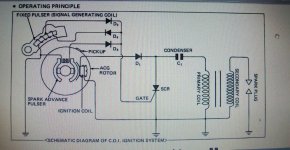
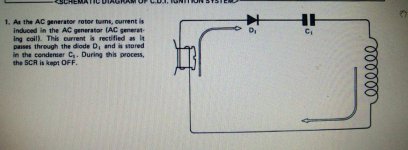
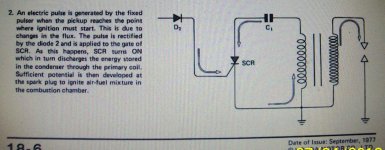
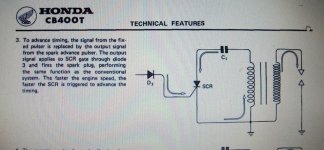
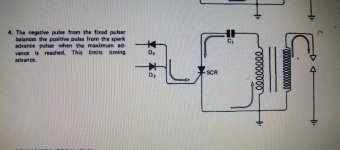
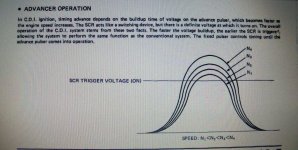
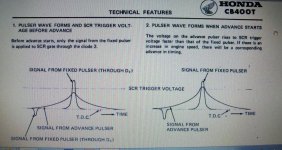
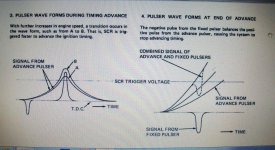
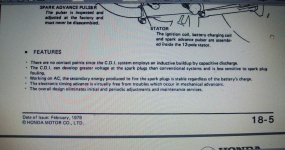
Here's the Honda description of these CDI's
201_4119.jpg

201_4120.jpg

201_4122.jpg

201_4123.jpg

201_4124.jpg

201_4125.jpg

201_4126.jpg

201_4127.jpg

201_4128.jpg

201_4130.jpg
 
Ok thanks! I did a quick flip through that thread and it looks like those bikes used two trigger coils (one for normal and one for advanced timing). That's new to me but I like the idea. I've also seen it where an arm rotates the trigger to a more advanced position in relation to the flywheel when given more throttle.

What I am looking to find is a CDI that advances electronically based on RPMs. I see this with DC CDIs, but haven't found an AC CDI that does this. Maybe this is uncommon with AC charged CDIs.

Hi 777funk!, I have been learning about ignition and I have a rambling thread here on ignition[https://www.vintagehondatwins.com/f...865-Making-spark-cave-man-with-a-smart-phone]. So here are my thoughts. Ignition systems tend to be very proprietary, vendors typically do not provide good information on how they work or what they do. The advantage I see in original AC-CDI from Honda is that it's power source is independent from battery, so could work with a dead battery.

You say that you have seen DC CDI's with advance capabilities. If you can give a link to any information on one that does this I would like to see it. I am aware of ignition modules that offer advance based on microprocessors. The early Honda one's like for the 1980's CM400's used analog methods with no microprocessor, so they would have added 2ndary signals like an added stator winding, or 2ndary CAM position signals.

There is a lot of variety in how ignition is done. So for example my lawn mower I pull start and it has a magneto system, it doesn't have a battery, it just works to my amazement. I have a cheap AC CDI unit hooked up and working with my old Y81 CM400 along with a switch to go to an advanced setting(from a more advanced CAM position sensor). If there was a cheap DC CDI unit that would somehow do advance work based on a single CAM position I would be interested. The thing is, if all you have is a single CAM position, I believe it has to be starting non-advanced fire position since starting is such a critical operation. Now a single CAM position could have a leading and trailing edge that might be used, but I'm not sure if this is something used. Modern systems go to a many CAM position arrangement(with a missing tooth to provide a TDC reference). But not all modern systems, like lawn mowers and chain saws, are still minimalist simple systems.
 
OK, start with the fact that my understanding of how a CDI works is probably a negative number, but add in that until recently my favorite scooter was a Honda CH250. The 85 I owned used an AC CDI and the 90 I still have uses a DC CDI and the spark advance was managed by that CDI on both. Poorly. On two that I owned (one is still in my garage) the advance system failed over time, leading to the engine suddenly losing power at speed and just dogging along, then recovering and speeding up. It was unpredictable and annoying. A new CDI solved it completely. Of course there are no Honda parts any more, so I bought a few cheapies on AliExpress and plugged them in until one solved the problem. I think it cost me $8.

Just search around for an AC 6 pin CDI for a Honda CH250 or CN250 scooter from the 80's or a DC CDI for the 1989 and 1990 CH250. If you need a schematic I probably have one somewhere.
 
@Wentwest, Most of what I have are AC 5 pin units with a light green plug. I believe these are made to work with a mechanical advance. I also have some AC 6 pin units. But I think neither have electronic advance.

@KBongos, to answer your question, supposedly the similar looking but larger bodied 4 pin DC CDIs on ebay ($10 to $12) have electronic advance. I have not confirmed this on a running engine (i.e. watch the timing with a light as RPMs increase), but from what I've read.

My guess as to why I haven't seen many AC CDIs with advance is that it may be difficult to power electronics from the AC generated voltage and a digitally controlled CDI may need 12V battery power. But I am not familiar with everything out there in the CDI world. Related to that thought @LongDistanceRider that method of timing advance (two triggers and dealing with the two signals and adjusting in electronics) is interesting! Never would have thought of that. The electronics are pretty low part count. I think the newer CDIs have around 40+ parts inside. I'll bet the old ones last longer.
 
@Wentwest, Most of what I have are AC 5 pin units with a light green plug. I believe these are made to work with a mechanical advance. I also have some AC 6 pin units. But I think neither have electronic advance.

@KBongos, to answer your question, supposedly the similar looking but larger bodied 4 pin DC CDIs on ebay ($10 to $12) have electronic advance. I have not confirmed this on a running engine (i.e. watch the timing with a light as RPMs increase), but from what I've read.

My guess as to why I haven't seen many AC CDIs with advance is that it may be difficult to power electronics from the AC generated voltage and a digitally controlled CDI may need 12V battery power. But I am not familiar with everything out there in the CDI world. Related to that thought @LongDistanceRider that method of timing advance (two triggers and dealing with the two signals and adjusting in electronics) is interesting! Never would have thought of that. The electronics are pretty low part count. I think the newer CDIs have around 40+ parts inside. I'll bet the old ones last longer.

@777funk, My understanding of the DC CDIs are they include an additional voltage step-up converter(compared to AC CDIs) to get the higher voltage, and this would account for the larger package. The DC CDI is also more universal(assuming you have a battery, decent regulator supply) and could replace a AC CDI system, so maybe more common. I don't trust much I read, there is a lot of mis-information with this sort of thing. You can also switch to newer TCI(not CDI) that just works off 12v. But this may need a different coil or better regulator. Some good sources of information are from people that sell replacements like Ignitech(https://www.ignitech.cz/en/) has some good info. This guy Thierry in France https://transmic.fr/ that has got some interesting hobby for sale efforts, one is a programmable DC-CDI using WiFi micro(ESP) for advance table. And there are other vendors.

Some of what I read from Thierry is that there are some motors that offer a pulse signal at advance position, and then a simpler controller(analog or digital) can just add delay to implement a kind of advance. I don't know how common that arrangement is, but it might be what is used for these generic DC CDI's that claim to offer advance. He notes that changing polarity on a pulser(coil) can change timing - they tend to put out a positive and negative pulse signal of some length.

On my bike I put a cheap AC-CDI with a switch that routes it to either 43deg adv or 15deg start pulser signals. Starting is important to have at the retarded position, but once it is running, mine is pretty happy on just the advanced 43deg point. On a few mistakes starting at advance position, it made some complaining noises, but I have not blown my engine yet. I think the starting 15degree or so position is most useful for starting, especially if you had a kick start to avoid kick back misfire issues if a module miscalculates things. And it is important for kick start to fire first few rotations. If I run down the road at 13deg, it is a dog and top speed is very limited.

Here's a few discussions I found searching on the CH250:
https://www.advrider.com/f/threads/elite-150-and-other-scooter-owners-beware-of-cdi.643822/
Elite 150 and other scooter owners beware of CDI!

https://www.advrider.com/f/threads/2-stroke-cdi-on-4-stroke.1122780/
2-stroke CDI on 4-stroke - discussion of CDI with advance.
 

Very interesting! I like the idea of having a switch to choose between the two. I've pull started a 50 horse 2 cylinder outboard once and the kick back (paracord) gave about the worst rope burn I've ever had. I need a retarded timing setting for that engine if I ever have a bad battery again... lol. Kickback stinks!

In outboards, the triggers are on a rotating assembly that is moved with the throttle. I think I've heard of some bikes also having this type of setup. The switch seems like a good simple solution.

With a relay that's SPDT you could have it so it was energized to the 43 deg advance pulser coil and use stator H.V. coil voltage generation to activate it. Un engergized, it could go to the 15 degree start pulser coil. I don't know what the stator puts out on your bike, but that would be a good control signal for the relay.

I'd half wave rectify it, charge a capacitor of some size to give a second or two post start delay to advance, and use that voltage for the relay coil control. Just have to size the relay specs accordingly. It wouldn't need much for the actual switching contacts since it's only carrying 1V pulse signals and hardly any current. The important spec would be that the relay coil voltage (control signal for switching) matches what it'll be receiving from the stator.

Maybe one easy way to make it automatic to go from 15 degrees to 43 degrees. Not that a switch is hard to deal with. Simpler is usually better in my book! I like the idea of having an advanced and start pulser coil.
 
Very interesting!
@777funk - I would like a analog control that I could set any point between min to max advance advance just to experiment with while I ride. I suppose the adjustable tables you can program a smart control comes close to this. Or if you had an old mechanical advance you could rig up a cable and do the same thing, no stinky electronics involved! Simplicity is good. It's one of the benefits of the old points and springs and weights for advance. Most anyone can figure it out and fix it. Not so much with electronics, ugh.
 
Back
Top Bottom