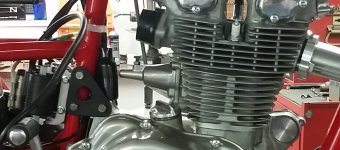
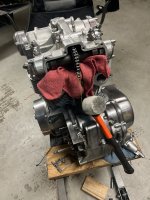
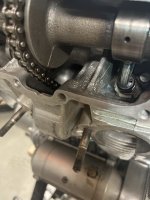
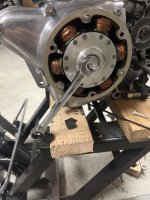
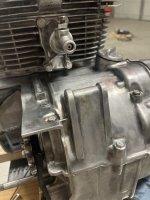
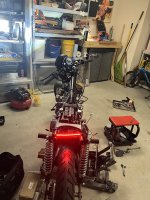
74 CB 450K Build - "Texas Midnight"

Good stuff for the kid, he'll remember it for life. Cool vanity tag too (I once had an old Tampa PD detective car bought from the City auction, got the tag 'Fed Sled' for it).

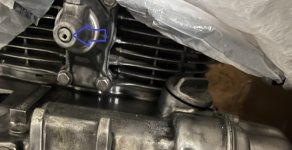
I'm wondering about the cam chain tensioner. Assuming the engine is ready to go, and you've already adjusted the cam chain, either you have the older short-body tensioner or the tensioner didn't move inward much. Looks flush with the back of the body in this pic

tensioner.jpg
 
I was thinking the same thing. It really didn’t feel like it popped out all the way, but the chain still “feels right” and the actuator landed dead flush with the spot it was in. When i disassembled it, it was pretty badly gunked up but the spring was strong enough to launch it off the bench and the rod was smooth and straight once cleaned up. I did not, however check the end of that set screw and I wonder if there’s a little tang snagging up. Could be the short throw? I’m fairly certain there isn’t a part on this bike that was original to it, outside of the upper crankcase and the frame.

I haven’t done final valve adjustments and put the intake covers on, and I’m really hoping to not have to pop that off again, but it’s going to be an issue, it’ll show up immediately. I might have been a little stingy with the assembly lube there after a pretty extensive clean, so it could just be hung up.

Like everything else it’ll either be checked or done twice or a third time it seems.
 
I haven’t done final valve adjustments and put the intake covers on, and I’m really hoping to not have to pop that off again, but it’s going to be an issue, it’ll show up immediately. I might have been a little stingy with the assembly lube there after a pretty extensive clean, so it could just be hung up.
I hope we're on the same page. One statement you made prior to my quoted part was "It really didn’t feel like it popped out all the way". The tensioner shaft should go inward into the tensioner body as it tensions the chain, so 'popped out' sounds like you were expecting the tensioner shaft to be extended further out of the body at the opening in the back end of it shown in the picture.

My concern was that it seemed like it should be less visible, as in the shaft should be further into the body after tensioning the chain. But, because there are 2 different tensioner assemblies over the course of the 450's history, you might have the earlier version that had a shorter 'tail section' where the shaft could actually protrude out the back when the tensioner was pushed back fully against the spring (some of the shaft would be exposed).

This is a picture of @jensen's CB450K0 cam chain tensioner body showing the shaft exposed beyond the tensioner body, after a discussion in @teebo's thread about his engine.

index.php


By comparison, this is the later tensioner body on my engine. The tail end of the body covers the entire shaft even when fully pushed back. So, to make sure the tensioner has actually taken all slack out of the chain, turn the crankshaft back and forth at the alternator rotor bolt and watch the exhaust cam closely at the advancer (points cover off) to be sure there is no lost movement between them.

450 tensioner.jpg
 
I meant popped out away from me as I was facing it, so we’re on the same page.

I’ve got a nice rainy afternoon planned after the kid’s stuff to dig through everything and figure out this oxidation. I’m probably going to pull the tensioner and check that actuator rod again to see if it’s binding somewhere. With these old things it could be one of those “it has to be in this exact spot of rotation to function perfectly, or it doesn’t work at all” situations.

It’s definitely the later style.
 
I’m probably going to pull the tensioner and check that actuator rod again to see if it’s binding somewhere.
Before you go to that trouble, there's a way to check it if you're careful. It's simple and effective as long as you do it just as I describe.

Remove the alternator rotor cover, then without rotating the engine (yet), loosen the lock nut and bolt on the tensioner. Take a 14mm wrench and move the rotor back and forth only about 5° or so while watching or feeling the end of the tensioner body where the shaft is inside. If you truly have the later version (which honestly I'm not convinced of based on the picture from the back of it) you might need a short probe to insert into the end of it to make contact with the tensioner shaft, and while moving the rotor back and forth (again, not a lot, just enough to make the tensioner shaft react backwards when the engine rotates slightly backwards) feel or see if the tensioner shaft is moving outward. If you have the early version you'll probably see the shaft extend out the back of the tensioner body a little. I like to watch the intake cam when tensioning the cam chain to make sure there are no valves being opened that would impede the tensioner spring from tightening the chain.
With these old things it could be one of those “it has to be in this exact spot of rotation to function perfectly, or it doesn’t work at all” situations.
Yes, and with the vale covers off it makes tensioning the chain easy and you can be sure it's done the job correctly.
It’s definitely the later style.
A side view picture like mine would tell the whole story.
 
As suspected. The problem reared its head immediately. Way too much deflection on the exhaust side.

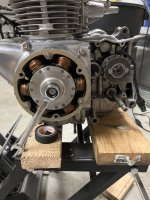
Pulled the tensioner out to see if I could get an easy look at the backside of the chain. Definitely off by a full link.

Taking a break and then grabbing the boroscope before ripping things apart.
 
Last edited:
As suspected. The problem reared its head immediately. Way too much deflection on the exhaust side.

Pulled the tensioner out to see if I could get an easy look at the backside of the chain. Definitely off by a full link.

Taking a break and then grabbing the boroscope before ripping things apart.
Not sure exactly what you mean by 'deflection'. If it is off a tooth, hopefully you didn't encounter any resistance during rotation and force past it.
 
Didn’t rotate it at all. Gave it the little bump test you described. Really easy to spot right away.

Here’s photos.
B7EADF78-696D-4159-9E4B-CEB68C45959B.jpeg

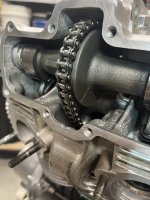
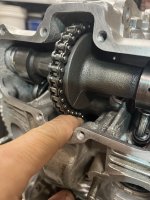
Both timing marks aligned, chain position at exhaust cam.

E544AC95-1871-44A5-9604-CD36CA2AC4F1.jpeg

deflection is the relative length of a flexible item (chain/belt) versus two fixed points, or in this case six different fixed points, the teeth in the individual cam chain gears.

Ideal is probably 7mm? Certainly not the slop I have between the exhaust cam and the crank, as you can see in the second photo.

Basically, the deflection the tensioner would solve is in the exhaust side, not intake.
 
deflection is the relative length of a flexible item (chain/belt) versus two fixed points, or in this case six different fixed points, the teeth in the individual cam chain gears.
I understand what you meant now and while that might be the proper technical term, around here we just call it 'slack' in the cam chain, LOL.
Ideal is probably 7mm? Certainly not the slop I have between the exhaust cam and the crank, as you can see in the second photo.
Absolutely not. You want ZERO slack in the cam chain.
Basically, the deflection the tensioner would solve is in the exhaust side, not intake.
While I understand what you're describing, the engine rotates toward the exhaust and while running the slack would be on the intake side - but no matter, because you don't want any at all. This is why I was describing how I like to adjust the cam chain with the valve covers off, so you can rotate in the proper direction to remove slack from the exhaust side while watching the intake cam so you hold at a point where no intake valves are adding tension to the intake side of the chain, then loosen the lock bolt to allow the tensioner to remove the slack on the intake side.

EDIT: to be perfectly clear, I'm not implying you should tension the cam chain any tighter than the tensioner itself will make it (by pushing on the tensioner shaft, for example), only that the chain should not have any soft or easy deflection. In the loose condition shown in your picture, it would be slapping the sides of the cam chain tunnel and slowly chewing up the tensioner roller at the very least.
 
Last edited:
Yeah. There’s about one extra link between the exhaust cam and the roller/crank run below it. No way to adjust that out. From cam to roller to cam at the top is 100% tight. Not a bit of wiggle front to back. Crank up to intake is really snug. I need to get the chain to jump a link at the crank to even out the tension so the adjuster can do its job.

So - other than getting crazy lucky with just breaking the chain and juggling it from the top, it’s back to the head off and start again. Yay me.

Edit. Holy nutballs. I think I got it just breaking the chain, hooked it to a “counterweight” letting a ton of chain drop and slowly wiggling it back up.

There’s still slack in the exhaust side, but not as much and there’s now some give on the chain by where the adjuster goes in. Once I find another master link around here, I can press that on and rotate the crank to 90 past LT and drop the bolt in the tensioner again.

6C960D04-D224-4754-8D39-74CF0C8C9AD0.jpegimage.jpg
 
Last edited:
Yeah. There’s about one extra link between the exhaust cam and the roller/crank run below it. No way to adjust that out. From cam to roller to cam at the top is 100% tight. Not a bit of wiggle front to back. Crank up to intake is really snug. I need to get the chain to jump a link at the crank to even out the tension so the adjuster can do its job.

So - other than getting crazy lucky with just breaking the chain and juggling it from the top, it’s back to the head off and start again. Yay me.

Edit. Holy nutballs. I think I got it just breaking the chain, hooked it to a “counterweight” letting a ton of chain drop and slowly wiggling it back up.

There’s still slack in the exhaust side, but not as much and there’s now some give on the chain by where the adjuster goes in. Once I find another master link around here, I can press that on and rotate the crank to 90 past LT and drop the bolt in the tensioner again.
I don't want to sound critical or blunt, but I'm not sure you fully understand what I've been saying. The parts in bold above do not apply or make sense if the cam chain is properly routed, all rollers and guides in place (including the top guide sprocket) and the tensioner is working correctly. And BTW, you do not have to remove the tensioner lock bolt to allow adjustment, simply loosen it a turn or so to be sure. When you mention dropping the bolt back in it implied to me that you removed it, but it may just have been how you were describing it.

Again, not trying to argue with you about what's in front of you that I can't see, but your description is all I have to go by.
 
Here’s probably why my explanation wasn’t making any sense. The only way what I was describing can happen is when you don’t realize your carefully braced 14mm wasn’t so braced and dropped off LT by that little jump it has, while you were routing the chain.
You can still get the chain all the way around, but the slack won’t be remotely uniform and there will be an immediate problem timing…. So. No more Big12 basketball games during work hours.

image.jpg
Upgraded the bracing. All timing marks aligned now. This is just resting against the chain. Still need to move it to the adjustment point and set the screw. But this looks right now, and the chain went together way easier.
image.jpg

So… anyone have any ideas on that oxidation?

And thanks man for catching a tiny thing that turned into a bigger thing. It would have shown up the minute I started trying to time anything, but would have had a billion other things in play as well.
 
The picture above shows the tensioner much better and it is indeed the later version.
And thanks man for catching a tiny thing that turned into a bigger thing. It would have shown up the minute I started trying to time anything, but would have had a billion other things in play as well.
However... this will be a problem (unless you realized it later and have since changed it).

cam timing.jpg
 
Jesus Christ. I swear there is an L in that dark circle. Why the &()/5 does every damn marking in this thing have to be invisible. Would it have killed someone to use maybe more than 1.5 kilos of pressure to make those marks?

Alright. “LF” it is - damn thing really looks like an F, not a T. Went ahead and marked it for next time as well - I’m sure it’ll only get more invisible with time.

As an aside. Getting pretty damn good at this routing the cam chain with the head on thing. image.jpg

Did also figure out that Brasso of all things started fixing that oxidation. Must have been the TSP sous vide I did to clean the block. I think it stripped everything out of the aluminum.
 
Last edited:
I usually use a Sharpie to mark the left timing marks. Just write all over the thing. No reason to squint and try and do everything else at the same time. Also, if the engine is in the frame (and maybe it could be done the way you have the engine mounted), I put a car jack like the one many cars come with on the floor to the left of the engine, rotate the engine until it's getting close to the timing mark, then put a breaker bar and socket on the nut on the crankshaft and rest the handle on top of the raised jack. Slowly lower the jack and the bar handle and when the engine wants to suddenly rotate past the timing mark it can't. You can set it exactly where you want it and it stays.

You can use the same system to manage the engine when you are setting the points.
 
Cam followers are gapped (well, as properly as those finicky little beasts are) pretty much a .0045 gap all around. I’m planning on leaving them that way for at least the first oil change at break in. Charlie’s ignition installed (close call with one of the circlips on the advancer weights), which was surprisingly straightforward- even if he didn’t really consider how tight that grommet is behind the points. That’s a bit of a wrestling match in a confined location.
11E842AD-D18B-4D58-8853-BC3F47585761.jpeg

Wanted to see it all pretty before I bagged it up and wheeled it to the corner until Jay’s pump gets here.

Until then, dust creation and bench sync the carbs, check float levels and idle adjustments one more time. Take off all the hangers and foot pegs hanging on the frame, swap the frame onto the lift Jack and start the real fun stuff. Putting things back in the frame.


Thanks for all the thwacks on the back of the head so far. It’s taking a while to dig through those files in my brain.
 
Last edited:
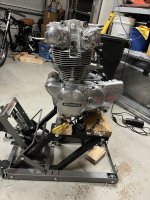
Proud colossus of something, that's for sure! Everything is in the case, transmission shifts, motor spins freely. Time to see if it can house some explosions and then find another project bike, I need to make something smaller and much more basic for my son - maybe next winter. Getting way ahead of myself now.
 
Wow. Our boy Jay must have a personal hook up with USPS. Oil pump got here today somehow - I can’t even get mail from FtWorth in a day!

So, of course the engine got pulled back out - so here’s the idiots guide to installing it, along with mistakes that can be made:
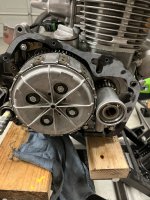
24EC89DD-8675-46DA-983C-653CAB3CF58D.jpeg
Small caveat here. I had a dry case, so no need to drain the oil, etc. probably makes it way easier to start this way. Watch me make it more difficult than it needs to be.

Pull your oil filter, clutch plates and basket - set all aside in order with all the stupid spring clips.

DB726D0E-BA64-472D-BB33-FD8528F28117.jpeg
Pull the clutch and oil pump out, flip the clutch basket in your lap, pop yet another spring clip and pull the rod, pin and piston
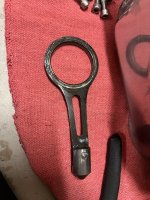
4E93AA6B-5003-495B-BD4F-380125EEF41E.jpeg
Ok. Here’s where I took the instructions included very literally. I ONLY removed this one assembly, putting the retaining plate and spring clip back on. Mistake? Maybe. I’ll let you know if something tries to fly through the case.

Mistake 2: getting overly excited about the new doohickey, playing around with it and snapping it all together to “get it ready”. Dumbass - follow the directions in order for once. You’ll see later.

2E9BBC5B-0040-4B90-928F-4AB00D86484C.jpeg
Super excited, pop your thoughtfully included new o-ring in, feet down strainer - bolt it up and go!

Not so fast:
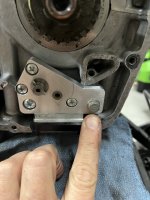
3C69BC2C-61C3-427F-959F-021CC63A82C8.jpeg
Notice the difference here? Yeah… the mounting screw is behind the gear. Have fun getting the world’s smallest spring clip off to just put it back in in the correct order.

Side note - the mounting bolt you’ll need right where I’m pointing is not included. This is the bolt from the prior water pump. If someone installed a 6x25 in there prior to this, Jay’s pump is ever so slightly thinner and you lose the thickness of that tabbed washer. You’ll need to dig up a 6x20. Locktite 242 and now we’re good to go!

Not yet. The faint of heart may want to turn away at this point. 87F59125-E1EA-4613-B211-990B32AF7BA9.jpeg
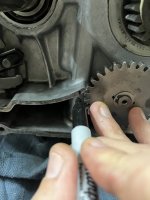
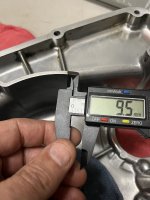
Place a mark at the edge of the gear for your oil pump. I used the thickness of the end of the sharpie as the clearance point (right about 4mm of clearance) measured this point back to behind the gear. Along that same oil fence line, came in at 9.5mm total. Then you take your “pristine for 50” cover, flip it over and mark that back in the corresponding tab on the cover.
CCF62AD9-2EA6-4274-A771-7CD362781D2B.jpeg

Then… sparks!
89A04FC3-D94F-4993-BE91-B9BC689331A5.jpeg
You’ll want a 4” grinder or one hell of a dremel for this part. Notch that little 9mil section out down to the backing, but not into the backing, then round your sides and corners and deburr, followed by a good cloud of brake cleaner and a lot of wiping and compressed air to make sure all the shavings and dust were gone.
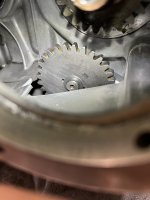
647F00D2-4B52-4B5F-A2BB-D225D8BF253A.jpeg
Mocked it up. The angle makes the clearance look a little bigger than it really is, but I probably could have gone tighter if needed.
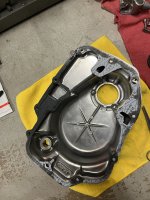
AC78AF86-9525-4163-85A2-4B2BE70BAC23.jpeg
Snip the tab of the gasket off that would just be flapping and chewed up in gears. So trim back to your line, then a fairly tight angle to the edge.

Wiggle that puppy on, tighten up your cover, put your oil filter cover on, Wipe up your greasy fingerprints and boom - Bob’s your uncle.
image.jpg
There she is. Time to put the bag back on and put it away for a nap.

All in about 1:30 including hunting down various tools and retracing steps.

You’ll need:

Oil filter nut wrench
Two sets of spring clip pliers, one with extremely small tips for the worlds smallest spring clip (of which Jay kindly included 2, knowing I would fire the first one somewhere into the 4th dimension.)
10mm sockets (one to use, one to lose)
JIS 3 screwdriver for the retaining screw behind the gear
Angle grinder
Patience for once. Maybe.
Baggie for your leftover oil pump that can be placed in the bin off abyss (spare parts)

So, nothing crazy - maybe read first then go to tactile learning would speed up the process.
 
E592E045-515C-44A9-B569-5898238E8868.jpeg

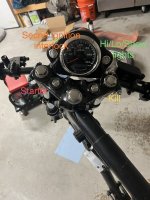
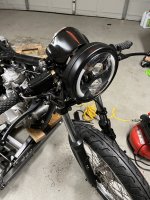
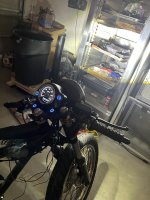
As I’ve said. I suck at restoring things. New electrical morphed into, well, new everything. Handlebar controls were abandoned, as was a good portion of the accessory circuits, tachometer, Speedo cable, pressure activated brake switch, stem mounted turn signals - switched everything to LED, tied the poles together in constant “night” mode, RFID ignition and made a (somewhat). Period appropriate cowl to house everything pulled from the handlebars.

Static dry fit because I couldn’t help myself.

Ok. Back to taking everything off the frame so I can load this engine in.
 
As I’ve said. I suck at restoring things. New electrical morphed into, well, new everything. Handlebar controls were abandoned, as was a good portion of the accessory circuits, tachometer, Speedo cable, pressure activated brake switch, stem mounted turn signals - switched everything to LED, tied the poles together in constant “night” mode, RFID ignition and made a (somewhat). Period appropriate cowl to house everything pulled from the handlebars.

Static dry fit because I couldn’t help myself.

Ok. Back to taking everything off the frame so I can load this engine in.
It's a clean look, but how does it all work? I see what looks like momentary contact push button switches in the old handlebar mount openings in the top bridge, and what look like 'rotary' switches on either side of the speedo. Latching relays somewhere? Or the electronic equivalent of? M-unit? And the kill switch is not near the throttle hand, you'd have to reach for it and if, while under duress, find the spot and hit it to kill the engine. Headlight high/low wouldn't be as closely/quickly available with oncoming traffic flashing at you when you needed to dim it as well.
 
The headlight Hi/Low is basically for show. Lo is a constant-on, Hi beam is for the 1 in 1,000 time I'd be riding at night. Definitely not as convenient as having it on your thumb, but I wasn't exactly going for daily driver functionality. It was actually this switch that made me realize I should flip the sides. The Interlock switch is just there to cut power to the RFID so it's not slowly killing the battery (and only one rotary looked odd), and if I had to use the headlight beam, I'd have to drop my throttle hand. In theory, I could also wire the ignition switch itself to function as either the starter button or the kill switch I guess

All of the switches have integrated relays (latching where needed, One rotary is a 3 position (1NC, 2NO that are tied to basically just add on to each other as you rotate). I've milled down the rubber bushings in the old handlebar mount to function as retaining rings for those momentary switches

Functionality definitely took a back seat to random stuff I had laying around and a desire to really strip down the clutter. When I came up with the cowl idea it kind of just kept growing legs. I'm sure this is version 1.0, and it'll likely be something I continue to mess with over time. There's a couple of companies out there producing wireless switches that I have my eye on for some of the accessory functions, I just don't know if I trust them enough for more than the horn and lights.
 
Consider using High beam when riding the FM roads, ranchers aren't the most observant pulling onto the road. Don't ask how I know.

FM translates to Farm to Market in Texas.
 
Consider using High beam when riding the FM roads, ranchers aren't the most observant pulling onto the road. Don't ask how I know.

FM translates to Farm to Market in Texas.
Heck. Even in my F150 they aren’t looking. It’s tempting as heck to blast down those roads because they’re usually wide open and straight, but you never know what’s in the other side of the rise - hit a feral hog doing about 70 a few years back… no thanks.
If you do move the kill, a USB with a voltage readout would be cool there.
That’s a good idea. I could just daisy chain one off the other switches. The most difficult part would be finding one with a 19mm aluminum bezel
 
Heck. Even in my F150 they aren’t looking. It’s tempting as heck to blast down those roads because they’re usually wide open and straight, but you never know what’s in the other side of the rise - hit a feral hog doing about 70 a few years back… no thanks.

That’s a good idea. I could just daisy chain one off the other switches. The most difficult part would be finding one with a 19mm aluminum bezel
Yeah, I always see a bunch of dash mount 1" hole ones on amazon. Maybe there is a smaller version or a way to remove the housing or something.
 
Wrestled off the corroded old tires, which were way way worse than I thought. Turned into a way bigger project than the simple swap I was aiming for so I figured in for a penny, in for a pound. Already dirty and tired so might as go for it. 0CB7DF8F-14A3-48B9-8656-D762E8B785F7.jpeg

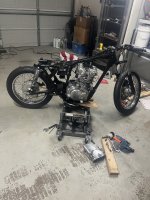
Finally, something in the frame that’s not a dry fit or a mock up or testing some damn fabrication or the other.

Backed off every single one of those Allen bolts and retorqued with the stubby 1/4” ratchet which basically makes it impossible to over torque, final check for 22 ft/lb at the head bolts, checked the valve lash one last time with the engine out, did my best at routing the starter cable - there’s surprisingly Jack all of nothing available for stuff like that, crankcase breather hose and I still cannot fathom why the carb choke linkage is a giant u shape, instead of a simple bar.

Anyway, I digress.

I didn’t take any pictures of the setup I used as I was running solo and really needed 3 hands most of the time.

Basically, made a little pallet to lay the engine down on its side in a wheel dolly, leaving it up about 6” off the ground. (Incidentally, I’m saving this brace I made that fits the wheel dolly to hold the engine. When it’s sitting upright the head is about eye level if you’re on a mechanics stool and with 4 heavy duty casters, you can spin that thing around while just sitting there - also made doing the valves incredibly easier and more accurate for me)

Laid the frame over it and wiggled/wrestled it into rough alignment, then used the lip of that transmission Jack to raise the lower frame rails, guiding the top rail until everything was aligned and relatively level, put a small Jack stand on the head tube and the left side rear foot peg mount so I wasn’t fighting two axis of rotation while I got everything lined up to drop the bolts in lower frame, front engine mount and top engine mount, then tipped the bike up to rest on the transmission jack.

Sounds simple, but those bolt tolerances are really tight and getting the first few points to get 3 dimensional alignment without percussive maintenance is a real challenge. Once that’s set, it’s pretty smooth from there. Front bracket game me a fight until I flipped the plates around. There are 100% identical, but apparently only work on one side?

Anyway, feels like progress. Now I just have to find my stator cover gasket and brake stop bar that somehow went into hiding. Looks like a shop cleanup is in the cards for today.
 
I still cannot fathom why the carb choke linkage is a giant u shape, instead of a simple bar.

Notice how the choke linkage lines up with the vertical frame tube. The U-shape avoids that interference.

Screenshot_20240217-103846.png

Edit: My clutch cable routing on the outside is incorrect, but functional. To me, it seems the cable has "less bend" in that position.
 
Oh. I get why it’s shaped that way. Just seems like an “oh **** I forgot about that” and then grabbed the crappiest piece of tin to do the job. Finding one that wasn’t corroded to hell and back was fun. And it’s a part that I keep finding off its tray with the carbs. I’m probably going to fabricate something up down the road - I’ve got a ton of aluminum rod and tube scrap left over from some other project, and some 1/2” plate. Add it to the bent shifter pile of stuff that needs some tweaking.
 
Thankfully on the swingarm/brake stop, I’m almost 100% positive my son had something to do with it. He’s been cobbling together a dog cart for our Pyrenees and I think he may have grabbed what he thought was scrap.

This means he and his nimble little hands gets to crawl under there to get that part attached. On the transmission jack I can get the bike comfortably up far enough to get a good angle on it.
 
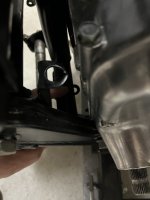
While we’re near the swingarm. Does anyone know what this tang is used for? It’s the perfect size for one of my ground busses. The one below the rear brake switch where my finger is. 86A718CB-C7EA-4F36-AB7D-80A5FBAAB4AC.jpeg
 
Most likely for the lead-acid battery vent tube, no longer needed if you're running an AGM or lithium ion.
 
Well. Nevermind. Whole damn thing is coming apart again.

Pretty disappointed in 4-1 parts. Front brake pads were just flat out too fat, gaskets were iffy at best and both tubes have faulty valves.

Gotta pull the rear wheel again, might as well just take it at the swingarm.
 
Well. Nevermind. Whole damn thing is coming apart again.

Pretty disappointed in 4-1 parts. Front brake pads were just flat out too fat, gaskets were iffy at best and both tubes have faulty valves.

Gotta pull the rear wheel again, might as well just take it at the swingarm.
Interesting. What brand pads? and gaskets? I've had no troubles with either NE or Vesrah gaskets from them. I've not bought pads or tubes from them. Did you email them?
 
I’ve got to find the order with the gasket set - did that one a while ago to take advantage of holiday sales and shipping.

Pads were their house brand - learned my lesson there. I can grind a mm off each side and they’ll work, just annoying.

Tubes were their house brand too - whatever they toss in with the tire/strip/tube set. At least there’s a Cycle Gear a half mile from my house. They’re rude as hell if you’re not on a Harley, but I know they have tubes
 
02220D88-7E37-4391-B75C-57885830E3FD.jpeg

Finally have a resident in the garage that doesn’t require jackstands and lifts. (As I post pics of it back in the lift).

Replaced the tubes, so now it holds air and can roll around. Incidentally, 4-1 sent TR4 tubes, Cycle Gear only had TR6 - both TR4 tubes failed in the exact same spot right at the valve TR6 is a little heavier there so maybe that’s the difference?

Got the brake stay on, exactly as suspected the shop gremlins had gobbled it up and tried to hide it (read: it was right in front of me on the parts tray hiding in plain sight) - it’s surprisingly easy if you Jack the bike up in the air and roll under it in a lowboy.

Adjusted the rear brakes, with brand new shoes they’re pretty touchy,

Adjusted the clutch as well - cable routes well, slides smooth, full actuation of the mechanism… up to actually engaging the clutch, which does feel a bit soft or light - snaps right back so I know it’s not binding, I didn’t even bother checking before ordering a replacement - 99% certain that #10 steel ball has successfully fled the metric community surrounding it. I’ll go pick the part up tomorrow - a whole whopping $0.29 including tax for the OEM part directly from a Honda Auto dealer - if you ever lose one, it’s part number 11 the MT Case parts diagram page from a 2017 civic with a manual.- same part number.

Then, onto the fun stuff. Fitting all that wire up inside the head unit and - all pretty smooth sailing apart from some interference right at the corner of the battery box, with the starter cable and ground cable coming through the same corner, things just feel really pinched there.

Also had to ditch the RFID ignition. I failed to factor the interference from the coil right there. It works perfectly fine on the bench, but as soon as you get it tucked up by the coil it stated getting wonky. So, that idea will have to wait for the spec sheet in version 2.0.

But… she’s got lights! And functional starting (up to the solenoid)

D6FEE3E6-C29E-4AE4-945C-9200C897395E.jpeg

875C539C-CEEA-41DF-99BA-0C232A6A224A.jpeg
 
Got a few moments this weekend to fix the clutch issue. Dropped the new steel ball in there and we’ve got clutch plate activation.

It still felt super light, and maybe it’s just my personal preference but a light clutch has always felt sloppy to me, so I modified an old throttle return spring I had. Same exact function, just a little heavier to pull.

Finally got the rust and old liner out of the tank. That was one heck of a process.

4 day vinegar bath with a couple handfuls of steel shot, put it in a tight-fitting box and in the bed of the pickup, flipping the orientation every time I got in. Basically a really slow tumbler clean.

Pressure washed the interior to find the back 2/3 of the tank had a liner disintegrating away. Same process again - swapping vinegar for paint stripper and the steel shot for a bunch of hex nuts over about a day and a half.

Pressure wash again, flushing forever to get all the scraps of liner out. Again, thankful for small assistant hands for getting the last of the gunk out of there.

One more vinegar bath - at this point the enclosed bed of my truck has the smell of vinegar and paint stripper baked into it.

2 days this time, steel shot again. Flush til everything runs clear, hit it with compressed air, a heat gun and a really nice breezy, sunny couple of hours in the driveway while I did the lawn. Got it dried up before it could start flash rusting again. Hit it with some fogging oil and called it good. Prepped both the side panels and the tank for some light body work and paint.

Also got my Uni air filters in, they took a rather circuitous route, but they’re a super clean install right into the factory space and offer a larger filter area/air handling space which can help mediate some of the issues that can pop up with the smaller pod type.

Looks like we’re at fuel and exhaust this week and then ready to fire up.

A weird issue did pop up after fixing the clutch, and the trans is stuck in gear. Shifted fine on the bench after assembly, again in the bike when I got the engine in and installed the levers. Yippee. Looks like I get to pull the left side cover and figure out what’s binding up here.
 
A weird issue did pop up after fixing the clutch, and the trans is stuck in gear. Shifted fine on the bench after assembly, again in the bike when I got the engine in and installed the levers. Yippee. Looks like I get to pull the left side cover and figure out what’s binding up here.
Do you have the large flat washer and circlip in place on the left side of the shift shaft under the front sprocket cover? If not, the shaft can migrate inward a little and cause binding in the movement.

honda-cb450k5-usa-e-16-gear-shift-and-kick-starter-spindles_big3IMG01171586_d899.gif
 
Yeah - that's there. That clip and I had a fun discussion upon removal, so I replaced that with a new one on reassembly. I'll pop the covers off and grab some pictures, but I'm leaning toward either something misaligned in the shift stopper/neutral stopper area, or it's just jammed up between gears and needs a bump.

Right now, it feels like it'll go one gear up, then kind of halfway and stick, will return the one gear, then stick - will not get to neutral.
 
Are you turning the gears while you're trying to shift? They don't shift really well if nothing's turning at all.

Also, what size is that circlip on the shift rod? I also had a serious confrontation with the old one, and it's no longer among the living.
 
Are you turning the gears while you're trying to shift? They don't shift really well if nothing's turning at all.

Also, what size is that circlip on the shift rod? I also had a serious confrontation with the old one, and it's no longer among the living.
Just dry shifting, which is why it may need a bump. I might be able to leave the coil off and hit the starter for as quick burst while downshifting to see if it'll jog loose.

Circlip is a 12 MM - they're available at any Honda Auto dealer if you don't want to pay for shipping, but want an OEM part. 1976-1993 Accord coupe, and 73-2015 Civics with manual transmissions also used that part (same part# 94510-12000) for their shift lever shaft. I think it was $1.79 out the door for a baggie of 3.

Incidentally, I've found quite a few of these fasteners/weird little clips/etc. around the clutch and transmission area are also very common in that era of Honda cars, at prices and availability that are far cheaper and easier to get.
 
Just dry shifting, which is why it may need a bump.
If it's on the wheels, just roll it back and forth while moving the shift lever. If it's not on its wheels yet, just rotate the rear wheel while shifting (if the chain is already on). These are constant-mesh transmissions so they need engagement dog alignment because they don't have synchronizers like car manual transmissions do.
 
Yeah - probably time to go get a chain. I thought I had one, but it's an O-ringed dirtbike chain and a hair wide for this application. It'll work to slap it on and roll the bike though, likely less traumatic on the internals than starter motor speed.
 
Yeah - probably time to go get a chain.
Then you probably don't have a problem. No Honda transmission of that era will shift to more than one gear from neutral without the shafts being rotated, it's just the design. Put a chain on it before you bother to disassemble anything to look for a problem you likely don't have.
 
I can't recall - did you check and address the large shift detent roller we affectionately call the pizza cutter? If not you can take care of it later since it's in the right crankcase cover behind the clutch, but if it's the original I know for a fact it will be sloppy and lead to shifting issues. I replaced mine here:

 
I can't recall - did you check and address the large shift detent roller we affectionately call the pizza cutter? If not you can take care of it later since it's in the right crankcase cover behind the clutch, but if it's the original I know for a fact it will be sloppy and lead to shifting issues. I replaced mine here:

I did. It wasn’t brand new, but looked like it had been replaced And had no slop. That said, your link made me think I may have that out of alignment - I’m almost positive it’s sitting on top of the star detent, not levered against the side like yours.

With no oil in it, I’m going to pop that side off and check.
 
With no oil in it, I’m going to pop that side off and check.
Way better now than later. If you have any doubt as to the looseness of the roller on the shaft, replace it anyway. Just another thing you won't likely ever have to do again. Here's a pizza cutter 'attack' during my ride with @12ozPBR on the Copperhead Loop in October 2019

 
Back
Top Bottom