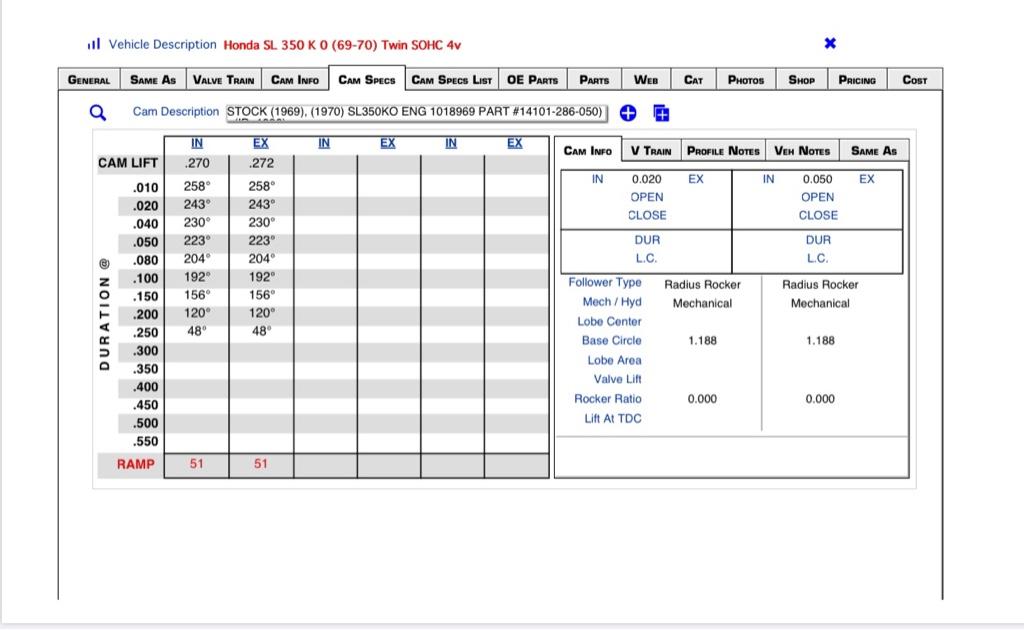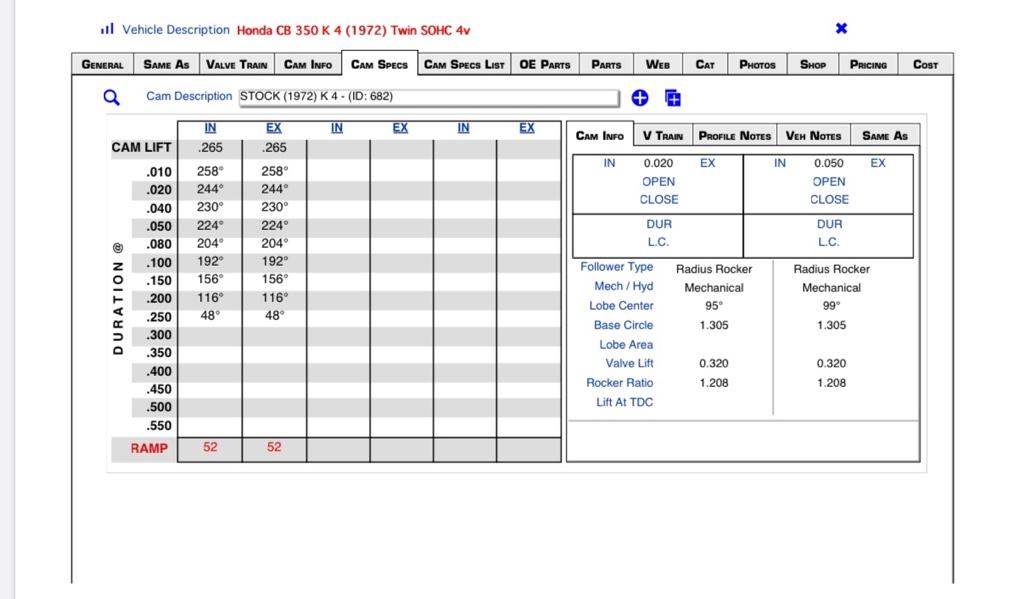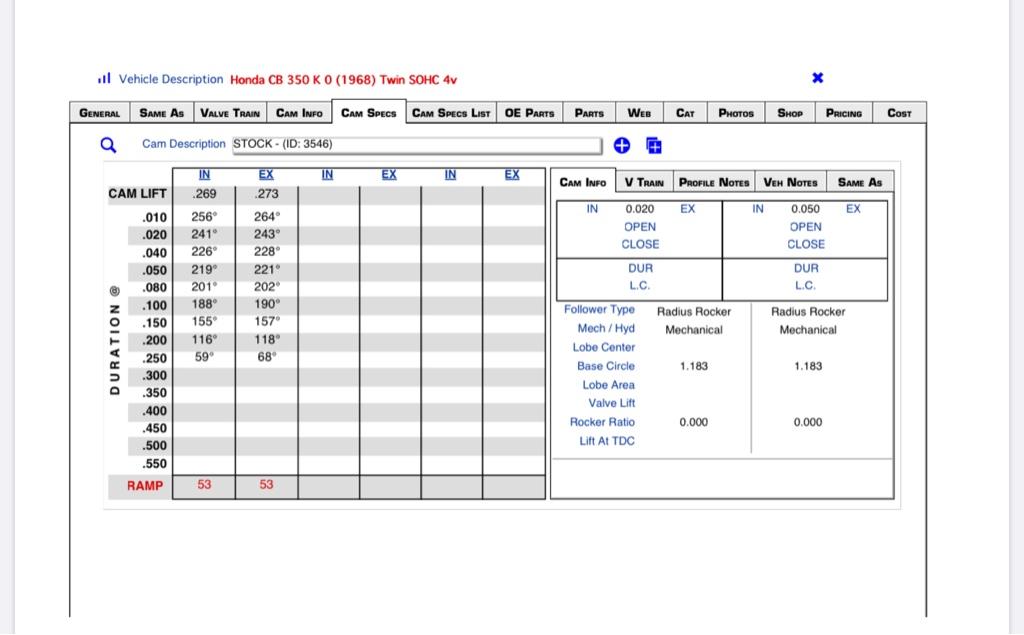
350 Camshaft profiles

LongDistanceRider

Super Moderator
Staff member
Joined
May 22, 2020
Total Posts
15,349
Total likes
3,677
Location
Vancouver, Washington USA
The early and late FSM's show the same valve timing for the Fat and Skinny cams Does anyone know if that is factual and if so are the profiles the same?
 
I know when I measured my skinny cam and looked in the FSM (both late and early) the overall cam height lobe height was way off.

I’m not clear if the base circles were identical making the lifts different.

I may be looking at a low mileage parts engine that still has the camshaft soon. If it isn’t too pitted I can retake measurements off of that.


Ed
1972 Honda CL350
 
I have a 350 Fat cam on the way to me and negotiating for a Skinny one today. If successful I'll be able to get those over to Oregon Cam and see what the actual answers are. I was hoping someone knew.
 
He doesn't have any motorcycle profiles other than some Harley's. If you had the actual cam profile he could do it. He won't just copy and old cam, requires a new cam to get the original profile from so there's no errors.

Without knowing the specifics of the cam opening closing degrees my understanding is the skinny cam has a taller lobe at just over 39mm while the fat cam was 36.5mm? The difference is made up between the rockers with the fat cam using 286 rockers and the skinny cams using 312 rockers. I believe in early 70 there were some fat cams that had skinny cam profiles or a variation thereof. They also used different variations of the cam boxes.


Sent from my iPhone using Tapatalk
 
I know when I measured my skinny cam and looked in the FSM (both late and early) the overall cam height lobe height was way off.

I’m not clear if the base circles were identical making the lifts different.

I may be looking at a low mileage parts engine that still has the camshaft soon. If it isn’t too pitted I can retake measurements off of that.


Ed
1972 Honda CL350

Noticed the same regarding the measurements in the old and new FSMs. Based on Internet research my cam looked to be in good condition without excess wear, so I opted to instead be more concerned with consistency across my measurements. I took measurements over, and over, and over until my technique was producing consistent results. Here are my results for reference:

Cam 1 (screw side)Cam 2Cam 3Cam 4
Nose to Heel39.7239.7439.7339.74
Base Circle33.1233.1133.1033.10
Cam Lift (calculated)6.66.636.636.64
 
He doesn't have any motorcycle profiles other than some Harley's. If you had the actual cam profile he could do it. He won't just copy and old cam, requires a new cam to get the original profile from so there's no errors.

There’s 2 NOS cams on EBay for over $500. At that point I’d just buy a billet cam from Megacycle. Last I talked with them they have a 123-00 Billet Cam in stock for $550. They said they know it’s expensive and they’d like to get the price down but they’re not willing to sacrifice the quality.


Sent from my iPhone using Tapatalk
 
Noticed the same regarding the measurements in the old and new FSMs. Based on Internet research my cam looked to be in good condition without excess wear, so I opted to instead be more concerned with consistency across my measurements. I took measurements over, and over, and over until my technique was producing consistent results. Here are my results for reference:

Cam 1 (screw side)Cam 2Cam 3Cam 4
Nose to Heel39.7239.7439.7339.74
Base Circle33.1233.1133.1033.10
Cam Lift (calculated)6.66.636.636.64

The average lifts on the bungled up cam I measured were about the same. I should get my camshaft back from Delta next week and will measure that.

Hoping to pick up a parts engine if this guy ever responds with the s/n. Claims it has less than 1,500 miles on it. Doesn’t mean it won’t be damaged, but can always hold out hope.

Will measure that too, but I believe there’s more to a cam profile than the base circle and cam diameter.

If I understand correctly, the ramps also have a lot to do with the characteristics of the engine - are they flat? Are they symmetrical?

Etc... unclear if the fat and skinny cam lobes will share those qualities, but it’s a good start to at least figure out lobe/base circle/lift.


Ed
1972 Honda CL350
 
My question is more about the ramps on the lead and trail sides of the lobes, since that determines how fast the the valve opens and closes, and also the degrees of full open duration.
Looks like some one bought the cam from Texas for $550, Florida is still up for sale.
Hopefully the Italian guy I'm talking to will ship to the US, language barrier is problematic even though I'm using Google translate reading and sending messages.
Fat cam is in the mail to me.
 
Well looks like I'll have an official answer in a month or so. I have a Fat cam in the mail to me already and I am waiting for shipping confirmation on a Skinny cam coming out of Italy. Once I have both off to Oregon Cam and have them run the profiles so they'll be able to regrind cams.
Next up will be to source a pair of DOHC 450 cams. Heard back from Jensen this morning and he doesn't have any new ones. So if anyone has a source for NOS cams let me know. I need a SL350K1 or K2 cam also since it's different than the CB/CL 350.
 
Well looks like I'll have an official answer in a month or so. I have a Fat cam in the mail to me already and I am waiting for shipping confirmation on a Skinny cam coming out of Italy. Once I have both off to Oregon Cam and have them run the profiles so they'll be able to regrind cams.
Next up will be to source a pair of DOHC 450 cams. Heard back from Jensen this morning and he doesn't have any new ones. So if anyone has a source for NOS cams let me know. I need a SL350K1 or K2 cam also since it's different than the CB/CL 350.


Hi Jim,
You sound like you'll have a Full collection of Honda 350 twin camshafts:you plan to swap different camshafts on your 350's for different uses ?
 
Hi Jim,
You sound like you'll have a Full collection of Honda 350 twin camshafts:you plan to swap different camshafts on your 350's for different uses ?
Nah, that requires engine removal and disassembly each time. I'm working on a cost efficient cam grinding option to Delta since there's been so many problems of late. I'll eventually resell them.
 
Jim, would be so kind as to take some measurements of that skinny cam when you get it back from Oregon Cam and post them to this thread? Unless I'm missing something (I'm a few cocktails deep right now lol) I think we've determined that the existing documentation is lacking, so it would be great to have an as-legit-as-possible measurement for the skinny cam. Thanks!
 
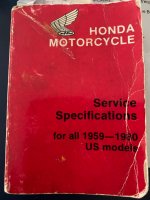
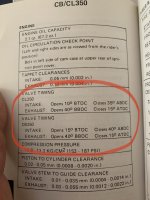
To possibly help in your quest to find knowledge on the cams I came across this bit of info so I thought I would post it here. The information does not distinguish between K models just that there is a slight difference between the CB and CL. There were no similar values given for an SL unfortunately. Perhaps this small difference works to frustrate the effort to compare and evaluate different intake cams? If you find this post to be irrelevant to your discussion then please delete it.
DB5AC727-FE0B-474B-8961-353955ECB099.jpg

Source:
3FA2F021-BD3A-4A28-B47B-284E4E801270.jpg
 
Huh?

The head, cams, rockers, and valves are all the same p/n between the cb and cl... how could they have different timing???


Ed
1972 Honda CL350
 
I've seen the different cam specs before and they make little sense when compared with part numbers. Cams match up for both models by engine serial number breaks.
It appears we actually have 4 cams in this engine series.
Fat cam 14101-286-040 that uses the 286 rocker arms and the appropriate cam gear to fit the cam, I suspect it's the ID of the gear.
Skinny cam 14101-286-050 that uses the 286 rocker arms and the same cam gear as the fat cam
Skinny cam 14101-286-060 & 070 that use the 312 rockers and a different cam gear.
14101-286-040 was used in both engines up to Eng. #1045164 which is the K0 model.
14101-286-050 was used in both engines up to Eng. #2072209 which is the K1 model AND beginning production of the K2. Engine numbers for the K2 begin at 2000001.
14101-286-060 was used in both engines up to Eng. #4061166 which is the late K2 thru early production of the K4
14101-286-070 was used in both engines thru the end of the engine series including the later K4 of both models, the CL350K5 and CB350G
I received what I thought was going to be a Fat cam last night. 14101-286-050 since it matched the 286 rocker usage. Opened it up and it's a skinny cam, original Honda packing paper and part label so I'm confident it's a 050.
The other cam coming left Milano in transit 9-9-20 at 7:24 AM or 10:24 PM last night, it's a 070 cam.
My thinking is that the 050 cam will have the same profile as the 040 and the 060 will have the same or close to the same as the 070.
 
If I recall, the timing advance pin also moved from the round of the shaft that the advance plate sits over to the outer face of the camshaft end for the 070 p/n.

Not that it impacts the timing discussion, but it should be an easy way to tell that cam from the earlier skinny cams.

edit: used the wrong locations, now corrected.

Ed
1972 Honda CL350
 
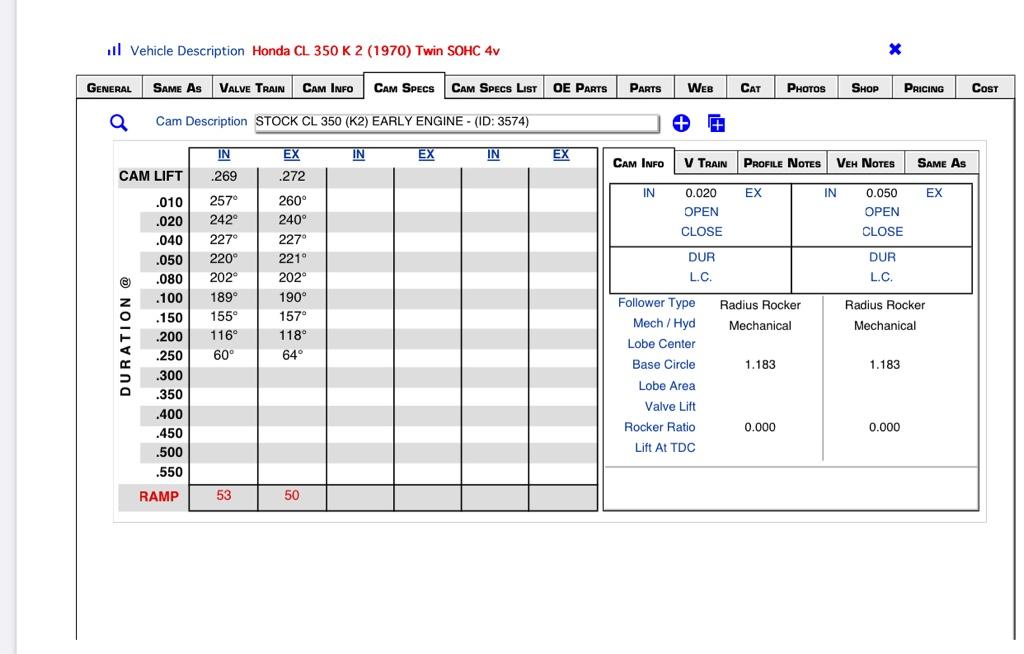
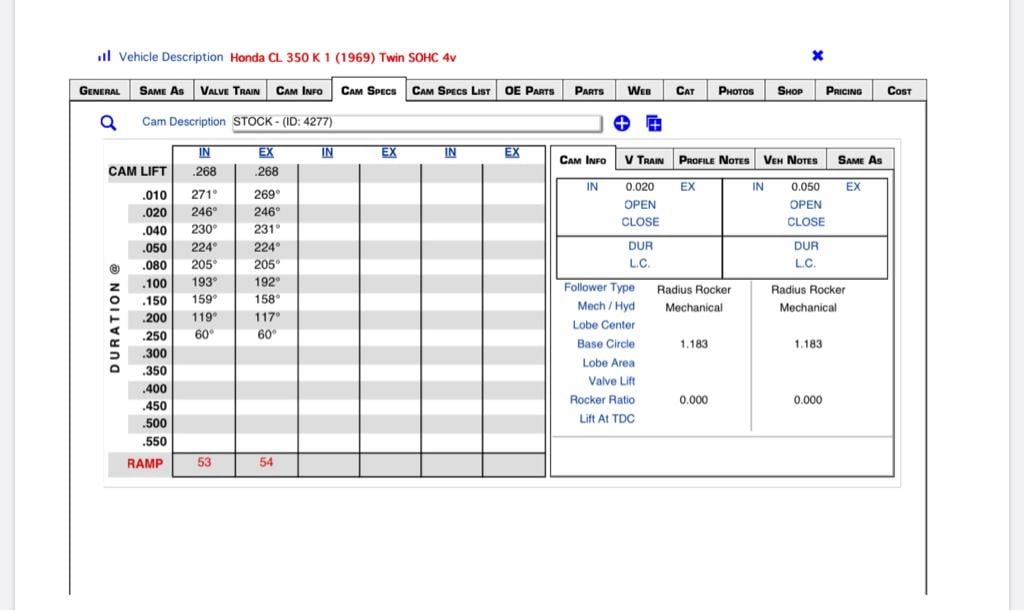
LDR , maybe these will help you. A fella I know sent them over. He thinks he has a few more profiles that he is looking for. Web Cam did these for him. Edited for correction of cams. Bottom is a skinny cam, Top is the fat cam. Pay attention to the base circles.

25ac987adb82cc722c1e4e3f8743f969.jpg


8ee8ee76f42914e96239fc0f82068dfe.jpg


Sent from my iPhone using Tapatalk
 
The bottom image is CB350K4,skinny cam,yes ?
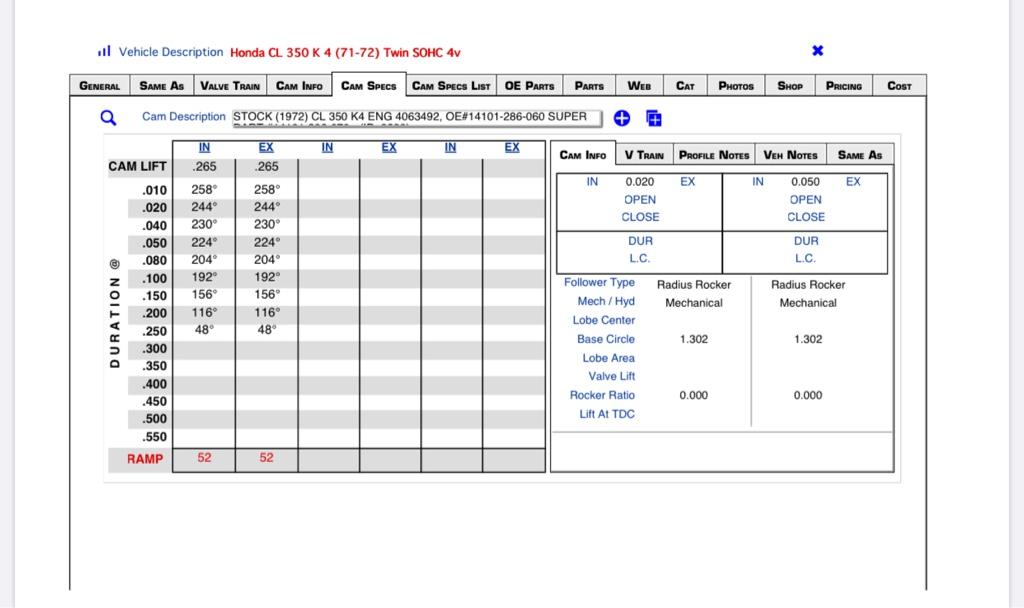
The K4 would be running the skinny cam, an 060 or 070 part number. The SL cam is the same part number as the early Fat cam
Interesting thing is I've read from multiple sources that racers preferred the Fat cam because it had more material to work with for cutting a new profile but the base circle numbers say the exact opposite. The rocker ratio though could be the difference there, too bad that's not listed for the K4 cam.
Thanks for posting these sheets.
 
I’ll post a few more he sent me one at a time . Trying not to mix them up since I’m having to do this from my phone.

The 60 profile

107a7c20c31862030adfa0a6f5e20a02.jpg


Sent from my iPhone using Tapatalk
 
The early K2 engines. I believe this was the one with a skinny cam but fat cam profile. Although the base circle is relatively the same you can see they are making changes in the duration through the degrees.

6046f7e8410aa43261c92f2201c160b7.jpg


Sent from my iPhone using Tapatalk
 
The rocker ratio though could be the difference there, too bad that's not listed for the K4 cam.
Thanks for posting these sheets.

I’ve got a single 286 early rocker sitting on my work bench. I’ll be sending it to this fella who gave me the sheets to get specs off the rocker ratio of a 312 vs a 286. Funny enough whoever worked in my engine before me had installed the 286 on just one cam lobe. All the others were a 312 along with this being a later K2 cam. I’ll post up those results.


Sent from my iPhone using Tapatalk
 
Racers like the fat cam as it supposedly breaks less frequently.

MountainGoat I tore down one engine I bought and it had the skinny cam, 3 of the 312 rockers and one 286 that the DPO had taken a grinder to the valve end to make it fit. That wasn't the only scratch your head moment in that engine. Luckily it had only been run for a short period of time.
 
Racers like the fat cam as it supposedly breaks less frequently.

MountainGoat I tore down one engine I bought and it had the skinny cam, 3 of the 312 rockers and one 286 that the DPO had taken a grinder to the valve end to make it fit. That wasn't the only scratch your head moment in that engine. Luckily it had only been run for a short period of time.

The cam lobe of the right exhaust valve on my late K2 cam had the 286 on mine. This is also the cam lobe I originally sent my cam to Delta Cam for as it had so much wear.


Sent from my iPhone using Tapatalk
 
Interesting information on those sheets, shows Honda working with different profiles with the K0, K1 and K2 before settling on one.
All of the prior information I gleaned from the old site seems to be wrong by in large. I've understood that fat cams used 286 rockers and all skinny cams used 312's. The K2 with a skinny cam may require 286 or 312 and the only way to know is measuring the cam. Makes buying used cams more difficult since sellers won't post the measurements since they don't know. Hmmm, there could be any number of engines wandering about with mismatched cam/rocker assemblies.
 
It would be interesting to consolidate all of this information into one chart that included the various stock cams plus aftermarket offerings from WebCam and Megacycle. I have two Delta cams that are their "RV" grind. No specs other than that. Oregon? Here is an old Norris cam card i found somewhere:

Old Norris hot cam specs for a CB350.jpg
 
Italy delivered. Somehow they messed up my address sending it to NE 66th Ave instead of NE 88th Ave but the delivery people sorted that out and it's here.
First obvious difference between the 050 and 070 cams is the drive pin. The 050 is a vertical pin whereas the 070 is a horizontal pin. My K4 has a vertical pin and it's an early production so I'm thinking I have the 060 cam, K4's take either the 060 or 070.
Next visual difference is the lobe ramps. The 050, smaller base circle, has really fast opening of the exhaust and closing of the intake and the toe shows a shorter duration of fully open. The 070 is a softer open/close and much longer toe open duration.
Need to print off those sheets MG posted and take the cams over to Oregon Cams to make sense of this. I'll get a couple pictures loaded in awhile.
 
I want to ask if there are any identifying marks,numbers on these camshafts to see if I was to consider purchasing a used camshaft on Ebay,etc.
I would guess not except for measuring the lobes? How about getting the exact engine number which was the donor or buying the camshaft with matching rockers ?? Thanks
 
I think you'd still be putting a bit too much faith in the eBay seller to expect that the cam and rockers actually came from the same engine in many cases, much less expecting that they'd have the engine number (although that one might be more likely depending on the seller), but then there's also the fact that after nearly 50 years, what are the chances that the original cam and rockers are still in ANY parted-out engine on eBay regardless of seller... in that respect, the 450 is an easier engine to buy used parts for.
 
The actual fat cam is easy to identify because the shaft area between left and right lobes is fat but that only applies to the 010 thru 030, maybe the 040. The 050 fat cam profile and base circle looks identical to the skinny cam and the one I bought does have cast numbers on it, 7 and something else. The 070 skinny cam has no marks but the drive pin is horizontal with the cam.
Other than a base circle measurement you can look at the lobes and make a judgement call.
 
A little off topic, but any idea why Honda changed the drive pin location/construction?

i prefer the early style only because I've had several pins come loose or get distorted.

Also, I seem to have come across some spark adv mechs that will work with one style and not the other.
 
A little off topic, but any idea why Honda changed the drive pin location/construction?

i prefer the early style only because I've had several pins come loose or get distorted.

Also, I seem to have come across some spark adv mechs that will work with one style and not the other.
No clue on that, best guess is it had to do with the CNC machining process.
 
Update:
Dropped by Oregon Cam yesterday. Nothing has been accomplished after all this time, he didn't make the masters. His rent has been doubled and I think he's mentally frozen up as to what he's going to do at age 74. Options are sell the business, just close it up and sell off the assets or move. Moving is tough because he has to have 400VAC 3 phase power which limits selection of sites not to mention the costs.
I have talked with Lockwood Engineering in Sturgis SD about grinding cams. He's knowledgeable and is interested in doing the work. He was home waiting for dinner when we talked last night and in fact we know some of the same people from racing, small world.
So I'm putting together a package of both new cams and all the information concerning them to send away. I have a 286 and 312 rocker coming that will get sent also. Then he can make the patterns and tooling needed. No, I don't know what the pricing will be at this time, he's got to get setup and then he'll be able to set a price.
In discussion with Greg he mentioned that he recommends Rotella as a break-in oil at least since it has the proper amount of ZDDP in it, 1200-1400 ppm. He also mentioned that adding it can be bad as too much will act as a grinding compound since zinc is a metal. A little is good, too much is bad. He also said the in the industry it's expected that Delta may not be around long term.
Now if we can source a pair of DOHC 450 new cams and rockers to send for pattern making that would be good.
 
Thanks for all your effort and investment in this Jim. Hopefully it will end with us having another resource for the cam and rocker/follower cleanup and repair we will always have a need for.
 
Update on this project. Bozo in Sturgis finally shipped everything back, in pieces.
I took both cams back to Ken at Oregon Cam. He's waiting for the special blanks to make masters with, hoping for @1 month but with supply chains messed up it could be longer. He did tell me that he could do a master from a good/excellent condition, never reground, used cam which opens so some avenues for the different cams. He guesses right now that a regrind of the cam will be @$80 but until he actually does one and finds out how hard the cam is he can't say for certain, harder than expected means more time=more money. He has sold the business, 5 months ago, but the new buyers have made zero interest in doing anything so I don't know what the future there is.

About the disassembled stuff back from Sturgis. He requested I send a cam box complete as well as a head so he could visually see and measure how the system worked with the eccentric adjusters. No problem since I had a K1 engine sitting collecting dust.
So I opened the boxes to find that he removed the tach drive from both cams, ostensibly to use the cam for a centering point rather than the gear. But he left them loose in the box, cams just laying loose also. The head has been disassembled for who knows why, 2 valve guides removed, baggy with the valve springs caps and 7 of 8 retainers. I felt around and found one valve spring but I'm so disgusted right now I stopped digging.

Ken informed me that Rockers Unlimited was sold a couple years ago to employees and then taken back for some unknown reason. Gary and his son Blaine were the OG's and I need to make a call to them to sort out what we can get done with rockers and such. May need to take a road trip to Redding, CA.
 
Update on this project. Bozo in Sturgis finally shipped everything back, in pieces.
I took both cams back to Ken at Oregon Cam. He's waiting for the special blanks to make masters with, hoping for @1 month but with supply chains messed up it could be longer. He did tell me that he could do a master from a good/excellent condition, never reground, used cam which opens so some avenues for the different cams. He guesses right now that a regrind of the cam will be @$80 but until he actually does one and finds out how hard the cam is he can't say for certain, harder than expected means more time=more money. He has sold the business, 5 months ago, but the new buyers have made zero interest in doing anything so I don't know what the future there is.

About the disassembled stuff back from Sturgis. He requested I send a cam box complete as well as a head so he could visually see and measure how the system worked with the eccentric adjusters. No problem since I had a K1 engine sitting collecting dust.
So I opened the boxes to find that he removed the tach drive from both cams, ostensibly to use the cam for a centering point rather than the gear. But he left them loose in the box, cams just laying loose also. The head has been disassembled for who knows why, 2 valve guides removed, baggy with the valve springs caps and 7 of 8 retainers. I felt around and found one valve spring but I'm so disgusted right now I stopped digging.

Ken informed me that Rockers Unlimited was sold a couple years ago to employees and then taken back for some unknown reason. Gary and his son Blaine were the OG's and I need to make a call to them to sort out what we can get done with rockers and such. May need to take a road trip to Redding, CA.

Jeez, that's such crap news about that moron in Sturgis. Not sure how people like that stay in business.
 
Ugh. I’m sorry your going through that, Jim.

I’m about to swap my engines, so I’ll have a spare K4 if you need any parts for that for this exercise, or in general.

Head just has beat up valve guides.


-Ed
1972 CL350
1985 VF700F
 
Ugh. I’m sorry your going through that, Jim.

I’m about to swap my engines, so I’ll have a spare K4 if you need any parts for that for this exercise, or in general.

Head just has beat up valve guides.


-Ed
1972 CL350
1985 VF700F
Thanks Ed. I've got NOS 050 and 070 cams, your K4 would be a 060 which is superseded by the 070 as far as I can tell. What I'd like to borrow from someone is the K0 cam from an engine with serial number below 103****, the original fat cam with more overlap and the 10.5 redline.
 
To possibly help in your quest to find knowledge on the cams I came across this bit of info so I thought I would post it here. The information does not distinguish between K models just that there is a slight difference between the CB and CL. There were no similar values given for an SL unfortunately. Perhaps this small difference works to frustrate the effort to compare and evaluate different intake cams? If you find this post to be irrelevant to your discussion then please delete it.
View attachment 4362

Source:
View attachment 4363

I did some parts number research years ago and if I remember correctly, the CB and CL used the same camshaft during any specific era, but the intake rockers on the CB differed from those on the CL in the earlier models. That could account for the difference in valve timing shown in the chart you posted if the CB rockers had a slightly different geometry.
 
Back
Top Bottom