1976 CJ360T Air/Fuel Mixture

norusa

Member
Joined
Nov 26, 2025
Total Posts
13
Total likes
8
Location
Sammamish, WA, USA
Hi all,

My 1976 CJ360T project is now up and running, and I'm having fun riding it. Getting to this stage is great, but now of course starts the fine-tuning. Hence, I have some questions regarding air/fuel mixture. Here's what I've done on the carb/fuel side:
  1. Full carb clean and rebuild
  2. Cleaned points and set to correct gaps
  3. Float heights set (to the best of my ability) to 18.5 mm (per shop manual)
  4. Bench sync (not vacuum sync yet)
  5. New fuel lines
  6. New intake manifolds
I've also set the valve tappets and ignition timing (again, to the best of my ability :). I'm running 92 octane ethanol-free gas. The bike starts fine and runs fine.

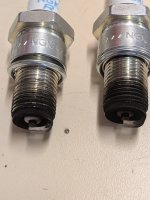
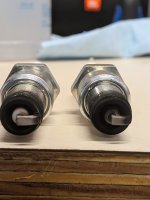
However, I had to set the air mix screws to only 1/4 of a turn (instead of the 2 full turns out per shop manual) in order for it to run without sounding like it's bogging down. This doesn't quite sound right, and I'm suspecting it's still running too rich. Attached are a couple of picture of new sparks plugs after only 4-5 hours of riding. The black on the threads is not oily, just dusty/sooty. Which I believe indicates carbon fouling from running too rich.

If you (experts) agree with my thoughts about it still running too rich, what are the most likely 'culprits'? Should I try changing the float heights (higher or lower?)? Fine-tune ignition timing? I'll do a carb vacuum sync (haven't gotten around to it yet), could this be a factor (although I've done a bench sync with guitar string and all)? Anything else?

Appreciate input, as always!
001 (1).jpg

002 (1).jpg

Best Regards,
Kim.
 
PJ has commented in the past how the well -defined line on the sparkplug strap is a good indicator. You have that on both plugs.

The plug on the left has a clean insulator, very white, maybe even a tad lean. The other is obviously dark and sooty, but the tip of the strap still shows heat to me.

Certainly do as Jim suggests and make sure you are not stacking resistance in both the caps and plugs.
  • Did your carb rebuild involve the slide diaphragms? Are they in good condition?
  • Did you clean the jets or replace with aftermarket?
  • Stock air boxes or other filters? If stock are they clean? Old ones may be too restrictive if really dirty.
Can you say more about what happens when the mixture screws are out further? Does it bog down while idling or are you saying that it bogs down if you open the throttle?

Would it be possible to get a video so we can understand better?
 
@LongDistanceRider @stl360+450 > Thank you!

I was not aware of the resistance complications, had no clue. Still learning. Did some reading and see there is plenty of info about it out there.

My understanding is that the NGK B8ES plugs I would want are the 2411 model, correct? Everywhere I look it's mentioned it's very hard to come by, but I'm finding items on ebay, e.g.:
Before I go ahead and order either of these, am I missing something? Not so hard to come by as I thought? Do I have the 2411 model no. right?

Re. @stl360+450's questions:
  • Carb rebuild included full teardown. Diaphragms and slides in great condition.
  • Jets were cleaned with guitar string, then thrown in the ultrasonic. All original jets.
  • Stock airboxes, in decent shape. Impossible to get aftermarket OEM filters for my bike, so only option I'm aware of is pod filters. Won't do that unless I have no other option.
I'll go shoot some videos and post back.

Thanks again!
 
Paying $50 shipped for 4 plugs is pretty steep. You can use your BR8ES plugs with a pair of non-resistor caps. You might be able to get the 2411 plugs from a local auto parts store, and there's also the ND W24ES equivalent from Nippon Denso which was also a spark plug supplier for Honda during the era of these bikes.
 
You can probably change to non-resistor caps pretty easily, then the resistor plugs are fine. I am not so confident that double resistance causes bogging, but I haven't tried it. Maybe it could contribute to the sootiness.

How dirty is the paper on your boxes? You could replace the paper with paper scavenged from automotive air filters.

Is it possible that the bench synch got messed up after the carbs were installed?
 
Last edited:
First off, I'm going to look like a fool > air mixture screw was 1 1/4 turn out (not just 1/4). Ah, well... I'm very new to all of this, and figure things out (or not...) as I go along.

I don't have a phone mount on the bike, so did not capture any video while driving.
I set the air mixture 2 full turns out, and it starts and idles fine (adjusted idle a bit, of course). It also revs well and high. However it bogs down / misfires during driving, when pushed to 4K+ RPMs under acceleration (otherwise fine).
I then turned the air mixture screw back to 1 1/4 turn out, and bogging / misfiring is gone. Everything else pretty much same as with the air mix screw 2 full turns out.

So (apart from me confusing 1/4 and 1 1/4 turn on the air mixture screw...), sounds to me like 1 1/4 turn out is acceptable? I guess I can go to 1 1/2 turn out and see how that works, but not sure if that's necessary? Is there any specific guidance on this?

I will look into getting non-resistor caps. Sound like a much smarter move than using non-resistor plugs if they are hard to come by.

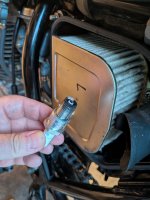
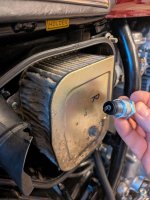
As for @stl360+450's question about the paper in the boxes, I'm attaching a couple of pictures of what they look like right now, with spark plugs included. I cleaned them (filters) out as best I could using my air compressor (carefully). Also, a couple of videos of starting the bike w/air mix screw at 1 1/4 turn after having driven it for ~1 hour or so. Another video of it idling > I'm not sure if the ticking I'm hearing is by design or something else (valve-related). One thing at a time...

Left.jpg

Right.jpg

Kim.
 
It sounds pretty okay to me.
  • There will always be some ticking from the valve tappets. You might check the current clearances if you have yet to do so since taking ownership.
  • The air filters seem fine.
  • The plug insulator and straps still appear slightly lean to me.
  • The motor sounds good.
The mixture screws are primarily controlling the idle mixture. It seems a little odd to me that adjusting them as you did between 1¼ and 2 turns would affect the stumble at 4000 RPM. There is a procedure described in the FSM for adjusting mixture based for maximum RPM. You might try that instead of just choosing where to set them.

A stumble around 4000 rpm could be related to the spark advance mechanism. If the mechanism is stuck or sticky from a long period without being used, you would notice it as you go from 3000 to 4000 RPM. It's possible that you worked it out by riding the bike. I'd be curious to see where adjusting the mixture for max rpm at idle gets you and whether any stumble in the transition to higher RPM returns. I hope that the plugs will pick up just a little color if you do that and the stumble will not return.

Offhand, I can't pull up a source for the non-resistor spark plug caps. Maybe someone else can point one out. Depending on the construction of your caps, it may be possible to replace the internal resistor with a large diameter copper solid core wire and convert to non-resistor. Photos of the cap ends might tell us more there.
 
Back
Top Bottom